8 Volumes
BANKS REDEFINED
American banking was invented in Philadelphia. The banking center of America has moved away and changed in extraordinary ways but the foundations remain.
Sociology: Philadelphia and the Quaker Colonies
The early Philadelphia had many faces, its people were varied and interesting; its history turbulent and of lasting importance.
Money
New volume 2012-07-04 13:46:41 description
Quaker Philadelphia 1683-1776
New volume 2012-11-21 17:33:18 description
Philadelphia: Decline and Fall (1900-2060)
The world's richest industrial city in 1900, was defeated and dejected by 1950. Why? Digby Baltzell blamed it on the Quakers. Others blame the Erie Canal, and Andrew Jackson, or maybe Martin van Buren. Some say the city-county consolidation of 1858. Others blame the unions. We rather favor the decline of family business and the rise of the modern corporation in its place.
Second Edition, Greater Savings.
The book, Health Savings Account: Planning for Prosperity is here revised, making N-HSA a completed intermediate step. Whether to go faster to Retired Life is left undecided until it becomes clearer what reception earlier steps receive. There is a difficult transition ahead of any of these proposals. On the other hand, transition must be accomplished, so Congress may prefer more speculation about destination.
Worldwide Common Currency and Corporate Headquarters
The Death of Money
Federal Reserve
New volume 2018-11-07 19:37:15 description
Whither, Federal Reserve? (1) Before Our Crash
The Federal Reserve seems to be a big black box, containing magic. In fact, its high-wire acrobatics must not be allowed to fail. Nevertheless, it may be time to consider revising or replacing it.
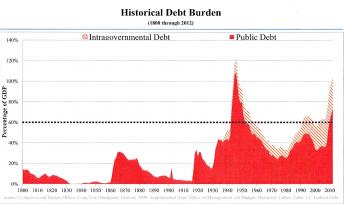 |
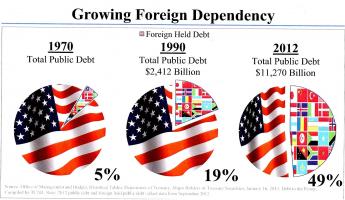 |
With thanks to: Hon. David M. Walker Founder and CEO The Comeback America Initiative and Former Comptroller General of the United States.
Stephen Girard once personally financed the War of 1812, and before him, Robert Morris had essentially done the same for the Revolutionary War. J.P. Morgan personally financed the Spanish-American War. Since then, American finance has become world finance, immense and too politically sensitive to entrust to bankers, even if their systems could handle the volume. Restoring control of the money supply "to the People" was what the 1913 Federal Reserve was all about. Unfortunately, the monetary system then just grew even bigger and more complex. A mistake might destroy civilization, and in 1929 it seemed it might do it right then and there. Instead of politicians, we think we need financial experts who never make mistakes, but unfortunately in 1929 many mistakes were made by both bankers and experts. We think we have learned a lot about the monetary system since then, and we think Nobel Prize winners have devised a workable system. For twenty years it has indeed seemed to work, because we haven't had another depression; bad inflation is what Austrians had, so they fear it most, and inflation is the other thing that's very bad. But inflation targeting without precious metal reserves, has not stood the test of centuries, and most people could not begin to explain it.
In summary, while we grew uneasy with banker control and political control, the rest of us don't have a clue. We want a Federal Reserve Chairman who explains it to us transparently, but it nevertheless seems better if he keeps his mouth shut. Men who wear beards always look as though they are trying to hide. We need a brand new Chairman, but we need one with a long track record. We want a born winner, but we don't even understand the game well enough to tell who has won. In this sort of confusion our nation always falls back on leaders with character -- Washington, Robert Morris, Ulysses Grant. They play for the breaks, waiting for the other side to make a mistake or quit; the only sure way to lose is to quit.
Monetary Causes of the American Revolutionary War
|
|
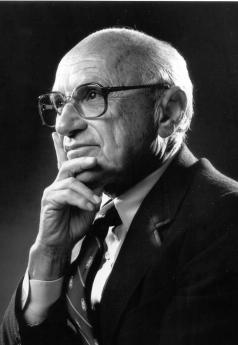
Milton Friedman The Father of Monetarism |
Milton Friedman won the 1976 Nobel Prize in Economics (more accurately, the Bank of Sweden Prize in Memory of Alfred Nobel), for generating controversial ideas made even more annoying to his professional adversaries by his matchless knack for attaching memorable slogans to them. A phrase in question is that "Inflation, always and everywhere, is a monetary phenomenon." Turned around, the converse emerges that the great deflation and depression of the 1930s was caused by a global monetary shortage. Then, to extend the same idea to the American Revolution, it could fairly be argued that inept British contraction of colonial coinage had a lot to do with provoking us to seek independence.
|
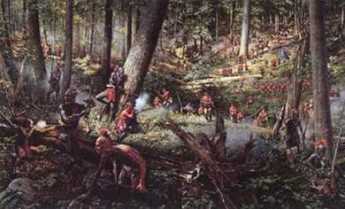
| French & Indian War |
Following the French and Indian War, the colonies experienced a major commodity depression which seems to have been caused by wartime shortages followed by post-war surpluses (associated with failure to adjust to the resulting financial confusion). In Milton Friedman's theory, it is the task of any government to maintain stable prices by balancing the amount of currency in circulation with the size of the gross national product. In 1770, the British Exchequer would thus have had to expand and contract the amount of currency in circulation pretty rapidly to maintain economic stability in the bumpy Colonial economy. Essentially, they had to ride a bucking broncho three thousand miles away. In the Eighteenth Century, there was no trace of understanding of the issues involved. Adam Smith's Wealth of Nations was only published in the fateful year of 1776, for example. Even if the techniques for maintaining stable prices had been crystal clear, there was a thirty-day lag in communication across the Ocean, and comparable lags between the colonies, where different imports and exports were affected at varying times. So it is a little harsh to blame the British for the chaotic result, except to notice that strongly centralized, the trans-Atlantic government was by nature unsuitable for managing rapidly-changing problems, currency and otherwise. The British government had more than a century of experience that should have made that clear. That's what the colonists said, in effect, and their solution for it was Independence.

|
| George III |
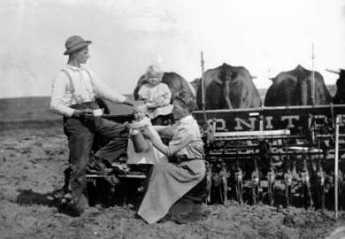
If you believe Friedman, a shortage of coinage causes a fall in prices or deflation. To correct that, you need a central banker constantly fine-tuning the currency. But banking in the colonies was too rudimentary to consider such a thing. If you needed a mortgage, you went to a prosperous neighbor and borrowed directly from him. That was fine because prosperous colonists had limited opportunities to invest their money conveniently, except by loaning money to their neighbors. Indeed, local communities were knit together socially by the mutual assistance of successful farmers directly assisting their less fortunate neighbors. However, pioneer farming
|
| Depression-era Farm Family |
communities are far too unsophisticated to remain tranquil when problems arise out of abstractions. Suddenly and without apparent explanation, in 1770 there was no money for anybody to use, and the fellow with a mortgage on his farm couldn't make his payments even though he was otherwise entirely successful. His creditor himself than couldn't pay his own bills, and eventually, even the kindliest ones were driven to foreclose the mortgage. It was said to be common for a farm worth $5000 to be sold to satisfy a mortgage of $100. And in this way, many honest and once-prospering farmers were forced to walk past their old home, now owned and occupied by a formerly friendly neighbor. It all seemed bitterly unfair, no one understood what was happening, evil motives were readily suspected, and old religious and personal grievances were heightened. When the British finally imposed a total ban on paper money as well as a prohibition of the export of British coinage outside the United Kingdom, things became almost impossible to manage. Almost no one knew exactly what was going on, but everyone could see it was bad. The colonies rapidly deteriorated toward class warfare, which is what the division between Tories and Rebels was soon to become, with both sides quite rightly asserting they were not responsible, and quite wrongly asserting the other must be.
From a far distance, it can be readily perceived the primitive banking and transportation systems of that time were inadequate to respond to the rapidly changing financial problems of a global empire; and it can be readily surmised that many other non-financial issues of governance were similarly hampered by attempting to centralize control over vast distances. In that sense, the colonists were approximately correct in directing their indignation to the person of King George III, whose mother was constantly nagging him to "be a real King". He had the particular misfortune to be dealing with Englishmen, deeply aware of the hidden political agenda made possible in the 13th Century by the Magna Charta and made explicit in 1307, when Edward I agreed not to collect certain taxes without the consent of the realm. Essentially, Parliament placed taxation in the hands of the people, who consistently withheld consent until the king gave them just a little more liberty. This was the reason irksome micromanagement of the distant colonies was immediately countered with the cry of "No taxation without Representation" since membership in the House of Commons was a traditional and historically effective means to the end. But it was getting late for this solution. Maritime New England now wanted to go further than that in order to dominate Western Atlantic trade. Virginia and the rest of the South wanted to go all the way to Independence in order to exploit the vast empty interior wilderness of Ohio and beyond. But the Quaker colonies in the middle felt quite sympathetic with John Dickinson's advice to remain part of the Empire and make a stand for representation in Parliament. When the Lord Howe's British fleet appeared in lower New York harbor an immediate choice had to be made, and ultimately the Quaker colonies were swayed by Benjamin Franklin's embittered report of his mistreatment in Parliament, and his assessment that he could persuade the French to help us. However reluctant they were to resort to force, the Quaker colonies had to choose, and choose immediately: either flee as Tories to Canada, or stand and fight.
Alexander Hamilton, Celebrity
 He had the kind of taudry private life and flashy public behavior that Philadelphia will only tolerate in aristocrats, sometimes. 
|
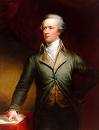
It comes as a surprise that most of the serious, important things Alexander Hamilton did for his country were done in Philadelphia, while he lived at 79 South 3rd Street. That surprises because much of his more colorful behavior took place elsewhere. He was born on a fly-speck Caribbean island, the "bastard brat of a Scots peddler" in John Adams' exaggerated view, was orphaned and had to support himself after age 13. The orphan then fought his way to Kings College (now Columbia University) in New York in spite of hoping to go to Princeton, and has been celebrated ever since by Columbia University as a son of New York. He did found the Bank of New York, and he did marry the daughter of a New York patroon, and he was the head of the New York political delegation. As you can see in the statuary collection at the Constitution Center, he was a funny-looking little elf with a long pointed nose, frequently calling attention to himself with hyperkinetic behavior. Even as the legitimate father of eight children, Hamilton had some overly close associations with other men's wives, probably including his wife's sister. Nevertheless, he earned the affection of the stiff and solemn General Washington, probably through a gift of gab and skill getting things done, while outwardly acting as court jester in a difficult and dangerous guerilla war. There is a famous story of his shaking loose from the headquarters staff and fighting in the line at Yorktown, where he insolently stood on the parapet before the British enemy troops, performing the manual of arms. Instead of using him for target practice, the British troops applauded his audacity. Harboring no such illusions, Aaron Burr later killed him in a duel as everyone knows; it was not his first such challenge.

|
| Alexander Hamilton |
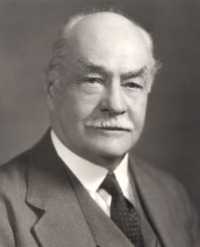
Columbia University President Nicholas Murray Butler told other stories of celeb behavior to reinforce Hamilton's New York flavor. But in the clutch, General Washington learned he could always trust Hamilton, who wrote many of his letters for him and acted as his reliable spymaster. When the first President faced signing or not signing the fateful bill to create the National Bank, a perplexed Washington had to choose between: the violent opposition of Thomas Jefferson and James Madison, or the bewildering complexity of Alexander Hamilton's reasoning in arcane economics. On the one hand, there was the simple principle that owing money was seemingly always evil; on the other was the undeniable truth that for every debit created, you create a balancing credit somewhere. Washington ultimately chose to go with Hamilton, whose reasonings he likely didn't understand very well. If you doubt the difficulty, try reading Hamilton's Report on the Bank, written to persuade the nation and its first President of the soundness of his ideas. And then consider the violence of even present-day arguments about such "supply side" economics.
|
| Nicholas Murray Butler |
All of these momentous events happened in Philadelphia at places now easily visited in a morning's stroll. But Hamilton's image as a Philadelphian, doing great things in and for Philadelphia, was forever tarnished at one single dinner he hosted. Jefferson and Madison, his political opponents but his guests, were persuaded to provide Virginia's votes for the federal takeover of state Revolutionary War debts, in return for offering New York's votes for moving the nation's capital to the banks of the Potomac. True, Pennsylvania allowed itself to be pacified with having the capital remain here for ten years while the southern swamps were being drained. But it was Hamilton who cooked up this deal and sold it to the other vote swappers. Philadelphia felt it was entitled to the capital without needing to ask, felt that Hamilton was deliberately under-counting Pennsylvania's war debts, and this city has never appreciated the insolent idea that its entitlements were forever in the hands of wine-swilling hustlers. As the economic consequences of this backroom deal became evident during the 19th Century, it was increasingly unlikely that Philadelphia would lionize the memory of the man responsible for it. Let New York claim him, if it likes that sort of thing. When Albert Gallatin, who was more or less a Pennsylvania home town boy, attacked Hamilton as a person, as a banker, and as a Federalist -- he had a fairly easy time persuading Philadelphians that this needle-nosed philanderer was an embarrassment best forgotten.
REFERENCES
| Alexander Hamilton Ron Chernow ISBN:978-0-14-303475-9 | Amazon |
After the Convention:Hamilton and Madison
|
| Signers |
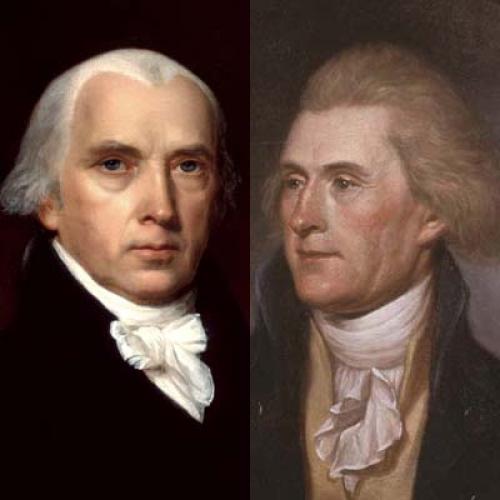
The Federalist Papers were written by three founding fathers after the Constitution had been completed and adopted by the Convention. Detecting hesitation in New York, the aim was for publication in New York newspapers to persuade that wavering State to ratify the proposal. It is natural that The Federalist was composed of arguments most persuasive to New York, putting less stress on matters of concern to other national regions. This narrow focus may explain the close cooperation of Hamilton and Madison, who must surely have suppressed some latent concerns in order to present a unified position. In view of how much emphasis the courts have placed on the original intent of almost every word in the Constitution, it seems a pity that no one has attempted to reconcile the words of the principal explanatory documents with the hostile disagreements of their two main authors, almost as soon as the Constitution came into action. Perhaps the psychological hangups would be more convincingly dissected by playwrights and poets, than historians.
John Jay wrote five of the essays, mostly concerned with foreign relations; his presence here highlights the historical likelihood that Jay might have been the one who first voiced the idea of replacing the Articles of Confederation. At least, he seems to have been first to carry the idea of a general convention for that purpose to George Washington (in a March 1786 letter). The remaining essays of The Federalist were written under the pen name of Publius by Alexander Hamilton and James Madison, both of whom had a strong enough hand in crafting the Constitution, but who quickly became absolutely dominant figures in the two central political factions after the Constitution was actually in operation. And their eagerness to be central is itself telling. They were passing from a stage of pleasing George Washington with his favorite project, into furthering a platform for launching their own emerging agendas. It is true that Madison's Federalist essays were mainly concerned with relations between the several states, while Hamilton concentrated on the powers of the various branches of government. As matters evolved, Hamilton soon displayed a sharper focus on building a powerful nation; Madison scarcely looked beyond the strategies of internal political power except to see clearly that Hamilton was going to get in the way. These two areas are not necessarily incompatible. But it is nevertheless striking that two such relentlessly driven men could work together to achieve the same set of rules for the game they were about to play so unflinchingly. Thomas Jefferson had been in France during the Constitutional Convention. It was he who was most dissatisfied with the resulting concentration of power in the Executive Branch, but Madison eagerly became the most active agent for forming the anti-Federalist party, with all its hints that Washington was too senile to know the difference between a President and a King. Washington abruptly cut him off and never spoke to Madison after the drift of his opinions became undeniable. Today, it is common to slur politicians for pandering to lobbyists and special interests, but that presents only weak competition with the personal forces shaping leadership opinion, chief among them being loyalty to, and perceived disloyalty from, close political associates.
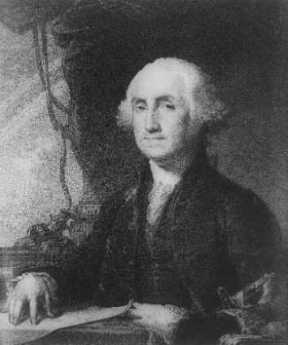
As a curious thing, both Hamilton and Madison were short and elfin, and both relied for influence heavily on their ability to influence the mind of
|
| George Washington |
George Washington, who projected the power and manner of a large formidable athlete. Washington had no strong inclination to run things and, once elected, no particular agenda except to preside in a way that would meet general approval. He had mainly wanted a new form of government so the country could defend itself, and pay its soldiers. Madison was a scholar of political history and a master manipulator of legislative bodies, while Hamilton's role was to supply practically unlimited administrative energy. Washington was good at positioning himself as the decider of everything important; somehow, everybody needed his approval. On the other hand, both Madison and Hamilton were immensely ambitious and needed Washington's approval. This system of puppy dogs bringing the Master a bone worked for a long while, and then it stopped working. Washington was very displeased.
The difference between these two short men immediately appeared in the way they chose a role to play. Madison the Virginian chose to dominate the legislative process as the leader of the largest state delegation within the
|
| Alexander Hamilton |
House of Representatives, in those days the dominant legislative chamber. Hamilton sought to be Secretary of the Treasury, in those days the largest and most powerful department of the executive branch. It's now a familiar pattern: one wanted to form policy through dominating the board of directors, while the manager wanted to run things his way, even if that led in a different direction. Both of them knew they were setting the pattern for the future, and each of them pushed his ideas as far as they would go. Essentially, this could go on until Washington roused himself.
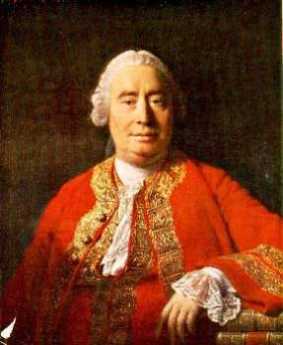
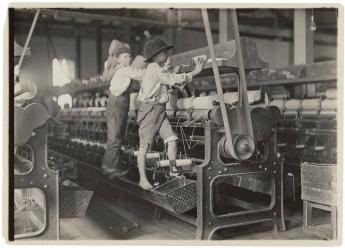
After a short time in office, Hamilton wrote four historic papers about two general goals: a modern financial system, and a modern economy. For the first goal, he wanted a dominant national currency with mint to produce it and a bank to control it. Second, he also wanted the country to switch from an agricultural base to a manufacturing one. You could even say he really wanted only one thing, a national switch to manufacturing, with the necessary financial apparatus to support it. Essentially, Hamilton was the first influential American to recognize the power of the Industrial Revolution which began in England at much the same time as the American Revolution. Hamilton was swept up in dreams of its potential for America, and while puzzled -- as we continue to be today -- about some of its sources, became convinced that the secrets lay in the economic theories of
|
| David Hume |
David Hume and Adam Smith in Scotland, and of Necker in France. Impetuous Hamilton saw that Time was the essence of opportunity; we quickly needed to gather the war debts of the various states into the national treasury, we quickly needed a bank to hold them, and a mint to make more money quickly as liquidity was needed. It seemed childishly obvious to an impatient Hamilton that manufacturing had a larger profit margin than agricultural products did; it was obvious, absolutely obvious, that this approach would inspire huge wealth for the new nation.
|
| Industrial Revolution |
Well, to someone like Madison who was incredulous that any gentleman would think manufacturing was a respectable way of life, what was truly obvious was that Hamilton must be grabbing control of the nation's money to put it all under his own control. He must want to be king; we had just got rid of kings. Furthermore, Hamilton was all over the place with schemes and deals; you can't trust such a person. In fact, it takes a schemer to know another schemer at sight, even when the nature of the scheme was unclear. Madison and Jefferson couldn't understand how anyone could look at the vast expanses of the open continent stretching to the Pacific without recognizing in this must lie the nation's true destiny. Why would you fiddle with pots and pans when with the same effort and daring you could rule a plantation and watch it bloom? If anyone had used modern business jargon like "Win, win strategy", the Virginian might well have snorted back, "When you say that to me, friend, smile."
Our Federal Reserve (1)
|
| Colonial Coins |
The most enduring, and bitter, controversy in American politics concerns the control of the currency. That's not unusual, since as far back as 1000 B.C. the person or group who controls any government of any country has met resistance in raising taxes, and so was tempted to coin more money. Unless you personally received a big chunk of that new coinage, you were opposed to the system, because of the inflation it invariably created. Prices go up.
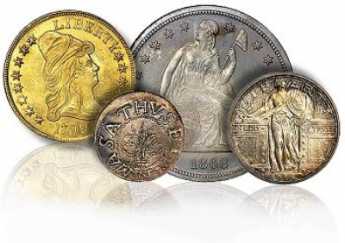
So people get upset with watered currency, and once refused to consider something to be real money unless it was made of gold. Gold doesn't rust, there's only a limited amount on the planet, and everybody agrees it's pretty. Silver was maybe all right, too. Gold dust was weighed in the marketplace, but if you trusted the dust you took a risk it had been diluted with something. So coins evolved, with a picture of the king stamped on them, and the edge of the coin serrated, so cheaters would be unable to shave the coin and use the shavings. It didn't matter who stamped the coin, and throughout Colonial times in America, the Spanish piece o'weight was good as gold. But the use of gold and silver coins was cumbersome, and occasionally there were local shortages. One of the important causes of resentment leading to the American Revolution was local discontent with the way the British allowed disruptive shortages of coinage to interfere with commerce in the colonies, at the same time the British prohibited paper currency as too easy to counterfeit. Without a common medium of exchange, commerce is driven to resort to the inefficiencies of barter.
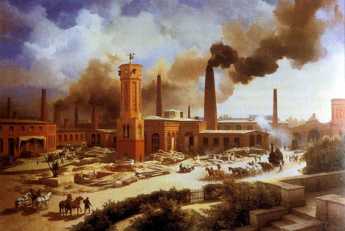
|
| Industrial Revolution |
So, barbarous relic or not, gold was quite effective in restraining governments from their irresistible tendency to promote inflation. The downside began to appear when the Industrial Revolution caused a great increase in a trade because a fixed amount of money in circulation will force all prices lower in a rapidly growing economy. Nobody will buy anything if everything is certain to be worthless if you wait. If people are reluctant to buy, prosperity soon comes to an end. Merchants don't like lower prices, and debtors don't like to repay their debts with money that's scarcer. People are just as unhappy as they were during inflation. Eventually, everybody came to see the best thing was price stability, neither rising nor falling. To accomplish that, the amount of money in circulation has to match the growth of the economy, technically a very difficult balancing act for the government. With the British treasury separated from the colonies by 3000 miles of ocean, and sailboats were used to communicate the distance, the whole thing became impossible.
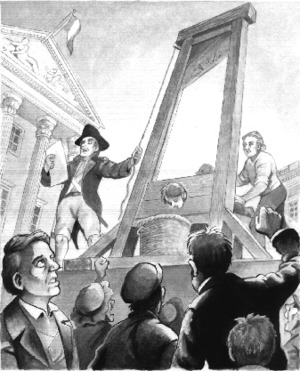
|
| French Revolution Guillotine |
It's sort of true that an unstable currency puts rich people and poor people into contention. But the more fundamental fact is that it puts creditors and debtors in conflict, thereby paralyzing commerce and injuring everybody else. For three centuries, our political rhetoric has enlisted the support of "workers" against the "the rich", but that's only acceptable shorthand if the balance of currency has gone too far in one direction or the other, and needs to be corrected. If you really let those slogans polarize society, you won't get fairness, you will get another French Revolution and the guillotine. What's needed is to fine-tune temporary imbalances, so the amount of currency in circulation grows gradually in parallel with the economy. During nearly three centuries of struggling with this mysterious issue, we have frequently lost our way with attempts to have "free silver", with honoring or dishonoring the Continental currency, with issuing Greenbacks during the Civil War, War Bonds during various wars, deliberate national deficits during recessions, going off the gold standard, and a host of other expedients and desperate political gestures. The first person to devise a workable system of matching the money in circulation with the size of the economy, was Nicholas Biddle, of 715 Spruce Street.
Our Federal Reserve : Biddle's Bank (2)
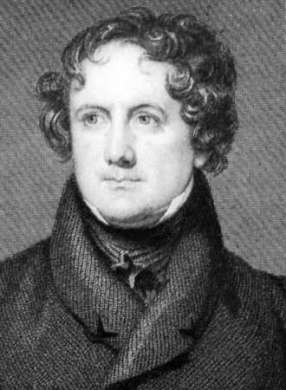
|
| Nicholas Biddle |
In 1823, the Biddles were prosperous, having made money in real estate (a Biddle ancestor had been a member of the Proprietors), and influential, having been Free Quakers who sided with the Revolution. So, Nicholas Biddle became the president of the Second Bank at 4th and Chestnut. Like all banks, he was given the ability to create money by taking deposits and loaning them out. Since in this process, two people (the depositor and the borrower) think they have the same money, there is effectively twice as much of it -- unless both actually demand it at the same time. If a bank has Federal revenues on deposit, as Biddle did, it is fairly easy for a politically active banker to predict whether that large depositor is likely to withdraw it. Political deposits seemingly make a bank stronger and safer, unless the banker has a fight with a politician. That's banking, but Biddle also became a central banker.
Biddle had ideas, derived in part from Alexander Hamilton. In those days, banks issued their own paper currency, or bank notes, representing the gold in their vaults or the real estate on which they held mortgages. There was a risk in one bank accepting bank notes from another bank that might go bust before you changed their notes into gold. The further away the issuing bank was, the riskier it was to rely on it. So, it was important to be a friendly sort of banker, who knew a lot of other bankers who would accept your money or who were known to be trustworthy.
Nicholas Biddle himself was well known to be pretty rich, and utterly trustworthy. He had a good instinct for how much to charge or discount the banknotes from other banks, or even other states. It was quite profitable to do this, but it became even more profitable when people began to use Biddle's own bank notes because they were safe. By setting a fair standard, he could control the exchange rate -- and hence the lending limits -- of banks that dealt with him. Sometimes a distant bank would get into cash shortages, and Biddle would help them out; if the other bank had a bad reputation, he might not.
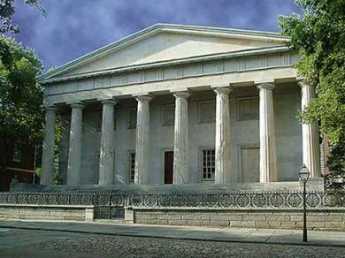
|
| Bank of the United States |
In this way, the Second Bank was a reserve bank for other banks, with its banknote currency coming close to being the currency for the whole country. Soon, within a few blocks of Biddle's Bank, there were dozens of other banks, making up the financial capital of the country. Although it was a little obscure, and even Biddle may not have completely realized what he was doing, in effect his system automatically adjust the amount of currency in circulation to the size of the economy. If the correspondent banks prospered, they issued more currency, and if there was a recession, the country had deflation. The volatility of this system was related to the volatility of a pioneer economy, so Biddle made lots of enemies whenever he guessed about the direction of the economy. It wasn't a perfect system, but at least he kept politicians from inflating the currency to get re-elected, and hence annoyed politicians by constraining them. During the great western land rush of those days, all banks were under pressure to issue more loans than was wise, and politicians were under pressure to make them do so.
The worst enemy Biddle made was Martin Van Buren of New York. Van Buren was a consummate politician, one of whose many goals was to move the financial capital of the country from Chestnut Street--to Wall Street.
REFERENCES
| America's First Great Depression: Economic Crisis and Political Disorder after the Panic of 1837 Alasdarir Roberts ISBN-13: 978-0801450334 | Amazon |
Our Federal Reserve: Okayed (3)
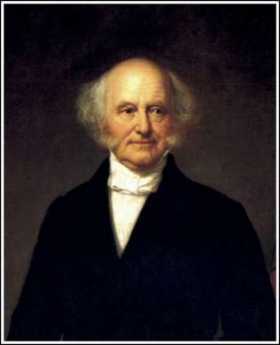
|
| Martin van Buren |
The 8th President of the United States, Martin van Buren, was born in Kinderhook, New York along the Hudson. He was known as "Old Kinderhook", so in time he initialed his documents "OK", and that's how that slang term originated. It's also of note that his retirement home in Kinderhook was named Lindenwald, although any connection with the terminus of the PATCO high-speed line is unclear. His real claim to fame is that he sort of invented what we know as the a modern political system, particularly that unfortunate doctrine known as the "spoils system". The full allusion is "to the victor belongs the spoils". The two-party a system, the Democratic Party, spinning, log-rolling, and other clever manipulations were of his devising. He must have been pretty shrewd, having defeated De Witt Clinton for Governor of New York, when Clinton was known as one of the most ruthlessly ambitious politicians around. Recognizing he was unlikely to be elected President, van Buren took on Andrew Jackson the war hero and manipulated him into the presidency, with the clear understanding that when Jackson stepped down, van Buren would have the job, next. Van Buren was a cabinet officer during Jackson's first term and Vice President during the second term. During that time, he was the real power running things from the shadows. He ruined the careers of John Calhoun and Henry Clay, regularly taking both sides of a number of disputes over the extension of slavery into new Western territories. What people ultimately thought of all this may be judged from the fact that he ran unsuccessfully for re-election -- three times.
It is therefore not certain just whose ideas were in operation when Jackson blocked the re-chartering of Biddle's bank, but one main benefit, "cui bono?", went to New York. Wall Street had sold stocks under a Buttonwood tree for fifty years, but its real start in the the financial world can be traced from Jackson's action.
The Industrial Revolution and the expansions of the United States by the Louisiana Purchase, the annexation of Texas and the Mexican acquisition caused an an explosion of new wealth, and hence an urgent need to make some better financial alignment of three asset classes: land, precious metals, and currency. Everywhere and at all times it is arguably what the land is really worth; 19th Century America it was particularly speculative, because there was so much of it. Most of the many bank waves of panic during that century can be traced to excessive borrowing to speculate in raw land. When Jackson closed Biddle's reserve bank, the land the speculating public was ecstatic because of any constraints on the lending power of banks made it harder to sell real estate. But what had been done was to eliminate the only reasonably effective way of matching the a true wealth of the country with its circulating monetary assets, and after a brief boom, the almost certain consequence was going to be a national bank panic. It came in 1837, during the first year of Martin van Buren Presidency.
The only imaginable alternative to a market-based monetary system is a government-based one. Van Buren's political behavior was by almost by itself sufficient warning of the danger of allowing politics into this matter. For nearly a century, one warning was enough.
Stephen Girard, Compulsive Gambler
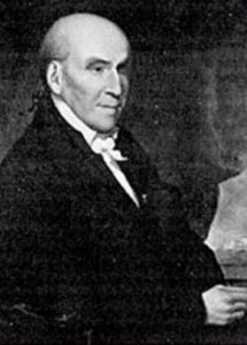
|
| Stephen Girard |
Keep flipping a coin, it's unlikely to come up Heads eighteen times in a row, but it could happen. Once they get to be the richest in the country, most people would quit flipping rather than risk everything on the fifty-fifty chance the next flip will come up Tails. But Robert Morris, William Bingham, Alexander Hamilton, and many others would not only reach the pinnacles of wealth but still gamble everything they owned on a bold chance to get lots more. Stephen Girard was the same way, although in his case he never seemed to lose.
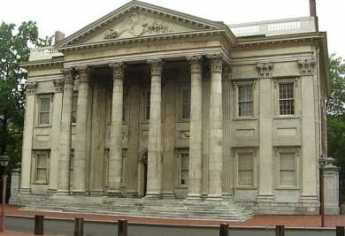
|
| First Bank |
By 1811, Girard was the wealthiest man in America. Among other things, he was the largest stockholder of the First Bank, and ran the largest shipping and merchantile empire in Philadelphia, trading extensively with France and England. From these contacts, he was able to see relationships between France and England, and between England and America, we're going to deteriorate into war. So, Girard cashed out, totally selling his overseas trading interests rather than risk blockades and confiscations. It was a shrewd move, boldly getting out before others could see what he saw. Girard was 61, his wife was permanently hospitalized, and he certainly never had to work again.
As a major stockholder in the bank, Steven Girard was well aware of the strong populist sentiment that the Government had no business running a bank. Although he did his best to preserve the bank, he could see its closure was politically inevitable with Thomas Jefferson as President of the United States, soon to be followed by his Virginia crony, James Madison. When the charter was revoked, Girard took his immense cash horde -- and bought the doomed bank with it. From the Virginians' perspective, they were going to need that money if they went to war with England; while in Girard's view they could not possibly fight a war without a bank to finance it. As matters turned out, the War of 1812 was largely financed by Girard's personal wealth, which ultimately meant that Girard bought the Government's bank with the Government's own money.
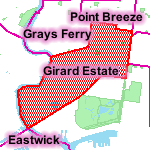
|
| Girard Estate Map |
Even making allowances for the fact that the troubles over the national banks were a symptom of the immature financial markets of the nation, which made passive investment difficult for those with rentier ambitions, Girard was clearly a compulsive gambler. Most compulsive gamblers are losers, Girard just happened to be a compulsive winner. His new bank was enormously successful, and as late as 1829 he purchased all of Schuylkill County for its coal discoveries, expressly directing in his will that his heirs were never to sell it. His estate still owns a large part of South Philadelphia, based on the same long foresight of a pretty old man. If you think that's easy to do, just ponder what finally happened to Robert Morris, Haym Salomon, and Alexander Hamilton.
Albert Gallatin: Enigma Furioso
|
| Appalachia |
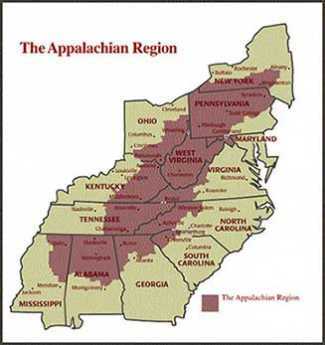
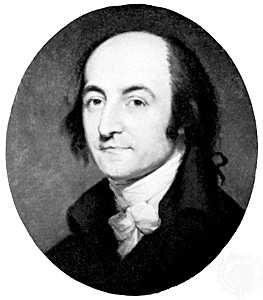
Abraham Alphonse Albert Gallatin was born to a rich, famous and noble family in the French part of Switzerland in 1761, but soon became a rich orphan fleeing to America in the 1780s to escape overbearing and grasping relatives. He started out in America teaching French at Harvard but soon purchased Friendship Hill, a 600-acre estate south of Pittsburgh along what was to become the National Road. At first, he ran a busy general store but soon branched out into successfully buying and selling real estate. Although Uniontown now seems a lonesome hermitage in Appalachia, it was then part of the area disputed between Pennsylvania and Virginia, coveted by both states because it seemed like the main route to Ohio when Ohio was the Golden Frontier. Friendship Hill is now a National Park, near Fort Necessity, also near General Braddock's grave, and the birthplace of George Catlett Marshall. So it had its attractions, but Gallatin led such a frenzied life it is hard to believe he spent much time there. There is a reason to believe he was one of the main instigators of the Whiskey Rebellion. Hamilton, and probably Washington, certainly thought so.
|
| Albert Gallatin |
Almost immediately after arrival in America, Gallatin threw in his lot with Thomas Jefferson in resistance to the centralizing, Federalist, qualities of the new Constitution. Both of them were looking for more liberty than the Constitution offered. The movement they led became the anti-Federalist party and would have been the anti-constitution party except for reluctance to oppose the towering figure of George Washington. Gallatin's French loyalties seem to have overcome his aristocratic family background in supporting what enemies of the French Revolution had called Jacobin (or "Republican") notions. His Swiss background additionally gave him great credibility in high finance in backwoods America. In spite of being rather out of place among Virginia Cavaliers, his personal qualities seem to have made him a natural politician. He hated Hamilton's idea of the National Bank, arguing against it effectively in the unsophisticated company. The issue was not so much opposition to banking, but to government dominance in central banking. He was certainly right that mixing the two created a constant risk of inflation from yielding to political demands, an empirical observation almost without any exception for 800 years. However, it was too early in the history of central banking to perceive that it was debtor pressure which promotes inflation. Governments are almost invariably debtors themselves, whereas the elites he was attacking, in general, become creditors, resisting inflation. Inflation is merely a variant of defaulting on debts, which debtor governments happen to have at their disposal because they control the currency.
At this early stage of central banking, America was largely using its vast amounts of land as a substitute for money, but quickly adapted to Hamilton's new monetary system which was far more flexible. Gallatin later played a role in the chartering of both the Second and the Third Banks, although his motives here were somewhat different. (Government caps on interest rates induced the Banks to lend to only the best risks, which amounted to favoring Philadelphia over the frontier, Gallatin's main constituency.) He was appointed U.S. Senator for Pennsylvania at the age of 32 but was evicted on a straight party vote on the ground that he had not been an American citizen for the required nine years. It seems likely that accusation was correct. He was soon elected a Congressman, becoming Chairman of Finance (later called Ways and Means), the majority leader after five years. In retrospect, while it seems perplexing that a sophisticated financier would oppose a central bank, his opposition may have been mainly against having politicians operate one, a rather unavoidable consequence of government control. Hamilton's idea that deliberately going into debt was a way to establish "creditworthiness" was denounced as particularly offensive by those who disdained indebtedness as the most dangerous sin of commercial life. The anti-Federalists were clearly wrong on this point, but it is possible to sympathize with their suspicions. Even today, the unwillingness of banks to lend money to someone who has no history of the previous borrowing is one of those things which seem so natural to bankers, and so irritating to apostles of thrift.
It remains unclear to history whether Gallatin had really never believed what he was saying, or had gradually changed his mind as he gained experience. He did confess or perhaps suddenly realize his error as the War of 1812 approached and he was Secretary of the Treasury. In this awkward event, he found himself charged with organizing the finance of a war with no way to do it. What was worse, Jefferson relentlessly pursued the closure of the National Bank for ideological, even fanatical, reasons; and Jefferson was the boss. The resolution of this conflict was to enrich Stephen Girard even further, while forcing Gallatin to a humiliating public reversal of stance. Nevertheless, America simply had to have a bank to fight a war. It is greatly to Gallatin's credit that his frenzied and obviously sincere entreaties to the bewildered Jefferson and Madison then saved the Nation from a disaster of foolish consistency. In a larger sense, the dramatic reversal of stance also played a role in shifting American sympathies from France to England. American sympathies were then wavering. On one side, there was gratitude to the French for bankrupting themselves with unwisely large loans to our struggling revolution, and for allying themselves with that revolution, soon imitating it with a revolution of their own against the common slogan, oppressive monarchy. True, there was more than a little hankering for the annexation of large chunks of Canada. That was one side of it, which Lafayette, Girard, Gallatin, and Jefferson labored to enhance, probably with their eye on French Quebec. On the other hand, there was that appalling genocide of the Jacobin guillotine, which Napoleon soon threatened to extend to all European monarchies within his reach. The Seven Years War, which we called the War of the French and the Indians, had left memories in America that French ambition could extend from Quebec to Louisiana and include Haiti. The French once even occupied Pittsburgh, and their Indian allies had scalped settlers in Lancaster. That was not so long ago. Furthermore, the English invention of the Industrial Revolution was immensely attractive to artisan Americans. Ultimately, we made our choice for steady prosperous commerce of the British sort, rather than glittering glorious conquest, of the French style. By 1813, Gallatin had served longer as Secretary of Treasury than anyone before or since, and earlier had a more distinguished career as both Congressman and Senator than all but a few have ever achieved. When he was offered the position as a commissioner to negotiate the Treaty of Ghent ending the War of 1812, it was natural to expect that it would be the final act of his long political career. It was, however, only the beginning of a ten-year diplomatic career as Ambassador, first to France and then to England. Following that with still another new career, he took up academic work, returning to America to found New York University, personally establishing the academic discipline of study in Indian Affairs and language, and founding the American Ethnological Society. Gallatin wrote two books about Indian language patterns and first suggested that the similarities between the languages of North and South American Indians probably meant they were related tribes. In another sphere, Gallatin is credited with originating the American doctrine of manifest destiny.
While skipping from one distinguished career to several others, Gallatin never forgot he was a banker. He wrote the charter for the Second National Bank ("Biddle's Bank"), plus the Third Bank of Pennsylvania, and founded the National Bank of New York, which was named Gallatin's Bank for a while, before gradually evolving into what is now called J.P. Morgan Chase Bank. As a diplomat, he negotiated many boundary disputes, including Oregon, Maine, and Texas. He bitterly opposed the annexation of Texas.
When it comes to writing about Gallatin, there is so much to say it is hard to say anything coherent. He was such a virtuoso of public life that he defeats his biographers in their central task, of telling the world what he was like. There haven't been many if indeed there were any, enough like him to offer a comparison. And yet history has not been kind to him. He can comfortably claim the title of the most famous American, that no one since has ever heard of.
Gallatin, Part 1
|
| Albert Gallatin |
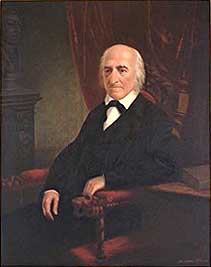
William Shakespeare died two centuries before the Whiskey Rebellion of 1794, but he left us a clear outline of his style. Tragedies end with everyone getting killed, comedies end with everyone getting married, but histories have no clear beginning or end. The Hollingshead chronicle underlying this particular effort is the excellent history by Robert E. Wright and David J. Cowen, called Financial Founding Fathers. The story of the young Swiss aristocrat Albert Gallatin, plonked into the backwoods of Pennsylvania only to be relentlessly pursued by his arch enemy General Alexander Hamilton, ends in 1804 when Hamilton is killed in a duel by the Vice President of the United States, Aaron Burr.
Act 1. Ex-Senator Gallatin.
Aged 33, Gallatin was young to be a U.S. Senator, but his Swiss background in finance made him one of only five or six Americans who knew anything about banks. Unfortunately, his passionate Swiss frugality immediately made him the arch enemy of Secretary of the Treasury Alexander Hamilton who wanted to combine state debts from the Revolutionary War into a national debt. This thorn in Hamilton's side was removed by evicting Gallatin from the Senate on the grounds that he had not been a citizen for the ten years required by the Constitution. Unfortunately, that was true. It was nevertheless galling that Robert Morris, the other Pennsylvania Senator, would vote against him. The humiliation of being forced to leave Philadelphia and ride horseback to his home in Fayette County, right on the Indian frontier among the semi-barbarian Scotch Irish, was extreme.
Act 2. Caught in the Middle.
When Gallatin arrived home in the backwoods, the incensed local farmers instantly rallied around him as the perfect leader of a rebellion they wanted to start. A four-year war with the Indians in nearby Ohio had shut off all hope of marketing their grain to the West, and the Allegheny Mountains made it unprofitable to ship it to the East. Their response was to distill it into whiskey, which would not spoil with storage, and was more compact to transport. Assisted in part by Quakers' horror at selling whiskey to the Indians, Hamilton had pushed through a tax on whiskey which rendered it impractical to make it at all. Gallatin was already Hamilton's enemy, and Gallatin the European knew how to talk to those swells in the East. Gallatin did make rousing speeches about injustice but always cautioned the wild men to behave peacefully. That wasn't exactly what the angry farmers wanted, so Gallatin soon became the enemy of both sides of the dispute when the western Pennsylvanians organized a rebellion. Both sides made threats to assassinate him.
Act 3. The Lion Roars
President George Washington didn't know much about banks or taxes, but he knew a lot about law and order, and he wasn't having any rebellions. Ordering up an army of fifteen thousand men, he and General Hamilton led it across the state of Pennsylvania to hang 'em. Meanwhile, however, General "Mad" Anthony Wayne had defeated the Indians along the Miami River in Ohio, thus removing the main reason for whiskey manufacture, and finally proving to the anti-Constitution Jeffersonians that the federal government really was a useful thing to have. Washington dropped out at Bedford and went back to running the country, allowing the relentless Hamilton to charge forward to Pittsburgh. By that time, the farmers had pretty well dispersed, but to Hamilton they were traitors and that particularly included Gallatin.
Act 4. Local Hero
Two ringleaders were convicted of treason, everyone was threatened and interrogated. Hamilton was particularly anxious to include Gallatin in the net, but no one in that frontier culture would accuse Gallatin of participating in the call to violence or testify to any treasonous speech by him. In the midst of the uproar, Washington rose to the occasion and pardoned them all. Every last one of them.
Act 5. Secretary Gallatin
In a surge of jubilation, western Pennsylvania elected Gallatin as their congressman, sending him back to Philadelphia where he could do them some good. And indeed he quickly assaulted all of Hamilton's policies, both good and bad, as well as just about every other Federalist program. He quickly rose to the effective leadership of Congress and swung the crucial 1800 election from Aaron Burr to Thomas Jefferson. Since Jefferson was another Virginia Cavalier who knew nothing about finance, it was a foregone conclusion that President Jefferson would appoint Gallatin to be Secretary of the Treasury. Finally, in 1804 Burr removed Hamilton from public affairs on the flats of Weehawken. At the news of the death of his enemy, Gallatin shed not a tear. His memorial was the statement that "a majority of both parties seemed disposed.....to deify Hamilton and to treat Burr as a murderer. The duel, for a duel, was certainly fair."
Gallatin Part II
Act 1 Gallatin Triumphantly Returns to Congress.
When Washington pardoned the Whiskey Rebels, Gallatin was immediately elected to Congress. It was his payback time for Hamilton and all his works. The desperate Federalists tried to oust him a second time with a Constitutional Amendment, which failed before the force of Gallatin's oratory. Gallatin then threw his influence behind Jefferson's deadlocked congressional contest with Aaron Burr, electing Jefferson and earning his own reward as Secretary of the Treasury. Although elected Vice President, Burr's fury is turned against Hamilton, foreshadowing the coming duel.
Act 2 The Virtuoso Financier.
Jefferson proves hopeless in domestic affairs, so Gallatin essentially takes over that role, just as Hamilton had taken over from Washington, who was another Virginia cavalier adrift in these matters. Gallatin promptly repealed the whiskey tax, cut government expenses, in particular, the million dollars annual tribute to the Barbary pirates, and almost performed magic in financing the Louisiana Purchase together with Stephen Girard and William Bingham.
Act 3 Burr Kills Hamilton
After his Vice President kills the leader of the opposition party, Jefferson's party was on the political defensive. But not Gallatin, who spits out his famous remark, "A majority of both parties seem disposed to deify Hamilton and treat Burr as a murderer. The duel, for a duel, was certainly fair." It is an all-time low moment in the politics of the young nation.
Act 4 Diplomacy or War?
As the Napoleonic wars engulf the whole world, both England and France harass our merchant ships, and cries go up for war. Partly out of a desire to annex Canada in the process, Gallatin sneers at proposals to restrain the fighting Europeans with mere sanctions. His prediction proves dismayingly correct that nothing would come of it except to make our own citizens into smugglers.
Act 5 War It Is.
The First Bank's charter was to expire in 1811, and the bank closed, creating an opportunity for Girard to buy it out and finance the coming war himself. Gallatin was desperate to end the war as quickly as possible, especially after the British burned Washington. To speed matters up, Gallatin took a leave of absence and went off to the peace conference in St. Petersburg himself.
Epilogue in front of the curtain.
Gallatin finally announces his resignation from the longest term of Treasury Secretary in our history. He is seventy years old, three scores and ten. Rather than play golf, he was to spend the last eighteen years of his life in three more careers. As a diplomat, he negotiated both our permanent northern and southern borders. As an academic, he founded the discipline of ethnology with the study of native Indian languages, meanwhile founding New York University. And as a banker, he founded a bank which has since evolved into JPMorgan Chase. After all, a man has to find something to keep himself busy.
Laundered Money
|
| Judge Edwin O. Lewis |
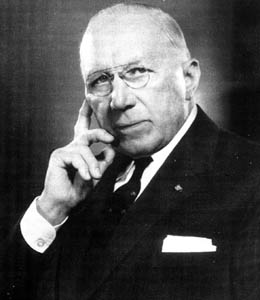
Judge Edwin O. Lewis finally got his way, the Pennsylvania State Government acquired four blocks of Chestnut Street stretching to the East of Independence Hall, and the Federal Government acquired four blocks stretching to the North. Judge Lewis was determined that a real revival of historic Philadelphia required the clearance of a lot of lands. Those who heard him describe it will remember the emphasis, "It must be BIG if it is to serve its purpose."
The open land is rapidly filling in but for a time the movers and shaker of this town had to scratch a little to find something to put there. That's fundamentally why the historic district has a Mint, a Federal Reserve, a Court Houses, a Jail, and a big Federal Building to house various local offices of the landlord, the federal government. It's where you go to visit your congressman, or to renew your passport, or to argue with the Internal Revenue Service. If you have certain kinds of business, there's an office for the FBI and the U.S. Secret Service. The mission of the Secret Service is a little hard to explain with logic.
The Secret Service is a federal police organization, charged with protecting the President of the United States, and enforcing the laws against counterfeiting money. In unguarded moments, the Secret Service officers will tell you they only have one function: to guard three-dollar bills. The President only comes to town from time to time, but the mandate extends to the President's family, and to the extended family of official candidates for election to that office. So, there is usually always a certain amount of activity relating to running behind limousines with one hand on the fender, or poking around rooftops near the speaker's platform at Independence Hall, or talking apparently to a blank wall, using the microphones hidden in their ear canals. The rest of the time is taken up with counterfeiters, but even then the excitement is only occasional, depending on business.
A few years ago, the buzz around the office was that some very good, even exceptionally good, fake hundred dollar bills were in circulation in our neighborhood. The official stance of The Service is that all counterfeits are of very poor quality, easily detected and no threat to the conduct of trade. Unfortunately, some counterfeits are of very good quality, not easily detected, and when that happens, The Service is made to feel a strong sense of urgency by its employers. These particular hundred dollar fakes were of very good quality.
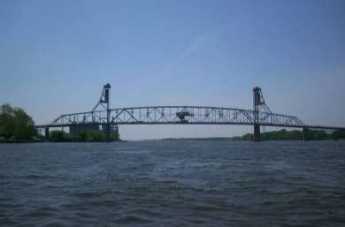
One evening, a call came in. Don't ask me who I am, don't ask me why I am calling. But I can tell you that a very large bag of hundred dollar wallpaper has just been tossed over the side of the Burlington Bristol Bridge, near the Southside on the Jersey end. Goodbye.
Very soon indeed, boats, divers, searchlights, ropes, and hooks discovered that it was true. A pillowcase stuffed with hundred dollar wallpaper of the highest quality was pulled out of the river. By the time the swag was located and spread out for inspection, it was clear that several million dollars were represented, but they were soaked through and through. Most of the jubilant crew were sent home at midnight, and two officers were detailed to count the money and turn it in by 7 AM. The strict rule about these things is that all of the money confiscated in a "raid" was to be counted to the last penny before it could be turned over to the day shift and the last officers could go home to bed. After an hour or so, it was clear that counting millions of dollars of soggy wet sticky paper was just not possible by the deadline. So, partly exhilarated by the successful treasure hunt, and partly exhausted by lack of sleep, the counters began to struggle with their problem. One of them had the idea: there was an all-night laundromat in Pennsauken. Why not put the bills in the automatic drier, so they could be more easily handled and counted? Away we go.
|
| Burlington Bristol Bridge |
At four in the morning, there aren't very many people in a public laundromat, but there was one. A little old lady was doing her wash in the first machine by the door. It was a long narrow place, and the two officers took their bag of soggy paper past the old lady, and down to the very last drying machine on the end. Stuffed the bills into the machine, slammed the door, and turned it on. Most people don't know what happens when you put counterfeit money in a drier, but what happens is they swell up and sort of explode with a terribly loud noise. The machine becomes unbalanced, and the vibration makes even more noise. The little old lady came to the back of the laundromat to see what was going on.
As soon as she got close, she could see hundred dollar bills plastered against the window, and that was all she stopped to see. She headed for the pay telephone near the front of the door. The secret Servicemen followed quickly with waving of hands and earnest explanations, but within minutes there were sirens and flashing lights on the roof of the Pennsauken Police car. Out came wallets and badges, everyone shouting at once, and then everything calmed down as the bewildered local cop was made to understand the huge social distance between a municipal night patrolman and Officers of the U.S. Secret Service. Now, he quickly became a participant in the great adventure and was delegated the job of finding something to do with armloads of (newly dried) counterfeit hundred dollar bills. He had an idea: the local supermarket was also open all night, and they carried plastic garbage bags for sale. Just the thing. But who was going to pay the supermarket for the bags? Immediately, everyone was thinking the same thing.
Fortunately for law and order, the one who first suggested the the obvious idea of passing one the counterfeits was the little old lady. At that, everyone came to his senses. Wouldn't do at all, quite unthinkable. The local cop was sent off for the bags, relying on his ability to persuade the supermarket clerk. And, yes, they did get the money all counted by 7 A.M.
Making Money (1)
|
| Barbarous Relic |
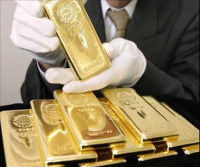
As 2005 turns into 2006, we watch an upward surge in the price of gold for the first time in three decades. The last time the gold price soared, America had gone off the gold standard completely, ending traditional promises that U.S. dollars could always be exchanged for precious metals at a specific price. A brief flutter of the exchange rate ("the price of gold") under floating-price circumstances was to be expected since it was even conceivable that the price of gold might eventually go down. It didn't, and when things settled out it was roughly true that the price had migrated from about thirty dollars for an ounce of gold to about three hundred dollars an ounce. The conversion price has experienced fluctuations since that time, gradually moving to four hundred dollars an ounce in thirty years. There was a reason to see this as a one-time readjustment. The floating prices of precious metals might drift along independently forever, responding to fashions in gold jewelry and advances in dentistry, but a matter of little interest to anything else. No doubt there would be panics in third-world politics, but anyone one who staked life's savings on predictions of wars and famines in the underdeveloped world was imprudent a nut. A gold bug.
This time, it seems to be different; all is calm. The price of gold now exceeds five hundred dollars an ounce; responsible publications even conjecture it will go to a thousand within five years, perhaps three thousand in fifteen years. You might say wild predictions are thus flying about that our savings will lose ninety percent of their value, but nowadays nobody seems willing to say this is either a crisis or just nutty talk. There is both an absence of alarm that the price of gold is predicting disaster, but also a lack of scorn for dumbbells who would actually believe such a thing. A cynic would say that the columnists in financial magazines all seem to be owners of some gold and are talking up its price. But we were told it didn't matter, so we seem to believe it.
A more reflective view would be that we are experiencing the first real test of the world's new monetary system, at least its first challenge by the marketplace since the convertible link between gold and dollars was officially severed. The value of gold seemingly has little to do with its basic utility for dentists. The value of the dollar seemingly does not attempt to relate to the actual supply in circulation, nor attempt to represent a share of all American assets; those things are too hard to measure. The number of dollars in circulation is governed by watching inflation and unemployment and having the Federal Reserve create more or fewer dollars as needed to keep inflation and unemployment at some steady, pre-determined level. The price of gold is something else, irrelevant to a civilized society. It's all terribly clever, but it ultimately depends on whether those pre-determined levels of inflation or unemployment are well chosen. And whether politicians might tinker with them.
It would, therefore, seem likely that the clearing price between gold and dollars is currently putting a high value on gold for reasons other than a current over-supply of dollars or a world shortage of the metal. We must look elsewhere for the cause of the gold-price panic. The Chinese and the Indians are getting richer; perhaps the value of precious commodities somehow reflects that relativity. Or perhaps we are dealing with political predictions; a civil war in China renewed war between India and Pakistan, a revolution in the Persian Gulf oil kingdoms. Or atomic bomb terrorism directed against the United States. Whatever political upheaval it is that bothers the gold bugs must be pretty big; neither the war in Afghanistan nor the one in Iraq or the combination of both, was enough to stir up gold prices to the present degree.
In a sense, the worst possibility would be: the gold hysteria has no rational basis at all, like the tulip bulb frenzy of several centuries ago. The immediate question gets raised whether a merely intellectualized value for the currency can withstand cataclysmic world events. But if there is no serious threat of world cataclysm, then the remaining question on the poker table becomes whether hysterical financial commentators can topple the dollar system just by mindlessly stampeding. A monetary system which cannot withstand such a trivial threat is not a viable monetary system. The financial world's eggheads would then be in a war with the financial world's green-eyeshade gamblers. It's not entirely safe to predict who will win.
Making Money (2)
|
| counterfeit money |
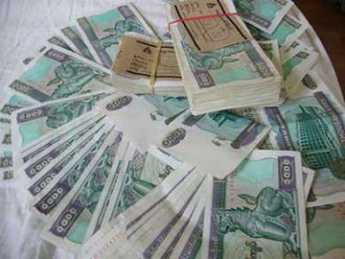
One of the important provocations of the American Revolutionary War was shortage of cash caused by a primitive currency system. The British government would not permit colonies to print easily counterfeited paper money; while dependence on gold coins regularly caused temporary shortages during seasonal trade imbalances. Colonists became bitter about farm foreclosures when an otherwise prosperous farmer simply couldn't find enough coins to satisfy his mortgage payments. So, from earliest days the monetary system highlighted the important distinction between how much cash you had jingling in your pocket, and how rich you actually were. Electronic banking and funds transfers have now largely eased the cash flow issue; measuring the true wealth of the whole economy still contains much guesswork. When the economy seems to be undervalued (deflated) by the prices collectively set by the marketplace on each of its parts, two common fiscal remedies still provoke political controversy. To inflate the economy, the government can spend money, or it can reduce taxes. The empirical history of the past century seems to show that cutting taxes is quicker and more effective, particularly when taxes were too high, to begin with. It may not work when taxes are insignificant, so the political debate between the two parties who have adopted these programs as pets tends to center on whether taxes are too high or too low and who is paying them.
To a certain extent, this is a tempest in a teapot. Both reducing federal taxes and increasing federal spending lead to increasing federal deficits, which are then covered by issuing federal bonds. Not much difference, there. The important difference on a practical level is that cutting taxes increases money in circulation more quickly than wrangling about what programs might be best, and then painfully organizing them. The choices for spending opportunities are set by the private sector when taxes are reduced, are therefore more effective in stimulating the private economy, less likely to be politically filtered than legislative authorizations are. The fresh funds from cutting taxes go to those who were successful enough to be paying taxes. They personally need them less than poor people do, but they have a better track record in multiplying them. Unless taxes are already too low to make a difference, reducing taxes is clearly quicker and more efficient than authorizing government spending. Finally, the argument about "planning" introduces an unnecessary sour note. Although the Communist Party was famous for five-year plans and the like, the truth is their system of subordinating economic goals to political ones was the main source of their economic collapse. It was a German, Italian and Japanese systems of central planning which can fairly claim a measure of economic success, growing out of their admiration for an earlier era of success by huge industrial corporations, stimulating even in America a spirit of "win the war" top-down organization. We thus have the ironic situation where it is awkward to point out the technical reasons for the post-war failures of the centrally planned Axis nations since the people who now seem most attracted to central planning are the ones most likely to be offended by the comparison. Somehow, we must hope that the French and Chinese learn this lesson by themselves.
Making Money (3)

|
| David Altman |
Daniel Altman draws attention in the January 1, 2006 New York Times to Ben Page's estimation of compensating rises in federal tax revenue after tax cuts. Page (for the Congressional Budget Office) says revenue increases will only offset 28% of tax loss. The Laffer theory (that tax cuts pay for themselves) may be overstated but it's kind of right. Not only is the full amount of the tax reduction immediately released to the private sector, but only 72% of it ever needs to be borrowed and repaid. Tax cuts may not pay for themselves but they fully stimulate the economy immediately; 28% of the stimulus is permanent.
Mr. Altman then comments taxes could never be cut to zero, because lenders would then refuse to lend; surely no one disagrees. But it's extreme to say tax rates must currently be at a point "on the curve" where reducing them further will not generate a worth-while gain in tax revenue to be effectively re-injected back into the economy. All of any tax cut is always a windfall for the private sector; that's its purpose. Ben Page just says that only 72% of this one needs to be borrowed; the other 28% is a permanent cost-free saving for everybody. If you chose to stimulate the economy by increased government spending, all of that would have to be borrowed, all of it would have to be repaid.
But cheers for Mr. Altman, who notices the role of lenders, who place limits on how far you can stretch this idea. You can't cut taxes to zero because lenders won't lend to a government without income. And even as taxes approach zero, lenders will raise interest rates. That gets us to the currently inverted yield curve; why aren't long-term bonds able to command higher interest rates? If they rose, the interest cost would eventually wipe out the free ride for tax cuts.
Well, the big artificiality in this Calder mobile is the fixed exchange rate for Chinese currency. The Chinese are inexperienced, rightly fearing chaos if they allow their currency to float upward against the dollar. When they solve their problem, unless God helps us they bungle it, American bond rates will tell us whether it's safe to cut taxes some more. Interest rates on American long-term bonds will rise, perhaps too uncomfortably high levels. At that point, no government -- R or D -- would cut taxes further.
Making Money (4)
If lowering taxes is inflationary, how can it be that several financial columnists refer to buying low priced

|
| China Man |
Chinese imports as "importing deflation"? It would seem, in both cases, that consumers end up with more money in their pockets, so both cases must be inflationary. To answer that twister, you also need to consider where the inflationary new money comes from.
|
| chinese labor |
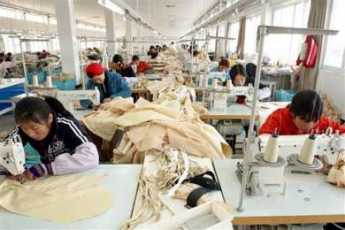
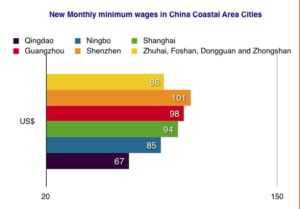
When the government lowers its revenue by lowering taxes, it creates a deficit which is paid for by issuing bonds. That's inflationary until the bonds are paid off. If the bonds are ever paid off, the amount of money in circulation then returns to its original level. The public has effectively given itself a loan by lowering taxes, so after a temporary spell of inflation, there is no permanent effect on circulating money at all. By contrast, when Chinese workers agree to work for lower wages than Americans, that causes inflation for the American economy because Americans have more spending power left over. How they spend it is their business; the bonanza may surface as a stock market bubble or a real estate bubble, a credit card bubble or a spectacular Christmas shopping season. But gradually the extra money seeps out into the economy as extra wealth of some sort. Whether you describe it as real added wealth or just inflation, maybe a quibble -- but it clearly is not deflation.
|
| Chinese wages |
But when a successful financier, betting his own money on his analysis, says that America is "importing Chinese deflation", it's likely he says something important, however imprecise technically. In this case, it would seem to be an observation that the globalization method of creating inflation minimizes some of the usual consequences of inflation. Since the low prices of Chinese products are mainly due to low Chinese wages, they discourage wage demands in this country, even in industries which do not compete against imports. That's politically important, even though there are many more consumers than manufacturing workers, and the nation as a whole is better off for the globalization. In short, inflation is not invariably a bad thing.
Now, just think of the problems that create for the Chairman of the Federal Reserve, who is charged with maintaining level prices, and defines our whole currency system on doing whatever it takes -- to avoid inflation.
Making Money (5)
|
| Keynes |
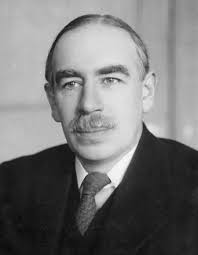
Every newly-rich country seems to experience at least one episode of adolescent giddiness, thinking there is no stopping them, their trees will all grow to the sky. America's comeuppance took place in 1929, Japan's in 1990. Sooner or later the Chinese and the Indians will learn that it is unwise to grow faster than human systems can readjust, overcapacity is certain to appear at some point, and the new bumpkin will then appreciate what it means to have a business cycle. After a variable time, deflation reaches the bottom, and it is past time to inflate back to normal. Lord Keynes (pronounced "Caine's") advised Franklin Roosevelt to promote government spending, even useless spending, but it didn't help as much as they hoped. The Japanese built bridges and tunnels to nowhere, and that didn't help much either, although encouraging residential construction worked better than they expected. Wars are good for deflation, too, but only if you win them.
America has devised three methods for combating deflation: cutting taxes when other nations maintain fixed currencies, cutting consumer prices at the expense of developing countries, and cutting costs by improving productivity. You could combine these three methods into one principle: if you can't increase the amount of money, you must increase virtual spending power by cutting prices. In a deflation, consumer prices have fallen because of overcapacity, so you must cut consumer costs in those areas which will not respond to overcapacity. Same money, more buying power. Other countries are apt to resort to gold as a way of preserving their buying power; it will be an interesting struggle.
Nevertheless, it will be important for America to spend its affluence on increasing productivity rather than trinkets and junkets; we, too, have our share of adolescents. Computers have helped us reduce transactional costs everywhere; transportation is in fair shape. Education is an expensive mess, simply begging for improvement. Housing is still using 19th Century methods. Entertainment is expendable. We have a huge supply of underutilized labor in the black male community, in the early retirees, and in our comfortable work habits. Fighting wars is a pretty expensive hobby. How well we withstand the next world recession will depend to a major degree on how well we solve the problems that obviously need solving.
The business cycle will continue to cycle, but it is possible to feel pretty good about American ingenuity in relating, globalizing and enhancing productivity. There is even a wicked satisfaction in reminding our British cousins of their little witticism which made the rounds after World War II:
In Washington, Lord Halifax
Once whispered across to Lord Keynes:
"It's true that they have big moneybags,
But we have all of the brains."
Making Money (6): The Laffer Curve
|
| Arthur Laffer |
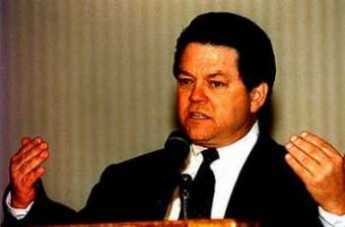
Recall for a moment, the two Republican idols, economists Milton Friedman and Arthur Laffer. Friedman won a Nobel Prize by observing that inflation is "always and everywhere" caused by too much money in circulation. Thus, a potential remedy for inflation was suggested: central banks (i.e. the Federal Reserve) can restrain that by raising short-term interest rates at the first sign of inflation. It certainly seemed to work; by doing so, Federal Reserve Chairman Alan Greenspan was able to avoid inflation for eighteen years.
Arthur Laffer offered a second idea for Presidents to test. Laffer maintained that if taxes were too high, you would paradoxically collect more taxes by lowering tax rates. The younger George Bush took him up on it, reasoning that if tax collections did rise after tax rates were cut, it would be proof that taxes had been too high all along. The appeal to tax technicians in the Treasury Department was that, by observing tax collections, all changes in tax rates up or down might lead to the identification of the most efficient possible tax rates. So, although President Reagan had felt warm about Laffer, while the senior George Bush rudely dismissed such ideas, George W. was eager to test his gut feeling that tax rates were too high. Each year during his presidency, George W cut taxes. Gratifyingly, each year total tax revenue (adjusted for GDP) increased. Eight years are not the same as eighteen, but it certainly looks as though W proved that taxes had indeed been too high. If some future Congress has the courage to raise taxes, and then tax collections go down, the Bush legacy would seem pretty secure. Two iron laws of national economics would be enshrined: The tax rate should be whatever maximizes tax revenue. Interest rates should be whatever restrains inflation. Live with it.
True, none of this insight casts much light on how to cope with wars and depressions. Raising interest rates seemingly defeats inflation, but lowering interest rates has not always cured recessions. Furthermore, the fiscal and monetary direction of the country may have to be altered when we face war, famine, weather disasters, and demographic shifts. But at least we seem to know how to determine the optimum level of (overnight, interbank) interest rates and taxes, so have a compass for return to those levels after detours around uncertain events. Maybe economists, even Voodoo economists, can suggest some other principles which politicians can test in the real economy. And political science can then start to have some true scientific method in it; propose a theory, test it, revise the theory and test it again.
But there's one more thing that Art Laffer didn't understand when he was drawing his famous curve on the back of a paper napkin. One of the main reasons tax collections rose spectacularly when George Bush finally had the nerve to try lowering taxes -- was that the underground, tax-evading, economy was a great deal larger than anyone had suspected. Laffer made crooks into honest people.
Making Money (7): Fractional Reserve Banking
|
| Money and Credit |
Academic economists make a useful distinction between "money" and "credit" when they point out that real money is always and everywhere created by governments and governments alone. To sustain this argument, it can be argued that banks only appear to double the money in circulation when they issued "credit" to the borrower, but simultaneously allow the depositors to retain the right to withdraw the same amount of "money". It's a little artificial, but it helps to clarify the next idea, which is fractional reserve banking.
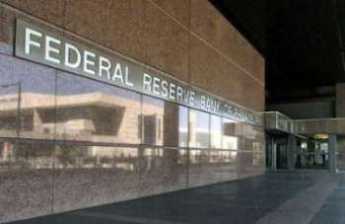
|
| Federal Reserve Bank of Philadelphia |
Self-reserved banking, to coin an otherwise unnecessary phrase, would be to insist that a bank limit its total loans to the amount of money in its vaults, which is what private individuals do when they loan to friends. Since the volume of bank withdrawals is ordinarily quite stable and amounts to only a small fraction of reserves, self reserving would unnecessarily limit the bank's ability to lend, thus constraining the economy in general. Only in the event of a bank panic, or "run" on the bank, would the bulk of the reserves be useful, and this rare risk can be covered by creating reserve banks who guarantee to come to the rescue. Since the federal government alone can create "real" money out of thin air, a federal reserve bank is a logical arrangement to establish. Its existence makes possible the concept of fractional reserves at the local level, which any reserve bank can then control by declaring what numerator it will tolerate before it prefers to infuse money into the denominator of the equation.
And from all this comes the "multiplier effect", where a bank can loan several times as much money as it has in reserves, so long as the federal reserve permits it. When those loans get deposited in other banks, they serve as reserves for a second (or third, or fourth) bank, and the multiplier effect can get quite dizzying. In our system, the Federal Reserve can thus control the inflation or deflation in the general economy by adjusting reserve requirements of the banks it governs. It does so by increasing or decreasing the "money in circulation", which is not really money, but credit, which feels exactly the same to those who can get it.
We're playing with words a little, but that's the general idea.
Setting National Interest Rates
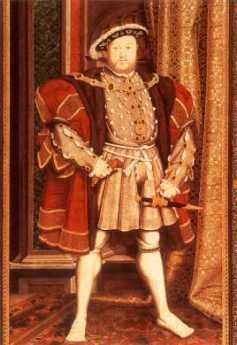
|
| Henry the VIII |
A bank has depositors' money in custody and makes a profit from loans of it. This amounts to borrowing money from depositors at a low-interest rate, then loaning it to borrowers at a higher rate. Banks can also borrow from other banks, or effectively a loan to the Federal Reserve by buying U.S. Treasury bonds. At one time, banks set interest rates for loans by leaning back in the chair and negotiating with the customer; interest rates were whatever the traffic would bear. After a long and complicated history, which includes the Catholic Church's forbidding interest-bearing loans, Henry VIII of England confiscating Church property, the Medici family in Italy and a political battle between Andrew Jackson and Nicholas Biddle, we got to the point where J. P. Morgan more or less decided which banks deserved to fail and neglected to rescue them in the next bank panic. He was in that position because of European, largely British, banking connections. In 1913, the Federal Reserve system was created, with government officials nominally but not totally in charge. Although it now seems pretty natural for the government to be in charge of the nation's money supply, it must be remembered that Robert Morris personally financed the Revolutionary War, Stephen Girard financed the War of 1812 out of his own bank, and J. P. Morgan financed the Spanish American War -- in each case because the government couldn't do it alone. On the other hand, the Civil War (and later, the two World Wars) showed that the nation had outgrown the control of a single private banker. We floundered through gold and silver standards, then bimetallism, then off metal standards entirely.
At the heart of it was an important difference of opinion. The banks were private businesses and didn't want outsiders setting their prices. They particularly didn't want the government to set interest rates after the government itself became a permanently big debtor. It left to them, banks want higher interest rates, governments want lower rates; neither one is a trustworthy referee for the whole country. The 1913 reform locked the two of them in secret struggles within a marble tomb. After eighty years, with one bad inflation, at least two bad depressions, and a dozen stock market crashes, the two combatants seem to have evolved a workable system of agreement on suitable goals and how best to achieve them.
The problem is this. Interstate business and national politics demand uniform national interest rates. But any national rate will be too high for some regions, too low for others. Such an impossible deadlock can only be solved by choosing between tyranny and payoffs. Just how the regional losers in these endless arguments are pacified is not entirely clear, but a recent remark is interesting. One regional governor of the Federal Reserve remarked that you might expect each regional governor to argue for the benefit of his own region, but in fact, there is little of that. No one with experience in politics would conclude from that remark that governors are filled with altruism. But it will apparently take more time before the mechanics of this balancing act are fully understood.
|
| The Federal Reserve Bank |
For now, the Federal Reserve can be described as a place where representatives of the regional banks negotiate with a federal appointee, behind closed doors. The question of enforcing a uniform national interest rate was effectively settled for good, shortly after the creation of the Federal Reserve. Texas defied the national rate and lowered Texas rates to meet Texas conditions. Almost instantly, everybody wanted a loan from Texas banks, but no one would deposit money in them. Texas came crawling back to conformity, and the national rate was thenceforth not only legal and ratified, but it was also seen to be self-enforcing. The European Union has recently gone through the same experience, with everyone learning there is simply no way to cheat the system.
One other thing needs mentioning. Total price control of all interest rates would cause rioting in the streets. India and other countries which tried to nationalize their banks have taken thirty years to recover from the experience. The Federal Reserve only controls short-term interest rates, while long-term bond interest remains set by the marketplace. This seems to work well enough for the purpose of regulating the supply of money, but it affects consumers and small businesses who do most of their borrowing through banks. Large corporations generally borrow money by issuing long-term bonds. This difference in application causes a certain amount of grumbling about fairness. But the wisdom of the arrangement was repeatedly illustrated to President William J. Clinton. We hear it reported that time after time some proposal of his was quashed by his Secretary of the Treasury, Robert E. Rubin, quietly commenting, "The bond market won't let you."
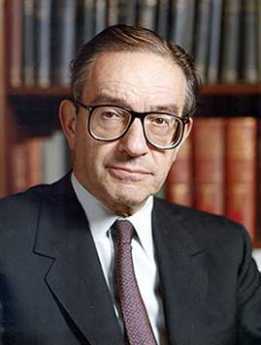
|
| Chairman Alan Greenspan |
That's how matters stood until the 2007-2009 debacle. The bond market was funded by corporations, overseen and controlled by investment bankers in the IPO process, and effectively ceding control of long-term interest rates to the investment banks, and providing them with a somewhat cheaper source of capital because it came in larger lumps, wholesale. It was in tension with, but essentially out of the direct control of, the government in the form of the Federal Reserve. The commercial banks raised capital by collecting deposits in dribs and drabs, a more expensive but more comfortably stable source. Short term interest rates were related to the overnight lending process between banks and controlled by the Federal Reserve. For many years it was satisfactory for the Fed to influence long term rates without directly controlling them, and the resulting prosperity and stability seemed to vindicate this indirection. However, when the far east and middle east started dumping huge amounts of liquidity into the international monetary pool, the carry trade and direct purchase of U.S. Treasury bonds by foreigners started to pull the two main banking systems apart, first destroying the control of the Federal Reserve over long term interest rates, and ultimately short term as well. Chairman Alan Greenspan exclaimed in the 1990s that the peculiar behavior of long term rates was a "conundrum". His successor, Ben Bernanke, was to find it was reversing the process; long term liquidity was affecting short term rates, and hence distorting the monetary supply. That might have been a workable rearrangement, except that the markets froze up in 2007, confusion was suddenly widespread, and panic reaction caused disorderly markets. Whether from confusion, expediency or deliberate choice, the Fed rescued the commercial banks while allowing the investment banks to go under. Those few investment banks who survived did so by wrapping themselves in a shell of commercial banking. They became one-bank holding companies.
It will be some time before we can judge whether Bernanke made the right choice or not. Commercial banking was on its way to extinction when it allowed itself to become an arm of the Federal Reserve, and perhaps instead it should have been allowed to die. Commercial banking based on collecting deposits is a more expensive way to raise capital than borrowing it wholesale. With credit cards, commercial credit, and asset-backed securities, the other functions of banking were effective enough to make it possible that no one really needed any of the products of commercial banks. The one thing investment banking cannot supply is an unchallengeable monetary standard. Having given up gold and other precious metals, having toyed with using real estate as a surrogate monetary standard, having tried oil and other commodities, we are left with government fiat as the world monetary standard, and commercial banking as the only tested way to make that system work. Going back to the origins of coinage in Lydia, governments have universally proven they cannot be trusted with the currency. Nevertheless, there seems to be no alternative in sight.
Supply-Side Tax Cuts
|
| Dollar Sign |
Some tax cuts are good, some are bad. Aside from the political truth that cutting my taxes is always better than cutting yours, there's the question of timing. Tax cuts are usually inflationary, so there are times when they should all be resisted. Taxes on some things are disincentives; that's been the argument for taxing cigarettes and liquor, maybe it is now an argument for raising gasoline taxes. But the argument for lowering taxes on capital gains and dividends is far more mysterious. It's supply-side economics, and absolutely no one knows what that means, right? Lately, it has come to mean that taxes don't just change revenue, they may change behavior.
The place to start is to recollect that the dividends on state and municipal bonds are exempt from federal taxes. Tax-exempts have a lower interest rate than similar bonds issued by corporations, or the federal government because such tax-free income is often greater for the purchaser than taxable dividends, net of taxes. But forget about the purchaser for a minute. The state or the local government gets enabled to borrow money at a lower interest rate. That's the supply side talking.
So, although it passes through extra steps, corporations would find it cheaper to issue bonds if the customer paid less income tax on the bond dividends. Not only does the issuing corporation get an interest-rate reduction, but all other corporations also do too, as the prevailing cost of capital is lowered. There's even an enticement for economic nationalists: only American bond-buyers get an American tax reduction. And all this is true whether you lower the rate from 25% tax to 15%, or eliminate taxes entirely. Corporations get an incentive to borrow more money, which we all pray they will use wisely so good things will happen to jobs and the economy. It's known as lowering the cost of capital.
It doesn't make a bit of difference whether the taxpayer who "gets" the tax cut is rich or poor, and in that sense, the argument for doing it isn't political. But in another sense, it may be. State and local governments are already getting cheaper capital, so we have in the past created an artificial incentive for them which disappears if everyone else gets it, too. There's a large segment of the country that believes the country would be better off with less government, based on efficiency, economics, and yes, political grounds. And there is another segment, heated up by the political spin, which believes that if rich people get any benefit at all, it must be harmful to others.
It is plainly true that all generalizations do not apply to every kind of tax at the same time. Right now, it would seem likely that the largest boost to the economy would come from lowering corporation taxes because there are people who just plain don't like big companies, and are therefore willing to shoot themselves in the foot with unemployment. When Ireland lowered corporate taxes to 12.5%, the resulting boom was so unexpectedly frothy it got out of hand. So maybe the boys in the Temple Bar were right -- don't give them nuthin'.
Inflating and Deflating Japan.
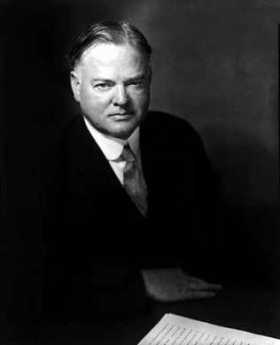
|
| Herbert Hoover |
Survivors of the Great World Depression of the Thirties need no convincing about the catastrophe of deflation, but even they would have trouble defining it. Deflation is, well, something that was caused by the 1929 stock market crash, or maybe it was Herbert Hoover's fault, or maybe Hitler's fault. It is enough to know it was bad, that it's all over, and that it is on page six of the newspapers, below the fold. Unfortunately, it has returned again to crush the poor Japanese for the past fifteen years, but still, no one seems willing to say what causes deflation, or what will cure it. So, let's venture.
|
| World Depression |
The world acts as though it believes the following one-liner: The main cause of deflation is inflation. Merely keep inflation under control, and you will then avoid deflation, as well as the awkward need to know what to do about it. The main proof of this fragile argument lies in the fact that America has somehow avoided serious recession for almost twenty years by relying on "inflation targeting". It's a little uncomfortable to notice that the main proof that inflation is the only cause of deflation rests on the fact that we have had no recessions during the time we had no inflation. When central bankers are confronted with the lack of logic in that position, they appear distinctly uncomfortable. It may be correct that only inflation can cause deflation, but the proofs are unsatisfying.
|
| Rock, Paper, Scissors |
So let's retreat to a little safer ground. Let's say that massive shifts of currency can topple the stability of any government or national economy; inflation is the main cause of massive currency movements. However, it's like the old children's game of paper, rock, and scissors; you can't be sure in advance whether you want diversification, strength, or flexibility. Stability rests on long term financial commitments, like long-term bonds, or mortgages, insurance, or pension schemes. But maybe you don't want strength, you might want agility. Then, if you are in a position to anticipate currency disruption, you will shift from long-term to short-term. Panic like that undermines the people who are locked to thirty-year commitments but may not have thirty years to ride them out. The value of a national currency is tied to shifts in interest rates; that's the same thing, one within borders and the other across borders, like pushing on a balloon.

|
| cameras |
If you think government action can rescue a real panic, look at Japan. The Japanese sold good cars and cameras, acquiring a lot of foreign currency. That should have caused their own currency to increase in value, but instead, the Japanese just printed more of it to maintain the low international price of cars and cameras. All that resulting loose cash, confined within their borders, caused serious inflation of Japanese real estate and stock market prices; when this inflation shifted around, it capsized their boat. Long-term debts defaulted, eventually bringing the banks down with them.
Perhaps the Chinese have learned a lesson from Japan's experience, but don't count on it.
Paying Bills Electronically
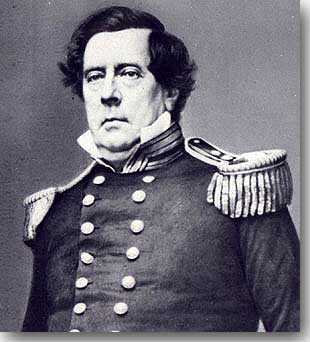
|
| Commodore Matthew Perry |
Commodore Perry "opened up" Japan in 1854, but Ronald Reagan opened up the banks and finances of that country more than a century later. Because his chief of staff Don Regan had been in charge of Merrill Lynch, the Japanese let that company in, and because of some favors by J. P. Morgan in the 19th Century, they also admitted Morgan Stanley. Although several Japanese banks had grown to be the largest in the world, the Japanese never adopted the popular American habit of personal checking accounts. One of the surprised observations of the new American pioneers was that a bank could be pretty successful, without all that expensive nuisance of processing checks. Twenty years later, American banks are starting the long and difficult job of weaning their customers away from paper checks.
There's even a personal story of an early American expatriate sent to work in Tokyo for Morgan Stanley, taking his shirts to be ironed by the local Japanese laundryman whose English was poor. Each time he collected his shirts, the American would pull out a blank check, signed with a flourish, accepted with much bowing and murmuring of delight. After several months, an English-speaking Japanese was summoned to one of these ceremonies, and the expiate was politely asked what he was planning to do about paying his bill. His highly venerated checks were all neatly stored in a lacquered box under the counter but had never been taken to the bank.
Americans are now engaged in a frenzy of using credit cards. Something has to change in that system, which is proving to be a very expensive substitute for checks since it amounts to giving short-term loans to and from a lot of people who don't need, and didn't ask for, a loan. Given an open choice of paying the invisible extra cost of using a plastic card, or just waiting until the end of the month to complete the transaction, most sensible people would prefer to wait. The plastic card system just can't continue in its present form, and one possible substitute is to use a personal computer to pay bills electronically. That's a step better than using plastic, but as we will describe, it needs to become two steps better before it is really satisfactory.
To do electronic bill-paying you, of course, need to have a computer, and you have to go through the laborious process of entering a lot of information about each person who is going to get paid. Once that is done, and security precautions established, paying bills is a much simpler task than it used to be. The helpless consumer even has the occasional experience of finding that some creditor billed him twice, or inaccurately; my computer caught your computer making a mistake. It now hard for me to imagine going back to paper checks and bank stubs.
However, I've become spoiled and demanding. There are four deficiencies in this system which irritate me enough to bring me to an open bidding process ill switch my accounts to any bank that fixes them.
1. Invoice memo entry. The entry screen you use when you prepare a check should contain a block to enter some kind of notation, such as the biller's invoice number. When that block is completed, the material should be printed on the check. The memo might say "Girl Scout Cookies", or "Hedge trimming", or "Invoice # 123456". Any programmer ought to be able to make that change in half an hour, and it could transform the average consumer's box of canceled checks into a meaningful set of accounts. More importantly, returning the invoice number to the biller would allow him to match the payment to the item, an important step in keeping your accounts straight with a regular counter-party. You are of course saving your creditor some trouble; but if he gets your accounts scrambled, it soon becomes your trouble, too. The inability of any bank I've asked, to make this simple change, is a clear sign that they are using a software vendor for this process, and everybody has stopped engineering the product once a sale has been made.
2. In Process, Processed, Paid. When you pay a bill, the item is noted to be "In Process". An impatient creditor can be told to be patient, it takes a day or so to get this work done. When the bank sends the check, the notation is changed to "Processed". But then, there is a limbo. The bank has sent the check, it washes its hands of it. Six months later, if the postman lost the check in the mail, it will still say "Processed", the creditor is dunning you, you tell him you paid it, he says he never got it, you call the branch bank to get an 800 number to stop payment. On the other hand, if the bank would change the word to "Paid" when the check clears, you would know that the problem is entirely different and act accordingly. If a check is still "In Process" after say two weeks, you stand alerted. Fixing this problem is somewhat more difficult, involving a matching process between the bill paying and the check clearing. The fact that this isn't already done is a strong indication that the bill paying is being done by an outside vendor, and two parties have to come to an agreement about how to match records. If, on the other hand, both steps are run by two departments in the same bank, then it may be time for management shuffling.
3. Your bank balance. Once you recognize that this internal reconciliation isn't being done, you see that your bank balance is inaccurate to some unknowable degree. If your bank balance is debited when the check is issued by you, you will have an uncertain balance to the degree that checks haven't been cashed, and you will be less likely to be alert to lost items. If the balance is only debited at the time the item is cashed by the recipient, you can easily be misled into thinking there is more money in your account than there really is. You will then be tempted to overdraw your account, thinking the stated balance is available to spend. If the third possibility is followed, the balance is debited when the bank puts the check in the mail, and you will never be sure just where you stand. So, although an argument can be made for each of the three methods, all three mislead the customer. There is no escaping it, the bank needs to post two different balances, or at least add a third notation for "items in process". A fourth item would be still better, "overdue items", for checks that have been sent but not cashed within a reasonable time. Lets even consider going big-time: put an asterisk beside items in the process, and two asterisks beside overdue items. And then total the asterisked items at the bottom of the page. Now, is that so hard?
4. Yearly Bank Statement. My present bank purges these records every three months, and even tell me of the big savings it makes by reducing dead storage space. That's a pain, because everybody pays income tax once a year, making it a big convenience to have all deposits, payments and pending items totaled for the year. For about a hundred dollars, I can buy enough disk space to hold about 10,000 yearly statements of average size, so yearly statements could be stored for a year at a cost of about a dime. It's pretty hard to believe there wouldn't be more savings than that, for the bank, in reduced telephone inquiries. If not, here's my dime.
And here's my checking account, with gratitude, for any bank that has the moxie to do these things for me. It would be well worth the nuisance of re-entering the account information to switch to a bank that seems to care what its customers would like. And if that new, imaginative bank gets as many customers as I think they would get, they will need an automated program to transfer all that account information.
European Common Currency

|
| Christian Noyer |
Philadelphia had the recent pleasure of a visit by Christian Noyer, the Governor of the Banque de France, offering to a Federal Reserve Bank audience a view from inside the Eurosystem's monetary policy. Mr. Noyer was a designer of the Euro, or common currency of Europe. A charming and polished man of education, he brought along a document which hangs in his office, dated June 5, 1779, signed by John Jay on behalf of the Continental Congress, sent to Benjamin Franklin to give to Caron de Beaumarchais. Since Independence Hall is visible from the upper windows of the building where he was speaking, it was a charming touch.

|
| European Central Bank |
The European financial system consists of one monetary policy, set by the European Central Bank, but twelve (soon to be twenty-five) fiscal policies, set by the various governments. This was once thought to represent a major difference from the American Federal Reserve, but in fact, it hardly matters. Our fifty component states are not permitted to run deficits, but our federal government runs deficits, plenty of them, and it turns out to make little practical difference if a Central Bank must float bonds to pay for a deficit arriving in one envelope or twelve. What matters is the size of the total. From that starting point, the central bank struggles to modify matters to restrain inflation, or combat unemployment. The main tool at the bank's disposal relates to the fact that governments no longer fear to print more money than they can redeem in gold. They print money, all right, but the spigot is now turned down when inflation begins to appear. In theory, at least, inflation is not possible if the central bank is able to maintain this policy. Of course, if money created in the past comes flooding in from abroad or out of mattresses, there might be a problem. Central bankers seem like terribly powerful people until you count up the people they can't control. The first is the politicians who create those deficits.
European politicians believe their constituents prize security above all else, a condition known as socialism. High taxes, high unemployment, and slow economic growth are considered more tolerable in Europe than sacrificing pensions, health care, and other features of the social safety net; out of this come government deficits, then maybe inflation. The central bank is told to make the best of it.
Then, there is the long-term bond market, which in the past responded to a flood of money by reducing the value of outstanding bonds, which results in higher interest rates.
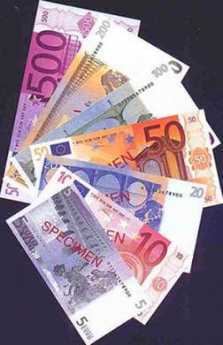
|
| Euro |
Recently, however, long-term interest rates have failed to rise in response to rising deficits, and speculation abounds as to why that should be so. It creates uneasiness to hear that the finances of the world are simply a "conundrum". And finally, foreigners will flee from an inflated currency, eventually triggering a devaluation. A few years ago, Argentina refused to devalue, but the result was a devastating recession when their foreign trading partners refused to deal with an unrealistic currency.
A government which refuses to respond to these "signals" from the bond market and foreigners, will be forced to take some undesirable actions. In Europe, it is to oppose globalization of the economy, thereby hurting everybody but especially poor nations. And the internal European unemployment is shifted as much as possible onto the backs of immigrants, even migrants from within the European community. Take that far enough, and you get serious threats to world peace. Even within the European community, many of the policies which protect the welfare state will consciously injure their own economic growth. Reform is resisted.
Many needed reforms are obvious to policymakers in Europe, and the American example would often seem to be convincing. But it isn't, because Europeans terrified of losing their welfare state recognize that the American model includes a large amount of contempt for socialism, no matter how otherwise successful it is. The interesting thing has been that the Scandinavian countries have an equally extensive welfare safety net, but have nevertheless prospered by adopting free-market reforms. There are signs that this experience is beginning to convince Europeans it is possible to work their way out of the dilemmas.
After his talk, which avoided mention of many of these concerns in the mind of his audience, Governor Noyer was even more charming in cocktail-party mode, but one thing made his face turn beet red. When asked what the John Jay letter was all about, he had to admit he hadn't the foggiest. It was just something hanging on his wall that seemed appropriate for a trip to Philadelphia.
The Economic Power of Laws
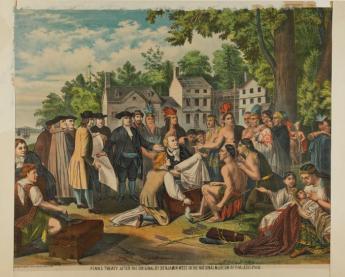
|
| William Penn Treaty |
Philadelphia is tucked down in the Southeast corner of Pennsylvania, right next to Delaware and New Jersey. All three states once belonged to William Penn and started out Quaker dominated. In time, they settled down to a life of independent states, and with the growth of population plus speed of transportation, they are all getting smudged together again. The Quaker influence is there if you look for it, and rather fierce, even hostile, political competition between the states is there, too. But if you were a foreign visitor who doesn't look at maps, you could drive around the metropolitan area without knowing which state you were in. To a large extent, the Rand-McNally lines are a hindrance to commerce and convenience, but they have their value. The quirks of political jurisdiction give the Philadelphia metropolitan area six U.S. senators, and the opportunity to take shrewd advantage of the three legal systems. You can buy things without a sales tax in Delaware, and estate tax lawyers tell me that if you must die, die in Delaware. At one time, New Jersey was a great place to get an uncontested divorce, Pennsylvania a better place to start an unincorporated business. More recently, the New Jersey doctors are complaining that malpractice rates are unbearable, but they are not as bad as they are in Pennsylvania, and it is rapidly becoming true that if you are going to be born, you will need to be born in New Jersey because the obstetricians have all moved there. That's also true in the District of Columbia; obstetrics has just about entirely fled to Virginia. Better watch out where you have your auto accidents, too. Neurosurgeons and orthopedists have also responded to the local disincentives to live near certain types of juries.
Long ago, James Madison designed things this way on purpose. The main author of our constitution hated taxes and oppressive government as much as any other founding father and argued it was a good thing to let neighboring states have differing laws. Corporations which do interstate business hate the complexity of course, but as Madison argued, people do shift their business, their businesses, and even their residence if the neighboring states become too extreme in their differences. It's still worth a thirty-minute drive to buy silverware and China in Delaware, and if you are driving to the New Jersey shore, you ought to fill up your gas tank on the Jersey side of the bridge. At one time, there was a thriving resort town in the Jersey woods, mostly entertaining people who needed a spell of New Jersey residence to be eligible for New Jersey divorces.
These things respond to local circumstances fairly rapidly. I once met a man from the Delaware Chamber of Commerce who boasted that the Chamber could get a Delaware law changed over a weekend if it had some particular commercial advantage. Governor du Pont saw the bigger advantages of this flexibility and got some laws enacted which drew most of the big credit card companies to Delaware, and at least a branch of all the big national banks. Delaware is starting to emulate Lichtenstein , and fairly successfully.
The effect on Philadelphia banking has been disastrous. Once the banking center of the whole continent, Philadelphia now does not have the headquarters of a single major bank. True, banking is becoming an obsolete industry whose products no one really wants, but the particularly severe effect in Philadelphia comes from the fact that if you were going to have a big bank in the metropolitan area, you would have it in Delaware.
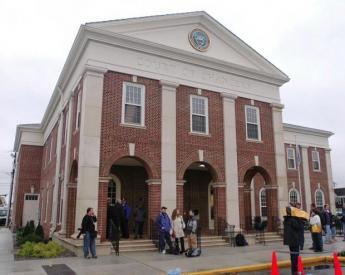
|
| Delaware Courts |
The location of so many corporate headquarters in the little state attracts lots of outside lawyers, of course, and it puts a heavy burden on Delaware Court of Chancery, the court for corporate disputes. The judges are appointed by the governor, and it doesn't take all that much outside money to lean on the governor, so the nation's giant corporations are at the mercy of a very small group of local politicians. The politicians, on the other hand, operate freely in an environment where comparatively few of their constituents have any interest in the goings-on of major corporations from far away.
It's an interesting thing that the legislatures of all three formerly Quaker states are torn with sectional disputes. In Pennsylvania and Delaware, it's the cities against the farmers. In New Jersey, it's the North versus the South. All states are having a hard time balancing their budgets in a recession, but somehow New Jersey has worse deficits than the others, and therefore more quarrels about taxes. The northern politicians dominate the legislature, and the south feels it is often the victim of state laws designed to help the North in its constant war with New York City. Ever since 9/11, the financial district of New York has been sending its subsidiary employees to safer cheaper regions. That might have meant going to New Jersey, but the tax flounderings there have led to many of those relocations going on a few miles to upstate Pennsylvania. You don't ordinarily think of Scranton as a financial center, but take another look. Madison, no doubt, would smile at the tendency, but wrinkle his brow at all the unintended consequences. At least, everyone in the region speaks English more or less, otherwise, the European Common Market could learn a lot from studying our local scene. About fifteen years ago, there was actually an unsuccessful provision on the ballot for South Jersey to secede.
Will Tax Cuts Invert the Yield Curve?
For those who just came in, let's explain a normal yield curve, and then an inverted one. In plain English, average interest on short-term bonds is normally smaller than average interest on long-term bonds, so a line drawn between them slopes upwardly. This reflects the reality that the risk of something going wrong is less in a short time than during a long one, so an up-trending yield curve is what emerges when everyone leaves interest rates alone. However the Federal Reserve has for a century adjusted short-term rates according to its view of whether banks should do more or less lending, whether inflation should be encouraged or discouraged, or whether the banking industry needs more or less profitability; sometimes these goals conflict, and sometimes the Fed is merely trying to maintain a stable spread when long term interest rates shift in response to market forces. In average circumstances the marketplace alone controls long term borrowing costs by supply and demand; long term rates are whatever they happen to be. However, Chairman Bernanke has introduced what he calls "Quantitative easing", which is to intervene directly in long term pricing by purchasing and selling long-term bonds. Therefore, the slope of the yield curve can reflect many motives; it's hard to deduce motive from changes in the slope of the yield curve alone. Indeed, suppose it doesn't have much to do with economic forecasting at all. Suppose it just reflects tax cuts.
After all, when federal taxes are reduced, rates can eventually approach the point where bond interest is essentially tax-exempt. Paying more interest, long-term rates are thus normally affected more than short ones by the change. However, a preponderance of U.S. Treasury bonds is now purchased by foreigners who are indifferent to our tax rates. It's clear, however, that cutting taxes will lower bond market interest rates in the general direction of tax-exempts. Although tax reduction is capable of inverting the yield curve, it may no longer do so, and the Federal Reserve may be relieved of lowering short term rates to maintain balance.
If there is anything to this idea, the yield curve might have inverted without a tax cut. That's because a majority of U. S. Government bonds are lately being purchased by Asian governments. The Chinese government doesn't pay U.S. taxes, so to them, all American bonds are tax-exempt. Federal bonds are a little safer than municipal government bonds, so they should command a little lower interest rate, and may eventually depress the yield curve still further.
By this line of reasoning, an inverted yield curve is no longer a reliable portent of trouble, because it no longer primarily reflects American owners of the bonds dumping them. It has some important consequences, however. If interest rates are lower, retired people, insurance companies and pension annuities will be financially worse off. Borrowers, however, will be better off, and within limits, the economy will be favorably stimulated. One can be uneasy about the overall effect on the real estate and insurance markets, and on the temptation to governments to borrow more than they can repay. As different segments of the population are affected differently, the main outcome might well be a political one.
There are, from this example, lots of mixed consequences to be expected from a general readjustment (?reform?) of tax rates. But it shouldn't be a mystery that tax consequences affect yields, yield curves, and politics. That effect may not even be a conundrum.
Do-It-Yourself Globalization
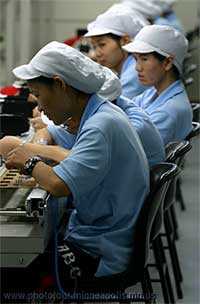
|
| Chinese Factory Workers |
Computers, whether small or mighty, could be described as modified telephone switches. In any event, almost every computer is attached to the telephone system with wires. It once required an electrician to splice the ends of copper wires together in a way that would hold, but now the ends are held together by a little plastic clip that slips into the fitting, and then is held in place by a small plastic dongle. Unfortunately, these dongles break off easily and you get a wire that keeps falling out of its attachment. The plastic dongle surely costs less than a tenth of a cent, but a multi-gigabyte Internet system is useless without it. Solution: go buy a whole new telephone wire, with new clips at both ends.
The other evening that approaches offended my sense of frugality, self-reliance and home repair ethos sufficiently that I went to an electronics store to buy a bag of clips and a special tool to apply them. After considerable discussion with several employees, all of them quite sympathetic to my repair- don't- replace motive, the equipment was located. I was half-way to the check-out counter when the arithmetic began to emerge. It would cost exactly three times as much to repair as to replace the whole wire with a new one having a clip already fastened to both ends. So, naturally, I bought the new wire instead, and will not have the repair tool and bag of spare clips to clutter up my drawer. To get lost before I need them again, or else forget I have them and buy a second set. It all makes sense, it's modern and increases productivity, but the clerks and I had a moment of bonding. Our way of life has taken another step out the door. We are just a little further from the self-reliance of the frontier, and a little closer to dependence on those starving wretches in China who make dongles.
On the way home with my new wire, I saw something I hadn't noticed as I went out shopping. Two hardware stores going out of business. Everything must go, the signs said.
Marty Feldstein Forecasts the Future
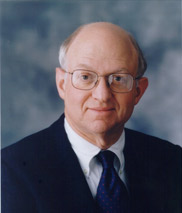
|
| Martin Feldstein |
With increasing frequency, the op-ed pages of the Wall Street Journal are opened to important people or important ideas. On April 28, 2006,Professor Martin Feldstein of Harvard wrote an article which purports to show how it is possible to have the American currency fixed for Americans but float for foreigners. After reading it twice, I conclude he is saying something rather different, and softening some startling announcements with circumlocution. It is my view that he says the following:
Inflation is not a worry; targeting 2% inflation with adjustments in short-term interest rates will take care of it.
International trade deficits need not be a worry, either, if only the Treasury Department (Could he mean nice old John Snow?) would allow the dollar to float on the international market. Not pure floating, of course, because it is a dirty world out there. The necessary dirty floating might hurt at first, especially American global businesses, but the sooner the boil is lanced, the better we will be. American exports of capital goods, consumer goods, and industrial supplies will especially benefit. Those who worry that trade deficits will weaken the dollar have got it backward a weaker dollar will correct the trade deficit. Yes, some people will be hurt by this.
In particular, high-wage countries like Europe, Canada, and Japan will be hurt, possibly severely hurt.
You will be able to tell that this plan has been set in motion when you see an international conference called among low-wage countries. The main purpose will be to reassure them that the U.S. Treasury won't punish them for strengthening their currency.
You will be able to tell this proposal has been rejected, probably for political reasons, if nothing soon happens to soften housing prices. And the word soon is emphasized. Because if they don't soften, they will break.
BEA Monitors the Economy

|
| Global Interdependence Center |
The Global Interdependence Center meets at the Philadelphia Federal Reserve, organizing frequent seminars of outstanding quality about finance. This week, the speaker was Andrew Hodge, head of Profits Research, U.S. Department of Commerce, Bureau of Economic Analysis. Someone there once had the brilliant idea that aggregate national income was almost identical to Gross Domestic Product, so national income could be easily derived from tax information at the I.R.S. Originally probably seen as a way of verifying GDP statistics derived in other ways, aggregated income and profits look in some ways to be superior to the data coming from Wall Street earnings reports. As a leading indicator, it appears to be outstandingly effective in predicting an impending upswing in the business cycle, just about at the time everyone is getting discouraged about downswings. It's not so good at predicting market peaks.
Seems to be superior to Wall Street earnings reports in four ways. 1) Wall Street is not particularly useful in distinguishing domestic from foreign activity within multinational firms. 2) Wall Street reports generally attempt to avoid seasonality noise by comparing this month with this-month-last- year. If the market direction has changed during the past year, downswings may cancel upswings and such comparisons can be misleading. 3) at market inflection points, volatility gets exaggerated by firms going out of business at the bottom or businesses formed or expanded at the top. 4) Wall Street is only 40% of the economy. The other 60% has private ownership, particularly in S-corporations.
Out of studying the differences between the two types of statistics about the economy, it emerges that the tax-derived BEA statistics are quite good leading indicators, particularly when the economy is in a trough. They are sort of leading indicators of coming market peaks as well, but they lead by longer intervals. A lead of as long as a year isn't very useful as an indicator.
As the jargon goes, that's the take-home message. BEA data is pretty good at predicting market bottoms. But some interesting sidelights appear, as well.
Our economy is becoming less volatile, with milder cycles and less frequent ones. But national income is just as volatile as ever, particularly in stock prices. This would appear to be due to the steadily increasing proportion which is in the financial sector (or decreasing proportion in the manufacturing sector). The financial sector is characterized, worldwide and for a long time in the past, as having "sticky" wages and costs. With the cost side comparatively inert, profits become much more volatile. In the final analysis, the stock market becomes more volatile than the underlying economy.
A final conclusion is my own. If the best personal investment vehicle is a broad index fund representing the whole economy, then you had better be watching national statistics like the BEA, rather than sector statistics. At the moment, the problem is deciphering what's available on BEA.gov in tabular rather than graphics format.
The Coming Baby Boomer Retirement Problem
|
In a few years, the baby boomers will retire and two things will happen. They will have to retire later in life, and the country will have to borrow money to pay for the rest.
|
In 2004, the Nobel Prize in economics was shared by Edward C. Prescott and Finn E. Kydland, for advancing the concept that business cycles are caused as much by what people expect to happen as by what actually does happen. By this reasoning, myriads of individual decisions are constantly made in the direction suggested by simple undeniable truths. What truths face us? Demographic facts related to how many people have already been born, and how fast they are dying, force everyone to acknowledge that both Social Security and Medicare are seriously underfunded. Consequently, it seems inescapable that the boomers must work longer and retire later. To whatever degree they don't, the country must go deeper into debt.
Prescott, writing in the December, 2006 Wall Street Journal, stated this truism slightly differently to reach the next step: the national debt must increase. Increasing the national debt raises interest rates, which is good for savers. At the moment, the main savers are American retirees and foreign governments. However, the bond market is and always has been a zero-sum game. What's good for American retirees is bad for American business. And mortgage-holders. And everyone else who is in debt. Higher interest rates, which are seemingly inevitable, encourage saving and discourage borrowing. Prescott seemingly welcomes those features, because he is remarkably cheerful about the inevitable coming demographic crunch.
There are at least two things about it which should be bothersome. The first is that the boomers will not be borrowing money from their own generation but from their children. Getting the chance to live longer than their parents, they seemingly want to retire at the same age or earlier, asking their children to pay for the unearned twenty-year vacation. Boomers simply must be shamed into later retirements. The American Gross Domestic Product has a long term growth rate of about 3% per year; 2% of that total comes from increased productivity, about 1% from population growth. Extending domestic working years has the same economic effect as, say, illegal immigration; it's good for the whole country to make this nativist substitution.
The other disturbing consequence of borrowing our way out of debt is the effect on banks. That's harder to explain, but the interest rates we have been describing are long-term rates, established by the world marketplace. Short-term rates are independently set by the Federal Reserve to control (or "target") inflation, and currently they are higher than market-set long term rates. Any sensible saver will therefore use moneymarket funds rather than buy bonds. That's mostly bad for banks because their profit largely derives from "borrowing short and lending long". The so-called inverted yield curve, then, is good for old folks and bad for banks. If the Treasury fails to issue enough long term bond debt, or the Federal Reserve fails to issue enough short-term debt, banks are in danger of going broke. To summarize the whole puzzle, the government clearly will become more deeply indebted, but it must preserve a proper balance between short-term and long-term borrowing. Otherwise, either a bank crisis or inflation will sink us.
As a guess, I would say that banks are the likeliest to fail. They are in precarious condition anyway because of wrenching changes in technology. And they are in the process of discrediting themselves by failing to pass along the currently soaring short-term rate bonanza to the public. Just compare your own money-market interest rate with the 5.25% which the Federal Reserve has dumped on the banking system, and see if your blood doesn't boil a little. If this pick-pocketing continues much longer, banks will be in a bad public relations position when they must come to the public with hat in hand.
So, there's only one defensible response to this demographic retirement problem. The baby boomers, having been handed several years of unexpected longevity, must spend a portion of it working longer.
Central Bankers Refine the Art of Diplomacy
Nancy Wentzler, Deputy Controller of the U.S. Currency, recently dramatized the arcane world of international currency exchange for the Global Interdependence Center's 25th annual Monetary and Trade Conference, held this year at Drexel University. For the most part, controlling currency operates flawlessly as far as the rest of us can tell. But every few years a sudden banking crisis pops up somewhere, pressuring a lot of bureaucrats in many countries to act quickly without a fire drill. Displaying panic could spread into world financial collapse, but so could acting too slowly. There's often a need for that most conflicting of all predicaments, the clear need to act outside of established channels. Hedge funds and private equity funds greatly increase the pace of banking panics, and if panic-stricken, can now send multi-billions from one place to another in fractions of a moment. In that same moment, everybody involved is in a meeting, or else frantically calling somebody. Even if the right person is identified, located, and takes the call, there is natural hesitation to take risky advice from a stranger without an identifiable track record. Protocol-driven supervisory bureaucracies may be suddenly forced to contend with professional traders whose whole life consists of calls roughly like this: "Hi, Joe, this is Bill. Buy me a gazillion shares of XYC at the market." To which Joe's answer commonly would be, "You got it. Thanks for the order, Bill. 'Bye. "
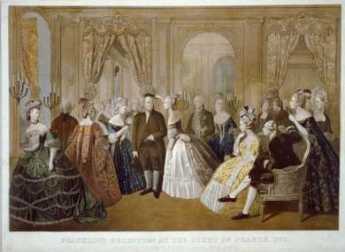
|
|
Benjamin Franklin at the French Court |
The potential for sudden fires calls out for fire drills. It also calls for the prior establishment of social networking among those who may have to depend on each other in a crunch. Whether by repeatedly dealing with each other or by social gatherings, or even just by immersing in trade gossip, it must somehow become possible for them to make a quick assessment of the person on the other end of the phone. Is the sound or flighty, can he be depended on to keep his word, or will he take for the hills.
Well, it sounds like a diplomatic corps, doesn't it? For the briefest of moments, one person represents the views of his country. The rest of his life is spent preparing for that moment. The most familiar American example is Benjamin Franklin, for eight years our ambassador to France. Franklin received heavy criticism for spending American money on social functions in Paris. John Adams, in particular, was outraged to see Franklin engaged in a constant series of dinners, balls, Royal parties, and salons; he was obviously having the time of his life, year after year. After all, he really only accomplished two tangible things -- he signed the Alliance with France which effectively won the war, and he signed the Treaty of Paris where Britain agreed to stop fighting.
No Laborer Left Behind
 |
| Ivy League |
The top thirty American colleges have ten times the applicants they have room for. Demand vastly exceeds supply, prices are essentially fixed; shortages result. Can-do is the American way, so our first reaction is to build a lot more colleges and beat them over the head if they aren't first-rate. To bring this down to a local scale, implications are that Philadelphia has a moral duty to build eighteen more Ivy-League universities.
 |
| Cosa Ricians Roofers |
Let's think about that, in a back-of-the envelope way. Since the rest of the country is going to be similarly driven, we can't attract Americans to run those universities. Philadelphians who are doing other things must staff those universities; people inclined to become professionals of a different sort are going to have to be trained to be university professors. Students now being rejected will be admitted, since that's the purpose of the thing. Unless we somehow increase academic productivity, every man, woman and child from Trenton to Wilmington is going to be in a college classroom in some capacity or other. We here confront the extrapolation fallacy; a new problem must be addressed in more productive ways than just more of the same.
Curiously, the readjustments to this overall shift from an industrial to a service economy are first making their appearance in things like roof repairs and ironing shirts. When my house needed a new roof, I found I had a choice of workgangs composed of Costa Rican, Puerto Rican, or Polish roofers. The Costa Ricans made the best bid and went to work immediately. They started pounding on my roof at 6 AM, and we're still pounding after I went to bed at night; I have grave doubts that American roofers would approach that work standard. I am told that the entire building industry, on which our current prosperity rests, would collapse if we banned illegal immigration. In a different industry, Philadelphia's convention hall cannot attract visitors unless we build more hotels. But the hotel industry cannot find nearly enough people who speak English to make the beds. For one purpose or another, we have imported 12 million illegal immigrants who mostly remain invisible because they are so hard at work.
We are going too recklessly fast with what is fundamentally a useful transformation of our society. Americans want to go to college because statistics show that will make them prosper. But that's only half of their transformation. The other half is a resulting shortage of labor in the jobs which do not require college. Normally, you would expect wages to rise, but they are suppressed -- deflated -- by substituting immigrant labor, legal and illegal. Impose an effective barrier to immigrants, and you would quickly see inflation like you wouldn't believe. Combat inflation by raising interest rates and the housing market would quickly collapse. That would prove to be a painful way to make the immigrants decide to go back home, although it would be effective. And so on, and so on, and so on.
Slow down, America. You're going in the right direction, but exceeding the speed limit.
Immigration
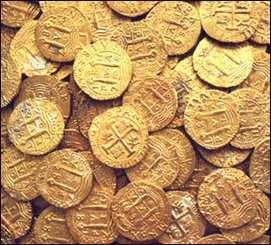
|
| Gold |
We're alluding indirectly to immigration as a general topic in this article because sooner or later every discussion of every aspect of immigration adds a claim of "fairness" to the balance. In this case, plain talk about fleecing peasants first requires the definition of an unfamiliar term. Seigniorage, also spelled seignorage, or seigneurage, originally only denoted a fee which governments charged for milling coins out of precious metal. Developing nations often didn't have the necessary technology, so they paid some other country to do it for them. That was fair enough, but soon "trimmers" would shave the side or surface of coins and gather up the dust for sale. That practice led to clever serration of the formerly flat edges, much simpler than weighing coins to detect cheats.
In time, improved printing techniques allowed governments to keep precious metal in vaults and issue paper currency, some of which inevitably got burned, shredded or lost. Since the issuing government could then keep the whole value of lost currency minus printing costs for itself, the term seigniorage evolved to include this more lucrative method for governments to cheat citizens, abusing their monopoly on the currency issue. There might seem to be some temptation for governments to print money on fragile paper, except it is overbalanced by the need to make it hard to counterfeit. Happily, this sort of seigniorage always seemed less offensive because everybody agrees that if you have money in your pocket, shame on you if you lose it. As transactions become more sophisticated, however, some innovative modern arrangements which loosely fit the definition of seigniorage become a new source of moral dismay. One facet of currency razzle dazzle concerns immigration, which is itself always a contentious matter.
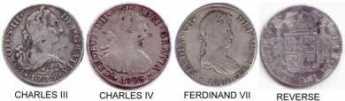
|
| Spanish |
Right now, it is authoritatively estimated that the Social Security program has collected half a trillion dollars in Social Security and Medicare taxes, whose rightful owner is impossible to determine. Some of the beneficiaries may have died without claiming the money, so some of this topic might be classified as escheat, or abandoned by the owner. But very likely the bulk of this money, under modern circumstances, was withheld from illegal immigrants by their employers, either without their knowledge or using counterfeit social security numbers; and the fugitive status of the owners made them reluctant to claim it. Half a trillion is five hundred billion dollars.
This sort of discovery leads to some troublesome thoughts. If the immigrants are legal, or if now illegal may receive amnesty, they will be fully eligible for social security benefits. You might say they earned such benefits, but our tormented public pension system is in fact almost entirely funded by one generation funding its parents' generation. That borrowing between generations means paying for it later, so of course, it enjoys the politician spin-term of "pay as you go". An American of multi-generational descent has paid for his parents while he works and expects to have his own pension paid for by his children. An immigrant, never mind his citizenship, is paying the same taxes, but has no parents as beneficiaries. When the newcomer retires he may be a burden to his children like the rest of us, but his current payments go into the black hole of government deficits without paying for any parents. Here we have seigniorage on a much grander scale. The money presently diverted from the usual channels by this ingenious arrangement is calculated to be two trillion dollars, or four times as much as the paper money seigniorage, and many many times as much as the shaved-coins scam. Just for comparison, consider that America is estimated to have 900 billionaires. Their aggregate net worth is probably only slightly greater than the amount our government garners from illegal immigrants.
The matter really does seem to be important enough for us to learn how to spell seigniorage, and even reconsider whether to apply the term to its most popular current manifestation.
Africa Comes to the Schuylkill
A journalist, John Ghazvinian, recently toured the many countries of Africa, wrote a book about it and carried his message to the Right Angle Club of Philadelphia. Philadelphia does not think of itself as particularly involved in oil matters, or African ones. But the fact is the refineries on the Schuylkill down by the airport generate two-thirds of the gasoline now used on the East Coast, and right now it mostly comes from Nigeria. There was a time when the crude oil coming to Philadelphia came from Venezuela, but politics are a little unpleasant there at present, and anyway Venezuelan oil is heavy and full of acids. The refineries which specialize in that kind of heavy oil are on the Gulf Coast. Long before the Venezuelan era, the Philadelphia refineries were constructed to refine crude oil from upstate Pennsylvania. They were once the main source of the dominance of the Pennsylvania Railroad, because oil refining from Bradford County gave the Pennsy a return freight, whereas the competitive railroads running out of New York and Baltimore had to return from the West without cargo.

|
| African Map |
There are 54 countries on the continent of Africa, quite different from each other in character. One dominant characteristic of Africa is its lack of natural ports, and even the Mediterranean ports are cut off from the rest of the continent by the huge transcontinental stripe of Sahara desert. Major wars and famines, monstrous genocides, unspeakable cruelty, and poverty go on there without much notice by the rest of the world.
The largest country in Africa is Nigeria. Anyone with even minor dealings with Nigeria soon sees that corruption and dishonesty pass all Western imagination, and they have serious tribal warfare as well. The discovery of large deposits of oil in the region faced the international oil companies with a rather serious difficulty. For instance, Shell Oil has had over 200 employees kidnapped for ransom and is seriously contemplating abandoning its whole venture. At the moment, corruption is coped with by constructing oil wells a hundred miles out in the ocean.It's almost true that the huge tanker ships make from Philadelphia and return, without the crew talking to any natives of Africa.
We hear that genocide is in full bloom in the Sudan, and that poverty in that country similarly passes belief.

|
| Chad Poverty |
They have oil in the South of Sudan so we may hear more of it. Chad has poverty and oil, and civil war. They have a big Exxon facility, but there isn't a single gasoline station in Chad. At the moment, Angola has paused in its enormous civil war, which killed millions, and Chevron will surely encounter unrest before it is done. Gabon appears to be extremely prosperous, from oil money of course, but they are being ravaged by the Dutch Disease, of which more later.
Apparently, Equatorial New Guinea sets some sort of record for wild behavior. It has lots of oil, and a strong Chinese influence. The current
|
| Mbasogo and Jintao |
President of Equatorial New Guinea got his job by shooting his uncle. But don't feel too sorry for the uncle, who used to have an annual Christmas morning celebration, consisting of herding his enemies into a football stadium, and shooting them for the edification and entertainment of the populace. After listening to Mr. Ghazvinian, it seems small wonder that so few American tourists, or journalists, or even missionaries, manage to complete extensive African excursions. As everyone notices, if you don't have journalists, there is never any news.
Let's turn to the Dutch disease,
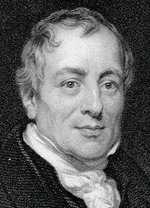
|
| David Ricardo |
of which Africa currently displays many examples likely to torment economics students for decades after Africa eventually rivals Houston. Let's start with David Ricardo, who electified the Nineteenth Century world of economics with his principle of comparative advantage. Ricardo pointed to the obvious truth that always and everywhere a nation does best for itself by identifying its best economic feature and then sticking to it. If every country wakes up and does that, every country must then trade with its neighbors for other things it isn't so suited to make. Consequently, tariffs and trade barriers are a hindrance for everyone, in time impoverishing all nations in the cycle, whatever short-run advantages of tariffs may seem enticing.
|
| North Sea Gas |
So far as I know, Ricardo was quite right, but someone had better hurry up and reconcile his underlying premise of comparative advantage with the Dutch Disease. The Dutch disease was identified and named by an anonymous writer for the London Economist about thirty years ago. Noticing that the Netherlands experienced a marked worsening of its general economy after the discovery of North Sea gas deposits, the observer for the magazine concluded that sudden accumulation of wealth in the gas industry led to a rise in the value of the Dutch currency, soon making it impossible for non-gas industries to export, unable to compete at home with now-cheaper foreign imports. Naturally, investors rushed to invest in gas, sold their holdings in other industries, and Holland was propelled in the direction of a one-industry economy, quite at the mercy of fluctuating prices of gas. This was the Dutch Disease born, and Ricardo's principle of comparative advantage exposed to quite a severe challenge from which it has not completely recovered. This is important, so how about a simpler description: When gold is discovered, people drop tools to have a gold rush. Wealth lost from dropping tools is greater than wealth gained from the gold.
Fear of the Dutch disorder seems to be the reason why the Chinese are buying our Treasury Bonds, the Japanese engaging in the astonishing "carry trade," and the Arabs buying American private equity funds. The common strand through all these schemes is this: By sending their bonanza savings abroad, they "sterilize" them from their tendency to force their currency upwards. They are exporting inflation, but also endangering their own struggling non-bonanza industries, which are the main hope for diversifying their economies and getting rid of the Dutch effect. Somewhere during this balancing act, politicians get involved and make things worse. So they call in their generals and admirals, to explore solutions we prefer they were not in a position to explore. Simpler description: When you discover oil, inflation soon follows. And all too often, revolution follows that.
The 1787 the American Constitution unknowingly cured thirteen cases of the Dutch Disease, by imposing absolute freedom of interstate commerce. After eighty years, the benefits of this national union would persuade the North to bleed and die for it. Although the Confederacy thought they were fighting for their way of life, meaning slavery, even the Southerners today recognize they are better off in a Union. Unfortunately today, the European nations are still having a hard time believing the benefits of union could possibly outweigh their allegiances to language, religion, and the wartime sacrifices of their ancestors. They are very wrong, but we are wrong to sneer at them. Except for maybe Switzerland, it is difficult to name another instance in all of history where several independent states gave up local sovereignty for the benefits of a diversified economy with local pockets of comparative advantage. Let's restate it again: the Dutch disease is a result of sudden single-industry prosperity in a country too small to control it.
By the way, what eventually happened to the Dutch? It seems likely that absorption of little Holland into the European Common Market helped dilute the corrupting effect of gas prosperity. It suggests the possibility that Dutch can be reconciled with Ricardo through the common denominator of reduced national barriers to trade and currency-- reduced sovereignty in a milder form. But it's a hard slog. Maybe we could envision annexing Alberta to soften the commotion of oil tar, but it takes a lot of imagination to see the amalgamation of China and India, any time soon. There may thus be nations too big to merge, but nevertheless, it would probably be less destabilizing to merge with all of Canada than just with Alberta if you overlook the obvious fact that it is easier to persuade a small country than a big one. Just kidding for the sake of example, of course, since Canada shows no interest in the idea.
Meanwhile, take a look backward from the highway overpass the next time you travel to the Philadelphia Airport. There's a lot more going on in those refineries than just black liquid flowing into steel pipes.
Hayek Confronts Keynes
|
| The Four Horseman |
Catastrophes seem to have fashions. There was a time when the four horsemen of the apocholypse -- pestilence, war, famine, and death -- rounded up the main things to keep you awake with worry. Perhaps it is too soon to gloat, but pestilence and famine seem tamed, even ready to be "put down". War remains a serious cause for concern, but a case can be made that two economic disasters, inflation, and recession, have moved up to dominate our nightmares. Indeed, it is the Summer of Love in 1967 which seems to mark the watershed moment, when basic survival stopped being the main risk in life, supplanted by threats to existence that are largely self-inflicted. The first warning of this sea-change appeared in the fall of 1929 when it seemed to be deflation, unemployment and all the other havoc of economic recession that caused wars, famines, and pestilences. The 1929 crash did not send a fully readable message, however, because it was so one-sided. It took another 37 years for the world generally to appreciate there was an opposite side to it; inflation was just as bad as recession, and both problems were largely man-made. One person gets most of the blame for the distorted emphasis. John Maynard Keynes, later Lord Keynes, was the prophet who seemed to save the world with the doctrine that the deflation emergency was so dire that civilization could not afford to worry about the long-term drawbacks of deliberate inflation. He persuaded world leaders to inflate the currency before civilization disappeared. After all, in the long run, we are all dead.
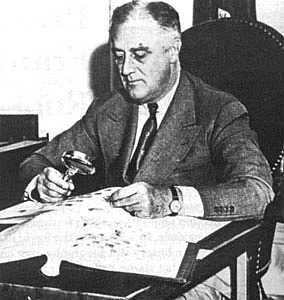
|
| Roosevelt Stamps |
There's an irony that Franklin Roosevelt was a hobbyist who collected postage stamps because stamp collectors were about the only Americans who were dimly aware that Germany and Austria had hyper-inflation as the main curse. Austrian postage for billions of marks gradually filtered into our collections of odd foreign stamps, arousing mild international curiosity. But Friedrich August von Hayek was living in the midst of it, painfully aware of its pain and chaos. It became the central focus of the life of an aristocratic decorated war veteran who became a distinguished economist, eventually winning a Nobel Prize. What caused inflation? Why didn't it stop? Why was it so destructive? How can inflation be prevented? How could Maynard Keynes possibly urge the leaders of nations to inflate their currency deliberately?
As a scholar in the dismal days of world depression, Hayek had a hard time, living for long periods on the charity of a few philanthropists who recognized his talents. He is best known for his scorching analysis of collectivism, a craze which swept through academic and political leadership, particularly in Europe, and his persuasive views probably constitute the main intellectual force which ultimately ended the Cold War. It is seriously stated that personal animosity by Socialist-leaning academics materially injured his academic career, although it probably gave him more time, and motive, for serious writing. Inflation and political collectivism do not seem tightly connected, but it is easy to observe that command economies do inevitably clash with private property and market decisions. For the present, it seems useful to set aside Hayek's monumental political achievement of discrediting Communism and focus on his penetrating view of inflation.
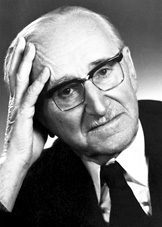
|
| August von Hayek |
You can almost watch his mind at work. If you give long hard consideration to the topic of inflation, you have to conclude that there seems no reason for it to be a bad thing. It may take a little time, but the price of everything will eventually readjust to a new higher level, and relationships will go on undisturbed. At first glance,
You can almost watch his mind at work. If you give long hard consideration to the topic of inflation, you have to conclude that there seems no reason for it to be a bad thing. It may take a little time, but the price of everything will eventually readjust to a new higher level, and relationships will go on undisturbed. At first glance,
inflation is just a harmless numbers game. You can understand the power of inflation; everybody likes a little of it for his own personal benefit. If everybody enjoys a little of it in his own sphere, then the whole world is pushed to a higher numerical level.
After long consideration, Hayek came to see that the disruptions of inflation are caused by the uneven speed of penetration throughout an economy or nation. If the price of oil goes up, the price of transportation goes up, then the price of home heating. But those who take the train or who heat their homes with coal are not affected so soon. Mortgages carry a fixed interest rate for thirty years until the unwisdom of such agreements becomes clear, but it takes time. The process of inflation creates winners and losers, and disruption in the culture of payments. The speed of payment is itself a factor in the virtual size of the monetary pool. In the long run, we're all dead and it all settles out unless we set in motion a universal scramble to get out the door before others get there. Inflation is just as much evil as collectivism, and somehow the two are usually seen together. The Road to Serfdom sits on the shelf, right next to The Austrian Theory of the Trade Cycle, and Other Essays .
Gloomy Future for Banks
|
Banks pay depositors modest interest rates, lending to borrowers at higher ones. This is known as lending long and borrowing short.
|
One of the many Joseph Nicholson's in Philadelphia once surprised me by criticizing Paul A. Volcker as merely a tool of the banks. That distinguished Chairman of the Federal Reserve had always been, and still is, one of my heroes for rescuing the nation from inflation. Instead of wringing his hands at inflation, Volcker had the courage to jolt short-term interest rates right up to 8%. It must have caused a lot of pain to some people, but in retrospect, it was exactly the right thing for him to do. How could anyone complain about his helping the banks when he was helping the world economy for everybody?
The answer is that the old Quaker felt 8% was too little, Volcker should have gone higher. In fact, banks always have comparatively little at stake in whether interest rates are high or low. Their profit lies in maintaining a steep yield curve. Which is to say, as long as short-term rates are safely lower than long-term rates, the banks make a profit. It may be hard to recollect, but typical interest rates facing Volcker were then about 18% for long-term loans. Joe Nicholson had a point when he complained that a 10% profit seemed too generous, but for Volcker to raise short term rates to say 15% would have been seen as the act of a madman. In fact, 8% did turn out to be adequate for curing inflation, so this episode had a happy ending for both inflation and bank profits. Borrowers commonly feel that banks are greedy, but remember they must accumulate reserves. If the yield curve becomes "inverted" for a protracted time (that is if ninety-day rates are higher than ten-year rates) refusing to make loans is the only alternative to spending reserves. If that fails there can be bankruptcy, usually triggered by runs on the bank by depositors in a panic.
Long term rates are set by the bond market, short term rates are set by the Fed. This limits the traditional ability of the Federal Reserve to sustain the viability of banks to one simple tool, keeping short term rates below whatever rates the bond market sets for long loans. In recent years, however, banks have a new competitor for deposits in the form of money market funds. The new formula for what banks want in their Christmas stocking is for the Federal Reserve to set short-term rates well below the market-set rate for long-term rates; but mind you, only slightly below the market-set rates for money market funds. Caught between these two implacable limits, the Federal Reserve has a small room for safe maneuver. It is disquieting to hear that fluctuations of market-set interest rates are very difficult if not impossible to understand. Alan Greenspan called them a "conundrum".
And so, when you see pictures of the Federal Reserve Chairman riding off in a long limousine, he may look fully equal to the responsibility of keeping the world from financial collapse. Someone on the sidewalk once muttered that a man with a beard always looks like he's hiding.
Five Macroeconomic Myths
|
It's a myth that Government debt is a burden on our grandchildren
|
| Wall Street Journal |
Myth No. 5: Government debt is a burden on our grandchildren. There's no better way to get people worked up about something than to call on their sympathies for their beloved grandkids. The last thing that I want to do is to burden my own grandchildren with the sins of profligacy. But we should stop feeling guilty -- at least about government debt -- because we are in better shape than conventional wisdom suggests.
Theory and practice tell us that the optimal amount of public debt that maximizes the welfare of new generations of entrants into the workforce is two times gross national income, or GDP. This assumes 1% population growth, 2% productivity growth, 4% real after-tax return on investments, and that people work to age 63 and live to age 85. Currently, privately held public debt is about 0.3 times GDP, and if we include our Social Security obligations, it is 1.6 times GDP. In either case, we could argue that we have too little debt.
What's going on here? There are not enough productive assets -- tangible and intangible assets alike -- to meet the investment needs of our forthcoming retirees. The problem is that the rate of return on investment -- creating more productive assets -- decreases as the stock of these assets increases. An excessive stock of these productive assets leads to inefficiencies.
|
| W.P. Carey School |
Total savings by everyone is equal to the sum of productive assets and government debt, and if there is an imbalance in this equation it does not mean we have too little or too many productive assets. The fix comes from getting the proper amount of government debt. When people did not enjoy long retirements and population growth was rapid, the optimal amount of government debt was zero. However, the world has changed, and we in fact require some government debt if we care about our grandchildren and their grandchildren.
If we should worry about our grandchildren, we shouldn't about the amount of debt we are leaving them. We may even have to increase that debt a bit to ensure that we are adequately prepared for our own retirements.
* * * There are at least three lessons here. First: Context matters. Take what you read in the paper with many grains of historical salt. Second: Current data often provide poor guidance for effective policymaking. To make forward-looking policies you have to understand the past. Finally: Establish good rules, change them infrequently and judiciously, and turn the people loose upon the economy. Booms will follow.
Mr. Prescott is a senior monetary adviser at the Federal Reserve Bank of Minneapolis and professor of economics at the W.P. Carey School of Business at Arizona State University. He is a co-recipient of the 2004 Nobel Prize in economics.
Curing Deflation
|
Some recessions and deflations have lasted a long time, in spite of every effort to reverse them. The cause and cure of deflation remain uncertain.
|
It's uncomfortable to notice that Japan almost couldn't recover from its fifteen-year depression, or deflation, in spite of numerous suggestions from economists, and in spite of the Chinese boom, right next door . It's even more uncomfortable to reflect that -- just as America has -- Japan experienced first a wild stock market bubble, then an incredible real estate bubble, or asset inflation. Soon came their stock market crash, followed by the very stubborn deflation which they are only starting to cure. Sounds ominous for us, except maybe we still have a chance to head off deflation, avoid the quicksand. Since it has previously been unprofitable to heap blame on industrial overcapacity and various other economic instabilities, let's have a look at the central unchallengeable truth of economics. Let's look for flaws in the marketplace.
During a recession, prices return to pre-boom normal. But during a depression, prices go lower than that and keep going lower. Something causes the buyers to expect even lower prices, something persuades the seller to lower his price. In a recession, both buyer and seller remember prices before the boom, expecting present prices to return there. In a depression, everyone looks into the future and fears prices will go much lower than that. The signals of the marketplace persuade the seller to lower prices while he still has a chance to sell, while the buyer waits for still lower prices. Things are bad, going to get worse. So all we have to fear, is fear itself?
Franklin Roosevelt showed that rhetoric might win elections, but couldn't reverse a deflation. It's been said that Roosevelt proved that only a world war would cure deflation, but that's wrong, too. World War II may well have reversed that particular deflation, but the huge war expenditures also demonstrated that the American economy had lots of money all during the depression and just wouldn't spend it. That's not invariably the case; England very nearly ran out of money and had to sell its empire, but we had wealth and were scared to spend. In spite of wealth, we had no money, showing there can be a real difference. That's a clue, but in fact, no one is certain how to combat deflation. Deflations do eventually end, but what cures them is elusive.
Increase liquidity. Some historians believe the confiscation of Catholic Church property by Henry VIII released wealth into the economy of Great Britain which then released prosperity, although it is also argued that the Spanish gold captured by Sir Francis Drake performed that function for Elizabethan England. This analysis of Tudor success puts its focus on the long dark ages after the fall of the Roman Empire, where inadequate banking systems paralyzed the bottled-up economy of Europe, and today is perhaps only partially useful as an example.
Wipe Out Bad Debt. The apparent solution to Japan's fifteen years of deflation was inadvertent and certainly surprising. The Japanese had seemingly tried everything, without effect. Interest rates had been driven to zero or even effectively below zero; huge government projects of bridges and tunnels to nowhere had not budged the economy. And then, private housing construction was stimulated by the government, with the result that increased supply made home prices affordable. Banks finally became willing to liquidate bad loans to meet the new demand, and the Japanese economy finally began to pick up. The paradox was that deflation was corrected by lowering prices on the one commodity which had seemingly maintained its value. Japan had plenty of money, plenty of liquidity and savings, but they were locked in the banking system by the unwillingness of bankers to admit they had over-loaned during the earlier boom times. This certainly sounds like a very special case, but perhaps it illustrates a more fundamental truth which future historians can explain to us. There's a hint here, just a hint, that prices will move up and down in harmony until one major commodity gets stuck and remains high. And the whole economic system refuses to rise, until that one discordant factor -- falls.
Bonds are Up: Is That a Good Thing?
|
|
| Federal Reserve Bank of Philadelphia |
Bonds are part of a collection called fixed-income investments. They have their advantages, but one great disadvantage is that they are a zero-sum contract. If both the investor and the issuer hold the bond to its stated maturity and are completely satisfied with the interest rate during the entire time, then it is just a contract whose terms please both parties. But if, as quite often happens, one party profits more than originally expected, then the other must lose an equal amount. If inflation makes the bond worthless to the holder, then the bond issuer can pay him back in cheaper dollars and is happy about it. If interest rates go down in a recession, then the reverse is true. The most unhappy situation for investors is to have the bond lack "call protection" and be redeemed earlier than expected, but at a moment that is to the advantage of the issuer.
Common stock, by the way, is not like that. It entitles you to a piece of the ownership of a company which works for you, and your interests will be parallel in wanting the company to succeed. When you buy or sell the stock, it is possible for both sides of the transaction to be pleased with the result. Or you both can be displeased, but neither should feel victimized by the other.
With bonds, it is often the case that newspaper reports seem ambiguous. When bonds go "up", sometimes it means interest rates go up, which pleases investors, displeases issuers. Unfortunately, when interest rates go up, the sale price of the principal must go down to remain in harmony with current market conditions. So, a rise in interest rate pleases those investors who are looking to buy but disappoints those who bought their bonds earlier and might be looking to sell. Note the multiplier here. Depending on the duration of the bond, a change of one percent in the interest rate might imply a ten-percent change in the principle. Stated another way, it takes a ton of money to affect prevailing interest rates very much.
There's one exceptional situation in fixed income markets, the viewpoint of the Federal Reserve, in charge of the money supply. To the Fed, rising short-term money market interest rates imply a scarcity of money, which the Fed can correct by printing more money. That's only a metaphorical expression; what it really does is set a lower interest target for short-term Treasury bills, which the Treasury Secretary dutifully announces. Flooding the country with money will reduce its scarcity, thereby lowering prevailing money-market interest rates. To repeat: money market interest rates are too high, the Fed announces they should be lower, the Treasury makes it happen. The Fed also has the ability to urge banks to do more lending, by reducing the number of reserves the banks are required to maintain, in the current partial-reserving system of bank regulation. In the one case, there is more money, in the other case there is more credit; there's scarcely any practical difference. The reserving method is more useful during times of inflation when there is too much money in circulation. It's easier to print money than to get rid of money once it has been printed, so in that case, more reliance is placed on raising bank reserve requirements.
All of this comes down to saying that interest rates reflect the scarcity of money. It is possible to adjust interest rates up or down in order to affect the scarcity of money. It is possible, even more common, to adjust the availability of money in order to cause a reverse effect on interest rates. They will go in opposite directions, no matter what action is taken, or in which direction.
Curing Stagflation
|
| Walter Baghot |
On Wednesday April 30, 2008 the Federal Reserve lowered short term interest rates by 0.25% (to 2%) . It had been rumored they would lower rates even more, but it became more than a rumor that two members of the Open Market Committee resisted. Paul Volcker the former chairman gave a speech describing what he had successfully done in similar circumstances, which was to raise interest rates, not lower them. On the same day, Brian Westbury published an opinion piece in the Wall Street Journal, advocating that the Federal Reserve lift interest rates back to their natural rate, which is somewhere north of 5%. A day earlier, John L. Chapman had written in the same publication that the dollar needed strengthening, which is effectively the same as raising national interest rates. All of these dissenters are more fearful of stagflation than the recession, or November elections. All of them are echoing the classic opinion of Walter Bagehot, editor of The Economist between 1860 and 1877 . Nevertheless, the people entrusted to act are still lowering interest rates, and the rest of us retreat before their superior information sources.
Bagehot (pronounced baa-joe) always made his points in few words. The solution to what is now known as stagflation is to raise interest rates to punitive levels while cutting taxes. Punitive levels are of course punishing, and unpopular. Furthermore, since the Democratic candidates for President have boxed themselves into advocacy of raising taxes because President George W. Bush had cut them, the tax-cutting part of Bagehot's terse prescription is also opposed, D versus R. To explain a little, stagflation defines a situation where there is simultaneously rising unemployment and rising inflation. That's not supposed to happen according to the rule of Phillips Curve. The theory behind the Bagehot approach is that the unemployment in this circumstance is caused by the inflation, so you must attack the inflation with higher interest rates, even though a lot of people will be fearful that unemployment is caused by other things, and will go up. Raising interest rates will likely worsen unemployment temporarily, so it takes grit to do it and keep doing it. The industry must be encouraged to invest by dangling inflated untaxed profits in front of its greedy nose. Class warfare opposition is likely to be fierce and unfair. This whole situation prompted one observer to wish we had Gerald Ford back as President because he was the only President in fifty years to have the country's interest at heart. That's perhaps extreme, but the general reaction is supportable.
It begins to look as though some economist ought to make himself famous with a curve. Going from left to right, it would show that inflating the currency by lowering interest rates will initially help a recession and unemployment. But above a certain level, continued inflating will generate more unemployment by injuring employers. Let's call it a Bagehot Curve.
Mortgages From the Bank's Viewpoint
|
| The Federal Reserve Bank of Philadelphia |
There has been much talk of the "moral hazard" for banks in acting as mere salesmen for mortgages they plan not to keep, ending up with "no skin in the game". But when a bank sells a mortgage to a mortgage packager, the bank gets rid of a lot of problems which the new owners of the loan didn't understand well enough when they got into the deal. After all, the securitization of loans is a new and complicated business in itself, and the investment bankers may have been a little bedazzled by the obvious efficiencies of the new system. Securitization provides an excellent way to transfer money from cash-rich foreign nations to local homeowners in cash-hungry regions, at a better price than either party would have been able to obtain locally. And mortgage prices are further reduced by largely ignoring the financial prospects of the anxious borrower on the other side of the desk in favor of lumping his risks and advantages with those of fifty others. The price is then no longer set by hiring a shrewd and experienced banker to ponder the speech patterns, family background, and demeanor of each applicant; such bankers tend to set the price too high just to protect themselves. The idea of bundling and securitizing is a brilliant and useful innovation which must not be destroyed in a national convulsion of revenge. Yes, prices must be adjusted upward somewhat to account for careless salesmanship; but once that risk has been priced, it's likely ample savings will still emerge, compared with the old one-by-one underwriting system.
Unfortunately, that's far from a complete description of the risks involved in holding a loan for five to thirty years. The risk of default and foreclosure is quite small at first, rising to a peak after the mortgage is about five years old, after which the rate of default steadily falls. During the first year, however, the banker anxiously watches the national delinquency rate -- missed payments -- and compares it with his own, or that of the locality, and compares those rates with earlier years. If all these delinquencies seem to occur at historic rates, the banker can normally breathe easy when a loan gets to be five years old. In the meantime, he has to agonize over whether local or national economic conditions are somehow going wrong, and whether some particular cohort is going to create unexpected losses which must be recovered by raising prices on new loans. The contract has been signed; while tempestuous re-negotiation of terms is possible along the way, it is expensive and often fruitless. Each year's delinquency and the default rate is compared with other years, attempting to discern whether a trend is starting, or reversing. If home prices are steadily rising, it is one thing, if they are falling it is quite another. Reading these tea leaves are combined with trade gossip, at conventions and the like. Out of this, the market establishes prevailing prices; the more things are lumped together, the fewer the issues which matter.
It is now clear the designers of this elegant system underestimated the degree to which the system itself would change its own environment. If loans get cheaper, weaker borrowers are able to risk them. One of the beauties of the new system is to permit international traffic in funds surpluses; the deterioration of the dollar was unexpectedly large for an issue which had been irrelevant to real estate under the old Jimmy Stewart system. Home prices rose faster than normal, and then they fell more than normal. That created a risk that more people would abandon their mortgages out of the calculation of costs, rather than an inability to pay. As matters now stand, thirty percent of mortgages issued in 2005 is showing delinquencies; no one is sure whether that will revert to a more normal rate, and when. Or whether the dumping of property on the market will depress prices, leading to a spiral of more mortgages being abandoned. As these warning signs of rising delinquencies appeared, they were noticed. It is not necessary to postulate some particular blunder or conspiracy which started a rush out the door.
In other words, no one knows what these loans will be worth in five years, so no one knows what to charge for one today. The result is a freeze; nominal prices may remain the same for a while, but no one will pay such prices until things stabilize. No one knows how long this uncertainty will last, but it could be a number of years. Meanwhile, a calamitous amount of debt and securities sit on the market, unable to move. Bad deal.
Trader's Option

Let's make this as succinct as we can: The Trader's Option is this: what risks will the trader likely take with his employer's money, when he is placed in the position of getting half of any winnings, but when he fails, he only gets fired. Almost any newspaper reports the millions and millions commonly available to lucky traders. There are indeed some timid souls who refuse to take risks of this sort, but on Wall Street, no one wants to hire them. Wall Street wants buccaneers, unafraid of risks. Make your pile as big as you can, take your lumps when you stumble, goodbye. Most of the time, someone else will hire you after six or ten months. No one will ask whether your failures were due to lack of skill or lack of luck. Napoleon once summed it up. He didn't hate unlucky generals, he just fired them.
The odds for the trader are not bad: The Trader's Option compensates richly for the turmoil of a sudden short period of unemployment, which tough-minded traders regard as the price of doing business. But what about the employer? It was his money the trader lost; if the mistakes are bad enough, the firm will go out of business. Unfortunately, often not.
If the traders are poorly trained and poorly controlled if the risk management is more talk than performance, the managers, of course, need to be fired, but ultimately the company goes out of business. But if the Federal Reserve comes along and rescues the company with an infusion of cash when no one else will consider it, moral hazard is created. The Buccaneers will take this rescue as a challenging dare to take even more risks in the future; in the long run, more banks will fail because of soft-heartedness than from tough love. No one worries about the offending bankers, the worry is that the innocent bystanders will get hurt. This is counterparty risk. If the bank is big enough, tangled up with every other major firm, almost everyone in the country could be an innocent bystander.
We will probably never know for certain whether the chaos from letting Bear Stearns fail would have been worse than the moral hazard we now have from rescuing Bear Stearns. What's absolutely clear is that we must quickly get out of the position where these choices have to be made. The completely sensible position is laid out in the proposal by the Federal Reserve to establish a central clearinghouse for financial instruments like Credit Derivatives, which will collect proportional assessments from all participants in the market, to be held in reserve against a market collapse. Not to protect the offending firm which mismanaged its affairs -- that firm must die -- but to protect all the innocent bystanders, the counterparties whose funds were tied up and possibly lost by the offender. The purpose of this insurance policy is not to protect the offender, but to free the hand of the Fed to snuff him out promptly. No one gets hurt here except the offender, and he better get wallopped.
Because the assumption is that a well-run firm will police its ruffians better than an outside regulator can ever hope to do, and will do so even more vigorously if there is absolutely no hope of pardon. The alternative to this bloody-minded approach is the regulation approach -- the Keystone Kops approach.
Oil Bubble
|
The cost of gas at the pump has soared, and conspirators are suspected. But, awkwardly, nice respectable pension funds and university endowments may be responsible.
|
Although gasoline in the U.S.A. costs only half what it does in France because of their taxes, prices at our friendly local pump have nearly doubled in a year. Scoundrels are suspected. The major oil companies have no trouble showing they are not profiteers but victims of high prices of crude oil, but not everyone believes them. The oil consumption of developing nations is assuredly increasing but not enough to cause prices to jump this much; the oil-producing nations are pumping about all the refining system can absorb; and American gasoline consumption is trending down a little, not up. So who's the speculative villain, here? An offshore trader named Michael Masters pointed out to befuddled congressmen at one of their show-trial hearings that the marketplace for crude oil is mainly divided between actual producers and actual consumers, plus a buffer of middle-men who may buy and sell but neither produce nor consume. Normally, middlemen are involved in about 20% of crude oil transactions. Recently, they constitute almost 80%. Aha!, we are starting to get somewhere.
|
| Lukoil Gas Prices |
There will be, however, little political mileage in hounding these speculators, because they indirectly represent mostly retirees and grandmothers whose purchases are not predatory but prudent. Life savings (encouraged by Congressionally created tax shelters) have accumulated in pension funds and custodial accounts of one sort or another, run by professional managers. Since the stock market is down over a thousand points and bonds look risky, these pooled funds have accumulated cash. Moreover, falling interest rates drop the value of the dollar, and real estate is presently a special catastrophe. So essentially only one investment asset class is rising in price -- commodities. Gold is a commodity but has already seen a big price runup, while agricultural products are seasonal. So, essentially, the huge global tidal wave of liquidity has exhausted one safe harbor after another. The current soft spot, where the tire bulges out, is the price of oil.
It has long been difficult to invest in commodities as an asset class, but modern investment theory devoutly believes in combining unrelated asset classes, and continually searches for more of them. So, investment managers have lately created index funds to facilitate investing in commodities as a general class. These funds are more costly and complicated to run than index funds of stocks and bonds, and there is rent to be charged for scarce expertise in a non-traditional field. Consequently, the low-hanging fruit for managers of commodity funds has been to solicit and even limit access to non-profit endowments, pension funds, and sovereign wealth funds. All of them are cash heavy, and almost all of them are touchingly trustful. So, a very large pool of money has switched from cash to commodities without much notice by its ultimate owners, and the main commodity at the moment is oil. These pensioners and rentiers through their surrogates don't want to burn oil, they want to own oil. But the effect is the same; increased demand with constrained supply leads to higher prices.
An illustration makes the point quite simple. An oil tanker filled with many thousands of barrels of oil takes five days to go from Venezuela to Philadelphia, somewhat longer to come from Africa, and considerably longer to go from the Persian Gulf to Japan. But even in the mere five day trip from Venezuela, it is quite common for owners of the cargo to change hands ten or twelve times, each time at a slightly higher price. The ship plows along uneventfully, but ownership of the cargo is held anywhere in the world and transferred over the Internet; the captain of the ship could care less. There's only one buyer in Venezuela and one seller in the Delaware Bay, but five or six other parties have the feeling they owned the cargo. The value of the cargo could well rise by millions of dollars in the interval between sale by the producer of the oil in Venezuela, and purchase by the refiner of the product in Philadelphia. It's hard to say whether aggregate demand has risen, but virtual demand certainly has and is capable of affecting the price. With this picture in mind, the aggregate total produced or the amount refined, or the amount burned in SUVs, are sometimes irrelevant to the price at the pump. And the speculative owners of the money involved can be blissfully unaware, or even vocally critical of what they are doing.
Where this will lead depends on whether the imbalance of true supply and virtual demand is a bubble or merely a sign of inflation. Another way of describing the matter is to ask what the "real" value of crude oil is. Some pretty experienced oil traders believe oil is only worth $45 a barrel, but the larger consensus is that it would sell at $80 rather than $140 if the "speculative" element were removed. Essentially, this analysis suggests that oil has moved from $15 to $80 because of inflation, but the further move from $80 to $140 is a bubble. The distinction is not whether consumption is out of balance with production, but whether the supply of oil and the supply of money are out of balance. If that's approximately accurate, all we need to worry about is the Federal Reserve, the European Central Bank, and the likes of George Soros. Always remembering the destructive potential of wars, hurricanes, and presidential candidates.
One final point needs to be made to the skeptical customer, encouraged by politicians to believe big oil companies headquartered in some other state are ripping him off. Without resorting to statistics and computers, the gut feeling of most motorists is based on quick notice that gasoline prices are asymmetrical. That is, they go up promptly when the price of crude oil does, but slyly are more sluggish in going down after a fall in crude oil. Asymmetry is quite verifiably a fact of the gasoline marketplace. However, it is not true of wholesale gasoline prices, which track the price of oil quite closely, both up and down. The observed delay in adjusting prices downward in response to wholesale gasoline prices is due to your friendly local retailer. When there is a sharp drop in wholesale gasoline prices, the retailer finds himself with gasoline in his underground tanks which tank trucks delivered earlier at a higher price. Until that inventory is exhausted, the retailer is reluctant to lower prices below his cost. That normal reluctance is heightened when prices are jumping up and down frequently, because it becomes possible for him to sell gas, both below the cost of what is in his tanks, and below the cost of new gas that hasn't arrived yet. For the retail gas station, cautious behavior isn't speculation, it's survival. And in case you believe that retail gas pumping wallows in unjustified profits, notice that the big oil companies are now doing their best to sell off the retail stations, after decades of buying them up. That probably accounts for all those new names you recently see on the old gas stations, possibly reflecting penetration of American domestic markets by Russians, Venezuelans and other enemies of democracy. Possibly so, but more likely it just reflects a decision by big oil to let someone else experience the hostility. Call it, if you like, Yankee ingenuity.
Chairman Bernanke of the Federal Reserve refuses to believe present high oil prices will persist. Although motorists mutter about it, the price of oil is excluded from the present calculation of America's inflation rate, which has been renamed "core" inflation. To simplify a little, core inflation reflects wages. In Bernanke's view, we don't have inflation until we have inflation expectation; and he chooses to measure expectations by the degree to which employers raise wages, in response to protests from employees. When wages go up, consumer spending also goes up, which forces up the price of goods. If rising prices of goods provoke another round of wage inflation, things are spiraling out of control. But if the price of goods like oil goes up without provoking a rise in wages, it's something else, maybe stagflation. Or, one can hope, a prediction that the price of oil will soon come back down where it belongs.
Mercantilism Dies Hard
|
| Mercantilism to Americans |
Whatever mercantilism was supposed to mean can be debated by captive college students; mercantilism to Americans is and was just a bad thing having to do with economics, mentioned only when the speaker is searching for an epithet. Our present understanding of the mercantilist term is that brutal government action, even war, was employed to benefit favored citizen merchants, while the economics of a whole nation of consumers was subverted toward enhancing state power. All of this rapacity was for the betterment of one nation at the expense of its neighbors, and at the expense of its colonies. The surprisingly vague but more modern term of fascism is often substituted, to denote evil uses of government to promote the interest of combined military and industrial elite, to the general disadvantage of everyone else. Because so many opponents of mercantilism were upset about specific forms of mercantilist activity, Adam Smith is associated with the idea that mercantilism was the opposite of international free trade, and the American founding father are associated with the idea that mercantilism embodied everything we disliked about colonialism. Some prominent 18th Century leaders constructed a body of theory to defend mercantilism and firmly established the idea that the whole approach was founded on long-discredited sophistry. In recent times, the only reputable economist to defend parts of mercantilism was John Maynard Keynes, who approved of the idea of emphasizing third-world exports in order to assist developing countries into a modern economy. Whatever is the underlying idea behind this mercantilist idea that has caused so much trouble, and includes so many disconnected features?
Allow an amateur theory. In my view the fundamental misconception underlying mercantilism was the idea that economic relations between individuals and nations are a zero-sum game; what I gain must be at the expense of someone else's loss. Almost every child believes that many or even most everyday transactions seem to confirm it, and vast multitudes of mankind believe it to the end of their days. But as part of the Industrial Revolution, the counter-intuitive realization began to spread that cooperative behavior, within limits, could sometimes result in all participants becoming better off, harming no one. Perhaps it was even a universal idea. Adam Smith popularized the idea that when two parties freely participate in the free trade of a marketplace, each one can come away from the trade feeling better off; one party would rather have the goods, the other party would rather have the money, and they trade. Multiplied millions of times, the expansion of free trade would enrich whole nations, even the whole world. George Washington may not have understood all that, but he did know that England was injuring him with rules about insisting British subjects must conduct all foreign trade in British sailing vessels, must not manufacture locally, must do this, must not do that.
Exporting was good, importing was bad, manufacturing was to be concentrated in the mother country, consuming was to be discouraged -- what was the unifying theory behind all this? It would seem to have been the gold standard. Gold was durable, and its supply was limited. It had certain undeniable advantages, but its overall effect was to restrain industrial progress. If the economy is constantly expanding, but the supply of gold is relatively limited, the price or value of everything will go steadily down over time. In George Washington's time that was particularly irksome with regard to the value of his plantation, and his vast land holdings of Ohio land. It was also true of everything else that was reasonably durable. If everything is measured in gold, and gold is limited, then the accumulation of gold is ultimately the only way to accumulate wealth. The English nobility who were profiting from the system might not perceive it, but the colonists could perceive it in their bones. Small wonder that modern banking, economics and innovative finance took root in the American colonies. If not first, at least most vigorously. Small wonder we had a revolution men would die for, while the British were merely annoyed and mystified.
Vast areas of Asia, Africa and the Middle East are still committed to the idea that the only way to get rich is to steal from others; since everyone wants to get rich, everyone steals. Someone has reduced this idea to a simple game theory called the Prisoner's Choice. If two prisoners tattle on each other, both will be severely punished. If both prisoners refuse to testify, both will go free. If one tattles and the other remains mum, the tattler will go free and the loyal comrade will get hanged. Reduced to its simplest level in a series of repeated games, the theory states that it's better for everybody to cooperate most of the time, but you must be willing to play tit for tat if the other party cheats. Be cooperative as much as you can, but never forget to wallop a cheater, and then forgive him later so he can have a chance to play nice. Lots of people will think you are a sucker if you play nice, so, unfortunately, it is necessary to retaliate -- swiftly and painfully -- when someone cheats. Centuries of American history are explainable with this simple game theory.
And not just with tribesmen and Nazis. When Winston Churchill finally realized that the Bretton Woods Conference was going to mean the end of the British Empire, he was almost tearfully plaintive with his friend Frank Roosevelt, but he said he understood.
And six years later, when Churchill's protege Anthony Eden invaded Egypt over the Suez Canal, Dwight Eisenhower the hero of the Normandy Invasion that saved England, suddenly turned nasty. England would immediately abandon that invasion, or Eisenhower would foreclose on British debts and ruin them.
That was the end of British colonialism, and in a sense, it was the final end of the Revolutionary War.
| Posted by: Walter Antoniotti | Aug 30, 2007 4:01 PM |
43 Blogs
Monetary Causes of the American Revolutionary War
For the only time in our history, the government didn't print enough money, The British found that was just as bad as printing too much,
Alexander Hamilton, Celebrity
He had the kind of taudry private life and flashy public behavior that Philadelphia will only tolerate in aristocrats, sometimes.
After the Convention:Hamilton and Madison
Two of the main authors of the Federalist Papers -- and hence of the Constitution -- ultimately proved to be acting on entirely different sets of principles, aiming for widely different goals.
Our Federal Reserve (1)
All governments find it easier to print (or coin) money than to raise taxes.
Our Federal Reserve : Biddle's Bank (2)
Nicholas Biddle was a cultured gentleman who invented a lot of the structure of modern banking. But he got in Andrew Jackson's road.
Our Federal Reserve: Okayed (3)
Martin van Buren of Old Kinderhook invented a lot of what
Stephen Girard, Compulsive Gambler
The richest men in early America had an astonishing characteristic in common. Once they got to the top, they often gambled their whole fortunes on a venture which either busted them or made them incredibly richer.
Albert Gallatin: Enigma Furioso
A man in constant motion for 88 years, Albert Gallatin almost defies description. America's longest-serving Secretary of the Treasury also founded New York University and the Chase National Bank and negotiated the Treaty of Ghent. Having led the charge in denouncing Hamilton's bank, his greatest achievement was to persuade Jefferson not to close it down.
Gallatin, Part 1
We present here the outline of a five act play in Shakespearian style about the Whiskey Rebellion of 1794.
Gallatin Part II
 When Jefferson won the deadlocked election of 1800, Albert Gallatin was the obvious choice for Treasury Secretary. But having destroyed Hamilton's Bank, he had the humiliating duty to reverse position to fight the War of 1812. A five-act play, with duels.
Laundered Money
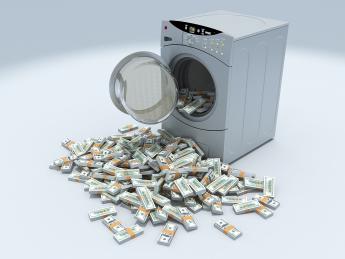 A real-life story of counterfeiting and the Secret Service -- and a little old lady doing her laundry.
Making Money (1)
Central bankers, managing the world's currencies without regard to gold, are about to be tested in their plausible scheme to do what has never been done. Hold on tight for the ride.
Making Money (2)
If the economy is deflated, and if taxes are too high, lowering taxes is better than inventing government spending programs. Central planning is so 1910.
Making Money (3)
Under the right circumstances, tax cuts are partially a free ride for us at the expense of foreign countries with fixed currency rates.
Making Money (4)
Money is nothing but spending power; lowering prices creates spending power. Is that "good" inflation?
Making Money (5)
The business cycle has not been repealed. Other countries are likely to drag us into the next world recession, and we had better be thinking ahead.
Making Money (6): The Laffer Curve
The first President Bush called it Voodoo Economics. His son embarrassed him with the truth.
Making Money (7): Fractional Reserve Banking
Once we stopped basing bank lending on the precious metals in their vaults, we substituted "cash" reserves, which are of course created by the federal government. Then we discovered there was a "multiplier effect" if banks were allowed to loan more than the reserves.
Setting National Interest Rates
The Federal Reserve system had slowly improved over eighty years of trial and error. Two decades of stability suggested they finally had it about right. But look at August 2007.
Supply-Side Tax Cuts
"Supply-side" refers to public policies which help or hinder the economic health of the whole nation. For example, raising or reducing the taxes on dividends and capital gains -- for individuals -- has its most important effect on raising or lowering the cost of capital throughout the economy.
Inflating and Deflating Japan.
Shifty financial winds rattle any boat, then panic at the helm can capsize it. Just look at Japan.
Paying Bills Electronically
Here are four suggestions for improving electronic bill paying.
European Common Currency
The European central bank has done a good job, but European culture is a little slow.
The Economic Power of Laws
The power to tax is the power to destroy, and so is the power to regulate. But anarchy can also destroy.
Will Tax Cuts Invert the Yield Curve?
Tax cuts make the bonds of the federal government more nearly resemble the bonds of state and municipal governments.
Do-It-Yourself Globalization
Cheap mass-produced (and mostly foreign-made) goods make it cheaper to buy a new one than to repair what you already have. The effect on our culture is largely unnoticed, but quite profound.
Marty Feldstein Forecasts the Future
Reading between the lines, Martin Feldstein announces his view that the Treasury must allow the dollar to weaken. Soon.
BEA Monitors the Economy
Thebusiness world is cyclic, and dispairs deeply when the trend is down. The Bureau of Economic Analysis seems to be very good at predicting turn arounds.
The Coming Baby Boomer Retirement Problem
In a few years, the baby boomers will retire and two things will happen. They will have to retire later in life, and the country will have to borrow money to pay for the rest.
Central Bankers Refine the Art of Diplomacy
Currencies once failed because big issues like the gold standard hadn't been addressed by cabinet ministers. Now they are likely to fail because central bankers can't keep up with technical events.
No Laborer Left Behind
Expanding prestige universities to fill American academic demands, unexpectedly provoke inflation obscured by illegal immigration.
Immigration
The United States government makes several trillion dollars profit on immigration, through a jaw-cracker called seigniorage.
Africa Comes to the Schuylkill
 African oil, refined in Philadelphia, supplies 2/3 of the gasoline on the East Coast.
Hayek Confronts Keynes
The influence of Austrian economist Friedrich von Hayek is slowly winning out over the views of the English economist Maynard Keynes, even though both of them are dead. Which is worse, inflation or depression?
Gloomy Future for Banks
Banks pay depositors modest interest rates, lending to borrowers at higher ones. Bank reserves grow from that difference; survival depends on enough reserves to ride out exceptional situations. Profit is what is left.
Five Macroeconomic Myths
The Wall Street Journal 12/11/2006
Curing Deflation
 Some recessions and deflations have lasted a long time, in spite of every effort to reverse them. The cause and cure of deflation remain uncertain.
Bonds are Up: Is That a Good Thing?
No matter how many times the newspapers explain it, many readers remain confused between the price of a bond and the rate of its interest payment. The two go in opposite directions.
Curing Stagflation
More than a century ago, Walter Bagehot succinctly told us what to do about the dilemma of stagflation. We'll get back to him after politicians make us try everything else first.
Mortgages From the Bank's Viewpoint
When a bank issues a mortgage, there are lots of bumps in the road it starts to travel.
Trader's Option
The Federal Reserve intervenes to protect healthy banks which are temporarily short of cash. Protecting unhealthy banks is quite another matter.
Oil Bubble
 The cost of gas at the pump has soared, and conspirators are suspected. But, awkwardly, nice respectable pension funds and university endowments may be responsible.
Mercantilism Dies Hard
Diplomacy has been described as war by other means. It's possible to regard both war and diplomacy as economics by other means, a general attitude called mercantilism.