|
|
Russell
|
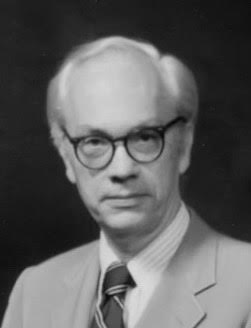
In 1940, the Barnes Foundation disturbed its Philadelphia's Main Line neighborhood in a way that had nothing to do with art. Dr. Barnes was still alive and running the place at that time so there can be no question about the testamentary intentions of the donor. He hired Bertrand Russell for a five-year contract to teach philosophy at the Foundation, under highly lurid circumstances. By doing so, he put his thumb in the eye of religions generally but especially the Roman Catholic Church, into the eye of the Main Line neighborhood that prized its privacy, and into the eye of the judiciary, although the judiciary found a way to get back at him.

Do not fear to be eccentric in opinion, for every opinion now accepted was once eccentric.

|
|
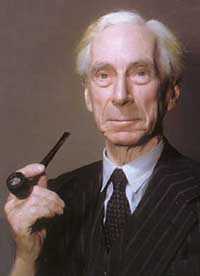
Bertrand Russell
|
Under the circumstances, hiring anyone at all would have been socially defiant, but Barnes went out of his way to offer a position to a man who was already internationally famous for sticking his own thumb in everybody's eye.
Lord Bertrand Russell was the third Earl, the son of a Viscount and the grandson of a British prime minister. He had such a brilliant mathematical mind that no less an observer than Alfred North Whitehead regarded him as the smartest man he ever met. He burned up the academic track at Trinity College, Cambridge, and was made a Fellow of the Royal Society at an early age. There was absolutely no one in the academic world who could look down on him, particularly no one in any American community college. His association with Haverford Quakers was established by marrying Alys Pearsall Smith, a rich thee-and-thou Quakeress then living in England, whose brother was the famous author Logan Pearsall Smith. Many early letters of Bertrand Russell contain instances of what the Quakers call "plain" speech.
If a man is offered a fact which goes against his instincts, he will scrutinize it closely, and unless the evidence is overwhelming, he will refuse to believe it.
If, on the other hand, he is offered something which affords a reason for acting in accordance to his instincts, he will accept it even on the slightest evidence.
|
|
Bertrand Russell
|
By the time of World War I, this odd mixture of Quaker pacifism and English aristocratic arrogance seems to have unhinged Russell from social moorings, and he began a lifelong career of defiance mixed with a rapier wit that made just about everybody his enemy. He went to jail for pacifism, got divorced three or four times, openly slept with the wives of famous people like T.S. Eliot, and proclaimed that monogamy was not a natural state for anybody. He wrote ninety books, and his denunciation of religion was sweeping. All religious ideas were, in his view, not only false but harmful. Accordingly, everybody in polite society kicked him out, and although he was entitled to a seat in the House of Lords, by 1939 he was nearly impoverished. In desperation, he went to (ugh) America to seek his fortune. He didn't last at the University of Chicago, and even California eased him out. Finally, he was reduced, if you can imagine, to accepting an offer to teach Philosophy at the City College of New York. That proved to be totally unacceptable to Bishop Manning, who led a public outcry against using public funds to support such a radical, known to have held long conversations with Lenin. When a CCNY student was induced to file suit along those lines, an especially hard-nosed judge overturned the College appointment, with the rather gratuitous declaration that Russell's appointment would establish a Chair of Indecency. At that point, Albert Barnes stepped in and offered Russell a five-year contract to teach philosophy at the Barnes Foundation on Philadelphia's main line.
|
|
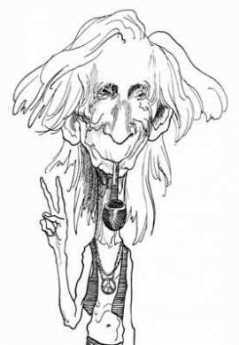
Bertrand Russell in 1960s regalia.
|
Bertrand Russell the bomb-thrower accepted the offer and came down to that quiet little lane where the neighbors object to the traffic coming to look at pictures. The five-year contract only lasted three years, when even Barnes got fed up, and summarily dismissed him. The circumstances have not been extensively documented, but they were sufficient to enable Russell to win a lawsuit for a redress of grievances. During that three year period on the Main Line, he had produced a book called History of Western Philosophy, which became a best seller and permanently relieved his financial difficulties, and was the basis for his winning the Nobel Prize in Literature. He spent the rest of his ninety-odd years leading demonstrations against the atom bomb, the Vietnam War, monogamy, religion and so on. There are those who regard Bertrand Russell as the role model for the whole Sixties generation, and, unfairly, the 2004 Democrat candidate for President. However, all that may be, his activity at the Barnes Foundation undoubtedly was a factor in the firm but the unspoken tradition of the Merion Township neighbors that they wanted to get that Art Gallery out of here.
|
|
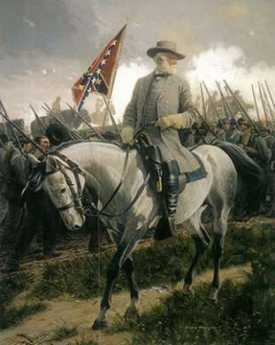
General Robert E. Lee
|
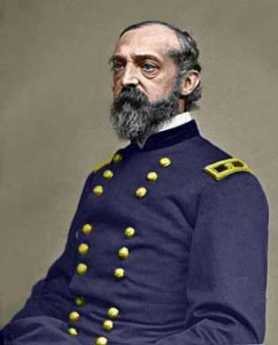
It's quite a long drive from Philadelphia to Gettysburg, but General Lee was attempting to disrupt supplies to the "Arsenal of the North" by capturing the railroad center at Harrisburg. Furthermore, Philadelphia reacted as if Lee's advance was aimed straight at us, creating hysterical preparations for an invasion which had to be stopped before it got here. And finally, George Gordon Meade, the Union commander, was a Philadelphia home town boy. So, regard the Battle of Gettysburg as part of Philadelphia history, please.
|
|
General George Gordon Meade
|
Major (ret.) Lawrence Swesey is a West Point graduate and currently Administrator of the 1st City Troop; because of his enthusiasm for the subject, he runs a tour agency which specializes in battlefields, especially Gettysburg. From him, the Right Angle Club recently learned much that made the whole episode comprehensible. Such as Lee's purpose in going there, which appears to have been based on the growing recognition that the South was likely to lose the war, and desperately needed some major victory in Northern territory, both to take the pressure off the Southern homeland and to improve whatever terms might be extracted at a peace negotiation. To fight successive battles against a larger enemy, with larger economic resources, was to doom the South eventually as resources and men were depleted with no hope of replacing them. Sooner or later, some Union General like Grant would settle down to a grinding unrelenting assault, with the willingness to trade one death for another, until only the larger side was left standing. That's quite different from guerilla warfare of the type Washington fought, where the way to win was simply to avoid losing until the stronger side lost its civilian support. Lee could feel the South beginning to lose its nerve to fight on indefinitely, without any visible route to victory. Although Grant eventually did defeat him by attrition, Grant's own opinion appears to have been more personalized. In every war, he was later to say, there comes a time when both sides want to quit. The side that wins is the one with a general who keeps fighting for no particular reason until the other side finally quits and he wins the war.
Major Swesey emphasizes that rifles were available, but they cost four times as much as smooth-bore muskets which were only effective for twenty or thirty yards. Rifles were reserved for sharpshooters, and the enemy at a distance was bombarded by artillery as the two sides approached. So, in Pickett's famous charge, most of the casualties took place in the last fifty yards. Pickett's men had to contend with trudging stoically through an exploding field of cannon fire, unable to fire effectively at the Union men behind a stone wall, who were also supposed to lie passively on the ground while the Confederate artillery pounded at a stationary target. Somehow, most of the Southern artillery fire went over the Union heads and landed beyond the crouching line; in many ways, this was the main factor in the Union victory.
As the waves of attackers got within musket shot of the wall, they formed into three ranks. Since it took about a minute to reload the musket, a more or less continuous fire could be maintained by rotating three successive volleys rank by rank, at more or less point blank range. Then, fix bayonets, and the real slaughter became a hand to hand, in the blazing heat of summer.
www.Philadelphia-Reflections.com/blog/1436.htm
|
Congress met in
"Congress Hall" from 1790-1799
First 10 amendments,
the "Bill of Rights," were added here.
|
Philadelphia was the center of the nation from the time of the First Continental Congress (1775) until the nation's capital was moved to the District of Columbia in 1800. For thirteen of those years (from 1775 until the 1788 inauguration of George Washington as the first President under the Constitution) our governing concept was that of a confederation of sovereign states. The framework of our rules was a little vague at the beginning of that period, eventually becoming explicit when the Articles of Confederation were finally ratified in 1781. Until that rather late moment in the eight-year war, the thirteen rebel colonies governed themselves in a manner similar to thirteen nomadic tribes. Later on, when the Constitution was agreed to in 1787, there was another period of ambiguity until the newer rules actually began to apply. Speaking loosely, for thirteen years the country operated according to the Articles of Confederation. For another twelve years, the United States were absorbed in the task of transition from the Articles to the Constitution of a unified nation.
More discrete episodes in the development of the American Constitution start with the long formative period of English law stretching back to the Magna Charta, with a general trend toward greater authority for individual barons and nobles, and later even to the common English peasant. The Magna Carta began the slow evolution toward the Rule of Law, simply stated as making the king obey his own laws. By the reign of Queen Elizabeth I, the legal profession had evolved considerable sophistication, tending in the direction of the Judges handling the law and the King leading the armed forces, and the Catholic Church supplying many of the rules of everyday conflict. King Henry VIII reduced church control of the courts considerably, but the Anglican church still retained the property and legal authority for decades, slowly giving ground to a King who appointed the Archbishop of Canterbury, who controlled the rest of the church. By the time of the first Queen Elizabeth, the legal profession was headed by the Lord Chancellor, who at that time was Sir Francis Bacon. Somehow, word of Galileo's scientific method traveled to London, and Bacon is credited with converting English Law to English Common Law, essentially grafting the scientific method onto the court system. The system was one of observing what happened and developing a theory about why it turned out that way. Experiments were then applied to test the theory, resulting in the modification of the theory. Decisions were standardized for common forms of dispute, and punishments were varied, with varied outcomes. When the courts were satisfied with a uniform result, the situation was then reduced to codified standard laws, and experimental testing was lessened. Common Law gradually emerged and slowly gathered public respect as a sensible guide to running the country. At that point, judges and kings discovered they had less latitude for capricious or ill-founded decisions; the Rule of Law grew stronger.
By the time of the American Revolution, a number of colonies had developed their own charters and rules, and many customs like the right to a jury trial became accepted rules of society. Many such similarities between colonial rules and the final Constitution have been noticed, and it is traditional to give credit to some of them as having "originated" the later Constitutional provisions. Some of this is strictly factual, some of it may only be conjectural; it probably doesn't seriously matter
This IRA withdrawal calculator is for the original owner of an IRA and shows the following:
- Each year's minimum withdrawal
- Each year's taxes
- Each year's after-tax payout (assuming withholding)
- The declining balance of the IRA
Note: the calculator assumes that the IRA grows at a fixed rate (default is 0%, i.e., cash)
Note: this calculator uses Table III, which is for the original owner of the IRA who is either unmarried or whose spouse is no less than 10 years younger.
Note: this shows the minimum withdrawal; you may withdraw up to the total amount remaining (taxes will be due).

|
|
|
Employer-based health insurance can be viewed as a lingering vestige of feudalism, or maybe Federalism. Employer-basing evokes images of the mansion on the hill, overlooking the factory and a little village of workers, allowing an eternal debt to the entrepreneur in the mansion who risked life and fortune to make the industry flourish. When a worker in the factory was injured, it really was the duty of the owner to see he was cared for. In fact, about 25% of major businesses are still controlled by the founding family, where notions of paternalism are taken more seriously. At least one mutual fund even specializes in family-owned and controlled businesses and can demonstrate that such attitudes really are an important asset. Unions, of course, sneer at such nonsense, while the owner-entrepreneur, in turn, reacts with fury at the implicit ingratitude. The Roebling family (of the Roebling Steel Company, builders of the Brooklyn Bridge, etc.) is famous for an epic performance with its company town, and there are a thousand such tales, starting with George Washington and his plantation. Although it is now difficult to see the slightest trace of feudal beginnings in the present administration of Blue Cross and other health insurance corporations, benign feudalism was in fact the foundation stone for employer-based health insurance.
And while most of them would deny it, it accounts for some of the vigor with which union leaders insinuate themselves into the board rooms of the present successor health insurance corporations, like schoolboys sitting on a vacant throne. It would go too far to describe the seventy-year struggle for national health care as entirely based on these primeval victories, but something does remain of that idea. In the 1920s, the big problem was to get people to buy health insurance. Civic-minded employers played such a leading early role in promoting this distinctively American solution it was often called an employer-based system. Dominating hospital boards of trustees, businessmen exerted peer pressure to spread the health insurance message. It became the right thing to do if you wanted to be regarded as the right sort, yourself. Even today, healthcare in many cities would suffer considerably if employers suddenly withdrew support.
In their civic role as hospital trustees, businessmen also recognized early that employer insurance mainly eased the cost load for the working population, and became less comfortable for outsiders, while insurer management increasingly recognized employer groups were the most profitable clients. Some of this was the inevitable tendency of all large customers to be more demanding of better treatment and to get it. This recognition became more apparent in scarcely two generations, as workers emerged as the healthiest, least expensive segment of our population. As a consequence, more assertive employer representatives professed uneasiness about employee premiums cross-subsidizing the rest of the population, even though it was always obvious that people with an income are the only ones available to help people without income. There was thus stubborn resistance to the idea that the main function of health insurance was to act as a transfer agent of health costs between age groups, unfortunately without a written contract to do so. There was then a period when the expedient was imagined that employed persons supporting their dependents, children and elderly parents, might cover the need more or less adequately. Eventually, government programs for the elderly and for the poor were recognized to be absolutely essential additions; by 1965, we had Medicare and Medicaid. Taxes were just a redistribution system on a larger scale, but Lyndon Johnson was in a hurry and those Great Society programs went unclarified as potential equivalents for the same goal: working people recycling funds for non-working ones. Unfortunately, 1965 was about the time the American post-war international trade balance turned negative, eventually forcing a recognition that the "pay as you go" financing systems designed for Medicare and Medicaid would be unsustainable until our trade balance turns positive again, which could be the same as saying "forever".
Current premiums (mostly from healthy people) are used to pay current costs (mostly generated by older, sicker people) on the assumption that new young subscribers will always outnumber sick older ones. Not a safe assumption.
|
|
|
Even large cost savings from nearly eliminating the common causes of healthcare delivery expense, like peptic ulcers, tuberculosis, polio, typhoid, malaria, heart attacks. strokes and rheumatic fever -- could not overcome the instability of balancing increasing non-worker costs on a steadily diminishing base of worker costs. "Pay as you go" requires quite a suspension of disbelief to be called anything but a Ponzi scheme. And the essence of a Ponzi scheme has been made widely familiar by the Bernie Madoff example of it. Current premiums (mostly from healthy people) are used to pay current costs (mostly generated by older, sicker people) on the assumption that new young subscribers will always outnumber sick older ones. The retirement of the baby boom bulge had been predictable for sixty years but was ignored. Even today, it is pronounced impossible to happen a second time. It became an informal banking system for healthy working-age people to store up savings for those later life eras of heavy health expenses when they would be unable to work. Unfortunately, it was implied without a written contract and thus was always a "best efforts" promise.
Even benevolent employers had to worry that our international competitiveness could not withstand the strain of it. Although most citizens, businessmen or not, probably did not understand why it was true, attempting to lower worker health costs through Managed Care HMOs proved to be a self-defeating disaster, combining worker antagonism with further upward-leveraging of employee premiums to support it; even so, it never addressed the underlying basis of the problem. Reform of hospital cost-shifting against employee groups was equally futile, as described in later paragraphs because such pushing on the balloon caused it to bulge out among the uninsured, who mostly transformed it into bad debts for the hospital. Unfortunately, cost-shifting which in 2008 generated a proposed solution as dumping the system's growing medical expenses on the backs of those with high premiums but low usage, became translated into a shift onto the backs of those who could not even afford their own costs. It violated the long-established tradition that those with the highest medical costs should pay the highest premiums, without proposing a way to make it politically acceptable. It must be evident that the solution supported here is a benevolent return to the concept of "Each ship on its own bottom," because of alarming signs of class warfare in the concept that one group must support another group against its will. The general concept here advanced as a more palatable substitute is individual lifetime insurance. A short-term concession would be to call for modified individual lifetime policies as a transition step. The success of even this proposal must frankly depend on the hope that interest rates will return to normal, and that cures for cancer and Alzheimer's disease are on some future scientist's horizon. No solution to this problem should be presented as free of problems, but it is equally unproductive to throw things against a wall, just to see what sticks.
To repeat an inconvenient truth: "service benefits" means cost is not a responsibility of the patient or his employer. It has been transferred to the hospital and the insurance company to "work it out", which they mainly do by raising prices or shifting them to outsiders.
|
|
|
Employer-basing is far from perfect, as are service benefits, but at least they only minimally distort the medical system. They do create the potential for the employer to invade employee privacy, and real awkwardness arises when the employee wants to change jobs, a situation often known as "Job Lock". Difficult as these features do make things, we are about to learn whether eliminating them by Obamacare will seem worth the disruption. First, transferring insurance to that of a new job needs rough uniformity between policies of different employers, and therefore hampers competition between insurance companies. A second seeming requirement is to recognize that a sick employee is an expensive employee, by creating pooling arrangements with "healthiness credits" and "sickness debits", unfamiliar concepts generated by "pre-existing conditions", which will not be changed by writing pre-existing condition clauses. Sweeping these perfectly sensible reservations aside without addressing their merits will not be helpful. It will be interesting to see how well Obamacare manages this difficult issue. Ultimately, most of the issue reduces itself to an extra charge (or discount) on the premium for the policy of the new employer. Since the Health Savings Account and catastrophic illness policies do not commonly include service benefits, they can be much more restricted to money issues with an indemnity resemblance. (Explanation: a service benefit is to pay all the costs of an appendectomy. An indemnity pays $5000 if you get appendicitis.) Therefore, indemnities also suit themselves better as a common denominator for quarrels between successive insurance carriers. To shrug off the Job-Lock issue by saying this problem has no solution is to say that employer basing has no place in health insurance, other than the present patchwork causing so much dissension. The public seems to be demanding some solution. Of the compromises available, the Health Savings Account imposes the least contortion because it requires a dollar settlement rather than an agreement to the open-ended limits of pain and suffering, weakness and disability. An employee with a disability needs to change jobs, but he is an expensive employee in the eyes of the new employer. His costliness occurred while his health was the responsibility of the first employer, but how is that to be transferred? Large employers will prefer a money solution, unnecessarily ending the employee's career. This problem cannot be solved unless health insurance is either permanent or freely transferrable; permanent is better because its costs are set in advance of the disability. Transferrable means costs are established after the fact by a referee who knows insurance will pay. To repeat an inconvenient truth: "service benefits" means cost is not a responsibility of the patient or his employer. It has been transferred to the hospital and the insurance company to "work it out", which they mainly do by raising prices or shifting them to outsiders.
Many problems will prove to be non-problems, while unanticipated problems are inevitable.
|
|
|
Even after conceding the advantages of permanent insurance, there remain problems. Increasing employment mobility collides with variable state regulation of insurance. That awkwardness is mandated by the McCarran Fergusson Act which is more or less guaranteed by the Tenth Amendment of the Constitution, challenged by the Roosevelt Court-Packing uproar, and tracing ancient origins to Thomas Jefferson and the anti-Federalists. Litigation could be protracted. Nevertheless, the idea of creating individually owned, lifetime health insurance is so attractive it is hard to say it is impossible and easier to say its traditional alternatives are worse. Health costs concentrate in the first and last years of life, while the several-thousand-dollar premiums would be largely unspent for long periods of time, gathering interest for many decades (in periods with normal interest rates) that might largely pay for the whole thing. Therefore, although it is attractive to design a program within existing laws, it is probably more feasible to examine the legal impediments and conduct a protracted campaign to modify them in many small ways. That is essentially why this proposal is offered as a Grand Strategy rather than a legislative package. When legal obstacles are proven to be intractable, it is then necessary to design workarounds. Many problems will prove to be non-problems, while unanticipated problems are inevitable.
Obamacare designers probably expected most of its problems to come from small business; they seem to have forgotten about ERISA, which presents some health insurance alternatives. Taking nearly a decade to design, ERISA is likely to withstand most attempts to change it.
|
|
|
Other Transition Problems To return to more mundane issues, it also generates vexing political problems to go from employer-basing to any government-dominated system, if you have allowed one segment to have a tax-deduction while denying it to another segment. At first, transferring the cost from employee to employer is a gift from one to the other. But in time, the employer adjusts, and the costs return to the employee as a reduction of wages; almost all economists agree this invisible readjustment occurs. But when one segment of the business has adjusted the pay-packet to pay for the fringes, while another segment has not, the unfairness surfaces abruptly when it does surface. That is the unfortunate situation with the coming program, and it accounts for much Tea Party rancor. Employers who have previously reached a tacit agreement that they won't offer health benefits, but will pay a little more in the pay-packet, will suddenly be confronted with a new cost which their bigger competitors have long since absorbed. In short, it is likely that small business will be much more hostile to the approaching Obamacare than big business, because they will genuinely be hurt more by it. Just what has been solved by delaying the implementation of large groups by a year is unclear; it does sound as if it had things backward. Perhaps a problem emerges from conflict with ERISA.
The mundane but ultimate downside of employer involvement is that top management of major companies seldom give healthcare a high enough priority on their time, thus allowing unions and human resources departments (their philosophical successors on the company payroll), to speak for the company in important forums, with the effect of appreciably softening price concerns. When top management was again drawn into a visible role by the Managed Care ("HMO") fiasco, the business-school approach did not distinguish itself, so government and academia have become less deferential, perhaps even hostile, to business. The final word on the role of employers in the transformation of an employer-based system by the Affordable Care Act has yet to emerge. Much will depend on how gracefully the transition is managed.
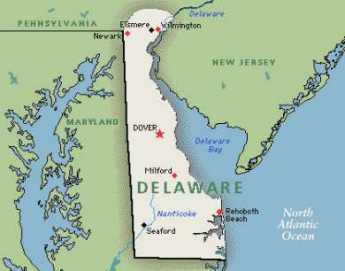 Originally the "lower counties" of Pennsylvania, and thus one of three Quaker colonies founded by William Penn, Delaware has developed its own set of traditions and history.
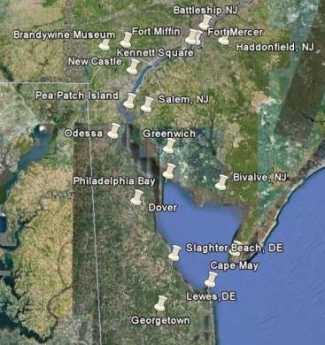 Start in Philadelphia, take two days to tour around Delaware Bay. Down the New Jersey side to Cape May, ferry over to Lewes, tour up to Dover and New Castle, visit Winterthur, Longwood Gardens, Brandywine Battlefield and art museum, then back to Philadelphia. Try it!
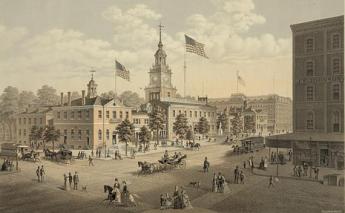
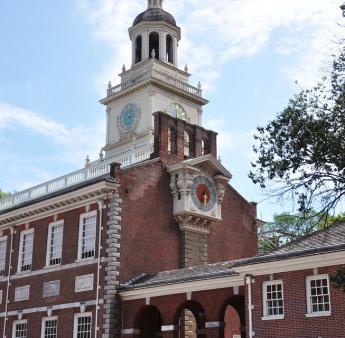 Millions of eye patients have been asked to read the passage from Franklin's autobiography, "I walked up Market Street, etc." which is commonly printed on eye-test cards. Here's your chance to do it.
 In 1751, the Pennsylvania Hospital at 8th and Spruce was 'way out in the country. Now it is in the center of a city, but the area still remains dominated by medical institutions.
 Grievances provoking the American Revolutionary War left many Philadelphians unprovoked. Loyalists often fled to Canada, especially Kingston, Ontario. Decades later the flow of dissidents reversed, Canadian anti-royalists taking refuge south of the border.