Related Topics
The British Attack Philadelphia
Fighting in the Revolutionary War lasted eight years; for two years (June 1776 to June 1778) Philadelphia was the main military objective of the British.
Particular Sights to See:Center City
Taxi drivers tell tourists that Center City is a "shining city on a hill". During the Industrial Era, the city almost urbanized out to the county line, and then retreated. Right now, the urban center is surrounded by a semi-deserted ring of former factories.
Sights to See: The Outer Ring
There are many interesting places to visit in the exurban ring beyond Philadelphia, linked to the city by history rather than commerce.
Historical Motor Excursion North of Philadelphia
The narrow waist of New Jersey was the upper border of William Penn's vast land holdings, and the outer edge of Quaker influence. In 1776-77, Lord Howe made this strip the main highway of his attempt to subjugate the Colonies.
Touring Philadelphia's Western Regions
Philadelpia County had two hundred farms in 1950, but is now thickly settled in all directions. Western regions along the Schuylkill are still spread out somewhat; with many historic estates.
Favorite Reflections
 In no particular order, here are the author's own favorites.
Montgomery and Bucks Counties
The Philadelphia metropolitan region has five Pennsylvania counties, four New Jersey counties, one northern county in the state of Delaware. Here are the four Pennsylvania suburban ones.
Pacifist Pennsylvania, Invaded Many Times
Pennsylvania was founded as a pacifist utopia, and currently regards itself as protected by vast oceans. But Pennsylvania has been seriously invaded at least six times.
George Washington in Philadelphia
Philadelphia remains slightly miffed that Washington was so enthusiastic about moving the nation's capital next to his home on the Potomac. The fact remains that the era of Washington's eminence was Philadelphia's era; for thirty years Washington and Philadelphia dominated affairs.
French Philadelphia
French Philadelphia
Washington Lurks in Bucks County, Waiting for Howe to Make a Move
|
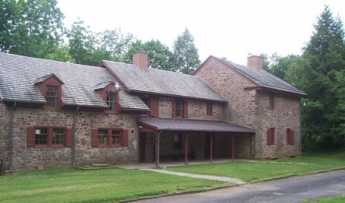
| Moland House |
Although Bucks County, Pennsylvania, is staunchly Republican, it has been home to Broadway playwrights for decades; this handful of Democrats have long been referred to as lions in a den of Daniels. One of them really ought to make a comic play out of the two weeks in August 1777, when John Moland's house in Warwick Township was the headquarters of the Continental Army.
John Moland died in 1762, but his personality hovered over his house for many years. He was a lawyer, trained at the Inner Temple and thus one of the few lawyers in American who had gone to law school. He is best known today as the mentor for John Dickinson, the author of the Articles of Confederation. Our playwright might note that Dickinson played a strong role in the Declaration of Independence, but then refused to sign it. Moland, for his part, stipulated in his will that his wife would be the life tenant of his house, provided -- that she never speak to his eldest son.
Enter George Washington on horseback, dithering about the plans of the Howe brothers, accompanied by seven generals of fame, and twenty-six mounted bodyguards. Mrs. Moland made him sleep on the floor with the rest.
Enter a messenger; Lord Howe's fleet had been sighted off Patuxent, Maryland. Washington declared it was a feint, and Howe would soon turn around and join Burgoyne on the Hudson River. Washington had his usual bottle of Madeira with supper.
A court-martial was held for "Light Horse Harry" Lee, for cowardice. Lee was exonerated.
Kasimir Pulaski made himself known to the General, offering a letter of introduction from Benjamin Franklin, which letters Franklin noted had been requested by Pulaski himself. As it turned out, Pulaski subsequently distinguished himself as the father of the American cavalry and was killed at the Battle of Savannah.
|
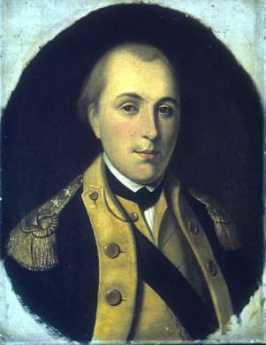
| Lafayette |
And then a 19 year-old French aristocrat, the Marquis de Lafayette, made an appearance. Unable to speak a word of English, he nevertheless made it clear that he expected to be made a Major General in spite of having zero battlefield experience. He presented a letter from Silas Deane, in spite of Washington having complained he was tired of Ambassadors in Paris sending a stream of unqualified fortune hunters to pester the fighting army. Deane did, however, manage to make it clear that the Marquis had two unusually strong military credentials. He was immensely rich, and he was a dancing partner, ahem, of Marie Antoinette.
In Mrs. Moland's parlor, Washington sat down with Lafayette to tap-dance around his new diplomatic problem. It was clear America needed France as an ally, and particularly needed money to buy supplies. But it was also clearly impossible to take a regiment away from some American general, a veteran of real fighting, and give that regiment to a Frenchman who could not speak English and who admitted he had no military experience. Fumbling around, Washington offered him the title of Major General, but without any soldiers under his command, at least until later when his English improved. To sweeten it a little, Washington seems to have said something to the effect that Lafayette should think of Washington as talking to him as if he were his father. There, that should do it.
It seems just barely possible that Lafayette misunderstood the words. At any rate, he promptly wrote everybody he knew -- and he knew lots of important people -- that he was the adopted son of George Washington.
Well, Broadway, you take it from there. At about that moment, another messenger arrived, announcing Lord Howe at this moment was unloading troops at Elkton, Maryland. General Howe might have been able to present his credentials to Moland House in person, except that his horses were nearly crippled from spending three weeks in the hold of a ship and needed time to recover. Heavy rains were coming.
(Exunt Omnes).
Suggested Stage Manager: Warren Williams
Originally published: Friday, June 23, 2006; most-recently modified: Friday, May 24, 2019
| Posted by: GDSAVTHQN | Aug 18, 2015 1:13 AM |
| Posted by: Nancy | Jul 1, 2011 5:21 PM |