2 Volumes
Culture: The Flavors of Philadelphia Life
Philadelphia began as a religious colony, a utopia if you will. But all religions were welcome, so Quakerism mainly persists in its effects on others, both locally and in America, in Art, clubs, and the way of life.
Sociology: Philadelphia and the Quaker Colonies
The early Philadelphia had many faces, its people were varied and interesting; its history turbulent and of lasting importance.
Evolving Philadelphia
The city changes.
Philadelphia in '76
|
| Spirit of '76 |
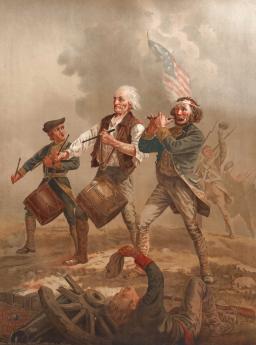
Although the origins of the American Revolution are subtle and complex, even historically controversial, we have more or less united in the idea that we "declared" our independence from Britain on July 4, 1776. We then spent eight years convincing the British we were serious and have been independent ever since. Reflect, however, on the fact that fighting had been going on for a year in Massachusetts, and that Lord Howe's fleet had set sail a month before the Declaration, actually landing on Staten Island at just about the same time as the Fourth of July. Add to that the fact that only John Hancock actually signed the document on July 4th, and some of the signers waited until September. You can sort of see why John Adams never got over the idea that Thomas Jefferson had quite a nerve implying the whole thing was his idea. What's more, New England subsequently had to live with a President from Virginia for thirty-two of the first thirty-six years of the new nation. Philadelphia may have been the cradle of Independence, but that was not because it was a colony hot for war, dragging the others along with it. It was the largest city in the colonies, centrally located. It had a strong pacifist tradition, and it had the most to lose from a pillaging enemy war machine.
New England was in the position of having started hostilities, and about to be subdued by overwhelming force. The Canadians were not going to come to their aid, because they were French, and Catholic, and enough said. What the New Englanders wanted was WASP allies, stretching for two thousand miles to the South. By far the largest colony was Virginia, which included what is now Kentucky and West Virginia; it even had some legal claims for vastly larger territory. The rest of the English colonies had plenty of assorted grievances against George III, and almost all of them could see that America was rapidly outgrowing the dependency on the British homeland, without any sign that Parliament was ever going to surrender home rule to them. Perhaps it was unfortunate that New Englanders were so impulsive, but it looked as though a confrontation with the Crown was inevitably coming, and without support, New England was likely to be subdued like Carthage.
And then, the last hope for flattery and diplomacy, for guile and subtlety, stepped off the boat. Benjamin Franklin, our fabulous man in London, had it "up to here" with the British ministry. He finally was saying what others had been thinking. It was now, or never.
Eakins and Doctors
|
| The Gross Clinic |
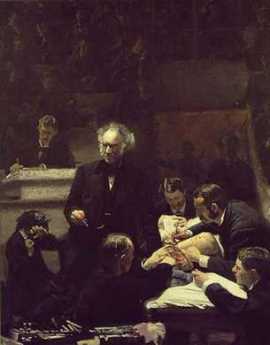
A Christmas visitor from New York announced he read in the New York newspapers that Philadelphia's mayor had just rescued a painting called The Gross Clinic, for the city of Philadelphia. The Philadelphia physicians who heard this version of events from an outsider reacted frostily, grumpily, and in stone silence. To them, the mayor was just grandstanding again, and whatever the New York newspaper reporters may have thought they were saying was anybody's conjecture.
Thomas Eakins is known to have painted the portraits of eighteen Philadelphia physicians. Several of these portraits have been highly praised and richly appraised, seen in the art world as part of a larger depiction of Philadelphia itself in the days of its Nineteenth-century eminence. That's quite different from its colonial eminence, with George Washington, Ben Franklin, the Declaration and all that. And of course entirely different from its present overshadowed status, compared with that overpriced Disneyland eighty miles to the North. Eakins depicted the rowers on the Schuylkill, and the respectable folks of the professions, every scene reeking with Victorian reminders. It's a little hard to imagine any big-city mayor of the present century in that environment. Indeed, it is hard to imagine most contemporary Americans in a Victorian environment -- except in Philadelphia, Boston, and perhaps Baltimore. So, Mayor Street can be forgiven for not knowing exactly what stance to take, and was not alone in that condition.
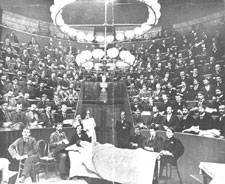
S. Weir Mitchell, for example, became known as the father of neurology as a result of his studies and descriptions of wartime nerve injuries. But the repair of injuries is a surgical art, and many novel procedures were invented and even perfected, many textbooks were written. Amphitheaters were constructed around the operating tables, for students and medical visitors to watch the famous masters at work.
In The Gross Clinic, we see the flamboyant surgeon in the pit of his amphitheater at Jefferson Hospital, in the background we see anesthesia being administered. Up until the invention of anesthesia, the most prized quality in a surgeon was speed. With whiskey for the patient and several attendants to hold him down, the surgeon had one or two minutes to do his job; no patient could stand much more than that. After the introduction of anesthesia, it might overwhelm newcomers to observe leisurely nonchalance, but in truth, the patient felt nothing, so the surgeon could safely pause and lecture to his nauseated admirers.
|
| Operating Amphitheater |
What made an operation dangerous was not its duration, but the subsequent complications of wound infection. By 1876, Eakins could have had no idea that Pasteur and Lister were going to address that issue in four or five years, making operations safe as well as painless. But his depiction of a surgeon with bloody bare hands, standing in Victorian formal street clothes, gives the most dramatic possible emphasis in the painting to the two most important scientific advances of the century. Modern medical students spend days or weeks learning the ceremonial of the five-minute scrubbing of hands with a stiff and somewhat painful brush, the elaborate robing of the high priest in a sterile gown by a nurse attendant, hands held high. The rubber gloves, the mystery of a face mask and cap. In some schools, the drill is to cover the hands of a neophyte with charcoal dust, blindfold him, and insist that he scrub off every speck of dirt that he cannot see before he is admitted to the operating theater for the first time. If he brushes some object in passing, he is banished to the scrub room to start over. So the Gross Clinic has an impact on everyone who sees the surgeon in street clothes, but it is trivial compared with the impact that painting has on every medical student who has been forced to learn the stern modern ritual. For at least fifty years, that painting hung on the wall facing the main entrance to the medical school, where every student had to pass it every day. To every graduate, the lack of clean surgical technique by the famous man was a wrenching sermon on every doctor's risk of trying his utmost to do his best, but doing the wrong thing.
That painting, hanging quite high, was rather cleverly displayed to the public through a large window above the door. With clever lighting, every layman who walked along busy Walnut Street could see it, too, and it became a part of Philadelphia. That was a feature the medical community barely noticed, but it was probably the main reason for public uproar when a billionaire heiress offered the school $68 million to take the painting to Arkansas. The painting was not just an icon for the medical profession, it had become a central part of Philadelphia. Philadelphia wanted to keep that painting for a variety of reasons, and one of the main ones was probably a sense of shame that we were so poor we had to sell our family heirlooms to hill-billies.
The doctors didn't pay much attention to that. They were mad, plenty mad, that a Philadelphia board of trustees would appoint a president from elsewhere who would give any consideration at all to such an impertinent offer.
Pennsbury Manor
|
| Fairmount |
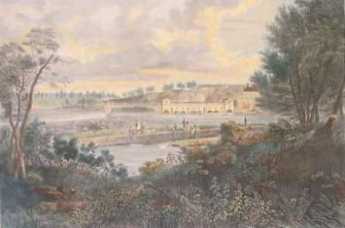
William Penn once had his pick of the best home sites in three states, because of course he more or less owned all three (states, that is). Aside from Philadelphia townhouses, he first picked Faire Mount, where the Philadelphia Art Museum now stands. For some reason, he gave up that idea and built Pennsbury, his country estate, across the river from what is now Trenton. It's in the crook of a sharp bend in the river but is rather puzzlingly surrounded by what most of us would call swamps. The estate has been elegantly restored and is visited by hosts of visitors, sometimes two thousand in a day. On other days it is deserted, so it's worth telephoning in advance to plan a trip.
|
| Gasified Garbage |
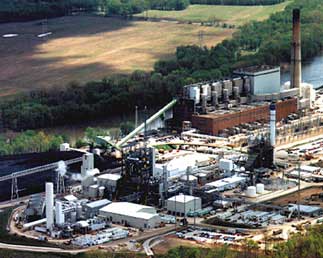
After World War II, a giant steel plant was placed nearby in Morrisville, thriving on shiploads of iron ore from Labrador, but now closed. Morrisville had a brief flurry of prosperity, now seemingly lost forever. However, as you drive through the area you can see huge recycling and waste disposal plants, and you can tell from the verdant soil heaps that the recycled waste is filling in the swamps. It doesn't take much imagination to foresee swamps turning into lakes surrounded by lawns, on top of which will be many exurban houses. How much of this will be planned communities and how much simply sold off to local developers, surely depends on the decisions of some remote corporate Board of Directors.
However, it's intriguing to imagine the dreams of best-case planners. Radiating from Pennsbury, there are two strips of charming waterfront extending for miles, north to Washingtons Crossing, and West to Bristol. If you arrange for a dozen lakes in the middle of this promontory, surround them with lawns nurtured by recycled waste, you could imagine a resort community, a new city, an upscale exurban paradise, or all three combined. It's sad to think that whether this happens here or on the comparable New Jersey side of the river depends on state taxes. Inevitably, that means that lobbying and corruption will rule the day and the pace of progress.
Meanwhile, take a trip from Washingtons Crossing to Bristol, by way of Pennsbury. It can be done in an hour, plus an extra hour or so to tour Penn's mansion if the school kids aren't there. Add a tour of Bristol to make it a morning, and some tours of the remaining riverbank mansions, to make a day of it.
Wall Art in Philadelphia
|
| Seasons |
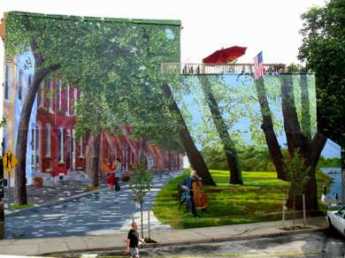
At last count, Mural Arts program of the city government of Philadelphia has sponsored and paid for 2700 large paintings on the walls of buildings around town, and several hundred more have appeared spontaneously. Comparatively few art museums have that many on display, so people are proud of the Philadelphia effort.
This program is now nearly thirty years old, beginning to emerge as a national treasure. Looking back, it is pleasing that it had humble, even deplorable, origins. As American cities lost their industrial focus, many homes in the neighborhood of former factories have been abandoned, getting torn down in random patterns. Industrial cities of the East Coast were tightly packed to save land costs and time commuting to work; the fashion of "row houses" evolved without any space between neighbors sharing a "party" wall. When a row house was torn down, there emerged a scabrous ghost, because the wallpapered interior walls were exposed and looked pretty hideous. It eventually became illegal to leave a scabrous building, leading to elaborate legal conventions about responsibility for the cost of covering exposed surfaces with concrete stucco. During the last half of the Twentieth Century, stucco was generally an improvement.

|
| Graffitti |
Meanwhile, during World War II it became clever for American military to inscribe "Kilroy was here" on unprotected public surfaces at home and abroad as a gesture of American triumphalism. Opinions differ about whether this started originally as an allusion to a certain line of 19th Century romance poetry, or whether there was in fact a John J. Kilroy, inspector of riveting in wartime shipyards, marking riveted materials with his name to enable piecework payment for shipyard tasks. Eventually, this Kilroy joke became a little tiresome, but soon was replaced by stylized decorations using cans of spray paint, until "graffiti" painting, in turn, became a public nuisance. It is true some graffiti artists were quite talented, but the associated vandalism of teenagers added a threatening quality to public defacement of property belonging to others. By implication, an area with graffiti was a home of lawlessness and that implication cast a negative shadow on the city economy. Public opinion demanded something effective be done to stop it.
|
| Frank Sintra |
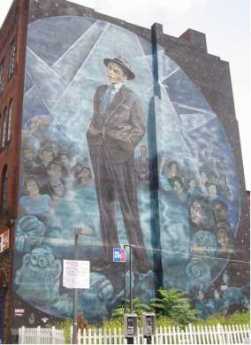
Since graffiti vandalism has declined nationwide in the past twenty years, it is difficult to claim that one public initiative in Philadelphia cleaned it up. But it might be true. Then-Mayor Wilson Goode formed an antigraffiti Network, essentially a think tank for concerned citizens, floundering about for a solution to an appalling problem. Somehow the inspired idea arose that the graffiti artists might be channeled into better directions if given professional art lessons, and working materials. A West-Coast artist named Jane Golden was hired to supervise what has become a multimillion-dollar project, overseen by some sort of guiding hand pushing the whole city into becoming part of a gigantic art project. Guides tell visitors that there are fifty employees involved in publicity and legal work, organizing artists, fundraising, organizing teams of painters at all levels of competence, helping oversee the general appropriateness of what is happening. And at the head of this team is Jane, a tornado of energy.
|
| Frank Rizzo |
It costs forty to seventy thousand dollars to produce one of these works, and since they are exposed to the weather, they only last about fifteen years. There are several techniques for transforming a small artwork into a big outdoor copy, some of them tracing back to Michaelangelo. Most of the Philadelphia murals are produced by dividing the original small artwork into squares and transferring numbered squares to the wall, one inch to one foot. As you can see by reviewing some of the websites devoted to the topic, a piece of art which is quite appealing can sometimes change into a drab mess when its size is blown up to three-story height. The problems of lighting such work are quite different from the lighting of a gallery painting. The surface is seldom smooth, so the bumps and grooves of the underlying scabrous "canvas" can destroy, or sometimes dramatically enhance, a salon painting. If you get too close, you can't see all of it, and that may be a problem. It's probably not entirely predictable what will come out in the final product.
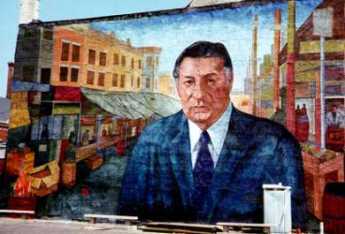
There are inevitably political problems as well. The best examples are the several paintings of former Mayor Frank Rizzo, who is a hero to the Italian neighborhoods where they stand, but provoke riotous feelings in near-by black districts. Luck alone has confined the antagonisms to graffiti on the murals, viewed by some groups as enhancements on what begins as graffiti. No wonder the committees assigned to approving locations can take a long time to come to a decision.
There's another problem, which seems to be embedded in the situation. In the central city skyscraper district, you don't have scabrous buildings. Nor can mural art be placed in the historic square mile. Just a few blocks in either direction from central city there are plenty of demolitions and scabrous walls, but, close to downtown, these are areas of gentrification and urban renewal. It doesn't make sense to spend fifty thousand dollars to paint a wall which will be demolished in two or three years. The net effect is that the city may have three thousand paintings all right, but only fifty at most are within a tourist ride of Independence Visitors Center. If half of these fifty are concerned with celebrating local heroes unfamiliar to tourists, there can be disappointment which would disappear if a selection of fifty outstanding products could be culled from three thousand -- and grouped together for exhibition.
A solution to these issues will surely emerge with time, but it will evolve, not be envisioned.
Quakerism and the Industrial Revolution
|
| Richard Arkwright |
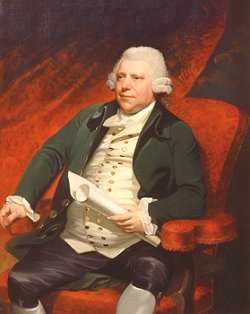
The Industrial Revolution had a lot to do with manufacturing cotton cloth by religious dissenters in the neighborhood of Manchester, England in the Eighteenth Century. What needs more emphasis is the remarkable fact that Quakerism and the Industrial Revolution both originated about the same time, in about the same place. True, the industrializing transformation can be seen in England as early as 1650 and as late as 1880. The Industrial Revolution thus extended before Quakerism was even founded, as well as long after most Quakers had migrated to America. No Quaker names are much mentioned except perhaps for Barclay and Lloyd in banking and insurance, and Cadbury in candy. As far as local history in England's industrial midlands is concerned, the name mentioned most is Richard Arkwright, whose behavior, demeanor and beliefs were anything but Quaker.
He seems to have invented nothing, stealing the patents and ideas of others freely, while disgustingly boasting about his rise from rags to riches. Some would say his skill was in the organization, others would say he imposed an industrial dictatorship on a reluctant agricultural community. He grew rich by coercing orphans, convicts and others he obviously disdained into long, unpleasant, boring and unwelcome labor that largely benefited him, not them. In the course of his strivings, he probably forced Communism to be invented. It is no accident that Karl Marx wrote the Communist Manifesto while in Manchester visiting his friend Friedrich Engels, representing reasonably well the probable attitudes of Arkwright's employees. What Arkwright recognized and focused on was that enormous profits could flow from bringing piecework weaving into factories where machines could do most of the work. Until his time, clothing was mostly made by piecework at home, with middlemen bringing it all together. The trick was to make clothing cheaper by making a lot of it, and making a bigger profit from a lot of small profits. Since the main problem was that peasants intensely disliked indoor confinement around dangerous machines, the industrial revolution in the eyes of Arkwright and his ilk translated into devising ways to tame such semi-wild animals into submission. For their own good.
|
| Charles Babbage |
Distinctive among the numerous religious dissenters in the region, the Quakers taught that it was an enjoyable experience to sit indoors in quiet contemplation. Their children were taught to submit to it at an early age, and their elders frequently exclaimed that it was a blessing when everyone remained quiet, enjoying the silence. Out of the multitude of religious dissenters in the first half of the Seventeenth century, three main groups eventually emerged, the Quakers, the Presbyterians, and the Baptists. Only the Quakers taught that silence was productive and enjoyable; the Calvinist sects leaned toward the idea that sitting on hard English oak was good for the soul, training, and discipline was what kept 'em in line.
|
| babbagemaq.jpg |
The Quaker idea of fun through daydreaming was peculiarly suitable for the other important feature of the Industrial Revolution that Arkwright and his type were too money-centered to perceive. If workers in a factory were accustomed to sit for hours, thinking about their situation, someone among them was bound to imagine some small improvement to make life more bearable. If such a person was encouraged by example to stand up and announce his insight, eventually the better insights would be adopted for the benefit of all. Two centuries later, the Japanese would call this process one of continuous quality improvement from within the Virtuous Circle. In other cultures, academics now win professional esteem by discovering "win-win behavior", which displaces the zero-sum or win/lose route to success. The novel insight here was that it has become demonstrably possible to prosper without diminishing the prosperity of others. In addition, it was particularly fortunate that many Quaker inhabitants of the Manchester region happened to be watchmakers, or artisans of similar trades that easily evolved into the central facilitators of the new revolution -- becoming inventors, machine makers and engineers.
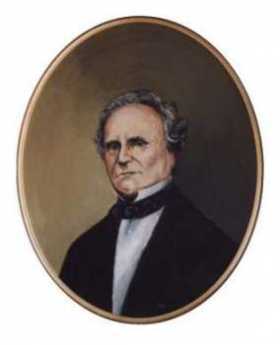
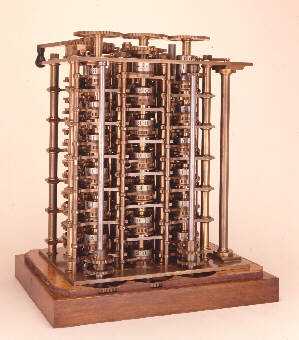
The power of this whole process was relentless, far from limited to cotton weaving. When Charles Babbage sufficiently contemplated the punched-cards carrying the simple instructions of the knitting machines, he made an intellectual leap to the underlying concept of the tabulating machine. Using what was later called IBM cards, he had the forerunner of the stored-program computer. There were plenty of Arkwrights getting rich in the meantime, and plenty of Marxists stirring up rebellion with the slogan that behind every great fortune is a great crime. But the quiet folk were steadily pushing ahead, relentlessly refining the industrial process through a belief in welcoming the suggestions of everyone.
Sacred Places at Risk
|
| Old St. Joe's |
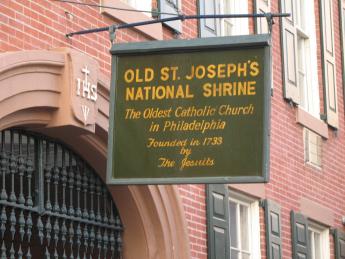
When William Penn invited all religions to enjoy the freedom of Pennsylvania, he created a home for the first churches in America of many existing religions, and furthermore the founding mother churches for many new religions. Regardless of the local congregation, there is obviously a strong wish to preserve the oldest churches of the Presbyterian, Methodist, United Brethren, African Methodist Episcopal, Baptist, Mennonite, and many other denominations. While the founding church of Roman Catholicism was obviously not in Philadelphia, St. Josephs at 3rd and Willing was for many decades the only place in the American colonies where the Catholic Mass could be openly performed. The towering genius of William Penn lay in the combination of an almost saintly wish to spread religious toleration, combined with what must have been a sure recognition that the motive of Charles II in giving him the land, was to get rid of all those dissenters from England.
Philadelphia now has a thousand church structures within the city limits, and more than a thousand in the suburbs. However, many church buildings find themselves stranded by the migration of local ethnic groups to other locations, and a decision must be made whether to demolish a relic or sell it to a new population who have moved into the old neighborhood with a new religion. There is still greater discomfort with selling an old church to a commercial enterprise, but even that happens. The resulting bewilderment and dissension among the surviving parishioners is easy to imagine as they face these choices, or fail to face them, and it is readily imagined that the establishment in 1989 of Partners for Sacred Places filled a very important need.
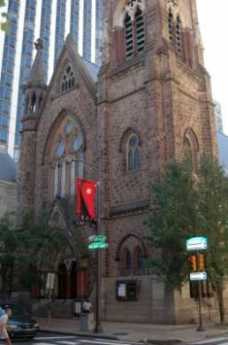
|
| First Presbyterian Church |
The Executive Director, Robert Jaeger, recently described to the Right Angle Club how the Partners operate. First of all, the Constitutional separation of church and state makes it difficult to seek funding or even advice from the Federal government. Pennsylvania has been less hesitant than most states in this regard, but even here the issue of fund-raising is a central issue. One only has to look at the Aztec and Mayan religious sites in Mexico to grasp that there are circumstances when the parishioners of a religion may have completely died out, but their monuments justify state assistance. Private, nondenominational philanthropy seems the easiest route for a society to take, in avoiding the obvious political and legal entanglements of seeming to assist one denomination more than others.
And then there are architectural issues;, can the building be saved at a reasonable cost, is it truly a unique or outstanding piece of art, can a reconstruction go ahead in an incremental way, are the necessary stone or other materials any longer obtainable, do the workman skills exist? In addition to these issues which are commonly presented to a congregation, there are issues they probably have never considered. As congregants move from center-city to the suburbs, they become commuters to church, largely out of touch with the local community and its activities. A survey conducted by the Partners suggests that 81% of the activity which takes place in church buildings on weekdays is conducted by and for non-members of the church; if the two groups lose touch with each other, opportunities are missed, and eventually there may be unnecessary friction. On the other hand, those non-religious activities probably escape the legal prohibitions against government assistance, and may suit themselves as vehicles for indirect government support. The approach has so much promise that Partners for Sacred Places has devised a computer program on their website which provides a way for congregations to assess their assets, and their problems. In fact, the organization conducts extensive training programs for church preservation, and has been forced by the size of the demand to exclude churches that are clearly failing beyond reasonable hope of recovery by their church membership.
The Partnership was originally founded by consolidation of the New York and Philadelphia organizations, to make a stronger national effort. But now things are going the other way. New chapters are springing up in Texas and California. Partners for Sacred Places is obviously proving to be a good idea, effectively managed.
WWW.Philadelphia-Reflections.com/blog/1269.htm
Quaker Gray Turns Quaker Green
|
| American Friends Service Committee Logo |
Miriam Fisher Schaefer, at one time the Chief Financial Officer of the American Friends Service Committee, had to cope with the economics of renovating the business headquarters complex for various central Quaker organizations. They're housed in a red-brick building complex, naturally, located on North 15th Street right next to the Municipal Services Building of the Philadelphia City Hall complex. The original building within the complex is the Race Street Meetinghouse, funds for which were originally raised by Lucretia Mott. The Quakers needed to expand and renovate their offices, a nine million dollar project. Miriam, a CPA, calculated that the job could be made completely environment-friendly for an extra $3 million. The extra 25% construction cost explains why very few buildings are as energy-efficient as they easily could be. However, in the long run, a "green" building eventually proves to be considerably cheaper. Not only would a green Quaker headquarters be a highly visible "witness" to environmental improvement, but it would also pay for itself in reduced expenses after about eight years. That is, if friends of the environment would provide $3 million in after-tax contributions, they would provide a highly visible example to the world, and reduce the running expenses of the Quaker center by a quarter of a million a year, indefinitely. Effectively, this is a charitable donation with a permanent tax-free investment return of 12%, quite nicely within the Quaker tradition of doing well while doing good.
|
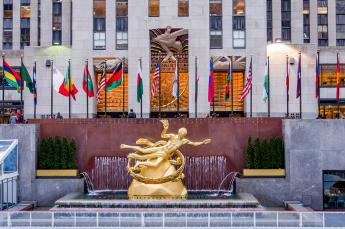
| Rockefeller Center |
Energy efficiency isn't one big thing, it is a lot of little things. If you dig a well deep enough, its water will have a temperature of 55 degrees, and only require heating up another 15 degrees to be comfortable in winter, or cooling down thirty degrees to be comfortable in the summer; that's described as a heat pump. Then, if you plant sedum, a hardy desert succulent plant, on the roof it will insulate the building, slow down rainwater runoff, and probably never have to be replaced. Rockefeller Center, you might be interested to learn, has a "green roof" of this sort, which has so far lasted seventy years without replacement. The Race Street Meetinghouse was built in 1854 and has so far had many roof replacements, each of which created a minor financial crisis when the need suddenly arose.
The ecology preservation movement is full of other great ideas for city buildings because buildings --through their heating, ventilating and air conditioning -- contribute more carbon pollution to the atmosphere than cars do. For another example, fifty percent of the contents of landfills originate in dumpsters taking construction trash away from building sites. What mainly stands in the way of more recycling of such trash is the extra expense of sorting out the ingredients. Catching rainwater runoff allows its reuse in toilets, eliminating the need to chlorinate it, meter it, and transport it from the rivers. And so forth; you can expect to hear about this sort of thing with great regularity now that the Quakers have got stirred up. You could save a lot of air conditioning cost by painting your roof white. At first, that would look funny. But do you suppose oddness would bother the Society of Friends for one instant? No, and you can expect them to make it popular, in time. People at first generally hate to look funny, but with the passage of time they grow to like looking intelligent.
A lot of people want to save the planet. So do the Quakers, but they have come to the view that the public is more easily persuaded to save money.
Immigration and Universal Health Insurance
Among the many articles about the economic wonder of Dubai,
|
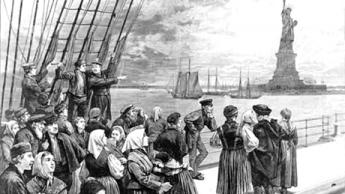
| Immigrants |
along the Persian Gulf, is the comment that only 20% of Dubai's residents are citizens of that country. The other 80% seem to be immigrant workers, flocking there to make $2 an hour because at home they can only make $1. America only has 12 million illegal immigrants at the moment, but comparing our problems with such extreme cases sharpens the discussion.
No matter what position you take on the question of universal American health care or universal anything else for that matter, you eventually have to re-examine your beliefs about our national borders. It is plainly absurd to propose that America should provide health care for the whole world, but if we allow essentially unlimited immigration it comes close to the same thing if you provide health care for everyone who is here.
The reason Dubai is a useful example is that we, too, are working our way into the fix of basing our prosperity on immigration we cannot handle. In recently seeking bids for a new roof, the choices I received were from Costa Ricans, Poles, and Puerto Ricans. True, one American citizen did inquire, but he was merely a contractor for some others, who were almost surely illegal migrant workers. Following the advice of a friend, I chose the Costa Ricans because they were rather small in size; my friend said they were less likely to get hurt falling off the roof. Although the situation in Dubai is more advanced, we seem to share the same difficulty that our economy would become pretty unworkable without immigrant labor. That problem for us does introduce an element of fairness into providing health care for people we really do depend on, or you could adopt the line that issues of practicality urge us to find a solution. Either way, you confront a dilemma, a problem offering two solutions or possibilities, of which neither is acceptable. Perhaps at least we could invent a new term, a multi lemma, defined as a problem with lots of solutions, none of which would work.
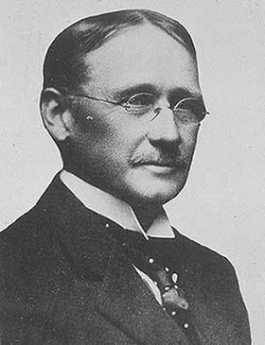
Quaker Efficiency Expert: Frederick Winslow Taylor 1856-1915
|
| F.W. Taylor |
For at least seventy-five years after Fred Taylor turned it down, any rich smart Philadelphia Quaker attending Phillips Exeter would have been automatically admitted to Harvard. We don't know why he did it, but instead F.W. Taylor just walked a few blocks down the hill from his Germantown house and got a job at the Midvale Steel Company as an apprentice patternmaker. During the twelve years, while he rose to become chief engineer of the company, he took a correspondence course for a degree in mechanical engineering at Stevens Institute and invented a process for making tungsten steel, called high-speed steel. That made Midvale Steel rich, but Taylor was going to make Philadelphia rich, and after that, he was going to make America rich. When he died, he was widely hated.
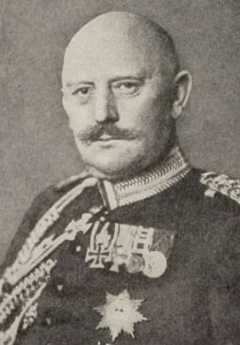
Evidently his lawyer father greatly admired German efficiency, having sent little Freddy to a famous Prussian boarding school where he was in attendance at the time of the
|
| General von Moltke |
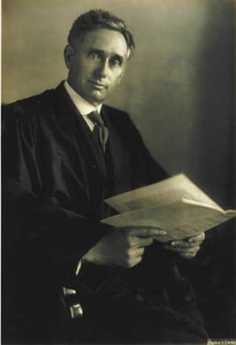
Battle of Sedan. General von Moltke had used Prussian efficiency and discipline to defeat those indolent lazy French, and Fred Taylor evidently absorbed and retained these stereotypes for the rest of his life. Whatever he was looking for at Midvale Steel, what shocked him most was to find workers "soldiering on the job". That's a Navy term, by the way, invented by sailors to describe the useless shipboard indolence of any Army they were transporting. Taylor later went to Bethlehem steel, reduced the number of yard workers from 500 to 180, and was promptly fired. It seems that most of the foremen at the plant were owners of local rental houses, which were emptied of tenants when Taylor reduced the workforce. Even management came to mistrust Taylor. When the railroads wanted a rate increase, Louis Brandeis defeated them with the argument that they wouldn't need higher rates if they adopted Taylor's system of efficiency. In his later years after he became enormously rich, he toured the country giving speeches without fees, promoting the doctrine of finding the one best way and then doing everything that way.
|
| Louis Brandeis |
Over time, Frederick Taylor had come to see that the industrial revolution had proceeded to the factory stage by merely bringing craftsmen indoors, each one treasuring his little trade secrets. Bringing the point of view of the company's owners onto the shop floor, Taylor could see how vastly more profitable the steel company would be if all those malingering tradesmen would stop soldiering on the job. No doubt the young Quaker soon learned that little was to be accomplished by remonstrating with workers, just as bellowing foremen had learned that bullying was also useless. Out of all this familiar scene emerged Taylorism, the idea of paying financial incentives to those who produced more, splitting the rewards of efficiency with the management. It sort of worked, but it didn't work enough to satisfy F.W. Taylor. When he walked around with a stopwatch, he collected the data showing how much more might be produced if the workers were perfectly efficient. Not only did that create the stereotype of the stop-watch efficiency expert, but it also provoked Congressional hearings and federal law against stopwatches which stayed on the books from 1912 to 1949. Although management responded by forming dozens of Taylor Societies to honor the approach, the unions invented the term "Taylorism" and bandied it about as the worst sort of epithet. Curiously, the Taylor approach proved to be enormously appealing both to Lenin and Stalin, who applied it as a central part of their five-year plans and general approach to industrialization. As we now all recognize, the Communist approach was a two-tier system instead of the three-tier system that was needed. It isn't enough to have a class of comrades called planners and another called workers; you need a layer of foremen, sergeants and chief petty officers in the middle. In addition to the elaborate time and motion studies leading to detailed written procedures, there needs to be an institutional memory for the required skills of the trade. In a funny sort of way, Fred Taylor the Quaker may have organized the downfall of the communist state before it was invented.
|
| Herbert Hoover |
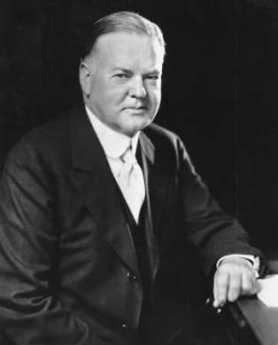
Another peculiar outgrowth of Taylorism may be the partisan lines of our own political parties. If you trace the American ideological divide to the 1932 election of Franklin Roosevelt, you can see we are still fighting the battles of the depression. It happens that Herbert Hoover, another Quaker, was totally captivated by Taylorism. Not only that, he was adamant that to get rid of the depression all the country needed was to return to self-reliance, individual responsibility, and hard work. Those were qualities Hoover himself had in superabundance. One telling remark that he probably regretted saying but nonetheless firmly believed was, "If a man hasn't made a million dollars by the time he is forty, he can't amount to much." Franklin Roosevelt had the million all right, but his family had given it to him. The Cadburys and Clarks could have given it to Fred Taylor, too, but he chose to make it himself.
www.Philadelphia-Reflections.com/blog/1296.htm
Gardening Survives
Adam Levine, the author of a new book about the Philadelphia public garden scene was recently the featured guest speaker at the Franklin Inn. He's a charming person, and has given us a great book.
He draws to our attention that the Philadelphia region is pre-eminent in the garden world, and has been so for several centuries. While it is true that Philadelphia has a mild enough climate to be suitable to two climate zones, the early settlers came from a region of middle England that has been a garden center since Roman times. And they were Quakers, uncomfortable with the outward show in buildings and furnishings, but flowers were innocent instruments of the display. Although Chanticleer was created by a Pennsylvania German family, the great centers of public gardens are mostly traceable to the influence of Quakers, and the du Pont family. Since one or two years of neglect will ruin almost any garden, the essence of great gardens lies in the ability to survive.
|
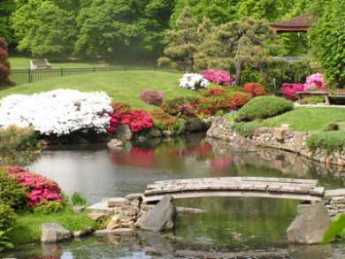
| The Horticultural Society |
In fact, the Philadelphia area contains hundreds of gardens which have decayed and virtually disappeared. The Horticultural Society is at the heart of garden preservation, financed in large part by the annual flower show, but even that thriving organization is hard pressed to do justice to the vast areas that need tending. Woodlands would be an example of an area needing tending, and Friends Hospital is an object lesson. When that venerable institution was sold to sharp pencil types from out of town, the Azalea gardens on the grounds were closed to visitors, except for two hours a year. It makes you tremble to imagine how long this famous azalea collection will probably survive. Meanwhile, Germantown's famous gardens are maintained in a minimal way, stretching the resources of the owners who have more urgent demands to meet in their buildings and furniture. Indeed, it is hard to name a really outstanding garden within the city limits, with the exception of the Morris Arboretum, which barely makes it within city boundaries. The area back of the Art Museum along Boathouse Row makes a brave attempt in the spring, but it's a pale reminder of the glory which used to be seen in East Fairmount Park, especially at Lemon Hill, Stenton, and Cliveden. Stotesbury is just a relic.
|
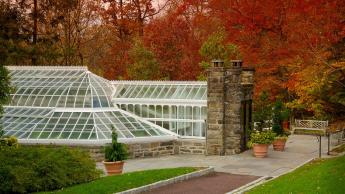
| Morris Arboretum |
Gardens have moved to the suburbs. Chanticleer, the Morris Arboretum, Longwood Gardens, Nemours, the Scott Arboretum at Swarthmore, West Laurel Hill, The University of Delaware in Newark, Cabrini College in Villanova, Haverford College Arboretum, Temple University's Ambler campus, and the Trenton Sculpture Gardens on the old fairgrounds -- all would demand mention in any list of outstanding gardens in America. But only a few of them aspire to the standards of an outdoor sculpture garden, where the goal was to surround each piece of sculpture with a garden in such a way that only one sculpture could be seen at a time. Now, that was gardening on the grand scale.
Hidden in a regional garden scene is the seed merchants, starting with John Bartram and famous under the Burpees, which make gardens possible. After all, there has to be a place to find these things. Perhaps the catalog stores, like Wayside Gardens, are the hope for the future. Every shrub or tree transported from a nursery takes up a ball of topsoil along with the specimen, and the appearance of nurseries around the periphery of a city is usually the first step in the development of housing projects. If there is an investment of topsoil in every garden, perhaps we ought to think a little bit about the way we let the investment dry up and blow away.
REFERENCES
| Gardens of Philadelphia and the Delaware Valley William Klein Jr. ISBN-10: 1566393132 | Amazon |
The Inky
 The Philadelphia Inquirer had a new, local, management. We wished it well. 
|
Brian Tierney, the then-new CEO of the Philadelphia Inquirer -- and Daily News -- recently addressed the Business Roundtable of The Union League. He's quite a peppy fellow, but unlike most fast-talking salesmen, appears to avoid slanting the truth in his reporting about his new job. He fired a lot of facts at the breakfast group in fifteen minutes, and in retrospect touched on several important issues.
|
| Brian Tierney |
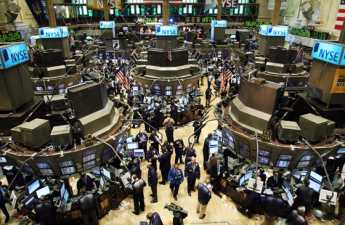
First of all, corporate control. Because the New York Stock Exchange for years prohibited dual classes of ownership, most major newspapers listed their stock elsewhere rather than give up the tight corporate control by minority management. That seems like an unreasonable position at first; the sort of undemocratic tyranny that most editorialists would reflexly criticize. However, Knight Ritter, the former owner of the Inquirer, surrendered to high principle and listed on the NYSE by having a single class of stock. Mr. Tierney didn't explain just how this caused the newspaper chain to lose money, but was cited as an example of the reasons why the newspaper was changed to a privately held arrangement in which the shareholders agree not to sell for five years, and then give the right of first refusal to other members of the group. We'll have to wait for the passage of time to judge what the arguments are and their merits. It's apparently linked to another agreement with more intuitive reasonableness; the stockholders agree not to interfere with the journalism. We'll see in time whether this arrangement leads to journalistic integrity, or whether it leads to one of those famous uproars where an eminent editor lets it go to his head and gets fired amidst a loud chorus of criticism from the editorial pages of other newspapers.
|
| New York Stock Exchange |
And then there is the issue of unionism. Some 2000 of the 2600 employees of the Inquirer are members of some union, and this is the main source of the famous liberalism of the media. The corporations which own newsmedia get trapped into the position of proclaiming their concern for the rights of the working man so frequently that they cannot escape it in their own labor negotiations. In the case of the Inquirer, this tendency led to the conferring of full sick pay to the employees, for 42 weeks a year. While this provision is really intended to be a generous provision for extended rehabilitation from medical catastrophes, it leads to some flagrant abuses from time to time, grimly defended by a rather embarrassed union lawyer. The Inquirer was losing money and needed to lose some more to revive its position by investing in the future. No doubt there was some significant posturing by both sides when these contracts were re-negotiated by the new management. Ultimately, the fairness of the labor agreements, union or otherwise, will be judged by whether the newspaper is able to attract and retain outstanding employees. If not, it will not matter how fair the contracts appear to be.
Both television news and newspapers are slipping. Perhaps that is temporary, perhaps it does not greatly matter what medium delivers our information to us. People under the age of 30 seem to be most distracted by other amusements, and it is anybody's guess whether they will return to the news as they grow up. But one central fact about newspapers emerges. The Inquirer employs 460 journalists and pays $3 million a year to the Associated Press and other sources. The nearest competitor is KYW, which has 38. Whatever you may think about their viewpoints or the nature of the media, this is the main news collection agency in the region by a very large margin. News is created by reporters. If you don't believe that, just watch how the papers shrink during the summer and long holidays. We wish the new owners well, hope they make a ton of money, and hope they don't let success go to their heads.
Forty Days Before the Mast
|
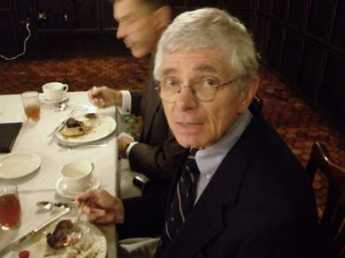
| Dick Watson |
Most Americans would like to lose weight, particularly if they could eat, and eat some more, at the same time. Dick Watson recently told the Right Angle Club about an adventure cruise on a sailing ship in the South Pacific, where he and everyone else ate huge mounds of delicious food, but still lost 12 pounds in a month. About twenty of these voyagers spent eight thousand dollars for the privilege of working as sailors for a month on an authentic pre-steam brigantine, sailing from Aukland to Easter Island. Dick took fourteen hundred beautiful photos of the experience, but most of his audience sat transfixed at the description of the horrors of sailor life. Not your average luxury cruise.
|
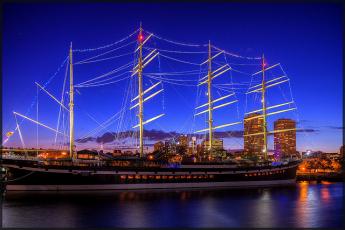
| Moshulu |
A brigantine is about an eighth the size of the Moshulu parked in Penn's Landing, and definitely does not plow the waves. Bobbing like a cork with every ripple, the ship "rode" waves throughout this "Pacific" cruise that averaged six meters or about twenty feet high. It thus follows that every single voyager was deathly sea-sick for the first two or three days; welcome to the bounding main. In spite of excruciating incapacity, sailors are not excused from standing watch; that's just about the first law of the sea. However, after a few days, this problem seems to go away for almost everyone and becomes only an initiation rite in retrospect. What doesn't go away is the wind, the cold, and the rain. Climbing the rigging gets you up to the fighting top, a wooden platform forty feet above the deck. Bigger ships sometimes have a hole in that platform to crawl through, but brigantines don't have rubber holes. You climb the mast and work your way out to the edge of the platform hanging upside down, then drag yourself up and over the edge. Once you are there, you can attach your safety belt, but the transition depends entirely on having enough strength in your hands to hold on while the ship rocks from side to side, forty feet below. Above the fighting, the top is another fifty feet of climbing, as the shrouds (ropes) which are attached to the top narrow down to the point where there is no longer room for your foot unless you turn it sideways. Ballet dancers learn to walk on their toes, but walking and climbing on the side of your foot is a step beyond excruciating.
Perhaps it is the good thing our ancestors came over to settle America that way. Except for a few people like Benjamin Franklin they gladly gave up all thought of returning to the home country. However difficult it may have seemed to cope with the Indians and all, they were going to be Americans forever. Other people could fight wars about events that took place in 1384. We weren't going to worry about that sort of thing because we were not going back, ever.
WWW.Philadelphia-Reflections.com/blog/1323.htm
Social Disintermediation
|
A term borrowed from the banking world seems to explain the recent decline of local government, local clubs, and local news sources.
|
The growing speed of communication, especially the electronic sort, exacts its price. Western civilization spent several centuries building up valuable social structures intended to unite citizen opinion with that of their leaders. A lot of that now seems unnecessary. Most people now know how to read, write, type and press enter. A dozen systems attempt to catch up with Google in the art of telling people what they say they want to know. C-span lets us hear our leaders speak, more or less in person, and then answers our phone call, sometimes.
Quite a change from the days when people knew nothing and knew they knew nothing. Benjamin Franklin formed dozens of little clubs and societies for people of like minds to learn what was going on, and to magnify the force of their collective opinion to influence it. That's essentially why Philadelphia remains a city of clubs, but the diminishing need for such megaphones also goes a long way toward explaining the decline of clubs. The Bar Association has less importance for lawyers, the AMA less for doctors. One consequence that is noticeable is an ascension to power within such declining organizations of minority groups, fringe opinions, and other elements still desperately searching for a voice. The power elites now prefer to aspire to befriend and influencing national power centers directly, and in the process unconsciously augment the importance of centralized power. The upper layers of the government bureaucracy have become infiltrated with educated and high-minded graduates of elite schools, and toward them often go the appeals of former classmates with less plausible motivations. Quite rapidly for a social revolution, people are changing political sides, and the consequence is polarization.
Regardless of laments for the systems and institutions of the past, polarization is dissolving the old glue that binds the nation together, heedless of the new glue of electronics and instant communication with like-minded strangers. It's hard to know what people really believe about the polarizing effect of gerrymandering congressional and legislative districts because it brings people of like opinion together and people generally enjoy that. But professional analysts of the political scene focus on the effect of each ten-year census and claim that the elections of the next decade are easily predictable once you know how the revised census was gerrymandered. Contrast the difference in deportment between the scruffy members of the U.S. Congress with those of the U.S. Senate, where gerrymandering is impossible. The consequence often goes unnoticed, because gerrymandering means that people of the same opinion are more likely to find that everyone they know -- agrees with them. It's not entirely a new phenomenon. When Franklin Roosevelt defeated Alfred Landon in the greatest landslide in our history, many voices were raised that the election must have been fixed because everyone they knew voted for Landon. Something like that misperception affects many who voted in the two elections of George W. Bush, differing in these essentially tied elections only that both sides believe they were cheated. The buffering organizations, the clubs, ethnic groups, and even the political parties either no longer survive, or are dominated by die-hards.
How much of all this is just temporary disorientation, how much is a growing trend predicting the future, is unclear. The harsh and thoughtless oaths and demands which have become so disagreeably common may pass away when people get a grip on themselves, or they may escalate into our normal level of public discourse. Negative campaigning, experts say, is effective. Political campaigns get progressively harsher and dirtier as they approach election day. Money talks, and it talks by buying professional assistance to say what the buyer is ashamed to say. A political party wants to win elections above all else; those who lose elections are quickly hounded into oblivion. And yet, and yet. A slogan or two can still turn this sort of thing around. Just tell a loudmouth that he sounds like a junkyard dog, and see how quickly the listeners quiet down. It's a vicious thing to do, but it works, using vile attacks to silence vile remarks.
To a considerable degree it works because it draws attention to how little substance is to be found in these shouting matches. Someone who heard a major general gives a talk may be emboldened to offer a different opinion on combat strategy, but he still knows how little he knows and retreats at the first sound of answering fire. The person who just listened to the Chairman of the Federal Reserve talking about interest rates may claim to disagree but soon looks a fool if asked to document that opinion. The barroom orator, unrestrained by association with local opinion makers in person, is emboldened to rise to combat with the champions of the opposition. Most of us soon learn not to pick fights with the varsity, and there is at least some small hope that civility will eventually return when a few more noses get bloodied.
You can try soft reasoned analysis if you wish, but at the moment it isn't very popular.
Germantown Avenue, One End to the Other

|
| Germantown Map |
Chestnut Hill really is a big hill poking up in the middle of Philadelphia, and Germantown Avenue follows an old Indian trail from the Delaware River right up to that hill. The waterfront area of the city has been built and rebuilt to the point where it's now a little hard to say just where Germantown Avenue begins. From a map viewpoint, you might look for a four-way intersection of Frankford Avenue, Delaware Avenue, and Germantown Avenue, underneath the elevated interstate highway of I-95. The present state of demolition and rubble heaps suggests that a Casino might be built there sometime soon, politics and the Mafia permitting.
|
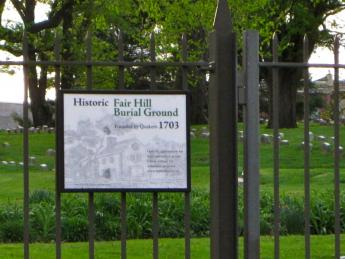
| Fair Hill Cemetery |
Although Germantown Avenue has wandered northwestward from this uncertain beginning for over 300 years, up to the rising slope of the town toward Broad Street, it is now rather difficult to make out anything but industrial slum along its path which could be called historic. There is hardly any structure standing which has a colonial shape, and no Flemish bond brickwork is seen in the tumble-down buildings. When with the relief you finally approach Temple University Medical Center at Broad Street, the Fair Hill cemetery does show some effort at preservation, and a sign says that Lucretia Mott is buried there. But that's about all you could photograph without provoking suspicious stares. Here's the first of four segments of Germantown Ave., and it's a pretty sorry sight.
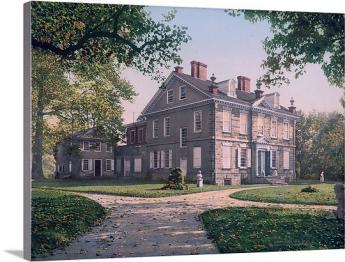
|
| Chew Mansion |
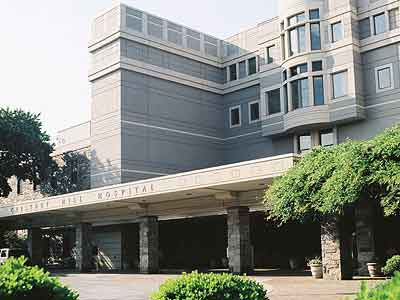
Crossing Broad Street, the busy intersection suggests 19th Century prosperity in its past, and on the west side of Broad, you can start to see signs of historic houses, either in colonial brickwork or grey fieldstone. The road gets steeper as you go west past Mt. Airy, where it almost brings tears to the eyes to see brave remnants of another time. George Washington lived here for a while, and the Wisters, Allens, and Chews; Grumblethorp and Wyck. The huge stone pile of the Chew Mansion glares at the imposing Upsala mansion, where British and Americans lobbed artillery at each other during the Battle of Germantown. Benjamin Chew the Chief Justice built this house as a summer retreat, to get away from Yellow Fever and such, and started the first migration to the leafy suburbs. His main house was on 3rd Street in Society Hill, next to the Powels and where George Washington stayed. At the peak of the hill in Chestnut Hill, a suburb within the city. Germantown Avenue rather abruptly goes from the relics of Germantown to the charming elegance of Chestnut Hill, but during a recession, it frays a little even there. At the very top is the mansion of the Stroud family, now in the hands of non-profits; across the road in Chestnut Hill Hospital, once the domain of the Vaux family. Then down the hill to Whitemarsh, where the British once tried to make a surprise raid on Washington's army. As you cross the county line into Montgomery County, it's conventional to start calling the Avenue, Germantown Pike. Germantown Pike was in fact created in 1687 by the Provincial government as a cart road from Philadelphia to Plymouth Meeting. Farmers used to pay off their taxes by laboring on the dirt road, at 80 cents a day. Germantown Pike, Ridge Pike, Skippack Pike, Lancaster Pike, and others are a local reminder that Pennsylvania was always the center of turnpike popularity; that's how we thought roads should be paid for. The present governor (Rendell) hopes to sell off some better-paying turnpikes to the Arabs and Orientals, possibly imitating Rockefeller Center by buying them back and reselling them several times by outguessing the business cycle. Parenthetically, the Finance Director of another state at a cocktail party recently snarled that the purpose of privatizing state infrastructure was not to raise revenue, but to provide collateral for more state borrowing. He wasn't at a tea party, but he may soon find himself there.
From a modern perspective, the third segment of the Germantown road runs from Chestnut Hill to Plymouth Meeting, with lovely farmhouses getting swallowed up by intervening, possibly intrusive, exurbia. The township of Plymouth Meeting is a hundred years older than Montgomery County, having been built to be near a natural ford in the Schuylkill River. Norristown, a little downstream, is the first fordable point on the Schuylkill, with Pottstown making a third. Plymouth's colonial character survived a period of industrialization based on local iron and limestone, and has established several prominent schools for the surrounding area. But the construction of a substantial highway bridge attracted a large and busy shopping center. The shopping center looks as though it will eradicate the quaint historical atmosphere more effectively than industrialization ever could.
The fourth and final segment of Germantown Pike starts at the Schuylkill and goes over rolling countryside to its final destination at Perkiomenville, where it joins Ridge Pike at the edge of the Perkiomen Creek. That's an Indian name, originally Pahkehoma. Perkiomenville Tavern claims to be the oldest inn in America, although that honor is contested by another one along the Hudson River near Hyde Park. The WPA during the Great Depression constructed a large park along the Perkiomen Creek for several thousand acres of camping and fishing, so Perkiomenville has several large roadhouse restaurants and antique auctions for bored wives of the fishermen. In the V where Ridge Pike and Germantown Pike come together, a dozen or more colonial houses are tucked away in a town called Evansburg. This formerly Mennonite terminus of Germantown Pike obviously still has a lot of charm potential, and its local inhabitants are very proud of the place. But it's easy to zip past without noticing the area, which includes an 8-arch stone bridge, said shyly to be the oldest in the country. It's hard to know whether you wish more people would visit and appreciate; or whether you are happy that obscurity might permit it to survive another century or so.
|
| Chestnut Hill Hospital |
The name change of the Germantown road from Avenue to Pike is probably not precisely where the turnpike began, but it is now notable for some pretty imposing mansions, standing between the humble and even somewhat dangerous slums along Delaware, and the charmingly humble but well-preserved Mennonite villages, at the other end. It is arresting to consider the two ends, whose houses were built at the same time; only the Mennonites endure. Somewhere just beyond the Chestnut Hill mansions is an invisible line. West of that point, when you say you are going to town, you mean Pottstown. When you say you are going to the City, you mean Reading. And as for Philadelphia, well, you went there once or twice when you were young.
Commercial Academic Think Tank
|
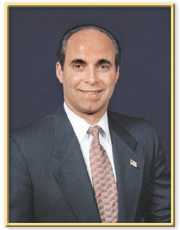
| Stephen P. Mullin |
Stephen P. Mullin recently addressed the Right Angle Club of Philadelphia about assorted economic subjects; he is certainly qualified. He was once the only Republican in Mayor Rendell's cabinet, acting first as Finance Director and then as Commerce Director. At first, he doesn't appear extroverted enough to be a politician but quickly demonstrated that he knew the first names of more of the members of the club than the president did, so maybe he does have the innate talents of a politician. Urban political machines don't usually respond cordially to graduates of Exeter and the Wharton School of the University of Pennsylvania. A number of University professors are consultants to the firm, which offers statistical economic advice to the many law firms in town, to philanthropic organizations considering public-interest projects in the region, to government agencies faced with regulating unfamiliar activities, and very likely to anyone else willing to pay for the service of academics, statisticians and analysts. It certainly sounds like a service that governments and philanthropies need, and which the region needs to avail itself of. In a way, it is probably something the University needs, as well. A friend of mine is now retired, but at one time I commuted on the train with an academic administrator of the Wharton School, who was quite obviously disturbed by handing diplomas to students who promptly took jobs which paid those graduates more than he was paid himself. Obviously, such a system cannot persist very long without creating a brain drain, so income supplementation by commercial consulting is a necessary and valuable support for academics. There are, of course, probably some negative features as well.
|
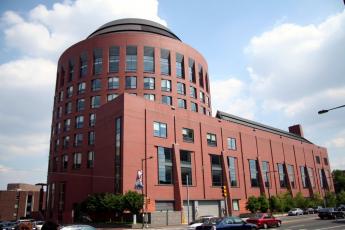
| The Wharton School |
It is interesting to hear from Steve how Philadelphia can be variously described. We have, for example, significantly less foreign immigration than other cities. New York, by contrast, has net immigration of about 700,000 persons a year; such forces can quickly transform a city in a variety of ways. The bombing of West Philadelphia during the Goode Administration was news for a while, then vanished from the papers. But it had a shattering effect on Philadelphia commerce, leading to a period of 8 or 9 years when there was essentially no private investment in the city. Philadelphia indeed now needs to have its municipal bonds issued by the state bonding authority, because our own bond rating is so low the extra cost of municipal debt is a significant one. And there is the cost of invisible shifting of power to Harrisburg. An unexpected result is that sales and real estate transfer taxes escalated to make up for property taxes which they could not possibly be raised as much as inflation. Real estate was in big trouble; whether ingenious strategies like the 10-year tax abatement for a new property will be successful in rescuing the real estate industry, remains to be seen. New office towers have been built, but they drain off tenants from older office buildings. We're seeing a massive conversion of older office space into residential apartments, an apparently successful maneuver. But that drains the older residential areas, which leads to -- well, who knows what it will lead to, but it could be slums.
|
| Mayor Michael Nutter |
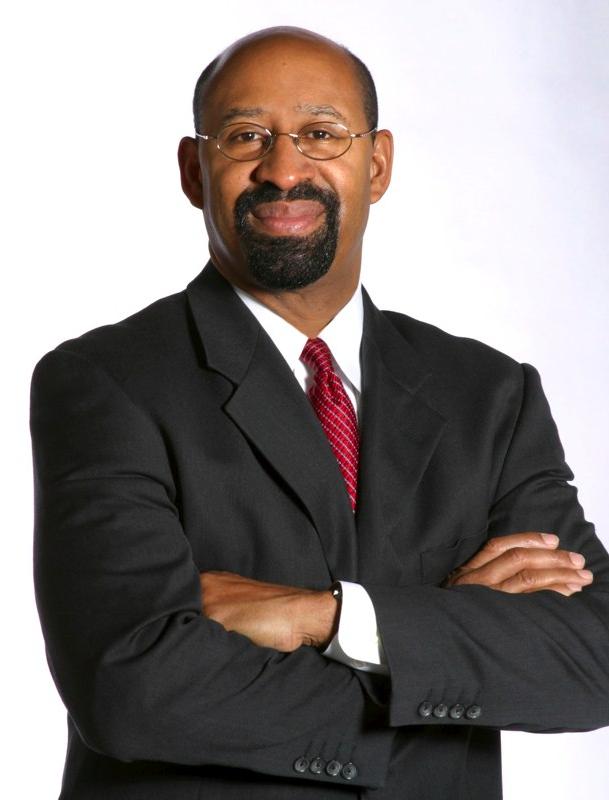
The traditional hostilities between Philadelphia and its neighbors can be defined in a new way, too. For a century, Philadelphia contributed more tax money to the rest of the state than it received in state services. But in the past 20 years, Philadelphia city has become a net importer of an annual billion dollars -- from the rest of the state. Two or three billion go to the schools, which the rest of the state regards as a deplorable waste in view of the quality of the product. And yet, the most hopeful feature of the situation is the vigor and ingenuity of the attempts being made to rescue the situation. In a certain sense, Mayor Nutter is the candidate of the Wharton School. He may well have some innovative ideas, and academic places like the Wharton School will surely suggest others. It remains to be seen whether Nutter can combine idealism with sufficient ruthlessness to make the city function. Cynical oldtimers will grumble that a mayor has to employ a moderate amount of deception and corruption in order to accomplish his mission. Maybe that overstates things, but it is very certain he must be tough. He's dealing with construction unions who will certainly be tough, and whose interest in sacrificing their own agendas in order to help the schools or street crime -- always fairly small -- is even further impaired by the econometrics that 70% of them live in the suburbs. We wish our new mayor all the best, since he seems smart enough to know what needs to be done, and is definitely smart enough not to drop any bombs on houses. He's smart enough to see that extra city revenue derived from gambling might permit the lowering of wage taxes, and hence an urban business recovery. But is he tenacious enough to stay in office long enough to achieve the balanced result; or will the forces of evil simply kick him out of office before wage taxes can be lowered and gambling discontinued? He won't break his promises, but will they break them for him? Beyond being competent, a city mayor needs to be tougher than the convivial but very mean friends he needs to associate with. He must, for example, decline to run for national office, the traditional way that city machines rid themselves of pointy-headed reformers.
The Garden Show Evolves
Adam Levine, who is the unofficial authority on the Philadelphia garden scene, has written elegant books about The Flower Show, and about the larger gardens in the region. At a recent luncheon meeting at the Franklin Inn, he traced the evolution of the Flower Show.

|
| The Pennsylvania Horticultural Society |
The Pennsylvania Horticultural Society was founded in 1827, and it organized the first Flower Show in 1829. For a century it was only an amateur display, very similar to the sort of local garden club display found in many towns and villages in England. The timing of such shows is dictated by the booming season of the flowers of the region, so the display depends on the dates of the local flowers, related in turn to soil and weather conditions. In the early part of the Twentieth Century, W. Atlee Burpee became the dominant force in the Philadelphia show. The show established a long tradition of domination by seed companies and nurseries, with elaborate displays which often took a week to set up, preceded by months or years of planning. The central difference in the nature of the Philadelphia show was that plants were forced into bloom, so much of its impact depended on displays which were seemingly entirely out of season. After World War II, Ernesta Ballard became the moving and controlling force, driving The Show into enormous popularity in the new larger quarters at Convention Hall. Considerable revenue was generated and used to beautify Philadelphia. The Show became the biggest, best, most popular and best funded flower show in America. Ernesta was a success.

|
| Mrs. Ballard |
Gradually, the most elaborate or dominant displays were put on by florists, using cut flowers. That was not necessarily Mrs. Ballard's original intention, although it might have been. It is the nature of plant nurseries to take away a ball of topsoil when they sell a plant, and that tends to dictate the location of the major nurseries in places where farmers are willing to ruin the land for farming, looking to speculate on suburban development. They thus are usually rural or exurban, because prime farmland is too expensive. Obviously, nurseries are pressed outward from the rim of the expanding city, and may even be forced to locate at a considerable distance away. These realities of the business tend to diminish the local loyalties of the nurseries and the city to each other. Mainly, cut flower arrangements resisted this trend by using greenhouses, but air freight has now made it possible for exhibitors of live plants to come from the Netherlands, Peru, and even Korea. The Flower Show is still held in Philadelphia, but it is much less a product of Philadelphians, especially amateur Philadelphians. When large single exhibits now can cost $100,000 apiece to organize, it is not surprising that the Philadelphians who do exhibit, are members of the upper crust.
And then there are those unions. While upper crust exhibitors can afford to pay full union wages for an electrician to plug in one electrical outlet, they are instantly offended by the whole featherbedding experience of being forced to do it. And since a great many blue collar union members are hostile to any suggestion that these gentleman farmers are in any way their social superiors, they can display what is known as an attitude. Philadelphia is famous for aggressive unions, and the Convention Center is additionally notorious for unions with political clout. Somehow, the politicians in charge of this unfortunate passive-aggressive scene get control of it and are seen to get control of it. After all, snooty exhibitors are occasionally in a position to move whole factories out to the suburbs, to the general injury of the city; moving a flower show wouldn't be too hard to do. The paradox is that 70% of these union members live in the suburbs themselves. The Flower Show cannot run without the enthusiastic help of 3500 volunteers, easily turned off by muscling them. The judging is done by 175 volunteer judges from all over America, coming to Philadelphia at their own expense, for example.
The Flower Show has had memorable moments. There was a time when the Shipley School consistently won most of the prizes. There was a famous episode when the Widener Estate of Linwood had a world-famous Acacia display. When it was broken up, there was an uproar when it was given to Washington DC, instead of staying right here where it belonged. Now, the gossip is about exhibitors from Ukraine, or from Japan, making little laughable mistakes about local geography with many streets named One Way.
The Show goes on and thrives. But just what its future is going to be is unclear. The Convention Center has doubled its space, but whether it can double its business is uncertain. And the management has recently changed from leadership which had a focus on the show and regarded city beautification as something to do with left-over profits, to leadership with a primary interest in the beautification of the city. No business will thrive if it neglects its revenue stream. So, please be careful with our nice Flower Show.
REFERENCES
| Standardized Plant Names: American Joint Committee on Horticultural, Frederick Law Olmsted | Google Books |
Rise and Fall of Books
| ||
| The Library Company of Philadelphia |
John C. Van Horne, the current director of the Library Company of Philadelphia recently told the Right Angle Club of the history of his institution. It was an interesting description of an important evolution from Ben Franklin's original idea to what it is today: a non-circulating research library, with a focus on 18th and 19th Century books, particularly those dealing with the founding of the nation, and, African American studies. Some of Mr. Van Horne's most interesting remarks were incidental to a rather offhand analysis of the rise and decline of books. One suspects he has been thinking about this topic so long it creeps into almost anything else he says.
 |
| Join or Die snake |
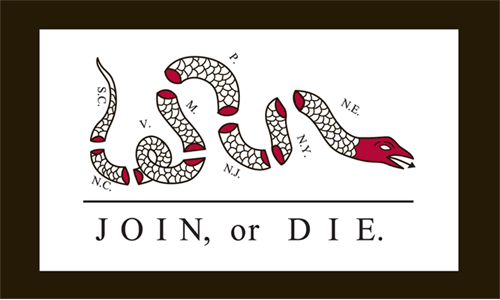
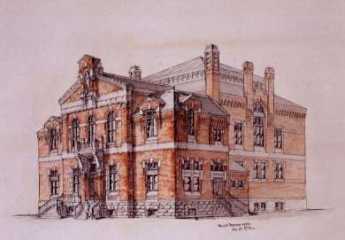
Franklin devised the idea of having fifty of his friends subscribe a pool of money to purchase, originally, 375 books which they shared. The members were mainly artisans and the books were heavily concentrated in practical matters of use in their trades. In time, annual contributions were solicited for new acquisitions, and the public was invited to share the library. At present, a membership costs $200, and annual dues are $50. Somewhere along the line, someone took the famous cartoon of the snake cut into 13 pieces, and applied its motto to membership solicitations: "Join or die." For sixteen years, the Library Company was the Library of Congress, but it was also a museum of odd artifacts donated by the townsfolk, as well as the workplace where Franklin conducted his famous experiments on electricity. Moving between the second floor of Carpenters Hall to its own building on 5th Street, it next made an unfortunate move to South Broad Street after James and Phoebe Rush donated the Ridgeway Library. That building was particularly handsome, but bad guesses as to the future demographics of South Philadelphia left it stranded until modified operations finally moved to the present location on Locust Street west of 13th. More recently, it also acquired the old Cassatt mansion next door, using it to house visiting scholars in residence, and sharing some activities with the Historical Society of Pennsylvania on its eastern side.
 |
| Old Pictures of the Library Company of Philadelphia |
The notion of the Library Company as the oldest library in the country tends to generate reflections about the rise of libraries, of books, and publications in general. Prior to 1800, only a scattering of pamphlets and books were printed in America or in the world for that matter, compared with the huge flowering of books, libraries, and authorship which were to characterize the 19th Century. Education and literacy spread, encouraged by the Industrial Revolution applying its transformative power to the industry of publishing. All of this lasted about a hundred fifty years, and we now can see publishing in severe decline with an uncertain future. It's true that millions of books are still printed, and hundreds of thousands of authors are making some sort of living. But profitability is sharply declining, and competitive media are flourishing. Books will persist for quite a while, but it is obvious that unknowable upheavals are going to come. The future role of libraries is particularly questionable.
Rather than speculate about the internet and electronic media, it may be helpful to regard industries as having a normal life span which cannot be indefinitely extended by rescue efforts. No purpose would be served by hastening the decline of publishing, but things may work out better if we ask ourselves how we should best predict and accommodate its impending creative transformation.
www.Philadelphia-Reflections.com/blog/1470.htm
Urban Bridges
|
| Reverend Mary E. Laney |
The Reverend Mary E. Laney recently told the Right Angle Club about her experiences in an Episcopal mission church, along with the history behind this innovation, and the establishment of a 501(c)(3) organization to help the idea on a national level. That may mean no more to readers of this site than at first it probably did to the Right Angle Club, before Mary Laney made it all come alive. It was quite moving.
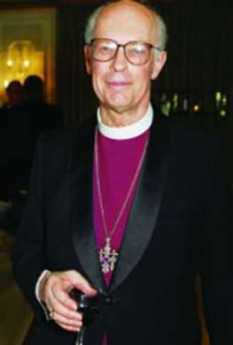
|
| Bishop Alan Bartlett |
During the 1980's she asked Bishop Alan Bartlett, at that time the Bishop of Eastern Pennsylvania for the Episcopal Church, if she might be assigned to an urban mission. As ethnic and religious population migrated around the Philadelphia landscape, quite a few Episcopal churches have been stranded in economically depressed neighborhoods, unable to afford a full-time pastor. The concept of a mission church was developed as a designation for churches that had dwindled to the point where only a handful of parishioners were left and were assigned to a category in which the Bishop would appoint a part-time Vicar to be in charge of what then needed financial support from the main church. Although in a sense Bishop White started the idea two hundred years earlier, there were no mission churches in Philadelphia in colonial times, but there are now over fifty of them, a quarter of the Episcopal churches in the region. Reverend Lancey was assigned to St. Gabriel's at the corner of Front Street and Roosevelt Boulevard, and stayed there fifteen years. She is now with St. Christopher's in Gladwynne.
The initial concept was to identify eight lead mission churches, build them up to be self-sustaining, and then replace them with eight new ones. With all good will and hard work in the world, this concept failed, largely because the social conditions of the poor at that time also depressed their educational level, and had instilled in them a culture of constant failure. In one telling episode, the parishioners said there was no hot water in the church. As a matter of fact, the pilot light of the hot water heater had gone out, and the parish was so sunken in the mindset of failure and despair they had not even looked into it. Mary Laney decided something had to be done to change the model.
What seems to have worked was the creation of a 501(c)(3) organization called Urban Bridges. The original idea behind this organization was that since the Constitutional separation of church and state precluded government grants to church no matter how struggling, but perhaps a tax exemption would make it possible for private donations to accomplish what was needed. There was, in addition, the sad experience that whenever the constitution barriers had somehow been overcome by circumvention, the many layers of bureaucracy usually consumed the money. It had proved disheartening to see four or five years go by after a government grant, with not a cent getting to the programs and all consumed by consultants, advisers and supervisors.
Meanwhile, the poor parishioners continued to base their hopes on this sort of relief, while neglecting things which might be more effective.
The Urban Bridges program evolved from a primarily fund-raising organization into a system of partnerships between prosperous suburban churches and the struggling urban missions. The suburban churches proved to be inspired with a wish to help but frustrated by a lack of means to do anything effective. It thus evolved that the suburban Episcopal churches supplied what was really most needed: practical examples of leadership on a local level, combined with visible evidence of successful effort. Literacy courses, drum and bugle instruction, computer tutoring and a variety of other spontaneous activities led to the example of leadership, and in the long run, was a far more effective fund-raising tool than printed appeals and button-holing. Even in the case of crime, it was the leadership that made the difference.
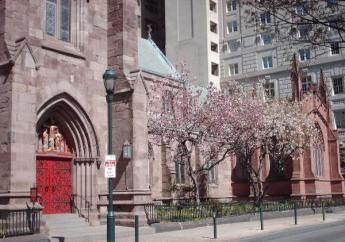
|
| St. Christopher's Church |
The story was told of a drug dealer in the neighborhood who dominated the streets with dogs and blocked access to schools unless the children agreed to sell drugs for him. Local police had proved unhelpful, and hopelessness was rampant. What would prosperous suburbanites do in such a situation? Obviously, suburbanites would not stand for such a situation and called in the Federal Drug Enforcement Agency. The crook was promptly deprived of his dogs and now resides in jail. That may not be wholly in the spirit of peaceful reasoning, but it's the American Way, all right. This was what seemed to be missing in the culture of poverty. It's the determination that whatever the cost, intolerable things will not be tolerated, combined with absolute faith that the system does provide ways to be effective without becoming either lawless or wards of the state. This is America, right?
John Head, His Book of Account, 1718-1753
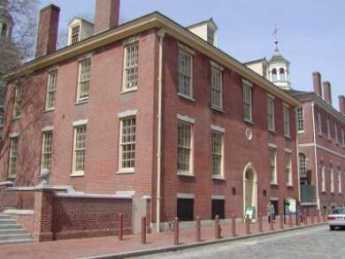
|
| American Philosophical Society |
Jay Robert Stiefel of of the Friends Advisory Board to the Library of the American Philosophical Society entertained the Right Angle Club at lunch recently, and among other things managed a brilliant demonstration of what real scholarship can accomplish. It's hard to imagine why the Vaux family, who lived on the grounds of what is now the Chestnut Hill Hospital and occasionally rode in Bentleys to the local train station, would keep a book of receipts of their cabinet maker ancestor for nearly three hundred years. But they did, and it's even harder to see why Jay Stiefel would devote long hours to puzzling over the receipts and payments for cabinets and clock cases of a 1720 joiner. Somehow he recognized that the shop activities of a wilderness village of 5000 residents encoded an important story of the Industrial Revolution, the economic difficulties of colonies, and the foundations of modern commerce. Just as the Rosetta stone told a story for thousands of years that no one troubled to read, John Head's account book told another one that sat unnoticed on that library shelf for six generations.
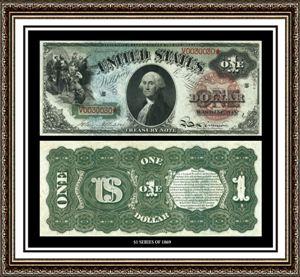
|
| Colonial Money |
The first story is an obvious one. Money in colonial days was mainly an entry in everybody's account book; today it is mainly an entry in computers. In the intervening three centuries, coins and currency made an appearance, flourished for a while as the tangible symbol of money, and then declined. Although Great Britain did not totally prohibit paper money in the colonies until 1775, in John Head's day, from 1718 to 1754, paper money was scarce and coins hard to come by. Because it was so easy to counterfeit paper money on the crude printing presses of the day, paper money was always questionable. Meanwhile, the balance of trade was so heavily in the direction of the colonies that the balance of payments was toward England. What few coins there were, quickly disappeared back to England, while local colonial commerce nearly strangled. The Quakers of Philadelphia all maintained careful books of account, and when it seemed a transaction was completed, the individual account books of buyer and seller were "squared". The credit default swap "crisis" of 2008 could be said to be a sharp reminder that we have returned to bookkeeping entries, but have badly neglected the Quaker process of squaring accounts. As the general public slowly acquires computer power of its own, it is slowly recognizing how far the banks, telephone companies, and department stores have wandered from routine mutual account reconciliation.
|
| John Head's Account Book |
From John Head's careful notations we learn it was routine for payment to be stretched out for months, but no interest was charged for late payment and no discounts were offered for ready money. It would be another century before it became routinely apparent that interest was the rent charged for money and the risk of intervening inflation, before final payment. In this way, artisans learned to be bankers.
And artisans learned to be merchants, too. In the little village of Philadelphia, chairs became part of the monetary system. In bartering cabinets for the money, John Head did not make chairs in his shop at 3rd and Mulberry (Arch Street) but would take them in partial payment for a cabinet, and then sell the chairs for the money. Many artisans made single components but nearly everyone was forced into bartering general furniture. Nobody was paid a salary. Indentured servants, apprenticeships trading labor for training, and even slavery benignly conducted, can be partially seen as efforts to construct an industrial society without payrolls. Everybody was in daily commerce with everybody else. Out of this constant trading came the efficiency step for which Quakers are famous: one price, no haggling.
One other thing jumps out at the modern reader from this book of account. No taxes. When taxes came, we had a revolution.
www.Philadelphia-Reflections.com/blog/1517.htm
World Finance, Columbus Day 2008
|
| Prime Minister Gordon Brown |
WITH voters watching three weeks before the 2008 American presidential election day, finance ministers and their political masters met to decide a basic question: dare they risk disaster to save the existing system, or play it safe by sacrificing small banks to rescue big ones? That is, guess if the situation is so bad only strong rowers can be allowed in the lifeboat, or whether things are really manageable enough to try to save everybody but at the risk of worse consequences for failure. For example the credit default swap mystery; there are $60 trillion notional value insurance policies in existence to cover $20 trillion of bonds. Is that massive double-counting, or an actual disaster so severe it makes every other consideration trivial? Answer quick, please, the ship looks like it might sink. At first, it seemed strange a Labor government in England would propose saving only the strong until you realize that Prime Minister Brown is protected from his Left, while the Democrats in America want to use a fairness argument to win their election. A Republican lame-duck president must do the deciding, a man who has been shown to be both a tough politician and a fearless gambler; playing things safe is not his style. The Dow Jones average soared a thousand points in a day's trading on the prayer that things were finally under control. But take a look around.
Little Iceland and Switzerland are proud to house some enormous banks. But if those banks approach failure, their homeland treasuries are far too small to bail them out.
On the other hand, little Hungary has a negligible banking system, so Hungarians commonly borrow money from foreign banks. The national currency devalued by half in this crisis, so most Hungarian mortgages doubled in price. Reserve systems based on national governments suddenly look obsolete.
Try another approach. Little Ireland went ahead and guaranteed all deposits in its financial institutions. Money from England and the rest of Europe immediately poured in to enjoy that guarantee, forcing other grumpy nations to match the unwise Irish offer. There's a sense that nations are losing control of their affairs.
Europe consists of 27 nations, of which fifteen are in the Euro zone. There are common currency and a constrained central bank, but can this gaggle of geese possibly agree on concerted action in this crisis? America was once in this situation under the Articles of Confederation, but even after almost losing the Revolutionary War, George Washington was nearly unable to get the colonies to form a union. Even after this experience, the Southern Confederate States later adopted the same system of a central currency without a central government and really did lose their war.
Are we to infer from Prime Minister Brown's attitude toward banks that he might soon suggest ditching little nations in order to save bigger ones?
www.Philadelphia-Reflections.com/blog/1525.htm
Financial Institutions of the Future
Things which normally dominate newspaper front pages, like presidential elections and World Series baseball, are now found back among the brassiere ads -- displaced by the stock market, credit market, banking and investment crisis of 2008. However, like the wake of a ship at sea, the past could be pointing to the future. Contemplate all the mighty financial institutions which have simply vanished.
It may even be trivial to say that Lehman Brothers and Bear, Stearns have disappeared. The fact is every investment bank has disappeared.
|
| Lehman Brothers |
And that's not all by a long shot. Savings and Loans have disappeared. Small commercial banks, and even most of the pretty big ones have disappeared. We may soon be left with half a dozen major banks and no lesser ones. Commission-based stock brokerage is now a rarity. Insurance? Well, the longevity increase of thirty years over the past century gave life insurance an enormous unearned windfall; when that flattens out, will such institutions still prosper? Individual corporate stocks are quickly vanishing into the homogenized soup of index funds, just as the securitized debt was digesting home mortgages before the current uproar. The ranks of stock analysts are thinning out; it no longer matters as much if they have a conflict of interest with nonexistent investment banks and stock brokers. All of this disappearance of institutions is in the recent past, and it mostly isn't coming back. Perhaps hedge funds and private equity companies will take over, but it is really too soon to say if they will survive, either.

|
| Credit Cards |
Credit cards have been overused and abused; that can be corrected. But the credit card system is supported by exorbitant fees charged to participating merchants; the card industry could easily disappear if the merchants devise a way to escape this private taxation; merchants universally wish to do so. The currency version of money is trying to disappear as fast as practical ways can be devised to measure value and transactions electronically. The remorseless pressure behind reducing all transactions to electronic form is created by the greatly reduced cost of it. And that pressure is magnified by electronically speeding up transactions; the faster money turns over, the more its virtual size increases. The converse, of course, is that a slow-down reduces its size. Like a giant tuna, the money supply dies of lack of oxygen if it slows down.
It can be seen in retrospect that banks are dying because everybody else stole their products by providing cheaper alternatives, mostly with computers. In the process, the national economy gets more uniform, less dependent on local agencies. Something of value has been lost, of course, particularly the local assessment of the capabilities and requirements of local customers; somehow, that seems to be expendable. But one thing, perhaps two, cannot be dispensed with.
|
| Warren Buffett |
For fifty years, we have grown accustomed to the idea that the electronic records of our institutions are accurate. That's definitely not so. Even a reliable firm makes a myriad of errors in its many transactions, catches them with redundancy and cross-checks, and presents the cleaned-up product once a month or maybe even once a day. But even though the illusion of flawlessness is maintained for the customer as much as humanly possible, it is not inherently flawless. Systemic breakdowns will always expose uncorrected flaws caught in the process, while disincentives are created by this one-sided system to spend money perfecting and refining its quality control. It's better than the old manual systems, of course, but its flaws are constantly exposed by the remorseless external pressure to do things faster, in bigger volume, in greater complexity. We approach the point where every individual needs to maintain a duplicate computer system to verify his accounts. Individual telephone bills, for example, require the aid of a computer to explain what another computer produced, brokerage transactions need computerized counterparty challenge to expose hidden fees and costs. We all know how lack of transparency brought securitized mortgages to their knees. We will soon learn that the meaning of credit default swaps defies even expert comprehension. The mysteries of university tuition discounts, hospital insurance, and even supermarket discounts cry out for safeguards to generate transparency. It may be true that even billionaires like Warren Buffett do not bother to check the accuracy of all accounts presented to them, trusting the fairness of the counterparty. But that does not contradict the need for balance. Institutions of independent public accounting are surely going to make an appearance in the future, telling people what they have and what they are paying for.
The other component which seems to be missing in our transaction system is a well-developed and widely available profession of financial advisors, equipped with electronic tools to provide their badly needed services affordably and accurately. Not only do agents and advisers need some tools, but they also need the political power to force high-handed vendor systems to permit universal customer verifications; the hooks and portals to their private systems need to be developed to make this system workable, and that will not be willingly forthcoming. But they must be provided because any independent advisor/auditors need to be subject to constant reverse-confirmation if we are to escape creating a gigantic imperfect-agency problem. But it always remains that a vendor is not an agent of the customer; his ultimate duty is only to provide an arms-length transaction with transparency. It is the customer's duty to secure his own verification system. When that occurs, it will become part of the third party duty to consent to safeguards against his own imperfect agency. But that's for later. At the moment, independent auditors of the sort needed, scarcely exist.
Much can be gained by searching to correct the flaws of the past whose significance is suddenly apparent. With a stroke of genius, the 2008 reforms of the Bush administration offered a government guarantee of safety for bank accounts which pay no interest. The light finally dawned that businesses use banks for settling up accounts and are more or less indifferent to the interest paid on deposits. When there is a bank panic or a run on a bank, deposits are shifted from bank accounts to Treasury bills in order to find safety; that's now unnecessary. If a bank account pays no less interest than a Treasury bill and is just as safe, why move it? Under the traditional system, deposits seeking safety depleted the load capacity of the bank and erected a barrier to recovery from the slump that often caused the problem. Why didn't we think of this before?
One of the sources of panic in 2008 was the enormous size of credit default swaps, several times larger than the entire American stock market, many times larger than the national debt. How could we allow such a vast over-insurance to occur? But as some appreciation of a large amount of credit swapping with foreign nations began to grow, things calmed down. If that should unravel the mystery, it is certainly far easier to determine the proportion of international swapping than to set up detailed accounting reports for $60 trillion of default insurance, particularly when the record-keeping intermediaries suddenly go bankrupt.
|
| Alan Greenspan |
As soon as the calamity of mortgage-backed securities made its appearance, hands were wrung that originating banks were not required to retain a piece of the mortgage. It seems sensible to impose this requirement on the only party in the chain with the opportunity to evaluate and screen the risks, face to face. So, we can probably expect legislation with the effect of requiring originating institutions to retain "a piece of the action". The principle may need to be extended into other areas, as well. Investment banks until fairly recently were partnerships, not corporations. The capital of an investment bank was supplied from the personal resources of the partners, who usually retired at quite an early age rather than retain big risks without actively coping with the constant pressures of hands-on oversight. Investment banks found they could not raise enough capital from rich partners who were constantly tempted to cash out, so they incorporated and sold stock to the general public. The consequence was the managers were placed in the position of taking big risks with other people's money, and able to pay themselves huge salaries without the constant snooping of rich partners at the next desk. For the time being, investment banking has been totally absorbed into other institutions, but the culture shock of mixing risk takers with risk avoiders will surely lead to something else. Like originating banks with mortgages, the originators of IPOs need to acquire some personal risk of their own, because their essential innovations will always race ahead of the imagination of underpaid plodding regulators. Instead of making a game of outwitting the regulators, investment banking must place much more reliance on the examples within their midst, of rich young kids turning themselves into paupers by assuming the wrong risks.
While we are wallowing in the idea of reconfiguring world finance to avoid the mistakes of the past, some thought should be given to goals. Alan Greenspan was able to win every argument with his reputation of guiding the economy through eighteen years without a major recession. Now that we have resigned ourselves to a return of the business cycle, maybe we should ask whether it is wise to go eighteen years, or even five years, without a correction. Some of this has to do with election cycles, so it isn't easy. But perhaps we have learned that perpetual prosperity is a mirage, small frequent readjustments are better.
Merging Cities With Their Suburbs
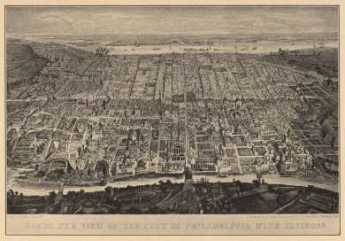
|
| Philadelphia 1854 |
When the City of Philadelphia turned into the County of Philadelphia (or vice versa) in 1854, the area had about 150,000 residents in 1850 but 500,000 in 1860. It qualified as one of the largest cities in America at the time, but what we today call middle-sized cities are about that same size. As a generalization, when a thriving American city approaches a size of about half a million, the business community often gets the idea that the city should expand its limits by annexing the neighboring districts. And, as a further generalization, the metropolitan newspapers are simply ecstatic about the idea of expanding their market reach, while the working classes of both the city and the region it proposes to swallow, are violently opposed. Since the business community typically feels that expansion would be good for business, labor unions are subdued. Leadership of the conservative middle-class rebellion is therefore generally led by the police and volunteer firemen, who are the most organized groups within the combative working class in a metropolitan region. Many citizens of all classes are of course quite indifferent about the matter. As history has turned out, only one such proposal in five will be successfully adopted, but it is almost unheard-of for a successful amalgamation to be reversed once it happens. In recent years, this general pattern has been followed in Indianapolis, Lexington, Jacksonville, Nashville, Baton Rouge, and Louisville. In countless other cities, the effort has been defeated by the voters.
It requires thriving prosperity for the business community to become politically dominant in a city, so the political context of these circuses amounts to a contest between the business "elite", often augmented by "carpet baggers from out of town" threatening comfortable lives within settled neighborhoods by merging them with culturally discordant residents in suburbs or countryside. On a political level, professional urban politicians favor expansion, because increasing the electorate generally makes it more expensive for an outsider to raise the funds to defeat them in an election. Exceptions to this rule occur when the two merging regions have different political parties in control, or when working-class city districts are so opposed that urban politicians fear to anger them. A symptom of this conflict for control of a city machine can be observed in the seemingly unrelated issue of a city charter with a "strong mayor" design. Cities with a strong city council generate greater ability to defeat the machine and are hence more reluctant to see mergers with suburbs. Nevertheless, the attraction which the business community can offer to the politicians is a larger tax base, although in the surrounding suburbs the dynamic is exactly the opposite. In the suburbs, it is the local businesses and professions who feel threatened, and who attempt to agitate the suburban politicians to protect their tax collections.
Although campaign rhetoric in these battles tends to exaggerate or distort the probable economic changes, academic studies find that the actual effect of city expansion is generally of modest subsequent growth, with modest increases in taxes. These effects seem comparatively weak since a metropolitan region is unlikely to produce a successful merger unless the economy is already growing fast enough to generate expansionism, and that vigor is likely to persist after the merger. These political uproars talk a great deal about economics, but in fact, the issue is primarily political. One commentator calls them "chess games pretending to be circuses", and the real force at work is usually an elaborate variation of gerrymandering. Urban minorities who usually vote Democrat can be swallowed up by suburban majorities who usually vote Republican. Or else a thwarted inner-city business community hopes to replace the urban machine with a more favorable suburban set of attitudes. There is seldom a uniform political gradient as the city border is approached from either side, so the chess game takes these patchwork population variants into detailed consideration. It is often argued that crossing a political boundary is unworkable, but since the thriving city of Atlanta is located in two different counties, that must not be a dispositive argument.
In their most elemental form, these expansion efforts have to do with political boundaries. It is therefore not surprising that the people most concerned are politicians. The battle cry is often to create a city without suburbs; failure to act leads to suburbs without a city. In fact, the underlying agendas are much more prosaic.
Philadelphia City-County Consolidation of 1854
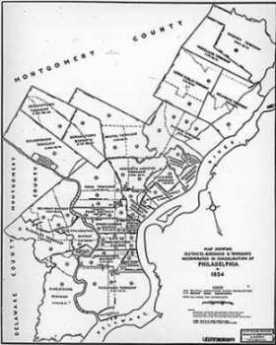
|
| Consolidation Map 1854 |
Philadelphia is still referred to as a city of neighborhoods. Prior to 1854, most of those neighborhoods were towns, boroughs, and townships, until the Act of City-County Consolidation merged them all into a countywide city. It was a time of tumultuous growth, with the city population growing from 120,000 to over 500,000 between the 1850 and 1860 census. There can be little doubt that disorderly growth was disruptive for both local loyalties and the ability of the small jurisdictions to cope with their problems, making consolidation politically much more achievable. A century later, there were still two hundred farms left in the county which was otherwise completely urbanized and industrialized. For seventy-five years, Philadelphia had the only major urban Republican political machine. By 1900 (and by using some carefully chosen definitions) it was possible to claim that Philadelphia was the richest city in the world, although this dizzy growth came to an abrupt end with the 1929 stock market crash, and the population of Philadelphia now shrinks every year. In answering the question of whether consolidation with the suburbs was a good thing or a bad thing, it was clearly a good thing. But since Philadelphia is suffering from decline, it becomes legitimate to ask whether its political boundaries might now be too large.
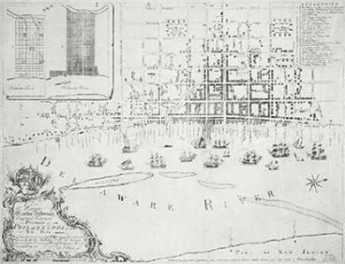
|
| Philadelphia Map 1762 |
The possible legitimacy of this suggestion is easily demonstrated by a train trip from New York to Washington. The borders of the city on both the north and the south are quickly noticed out the train window, as the place where prosperity ends and slums abruptly begin. In 1854 it was just the other way around, just as is still the case in many European cities like Paris and Madrid. But as the train gets closer to the station in the center of the city, it can also be noticed that the slums of the decaying city do not spread out from a rotten core. Center City reappears as a shining city on a hill, surrounded by a wide band of decay. The dynamic thrusting city once grew out to its political border, and then when population shrank, left a wide ring of abandonment. It had outgrown its blood supply. Prohibitively high gasoline taxes in Europe inhibit the American phenomenon of commuter suburbs. The economic advantage of cheap land overcomes the cost of building high-rise apartments upward, but there is some level of gasoline taxation which overcomes that advantage. Without meaning to impute duplicitous motives to anyone, it really is another legitimate question whether some current "green" environmental concerns might have some urban-suburban real estate competition mixed with concern about global warming. Let's skip hurriedly past that inflammatory observation, however, because the thought before us is not whether to manipulate gas taxes, but whether it might be useful to help post-industrial cities by contracting their political borders.
Before reaching that conclusion, however, it seems worthwhile to clarify the post-industrial concept. America certainly does have a rust belt of dying cities once centered on "heavy" industry which has now largely migrated abroad to underdeveloped nations. But while it is true that our national balance of trade shows weakness trying to export as much as we import, it is not true at all that we manufacture less than we once did. Rather, manufacturing productivity has increased so substantially that we actually manufacture more goods, but we do it with less manpower and less pollution, too. The productivity revolution is even more advanced in agriculture, which once was the main activity of everyone, but now employs less than 2% of the working population. This is not a quibble or a digression; it is mentioned in order to forestall any idea that cities would resume outward physical growth if only we could manipulate tariffs or monetary exchange rates or elect more protectionist politicians to Congress. Projecting demographics and economics into the far future, the physical diameters of most American cities are unlikely to widen, more likely to shrink. If other cities repeat the Philadelphia pattern, the vacant land for easy exploitation lies in the ruined band of property within the present political boundaries of cities, or if you please, between the prosperous urban center and the prosperous suburban ring.
Many American cities with populations of about 500,000 do need more room to grow, so let them do it just as Philadelphia did a century ago, by annexing suburbs. But there are other cities which have lost at least 500,000 population and thus have available low-cost low-tax land which would mostly enhance the neighborhood if existing structures were leveled to the ground. Curiously, both the shrunken urban core and the bumptious thriving suburbs could compete better for redeveloping this urban desert if the obstacles, mostly political and emotional, of the political boundary, could be more easily modified. But that's also just a political problem, and not necessarily an unsolvable one.
HSP: Philadelphia's Attic
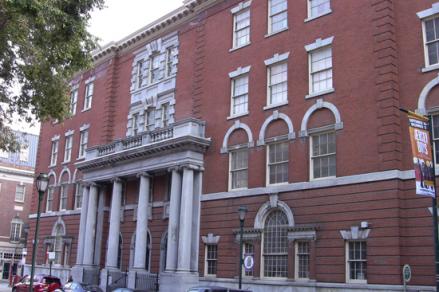
|
| Historical Society of Pennsylvania |
There was a time when the mission of the HSP (Historical Society of Pennsylvania) was clearly and proudly centered on the history of Philadelphia's old families. There generally comes a time in every family when its accumulation of stuff requires facing the fact that many possessions are too valuable to sell and too bulky to store. HSP in time became a place where families contributed these objects of memory and value, at least keeping them out of the hands of antique dealers when dusting and ensuring them became a burden. When many families entered into such a joint venture, the shared goals and experiences created a tradition over time which was reassuring to the donors. The famous lawyer Howard Lewis came to the board of HSP at a time when it was facing up to some of its own problems.
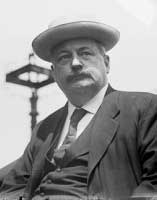
|
| Boies Penrose |
The then Board Chairman Boises Penrose came to the young lawyer one day and told him it was time he joined the board. Well, why? Because your grandfather was once Chairman of the Board; no other explanation was offered. Howard Lewis recounts that it was his introduction to a Philadelphia fact: some board appointments are hereditary. He dutifully joined.
It became apparent that HSP was a museum of immensely interesting artifacts, including decorations used at the Machianza of 1778, a copy of the handwritten originals of the Declaration of Independence and the Constitution, and ten thousand other curious of great interest. It was a place to visit one's family relics, it was a great place to hold a party. It had a three million dollar endowment in 1969. But it had a big problem: essentially no one visited the museum. It isn't hard to imagine the anguish waiting for anyone who stirred up the hornet's nest by pointing out the obvious problem. You can't fire hereditary directors, so hereditary directors don't budge in an argument. You can make hired staff into scapegoats and fire them; that doesn't accomplish much, although it is commonly tried. The Genealogy Society is a natural partner of Philadelphia's attic, but although the two partners were intimately mixed, natural partners who can't be fired add to the scene.
Things went on. Boies Penrose held board meetings which lasted precisely forty-five minutes. He had a train to Devon to catch at 5:15, so meetings ended at 4:45 PM, precisely. Even when a speaker was in mid-sentence, the gavel banged down at 4:45. Eventually this impasse was broken by reaching an agreement with the Atwater Kent Museum to the effect that historical three-dimensional objects would go to the Atwater Kent, freeing up 40% more library space for the two-dimensional papers, maps, and documents which were to become the main focus of the new HSP. More separation between HSP and the Genealogy Society was effected. Much of this was made possible by the extraordinary investment ability of Ralph Kynette, who had run the endowment up to $18 million, in spite of maintaining a spending rule of 9%. There are not many non-profit organizations which can match such a performance.
The reorganized HSP floundered a bit, and then it had the good fortune to enter into a merger with the Balch Institute. The Balch also had a store of valuable papers, but its main mission was educational. The addition of this educational effort to the more static museum and library functions has allowed the recruitment of ambitious staff, and a considerable redirection from Olde Philadelphia to the city as it now is.
In the course of the many reexaminations which all this reorganization stirred up, some familiar issues in non-profit administration had to be faced. The American Museum Association is firm in its principles that no asset in the archives of a museum may ever be sold, except to purchase some other asset which comes closer to the museum's stated mission. The underlying sense of this rule is plain: it would be unfortunate for paid staff to sell artwork for the purpose of sustaining or raising their own salaries. Unfortunately, in a great many instances, collection value has grown more rapidly than the size of the endowment to preserve the collection. That's about the size of the problem at the Barnes Museum, where collections worth many billions cannot be touched to raise money to protect and display them. It is confidently asserted that the Barnes has many objects in its basement which could easily correct its endowment imbalance, but the AMA rule prevents it. The Barnes must now be moved to a new county to overcome this impasse. It all seems like an awkward way to solve one problem by creating another, but the lawyer in Howard Lewis takes it in quite an unexpected direction.
It is his view that locking the museums of the nation in this position creates a constantly shrinking market in the artwork; when a museum acquires a piece of art it forces it to enter a one-way tunnel, never to reappear on the market. A constantly shrinking market of salable art raises prices, and it does so in a way that resembles a violation of the Clayton Antitrust Act, the beneficiaries of which are the art dealers, art collectors and artists of the world. Add to this injury to competition, the tax benefits of creating or holding a constantly appreciating market; and it really is an uncomfortable thing to consider in depth. The American Museum Association ought give serious consideration to finding alternative routes to its legitimate goals. One of the other probably unintentional results of this rule are that the donation of a valuable piece of art to a museum is very likely to lead to its instant sale for cash. The reasoning here is that the donation has not yet been "taken into the collection", and thus it can be sold without violating the Museum Association rule. People who wear wigs while sitting on a bench may consider this a valid interpretation, but when you set about trying to fashion a better museum rule, this rebuttal seems highly contrived.
If we should someday set about to re-examine what we are doing in the legal thicket of museums, we might consider how the principles of non-profit accounting for museums might be fundamentally modified. Since a non-profit is thought to generate no profits, its financial health cannot be measured by the size of its profits. Consequently, it is traditional to account for the finances of a non-profit by measuring whether its assets have grown or declined. However, conducting an annual appraisal of all the artwork in a museum that never sells anything is a monumental expense without any other purpose than to satisfy the accounting rule. Consequently, I'll tell you a little secret. Absolutely everyone ignores the issue, and the annual audits are totally uninformative if not misleading. Who's going to hang the bell on this cat?
Plays and Players, Haddonfield Version
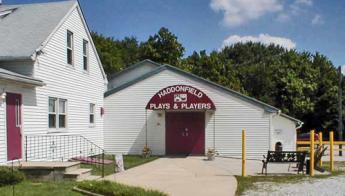
|
| Haddonfield Plays and Players |
First, an anecdote from my own lurid past. When I went there, Yale was an all-male institution with one exception, the Drama School. It's true that Shakspere had boys play the part of women in his plays, but Yale evidently felt that was going unnecessarily far, and had thus let the nose of the female camel get under the all-male tent. Meanwhile, I had discovered that a course in Advanced Chemical Engineering was carrying my amateur interest in chemistry sets a long way too far, and after two weeks, I wanted out of it. Out!
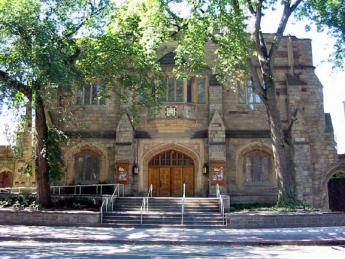
|
| Yale Drama School |
The Dean was sympathetic until I answered what I wanted to transfer into -- a course at the Drama School. Somehow, he felt that was immensely amusing, one he hadn't heard before. But, finding my grade average satisfactory, he gave a big wink and signed the paper. I didn't pretend to be offended, but I did pretend to be solemn. The experience subsequently served me very well, since that class of girls went down to Broadway at the same time I went down to New York to medical school. Almost none of my mostly all-male class of medical students knew any girls in New York, but by comparison, I knew lots. It made me very popular with both groups.
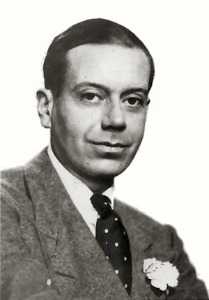
|
| Cole Porter |
It thus develops that I had the courage recently to accompany to a theater party in Haddonfield, a lady who had spent twenty-five years on the stage. The play was Cole Porter's Anything Goes, put on by the Haddonfield Plays and Players, a group celebrating its 75th year of productions. You seldom see musical comedies anymore, because the large cast and orchestra requirements are pushed by Union rules to the huge expense which a professional group cannot safely risk, and amateur groups mostly cannot enlist a large enough audience to support. In addition to the orchestra, stagehands, and administration, I counted thirty members of the cast up on the stage for the big chorus numbers. There might have been a hundred in the audience to pay the bills. This wasn't the only play of the season, there will be five I understand, so the performers have to be quick studies, which generally means considerable experience. Even with what therefore must have been a short time to rehearse, this group was good, really, really good. The lady by my side remarked these people must be semi-professionals, at least. I didn't think so, so she demanded a playbill to see. Sure enough, semi-pro.
|
| Anything Goes |
All of which may seem a round-about way to get to an observation about the current theater revival in Philadelphia. There are at least fifty new amateur theater groups scattered throughout our region, filled with "kids" having a wonderful time playing Shakspere, Albee, Shaw and whatever. At cast parties, almost none of them expresses any interest in going to Broadway or Hollywood; they are mostly software engineers or similar. Since the Philadelphia revival of interest in performing arts is so striking, it has led to ruminations about why the theater similarly flowered in Elizabethan London, at a time when there were only two theaters in Paris, by comparison. Perhaps this parallel has something to teach us about the hidden social impact of Sir Thomas Gresham and dual coinage, or Sir Francis Drake and the Armada.
But maybe, I realize for the first time, there is a flight in our direction, from New York City.
Grand Union
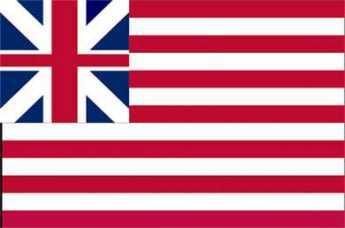
|
| Grand Union Flag |
THERE are a number of supermarkets in Philadelphia called Grand Union Stores, but the grocery conglomerate was founded in 1872. That Union was the Northern side in The American Civil War, and it is reported that life-sized replicas of Abraham Lincoln were once a common feature in the stores. Much earlier than that, the Grand Union was a term that meant the first American national flag, adopted in 1775, and created by a Philadelphia milliner, Margaret Manny. It was, however, quite similar to the flag of the British East India Company, and the Grand Union they were both talking about was the Union of England and Scotland of 1707. The jack of the Grand Union flag, soon to be replaced with a ring of thirteen stars, represented the crosses of England and Scotland, superimposed. When Northern Ireland joined the United Kingdom, the cross of Ireland was superimposed, to give the present form of the Union Jack. In 1775, the considerable colonial sentiment still hoped that hostilities would achieve a status for America along the lines of the other members of the United Kingdom.
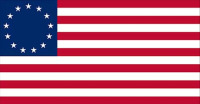
|
| "Betsy Ross" Flag |
Although the number of stripes in the national flag briefly increased to fifteen at the time of admission of Kentucky and Vermont, stripes soon reverted to thirteen to symbolize the original thirteen states. After that single exception, only the stars in the jack increased to match the number of current states.
The early use of the Grand Union Flag is in some dispute, but it may possibly have been used by George Washington in the various battles around Boston and Charlestown. It was most certainly flown by John Paul Jones on his ship the Alfred . Because of its resemblance to the flag of the nation we were fighting to overthrow, it is understandable that there would soon be a desire to change it. That is what happened in 1777, although just who first had the idea is still open to dispute and myth-making.
America has had three flag acts:
The Flag Act of June 14, 1777 was passed by the Second Continental Congress (under the Articles of Confederation, of course. June 14 is now called Flag Day.) "Resolved, That the flag of the United States be made of thirteen stripes, alternate red and white; that the union be thirteen stars, white in a blue field, representing a new Constellation."
The Flag Act of January 13, 1794 (1 Stat. 341) An Act making an alteration in the Flag of the United States. Be it enacted by the Senate and House of Representatives of the United States of America in Congress Assembled, That from and after the first day of May, Anno Domini, one thousand seven hundred and ninety-five, the flag of the United States, be fifteen stripes alternate red and white. That the Union be fifteen stars, white in a blue field.
The Flag Act of April 4, 1818 (3 Stat. 415) An Act to establish the flag of the United States. Be it enacted by the Senate and House of Representatives of the United States of America, in Congress Assembled, That from and after the fourth day of July next, the flag of the United States be thirteen horizontal stripes, alternate red and white: that the union be twenty stars, white in a blue field. And be it further enacted, That on the admission of every new state into the Union, one star be added to the union of the flag; and that such addition shall take effect of the fourth day of July then next succeeding such admission.
Country Auction Modernized
Only a decade ago, the Quakertown exit of the Pennsylvania Turnpike made possible a quick trip from the city to the country, letting you off in the cornfields between Sumneytown and Lansdale. Today, the rush hour traffic is as bad as anywhere else, even on the four-lane express highway known as Forty Foot Road. A comfortable two-lane highway would be about forty feet wide, so presumably, the name denotes what was once a modern miracle of a two-lane highway, in this case until quite recently. It's all built up for miles, but almost all the commercial buildings are new. Exurban sprawl has positively lurched across the landscape, making prosperous people rich, and poor people prosperous. It won't be long before the housing subdivisions demand traffic signals to protect the school children, speed limits to reduce the collisions by teenagers, and other things destined to bring high-speed travel to a crawl, all day long. When that happens, it won't be called farm country anymore.
|
| Alderfer Auction Company |
On Fairground Road, where occasionally corn is still growing, a number of large new commercial enterprises have located, among them a moving and storage company with ten or so truck loading platforms in the back. Behind that is another large new building, also with a parking lot for fifty or so cars, the auction house. Different categories come up for auction on different days, so used furniture, for example, comes up every few weeks and has to be stored as things accumulate for the big day. With a moment's thought, you can easily see why the auction is affiliated with or owned by a moving and storage company. As you go through the entrance, you are invited to sign up and identify how you plan to pay, just in case you buy something; the product of this registration is a card with a number in big colored letters. That's your number, your payment arrangement, and soon you will find no one cares anything about you except that number. The auction I was interested in was for used books, one of three or four auctions conducted in different rooms.
|
| Auctioneer |
Nearly a hundred people had numbers for used books, maybe a similar number for antique furniture and paintings. Obviously, one other purpose of the registration process is to create a mailing list of customers interested in various objects, possibly linked to a program which sends out flyers and announcements. Country auctions have always been a source of local entertainment, so non-buying spectators are able to come and watch if they wish. There seemed to be few if any casual sight-seers; just about everybody is a buyer or a potential buyer. Players, as they say.
Most of the customers probably set their alarm clocks for 5 AM or earlier; the auction is centrally located, but most everybody comes from a considerable distance. At 9 AM, very promptly, the auction began, and from his manner, you could tell the auctioneer was anxious to get started. The object for sale had been on display for a day, but most people arrived around 7 AM to examine the goods, which are frequently sold in lots, meaning a box full of thirty or forty books more or less on the same topic. At the stroke of nine, the auctioneer chanting began, "Do I have ten dollars, yeh, ten, ten, ten, five, five, ten, fifteen, twenty, twenty, sold for fifteen. Your number, sir?" Two assistants took down the customer number, and the lot number, and the price; one of the two recorded the transaction in a computer, the other on a list by hand. One gathers the man without a computer was on the look-out for shills, people trying to bid up to the price without getting stuck for a purchase. The auctioneer repeatedly assured the audience that no one but a real bidder was allowed to bid, you owned it, and no excuses about being confused. When he reached he hundredth sale, he stopped for a drink of water, and proudly noted the first hundred sales took thirty-seven minutes. It required four other assistants to fish out the lots next in line, holding them up for confirmation only, since inspecting them at as the distance was out of the question. After each sale, the assistant dumped the prize in the new owner's lap.
|
| Auction Paddle |
And yet entitled to wonder a little. The ordinary run of books thirty or forty years old will sell for between ten and twenty dollars. Books about golf, just about any old book about golf, "go" for about forty dollars. Children's books are about sixty dollars. And, to my great surprise, boxes or albums of old photographs go for over a hundred dollars. A lady next to me excitedly brought an album of old photos back to her seat and thumbed through them. "Are you a dealer?" Yes. "Who buys this stuff?" I don't know, they come to my store and just buy it. Like the Auctioneer, she had a feeling for what the retail price would be, made a calculation, and knew what she could afford to pay wholesale. What the stuff actually represented, why people wanted it, what was a good one and what was a bad one--these people in the trade had very little idea. But they knew very precisely what a fair price, and gradually lowers it until it sells. Fun Lots of fun. When a familiar insider makes a mistake and pays too much, the others laugh heartily at him. Why this funny system works has long been a mystery, but everyone except a socialist readily acknowledges it does work. At least it works better than any known substitute.
Although the ritual of the country auction has been essentially unchanged for the centuries, it is just another transaction system. In the past fifty years, the world economy has been transformed by computerized efficiencies in transaction systems, with vast prosperity resulting from small saving endlessly repeated. Banking and Wall Street have concentrated most of the standardized transaction, in perfectly astounding volume; lots and lots of people have become immensely rich for producing small efficiencies in high volume. Those of us who have not become immensely rich can easily identify trivial innovations which resulted in wealth, and we easily sense the unfairness of old photos worth more than books of poetry. After all, the country auction is still grossly inefficient; the seller pays the auction company 20% of the price, and the buyer pays another 10%. There's 3% for the credit card company and &% for the sales tax. Forty percent of this transaction is going to the middle man, over and over and over again. The goal is to reduce transaction costs to the level of Wall Street, considerably less than one percent, Which still lots of yachts for middlemen.
As you walk out of the country auction, it doesn't take a mathematical genius to multiply thirty percent times the number of transactions, times a guess at the average sales price. No wonder these auction people are so cheerful, so much in love with their work. But two other parties are cheerful, too. That is, the buyer and the willing seller.
Camden NJ: The Third, or Irish, Tenth
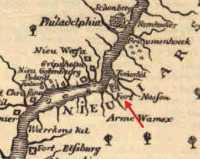
|
| Camden in 1662 |
The early Swedish and Dutch settlers tended to sail up the Delaware Bay, and settle on the right-hand bank, which we now call New Jersey. In time, Seventeenth-century settlers, even William Penn, switched over to the left, or Pennsylvania, side. The Dutch, who had experience with dikes on the Zuider Zee, knew that it was quicker and easier to drain the lowlands than to chop down big trees and dig up the roots. Although the Dutch were more interested in fur trading than agriculture, they had to eat. Fish, crabs, oysters and truck gardens were enough for that purpose. After establishing a Fort Nassau at what is now the town of Gloucester, on the south edge of Camden, fur trading on the New Jersey side began to fall off, and the Dutch settlement was moved across the river as Fort Casimir, next to the mouth of the hidden river, the Schuylkill, just south of what is now the international airport. That was fine for the Dutch to stay close to their ships, but the Indians on the far side of the swamp resisted coming down the swampy river and held back to do their fur trading at Gray's Landing, on the high ground between Bartram's Gardens and the University of Pennsylvania. For the Dutch it was a pleasant paddle up from the mouth of the river at Fort Casimir, and anyway you never know about strangers.
William Penn followed the same path, buying and reselling farmland in New Jersey for a decade before he asked for, and King Charles gave him, Pennsylvania. Skipping many of the details, northern New Jersey, called East Jersey, was given to Scottish Quakers, while what we call South Jersey and they called West Jersey, was divided into ten parts among the English Quakers. The Third Tenth around the Cooper River roughly corresponds to Camden County, and was mainly purchased by Irish Quakers and for a while was called the "Irish Tenth". In time, Gloucester County was split off from Camden County, which was mainly known originally as Newton Township. After a century, the Irish origins of the local inhabitants of Newton and Haddonfield were largely forgotten. The town of Gloucester, however, was situated on the river next to what was to be the vast shipyards of New York Shipbuilding Corp.(1899-1967). First addressing the oak forests of West Jersey for the masts of sailing ships, sailing ships were built with lumber logs floated down the Susquehanna River in rafts during the Nineteenth century. This industry attracted later Irish immigrants during the time of the great Irish migrations, and still more were attracted when World War I made Camden a major steamship building center. The experience was repeated during World War II, reaching its eventual high point when the nuclear Aircraft carrier Eisenhower could be seen under construction by commuters going over the Walt Whitman Bridge.
Shipbuilding, like other heavy industry of the rust belt, moved abroad seeking cheaper labor, and what little remained on American soil moved to Norfolk, Virginia. The response of protectionist legislation made America even less attractive for unionized industry. The wiser workers saw what was happening and sought jobs in other industries, elsewhere. But Gloucester City, underneath the bridge girders and surrounded by winding creeks, held out as an oasis of working-class Irish as the southern anchor of crumbling, decaying Camden. About a thousand homes had been built by the federal government during the labor shortages of World War I, as Fairview. These two little Irish enclaves, 97% Caucasian, continue to hold out for a day that will likely never return, gathering in their taverns to sing songs about old martyrs, fighting to maintain control of the industrial unions, and dominating the Democrat politics of the county. There was a time when leverage might have established political control of South Jersey, and through that to the domination of the whole state, but that gets progressively less likely. Tough politics essentially met more than its match in the river towns of North Jersey, other groups learned to play the ethnic game, and the recent uproar about child molestation has loosened the hold of their church on young adherents with school children. The same pattern seems to be emerging on the Pennsylvania side of the river in Delaware County, where however the political machine has historically been Republican.
Meanwhile, just a little to the north, the city of Camden steadily decays and deteriorates. Now only half the size of its 125,000 "Citadel of Republicanism" in 1950, the title of America's poorest city is applied to an average income of $18,000, and various statistics of violent crime make it the first or second most dangerous place in America to live. The City is 53% black, 29% of Puerto Rican origin, and 44% below the official poverty level. In 2001, its Mayor was sent to jail as an affiliate of the Mafia, and the state took over the running of the city. In 2009, a state auditor reported that the books were in such chaotic condition that it was impossible to say where they stood, financially. Along the way to this sorry state, RCA Victor (1901-1986) finally moved out, after decades of watching its employees migrate to the suburbs, taking their tax revenue with them. Although Campbell Soup loyally maintains and is even expanding its national headquarters in Camden, the soup is made elsewhere. Frozen chicken dinners are made by the hundreds of thousands in Delaware, assembling the tinfoil, chickens, and peas from hundreds of miles to the moment when it is packaged mechanically in a manner that would shame the Japanese. There was a time in living memory when truckloads of Jersey tomatoes were lined up at the Camden soup factory for miles, but all that has moved to California. Jersey tomatoes ripened sequentially throughout the season, requiring human tomato pickers to tell green ones from red ones. A new form of hybrid tomato ripens all the fruit simultaneously, allowing it to be mechanically harvested, and taking advantage of three crops a year in California. The Golden State on our western coast seems to be having labor and tax trouble, too; but that is small comfort to Camden.
As factories close, people abandon their homes, slums result. The schools deteriorate, migration and crime increase. Most people would say it is a mess. A recent sociological study, called Camden After the Fall describes in painful detail how every idea anyone has ever had about how to turn Camden around -- has been tried, amply funded and found to be an utter and discouraging failure. The highway system has been modernized, only to allow commuters to buzz through Camden somewhat faster. Public buildings have been built, only to underline the fact that no new construction has taken place with private money in decades. Building a prison in the center of town created jobs, and now more jobs are being created to tear it down. Rutgers, the state university, has a branch under the shadow of the Ben Franklin Bridge. The battleship New Jersey is at anchor in a lovely riverside park, there's a nice little minor league baseball park. Anything you can build with tax money has been built. There's just no private industry, or business, or profession. Anyone who has a bright idea is welcome to read Camden After the Fall . It's just possible something to try has been overlooked, though it isn't very likely. Except for law, order and good schools.
After decades of watching Camden get steadily worse as I commuted hastily through it, I would say there actually is sort of a plan visible. As houses decay, they are torn down, and the grass is planted. It seems likely that the plan is to wait until a large enough plot of land is cleared and planted to grass, so it eventually becomes attractive to a developer. And then the developer will make tons of money with raw land that even the Indians in 1640 could see was very well situated.
Time To Care
|
| Dr. Norman Makous |
It sometimes seems as though Medicare has been a standard part of the scene for so long it now needs major reform, but when a doctor has practiced Medicine for sixty years he has seen a lot of contrasts between the old way and the new way, not all of them favorable to the new -- which we are now tired of, and trying to repair. That's particularly true if the doctor practiced at America's first and oldest hospital, because it sustained many traditions from two centuries before, and was among the last to yield to the imperatives of newcomers for the last forty years, their hands grasping for the purse strings. Dr. Norman Makous must either have a remarkable memory or a thick, detailed diary. He tells three hundred pages of fast-reading anecdotes about sixty years of his own medical practice, before summing up in fifty pages of reflection. One by one, he describes the innovations in his field of cardiology and how they affected him and his patients. Thiomerin, one of the first of many easy ways to pump out excess body fluid accumulation, transformed the treatment of congestive heart failure. Synthetic digitalis claimed to but probably did not much improve things over dried digitalis leaves; it certainly raised the cost. Cardiac catheterization, electro-shock resuscitation, ultra sound diagnostics, MRI and CAT scans, cardiac surgery using the heart-lung machine, and finally cardiac transplants -- all started out as headline-news spectaculars, evolved into cutting-edge advances, and then settled down into the Standard of Care that you obtained a plaintiff lawyer to sue about. All in one medical lifetime, supposedly prepared for by one Medical School course, followed by one residency apprenticeship, the specialty of Cardiology was completely transformed at least six times.
Meanwhile, the leadership of the medical profession was tenaciously resisted by those who supposedly followed its direction. Hospital administration.
SEPTA's Long Term Planning
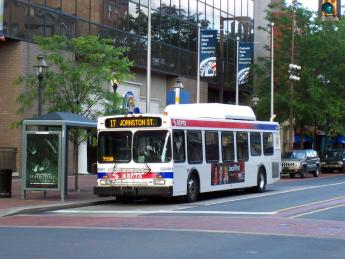
|
| Septa |
Byron S. Comati, the Director of Strategic Planning and Analysis for SEPTA (Southeastern Pennsylvania Transportation Authority), kindly gave the Right Angle Club an inside look at the hopes and plans of SEPTA for the near (five-year) future. Students of large organizations favor a five or six-year planning cycle as both short enough to be realistic, and long enough to expect to see tangible response. If plans continuously readjust to fit the five-year horizon, the concept is that the organization will move forward on these stepping stones, even accounting for setbacks, disappointments, and surprises. Furthermore, a serious level of continuous planning puts an organization in a position to react when funding opportunities arise, such as the sudden demand of the Obama Administration that economic stimulus proposals be "shovel ready."
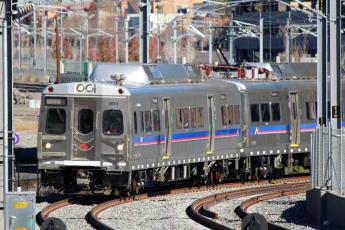
|
| The Silverline V |
So, SEPTA is currently promoting five major expansions, based on the emerging success of an earlier plan, the Silverliner V. Silverline is a set of 120 shiny new cars, built in Korea on the model of electrical multiple units, which are expected in Spring 2011 to replace 73 cars or units which were built in 1963. Obviously, 120 are more expensive than 73, but they are more flexible as well. And less wasteful; most commuters are familiar with the model of three seats abreast which unfortunately conflict with the social preferences of the public, tending to make the car seem crowded even though it is a third empty. When a misjudgment like this is made, it takes fifty years to replace it with something better. For example, there's currently a movement toward "Green construction", which is acknowledged to be "a little bit more expensive". The actual costs and savings of green construction have yet to become firmly agreed on, so there's an advantage to being conservative about what's new and trendy in things that take fifty years to wear out.
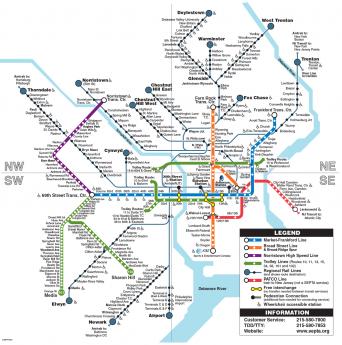
|
| Septa Regional Map |
Four of SEPTA's five major proposed projects are in the Pennsylvania suburbs. New Jersey has its own transportation authority, and Philadelphia is thus left to struggle with the much higher costs of urban reconstruction assigned to its declining industrial population. And left unmentioned is the six hundred pound gorilla of the transportation costs of new casinos. A great many people are violently opposed to legalized gambling, and even more upset by the idea of crime emerging in the neighborhoods of gambling enterprises. Even the politicians who enacted this legislation are uncomfortable to see the rather large expenditures which will eat into the net revenue from this development. Nevertheless, if you are running a transportation system, you have an obligation to plan for every large shift in transportation patterns, no matter what you might think of the wisdom of the venture. The alternative is to face an inevitable storm of criticism if casinos come about, but without any preparation having been made for the transportation consequences. At present, the public transportation plan for the casinos is to organize a light rail line along the Delaware waterfront, connecting to the rest of the city through a spur line west up Market Street; it may go to 30th Street Station, or it may stop at City Hall. That sounds a lot like the present Market-Frankford line, so expect some resistance when the cost estimates are revealed. Because all merchants want to have the station stops near them, and almost no residents want a lot of casino foot-traffic near their homes and schools, expect an outcry from those directions, as well. It would be nice to integrate this activity with something which would revive the river wards, but it seems a long stretch to connect with Wilmington on the south, or Trenton on the north.
The planned expansions in the suburban Pennsylvania counties will probably encounter less controversy, although it is the sorry fate of all transportation officials to endure some hostility and criticism for any changes whatever. Generally speaking, the four extensions follow a similar pattern of building along old or abandoned rail lines, following rather than leading the population migrations of the past. When you are organizing mass transit, there is a need to foresee with some certainty that there will be a net increase in commuters in the region under consideration. The one and two passenger automobile is a much more flexible instrument for adjusting to the growth of new development, schools, retail, and industry. Once the region has become established, there is room for an argument that transportation in larger bulk is cheaper, cleaner or whatever.
The Norristown extension follows the existing but underused rail connections to Reading. Route US 422 opened up the region formerly serving the anthracite industry, but now the clamor is rising that US 422 is impossibly crowded and needs to be supplemented with mass transit.
The Quakertown extension follows the rail route abandoned in 1980 to Bethlehem and Allentown, although the extension is only planned as far as Shelly, PA.
The Norristown high-speed extension responds to the almost total lack of public transportation to the King of Prussia shopping center, and will possibly replace the light rail connection to downtown Philadelphia.
And the Paoli extension follows the mainline Amtrak rails as far as Coatesville.
All of these expansions can expect to be greeted with huzzahs by developers, land speculators, and newsmedia, but resistance will inevitably be as fierce as it always is. Local business always fears an expansion of its competitors; the feeling is stronger in the suburbs than the city, but local business always resists and local politicians always follow their lead. To some extent, the suburbs have a point, since radial extensions are usually much cheaper to build than lateral or circumferential transportation media; bus routes are the favored pioneers in connecting one suburb with another. Therefore, the tendency in these present plans remains typical by threatening the suburbs with a need to travel toward the center hub, then take a reverse branch back in the general direction of where they started, in order to go a short distance to a shopping center or school system. The two main river systems around Philadelphia interfere with the construction of big "X" routes from the far distance in one direction to the far distance in the opposite direction. Euclidian geometry makes the circumferential route elongate as the square of the radius. And jealousies between the politicians in three states create rally foci for the special local interests which feel injured. Since it seems to be an established fact that the proportional contribution to mass transportation by the surrounding suburbs of Philadelphia is traditionally (and considerably) lower than the national average, a political reconciliation might do more for the finances of SEPTA than any federal stimulus package could do. For such reconciliation, a few lateral connections in the net might pacify the suburbs enough to justify the extra cost. Unfortunately, the main source of unjustified cost in regional mass transit is the high wage and benefit levels of the employees, a situation inherited from the old days when commuter rail was part of the stockholder-owned regional railroads. Just as featherbedding was the main cause of the destruction of the mainline railroads, health and pension benefits threaten the life of mass transit. In the old days, local governments acted as a megaphone for union demands. So the railroads just gave the commuter system to the local governments, and let them wrestle with the unions themselves. Since the survival of the urban region depends on conquering this financial drain, the problem must be gradually worn down. But it has been remarkable how long the region has been willing to flirt with bankruptcy rather than bite this bullet.
If anything, this friction threatens to get worse. In 2009, for the first time, a majority of union members in America -- work for the government, the one industry which thinks it cannot be destroyed by losing money. True, SEPTA is not exactly a government function, but it has enough in common with a government department to arouse suburban voters, who regularly refer to it as an arm of the urban political machine. SEPTA isn't too big to fail, but there exists little doubt that government at some level would probably try to bail it out if it did.
Urban Transportation
Stuart Taylor, who spent twenty years working for the Pennsylvania Railroad in the company of our member Bill Brady, recently gave the Right Angle Club his observations about urban transportation, which grew out of his second career as a consultant. As he describes the evolution from the horse-drawn omnibus carriage to the horse-drawn trolleycar, to the steam-driven trolley, to the electric trolley, to the underground subway, certain parallel historic movements occurred to at least one member of this audience.
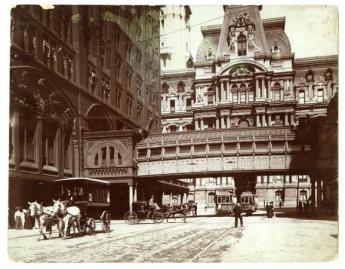
|
| Horse-Drawn Trolley Car |
In the first place, mass transportation is only of value when cities grow to a large enough size to justify the expense. And the growth of cities in the 19th Century was propelled by the Industrial Revolution attracting mass immigration into urban centers. Whether the Industrial Revolution is over or not, is a topic which could be debated, but it was the gasoline engine which made buses and autos attractive, and the decaying slums made cities sufficiently unattractive to cause the flight to the suburbs in the 1920s and 1930s, heavily resumed after World War II in the 1950s. During the heyday of city growth, the evolution of mass transit seemed to be driven by technology, and that in turn attracted private ownership. When the gasoline engine and/or the decline of the Industrial Revolution made the Flight to the Suburbs possible, it made urban transportation unprofitable and hence unattractive to private business owners. Somewhere just before or after the 1929 Crash, the changing situation made it more attractive to live and/or work in the suburbs. A sign of this change in dynamics was the total disappearance of private ownership of public transportation and its supporting infrastructure, and replacement by public ownership and public tax subsidy. As local politics began to reflect this change, Urban politics somehow became dominated by Democrats, and Suburban politics became dominated by Republicans; so the enthusiasm for mass transit has waxed and waned as the political domination of federal subsidies has shifted between the parties. That's probably only an outward sign, however. The real issue is that urban transportation now has to be subsidized since its base has shrunk to the point where people like Widener and Elkins invest in other things. And do so from their homes in exurbia, where the neighbors could care less about subways, let alone pay taxes to subsidize them. And until the city gets control of its crime, public schools, and taxes, it's hard to see what will attract them back in town.
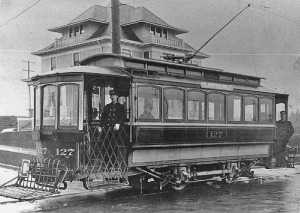
|
| Electric Trolley |
That's perhaps an overly censorious view, coming from a resident of the suburbs. A more economic view of things would be that the construction of underground subways now costs about a billion dollars a mile. Very few cities and no private entrepreneurs can justify costs of that magnitude since the potential ridership cannot afford the costs per ride which are implicit in that capital expenditure. Until the cities can manage to entice the suburbanites back into town, those people will solve their air pollution problems by avoiding the cities. Living to the windward seems much more plausible to them. China is just beginning this process, but they have the advantage of building the subways first, then the surrounding skyscrapers, and thus greatly reducing the costs of avoiding underground sewer systems, etc. If you could call it that, the Europeans had the advantage of massive war destruction, along with much more expensive farmland to inhibit suburbanization. None of this is an argument that we shouldn't build subways, or clean up the atmosphere. It's just a warning of the daunting construction costs and staunch political opposition to mass transit. Not to mention featherbedding, over-hiring, massive hidden benefits costs, and other features which seem to be inherent in union activity, at least of the historical variety.
A member of the Right Angle audience asked the speaker what he thought of the proposed Market Street light rail line. Insane, was the answer. No visible ridership. And that seemed to summarize the present debate.
Except that it really shouldn't frame the argument for Philadelphia. Philadelphia doesn't need a mass transit network, it already has a mass transit network. Much of it is growing obsolete, but the land costs and local opposition to change are greatly diminished when the network is already there. If any city can do it, Philadelphia can. The technology will surely evolve enough for our purposes if the money is there, and the money will be there if people return to using the city. What Philadelphia needs is a return of business headquarters and other sources of employment, bringing the ridership and the public demand along with it. And for that, what is essentially needed is for government to address our problems of uncontrolled crime, inferior public schools and maladministered taxes.
Heron Rookery on the Delaware
 |
| Great Blue Heron |
When the white man came to what is now Philadelphia, he found a swampy river region teeming with wildlife. That's very favorable for new settlers, of course, because hunting and fishing keep the settlers alive while they chop down trees, dig up stumps, and ultimately plow the land for crops. As everyone can plainly see, however, the development of cities eventually covers over the land with paving materials; it becomes difficult to imagine the place with wildlife. But the rivers and topography are still there. If you trouble to look around, there remain patches of the original wilderness, with quite a bit of wildlife ignoring the human invasion.
 |
| Heron Nests |
Such a spot is just north of the Betsy Ross Bridge, where some ancient convulsion split the land on both sides of the Delaware River; the mouth of the Pennypack Creek on the Pennsylvania side faces the mouth of the Rancocas Cree on Jersey side. In New Jersey, that sort of stream is pronounced "crick" by old-timers, who are fast becoming submerged in a sea of newcomers who don't know how to pronounce things. The Rancocas was the natural transportation route for early settlers, but it now seems a little astounding that the far inland town of Mt. Holly was once a major ship-building center. The wide creek soon splits into a North Branch and a South Branch, both draining very large areas of flat southern New Jersey and making possible an extensive network of Quaker towns in the wilderness, most of whose residents could sail from their backyards and eventually get to Europe if they wanted to. In time, the banks of the Rancocas became extensive farmland, with large flocks of farm animals grazing and providing fertilizer for the fields. Today, the bacterial count of Delaware is largely governed by the runoff from fertilized farms into the Rancocas, rising even higher as warm weather approaches, and attracting large schools of fish. My barber tends to take a few weeks off every spring, bringing back tales of big fish around the place where the Pennypack and Rancocas Creeks join Delaware, but above the refineries at the mouth of the Schuylkill The spinning blades of the Salem Power Plant further downstream further thin them out appreciably.
Well, birds like to eat fish, too. For reasons having to do with insects, fish like to feed at dawn and dusk, so the bottom line is you have to get up early to be a bird-watcher. Marina operators have chosen the mouth of the Rancocas as a favorite place to moor boats, so lots and lots of recreational boaters park their cars at these marinas and go boating, pretty blissfully unaware of the Herons. Some of these boaters go fishing, but most of them just seem to sail around in circles.
 |
| As Seen From Amico Island |
Blue herons are big, with seven-foot wingspreads as adults. Because they want to get their nests away from raccoons and other rodents, and more recently from teen-aged boys with 22-caliber guns, herons have learned to nest on the top of tall trees, but close to water full of fish. And so it comes about that there is a group of small islands in the estuary of the Rancocas, where the mixture of three streams causes the creek mud to be deposited in mud flats and mud islands. There is one little island, perhaps two or three acres in size, sheltered between the river bank and some larger mud islands, where several dozen families of Blue Herons have built their nests. One of the larger islands is called Amico, connected to the land by a causeway. If you look closely, you notice one group of adult herons constantly ferries nest building materials from one direction, while another group ferry food for the youngsters from some different source in another direction. At times, diving ducks (not all species of ducks dive for fish) go after the fish in the channel between islands, with the effect of driving the fish into shallow water. The long-legged herons stand in the shallow water and get 'em; visitors all ask the same futile question -- what's in this for the ducks? The heron island is far enough away from places to observe it, that in mid-March its bare trees look to be covered with black blobs. Some of those blobs turn out to be heroes, and some are heron nests, but you need binoculars to tell. When the silhouetted birds move around, you can see the nests are really only big enough to hold the eggs; most of the big blobs are the birds, themselves. There are four or five benches scattered on neighboring dry land in the best places to watch the birds, but you can expect to get ankle-deep in the water a few times, and need to scramble up some sharp hills covered with brambles, in order to get to the benches. In fact, you can wander around the woods for an hour or more if you don't know where to look for the heron rookery. Look for the benches, or better still, go to the posted map near the park entrance south of the end of Norman Avenue. There are a couple of kiosks at that point, otherwise known as portable privies. Strangers who meet on the benches share the information supplied by the naturalists that herons have a social hierarchy, with the most important herons taking the highest perches in the trees. That led to visitors naming the topmost herons "Obama birds", and the die-hard Republicans on the benches responding that the term must refer to dropping droppings on everybody else. That's irreverent Americans for you.
There is quite a good bakery and coffee shop just north on St. Mihiel Street (River Road), and the new diesel River Line railroad tootles past pretty frequently. That's the modern version of the old Amboy and Camden RR, the oldest railroad in the country. It now serves a large group of Philadelphia to New York commuters, zipping past an interesting sight they probably never realized is there because they are too busy playing Hearts (Contract Bridge requires four players, Hearts are more flexible). However, there's one big secret.
The birds are really only visible in the Spring until the trees leaf out and conceal them. Since spring floods make the mud islands impassible until about the time daylight savings time appears, there remains only about a two-week window of time to see the rookery, each year. But it is really, really worth the trouble, which includes getting up when it is still dark and lugging heavy cameras and optics. Dr. Samuel Johnson once remarked that while many things are worth seeing, very few are worth going to see. This is worth going to see.
And by the way, the promontory on the other side of the Rancocas is called Hawk Island. After a little research, that's very likely worth going to see, too.
Cushman Club for Lonesome Actresses
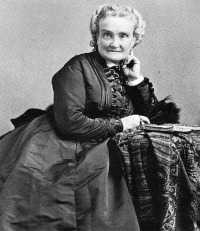 |
| Charolotte Cushman |
Lydia Ellicott Morris was married to another member of the Quaker colonial aristocracy, George Spencer Morris; both of them were active members of many organizations, including the Philadelphia Savings Fund Society, Friends Hospital, and several of the clubs on Camac Street. Their home for many years was located at 225 South Eighth Street. George Morris was a senior partner of Morris and Erskine, Architects. One day, Lydia was riding on a trolley car.
On the trolley, she overheard two young actresses fretting over the problem that traveling actresses were forced to live in hotels and boarding houses along with traveling salesmen. This circumstance forced them to experience much-unwanted attention and made being an actress a difficult occupation for respectable women. Lydia promptly got off the trolley and formed an organization raising funds to create in 1907 a boarding home to provide safe, respectable, inexpensive lodgings for actresses in traveling shows, playing in Philadelphia. It was named after Charlotte Cushman, the first internationally famous American actress, and located at 1010 Spruce Street. Charlotte Cushman had no connection with the club, but her fame can be appreciated from the fact that in 1874 after her final performance, 15,000 people were reported to have serenaded her outside of New York's Fifth Avenue Hotel. The Ninth Regimental Band played, while fireworks illuminated Madison Square. Ms. Cushman died in 1876.
Another major donor to the club was a Mr. Peterson, otherwise unidentified, who gave them $50,000. Further funds were raised at five annual teas. In 1925, Philadelphia was a major center for the film industry, and much Charlotte Cushman Club early history relates to movie associations. Much of the early endowment was unfortunately lost in the 1929 stock market crash, however, and the club continued only a subdued presence for a number of years. By 1999, it was clear that the original purpose was not really needed, and the club was disbanded. Its possessions, including the last of several clubhouses, the collections, and a rather valuable library, were sold off, and most of its other belongings were donated to the Franklin Inn Club. The club began a new existence as the Charlotte Cushman Foundation, first endowing the Charlotte Cushman Board Room and Exhibit, at the University of the Arts, and then in 2001 began making grants to local nonprofit theatre groups. At present, the Foundation dispenses an income of about $45,000 yearly among 43 non-profit theatrical societies which continue in Philadelphia. Present dominant activity is to select the Leading Actress in a Play, as part of the annual Barrymore Awards. The rise of the club reflected the vibrant downtown social life of Philadelphia at a time when almost all Philadelphians were residents of the center city. And its decline parallels the loss of civic-minded center city residents following the spread of household automobiles and the continuing wreckage of traditional civic feeling following the 1929 crash.
The Foundations's website is www.charlottecushmanfoundation.org, and its email address is CharlotteCushmanFoundation@gmail.com
Foot of Arch Street
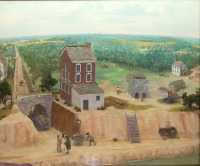
|
| The Foot of Arch St. |
What we now call Arch Street in Philadelphia was originally named Mulberry Street. Just when that change officially occurred could be argued about, but it took its new name from the fact that a road was cut through the high river bank for easier access to riverside shipping, and an overhead arch connected the two cut ends of Front Street at the point of crossing. A model which is still on display in the Friends Meetinghouse at 4th and Arch depicts this arch in place in 1684. The model displays Thomas Holme, Penn's surveyor, and map-maker, pointing up at the arch. It is a matter of record that Thos. Holme owned the property at the corner of Front and Mulberry, so presumably, the red brick house stranded by the newly excavated street was Holmes. By the time of the Revolution, the Arch Street wharf had become the center of Delaware River commerce. The model depicts that even in 1684, Arch Street led straight to the Schuylkill.
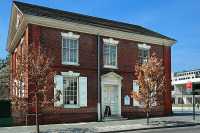
|
| The Free Quaker Meetinghouse |
The cemetery at 4th and Arch, set aside as early as 1684 as a burying yard, is known to contain at least 40,000 unmarked graves, many of them from the yellow fever epidemics of the late 18th Century. The meetinghouse was built right on top of them, a fact which may now offend some visitors. But it was in keeping with the ancient tradition of burying the dead in the consecrated ground of a churchyard, more or less as a sanitation measure. It is also in keeping with the tradition of early Quakers not to allow their pictures to be displayed, or even their names to be placed on tombstones.
When disputes arose about warfare in the Revolutionary War, and many non-Quakers who had been expelled for one reason or another joined with non-Quakers to form the Free Quaker Meeting, it ended up where it is now, at 5th and Arch. The Friends Center, home to the administrative focus of Quakerdom, is at 15th and Cherry, just a partial block from Arch Street. At the time of the construction of the 4th and Arch Meeting, many Quakers moved into the area to be within walking distance, giving rise to the original meaning of the term "North of Market".
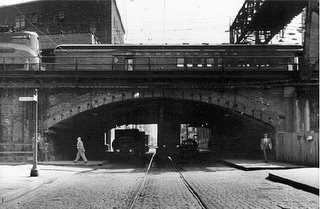
|
| Chinese Wall |
By the time of the Revolution, the Arch Street dock was the commercial heart of town, and the London Coffee House at Front and Market was the thriving center of international gossip. Tradition has it that it was Bradford, the owner of the London Coffee House, who first got the news of the Stamp Act, and started the agitation which famously resulted. The construction of the elevated "Chinese Wall" of the Pennsylvania Railroad along what is now John Kennedy Boulevard, sliced off the Northern side of town as a quiet fashionable place to live for nearly a century. And while the Benjamin Franklin Parkway was intended to correct this situation, it actually finished "North of Market" as even inhabitable. Things are gradually improving, particularly with infusions of public money, but it takes a long time for such urban scars to heal.
Willow Grove Park
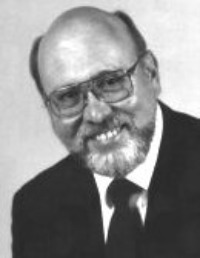
|
| Richard Karschner |
The Right Angle Club was recently highly entertained by a talk by Richard Karschner about the hay day of Willow Grove Park. Mr. Karschner appeared before the club in full uniform of the Marine Marching Band with medals and quickly demonstrated an immersion in this topic that must have taken a lifetime to perfect. He put on a virtuoso performance, a prepared speech perfectly timed to an automated slideshow, which was in turn in perfect synchrony with an automated musical background, exactly tailored to fit the momentary subjects. He concluded with a brilliant brief solo on the cornet (trumpet), using double and triple tongue-ing. To some of us who remember some futile struggling with the trumpet in our high school marching bands, the skill demonstrated was certainly impressive.
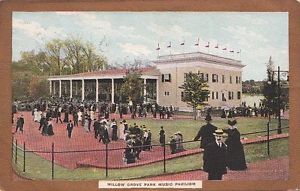
|
| Music Pavilion |
To go back a moment in time, the trolley car was the main method of public transportation in the last half of the 19th Century, blanketing the cities of America and their suburbs, and connecting to the trolley lines of other cities through an interurban network. Somewhere the idea developed of building Amusement Parks out at the far end of suburbs, to attract riders into using the trolleys for more than just commuting; there may have been as many as seventy or eighty such permanent circus grounds in America at one time, with more elaborate attractions that could be managed by traveling circuses. Philadelphia had several such trolley parks, notably Woodside Park in Fairmount Park, serviced by the "Park Trolley". But in 1896 Willow Grove was created on the edge of Abington, far more elaborate than any others, at the intersection of Old York Road and Easton Pike (Rte 611). Its terminal could hold as many as a hundred trolleys at once; the ride from Center City Philadelphia took 70 minutes and cost 15 cents. The area had mineral springs and had long been a favored vacation spot. Horace Trumbauer designed four or five of the buildings, and the Park eventually included a lake with rental boat rides, an arboretum, amusement rides, restaurants, a fun house, silent movie theaters, rodeos, roller coasters, a picnic park, and even an artificial mountain with a slow scenic ride up but a rip-roaring fast descent. By far the most central feature of Willow Grove was the 4000-seat music center, dominated by John Philip Sousa and his band giving four performances a day. Other musical performers were Victor Herbert, Walter Damrosch, Arthur Pryor ("The Whistler and His Dog"). Many of the ideas of Willow Grove are now to be found in the modernized form at Disneyland, but for twenty-five years music under the direction of John Philip Sousa was really the central unifying feature.
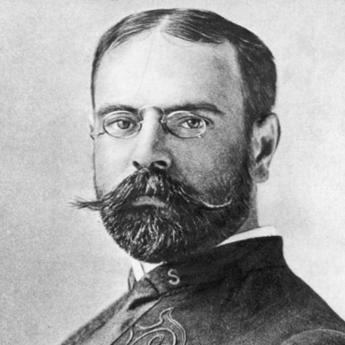
|
| John Philip Sousa |
It's generally held the arrival of radio broadcasting caused the decline of Willow Grove, although "The March King's" immense energy declined toward the end, as he began to enjoy being a multimillionaire. The composition of marches was in fact only a minor part of his musical output, which included among other things 16 full-length Broadway musicals. He was a national champion trap-shooter and a horseman of some note. One arm became nearly useless to him after a fall from his horse. Meyer Davis took over in the last few years, but a major fire pretty well finished the place off just in time to be buffeted by the 1929 crash. There was an attempted resurgence in 1933, but circumstances which made Willow Grove a successful "Virtuoso Solo" just couldn't withstand the competition of the automobile and television, and the land was finally broken up and sold for $3 million in 1976. Remnants of the gilded past are now scattered around the Willow Grove Shopping Mall, for those who wish to renew fond memories from their childhood. Or perhaps their grandparent's childhood.
Reservoir on Reservoir Drive
William Penn planned to put his mansion on top of Faire Mount, where the Art Museum now stands. By 1880, long after Penn decided to build Pennsbury Mansion elsewhere, city growth outran the capacity of the new reservoir system which had then been placed on Fairmount. An additional set of storage reservoirs were placed on another hill across East River (Kelly) Drive, behind Robert Morris' showplace mansion now called Lemon Hill (Morris merely called it The Hill); the area was eventually named the East Park Reservoir. In time, trees grew up along the ridge and houses got built; the existence of these reservoirs right in the city was easily forgotten, even though the towers of center city are now plainly visible from them. These particular reservoirs were never used for water purification; that's done in four other locations around town, and the purified water is piped underground to Lemon Hill, for last-minute storage; gravity pushes it through the city pipes as needed.
Now, here's the first surprise. Water use in Philadelphia has markedly declined in the past century. That's because the major water use was by heavy industry, not individual residences, so one outward sign of the switch from a 19th Century industrial economy to a service economy is -- empty old reservoirs. Only one-quarter of the reservoir capacity is in active use, protected by a rubber covering and fed by underground pipes. The rest of the sections of the reservoir are filled by rain and snow, but gradually silting up from the bottom, marshy at the edges. Unplanted trees have grown up in a jungle of second-growth, attracting vast numbers of migratory birds traveling down the Atlantic flyway. Although there are only a hundred acres of water surface here, the dense vegetation closes in around the visitor, giving the impression of limitless wilderness, except for the center city towers peeping through gaps in the forest. It's fenced in and quiet except for the birds. For a few lucky visitors, it's easy to get a feeling for how it must have looked to William Penn, three hundred or more years ago, and Robert Morris, two hundred years ago. In another sense, it demarcates the peak of Philadelphia's industrial age, from 1880 to 1940, because that kind of industrialization uses a lot of water.
The place, in May, is alive with Baltimore Orioles. Or at least their songs fill the air and experienced bird watchers know they are there. Even a beginner can recognize the red-winged blackbirds, flickers, robins, and wrens (they like to nest in lamp posts). The hawks nesting on the windowsills of Logan Circle suddenly makes a lot more sense, because that isn't very far away. In January, flocks of ducks and geese swoop in on the water surface, which by spillways is kept eight feet deep for their favorite food. Just how the fish got there is unclear, perhaps birds of some sort carried them in. The neighborhoods nearby are teeming with little boys who would love to catch those fish, but it's fenced and guarded much more vigorously since 9-11. In fact, you have to sign a formal document in order to be admitted; it says "Witnesseth" in big letters. Lawyers are well known for being timid souls, imagining hobgoblins behind every tree. However, there are some little reminders that evil isn't too far away. Just about once a week, someone shoots a gun into the air in the nearby city. It goes up and then comes down at random, with approximately the same downward velocity when it lands as when it left the muzzle upward. That is, it puts a hole in the rubber canopy over the active reservoir, which then has to be repaired. No doubt, if it hit your head it would leave the same hole. So, sign the document, and bring an umbrella if the odds worry you.
A treasure like this just isn't going to remain as it is, where it is. It's hard to know whether to be most fearful of bootleggers, apartment builders or city councilmen, but somebody is going to do something destructive to our unique treasure, possibly discovering oil shale beneath it for example, unless imaginative civil society takes charge. At present, the great white hope rests with a consortium of Outward Bound and Audubon Pennsylvania, who have an ingenious plan to put up education and administrative center right at the fence, where the city meets the wilderness. That should restrict public entrance to the nature preserve, but allow full views of its interior. Who knows, perhaps urban migration will bring about a rehabilitation of what was once a very elegant residential neighborhood. And push away some of those reckless shooters who now delight in potting at the overhead birds.

This whole topic of waterworks and reservoirs brings up what seems like a Wall Street mystery. Few people seem to grasp the idea, but Philadelphia is the very center of a very large industry of waterworks companies. The tale is told that the yellow fever epidemics around 1800 were the instigation for the first and finest municipal waterworks in the world. There's a very fine exhibit of this remarkable history in the old waterworks beside the Art Museum. But that's a municipal water service; why do we have private equity firms, water conglomerates, hedge funds for water industries, and other concentrations of distinctly private enterprise in the water? One hypothesis offered by a private equity partner was that the success of the municipal water works of Philadelphia stimulated many surrounding suburbs to do the same thing; it was surely better than digging your own well. This concentration of small and fairly inefficient waterworks around the suburban ring of this city might well have created an opportunity for conglomerates to amalgamate them at lower consumer cost. Anyway, it seems to be true that if you want to visit the headquarters of the largest waterworks company in the world, you go about seven miles from city hall and look around a nearby shopping center. If you are looking for the world's acknowledged expert in rivers, you go to the Academy of Natural Sciences of Philadelphia on Logan Square and look around for a lady who is 104 years old. And if you have a light you are trying to hide under a barrel, come to Philadelphia.
Frank Furness (2) Rittenhouse Square
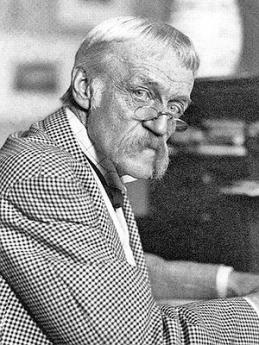
|
| Frank Furness |
George Washington had two hundred slaves, Benjamin Chew had five hundred. It wasn't lack of wealth that restrained the size and opulence of their mansions, particularly the ones in the center of town. The lack of central heating forced even the richest of them to keep the windows small, the fireplaces drafty and numerous, the ceilings low. Small windows in a big room make it a dark cave, even with a lot of candles; a low ceiling in a big room is oppressive. Sweeping staircases are grand, but a lot of heat goes up that opening; sweeping staircases are for Natchez and Atlanta perhaps, but up north around here they aren't terribly practical. Building a stone house near a quarry has always been practical, but if there is insufficient local stone, you need railroads to transport the rocks.
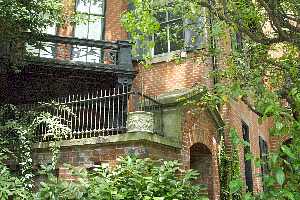
|
| Early Victorian |
So to a certain extent, the advent of central heating, large plates of window glass, and transportation for heavy stone and girders amounted to emancipation from the cramped little houses of the Founding Fathers. Lead paint, now much scorned for its effect on premature babies, emancipated the color schemes of the Victorian house. Many of the war profiteers of the Civil War were indeed tasteless parvenu, but it is a narrow view of the Victorian middle class to assume that the overdone features of Victorian architecture can be mainly attributed to the personalities of the Robber Barons. This is not the first nor the only generation to believe that a big house is better than a small one. The architects were at work here, too. It was their job to learn about new building techniques and materials, and they were richly rewarded for showing the public what was newly possible. Frank Furness was as flamboyant as they come, a winner of the Congressional Medal of Honor for heroism, a man who wore a revolver in Victorian Philadelphia and took pot-shots at stuffed animal heads in his office. He affected the manners of a genius, and his later decline in public esteem was not so much disillusion with him as with the cost of heating (later air-conditioning), cleaning, and maintenance which soon exceeded provable utility. The simultaneous arrival of the 1929 financial crash and inexpensive automobile commuting to the suburbs stranded square miles of these overbuilt structures. It was the custom to build a big house on Locust, Spruce or Pine Streets, with a small servant's house on the back alley. During the Depression of the 1930s, there were many families who sold the big house and moved into the small one. Real estate values declined faster than property taxes and maintenance costs; incomes declined even faster.
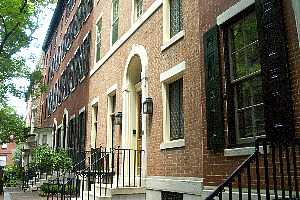
|
| Delancey Street |
It thus comes about that large numbers of very large houses have been sold for very modest prices, and the urban pioneers have gentrified them. You can buy a lot of house for comparatively little if you are willing or able to restore the building. We thus come back to Frank Furness, who was the idolized architect of the Rittenhouse Square area, in addition to the massive banks and museums for which he is perhaps better known. Unfortunately, most of the Furness mansions on the square have been replaced by apartment buildings, but one outstanding example remains. It's sort of dwarfed by the neighboring high-rises, but it was originally the home of a railroad magnate, a few houses west of the Barclay Hotel, and it holds its own, defiantly. Inside, Furness made clever use of floor-to-ceiling mirrors to diffuse interior light and make the corridors seem wider. Although electric lighting made these windowless row houses bearable, modern lighting dispels what must have been originally a dark cave-like interior on several floors, held up by poured concrete floors. Furness liked to put in steel beams, heavy woodwork, and stonework, in the battleship school of architecture. If you were thinking of tearing down one of his buildings, you had to pause and consider the cost of demolition before you went ahead.
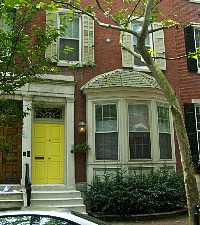
|
| Frank Furness Window |
There are several others of his buildings around the corner on the way to Delancey Street, one of them set back from the street with a garden in front. That's what you expect in the suburbs, but the land is too expensive in center city for very many of them; this is the last one Furness built before rising real estate costs drove even him back to the row-house concept. On Delancey Street, there is a house which he improved upon by adding an 18-inch bay window in front. The uproar it caused among the neighbors is still remembered.
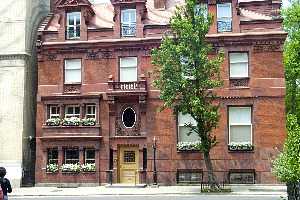
|
| Doctor Home and Office |
A block away on the part of 19th Street facing down the street, Furness built another reddish brownstone house to glare back at the neighbors. The facings of the front suggest three-row houses, and it was indeed the home of a physician who had his offices on one side, entrance in the middle, and living room on the right. The resulting staircase in the middle is used to good effect by opening a balcony on the landing overlooking the parlor below. As befits the Furness style, the wall is thick, the wooden beams heavy. And, in a gesture to the lady of the house, the room adjoining the living parlor is a modern kitchen so the kids can play while mama cooks or guests can wander by as she gets dinner ready. Times have changed, the servants quarters once were plain and undecorated. The lady of the house never set foot in the kitchen so she could care less what it looked like.
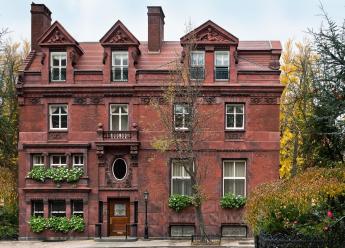
|
| Frank Furness Home |
As a matter of fact, that's the remaining problem for these places, the rate-limiting factor as chemists say. Automatic washers, microwaves, electric sweepers, spray-on cleaning fluids and similar advances are the new industrial revolution which makes these hulking mansions almost practical. What's still lacking is the social structure of Upstairs and Downstairs, the servant community overseen by the lady of the house, who once was sort of the Mayor of a town. The lady of the house is now a partner in a big law firm, or similar. It simply is not wise to leave a big expensive place unattended by someone constantly supervising the domestic help. It is never entirely safe to leave the financial affairs of the household in the hands of someone who is not a central member of the owning family. Perhaps the father of the family can be brow-beaten into spending some quality time with the children once in a while.
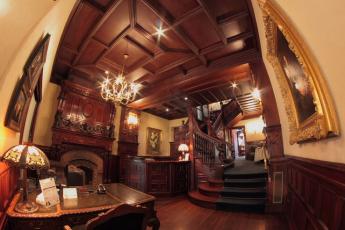
|
| Structure of Upstairs and Downstairs |
Perhaps an accountant can for a fee be trusted with the finances; perhaps a butler can be found who will whack the staff when they get out of line. But the plain fact is these monster houses were built around the assumption that the lady of the house would run them, and the old style of manorial life cannot return unless the house is completely redesigned for it. Someday, perhaps a genius of the Frank Furness sort will make an appearance, change everything, and make everybody want to have it. But it is asking for something else when you insist on this happening in an old stone fortress that was designed to house a different style of life.
Chester County, Pennsylvania
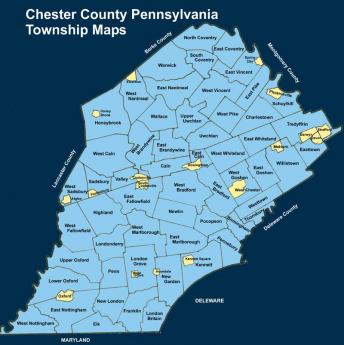
|
| Map of Chester County |
Chester County was one of the four original counties of Pennsylvania, as first laid out by its first white owner, William Penn. Although several parts of Chester County have been cut away, what's left is still quite large. Lancaster County was separated in 1729, and in 1785 Dauphin County was separated from that. In 1789, Delaware County was separated. If you stand in the horse country of Chester County, you still might find it hard to believe anything much has happened in three hundred years. But as a matter of fact, the present population residing within Penn's original boundaries of Chester County would make it the most populous county in the state and growing steadily. Since Philadelphia and Pittsburgh are meanwhile shrinking in population, projected future relationships would strike most residents of Chester County as quite remarkable. Horses, that's what Chester County wants to be all about. Even the mushroom growers of Kennett Square sort of count as part of the horse industry, because mushrooms are grown on horse manure, in the dark. Electronics and steel mills are not exactly traditional, but they reside here, too. As a small footnote, the Lukens Steel Company was recently purchased by an investor named Ross, who lumped it with several other steel mills and then sold the bundle to an owner in India. The consequence is that Chester has a footprint of the largest steel company in the world, or the largest steel company in India, whichever way you wish to style it. Nevertheless, the neighborhood still looks like horse country.
Furthermore, southern Chester County is socially part of the state of Delaware, while western Chester County is thoroughly Pennsylvania Dutch. Up north, the Philadelphia Main Line is building mansions as fast as mortgage originators will allow, and many of them end up paying Chester County taxes. All along Route 202, the central artery of the Great Valley, stretches a burgeoning electronics industry, within which is found Vanguard, the largest investment company in America, or possibly the second largest, depending on temporary quirks of mark-to-market pricing. Chester County presently has the highest average personal income of any county in America. It is far from true that everybody has a horse farm or a trust fund.
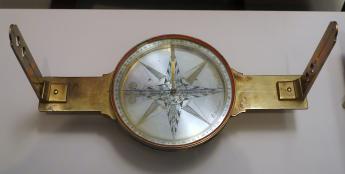
|
| David Rittenhouse's compass |
In a spiritual sense, Chester County horse culture contiguously spreads far beyond even historic outlines of Chester County. The boundaries of southeastern Pennsylvania were laid out with David Rittenhouse's compass, so the rolling hills suitable for horse farming extend into the states of Delaware and Maryland, and of course out into Lancaster and Dauphin counties, without much visible sign of individual state or county. In Europe, by contrast, almost all boundaries are set by rivers and mountain ranges, so the physical appearance of the countryside is apt to change sharply when crossing political borders. In fact, it is possible to say it in reverse: the State of Delaware is mostly Chester County extended, at least in its upper third. Below that lies urban and suburban Wilmington, and below that ("south of the canal") spreads loamy flat farm country, formerly slave country. Maryland divides similarly; an upper third of Maryland's rolling hillsides (sometimes known colloquially as Chester County extended), followed on the south by tidewater Maryland, in turn, followed by the suburbs of Washington, DC. The remnants of Baltimore are mixed in there somewhere, too. When you drive through miles of silent prosperous farms, regardless of highway signs, it is natural to think of yourself in the heart of America.
The one thing Chester County never much warmed to was Universities. It may shock residents of New York City to hear that Chester County never thought much of having its own art museums, classical music, theater performances or opera. However, Chester County doesn't share typical urban dislikes, either. Local speech patterns suggest Appalachian hillbillies and the Pennsylvania Dutch L'il Abners are just like us, just not so rich. Chester County sometimes thinks of itself as nobility, but it isn't Ivy League nobility, it's a country squire. We all like horses, dogs, and guns, we can't imagine why everyone else doesn't like them, too. Chester County has more history than almost anybody; it just doesn't talk much about it.
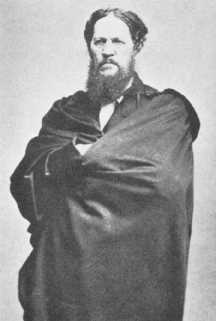
|
| Josiah Harlan |
So let's mention just the highlights: George Washington fought the battle of the Brandywine, the biggest battle of the American Revolution, in Chester County, the Paoli Massacre was long regarded as the second nastiest event of that campaign. A local farmer's son, Josiah Harlan (1799-1871), did what the Tsars and Dictators of Russia and the Kings and Queens of England couldn't do; he conquered Afghanistan. Moreover, he did it single-handedly, making himself King. Even the 350 American Rangers who conquered Afghanistan in 2002 can't match that exploit by this local Quaker boy. The first intern doctor of the first hospital in America (Jacob Ehrenzeller) spent his long life practicing in Chester County. The only President of the United States to come from Pennsylvania (James Buchanan) hailed from Lancaster, not terribly long after it split off from Chester County. In a wry sort of way, it can be said that Buchanan created the Republican Party by almost getting us to annex Cuba. Harrisburg, the present capital of the state, was once part of Chester County. Major portions of both British General Howe's and General Washington's armies left the Brandywine battlefield and swept up the Great Valley of Chester County to Philadelphia and Valley Forge, respectively. Conestoga Creek was once part of Chester County, and Conestoga wagons took many generations of settlers westward to build the new nation; wagons do go pretty naturally with horses. But drive through miles of Chester County today, usually alone through the silent stone barns and rolling grasslands: nothing much seems to have happened except real estate is more expensive.
But then, just drive up Route 202 from Wilmington to King of Prussia, at rush hour. This may be the Great Valley where Washington retreated to Valley Forge, but now it's where employees of the electronics industry ferry children to school, in order to get into the Ivy League, and maybe to shop at fancy stores in King of Prussia. With time out for a recession, it could be wall-to-wall McMansions around here in a generation. It seems almost certain the future will bear little resemblance to the past. It's sort of a pity, it is a great economic opportunity, and it seems inevitable.
South Philadelphia: Ideal Intermodality Transportation Site
The Right Angle Club was recently visited by Troy Adams, representing the Greater Philadelphia affiliate of the regional Chamber of Commerce. Sustained by contributions from sixty local corporations, the Greater Philadelphia organization is a major storehouse of data useful for businesses, supported by a staff of analysts and computer experts. The purpose of this institution is to help businesses who are trying to decide whether or how to locate in the Philadelphia region. With such an organization behind him, Mr. Adams was able to show a number of slides displaying the demography, geography, and statistics about our region, and his appearance is greatly appreciated. This is definitely the place to go if you have questions of that sort. It would probably also be a good place to go for opinions and gossip about the politics and inside baseball of the town, but the Chamber has a strict rule about avoiding any involvement in business moving from one district to another within the region or hearsay that might lead to such internal friction.
One really important insight into the potential of our region concerns South Philadelphia. Historically, this was the place where the Schuylkill and Delaware Rivers met, and was once a very big swamp (wetland, nature sanctuary or whatever). Over time, the swamp became a trash and garbage landfill, and over still more time it became a big flat uninhabited area right next to a big city. But then an Interstate Highway (I95) was built on its circumference, and several rail lines, and an international airport, not to mention extensive port and shipping terminals for ocean transport. While it is true that a certain number of houses would have to be purchased and demolished to accomplish it, the potential exists for the construction of an intermodal interconnection which would be almost unique in the world.
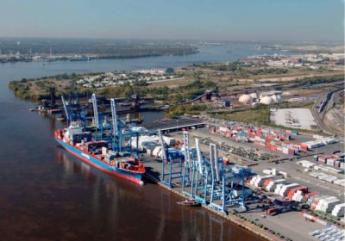
|
| South Philadelphia Ports |
There would be plenty of lands left over for industries related to freight forwarding and the like (the food distribution center is a good example of the general concept), and all of this would be within twenty minutes of the center of a major city. SEPTA already sends a passenger rail spur from the very heart of the city to the very center of the airport, and there is no reason it could not be extended to include ocean, bus, and distribution terminals. Whether this exactly fits with the extensive sports stadium complex in the area is unclear, but these entertainment features are doing no harm to the intermodal interchange idea in the meantime. Judging by the city government's willingness to tear these structures down every five or ten years, there should be no great resistance to moving them elsewhere if the need should arise.
Reviving Schuylkill: Eight Miles From the Dam to Ft. Mifflin

|
| Joshua Nims |
Joshua Nims of the Schuylkill River Development Corporation recently addressed the Right Angle Club about current activities of that organization. It's a non-profit corporation, but in a sense is a quasi-City agency, spending State and Federal funds, plus remediation funds. Just what remediation funds are was not clearly explained, but seem to be fines or assessments on companies who are thought to have fouled up the environment. Whether those assessments are fair or unfair, too small or too large, are political issues largely avoided in Mr. Nims' presentation, and hence are avoided here.
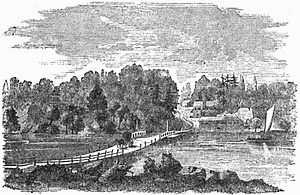
|
| Gray's Ferry Bridge |
The Gray's Ferry area is certainly an urban tragedy of epic proportion, but since its deterioration began in 1856, the events of the Civil War probably had a lot to do with it. Up until the Civil War, the western banks of the Schuylkill, especially around Gray's Ferry, were famously upscale and beautiful. The South Street Bridge, for example, was originally envisioned as leading into a boulevard of the Arts, with the University Museum, Irvine Auditorium, the University Hospital and the mansions on the top of the hill setting off what promised to become a striking cultural statement. Anthony Drexel himself lived up there, walking it to work at Third and Chestnut. And that's just one famous example. It's hard to know what started the blight, but Harrison Brothers White Lead, Color and Chemical Works might be a good candidate and the fact that the area soon developed the tracks often (10) smoke-belching railroads was certainly another major issue. The western bank of the Schuylkill rose to a high rocky promontory at Gray's Ferry, crowding wartime industrialization into a narrow place. Before that, Gray's Ferry Bridge had been the main artery to the South, traveled by George Washington many times, often stopping at Woodlands, that palatial home of Andrew Hamilton the original Philadelphia lawyer. A century before that, the Dutch fur traders had found it to be the first firm land after they sailed inland through the swamp, while the Indians knew it was the last forest area before you reached the (South Philadelphia) area of malaria, yellow fever and other mysterious vapors that must be avoided. In the sense of land travel, Gray's Ferry was, therefore, the most prominent part of the Philadelphia landscape for two centuries. The ferry itself was a floating bridge, pulled back and forth by ropes on each shore of the river. Given a choice of pretty much all of the North American continent, John Bartram placed his farm just south of this promontory. Where it still stands today but surrounded by slums and urban decay.
It's a little hard to judge whether the Civil War pushed railroad construction into the only rocky crevice suitable, and then industrial pollution followed with vile and noxious effluents, or whether the Harrison Lead, Color, and Chemical factory simply started it across the river in the river bend. That's where the DuPont paint factory relocated in 1916, and in fact, the Duponts get local blame as polluters when in fact they made considerable effort to clean things up after they acquired it. The area had a major slaughterhouse abattoir, and an asphalt plant and several other major inducements to the populace to abandon their elegant mansions and run for their lives. The place now has old rusting bridges, tumble-down concrete pilings, lots of weeds, and not a single living fish for a century in that water. To diffuse the blame somewhat, it should be remembered that after the War of 1812, the Schuylkill was the main transportation artery for coal coming down from Pottsville and the rest of Schuylkill County. The river didn't have a sandy bottom, it was pulverized anthracite which releases acids and toxins when washed.
So that's the river region the Schuylkill Development Corporation plans to line with grassy running paths and benches to admire the view. Maybe the Wilson Steamship Line or something like it can again be persuaded to bring tourists here, or maybe the riverbanks can be lined with hotels to house people who take rides on river flatboats, as they do in San Antonio. Or dare we mention it, maybe Paris. Maybe Philadelphia can once again be a tax collector's idea of heaven, together with five-day weekends.
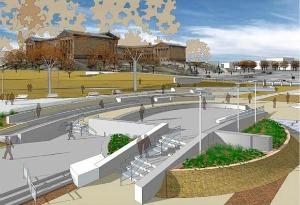
|
| Schuylkill River Development Corporation |
At the moment, this little non-profit city agency is run on a $500,000 operating budget, and has about $20 million worth of projects in progress. Some of that is reparation money pried from the grandchildren of the owners of those factories who did the damage over a century ago, and some large part of it is Philadelphia's share of the boodle from the Stimulus package. There's no doubt the area will look immensely improved in the next year or two, and a lot of hope that private investment will be attracted to an area previously shunned vigorously. The area which has already been cleaned up, from the Wissahickon to the Dam, really must be called a great success; there's lots of foot traffic and joyousness. And the area can also be praised in what unfortunately is the measurement of modern urban development: it has only had two lawsuits for sprained ankles, and only two muggings, quite a commendable record. But now development is going past South Street, into much murkier areas, with more low-income residential spaces. Surveillance cameras are planned, and bright lighting, but it's far from certain that a little strip of gentrification can defeat miles of surrounding decay.
Only if they pull it off will private investment creep into the area, and the parents of University students permit their children to run there. If private investment arrives, this organization can do no wrong, because only then can it fairly be described as "Infrastructure". My own definition of infrastructure as an economic stimulus is of early public spending on projects which would have eventually consumed the money anyway, except later. By that standard, infrastructure spending's only true cost would be the interest on borrowed money to do it sooner. Let's make a note to revisit this experiment in a couple of years, cautiously wishing everyone the best, in the meantime.
Foreground: Parliament Irks the Colonial Merchants
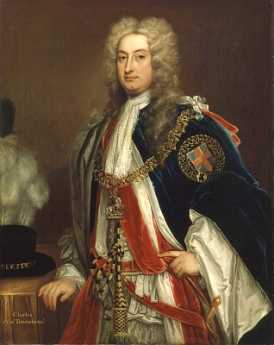
|
| Charles Townshend |
Charles Townshend, Chancellor of the Exchequer under King George III in 1766-67, had a reputation for abrasively witty behavior, in addition to which he did carry a grudge against American colonial legislatures for circumventing his directives when earlier he had been in charge of Colonial Affairs. His most despised action against the Colonies, the Stamp Act, seems to have been only a small part of a political maneuver to frustrate an opposition vote of no confidence. The vote had taken the form of lowering the homeland land tax from four to three shillings (an action understood to be a vote of no confidence because it unbalanced the budget, which he then re-balanced by raising the money in the colonies.) The novelist Tobias Smollett subsequently produced a scathing depiction of Townshend's heedless arrogance in Humphry Clinker, but at least in the case of the Stamp Act, its sting was more in its heedlessness of the colonies than vengeance against them. One can easily imagine the loathing this rich dandy would inspire in sobersides like George Washington and John Adams. After Townshend was elevated in the British cabinet, almost anything became a possibility, but it was a fair guess he might continue to satisfy old scores with the colonies. When King George's mother began urging the young monarch to act like a real king, Townshend was available to help. On the other hand, the Whig party in Parliament had significant sympathy with the colonial position, as a spill-over from their main uproar about John Wilkes which need not concern us here. Vengefulness against the colonies was not widespread in the British government at the time, but colonists could easily believe any Ministry which appointed the likes of Townshend might well abuse power in other ways before such time as the King or a more civilized Ministry could arrive on the scene to set things right. It was vexing that a man so heedless as Townshend could also carry so many grudges. Things did ease when Townshend suddenly died of an "untended fever", in 1767.
Whatever the intent of those Townshend Acts, one clear message did stand out: paper money was forbidden in the colonies. Virginia Cavaliers might be more upset by the 1763 restraints on moving into the Ohio territories, and New England shippers might be most irritated by limits on manufactures in the colonies. But prohibiting paper money seriously damaged all colonial trade. Some merchants protested vigorously, some resorted to smuggling, and others, chiefly Robert Morris, devised clever workarounds for the problems which had been created. Paper currency might be vexingly easy to counterfeit, but it was safer to ship than gold coins. In dangerous ocean voyages, the underlying gold (which the paper money represents) remains in the vaults of the issuer even if the paper representing it is lost at sea. Theft becomes more complicated when money is transported by remittances or promissory notes, so a merchant like Morris would quickly recognize debt paper (essentially, remittance contracts acknowledging the existence of debt) as a way to circumvent such inconveniences. In a few months, we would be at war with England, where adversaries blocking each other's currency would be routine. By that time, Morris had perfected other systems of coping with the money problem. In simplified form, a shipload of flour would be sent abroad and sold, the proceeds of which were then used to buy gunpowder for a return voyage; as long as the two transactions were combined, actual paper money was not needed. Another feature is more sophisticated; by keeping this trade going, short-term loans for one leg of the trip could be transformed into long-term loans for many voyages. Long-term loans pay higher rates of interest than short-term loans; it would nowadays be referred to as "riding the yield curve." This system is currently in wide use for globalized trade, and Lehman Brothers were the main banker for it in 2008. And as a final strategy, having half the round-trip voyage transport innocent cargoes, the merchant could increase personal profits legitimately, while cloaking the existence of the underlying gun running on the opposite leg of the voyage. If the ship is sunk, it can then be difficult to say whether the loss of such a ship was military or commercial, insurable or uninsurable. In the case of a tobacco cargo, the value at the time of departure might well be different from the value later. Robert Morris became known as a genius in this sort of trade manipulation, and later his enemies were never able to prove it was illegal. Ultimately, a ship captain always has the option of moving his cargo to a different port.
Other colonists surely responded to a shortage of currency in similar resourceful ways, including barter and the Quaker system of maintaining individual account books on both sides of the transaction, and "squaring up" the balances later but eliminating many transaction steps. Wooden chairs were also a common substitute as a medium of exchange. But "Old Square-toes," Thomas Willing, experienced in currency difficulties, and his bold, reckless younger partner Morris displayed the greatest readiness to respond to opportunity. Credit and short-term paper were fundamental promises to repay at a certain time, commonly with a front-end discount taking the place of interest payment. The amount of discount varied with the risk, both of disruption by the authorities, and the risk of default by the debtor. This discount system was rough and approximate, but it served. Quite accustomed to borrowing through an intermediary, who would then be directed to repay some foreign creditor, Morris, and Willing added the innovation of issuing promissory notes and selling the contract itself to the public at a profit. Thus, written contracts would effectively serve as money. A cargo of flour or tobacco represented value, but that value need only be transformed into cash when it was safe and convenient to do so.
The Morris-Willing team had already displayed its inventiveness by starting a maritime insurance company, thereby adding to their reputation for meeting extensive obligations; they established an outstanding credit rating. Although primarily in the shipping trade, the firm was also involved in trade with the Indians. There, they invented the entirely novel idea of selling their notes to the public, essentially becoming underwriters for the risk of the notes, quite like the way insurance underwriters assumed the risk of a ship sinking. Their reputation for ingenuity in working around obstacles was growing, as well as their credibility for prompt and reliable repayment. In modern parlance, they established an enviable "track record." A creditor is only interested in whether he will be repaid; satisfied with that, he doesn't care how rich or how poor you are. The profits from complex trading were regularly plowed back into the business; one observer estimated Robert Morris's cash assets at the start of the Revolution were no greater than those of a prosperous blacksmith. It didn't matter; he had credit.
In the event, this prohibition of colonial paper money did not last very long, so profits from it were not immense. But ideas had been tested which seemed to work. Today, transactions devised at Willing and Morris are variously known as commercial credit, financial underwriting, and casualty insurance. In 1776, Robert Morris would be 42 years old.
Ageing Owners, Ageing Property
|
| Kiyohiko Nishimura |
Kiyohiko Nishimura is currently the Deputy Governor of the Bank of Japan (BOJ), and as such is expected to have wise things to say about finances, as indeed he does. Japan has a far older culture than the United States, and a botanical uniqueness growing out of the glaciers avoiding it, many thousands of years ago. But its latitude is approximately the same as ours, and its modern culture is affected by the deliberate effort of the Emperor to westernize the nation, following its "opening up" by our own Commodore Matthew Perry in 1852. Perhaps a more important relationship between the two cultures for present purposes is that Japan has been suffering from the current deep recession for fourteen years longer than we have. We don't want to repeat that performance, but we can certainly learn from it.
Mr. Nishimura lays great stress on the aging of the Japanese population because, in all nations, houses are mainly purchased by young newly-weds, and sold by that same generation years later as they prepare to retire. If a nation has an elderly population, it can expect a general lowering of house prices someday, reflecting too many sellers leaving the market at the same time. The buyers of those houses are competing with other young people, so the simultaneous bulges and dips of the population at later stages combine to have major effects on housing prices. At the moment, younger couples are having fewer children as a result of women postponing the first one. Nishimura goes on to reflect that something like the same is true of stocks and bonds, although at age levels five or ten years later. One implication is that retirement of our own World War II baby boom is about to depress American home prices, which will likely stay lower for 10-20 more years. Furthermore, our stock market will have a similar effect, stretching the depression out by as much as 5-15 years. The Japanese stock market has been a gloomy place to be during the past fifteen years, and by these lights might continue in the doldrums for another five or so. Meanwhile, our own situation predicts an additional generation of struggle while Japan is recovering. It's best not to apply these ideas too closely, of course, but surely somebody in our government ought to dig around in the data, at least telling us why we ain't goin' to repeat this pattern. Please.
Perhaps because they eat so much rice and fish, the Japanese already have a longer life expectancy than Americans do, but in terms of outliving your assets, that's not wholly advantageous, the way a love of golf might be. The best our nation might be able to do is to examine some of our premises about housing construction. In Kyoto, most houses were built with paper walls, for example.
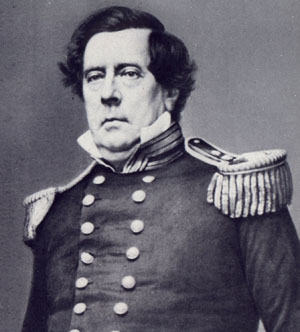
|
| Commodore Matthew Perry and Japan |
The house walls of the town of Kyoto were in fact made of waxed paper, which seems to work remarkably well. While no one now advocates going quite that far, we might think a second time about building the big hulking masonry houses so favored in our affluent suburbs. Such cumbersome building materials almost dictate custom building and strongly discourage mass production. How likely are such fortresses to survive in the real estate markets of fifty years from now? Judging from my home town, not too well. Haddonfield boasts it has been around since 1701, and there are at most three or four of its houses which have survived that long. We favor great hulking Victorian frame houses, with a good many bedrooms unoccupied, and high drafty ceilings, very large window openings and little original insulation. The heating arrangements have gone from fireplaces to coal furnaces, to oil, and lately to natural gas. The meter reader who checks my consumption every month tells me that almost all the houses now have gas heat, so almost all the houses are using their second or third heating plant, along with their eighth or tenth roof, and thirty coats of paint. This kind of maintenance is not prohibitively expensive, but just wait until the plumbing starts to go, and leak, and freeze, with attendant plastering, carpentry, and painting. Our schools and transportation are excellent, so we have location, location, location. But when the plumbing, heating, and roofing start to require financial infusions all at once, you get tear-downs. A tear-down is a new house in which a specialist builder buys the old house, tears it down, and looks for a buyer to commission the new house on an old plot of land. Right now, there appear to be six or eight such Haddonfield houses, torn down and looking for a buyer to commission a new house on that location, location. If we repeat the Japanese experience, there will be some unhappy people, somewhere. And that will include the neighbors like me, who generally do not relish languishing vacant lots next door, but fear what the new one will be like.
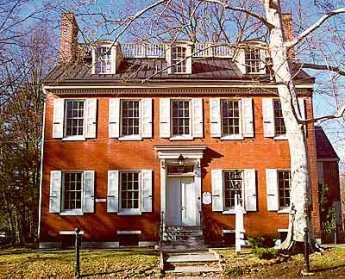
|
| Greenfield Hall |
The thought has to occur to somebody that building the whole town of less substantial materials in the first place would be worth investigation, replacing the houses every forty years when the major stuff wears out. At the present, when a town of several thousand houses has five or six tear-downs, the neighbors would not tolerate replacing tear-downs with insubstantial cardboard boxes. Seeing what has happened to inner-city school systems, the neighbors would be uneasy about "affordable housing" built in place of stately old Homes of Pride. In time, that might lead to a deterioration of one of the two pillars of location, location -- the schools -- and hence to a massive loss of asset value. And yet when those houses empty out the school children, leaving only retirees in place, the schools will not be worth much to the owners or in time to anybody else. There's an unfortunate tendency for local political control to migrate into the hands of local real estate brokers, so you had better be sure any bright new proposal is tightly buttressed with facts.
The only real hope for evolution in this obsolete system may lie in the schools of architecture, strengthened perhaps by some research grants. Countless World Fairs have displayed the proud products of their imaginative thinking, but mostly to no avail. Perhaps the ideas are not yet ripe, but since it would take more than a generation to create a useful demonstration project of whatever does become ripe for decision, let's start thinking about some innovative suburban designs, right now.
Morris Upended by a Nobody
THE Revolutionary War ended militarily with the Battle of Yorktown in 1781, and diplomatically with the Treaty of Paris in 1783. The careers of Washington and Franklin appeared to be complete, while the economic and financial career of Robert Morris seemed likely to stretch for decades into the future. But as matters actually turned out for these three fast friends, it was Washington who was propelled into a new political career, Franklin soon died, and Morris got himself into a career-ending mess. The financial complexity and economic power of the United States did grow massively in the next several decades, but unfortunately, Robert Morris was soon unable to exert any leadership. At the end of Washington's eight years as President, the power of the Federalists, and particularly the three men most central to it, was coming to a close. John Adams had a tempestuous single term, and then Federalism was all over.
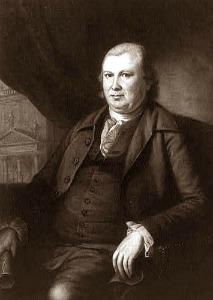
|
| Robert Morris |
The end of the Eighteenth century marked the end of The Enlightenment and the beginning of the Industrial Revolution, accompanied by many national revolutions, not just the American one. This was a major turning point for world history. The momentum of these upheavals still continues, but it is clear that the Industrial Revolution of which the Morris banking revolution was an essential part swept the world far faster than the social and political revolution, in which he also played a pivotal role. In the banking and industrial revolution, it is universally agreed that Morris was almost always right. In the social and political world, it is conversely agreed he was quite wrong. Essentially, Morris assumed that a small minority, an aristocracy of some sort, would rule any country. Within weeks of the ratification of the new Constitution, or even somewhat in anticipation of it, America made it clear that replacing an aristocracy of inheritance with an aristocracy of merit would not satisfy the need. Morris, born illegitimate and soon an orphan, was obviously in favor of promotion based on merit. John Adams defined leadership even more narrowly; he said a gentleman was a man who went to college, and he probably meant Harvard. Nobody extended the leadership class to include Indians and slaves, but the backwoodsmen of Appalachia made it clear that power and leadership at least included them. Thomas Jefferson was the visible leader of this expansion of the franchise, but changed his mind several times. James Madison switched sides; Thomas Paine switched in the opposite direction. The leaders of Shay's Rebellion and the Whiskey Rebellion lacked coherence and consistency on this point; instead of agitating for a refined goal, they mostly seemed to be running around looking for a leader. William Findlay, on the other hand, knew what he wanted. The issue might be defined as follows: it was obvious that hereditary aristocracy was too small and too inflexible to suffice, but it was also obvious that every man a king was too inclusive. An expanded leadership class was needed, but its boundaries were indistinct and contentious. But to return to Findlay, who at least had a clear idea of what he wanted.
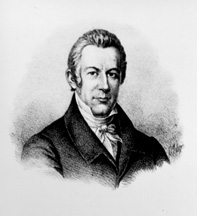
|
| William Findlay |
William Findlay was a member representing Western Pennsylvania in the State Legislature, in 1785. It would be difficult to claim any notable accomplishment in his life; he was largely uneducated. The new leadership class must, therefore, include both the uneducated and the mediocre. The Legislature at that time met in the State House, Independence Hall, in Philadelphia, where no doubt the unconventional dress and manners of backwoodsmen did not pass without audible comment. Findlay made his own political goals quite explicit; he was for paper money to facilitate land speculation which could make him rich. Wealth was a goal, but it did not confer distinction. The rights of the Indians, the rights of the descendants of William Penn, the rights of the educated class and the preservation of property were all just obstacles in the way of an ambitious man who had carefully studied the rules. Everybody's vote was as good as everybody else's, and if you shrewdly controlled a majority of them, you could do as you please. If this meat-ax approach had any rational justification, it lay in the essential selfishness of every single member of the Legislature, working as hard as he could to further his own interest. If someone controlled a majority of such votes, then the majority of the public were declaring in favor of the outcome. Those who believed in good government and the public interest were saps; the refinements of education mostly just created hypocritical liars. There was a strain of Calvinism in all this and a very large dose of Adam Smith's hidden hand of the marketplace. If you were rich, it was proof that God loved you, if you were poor, God must not think much of you, or He wouldn't have made you poor. Findlay had the votes and meant to become rich; if his opponents didn't have the votes, they could expect soon to be poor. In this particular case, the vote coming up was a motion to renew the charter of the Bank of North America. Findlay wanted it to die.
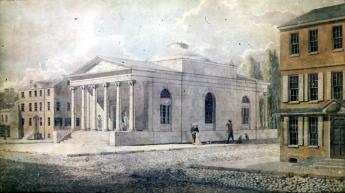
|
| America's first bank, the Bank of Pennsylvania |
It came down to a personal debate between Findlay, and Robert Morris. Morris had conceived and created America's first bank, the Bank of Pennsylvania. Today it would be called a bond fund, with Morris and a few of his friends put up their own money to act as leverage for loans to run the Revolutionary War. After a short time, it occurred to Morris that the money in a bank could be expanded by accepting interest-bearing public deposits and making small loans at a higher interest rate, which is the way most banks operate today. Accordingly, a new bank called the Bank of North America was chartered to serve this function, which greatly assisted in winning the Revolutionary War. There was no banking act or general law of corporations; each corporation had its individual charter, specifying what it could do and how it would be supervised. When the charter came up for renewal, Findlay saw his chance to kill it. Morris, of course, defended it, pointing out the great value to the nation of promoting commerce and maintaining a stable currency. The reply was immediate. Morris had his own money invested in the bank and only wanted to profit from it at the public expense. His protests about the good of commerce and the public interest in stable money were simply cloaking for this rich man's greed to make more money. Findlay made no secret of his interest in reverting to state-authorized paper money, which could then be used by the well-connected to buy vast lands in Ohio for speculation. There were enough other legislators present who could see welcome advantages, and by a small majority the charter was defeated.
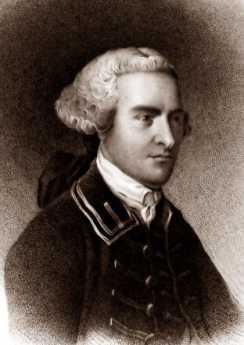
|
| John Hancock |
At this point, Morris made a staggering mistake. After all, he was a simple man of no great background, largely uneducated but fortified by his ascent in society from waterfront apprentice to the highest of social positions, a friend of George Washington and Benjamin Franklin, acclaimed as a financial genius, the man who saved the Revolution, very likely the richest man in America. For many years, he had harbored not the slightest doubt of his personal genius, his absolute honesty, and total dedication to the welfare of his country. To have this reputation and accomplishment sneered at by a worthless backwoodsman, a man who would stoop to using the votes of other backwoodsmen to accomplish self-enrichment, was intolerable. Morris announced and actually did sell out his entire business interest as a merchant, at a moment when he fully understood the new nation was about to enjoy an unprecedented post-war boom. So much for his self-interest. It helps to understand that John Hancock and Henry Laurens had done the same thing in Boston and Charleston, against what we now see as a strange aristocratic tradition of prejudice against bankers and businessmen. In even the few shreds of aristocracy now surviving in Britain and Europe, the tradition persists that a true aristocrat is so independently wealthy that no self-interested temptations can attract him away from purest attention to the public good. The original source of this wealth was the King, who conferred high favor on those who served the nation well. A curious exception was made for wealth in the form of land, the only dependable store of tangible wealth, and transactions in land. Wealth was something which came from God and the King in return for public service. Land ownership was its tangible storage and transfer medium. Otherwise, grubbing around with trade and manufacture was beneath the dignity of a true gentleman.
|
| Henry Laurens |
We now know what was coming. Wealth was soon to be the reward of skill and merit, recognized by fellow citizens in the marketplace, by consensus. Findlay and his friends wholly accepted this conclusion, unfortunately skipping the merit part of it for several decades. In their view, you were entitled to the money if you had the votes. As the nation gradually recognized that rewards must be durable, and once granted were yours to have and to hold, the new nation gradually came to see the need for durable ownership of property. Unless or until the owner places it out at risk in the marketplace, legislative votes may not affect its ownership. Our system ever since has rested on the three pillars of meritorious effort, assessment of value by the free market, and respect for pre-existing property. That's quite a change from the Divine Right of Kings, and therefore quite enough material to keep two political parties agitated for a couple of centuries. And quite enough change to bewilder even so brilliant a victim as Robert Morris.
State in Schuylkill Fishing Club
|
| Richard Romm |
Richard Romm, a rising historical scholar with a special interest in early Philadelphia, recently educated the Right Angle Club in the history of the Schuylkill Fishing Club in the State in Schuylkill, and was immediately accepted into membership. Of the Right Angle, that is, which is an old club by some standards, but scarcely a hundred years old in the eyes of the really old, old clubs.
The State in Schuylkill is an eating club, originally a fishing and eating club, apparently organized around the annual shad run up the river. The clubhouse, or Castle, was moved several times, in response to damming of the river, and is now located on the grounds of, or adjoining the edge of, Nicholas Biddle's estate on the Delaware River called Andalusia. One by one, the Atlantic Ocean rivers of America have been dammed and their annual shad migrations brought to an end, except through the city of Richmond, Va, so there was little point in moving The Castle to follow the fish. It remains, overlooking Delaware in spite of its name.
There seems to have been several name changes, the most important of which was to change the Colony of Schuylkill to the State of Schuylkill for obvious reasons. Originally, the Castle was roughly opposite the falls of Fairmount on the West Bank of the Schuylkill at about Girard Avenue; thus, from 1732 to 1822 located on Baron Warner's property called Eaglesfield. In 1822 it moved to Rambo's Rock (the Rambo family is said to be the oldest European settler family in Pennsylvania) opposite Bartram's Gardens, then finally in 1887 to Andalusia, Nicholas Biddle's country estate. The club was founded in 1732, and dates of movings are possibly hazy, possibly somewhat because of the reluctance of club officers to return the calls of inquiring historians. The State in Schuylkill claims to be the oldest organized men's club in the world, an honor contested by White's in London. The roots of this argument are found tangled in the vital issue of whether their age should be based on the formal organization of the clubs, or on the establishment of the coffee houses which housed the original clubs. Four books are said to have been written about club history, but we depend here on Mr. Romm.
|
| Chief Tammenend |
There is also an unclear relationship with Chief Tammenend, possibly traceable to the shad run, but in any event to the Indian chief depicted with William Penn in the paintings by Benjamin West and Edward Hicks. May 1 is St. Tammany's day, growing into the fancy that he was the "Patron Saint of America", before a branch of the nation-wide Tammany association opened in New York and sort of tarnished up the name. Other traditions of the Fishing club have to do with wearing Mandarin hats, possibly having to do with the export of ginseng which was once abundant in our colonial suburbs, with a return cargo of Chinese dishware. All of the cooking is done by official citizens of the club. The quantities of food are remarkable; one 19th Century menu listed eleven pounds of meat per member. The club drink is a punch, the famous Fishhouse Punch, widely recognized to be rather strong. Its inventor is reputed to be Edward Shippen Willing, on the occasion of the first visit to the clubhouse by women guests. The quantity of alcoholic beverage at these events is especially remarkable in view of the Quaker origins of many original members of the club, but not necessarily of the guests. Among the various guests were Generals Grant, Meade, and McClellan. Dinner begins with two traditional toasts: to George Washington, and to Captain Sam Morris. Washington was appropriate enough, having a history of drinking a bottle of Madeira every day at lunch. But Sam? Captain Sam the Quaker?
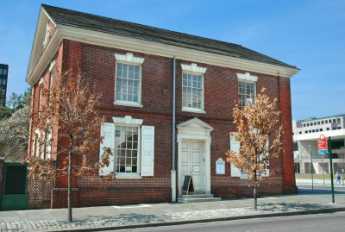
|
| Free Quaker Meetinghouse, Fifth and Arch Streets |
Somewhere in this tradition are allusions to the Free Quakers, Quakers who abandoned the peace testimony to fight the British. There is also the tradition of hostility to British rule which antedates the Revolution and may have some connection to the fanciful contention that their little state was not really part of Penn's colony. Captain (of the City Troop) Sam was a stalwart, possibly the sole founder, of the Gloucester (N.J.) Fox-hunting club. The history is passed down that 22 of the original 26 members of the First City Troop were members of the fox-hunting club, and many if not most were Quakers. The first "Governor" of the State in Schuylkill was Thomas Stretch, but the second Governor, from 1766 until his death, was Captain Sam. He was repeatedly referred to as the life of the club and held in the highest esteem by all. He was "read out" of the main Quaker Meeting, not so much for his drinking as for his flouting of Quaker belief in pacifism. He reputedly led a saber charge at the Battle of Trenton and was a leader of the City Troop in that revolution within a revolution at James Wilson's house, which rescued at least four future signers of the Constitution from a mob of militia which momentarily turned Jacobin.
Naturally, descendants of Quakers on both side of this uproar have been reluctant to say much about it. But somewhere within the history of Samuel Morris must be some important clues about the 18th Century splits within the Quaker Church, to say nothing of the revolt of the three Quaker colonies against British rule.
A Few Rooms of Your Own
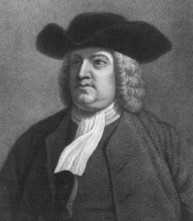
|
| William Penn |
If William Penn could revisit Philadelphia today, he would surely feel disappointed that the Greene Country Towne still hasn't materialized. Even a century after Penn's real visits, Philadelphia at the time of the Revolutionary War still nestled East of Fifth Street. There have been many conjectures about this, perhaps fear of Indian attack, perhaps lack of firewood, desire to be near the port, perhaps a number of things. Let's examine whether it's just the nature of a successful city to organize itself the way it does.
Ancient Athens, for example, was a nice warm place without much rain, which possibly accounts for the miserable little hovels where people lived, contrasting with the magnificent Acropolis, Parthenon, Stoa and other public buildings. It has been speculated that the architecture created the social system, not the other way around; the same contrast between big stone temples and little wooden huts is also seen in the Mayan cities of Yucatan. Hong Kong certainly isn't poor, but it's built like that. Japan cannot claim that lack of land forces the citizens to live in tiny apartments. It's hard to say whether the lowly social state of Japanese women accounts for the contrast between where they live and where their husbands spend most of their time because it's just as easy to believe the proposed cause is really an effect.
The more you look around the world, the more you wonder if it isn't the American suburb that's out of step with the world. When they can afford it, hardly any of the world seems to want to live in the suburbs; their homes are seldom their castles. There's New York City, of course. New Yorkers seem to like living in high-rises.
An architect friend makes short work of construction economics as a driving feature. According to him, it is unduly expensive to live in a high-rise. Just a pointless ego trip. The cost per square foot of usable floor space just keeps going up as the building gets taller, requiring more elevator shafts, more elaborate HVAC. That's heating, ventilating and air conditioning. Everything has to be built with a derrick, the traffic congestion at the base is horrific, high winds can break the window glass. The list rapidly grows convincing. Why does anyone pay all that extra money to live high in the sky? Not my idea of something to do, says Cole Porter.
Notice there is a major difference between sleeping in the suburbs as they do in Japan, and sleeping in apartments right near the center of town, as they do in Budapest, Berlin, Prague, and Vienna. The Orientals are staying close to work for longer hours, while the Central Europeans are staying close to the cafes and theaters to which they flock the moment work is over. Just what to think of the Spanish siesta system isn't clear, but it seems to have the main effect of bringing people back into the center of the town at night. You can't live very far away from work if you have to commute twice a day.
The Lord only knows where everybody in New York is going every Friday night, with return traffic jams in the other direction on Sunday night. The weekly exodus suggests they don't really luxuriate in their penthouses or flock to their entertainment district on weekends; apparently, a cabin in the woods is beckoning. As, by contrast, the empty nesters in the suburbs eventually look around for retirement villages to live, repeating the endless complaint about the nuisance of maintaining a big house and garden. Pennsbury looks like a comfortable place to live, but even William Penn seems to have tired of it. One really does have to wonder whether a heart's desire in architecture all too frequently leads to heart's discontent in lifestyle. Philadelphia appears to be trying a new approach; the suburbs are moving back downtown.
We'll eventually see if it changes our character and lifestyle so somebody can write sociology books about it.
Relocation

|
| Moving Truck |
For many decades, at least since the Second World War, the Northeastern part of the country has been losing population. And business, and wealth. In recent years, New Jersey has been the state with the greatest net loss, and the Governor who is making the greatest fuss about it. Statisticians have raised this observation to the level of proven fact, although lots of people are even moving into New Jersey at the same time. This is a net figure, and it remains debatable what sort of person you would want to gain, hate to lose; so it's hard for politicians to be certain whether New Jersey's demographic shifts are currently a good thing or a bad thing.
Take the prison population, for example. Most people in New Jersey would think it was a good thing if the felons all moved to some other state because it would imply less crime and law enforcement costs. But one of the major recent causes of a decline in violent crime seems to be the universal presence of a portable telephone in everyone's pocket. Just let someone yell, "Stick 'em up!" loud enough, and thirty cell phones are apt to emerge, all dialing 911. On the other hand, cell phones are the universal communication vehicle for sales of illicit drugs and other illegal recreations, and the increase in automobile accidents is a serious business for inattentive drivers. Add to this confusion the data that capital punishment is more expensive for the State than incarceration is, and you start to see the near futility of knowing what is best to have more, or less, of.
What the Governor and his Department of Treasury mostly want to know is whether certain taxes end up producing a good net revenue for the State. That is, whether more revenue is produced by raising certain taxes more than others, or whether some taxes are a big component of the Laffer Curve, causing revenue to be lost by driving business, or business owners, out of state, in spite of the immediate revenue gain. The studies which have been done are fairly conclusive that executives tend to be most outraged by property taxes, since they have a hidden effect on the sale price of the house, and the amount of money available for school improvements. At least at present levels, a Governor is better off taking abuse for raising income or sales taxes, even though the apparent tax revenue might be the same as a rise in property taxes. Since property taxes are mostly set by a local municipal government, while sales and income taxes are usually set by state governments, a decision to raise one sort of tax or another can have unexpected consequences, or require obscure manipulations to accomplish.
Some politicians who believe their voting strength does not lie in the middle class, would normally want to hold up property values, not taxes because the data show that higher home prices drive away from the middle class and in certain circumstances are positively attractive to wealthy ones. Higher prices appeal to home sellers, at least up to a point. Wealthier people who are buying houses are likely to have an old one to sell; that's less true of first-time home buyers or people presently renting. Certain issues can even be reduced to rough formulas: a 1% increase in income tax would cause a 1% loss of population, but a 5% loss of people earning more than $125,000. A $10,000 increase in average home prices, on the other hand, causes a net loss of population, but mostly those with lower income. One important feature of tinkering with average home prices and property taxes is that these effects are "durable" -- they do not fade away over time.
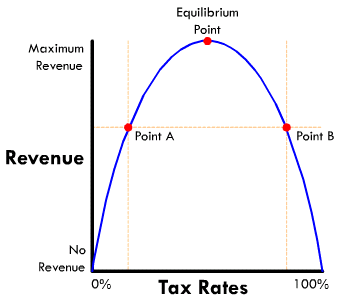
|
| Laffer Curve |
New Jersey is financially a bad state to die in, but the decision to move to Delaware, Florida or Texas is often made over a long period of years in advance of actually doing it. It has been hard to compile statistics relating changes in inheritance tax law to net migration of retirees and to present such dry data in an effective manner to counteract the grumblings that rich people are undeserving of tax relief, or dead people are unable to complain. But rich old folks are very likely to own or control businesses, and if you drive them out of state, you may drive away a considerably larger amount of taxation relating to the business in other ways. This is the underlying complaint of Unions about Jobs, Jobs, Jobs; but state revenue also relates to sales taxes of the business, business taxes, employee taxes, real estate taxes on the business property, etc, etc. Sometimes these effects are more noticeable in the region they affect; the huge population growth of the Lehigh Valley in recent years is mainly composed of former New Jersey suburbanites, who formerly earned their income in New York. The taxes of three different states interact, in places like that.
The audience of a group I recently attended contained a great many people who make a living trying to persuade businesses to move into one of the three Quaker states of the Delaware Valley. The side-bar badinage of these people tended to agree that many of the decisions to relocate a business are based on seemingly capricious thinking. The decision to consider relocation to the Delaware Valley is often prompted by such things as the wife of an executive having gone to school on the Main Line. Following that, the professional persuaders move in with data about tax rates, average home prices, and the ranking of local school quality by analysts. Having compiled a short list of places to consider by this process, it all seemingly comes back to the same capriciousness. The wife of the C.E.O. had a roommate at college who still lives in the area. And she says the Philadelphia Flower Show is the best there is. So, fourteen thousand employees soon get a letter, telling them we are going to move.
And, the poor Governor is left out of the real decision-making entirely, except to the degree he recognizes that home property taxes have the largest provable effect on personal relocation. And lowering the corporate income tax has the biggest demonstrable effect on moving businesses. But the largest un-provable effect is dependent on the comparative level of the state's inheritance tax.
Who Killed Philadelphia Industry?
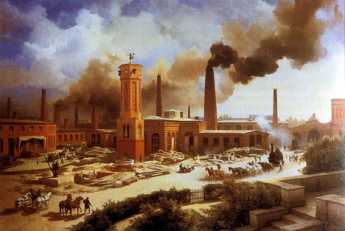
|
| The Industrial Revolution |
The term "Rust Belt" makes clear that Philadelphia is only one city in a whole region which lost its industrial core. The Industrial Revolution surely isn't over, it has moved. When we had too much of it, we deplored the smoke and fog of industry, its acid rain, its grimy desolation. But now that industry has obliged us by departing, we miss it, if for no better reason than it imposed structure on the city. It was the organizing principle, which we now need to replace with something more than the dreams and sketches of architects and planners. Figure out what we want the city to be, or at least try to figure out where it is going. And then, the city will shape itself. Philadelphia is far from the worst afflicted city in the region; compared with Detroit, it was hardly affected. What determines relative success within regional decline is whether a city has other assets, sufficient to create substitute routes to success. In Philadelphia's case, non-profit activity provided survival, but the avoidance of profits soon became altogether too praiseworthy.
My friend the railroad lawyer gives an unexpected answer to the question why we no longer have much industry in Philadelphia. The cause, in his wry phrase, is air conditioning. Not even Congressional logrolling would have been able to push industry into Huntsville, Alabama or even Atlanta, without air conditioning to make those places inhabitable. He jests. The South has developed the infrastructure to take its place in the industrial world and has a lower wage scale at all levels of society. The Second World War stirred them out of their provincialism, the GI Bill educated them. And let's face it, the migration of their black people from the rural south to the urban north reduced the strain on southern education and welfare, at the same time it imposed much of that burden on the haughty Civil War victors. There had been a massive migration westward of the white South, fleeing the devastation of the Civil War; but the blacks didn't much participate in that. Their migration from the former slave states came by the busload after the end of World War II.
We focus on the newly industrialized South as a competitor because it is more personal; we know the cities of the South and Southwest are growing rapidly, and we have a fair idea of who is moving there. Meanwhile, the rest of the underdeveloped world is flowering, economically developing, at a far faster rate. Over a billion Chinese and Indians have been lifted out of unspeakable poverty and transformed into serious economic competitors. Air conditioning sort of gets the idea across. But the word we are searching for is -- globalization. Philadelphia is a perfectly wonderful place to live, particularly if you are able to retire here. What we lack is a sustainable way to earn a living.
It took the destruction of eight railroads to break the back of the industrial unions. The union movement has shifted to the public sector by exploiting a highly dubious partnership with urban political machines. This sort of thing must not be permitted to continue unresisted, if only to avoid the example of New Jersey with the apparent invasion of politics by the Mafia entering by way of union politics, maybe by way of the legalized gambling industry. It requires no advanced degree in economics to see that aggregation of non-productive sectors into a political force is incompatible with success in a globalized world. Foreign competitors will destroy businesses which yield, and the bond market will teach the public sector a bitter lesson.
Globalization did not destroy the Rust Belt, it simply gave a shove to a tottering structure. By the 1920s, our industries had enjoyed their expected seventy-five-year life span; the 1929 crash was a belated recognition of the facts. The ensuing Depression and World War II protected our obsolete industrial plant from foreign competition, but by 1960 our monopoly was under attack by modern new factories abroad, enjoying cheap labor, copying our methods. In what has proved to be the most astute investment judgment of a century, the DuPont family perceived the facts and sold General Motors, just as they had earlier given up the gunpowder business to make nylon stockings. It would be exaggerated to say that political subsidies kept the auto business alive for another forty years after the duPonts got rid of it, but that would appear to be approximately true. The seller of any business is in position to foretell its future better than most buyers and is looking for top dollar to dress it up and cash out.
We thus arrive at the conclusion that no one in particular killed Philadelphia industry, at least to the extent it is unproductive to search for villains. My friend the lawyer feels maritime unions were more guilty than other unions, and he has no reason to love railroad unions. But if it can be accepted that Philadelphia's main problem was to fail to replace aging industries with new ones, the more productive search lies among correctible obstacles for new businesses. Since globalization has apparently resulted in Philadelphia's impaired competitiveness for untrained and uneducated workers, it would seem most productive to educate more of them up and out of that class. Our clearly dysfunctional public school system must either be improved or radically revised; the teachers' unions seem to be a serious problem to address. For some reason, the most serious problems appear in the fourth grade.
|
| Father Time Baby New year |
Our criminal justice system seems to be in a circular pattern which must be broken. We spend too much on police, prisons, and courts, to the point where convicted criminals exceed the prison capacity, and courtroom procedures seem designed to avoid convictions. Our local judges are a national joke, with an excessive tendency to settle cases out of an inexperienced judge's fear of his own inability to conduct a trial. In fact, the chief justice of our state supreme court is presently accused of corruption in the location of the family courts. Apparently much could be accomplished simply; the number of liability filings is down over 50% in a few years, simply by a few changes in civil procedures. Increasingly, lawyers are turning to alternative dispute resolution under private auspices. Apparently, litigants on both sides find it preferable to pay for private judging than to utilize the free judging provided by the Commonwealth. Surely, both the law schools and the bar associations are derelict in their implicit duty to guide the public through this arcane labyrinth. Perhaps the solution, and maybe the source of the problem, is to be found in the State Legislature.
The Legislature, now there's a piece of work. Between the gerrymandering they create and the single party urban machines which command their nominating primaries, it is hard to believe a reform movement can have more than transient effect, or that a tea party could unite around an effective solution. Proposition Fourteen in California (open, non-party primaries) is a promising idea, but probably it will not be possible to amend the state legislative process with a single stroke, and then everybody could go home. This project seems more likely to require large private contributions to multiple in-depth studies of the history and intricacies of the local governance problem, together with a series of tentative steps and revisions over at least a decade. Perhaps a portion of the money now being spent purchasing and trading professional sports teams could be diverted to generating the ideas and research, maybe the publicity, required to accomplish such an ambitious project. But for a beginning, Proposition Fourteen has the right idea; politics keeps its stranglehold on reform through iron control of the nominating process.
In addition to cleaning up the governance mess, we need to look at the industries we have driven away, to see how to mend our ways.
Musical Theatre at the 11th Hour
|
| Michael O'Brien |
Philadelphia is having a theatrical revival, very likely leading the cities of America in that regard. One of the central movers and shakers of that movement visited the Right Angle Club recently. Touting his own company, without a doubt, but nevertheless illuminating a movement which seems pretty central to Philadelphia's future. Michael O'Brien is the Producer and Artistic Director of the 11th Hour Theatre Company, which had its origin eight years ago in the Studio of the Walnut Street Theatre, and has since spread out to many venues within Philadelphia. Since Mike O'Brien got his start in theater at the Walnut, it is only fair to say the Walnut Street Theatre was a parent of the 11th Hour. The 11th Hour is a 501(c) (3) nonprofit corporation, so it sort of sounds as though the William Penn Foundation was somewhere in the background, at least at one time.
The 11th Hour Theatre Company is one of 1200 theater companies now active in Philadelphia but is the only company dedicated exclusively to musicals. More finely tuned than that, it specializes in small productions with five or six members of the orchestra, and about the same number of actor/singers on stage. It happens there aren't very many such productions to chose among, so someone must stimulate more composers to pay attention, or the 11th Hour could run out of musicals to produce. Some of this is economic. The kind of big-time musical comedy which makes a gazillion dollars with a huge cast, huge orchestra, huge scenery is very expensive to produce, and probably soon runs out of audience members who are willing to pay huge ticket prices for anything except a huge production success, produced at huge financial risk. For the most part, the national market will only profitably support one or two of those a year, with the consequence that lots of people lose a lot of money on the ones which fail, and most of the successes are rescued by movie and television revenue, which involve further financial risk-taking. Apparently, the successful composers either try to claw their way to the big brass ring or else look for other lines of work. Someone may eventually figure out a way to start with a small musical and then scale it up to the big-time, but what has happened seems to be that actors and musicians who shrug off the big time, cluster together and try to produce a career which prefers a normal sort of home life, to the neurotic struggling which seems inherent in those who consider themselves big-time theatrical material. Somehow, the dictionary definition of the 11th Hour -- the time when most creativity appears -- has instant appeal to the sort of person who prefers to live a normal life within a close circle of like-minded friends and finds that to be a possibility in Philadelphia. We'd like to remind him you can't fill the seats of a theater without an enthusiastic audience, but it's nice to hear our town is a congenial place to live and be an actor.

|
| 11th Hour Theater |
Michael O'Brien regards the theatrical revival of Philadelphia to be part of the restaurant revival of the 1980s. Just as the nightlife of Philadelphia was once centered around coming to town to go to the movies, Mr. O'Brien regards the theater as the centerpiece of an evening in town for a couple who want to come for exotic food, plus some entertainment. We have night clubs and celebrity concerts for the dating set, but a quiet dinner followed by the theater appeals to a different, somewhat older set. Once this movement gets started, performers arrive from out of town and discover they like the sort of life entertainers enjoy here, so they stay. And many graduates of local colleges and universities grow up close enough to the scene that they decide they never want to leave. Naturally, a producer and artistic director has the perspective of the performing community and tends to emphasize the attractiveness of Philadelphia to performers. In addition to that, of course, enough dumb old plain citizens have to be attracted to the theatrical product, in order to provide audiences for 1200 theatrical companies; and novelty alone is not enough to sustain that. Some such mutual need was once provided by the sudden Elizabethan flowering of the theater of London, and five hundred years later no one has completely explained it. But for comparison, in Shakspere's day, there were fifty-nine London theaters at the height of the Elizabethan boom, but only two in Paris.
Adoption

|
| Peter Conn |
Peter Conn, a member of the Franklin Inn of Philadelphia, is recently retired from the University of Pennsylvania. Since he has adoption in his family, he became curious about the matter, found that almost nothing has been written about the history of this topic, and decided to write a book about it himself. At a recent monthly meeting of the club, he described his findings, which are pretty surprising.
In a vague sort of way, everyone's general readings do confirm his findings that adoption was frequent among the American Indians, and also among the ancient Romans. In early 6th century Europe, however, it seems to have died out, only to return as a common experience in the 16th century. The first American law that Dr. Conn could find establishing the rules and legal conditions of adoption was passed in Massachusetts in the 19th century, at roughly the time American states were passing laws forbidding abortion. Whether there is a connection between the two movements or not is speculative. However, it does seem pretty likely that our current perceptions about adoption are surprisingly recent, reflecting a strong likelihood that Roman and Indian traditions have nothing to do with it, but fairly recent history might well have a lot to do with it.
Just a little reflection about all the stories we read, alluding to orphanages, foundlings, wards, primogeniture, romantic love, choices of marriage partners, and the like, quickly confirm a realization that conditions and attitudes about reproduction must have changed a very great deal, and fairly recently. It was not very long ago that children were apparently so numerous they could be treated as expendable. Considering how dangerous childbirth has been until recently, current attitudes about "valuable babies" , motherhood, and even the role of women in society must be evolving quickly without our realizing it, and in directions so recent they may well require further revision. Just whose views are old fashioned and whose views reflect modern insights are both judgments we probably should classify as tentative for at least a few more decades.
For example, the dates of major changes in attitudes about foundlings inevitably generate reflections about the attitudes of the Catholic Church. That ancient organization probably has enough troubles with bedroom issues, without adding this one. But the coincidence of the dates with the rise of the Church in Europe, and the subsequent rise of Protestantism, inevitably generate questions about Church attitudes as the cause, or possibly some sociological changes in society which transform both church and reproductive attitudes at the same time. What were the roles of the Crusades, and the Arab invasion of Europe, or the Ottoman invasion? Or the black plague and the white plague, or the Industrial Revolution? We have to know more about these cataclysmic events in order to have even a small idea of whether they might have influenced each other.
|
| Milton Hershey founded the Hershey Industrial School |
It makes a lot of difference whether a culture needs agrarian workers or not, to understand why "the best interests of the child" should only recently have been established as a legal basis for oversight of contested adoptions. Or why inheritance by adoptive children has only been such a recent phenomenon, endorsed by law. What happened to cause the abandonment of all the orphanages we used to have? Why have we chosen to split the issue between adoption and foster care, and treat the two so different? Where do the Girard College and the Hershey School fit into this transition? Why do the Russians feel they are injuring America by forbidding American adoption of Russian orphans?
And get this: during the 19th century in America, when there was a surplus of women on the East Coast resulting from a massive migration of males to the West, about 250,000 American orphans were packed on various trains and sent West. We are told they stopped at a station and let the local settlers select a few, and then the train continued going West, letting off more and more adoptees until they were all gone. Transcontinental railroads were only built after the Civil War, so this sort of child disposal was not more than a century before the political battles of Roe v Wade. We have a lot to learn, and probably a lot to be humble about. So let's not bury the truth under a mountain of political correctness, but let's not have any witch-hunts, either.
REFERENCES
| Adoption: A Brief Social and Cultural History: Peter Conn: ISBN:ISBN-13: 978-1137332202 | Amazon |
Proposal for the Parkway
|
| Alvin Holm |
Architect Alvin Holm spoke recently about an idea he had dreamed up in 1986, for an amphitheater in the Eakins Oval, right in the middle of the Benjamin Franklin Parkway. At that time he envisioned it as a memorial to Grace Kelly, but Monaco wasn't interested, and the City was broke. But times change, neighborhoods change, and maybe the idea needs to be re-examined.
A bit of history needs to be refreshed. Around 1900 when the Parkway was dreamed up, Philadelphia was said by some local boosters to be the richest city in the world. That may have been a little overoptimistic, but it was nearly true enough that no one laughed loudly when it was enunciated. The Parkway was envisioned as a new departure to transform the whole city from square blocks of red-brick buildings of Georgian style, into a classical French version of grand elegance. To emphasize the new departure, it cut a diagonal from City Hall to the Art Museum, uniting these two French architectural monuments into a transformational classic boulevard. It wasn't just an imitation of Champs Elysees, it was a design by the very same architects, intended to lead the centers of many great cities of the world into modernized versions of the Roman Forum. Paris somehow managed to get away with it in time, but the 1929 crash stopped Philadelphia's dreams dead in their tracks, and the city just didn't recover.
Consequently, vast stretches of North and West Philadelphia were abandoned, then transformed into slums as poor people sought cheap housing. If you just look at Baltimore and Newark, you can easily see how sudden reversals can destroy a city completely. Philadelphia retreated into Center City, surrounded by an inner ring of slums, which were in turn surrounded by a ring of newer suburbs. The automobile hastened the flight to the suburbs, while the business district retreated to the inner core of Center City. In order to protect the Shining City on a Hill from being completely disrupted, informal barriers were sought, and the Parkway became one of them. They weren't walled moats, but they served the same purpose. Therefore, during the long decades of limping along, occasional cries of, "Why don't we make the Parkway into a grand boulevard?" had a silent, sullen answer. We weren't really sure it was a good idea. It didn't fit within our revised circumstances.
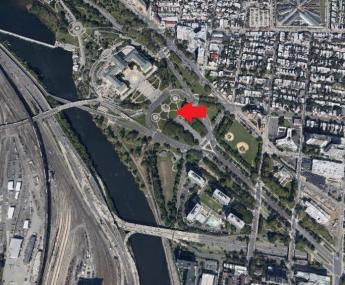
|
| The Amphitheatre on the Parkway |
But the City is now getting back on its feet, as anyone who has noticed the astonishing restaurant revival of Fairmount Avenue, or of Old Towne, or Society Hill, and the rebuilt "Chinese Wall" leading to and from the old Broad Street Pennsylvania Railroad station, can easily see. The Independence Mall and the University of Pennsylvania areas were largely built with Federal Money, but no matter, the transformation is still evident, the tide has turned. So Alvin Holm got out his drawings about premature dreams we couldn't afford, and asked, "Is it time?"
The unfinished Ben Franklin Parkway has cut its path, willy-nilly, through the neighborhoods, the trees have had time to grow, the museums time to migrate. The childless couples of the metropolitan area were coming back in town to enjoy the restaurant revolution and the theater revolution. Alvin Holm was getting a little older but not less energetic. He remembered that at the foot of the Art Museum was a statue of George Washington on a horse, and behind our First President was a big expanse of empty land. To build an amphitheater only took bulldozers, and could seat a thousand people. If you were as lucky as the ancient Greeks, and possibly if you built in precisely the same way, a speaker in the center could be heard -- without artificial amplification -- if he whispered, by everyone in the amphitheater audience. If you do use electronics, there's plenty of space in back of General Washington for a dignitary to give a speech on a raised platform, and there's enough empty audience space in a wider sweep, for fifty thousand people to congregate and listen. To him, or to a rock band, or whatnot. There aren't very many places left on earth in the center of a big city, where a single person can stand against a magnificent classical background, and be heard by fifty thousand chanting, hollering true believers. All of this could be accomplished by essentially digging a hole in the ground and closing off the area to traffic. But oh, yes, it takes one more thing. You have to want to do it. So let's consider for a moment who else covers the neighborhood, waiting for the right time to make a move.
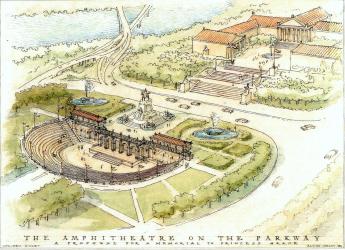
|
| Amphitheater Sketch |
Instead of regarding Fairmount Hill as just a big obstacle to automobiles trying to get home, let's just see what some others are thinking. For example, the people who run Drexel University are seriously talking about buying the air rights above the railroad marshaling yards on the west bank of the Schuylkill, and putting up a major business district and residential complex. They are thinking mainly of reviving West Philadelphia, and that's fine, but another bridge at that spot is badly needed to divert traffic around the present choke point on the Schuylkill Expressway, and that's also fine. Put some paths down to the river from the Art Museum to meet a new pathway to the Drexel development, as well as the recreational area along the river, and you could really have something pretty nice for the commuters who would otherwise begrudge the cost of digging an amphitheater hole in back of G. Washington.
Looking to the north of the Art Museum, there's a second small mountain with Kelly Drive between the two. At one time, both hills had reservoirs on top. The Art Museum demolished one reservoir, but the other reservoir is still there. It's a fifty-acre lake surrounded by dense forest; but from the inside look back over the top of the trees and you can see skyscrapers, almost right next to you. It's been adopted by migratory birds as part of the Atlantic flyway, and you would just be amazed at the hawks and ducks and all manner of other little black jobs that fly around and get recorded by bird watchers. The lake is full of fish, probably originally dropped by passing birds. The Audubon Society has a fundraising project going on, right now, to build a visitors' center in the forest, in conjunction with Outward Bound, the rock climbers group. Go to the left and you are overlooking the races at Boathouse Row, turn in the other direction to see Girard College, the hospital complex, and the further north you get to Temple University.
And one more thing. The old B&O Railroad once snaked along the Schuylkill and turned right around the (now) Art Museum, through tunnels over to Spring Garden Street, and down to Reading Terminal. Just what to do with this ditch running through the center of town unnoticed, is beyond my scope. Let someone else have a chance at being a visionary, but it must be remembered that New York City recently had a similar relic on its hands, and made something pretty nice out of the West Side of their town.
All of this potential even has the danger that projects will collide with each other, so it would sound like a nice idea for some Foundation to put together a planning board, to fit it all together without getting mixed up in politics, or squabbling over who will run things. But even that fuss would be a novelty, a nice thing to have for a while.
Enforcing the Constitution: Civil Monetary Penalties (CMP)
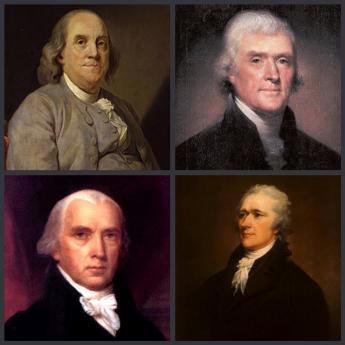
|
| Founding Fathers |
The 1787 Constitution created three branches of government along with their defined powers but described no remedy for a branch overstepping its boundaries. Gradually, a system evolved for declaring some laws unconstitutional, one by one, clarifying individual issues along the way. By contrast, the founding fathers viewed the President as an agent of Congress, expecting Congress to devise controls if needed. George Washington had an intense distaste for monarchs, and eight years as Commander in Chief had exposed no taste for conflict with the Continental Congress. Unfortunately, this has proven to be unusual for Presidents, especially as popular sovereignty appears to expand the Presidential mandate. Moreover, Washington himself developed more friction with Congress during his two terms as President.
In retrospect, the main factor behind Presidential restlessness is the experience of misinterpreting the meaning of a broader electoral mandate, which can more properly be traced to hasty repair of the defects of the 1800 election process. Experience has shown that while ignoring rules invites anarchy, the impeachment of a President usually seems too drastic a remedy for unwelcome innovation while impeaching the whole Legislative Branch for failure to supervise in a general way, is incomprehensible. The President needs some sort of supervision. While the original intent was to have Congress do the supervising, the Supreme Court is now probably better suited for judging the issue of unconstitutional behavior, except for the awkwardness that the President appoints the Supreme Court. These are the simple ingredients of a solution, preferably unwritten and revolving around conferring special "standing" in special circumstances.
|
| Chief Justice, John Marshall |
At present, grievances tend to accumulate until someone acquires "standing" by being injured. At present it is generally true a grievance scarcely matters if no one is injured, but the exception is the lack of redress for injury to the Constitution, whereby everyone may be injured. Furthermore, actual experience with creeping boundary encroachment has mostly proved to be nuanced, rather than confrontational, gradual rather than abrupt. The descriptive example is that of a frog in a gradually heated pan of water, whereby the frog is cooked faster than he realizes he is in danger. Otherwise, the courts have evolved an unspecified balance which has proved remarkably serviceable.
It took thirty years for John MarshalI to formulate the general approach needed. In Marbury v. Madison , his first action after becoming Chief Justice, John Marshall suggested a writ of Mandamus (i.e. "We command...") from the Court might well be the first step in what he coyly described as only a hypothetical situation. Only lawyers were expected to recognize fully that If the President ignored the writ, then the grounds for impeachment might escalate, with the President forced into the role of flouting a decision of the Court. Regardless of how it stood on the original issue, the public would likely support a Court in performing its duty to make difficult decisions.
One way or another, the national issue would become one of whether the nation wished to continue with its Constitution; Marshall had only outlined the steps the process would probably take. At several points along the way, the Chief Justice would have a chance to back off. But Marshall's lifelong hatred of his cousin Thomas Jefferson was so well known there was little doubt he was serious. Knowing of his cousin's hatred for him, President Jefferson let the matter drop; subsequent Presidents followed his example. Generations of lawyers have studied this case and pondered its implications. The solution to the problem of extending it from unconstitutional laws to unconstitutional behavior, probably already exists in many minds.
The Eventual Economy of Excellence
|
| Samuel Y. Harris |
The Right Angle Club was recently visited by two sprightly young ladies who run a historical building reconstruction firm. Sam Harris once ran the firm and built it into the pre-eminent example of its type, with the quirk that he surrounded himself with women. So, after Sam's unfortunate early death, two of the ladies decided to carry on the business. It was a little hard to picture these two young ladies in blue jeans, climbing all over the rafters of old buildings, but they showed plenty of slides of their work, which in the background showed the ladies doing just that.
Historical old St. Peter's Church at 2nd and Pine called the ladies in to consult on why the beautiful old church built in 1764 would develop a dip in its roof, and were soon told that a rafter had rotted underneath the dip. Further investigations showed that all of the rafters were rotted at the point where they joined the top of the walls and had to be replaced or reinforced. It eventually developed that a two-million dollar campaign had to be undertaken to finance the restoration. The details of the problem were the rafters had been made of gumwood, which is now unobtainable, and substitute wood of the same quality had to be identified, located, and transported. The original builder named Smith had also built Carpenter's Hall, so he knew what he was doing; it was just hard to find the same materials. The original construction might have lasted another couple hundred years, except there was a time when the upscale Society Hill neighborhood had largely been abandoned to fruit and vegetable distribution, and the congregation dwindled. To save money, the attic had been insulated to save heating costs. It did that, all right, but unfortunately, it caused moisture to form, and rot to ensue. Bob Linck, a roofing contractor who was sitting near me, commented that it just went to prove an old adage. Eventually, the economy of excellence would emerge and demonstrate its value. If reduced cost is what you want, just build things right, and leave them alone.
River to River, Pine to Vine
|
| R. Bradford Mills |
Brad Mills, a former Marine officer who now is a Commercial real estate advisor for Tactix Real Estate Advisors, was recently on the podium of the Right Angle Club. His theme was the Decline of the Suburbs, creating a return to Center City. Although some other cities have experienced an even greater change, his point generally corresponds to everyone's experience. If Stephen Levy is right that the automobile choked center city to death in the 1920s, this reversal of fortunes would seem to correct the migration of a century ago. The big question is whether it will continue, once an economic recovery, and cheap gasoline prices, make the auto popular again.
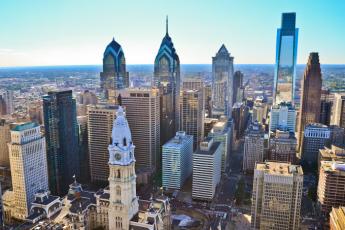
|
| Center City Scene |
The Center City scene at present is summarized by its rental prices: $100 per square foot for offices, $400 per square foot for top-level residential. So, naturally there are a number of office buildings being transformed into either residential or mixed-use. And about 20% of office space is unoccupied. The offices themselves are being transformed into a style which absolutely no one likes. Open space offices with insignificant partitions between them. Even the top officers are forced to abandon corner offices in order to show the rest of the employees they are participating in the new style, which as mentioned, everyone hates. Another statistic: the office space averages ten units per 1000 square feet, instead of the more luxurious 4 per thousand, and more often single offices. SEI carries matters to some sort of extreme: desks on wheels can be gathered together for conferences, pulled apart to talk on the phone. And to make things even worse, this seems to be following a European style. Ugh. For one thing, no American likes to appear European. No one likes it when office space is "hotelized", sharing a desk between someone in the office and someone else who is on the road, visiting the trade.
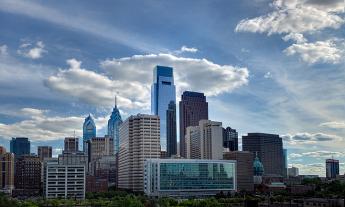
|
| Comcast Building |
There's a lot of talk of Drexel showing us the future, but that's probably in the far future, when Drexel has to consider building over the West Philadelphia train tracks along the river, for dormitories or whatever. In time that may happen, but what's immediately in prospect is the second building Comcast is building next to the existing one. To a degree, the people who will fill the new building are already here, scattered out in vacant spaces around City Hall. When the building is finished, those people will move into it, leaving their existing space -- either empty, if the recession continues, or occupied with "secondary" offices if we recover from the recession in time. It's a time of anxiety for architects.
And the people? Well, we have a doughnut hole model. The top executives want to be in town, close to work, where the action is. And young couples want to save on commuting expenses, living close to work, using public transport, living close to other people their own age. Out in the suburbs, things are emptying out, prices are down, and "crazy money" from New York is moving in for what they imagine are bargains. It promises to be an exciting scene, full of action. But what's missing? School-age children. It won't be much of a normal city without some kids, and to get them you need good schools, public safety, and a shift in taxes from that 19th Century wage tax, to the more modern real estate tax. Meanwhile, our speaker has his own individual office -- in Radnor.
| Posted by: esalerugs promo code | Feb 13, 2012 9:19 AM |
53 Blogs
Philadelphia in '76
There were about 30,000 residents, the size of a small town, but it was the second largest city in the English-speaking world. Aside from wagons, there were thirty wheeled vehicles.
Eakins and Doctors
Philadelphia's art world joined its medical world in reacting fiercely to Jefferson Medical College's sale of the best painting by the best artist of Philadelphia's Nineteenth century.
Pennsbury Manor
The Delaware River takes an abrupt right turn at Trenton, creating extensive wetlands for miles around. Whatever its environmental drawbacks, the river delta is moving toward landfill and "development". Come back in fifteen years and be amazed.
Wall Art in Philadelphia
Several thousand Philadelphia buildings now display outdoor paintings by local artists, encouraged and funded by the City government. In the summer, bus trips with guides tour around the town, explaining things.
Quakerism and the Industrial Revolution
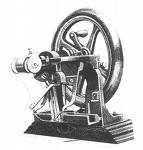 The Industrial Revolution extended over two centuries and was more important than all the wars, governments, and agitations of its time. Quakerism began at the same time, in the same place. Was that only coincidence?.
Sacred Places at Risk
Church structures don't migrate, but church members do. A volunteer organization in Philadelphia has formed, to help endangered congregations decide how to review their options and act on the best choice.
Quaker Gray Turns Quaker Green
Quakers mean to turn their headquarters near Philadelphia City Hall into a glowing example of how to save money while they save their environment.
Immigration and Universal Health Insurance
How can we give health insurance to illegal immigrants?
Quaker Efficiency Expert: Frederick Winslow Taylor 1856-1915
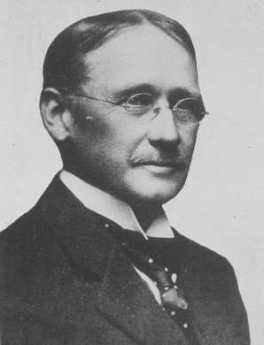 A rich Germantown Quaker boy became the world's symbol of the efficiency expert with a stop-watch, hated by Labor Unions but admired by Lenin and Stalin. He enriched the Midvale Steel Company with his invention of high-speed steel but was fired by Bethlehem Steel for eliminating too many employs. 000..0ees. Peter Drucker placed him in the class of innovators beside Darwin and Freud.
Gardening Survives
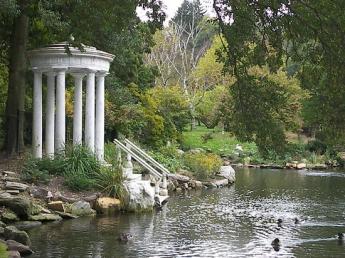 A new book has arrived, describing the 90 great public gardens of the Philadelphia regions, and discussing the best 40 of them in detail.
The Inky
The Philadelphia Inquirer had a new, local, management. We wished it well.
Forty Days Before the Mast
Before steamships, most of our ancestors spent a month at sea in a sailing ship and never would consider going back home if it meant another such trip. Here's a taste of what it was like.
Social Disintermediation
 A term borrowed from the banking world seems to explain the recent decline of local government, local clubs, and local news sources. Alas, the consequence of such social disintermediation is a rise of insolence, insubordination, and junkyard dog-ism.
Germantown Avenue, One End to the Other
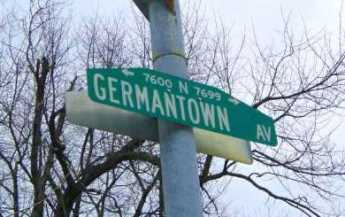 An old Indian trail cuts diagonally across Penn's street grid, from the Delaware River to Chestnut Hill, and beyond. Lots of history, there.
Commercial Academic Think Tank
There are universities and there are think tanks. Philadelphia has at least one commercial consulting firm which combines elements of both.
The Garden Show Evolves
Exhibitors at the Philadelphia Garden Show have gradually evolved from amateurs to nurserymen, and from nurserymen to florists.
Rise and Fall of Books
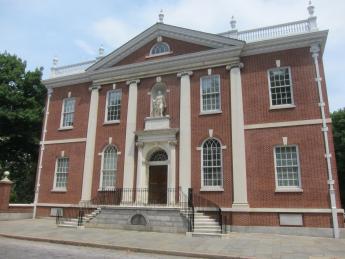 The The Director of America's first library sees books as mainly a 19th Century phenomenon.
Urban Bridges
The Episcopal Church has found a practical way for its prosperous suburban branches to form partnerships with struggling urban parishes.
John Head, His Book of Account, 1718-1753
 The equivalent of the rosetta stone for colonial commerce had been sitting on George Vaux's shelf for six generations.
World Finance, Columbus Day 2008
 Europe's leaders met in Paris, while finance ministers met in Washington over the three-day weekend in October 2008. Should nations chance total collapse to save the whole system, or sacrifice the weak to save the strong? Unfortunately, the source of the answer may not be financial but political.
Financial Institutions of the Future
Impending financial crisis has pushed everything else off the front page. But looking backward may show where we are likely going.
Merging Cities With Their Suburbs
When middle-sized cities are thriving and growing, they tend to want to annex neighboring districts. Their newspapers are ecstatic about it.
Philadelphia City-County Consolidation of 1854
Prior to 1854, Philadelphia City was one of twenty-nine political entities within Philadelphia County. After that, it became one big city without suburbs. Growth pressure now reverses toward suburbs without a city. Political boundaries should thus shift inwardly.
HSP: Philadelphia's Attic
The Historical Society of Pennsylvania started out in 1824 as a repository of family treasures. Several mergers and changes of direction have given it a new mission.
Plays and Players, Haddonfield Version
This year the Haddonfield Plays and Players celebrate their 75th anniversary, with an outstanding production of Anything Goes, by Cole Porter Y'13.
Grand Union
Thirteen stars and stripes became the National Flag in 1777, but a rather similar flag was the National flag from 1775-1777. It was also designed by a Philadelphia milliner, Margaret Manny.
Country Auction Modernized
On Fairgrounds Road, in the Quaker farmlands of Bucks County, efficiency and computerized streamlining are nibbling at the enduring customs of country auctions.
Camden NJ: The Third, or Irish, Tenth
Early settlers of the Delaware Bay, generally picked the eastern, now New Jersey, side of the river because the terrain was easier to farm. In time, the vast wilderness on the western, or Pennsylvania, side led to more commerce.
Time To Care
A physician who practiced for sixty years, before and after Medicare, has a lot of stories to tell about how Medicine has changed and been changed.
SEPTA's Long Term Planning
SEPTA is slowly making progress, but it's a struggle, every step of the way.
Urban Transportation
The industrial revolution made cities grow, and thus made mass transit desirable. The flight to the suburbs then made mass transit attractive only to urban politicians.
Heron Rookery on the Delaware
Two or three miles from Philadelphia City Hall, a large flock of Blue Herons with seven-foot wingspreads are nesting in the trees, largely unnoticed.
Cushman Club for Lonesome Actresses
One of the ancient Camac Street clubs has closed its doors, to become a charitable foundation.
Foot of Arch Street
The foot of Arch was once the center of town, and Arch Street from Delaware to the Schuylkill was the center of Quaker life for two centuries.
Willow Grove Park
There were dozens of Amusement Parks run by trolley companies in 1900, and Willow Grove was the acknowledged Queen of the trolley parks.
Reservoir on Reservoir Drive
Philadelphia has a wildlife treasure within a mile of City Hall. The birds know all about it, but citizens need to search a little.
Frank Furness (2) Rittenhouse Square
There were plenty of rich folks in Philadelphia before the Civil War. But it took the industrial revolution to make possible what we call the Victorian urban mansions.
Chester County, Pennsylvania
When you say Chester County, you are probably talking about horses. There's much more to say.
South Philadelphia: Ideal Intermodality Transportation Site
Very few places on earth have rail, airport, ocean port, and Interstate Highway exits all crowded in a small place. An ideal location for intermodality connections, twenty minutes travel from the center of a major city.
Reviving Schuylkill: Eight Miles From the Dam to Ft. Mifflin
Cleaning up eight miles of banks of the Schuylkill from Fairmount Dam to Fort Mifflin, is Philadelphia's share of the Obama Stimulus Package. It will take a decade to know whether it was worth it, but as the program begins, it stirs a lot of excitement.
Foreground: Parliament Irks the Colonial Merchants
The Townshend Acts, upsetting trade and hated by Americans, bordered on economic warfare. The British tested tea, stamps and manufactures, but the most effective economic pressure points proved to be paper money and gunpowder. The Americans reacted to all this as second-class citizenship.
Ageing Owners, Ageing Property
From Japan, we get a fresh view of our assets. Kiyohiko Nishimura observes that the price of a house, even of a stock portfolio, has something to do with the age of the owner who is selling it.
Morris Upended by a Nobody
Adjusting to winning the Revolutionary War was almost as painful as losing it would have been. Especially for Robert Morris.
State in Schuylkill Fishing Club
 Unless you listen to some quibbles from White's in London, the Schuylkill Fishing Club of the State in Schuylkill is the oldest organized men's club in the world. And even if that exception is admitted, it's the oldest men's club in America. It's no secret, but it's very private.
A Few Rooms of Your Own
The way we live changes what we are.
Relocation
Moving your place of residence has many influences, but property taxes seem to have the biggest influence on business executives decided to move. By contrast, property prices have the biggest influence on the middle class.
Who Killed Philadelphia Industry?
Until recently, Philadelphia was a thoroughly industrial city. Why has industry abandoned us?
Musical Theatre at the 11th Hour
There are 1200 theatrical companies in Philadelphia, but only one devoted to musicals. Does that say something about the audiences, the unions, or the musicians?
Adoption
 Although the Romans frequently adopted children, the practice died out in the 6th century, and only became common a thousand years later. Curiously little has been written about this matter, so speculation is probably unwise.
Proposal for the Parkway
In 1986 the architect Alvin Holm proposed an amphitheater for the Parkway. It was too soon, but maybe its time is approaching.
Enforcing the Constitution: Civil Monetary Penalties (CMP)
The Constitution does not define penalties if one branch of government oversteps its grant of authority. But starting with writs of mandamus , the U.S. Supreme Court has left the other two branches with little alternative but compliance.
The Eventual Economy of Excellence
In the long run, it's cheaper to leave good construction alone.
River to River, Pine to Vine
New blog 2015-01-24 23:37:34 description