4 Volumes
Constitutional Era
American history between the Revolution and the approach of the Civil War, was dominated by the Constitutional Convention in Philadelphia in 1787. Background rumbling was from the French Revolution. The War of 1812 was merely an embarrassment.
Sociology: Philadelphia and the Quaker Colonies
The early Philadelphia had many faces, its people were varied and interesting; its history turbulent and of lasting importance.
Money
New volume 2012-07-04 13:46:41 description
Worldwide Common Currency and Corporate Headquarters
The Death of Money
Philadelphia Changes the Nature of Money
Banking changed its fundamentals, on Third Street in Philadelphia, three different times.
The Industrial Revolution was started by religious dissidents, among whom Quakers were a major force, in the Midlands of England in the early Eighteenth century. The predominantly Quaker city of the time was colonial Philadelphia, where by necessity the financial transactions of commerce were conducted with a system of individual books of account. Both creditors and debtors kept such books; periodically squared them up. In time, it dawned on Alexander Hamilton, a non-Quaker living on Third Street, that such books of account represented the wealth of a business, or at least most of its unspent accumulated profits. Debts were in fact assets, objects of value, growing more valuable with time. The supply of precious metals in which assets were denominated was inelastic, whereas commerce in America was fluid and consistently expanding. These asset/debts did not pay interest, but nominal value in hard coin held steady, thereby effectively increasing in purchasing power. It was colonial debtors who were squeezed by a shortage of gold coins, and consequently it was predominantly debtors who searched for relief through Independence. Not necessarily poor people; the southern plantation class were heavily indebted.
It was just one logical jump for Hamilton to perceive that the national debts accumulated by the young nation during the Revolutionary War were also assets of increasing value, not worthless paper as people seemed to think; and in this case they were valuable possessions of the whole nation. Many prominent people, among them Thomas Jefferson, Albert Gallatin, and later Andrew Jackson lacked the imagination to grasp this simple but counter-intuitive truth, and fought it bitterly. When Hamilton proclaimed that, "A national debt is a national treasure," it was not viewed as a brilliant insight, but a sign of insanity. Somehow, Hamilton managed to persuade George Washington of the truth of it, and the rest is history. Unfortunately, history also includes a tenacious retention of the opposite beliefs buried within the Articles of Confederation by the Confederate States of America, and even the charter of the European Union in the 21st century. Essentially currency, in a confederacy of jealous sovereign states forced to fight a common war, is made independent from the treasuries of those states, who then become its slaves rather than permit others to share its ownership. Lack of perception of this insight nearly lost the Revolution, was a major factor in the loss of the Civil War by the South, and still poses a contemporary risk that it may destroy the European community in the credit panic of 2008. Or adopt the tragic choice to destroy the European common currency in order to break free of its constraints, thus ultimately depriving twenty-seven pitiable little squabblers of the obvious utility of union.
Much economic history lies between 1790 and 2008, but a theme runs through all of it: Hamilton's devotees as much as those of Jefferson are seemingly incapable of understanding how the other side could possibly hold such preposterous ideas. Only Albert Gallatin stands out as an important national leader who switched sides.
But there is major truth in the opposite viewpoint, too. Hamilton's complete statement was " A national debt, if it be not too large, is a national treasure. Two centuries of compromising this definition have led to a system of enlarging national debts without acknowledging them. The present national debt is officially estimated to be about $5 trillion, while the unfunded liabilities of the federal entitlement programs alone are set at around $58 trillion. Inherent in this rampant but unacknowledged growth is the perception of foreigners that we might only be able to sustain a debt of this size -- by dishonoring it.
Quakerism and the Industrial Revolution
|
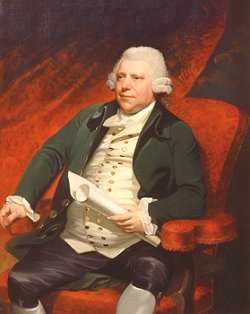
| Richard Arkwright |
The Industrial Revolution had a lot to do with manufacturing cotton cloth by religious dissenters in the neighborhood of Manchester, England in the Eighteenth Century. What needs more emphasis is the remarkable fact that Quakerism and the Industrial Revolution both originated about the same time, in about the same place. True, the industrializing transformation can be seen in England as early as 1650 and as late as 1880. The Industrial Revolution thus extended before Quakerism was even founded, as well as long after most Quakers had migrated to America. No Quaker names are much mentioned except perhaps for Barclay and Lloyd in banking and insurance, and Cadbury in candy. As far as local history in England's industrial midlands is concerned, the name mentioned most is Richard Arkwright, whose behavior, demeanor and beliefs were anything but Quaker.
He seems to have invented nothing, stealing the patents and ideas of others freely, while disgustingly boasting about his rise from rags to riches. Some would say his skill was in the organization, others would say he imposed an industrial dictatorship on a reluctant agricultural community. He grew rich by coercing orphans, convicts and others he obviously disdained into long, unpleasant, boring and unwelcome labor that largely benefited him, not them. In the course of his strivings, he probably forced Communism to be invented. It is no accident that Karl Marx wrote the Communist Manifesto while in Manchester visiting his friend Friedrich Engels, representing reasonably well the probable attitudes of Arkwright's employees. What Arkwright recognized and focused on was that enormous profits could flow from bringing piecework weaving into factories where machines could do most of the work. Until his time, clothing was mostly made by piecework at home, with middlemen bringing it all together. The trick was to make clothing cheaper by making a lot of it, and making a bigger profit from a lot of small profits. Since the main problem was that peasants intensely disliked indoor confinement around dangerous machines, the industrial revolution in the eyes of Arkwright and his ilk translated into devising ways to tame such semi-wild animals into submission. For their own good.
|
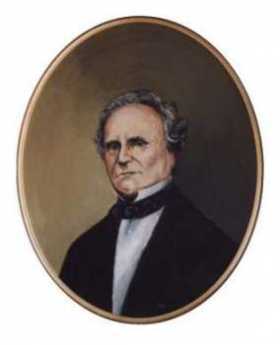
| Charles Babbage |
Distinctive among the numerous religious dissenters in the region, the Quakers taught that it was an enjoyable experience to sit indoors in quiet contemplation. Their children were taught to submit to it at an early age, and their elders frequently exclaimed that it was a blessing when everyone remained quiet, enjoying the silence. Out of the multitude of religious dissenters in the first half of the Seventeenth century, three main groups eventually emerged, the Quakers, the Presbyterians, and the Baptists. Only the Quakers taught that silence was productive and enjoyable; the Calvinist sects leaned toward the idea that sitting on hard English oak was good for the soul, training, and discipline was what kept 'em in line.
|
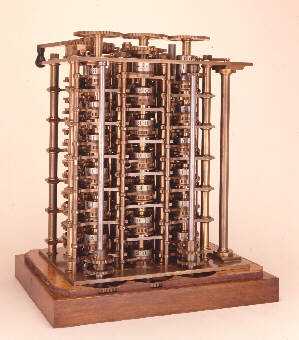
| babbagemaq.jpg |
The Quaker idea of fun through daydreaming was peculiarly suitable for the other important feature of the Industrial Revolution that Arkwright and his type were too money-centered to perceive. If workers in a factory were accustomed to sit for hours, thinking about their situation, someone among them was bound to imagine some small improvement to make life more bearable. If such a person was encouraged by example to stand up and announce his insight, eventually the better insights would be adopted for the benefit of all. Two centuries later, the Japanese would call this process one of continuous quality improvement from within the Virtuous Circle. In other cultures, academics now win professional esteem by discovering "win-win behavior", which displaces the zero-sum or win/lose route to success. The novel insight here was that it has become demonstrably possible to prosper without diminishing the prosperity of others. In addition, it was particularly fortunate that many Quaker inhabitants of the Manchester region happened to be watchmakers, or artisans of similar trades that easily evolved into the central facilitators of the new revolution -- becoming inventors, machine makers and engineers.
The power of this whole process was relentless, far from limited to cotton weaving. When Charles Babbage sufficiently contemplated the punched-cards carrying the simple instructions of the knitting machines, he made an intellectual leap to the underlying concept of the tabulating machine. Using what was later called IBM cards, he had the forerunner of the stored-program computer. There were plenty of Arkwrights getting rich in the meantime, and plenty of Marxists stirring up rebellion with the slogan that behind every great fortune is a great crime. But the quiet folk were steadily pushing ahead, relentlessly refining the industrial process through a belief in welcoming the suggestions of everyone.
John Head, His Book of Account, 1718-1753
|
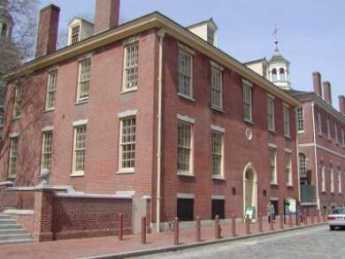
| American Philosophical Society |
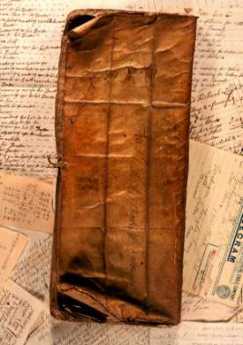
Jay Robert Stiefel of of the Friends Advisory Board to the Library of the American Philosophical Society entertained the Right Angle Club at lunch recently, and among other things managed a brilliant demonstration of what real scholarship can accomplish. It's hard to imagine why the Vaux family, who lived on the grounds of what is now the Chestnut Hill Hospital and occasionally rode in Bentleys to the local train station, would keep a book of receipts of their cabinet maker ancestor for nearly three hundred years. But they did, and it's even harder to see why Jay Stiefel would devote long hours to puzzling over the receipts and payments for cabinets and clock cases of a 1720 joiner. Somehow he recognized that the shop activities of a wilderness village of 5000 residents encoded an important story of the Industrial Revolution, the economic difficulties of colonies, and the foundations of modern commerce. Just as the Rosetta stone told a story for thousands of years that no one troubled to read, John Head's account book told another one that sat unnoticed on that library shelf for six generations.
|
| Colonial Money |
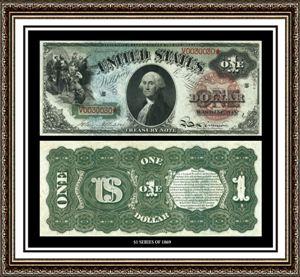
The first story is an obvious one. Money in colonial days was mainly an entry in everybody's account book; today it is mainly an entry in computers. In the intervening three centuries, coins and currency made an appearance, flourished for a while as the tangible symbol of money, and then declined. Although Great Britain did not totally prohibit paper money in the colonies until 1775, in John Head's day, from 1718 to 1754, paper money was scarce and coins hard to come by. Because it was so easy to counterfeit paper money on the crude printing presses of the day, paper money was always questionable. Meanwhile, the balance of trade was so heavily in the direction of the colonies that the balance of payments was toward England. What few coins there were, quickly disappeared back to England, while local colonial commerce nearly strangled. The Quakers of Philadelphia all maintained careful books of account, and when it seemed a transaction was completed, the individual account books of buyer and seller were "squared". The credit default swap "crisis" of 2008 could be said to be a sharp reminder that we have returned to bookkeeping entries, but have badly neglected the Quaker process of squaring accounts. As the general public slowly acquires computer power of its own, it is slowly recognizing how far the banks, telephone companies, and department stores have wandered from routine mutual account reconciliation.
|
| John Head's Account Book |
From John Head's careful notations we learn it was routine for payment to be stretched out for months, but no interest was charged for late payment and no discounts were offered for ready money. It would be another century before it became routinely apparent that interest was the rent charged for money and the risk of intervening inflation, before final payment. In this way, artisans learned to be bankers.
And artisans learned to be merchants, too. In the little village of Philadelphia, chairs became part of the monetary system. In bartering cabinets for the money, John Head did not make chairs in his shop at 3rd and Mulberry (Arch Street) but would take them in partial payment for a cabinet, and then sell the chairs for the money. Many artisans made single components but nearly everyone was forced into bartering general furniture. Nobody was paid a salary. Indentured servants, apprenticeships trading labor for training, and even slavery benignly conducted, can be partially seen as efforts to construct an industrial society without payrolls. Everybody was in daily commerce with everybody else. Out of this constant trading came the efficiency step for which Quakers are famous: one price, no haggling.
One other thing jumps out at the modern reader from this book of account. No taxes. When taxes came, we had a revolution.
www.Philadelphia-Reflections.com/blog/1517.htm
Monetary Causes of the American Revolutionary War
|
|
Milton Friedman The Father of Monetarism |
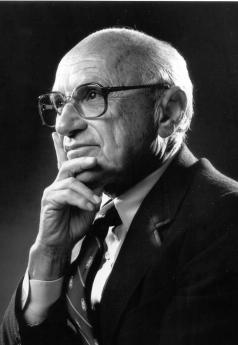
Milton Friedman won the 1976 Nobel Prize in Economics (more accurately, the Bank of Sweden Prize in Memory of Alfred Nobel), for generating controversial ideas made even more annoying to his professional adversaries by his matchless knack for attaching memorable slogans to them. A phrase in question is that "Inflation, always and everywhere, is a monetary phenomenon." Turned around, the converse emerges that the great deflation and depression of the 1930s was caused by a global monetary shortage. Then, to extend the same idea to the American Revolution, it could fairly be argued that inept British contraction of colonial coinage had a lot to do with provoking us to seek independence.
|
| French & Indian War |
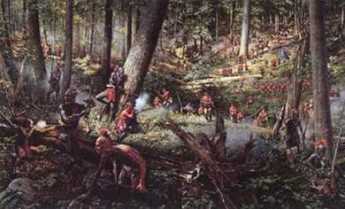
Following the French and Indian War, the colonies experienced a major commodity depression which seems to have been caused by wartime shortages followed by post-war surpluses (associated with failure to adjust to the resulting financial confusion). In Milton Friedman's theory, it is the task of any government to maintain stable prices by balancing the amount of currency in circulation with the size of the gross national product. In 1770, the British Exchequer would thus have had to expand and contract the amount of currency in circulation pretty rapidly to maintain economic stability in the bumpy Colonial economy. Essentially, they had to ride a bucking broncho three thousand miles away. In the Eighteenth Century, there was no trace of understanding of the issues involved. Adam Smith's Wealth of Nations was only published in the fateful year of 1776, for example. Even if the techniques for maintaining stable prices had been crystal clear, there was a thirty-day lag in communication across the Ocean, and comparable lags between the colonies, where different imports and exports were affected at varying times. So it is a little harsh to blame the British for the chaotic result, except to notice that strongly centralized, the trans-Atlantic government was by nature unsuitable for managing rapidly-changing problems, currency and otherwise. The British government had more than a century of experience that should have made that clear. That's what the colonists said, in effect, and their solution for it was Independence.
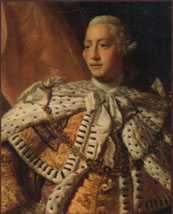
|
| George III |
If you believe Friedman, a shortage of coinage causes a fall in prices or deflation. To correct that, you need a central banker constantly fine-tuning the currency. But banking in the colonies was too rudimentary to consider such a thing. If you needed a mortgage, you went to a prosperous neighbor and borrowed directly from him. That was fine because prosperous colonists had limited opportunities to invest their money conveniently, except by loaning money to their neighbors. Indeed, local communities were knit together socially by the mutual assistance of successful farmers directly assisting their less fortunate neighbors. However, pioneer farming
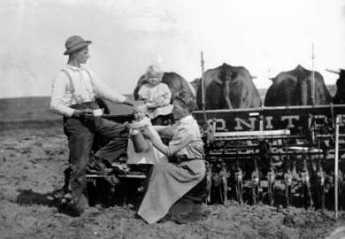
|
| Depression-era Farm Family |
communities are far too unsophisticated to remain tranquil when problems arise out of abstractions. Suddenly and without apparent explanation, in 1770 there was no money for anybody to use, and the fellow with a mortgage on his farm couldn't make his payments even though he was otherwise entirely successful. His creditor himself than couldn't pay his own bills, and eventually, even the kindliest ones were driven to foreclose the mortgage. It was said to be common for a farm worth $5000 to be sold to satisfy a mortgage of $100. And in this way, many honest and once-prospering farmers were forced to walk past their old home, now owned and occupied by a formerly friendly neighbor. It all seemed bitterly unfair, no one understood what was happening, evil motives were readily suspected, and old religious and personal grievances were heightened. When the British finally imposed a total ban on paper money as well as a prohibition of the export of British coinage outside the United Kingdom, things became almost impossible to manage. Almost no one knew exactly what was going on, but everyone could see it was bad. The colonies rapidly deteriorated toward class warfare, which is what the division between Tories and Rebels was soon to become, with both sides quite rightly asserting they were not responsible, and quite wrongly asserting the other must be.
From a far distance, it can be readily perceived the primitive banking and transportation systems of that time were inadequate to respond to the rapidly changing financial problems of a global empire; and it can be readily surmised that many other non-financial issues of governance were similarly hampered by attempting to centralize control over vast distances. In that sense, the colonists were approximately correct in directing their indignation to the person of King George III, whose mother was constantly nagging him to "be a real King". He had the particular misfortune to be dealing with Englishmen, deeply aware of the hidden political agenda made possible in the 13th Century by the Magna Charta and made explicit in 1307, when Edward I agreed not to collect certain taxes without the consent of the realm. Essentially, Parliament placed taxation in the hands of the people, who consistently withheld consent until the king gave them just a little more liberty. This was the reason irksome micromanagement of the distant colonies was immediately countered with the cry of "No taxation without Representation" since membership in the House of Commons was a traditional and historically effective means to the end. But it was getting late for this solution. Maritime New England now wanted to go further than that in order to dominate Western Atlantic trade. Virginia and the rest of the South wanted to go all the way to Independence in order to exploit the vast empty interior wilderness of Ohio and beyond. But the Quaker colonies in the middle felt quite sympathetic with John Dickinson's advice to remain part of the Empire and make a stand for representation in Parliament. When the Lord Howe's British fleet appeared in lower New York harbor an immediate choice had to be made, and ultimately the Quaker colonies were swayed by Benjamin Franklin's embittered report of his mistreatment in Parliament, and his assessment that he could persuade the French to help us. However reluctant they were to resort to force, the Quaker colonies had to choose, and choose immediately: either flee as Tories to Canada, or stand and fight.
Alexander Hamilton, Celebrity
 He had the kind of taudry private life and flashy public behavior that Philadelphia will only tolerate in aristocrats, sometimes. 
|
It comes as a surprise that most of the serious, important things Alexander Hamilton did for his country were done in Philadelphia, while he lived at 79 South 3rd Street. That surprises because much of his more colorful behavior took place elsewhere. He was born on a fly-speck Caribbean island, the "bastard brat of a Scots peddler" in John Adams' exaggerated view, was orphaned and had to support himself after age 13. The orphan then fought his way to Kings College (now Columbia University) in New York in spite of hoping to go to Princeton, and has been celebrated ever since by Columbia University as a son of New York. He did found the Bank of New York, and he did marry the daughter of a New York patroon, and he was the head of the New York political delegation. As you can see in the statuary collection at the Constitution Center, he was a funny-looking little elf with a long pointed nose, frequently calling attention to himself with hyperkinetic behavior. Even as the legitimate father of eight children, Hamilton had some overly close associations with other men's wives, probably including his wife's sister. Nevertheless, he earned the affection of the stiff and solemn General Washington, probably through a gift of gab and skill getting things done, while outwardly acting as court jester in a difficult and dangerous guerilla war. There is a famous story of his shaking loose from the headquarters staff and fighting in the line at Yorktown, where he insolently stood on the parapet before the British enemy troops, performing the manual of arms. Instead of using him for target practice, the British troops applauded his audacity. Harboring no such illusions, Aaron Burr later killed him in a duel as everyone knows; it was not his first such challenge.

|
| Alexander Hamilton |
Columbia University President Nicholas Murray Butler told other stories of celeb behavior to reinforce Hamilton's New York flavor. But in the clutch, General Washington learned he could always trust Hamilton, who wrote many of his letters for him and acted as his reliable spymaster. When the first President faced signing or not signing the fateful bill to create the National Bank, a perplexed Washington had to choose between: the violent opposition of Thomas Jefferson and James Madison, or the bewildering complexity of Alexander Hamilton's reasoning in arcane economics. On the one hand, there was the simple principle that owing money was seemingly always evil; on the other was the undeniable truth that for every debit created, you create a balancing credit somewhere. Washington ultimately chose to go with Hamilton, whose reasonings he likely didn't understand very well. If you doubt the difficulty, try reading Hamilton's Report on the Bank, written to persuade the nation and its first President of the soundness of his ideas. And then consider the violence of even present-day arguments about such "supply side" economics.
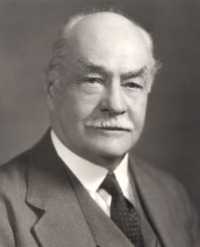
|
| Nicholas Murray Butler |
All of these momentous events happened in Philadelphia at places now easily visited in a morning's stroll. But Hamilton's image as a Philadelphian, doing great things in and for Philadelphia, was forever tarnished at one single dinner he hosted. Jefferson and Madison, his political opponents but his guests, were persuaded to provide Virginia's votes for the federal takeover of state Revolutionary War debts, in return for offering New York's votes for moving the nation's capital to the banks of the Potomac. True, Pennsylvania allowed itself to be pacified with having the capital remain here for ten years while the southern swamps were being drained. But it was Hamilton who cooked up this deal and sold it to the other vote swappers. Philadelphia felt it was entitled to the capital without needing to ask, felt that Hamilton was deliberately under-counting Pennsylvania's war debts, and this city has never appreciated the insolent idea that its entitlements were forever in the hands of wine-swilling hustlers. As the economic consequences of this backroom deal became evident during the 19th Century, it was increasingly unlikely that Philadelphia would lionize the memory of the man responsible for it. Let New York claim him, if it likes that sort of thing. When Albert Gallatin, who was more or less a Pennsylvania home town boy, attacked Hamilton as a person, as a banker, and as a Federalist -- he had a fairly easy time persuading Philadelphians that this needle-nosed philanderer was an embarrassment best forgotten.
REFERENCES
| Alexander Hamilton Ron Chernow ISBN:978-0-14-303475-9 | Amazon |
National Debt, National Blessing
|
|
| Alexander Hamilton |
In 1789 while arguing for the establishment of a National Bank, Alexander Hamilton made one of the most famous counter-intuitive assertions of his controversial career. "A national debt, if it is not excessive, will be to us a national blessing".
The very suggestion of such an idea enraged Thomas Jefferson and his Calvinist adviser, Albert Gallatin. James Madison, ever the political schemer, immediately recognized a new bargaining chip in his move to relocate the national capital to Virginia. Political parties were promptly invented to mobilize votes on both sides, and the national bank remained a divisive issue for half a century afterward. Neither a borrower nor a lender is; how could anyone, then or now, say the debt was a blessing?
Indeed, that's evidently how the leaders of Singapore, Malaysia, Australia, China, and several other prosperous states still feel about it. While not eliminating taxes, these countries accumulated surpluses and created sovereign-wealth funds. Having paid off the national debt, and still finding a national surplus, what else are you going to do with it?
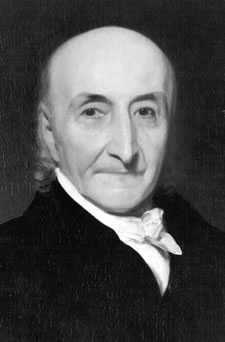
|
| Gallatin |
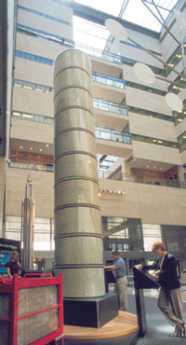
These countries hired investment advisers to buy stock for the funds, evidently feeling American stocks were the safest bet; it's hard to criticize that conclusion. In the present credit crunch, they are investing five and ten billion per transaction in the equity of America's premier investment banks. So far, they only acquire 5 or 10 percent ownership, but then the credit crisis may not be over yet. For them eventually to acquire 51% controlling ownership somewhere is not at all inconceivable. An ominous sign of where that might lead is found in our own captive pension funds. The state employee pension funds have quickly become captive to unions with their own agenda, with the result that the prosperity of the companies in the portfolio could be sacrificed to the benefit of interest groups. And yet, it wouldn't be so hard for America to do the same thing. If Congress had adopted the Bush proposal of three years ago to create an investment fund for Social Security, we ourselves would soon have what amounts to the largest sovereign wealth fund in the world. Could this be a solution to the weakness of the Federal Reserve in controlling the currency with bank debt? Could we somehow create a common world currency based on a common fund of sovereign wealth funds and with that, create a new definition of wealth based on equity rather than debt? The technical answer to the potential corruption issue would probably lie in stripping the voting power from such shares and then submerging them in a world index fund. The United Nations sound of it nevertheless still boggles the mind. Are people who oppose an equity-based world currency going to be forced like Gallatin to eat their own dusty words when the reality of debt-based currency sinks in? How many of the ambassadors of ideas about such suggestions, both pro, and con, would eventually surface as sneaky connivers like Madison, with a hidden side-agenda? After all, in a democracy, everyone is expected to marshal every argument, weak or strong, for his own self-interest.
|
| Federal Reserve |
The loss of banks as a tool for the Federal Reserve would undermine the way the Fed does its job. A deeper reality is that many governments really don't want the job to be done perfectly and independently. The European common currency, the Euro, is already irking the French and other national governments who sometimes hanker to inflate away their debts or deflate their way out of the subsequent inflation. A perfectly automatic currency regulation threatens an important ingredient of the sovereignty of nations, thus the whole concept of nationhood. Somehow, the desire of markets to enhance wealth must come to terms with the desire of governments to re-elect themselves.
It will take more than the present crisis to provide credibility for ideas as wild as substituting equity-based currency for the present debt-based one. Unless someone devises a better-sounding scheme, it seems more likely that financial Jacobins will propose sacrificing the unwelcome intruder. Derivatives, whatever that means, started this mess. Maybe we should make them illegal.
After the Convention:Hamilton and Madison
|
| Signers |
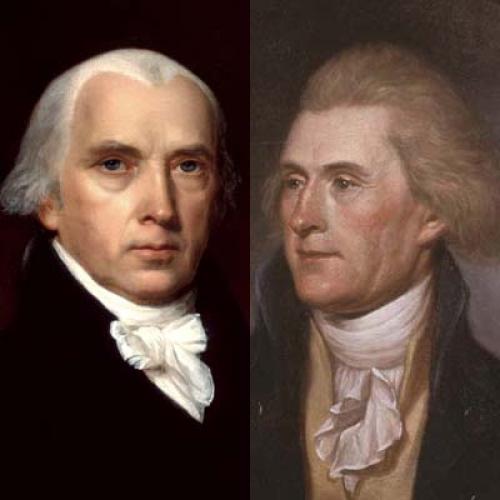
The Federalist Papers were written by three founding fathers after the Constitution had been completed and adopted by the Convention. Detecting hesitation in New York, the aim was for publication in New York newspapers to persuade that wavering State to ratify the proposal. It is natural that The Federalist was composed of arguments most persuasive to New York, putting less stress on matters of concern to other national regions. This narrow focus may explain the close cooperation of Hamilton and Madison, who must surely have suppressed some latent concerns in order to present a unified position. In view of how much emphasis the courts have placed on the original intent of almost every word in the Constitution, it seems a pity that no one has attempted to reconcile the words of the principal explanatory documents with the hostile disagreements of their two main authors, almost as soon as the Constitution came into action. Perhaps the psychological hangups would be more convincingly dissected by playwrights and poets, than historians.
John Jay wrote five of the essays, mostly concerned with foreign relations; his presence here highlights the historical likelihood that Jay might have been the one who first voiced the idea of replacing the Articles of Confederation. At least, he seems to have been first to carry the idea of a general convention for that purpose to George Washington (in a March 1786 letter). The remaining essays of The Federalist were written under the pen name of Publius by Alexander Hamilton and James Madison, both of whom had a strong enough hand in crafting the Constitution, but who quickly became absolutely dominant figures in the two central political factions after the Constitution was actually in operation. And their eagerness to be central is itself telling. They were passing from a stage of pleasing George Washington with his favorite project, into furthering a platform for launching their own emerging agendas. It is true that Madison's Federalist essays were mainly concerned with relations between the several states, while Hamilton concentrated on the powers of the various branches of government. As matters evolved, Hamilton soon displayed a sharper focus on building a powerful nation; Madison scarcely looked beyond the strategies of internal political power except to see clearly that Hamilton was going to get in the way. These two areas are not necessarily incompatible. But it is nevertheless striking that two such relentlessly driven men could work together to achieve the same set of rules for the game they were about to play so unflinchingly. Thomas Jefferson had been in France during the Constitutional Convention. It was he who was most dissatisfied with the resulting concentration of power in the Executive Branch, but Madison eagerly became the most active agent for forming the anti-Federalist party, with all its hints that Washington was too senile to know the difference between a President and a King. Washington abruptly cut him off and never spoke to Madison after the drift of his opinions became undeniable. Today, it is common to slur politicians for pandering to lobbyists and special interests, but that presents only weak competition with the personal forces shaping leadership opinion, chief among them being loyalty to, and perceived disloyalty from, close political associates.
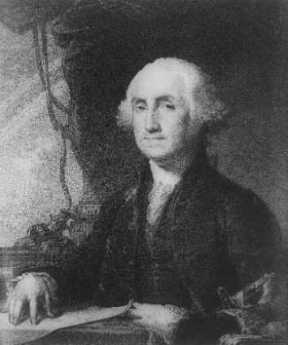
As a curious thing, both Hamilton and Madison were short and elfin, and both relied for influence heavily on their ability to influence the mind of
|
| George Washington |
George Washington, who projected the power and manner of a large formidable athlete. Washington had no strong inclination to run things and, once elected, no particular agenda except to preside in a way that would meet general approval. He had mainly wanted a new form of government so the country could defend itself, and pay its soldiers. Madison was a scholar of political history and a master manipulator of legislative bodies, while Hamilton's role was to supply practically unlimited administrative energy. Washington was good at positioning himself as the decider of everything important; somehow, everybody needed his approval. On the other hand, both Madison and Hamilton were immensely ambitious and needed Washington's approval. This system of puppy dogs bringing the Master a bone worked for a long while, and then it stopped working. Washington was very displeased.
The difference between these two short men immediately appeared in the way they chose a role to play. Madison the Virginian chose to dominate the legislative process as the leader of the largest state delegation within the
|
| Alexander Hamilton |
House of Representatives, in those days the dominant legislative chamber. Hamilton sought to be Secretary of the Treasury, in those days the largest and most powerful department of the executive branch. It's now a familiar pattern: one wanted to form policy through dominating the board of directors, while the manager wanted to run things his way, even if that led in a different direction. Both of them knew they were setting the pattern for the future, and each of them pushed his ideas as far as they would go. Essentially, this could go on until Washington roused himself.
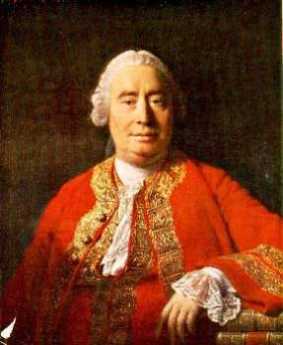
After a short time in office, Hamilton wrote four historic papers about two general goals: a modern financial system, and a modern economy. For the first goal, he wanted a dominant national currency with mint to produce it and a bank to control it. Second, he also wanted the country to switch from an agricultural base to a manufacturing one. You could even say he really wanted only one thing, a national switch to manufacturing, with the necessary financial apparatus to support it. Essentially, Hamilton was the first influential American to recognize the power of the Industrial Revolution which began in England at much the same time as the American Revolution. Hamilton was swept up in dreams of its potential for America, and while puzzled -- as we continue to be today -- about some of its sources, became convinced that the secrets lay in the economic theories of
|
| David Hume |
David Hume and Adam Smith in Scotland, and of Necker in France. Impetuous Hamilton saw that Time was the essence of opportunity; we quickly needed to gather the war debts of the various states into the national treasury, we quickly needed a bank to hold them, and a mint to make more money quickly as liquidity was needed. It seemed childishly obvious to an impatient Hamilton that manufacturing had a larger profit margin than agricultural products did; it was obvious, absolutely obvious, that this approach would inspire huge wealth for the new nation.
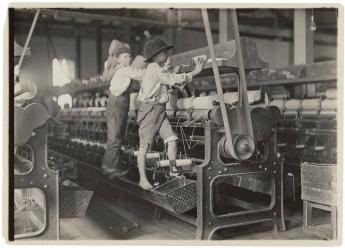
|
| Industrial Revolution |
Well, to someone like Madison who was incredulous that any gentleman would think manufacturing was a respectable way of life, what was truly obvious was that Hamilton must be grabbing control of the nation's money to put it all under his own control. He must want to be king; we had just got rid of kings. Furthermore, Hamilton was all over the place with schemes and deals; you can't trust such a person. In fact, it takes a schemer to know another schemer at sight, even when the nature of the scheme was unclear. Madison and Jefferson couldn't understand how anyone could look at the vast expanses of the open continent stretching to the Pacific without recognizing in this must lie the nation's true destiny. Why would you fiddle with pots and pans when with the same effort and daring you could rule a plantation and watch it bloom? If anyone had used modern business jargon like "Win, win strategy", the Virginian might well have snorted back, "When you say that to me, friend, smile."
Second and Market to Sixth and Walnut
|
Millions of eye patients have been asked to read the passage from Franklin's autobiography, "I walked up Market Street, etc.", which is universally printed on eye-test cards. Here's your chance to do it.
|
| Dr. Fisher |
Emerge from Christ Church onto Market Street, crossing to the Southside. Between Third and Fourth Streets (318 Market), there is a row of Eighteenth-Century Houses, commissioned by Benjamin Franklin, with a central archway leading to the interior of the block where he placed his own house. The restorationists have cleverly displayed the skeleton of the rafters of the house. When the British occupied Philadelphia in 1788, Major Andre (later to become Benedict Arnold's spy-handler) insolently took Franklin's own house as his headquarters (General Howe took Robert Morris's much more splendid house further up Market Street between Fifth and Sixth.) John Andre was court jester for the British officers. He was a poet, playwright, wit, and dashing life of every party. Washington was in tears when he ordered his hanging.
Continue on and out the South end of Franklin Court, onto Chestnut Street, after you have visited the Museum of Ben Franklin, aimed at children but containing examples of his many inventions, a theater with interesting short presentations, and a fascinating sound and light show of Franklin's great moments. The somewhat unexpected underground building is a product of the famous architect, Frank Venturi. At the corner of 3rd and Chestnut (where a restaurant now stands) once stood the house of Alexander Hamilton, and a few houses further North on 3rd Street remains the dilapidated remnant of the business of Anthony Drexel, the mentor and later senior partner to J.P. Morgan. Turning about and looking south, you can see the reason for this concentration of financiers. Just south of Chestnut is the First Bank of the United States (the fascinating Museum of Old House Parts is on the second floor), while the two blocks of Chestnut Street -- Third to Fifth Streets -- are filled with the massive stone piles of other banks of Philadelphia, culminating in that Parthenon-appearing Second Bank, Nicholas Biddle's bank. In the forty years before Andrew Jackson and Martin van Buren interfered, it wasn't Wall Street that mattered, it was Chestnut Street.
Proceed westward on Chestnut Street, and pass the converted bank now used by the Chemical Heritage Foundation, followed by another bank used by the American Philosophical Society as an auditorium. On the other side of the street, an alley leads southward to Carpenters Hall, where the First Continental Congress held deliberations. At that time, it was the largest private building in the Colonies.
Continuing to Fifth and Chestnut, you may wish to take a detour south to around Sixth and Pine to see the mansions of Society Hill, particularly the Powell House and the Physick House. Intermingled with the red brick Georgian style are examples of classical style reflecting French influence. Our present tour, however, points you to the red brick building just to the south of Independence Hall on Fifth Street. It looks like part of the State House complex but is actually the home of the American Philosophical Society, now housing its fascinating museum (seen only by appointment). After that, by all means, stand in line and take the National Parks tour of Independence Hall, which is one of the best displays in the whole Park Service. After that, the tour of the Liberty Bell on the north side of Chestnut is just a trifle tame, but a mandatory visit.
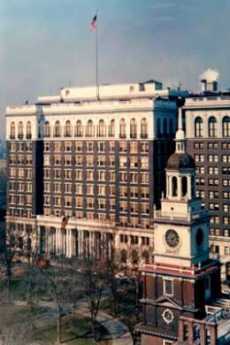
|
| The Curtis Building |
Do not neglect to cross Sixth Street to the Curtis Building, where a few steps inside is the astonishing mosaic constructed by Louis Comfort Tiffany out of Tiffany glass, based on the artistry of Philadelphian Maxfield Parrish. Look around the lobby, which is pretty ornate, but it once held printing presses for the Saturday Evening Post.
Emerge from the Curtis Building on the Seventh Street side. Take a look at the Atwater Kent Museum of the City of Philadelphia, then notice the Jeweler's Row on Samson Street. The house where Thomas Jefferson wrote the Declaration of Independence is at the corner of 7th and Market; it's a reproduction, however. This would bring you back to the subways and high-speed line where the tour began. Instead, the full tour goes back to the Curtis Building and heads south.
Stephen Girard 1750-1831
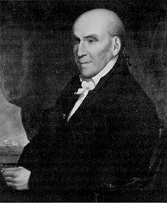
|
| Stephen Girard |
Girard was born in Bordeaux, France and never went to school. By the age of 23, he had become a sea captain, like his father and grandfather. By the age of 27, he owned his own ship and was thus launched on a successful career in a very dangerous occupation. Depending on the destination and weather during that era, up to forty percent of sailors were lost at sea on long voyages. From the point of view of the passengers and shippers, when you were selecting a captain you wanted one who had returned unharmed from many voyages. It was irrelevant whether he had been lucky, or diligent, or had learned a lot from his relatives in the trade.
Stephen Girard did start with a handicap, being born blind in one eye. It may have been a personality disorder which drove him to precise, minute instructions to his subordinates in excruciating detail; he might now be called a "control freak" and be disliked for it. For example, he kept a handwritten copy of all letters he wrote, and at his death, there were 14,000 of them, sorted and filed. His wife went insane, and after spending years at the Pennsylvania Hospital, was buried on the grounds. If this is the price of being rich, some might consider remaining poor. During his working years in Philadelphia, he would normally get to the counting-house at 5 AM, go to his bank at noon, and go to work on his 600-acre farm in South Philadelphia after 5 PM. He said he liked farm work the best. The image left behind by this role model, then, was workaholic. Nevertheless, if you wanted to become the richest man in America, here was the pattern to follow.
Girard probably came as close as any rich man in history, to "taking it with him" when he died. His innately compulsive personality, combined with the sure knowledge that his relatives and others would probably try to break his will for their own benefit, led to the construction of a last will and testament that withstood a century of court challenges. It launched remarkable philanthropy for thousands of orphans and organized the whole Delaware Valley into an industrial machine unlike anything else in the country. Although he left the largest estate in the nation's history, that estate continued to accumulate money from his minute instructions to executors, eventually enlarging his vast fortune fifty-fold, a century after his death. In retrospect, Philadelphia might well have slowly declined into obscurity after the nation's capital moved to Washington in 1800. Instead, the coal, canal, railroad and industrial empire of the Philadelphia region became the "arsenal of the North" during the Civil War, and the main wealth generator of the Gilded Age which followed.
Girard's business career can be somewhat oversimplified as consisting of shipping at the base of his early good fortune, followed by banking during the era when banking was poorly understood and usually ineptly managed. He ended his career with an eager and successful embrace of the emerging Industrial Revolution. Throughout all of this, he characteristically took great risks for great profits, through recognizing what others were too timid to accept fully. On many occasions, his risky ventures resulted in very large losses, made acceptable by other risky ventures proving unexpectedly successful. An example would be Girard's Bank. When the Federal Government first started and then abandoned the First National Bank Girard bought up the remnants and made a great private success of banking, where he had little previous experience. He saw the potential of the canals, and later the railroads when others were content to be farmers or country gentlemen. When he was 79 years old, he purchased vast tracts of wilderness containing some outcroppings of coal, because he could foresee a great industrial future for the region. No pain, no gain.
Another way of looking at Girard was as the most prominent French-American citizen of his time. He arrived in Philadelphia at about the same time Benjamin Franklin stepped off another boat, returning from abusive treatment by British officials which finally flipped him for American independence. Franklin recognized that independence from England meant an alliance with France, or else it meant defeat. It is possible to view the American Revolution as an episode of France searching for an American foothold after its expulsion fifteen years earlier in the French and Indian War; trouble between Britain and its colonies might re-open opportunities for France. Girard was extremely friendly with Thomas Jefferson, the most Francophile of founders and early American presidents. When the War of 1812 with Great Britain threatened disaster for the new American state, Girard staked $8 million dollars, his whole fortune, on financing that war. During the entire period from 1776 to the Louisiana Purchase, America was wavering between its gratitude to France and underlying loyalty to the English-speaking community. During that long formative period, Girard the very rich Frenchman was hovering in the background, probably influencing American foreign policy more than is known, even today. But the France that Girard stood for was neither aristocratic of the LaFayette variety nor intellectual of the Robespierre sort. It was France of the French peasant, crabbed, acquisitive, and morose, forever responding to a "hidden hand" of his own self-interest in a way that paradoxically benefited his whole community, and thus would have hugely amused the Scotsman Adam Smith.
Our Federal Reserve : Biddle's Bank (2)
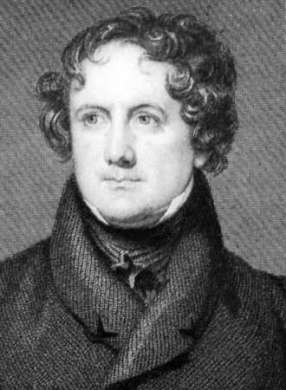
|
| Nicholas Biddle |
In 1823, the Biddles were prosperous, having made money in real estate (a Biddle ancestor had been a member of the Proprietors), and influential, having been Free Quakers who sided with the Revolution. So, Nicholas Biddle became the president of the Second Bank at 4th and Chestnut. Like all banks, he was given the ability to create money by taking deposits and loaning them out. Since in this process, two people (the depositor and the borrower) think they have the same money, there is effectively twice as much of it -- unless both actually demand it at the same time. If a bank has Federal revenues on deposit, as Biddle did, it is fairly easy for a politically active banker to predict whether that large depositor is likely to withdraw it. Political deposits seemingly make a bank stronger and safer, unless the banker has a fight with a politician. That's banking, but Biddle also became a central banker.
Biddle had ideas, derived in part from Alexander Hamilton. In those days, banks issued their own paper currency, or bank notes, representing the gold in their vaults or the real estate on which they held mortgages. There was a risk in one bank accepting bank notes from another bank that might go bust before you changed their notes into gold. The further away the issuing bank was, the riskier it was to rely on it. So, it was important to be a friendly sort of banker, who knew a lot of other bankers who would accept your money or who were known to be trustworthy.
Nicholas Biddle himself was well known to be pretty rich, and utterly trustworthy. He had a good instinct for how much to charge or discount the banknotes from other banks, or even other states. It was quite profitable to do this, but it became even more profitable when people began to use Biddle's own bank notes because they were safe. By setting a fair standard, he could control the exchange rate -- and hence the lending limits -- of banks that dealt with him. Sometimes a distant bank would get into cash shortages, and Biddle would help them out; if the other bank had a bad reputation, he might not.
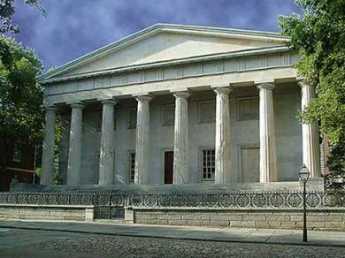
|
| Bank of the United States |
In this way, the Second Bank was a reserve bank for other banks, with its banknote currency coming close to being the currency for the whole country. Soon, within a few blocks of Biddle's Bank, there were dozens of other banks, making up the financial capital of the country. Although it was a little obscure, and even Biddle may not have completely realized what he was doing, in effect his system automatically adjust the amount of currency in circulation to the size of the economy. If the correspondent banks prospered, they issued more currency, and if there was a recession, the country had deflation. The volatility of this system was related to the volatility of a pioneer economy, so Biddle made lots of enemies whenever he guessed about the direction of the economy. It wasn't a perfect system, but at least he kept politicians from inflating the currency to get re-elected, and hence annoyed politicians by constraining them. During the great western land rush of those days, all banks were under pressure to issue more loans than was wise, and politicians were under pressure to make them do so.
The worst enemy Biddle made was Martin Van Buren of New York. Van Buren was a consummate politician, one of whose many goals was to move the financial capital of the country from Chestnut Street--to Wall Street.
REFERENCES
| America's First Great Depression: Economic Crisis and Political Disorder after the Panic of 1837 Alasdarir Roberts ISBN-13: 978-0801450334 | Amazon |
Our Federal Reserve: Okayed (3)
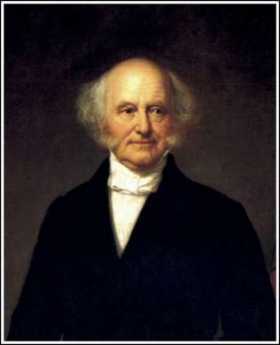
|
| Martin van Buren |
The 8th President of the United States, Martin van Buren, was born in Kinderhook, New York along the Hudson. He was known as "Old Kinderhook", so in time he initialed his documents "OK", and that's how that slang term originated. It's also of note that his retirement home in Kinderhook was named Lindenwald, although any connection with the terminus of the PATCO high-speed line is unclear. His real claim to fame is that he sort of invented what we know as the a modern political system, particularly that unfortunate doctrine known as the "spoils system". The full allusion is "to the victor belongs the spoils". The two-party a system, the Democratic Party, spinning, log-rolling, and other clever manipulations were of his devising. He must have been pretty shrewd, having defeated De Witt Clinton for Governor of New York, when Clinton was known as one of the most ruthlessly ambitious politicians around. Recognizing he was unlikely to be elected President, van Buren took on Andrew Jackson the war hero and manipulated him into the presidency, with the clear understanding that when Jackson stepped down, van Buren would have the job, next. Van Buren was a cabinet officer during Jackson's first term and Vice President during the second term. During that time, he was the real power running things from the shadows. He ruined the careers of John Calhoun and Henry Clay, regularly taking both sides of a number of disputes over the extension of slavery into new Western territories. What people ultimately thought of all this may be judged from the fact that he ran unsuccessfully for re-election -- three times.
It is therefore not certain just whose ideas were in operation when Jackson blocked the re-chartering of Biddle's bank, but one main benefit, "cui bono?", went to New York. Wall Street had sold stocks under a Buttonwood tree for fifty years, but its real start in the the financial world can be traced from Jackson's action.
The Industrial Revolution and the expansions of the United States by the Louisiana Purchase, the annexation of Texas and the Mexican acquisition caused an an explosion of new wealth, and hence an urgent need to make some better financial alignment of three asset classes: land, precious metals, and currency. Everywhere and at all times it is arguably what the land is really worth; 19th Century America it was particularly speculative, because there was so much of it. Most of the many bank waves of panic during that century can be traced to excessive borrowing to speculate in raw land. When Jackson closed Biddle's reserve bank, the land the speculating public was ecstatic because of any constraints on the lending power of banks made it harder to sell real estate. But what had been done was to eliminate the only reasonably effective way of matching the a true wealth of the country with its circulating monetary assets, and after a brief boom, the almost certain consequence was going to be a national bank panic. It came in 1837, during the first year of Martin van Buren Presidency.
The only imaginable alternative to a market-based monetary system is a government-based one. Van Buren's political behavior was by almost by itself sufficient warning of the danger of allowing politics into this matter. For nearly a century, one warning was enough.
Sixth and Arch to Second and Arch
|
When the large meeting house at Fourth and Arch was built, many Quakers moved their houses to the area. At that time, "North of Market" implied the Quaker region of town.
|
| Dr. Fisher |
During a recent speech, Senator Arlen Specter let it slip that he had a lot to do with obtaining federal financing to establish the new Constitution Center on the north end of Independence Mall. Probably even more important, he intimated that his wife, Joan Specter, did a lot of domestic agitating to see that it happened. The earmarks were his, the fingerprints were hers. Some have worried that the Supreme Court might be uneasy about a center telling the world what the Constitution is because the Justices see Constitutional interpretation as their unique function. The point that is sensitive is the emphasis on the words "We, the People", which could be seen as urging easy modification of the document by shouting demands or repetition of certitudes without passing due process in order to be considered. The second floor of this enormous new building is devoted to some very skillful exhibits relating to the history and significance of certain features of Constitutional history. The many auditoriums are the site of public lectures and programs, and there is a very interesting set of life-sized bronze figures of every member of the original Constitutional Convention. A striking feature of the display is to show how short and inconsequential Hamilton and Madison seemed to be in person, while Ben Franklin and Gouverneur Morris appear imposing and formidable in the flesh. These things matter in politics.
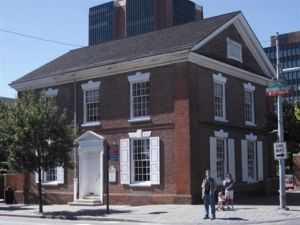
|
| Free Quaker Meeting House |
Cross Arch Street to the Free Quaker Meeting House, and if you have called the Park Service in advance, perhaps you can visit, noting how visually dramatic design of drastic simplicity can be. Just across Fifth Street is Ben Franklin's gravesite, in Christ Church cemetery, extended to this location when the gravesites became full around the church itself.
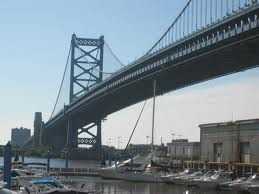
|
| Ben Franklin Bridge |
Going down Arch Street from Fifth to Fourth, you can visit the orthodox pacifist Meeting House, it's interior largely unpainted and grimly plain -- quite different from the effect of pristine simplicity of the Free Quakers. If you go inside the meetinghouse, a quiet and unprepossessing Quaker will be more than happy to give you a magnificently short and simple explanation of what Quakerism is all about. In passing down Arch Street, glance at the warehouses on the left, covering the site of what was once a major factory for shoes and uniforms for Union soldiers in the Civil War. Behind the buildings on the North side of the street, as the ground slopes sharply toward the river, you can sense the rough, tough waterfront of the Eighteenth Century. Charles Dickens might have felt entirely at home in the Nineteenth Century. Looking three blocks further North on Fifth Street, you can see St. George's Church, the oldest Methodist Church in the world, its view unfortunately obscured by the approaches to Ben Franklin Bridge.
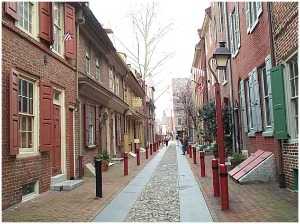
|
| Elfreth's Alley |
Continue down Arch Street, past the building once said to have been the house of Betsy Ross, turning a half-block to the left on Second Street to the head of Elfreth's Alley. For full effect, continue down the alley to the end, but you will eventually have to retrace your steps because of rearrangements of the streets. Going down Elfreth's Alley, observe how tiny the Colonial buildings are. That's a reminder that placing taxes disproportionately on land will result in small residential plots, even though a whole continent of vacant land stretches to the Pacific. At one time, you might have walked south on Front Street, to Market, and then right to Second and Market. However, the embankment of the Interstate highway blocks you so you have to retrace your steps to Second Street. At the corner of Second and Market, however, do not neglect to look back toward the Southwest corner of Front and Market. The original building has unfortunately been demolished, but here was the site of the London Coffeehouse, where it could be fairly argued the American Revolution began. The owner, John Bradford, first learned of the Tea Act from a sailor at the Arch Street Wharf and fiercely resolved to stir up trouble about it. In retrospect, the Revolution might have seemed justified, but the Tea Act itself was intended by the British to be conciliatory, actually lowering the price of tea.
Now, go to the corner of 2nd and Market, where Christ Church displays Colonial architecture at its most breath-taking. If your feet hurt, you could rest by sitting in the pew once reserved for George Washington.
At this point, you have a choice. You can go South on Second Street to the restaurant and hotel area at the foot of Society Hill, eventually going on to a tour of either the elegant mansions to your right or the waterfront marinas and museums, on your left. Or instead, at Second and Market, you can turn West on Market, crossing at 3rd and Market to go through the archway to Ben Franklin's house and museum, eventually to the financial district and the State House. All of these are good choices, and if you are really smart you will do all of them.
Gallatin, Part 1
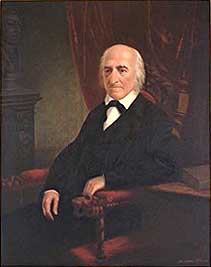
|
| Albert Gallatin |
William Shakespeare died two centuries before the Whiskey Rebellion of 1794, but he left us a clear outline of his style. Tragedies end with everyone getting killed, comedies end with everyone getting married, but histories have no clear beginning or end. The Hollingshead chronicle underlying this particular effort is the excellent history by Robert E. Wright and David J. Cowen, called Financial Founding Fathers. The story of the young Swiss aristocrat Albert Gallatin, plonked into the backwoods of Pennsylvania only to be relentlessly pursued by his arch enemy General Alexander Hamilton, ends in 1804 when Hamilton is killed in a duel by the Vice President of the United States, Aaron Burr.
Act 1. Ex-Senator Gallatin.
Aged 33, Gallatin was young to be a U.S. Senator, but his Swiss background in finance made him one of only five or six Americans who knew anything about banks. Unfortunately, his passionate Swiss frugality immediately made him the arch enemy of Secretary of the Treasury Alexander Hamilton who wanted to combine state debts from the Revolutionary War into a national debt. This thorn in Hamilton's side was removed by evicting Gallatin from the Senate on the grounds that he had not been a citizen for the ten years required by the Constitution. Unfortunately, that was true. It was nevertheless galling that Robert Morris, the other Pennsylvania Senator, would vote against him. The humiliation of being forced to leave Philadelphia and ride horseback to his home in Fayette County, right on the Indian frontier among the semi-barbarian Scotch Irish, was extreme.
Act 2. Caught in the Middle.
When Gallatin arrived home in the backwoods, the incensed local farmers instantly rallied around him as the perfect leader of a rebellion they wanted to start. A four-year war with the Indians in nearby Ohio had shut off all hope of marketing their grain to the West, and the Allegheny Mountains made it unprofitable to ship it to the East. Their response was to distill it into whiskey, which would not spoil with storage, and was more compact to transport. Assisted in part by Quakers' horror at selling whiskey to the Indians, Hamilton had pushed through a tax on whiskey which rendered it impractical to make it at all. Gallatin was already Hamilton's enemy, and Gallatin the European knew how to talk to those swells in the East. Gallatin did make rousing speeches about injustice but always cautioned the wild men to behave peacefully. That wasn't exactly what the angry farmers wanted, so Gallatin soon became the enemy of both sides of the dispute when the western Pennsylvanians organized a rebellion. Both sides made threats to assassinate him.
Act 3. The Lion Roars
President George Washington didn't know much about banks or taxes, but he knew a lot about law and order, and he wasn't having any rebellions. Ordering up an army of fifteen thousand men, he and General Hamilton led it across the state of Pennsylvania to hang 'em. Meanwhile, however, General "Mad" Anthony Wayne had defeated the Indians along the Miami River in Ohio, thus removing the main reason for whiskey manufacture, and finally proving to the anti-Constitution Jeffersonians that the federal government really was a useful thing to have. Washington dropped out at Bedford and went back to running the country, allowing the relentless Hamilton to charge forward to Pittsburgh. By that time, the farmers had pretty well dispersed, but to Hamilton they were traitors and that particularly included Gallatin.
Act 4. Local Hero
Two ringleaders were convicted of treason, everyone was threatened and interrogated. Hamilton was particularly anxious to include Gallatin in the net, but no one in that frontier culture would accuse Gallatin of participating in the call to violence or testify to any treasonous speech by him. In the midst of the uproar, Washington rose to the occasion and pardoned them all. Every last one of them.
Act 5. Secretary Gallatin
In a surge of jubilation, western Pennsylvania elected Gallatin as their congressman, sending him back to Philadelphia where he could do them some good. And indeed he quickly assaulted all of Hamilton's policies, both good and bad, as well as just about every other Federalist program. He quickly rose to the effective leadership of Congress and swung the crucial 1800 election from Aaron Burr to Thomas Jefferson. Since Jefferson was another Virginia Cavalier who knew nothing about finance, it was a foregone conclusion that President Jefferson would appoint Gallatin to be Secretary of the Treasury. Finally, in 1804 Burr removed Hamilton from public affairs on the flats of Weehawken. At the news of the death of his enemy, Gallatin shed not a tear. His memorial was the statement that "a majority of both parties seemed disposed.....to deify Hamilton and to treat Burr as a murderer. The duel, for a duel, was certainly fair."
Gallatin Part II
Act 1 Gallatin Triumphantly Returns to Congress.
When Washington pardoned the Whiskey Rebels, Gallatin was immediately elected to Congress. It was his payback time for Hamilton and all his works. The desperate Federalists tried to oust him a second time with a Constitutional Amendment, which failed before the force of Gallatin's oratory. Gallatin then threw his influence behind Jefferson's deadlocked congressional contest with Aaron Burr, electing Jefferson and earning his own reward as Secretary of the Treasury. Although elected Vice President, Burr's fury is turned against Hamilton, foreshadowing the coming duel.
Act 2 The Virtuoso Financier.
Jefferson proves hopeless in domestic affairs, so Gallatin essentially takes over that role, just as Hamilton had taken over from Washington, who was another Virginia cavalier adrift in these matters. Gallatin promptly repealed the whiskey tax, cut government expenses, in particular, the million dollars annual tribute to the Barbary pirates, and almost performed magic in financing the Louisiana Purchase together with Stephen Girard and William Bingham.
Act 3 Burr Kills Hamilton
After his Vice President kills the leader of the opposition party, Jefferson's party was on the political defensive. But not Gallatin, who spits out his famous remark, "A majority of both parties seem disposed to deify Hamilton and treat Burr as a murderer. The duel, for a duel, was certainly fair." It is an all-time low moment in the politics of the young nation.
Act 4 Diplomacy or War?
As the Napoleonic wars engulf the whole world, both England and France harass our merchant ships, and cries go up for war. Partly out of a desire to annex Canada in the process, Gallatin sneers at proposals to restrain the fighting Europeans with mere sanctions. His prediction proves dismayingly correct that nothing would come of it except to make our own citizens into smugglers.
Act 5 War It Is.
The First Bank's charter was to expire in 1811, and the bank closed, creating an opportunity for Girard to buy it out and finance the coming war himself. Gallatin was desperate to end the war as quickly as possible, especially after the British burned Washington. To speed matters up, Gallatin took a leave of absence and went off to the peace conference in St. Petersburg himself.
Epilogue in front of the curtain.
Gallatin finally announces his resignation from the longest term of Treasury Secretary in our history. He is seventy years old, three scores and ten. Rather than play golf, he was to spend the last eighteen years of his life in three more careers. As a diplomat, he negotiated both our permanent northern and southern borders. As an academic, he founded the discipline of ethnology with the study of native Indian languages, meanwhile founding New York University. And as a banker, he founded a bank which has since evolved into JPMorgan Chase. After all, a man has to find something to keep himself busy.
Albert Gallatin: Enigma Furioso
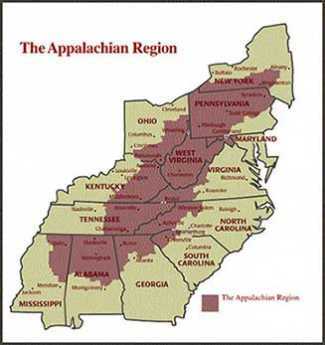
|
| Appalachia |
Abraham Alphonse Albert Gallatin was born to a rich, famous and noble family in the French part of Switzerland in 1761, but soon became a rich orphan fleeing to America in the 1780s to escape overbearing and grasping relatives. He started out in America teaching French at Harvard but soon purchased Friendship Hill, a 600-acre estate south of Pittsburgh along what was to become the National Road. At first, he ran a busy general store but soon branched out into successfully buying and selling real estate. Although Uniontown now seems a lonesome hermitage in Appalachia, it was then part of the area disputed between Pennsylvania and Virginia, coveted by both states because it seemed like the main route to Ohio when Ohio was the Golden Frontier. Friendship Hill is now a National Park, near Fort Necessity, also near General Braddock's grave, and the birthplace of George Catlett Marshall. So it had its attractions, but Gallatin led such a frenzied life it is hard to believe he spent much time there. There is a reason to believe he was one of the main instigators of the Whiskey Rebellion. Hamilton, and probably Washington, certainly thought so.
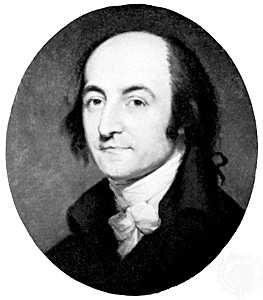
|
| Albert Gallatin |
Almost immediately after arrival in America, Gallatin threw in his lot with Thomas Jefferson in resistance to the centralizing, Federalist, qualities of the new Constitution. Both of them were looking for more liberty than the Constitution offered. The movement they led became the anti-Federalist party and would have been the anti-constitution party except for reluctance to oppose the towering figure of George Washington. Gallatin's French loyalties seem to have overcome his aristocratic family background in supporting what enemies of the French Revolution had called Jacobin (or "Republican") notions. His Swiss background additionally gave him great credibility in high finance in backwoods America. In spite of being rather out of place among Virginia Cavaliers, his personal qualities seem to have made him a natural politician. He hated Hamilton's idea of the National Bank, arguing against it effectively in the unsophisticated company. The issue was not so much opposition to banking, but to government dominance in central banking. He was certainly right that mixing the two created a constant risk of inflation from yielding to political demands, an empirical observation almost without any exception for 800 years. However, it was too early in the history of central banking to perceive that it was debtor pressure which promotes inflation. Governments are almost invariably debtors themselves, whereas the elites he was attacking, in general, become creditors, resisting inflation. Inflation is merely a variant of defaulting on debts, which debtor governments happen to have at their disposal because they control the currency.
At this early stage of central banking, America was largely using its vast amounts of land as a substitute for money, but quickly adapted to Hamilton's new monetary system which was far more flexible. Gallatin later played a role in the chartering of both the Second and the Third Banks, although his motives here were somewhat different. (Government caps on interest rates induced the Banks to lend to only the best risks, which amounted to favoring Philadelphia over the frontier, Gallatin's main constituency.) He was appointed U.S. Senator for Pennsylvania at the age of 32 but was evicted on a straight party vote on the ground that he had not been an American citizen for the required nine years. It seems likely that accusation was correct. He was soon elected a Congressman, becoming Chairman of Finance (later called Ways and Means), the majority leader after five years. In retrospect, while it seems perplexing that a sophisticated financier would oppose a central bank, his opposition may have been mainly against having politicians operate one, a rather unavoidable consequence of government control. Hamilton's idea that deliberately going into debt was a way to establish "creditworthiness" was denounced as particularly offensive by those who disdained indebtedness as the most dangerous sin of commercial life. The anti-Federalists were clearly wrong on this point, but it is possible to sympathize with their suspicions. Even today, the unwillingness of banks to lend money to someone who has no history of the previous borrowing is one of those things which seem so natural to bankers, and so irritating to apostles of thrift.
It remains unclear to history whether Gallatin had really never believed what he was saying, or had gradually changed his mind as he gained experience. He did confess or perhaps suddenly realize his error as the War of 1812 approached and he was Secretary of the Treasury. In this awkward event, he found himself charged with organizing the finance of a war with no way to do it. What was worse, Jefferson relentlessly pursued the closure of the National Bank for ideological, even fanatical, reasons; and Jefferson was the boss. The resolution of this conflict was to enrich Stephen Girard even further, while forcing Gallatin to a humiliating public reversal of stance. Nevertheless, America simply had to have a bank to fight a war. It is greatly to Gallatin's credit that his frenzied and obviously sincere entreaties to the bewildered Jefferson and Madison then saved the Nation from a disaster of foolish consistency. In a larger sense, the dramatic reversal of stance also played a role in shifting American sympathies from France to England. American sympathies were then wavering. On one side, there was gratitude to the French for bankrupting themselves with unwisely large loans to our struggling revolution, and for allying themselves with that revolution, soon imitating it with a revolution of their own against the common slogan, oppressive monarchy. True, there was more than a little hankering for the annexation of large chunks of Canada. That was one side of it, which Lafayette, Girard, Gallatin, and Jefferson labored to enhance, probably with their eye on French Quebec. On the other hand, there was that appalling genocide of the Jacobin guillotine, which Napoleon soon threatened to extend to all European monarchies within his reach. The Seven Years War, which we called the War of the French and the Indians, had left memories in America that French ambition could extend from Quebec to Louisiana and include Haiti. The French once even occupied Pittsburgh, and their Indian allies had scalped settlers in Lancaster. That was not so long ago. Furthermore, the English invention of the Industrial Revolution was immensely attractive to artisan Americans. Ultimately, we made our choice for steady prosperous commerce of the British sort, rather than glittering glorious conquest, of the French style. By 1813, Gallatin had served longer as Secretary of Treasury than anyone before or since, and earlier had a more distinguished career as both Congressman and Senator than all but a few have ever achieved. When he was offered the position as a commissioner to negotiate the Treaty of Ghent ending the War of 1812, it was natural to expect that it would be the final act of his long political career. It was, however, only the beginning of a ten-year diplomatic career as Ambassador, first to France and then to England. Following that with still another new career, he took up academic work, returning to America to found New York University, personally establishing the academic discipline of study in Indian Affairs and language, and founding the American Ethnological Society. Gallatin wrote two books about Indian language patterns and first suggested that the similarities between the languages of North and South American Indians probably meant they were related tribes. In another sphere, Gallatin is credited with originating the American doctrine of manifest destiny.
While skipping from one distinguished career to several others, Gallatin never forgot he was a banker. He wrote the charter for the Second National Bank ("Biddle's Bank"), plus the Third Bank of Pennsylvania, and founded the National Bank of New York, which was named Gallatin's Bank for a while, before gradually evolving into what is now called J.P. Morgan Chase Bank. As a diplomat, he negotiated many boundary disputes, including Oregon, Maine, and Texas. He bitterly opposed the annexation of Texas.
When it comes to writing about Gallatin, there is so much to say it is hard to say anything coherent. He was such a virtuoso of public life that he defeats his biographers in their central task, of telling the world what he was like. There haven't been many if indeed there were any, enough like him to offer a comparison. And yet history has not been kind to him. He can comfortably claim the title of the most famous American, that no one since has ever heard of.
Constitution-tampering is Unwise
.
Economics of La Cosa Nostra
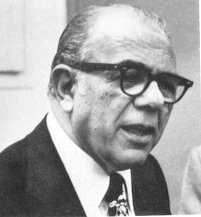
|
| Angelo Bruno |
During all of the reign of Angelo Bruno, it was a common street opinion that The Organization tried to stay away from drugs, prostitution and shooting anybody except other mobsters. Some of that attitude is found in the scene of the movie The Godfather where a neophyte going to his first killing is instructed to "Watch out for those goddam innocent bystanders". It was okay to bribe the police, not okay to annoy them. Counterfeiting and kidnapping were big no-no's, even though counterfeiting was a core activity for the ancestral Mafia in Western Sicily during the Nineteenth century.
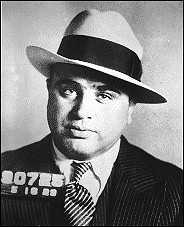
|
| Al Capone |
According to Robert Simone's book, the Philadelphia mob was mainly enriched by loan sharking. There are a lot of people who suddenly need cash desperately and can't get it quickly from banks. Simone himself was a compulsive gambler and frequently was in urgent need of money, either to throw it away or pay it back. Other people get caught in some illegal activity and suddenly need bail money to stay out of prison or up-front money for a lawyer. Or whatever. The Philadelphia mob had a reputation for being able to loan amounts of fifty or a hundred thousand dollars in response to a phone call, with home delivery of the money in fifteen minutes. For this, they would charge interest in the range of three percent a week, well above the usury limit, but probably not greatly out of proportion to the risk of loss. The police have little interest in transactions between willing parties, at least until the borrower fails to pay it back. Even at that point, it becomes a question of whether kneecaps will actually get broken, or baseball bats actually come in contact with skulls. Probably not very often, because the threat seems a credible one.
To run such a business requires large amounts of cash, hidden in safes or bricked up in walls. From this comes theft or attempted theft, with violent defense measures that often don't concern the police, much, unless those aforementioned bystanders get injured. Sometimes couriers get tempted to make unscheduled detours, but the police are fairly tolerant of informal restitution efforts. All in all, it's a nice clean illegal business.
An interesting sidelight is income tax evasion. It's entirely possible that The Organization would be willing to pay taxes if it could be done without filling out all those forms. Restaurants, bars, and market stalls can be run as a way to launder money and yet pay tax on it. But boys will be boys, and no doubt the IRS has, or had, some legitimate concerns. For years I felt the government was over-reaching when it jailed Al Capone for income tax evasion, after being unable, however, convinced it may have been, to convict him of overtly illegal activities. That's one side of it. But if you envision these organizations with millions of dollars in cash hidden away, it's easy to imagine them extending invisible credit to their associates for services rendered but not yet paid out and, of course, untaxed. Calling for such money on demand is not much different from having it in a bank. If appreciable amounts of that circumvention go on, the Internal Revenue Service really might have a grievance. Its image would be improved by demonstrating it is pursuing a named crime rather than a pretext to jail someone it doesn't like. Legislation could surely be devised which more carefully specified such illegalities. It might then be possible to bring an end to the appearance of putting people in jail for merely enjoying an ornate lifestyle. People who, almost by definition, cannot be proven to have committed a crime.
Making Money (8): Virtual Money
|
When money was tangible you had to guard it, now that it's mostly virtual you have to verify it. Hardly anybody can, and that's a problem.
|
When money and wealth were wampums, precious metals, and paper currency, these physical objects required physical protection. It was all a big nuisance, with six-guns on the belt, bank vaults, and appraisers of one sort or another. But now that wealth is merely a bookkeeping entry on someone's computer, things may be even more nuisance because verification is almost beyond us. Counterfeiting of the computer variety must be left to institutions to detect or deflect, causing them to introduce firewalls of various sorts that also block legitimate inspection by customers. "Trust but verify" doesn't work so well in this environment. Let's use a personal example, slightly fictionalized to protect the innocent.
Several software products now exist to download transaction information automatically from various institutional sources to a customer's home computer; they are either free or cost a nominal amount, and are quite "user-friendly". In my case, however, the reports they generated were quite significantly at variance from the monthly reports which were issued directly by my counterparties. Dear Sirs, Please explain.
What I soon discovered was that everyone blamed someone else, and everyone blamed me for bothering them. Quite obviously, I had little understanding of these specialized accounting niceties, and quite obviously I had too much spare time on my hands. Telephone help desks, often located in India, will not give out telephone numbers for incoming calls and are programmed to check the size of your account before placing you in a call-back queue. The first call is usually taken by a trainee whose job it is to screen out the silliest sort of help request, and then to refer to a supervisor if things rise in complexity. Supervisors have supervisors. That's if you are lucky. More commonly, the tedious software business has been farmed out to a vendor, and the contracting agency has neither the necessary understanding of the issue nor any ability to fix it. From the sound of it, the vendor often gives the contracting agency the same sort of isolation treatment that they would give a customer if he could find their telephone number. And guess what. At the end of the day, one of those high-handed defensive linemen -- turns out to have been at fault.
Let's explain one problem. On the surface, we were talking about a $40,000 difference in account balances; one may have been correct, but a second one must have been wrong. That rises to lawsuit level, so the matter got intensive study. It turns out the stockbroker had misinterpreted instructions for a "sweep-account" system. When a stock in your portfolio pays a dividend, the amount of the dividend is subtracted from that stock's line item and added to the line item of your money-market fund. That's fine, but there is one exception. When the money market fund itself pays a dividend, subtracting that dividend cancels out the addition, and the dividend essentially disappears from your net worth. Was this intentional? Certainly not; no one could stay in business doing that. It's not even a highly stupid error, since you can easily see yourself making the same oversight of the one implicit exception to the rule of sweep accounting. Because of this "bug" in the program involved one institution making a mistake and transmitting it to a second institution, the systematic error did not unbalance any books, until it reached mine. But since I did not detect the error for five months, there must be dozens, hundreds, maybe thousands of customers who did not detect it. Ouch. Do the math yourself to judge whether this was a serious error.
This illustration, only one of several on my personal report, leads to at least two larger principles. The first is that the transformation of money from tangible to virtual has occurred so rapidly that bullet-proof safeguards have not had time to emerge. After a century of use, most people cannot balance their checkbooks, but enough people can balance them so that systematic errors are not likely to slip past. When enough people with home computers repeatedly test the internal complexities of their virtual money accounts, confidence will develop that the system is probably working. Confidence is an important matter; it is possible to imagine quite a bank panic if the public suddenly got the idea that virtual money is maybe a mere vapor. In fact, the securitized credit panic of 2007 is a little like that. With a few new regulations and a lot of computer programming it surely will be possible to know who owns how many bum mortgages. That innovative mortgage system got ahead of its tracking verification, and we now just have to hope nothing serious happens before that gets fixed.
The second important lesson is that our health insurance system has a similar problem of far greater size and complexity. We are here talking about at least ten percent of Gross Domestic Product, in which one daily unit of measurement is in truckloads of insurance claims forms. Stocks and bonds are admittedly complicated but compared with thousands of different diagnoses, drugs, procedures, and hospitals -- verifying financial transactions is trivial compared with measuring medical ones. With a twenty billion dollar budget and ten years of lead time, we might have a shot at it. Except for the fact that during the ten-year interval, medical care will have changed so much, you will have to start over on the project.
August, 2007: Sudden Financial Jolt
|
For the moment, the broadly unanticipated behavior of world bond markets remains a conundrum.
|
| Alan Greenspan, Feb.16, 2005 |
In early August, 2007 the stock market was sailing along nicely. A great many people were on vacation. September is traditionally the month for severe market reversals, but this year in early August there was not much sign of an impending jolt. The stock market's Dow Jones Industrial Average had reached an all-time peak over 14,000. Long term interest rates were abnormally low, it is true, but that anomaly had gone on uneventfully for years; anyway, even Alan Greenspan said he didn't understand it. Suddenly, the Dow Jones Industrial Average dropped 400 points in ten minutes, on heavy volume. It takes a big volume of sales to move the market that much, that quickly. Somebody knows something, but I don't know what it is, was the thought at ten thousand trading desks watching computer screens, worldwide. A quick check with networked friends showed that nobody else seemed to know what was stirring things up, either. In retrospect, we still don't know who did the first heavy selling, but it soon spread to hedge funds. Hedge funds have a lot of money, and vast banks of computers to do their selling. When the computers of heavy traders detect sudden selling volume, they are programmed to sell, too. Don't ask questions; somebody must know something, so get out, get out the door without a backward look. Not only was someone selling big, but probably selling short. The commentators on cable TV started jumping up and down, talking all at once.
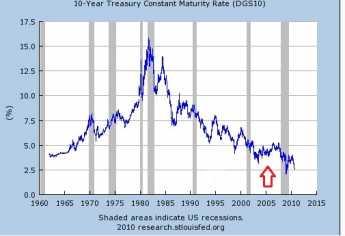
|
| Graph: Prices of 10-yr Bonds |
About a day later, someone made a shrewd guess. The problem seemed to center on those low-interest rates for long-term bonds because those low rates were abruptly going higher. In the language of the market, the "spread" between short-term and long term rates was widening or at least returning to normal. Not knowing why the spread had narrowed, no one knew why it had stopped being narrow; but it was nevertheless a clue where the problem might be centered. About a month later, rising interest rates seemed even more central when clues to many other suggested culprits had proved false. The selling concentrated on blue-chip stocks, but there was nothing the matter with blue chips. They had been sold because other markets were frozen with fear; if someone needed cash, there was nothing else the market would buy. The "quants", the traders who programmed computers to react without thinking, had merely reacted in sports jargon, to a 'head fake' in the blue chips. Meanwhile, interest rates continued to spread apart; someone big was selling a lot of long-term bonds, and was really serious about it.
|
| Alan Greenspan |
Come to think of it, if long-term interest rates were returning to normal because someone was selling bonds, then, of course, they had been too low for years because someone else was buying too many bonds. Maybe the Middle East oil barons had a hand in it, but more likely it was the Chinese government, who were known to hold a trillion dollars of U.S. Treasury bonds. Some years ago, Chairman Alan Greenspan of the Federal Reserve worried out loud that by historical standards, public markets [in this case, the Chinese government] were agreeing to accept interest rates for long term debt that seemed much too low for the risks undertaken in loaning it. Worse still, the reasons were unclear. Greenspan called it -- a conundrum. Home mortgages are long term debt, and here's maybe another clue. For political reasons, tax laws had effectively made mortgages the cheapest way to borrow. For another, the reverse mortgage, or home equity loan innovation, transformed home mortgages into the equivalent of ATM machines. A great many young people who might have been better off renting a place to live were persuaded that owning a house was essential to improving 18% credit card interest into 6% mortgages, and tax-sheltered 6% at that. Hidden in this borrowing revolution was the unrecognized temptation to maintain far less owner investment in the house that had been true in the past. It became cheaper to borrow, riskier to loan. American homebuyers were subsidized to borrow, and for whatever reason, Chinese were inclined to lend.
If interest rates go up, the value of bonds with low coupons goes down. Plenty of non-Chinese owned bonds, mainly American banks, and insurance companies. If these bonds had been purchased as long-term investments, there was no sense in selling them, and it was merely annoying that stock market prices for bank and insurance stocks dropped to reflect this lessened value of their holdings. If the banks and insurance companies merely held the bonds to maturity as they had always planned to do, bond values would return to their original price. True, there were rumors that bonds related to California and Florida real estate were in an unsound bubble. But if every one of those bonds became worthless, which was unlikely, it would only amount to $100 billion in losses. That's, of course, a lot of money, but easily absorbed by a big economy. Many of those bonds were insured, and at least half of real estate value is usually recovered in mortgage foreclosure. A lot of people would be inconvenienced by markets frozen with fear, and panic selling of various sorts would make the markets volatile. But this was mainly a liquidity crisis, roughly equivalent to a man with a $20 bill who was temporarily unable to get a candy bar out of a dispensing machine.
Supported by such talk, the stock market went down moderately but steadily. After a year, it was down two thousand points, or perhaps 15%. We seemed likely to have a recession, but periodic recessions are a healthy way to correct irrational exuberance. Most Americans do not own Florida and California real estate, don't use the banks and insurance companies in those regions, and have a reserved opinion about those who do. Somehow, it was overlooked that the very first banks to collapse in this upheaval had been in Germany, France and England.
In retrospect, in 2011 we
Bank Accounting Off the Books

|
| Banking |
Banks have long operated in a dual system of regulation, state and federal, which permits some shifting back and forth between regulators. Mergers sometimes confuse matters further, and a system of one-bank holding companies adds to the stew. Local banks, waving the red shirt of domination by Wall Street at their state legislatures, have resisted interstate banking in a wide variety of ways. Sometimes a customer finds that funds transfer between two branches of the same bank must be treated as out-of-state action, and so on. Inevitably there is a certain amount of dealing by subsidiaries which are not recorded on the books of the home bank of a bank conglomerate in ways prescribed by the subsidiary's regulator, or not recorded at all. Equally inevitable is the accusation of off-the-books illegality by competitors, politicians, or the merely captious. Fine points of these legal and accounting arguments must be left to experts, peer review, and courts. Muttering Enron at every opportunity, accusers may be right that some of these arrangements have stepped over the line; partisans in Congress and the legislatures, on the other hand, may be correct that existing law is bad law. This is not a good place to debate either point.
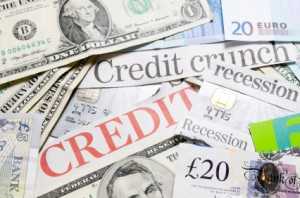
|
| Credit Crunch |
It does seem appropriate to notice that banking has long been massively inefficient and that much of this inefficiency has been imposed by regulators. Regulators represent the public, more or less, and the public is rightly nervous about stewardship of its assets. Dual regulation offers refuge from the ancient fear of confiscation by the sovereign and is worth a certain amount of inefficiency if it works. But it does create loopholes, and it does impair transparency. In the case of the credit crunch of 2007, it sequestered bad debt in off-the-books ways, perhaps creating tax avoidance, but mainly creating distrust among counterparties. In those days of awful turmoil, no one knew what was going on, multi-billion dollar losses were being confessed by premier institutions, so transactions were delayed, avoided, or rejected. Transactions with anybody. When the time comes to reconsider regulations, it should be emphasized that by far the most damaging component of the whole mess was lack of transparency. Once more, a massive computer programming effort is entirely capable of restoring transparency to the existing regulatory structure, highly pigglety though it may be. After we achieve transparency we might consider achieving efficient transparency, and after that perhaps ponder fairness in transparency. When a trader calls another and asks to buy a zillion shares, the happy recipient of the call likes to glance up at his screen to see what the other fellow is worth, before he shouts, "You got it!"
What the Federal Reserve might well call the highest priority calls for respect, as well. Ever since we began the century-long transition from a gold standard for money, there has been a concern that the Fed might not be able to determine how much money, or credit, or liquidity -- is actually in existence. We have reached a point in this process where the Fed has largely stopped trying to measure monetary aggregates, and merely adjusts its tools to keep the money supply sailing between the rocks of inflation and recession; if neither rock is in sight, the amount of money is about right. That system has served us for eighteen years, long enough to spark hope that it can be permanent. But when a rocky shore does make an appearance, the Captain of the ship must know how much slack he has, and how reliable his sonar. For huge sums to be obscured within bank subsidiaries or delayed marking to market, is to increase the chance we will run up on the rocks when it might have been avoided. He too needs transparency, but he also needs prompt obedience to his orders. The rest of us passengers are rightly concerned when he appears before Congress and admits he is not sure what the situation is. As long as that is the case, fairness -- and dogma -- be damned.
Taking a step backward, the whole credit crunch has brought to the world's attention that real estate transactions are both immense, and immensely inefficient; a great deal of money is to be made if any step in the chain can be streamlined. Therefore, real estate agents, real estate lawyers, title insurance, surveyors, advertisers, inspectors and everyone else who makes a living from real estate sales -- can expect to be drawn into an annoying process of inspecting the premises, promises, kickbacks, referral fees and marketing costs of a whole expensive process, first blasted open to inspection by implementation defects while computerizing the mortgage step. It appears to be high time for it.
Bye, Bye, Banks
|
| Fort Knox |
Banking is a comparatively recent invention; in its present form, it's only a couple of centuries old. Paper certificates circulated as money, representing precious metals like gold and silver in the bank vaults, eventually concentrated in Fort Knox as Federal Reserves. When the economy grew faster than the supply of gold, silver was also monetized, then diluted by only partial reserving. Finally a couple of decades ago we abandoned precious metal reserving entirely, and resorted to partial reserving leveraged to a virtual concept known as Federal Reserves whose quantity depended on the behavior of American inflation. Almost the whole world soon depended on the American Federal Reserve to stand behind its virtual dollars, formerly redeemable in gold or silver, but now based on inflation targeting. That is, the Fed sets a target of something like 2% inflation a year, and either absorbs currency or floods the world with currency, sufficient to maintain a steady match to the target. It's a little uncomfortable to see the standard of measurement shifting, from inflation as most people understand it, to "core" inflation, which subtracts the cost of food and oil. Especially oil. It's additionally disquieting to realize that the Fed is dependent on its own computers, reading other people's computers, all subject to the frailties of computers. to determine the degree of match to the target. We sort of got into this fix because the supply of precious metals was inelastic; perhaps the present expedient could become a little too elastic because it is so heavily dependent on vast streams of computerized information. Garbage in, garbage out?
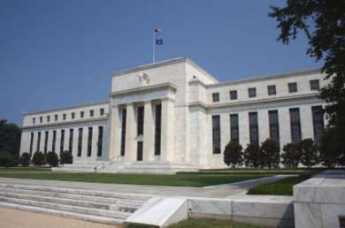
|
| Federal Reserve Bank |
Meanwhile, banks simply had to surrender to the obvious efficiencies of using electronic stored-program calculators. Paper checks, canceled checks, and bank tellers are consequently disappearing. Banks themselves are disappearing, as anyone can see by looking at the abandoned stone tombs on America's main streets. At the moment, the process is one of concentration of smaller banks into bigger ones; eventually, there will be some kind of transformation of the way they conduct business to a point where banking could effectively disappear. Who needs banks, anyway? One significant answer to that question is that, the Federal Reserve Bank needs them. And the rest of us need the Federal Reserve because that's how the value of money is determined nowadays.
|
| Federal Reserve |
Customers, however, don't need banks for deposits; money market funds pay higher interest rates. There's no need for banks to provide loans; credit cards do that for small borrowers, while big borrowers float bonds through an investment banker. Bank vaults may be useful to store grandmother's pearl necklace, but no one needs vaults to store securities, which are now mainly held as bookkeeping entries in "street" name. People used banks for the origination of mortgages, but other institutions could serve as well. Anyway, home mortgage origination is what broke down in August 2007, when banks eluded Federal Reserve lending constraints by selling mortgages to subsidiary corporations they often owned. To repeat, we need banks because the Federal Reserve needs banks to control the currency, through regulating loan volume, which is achieved by regulating the number of reserves that banks are required to maintain. Reflect on how that matters to currency.
Before a bank makes a loan, only the depositor owns the money in question. After a loan is made, two people have a claim on the money, the borrower and the depositor. Although there is a fine distinction between money and credit, between money and liquidity, the real point is that making a loan effectively doubles the money. If a bank is then only required to keep half of its total loan volume in reserve, the money in circulation is multiplied four times what it was, and so on. Loan volume is also controlled by its scarcity value, which is indirectly affected by setting short-term interest rates. Unfortunately, cheaper money is worthless -- the dollar goes down in relation to the currency of the rest of the world. There are probably other ways which could be devised to control the currency, but a time of frozen credit markets is a dangerous time to consider radical changes in the currency. If the Fed is forced to make such changes, they had better be correct.
It's unfortunately also true that radical changes can only be made when people are scared stiff by a crisis. Is it entirely out of the question that we may soon need to scrap the Federal Reserve system? Just think back to the bitterness when Hamilton and Jefferson, later followed by Biddle and Jackson, fought about whether central banks were necessary at all. Or, more recently in 1913, when Wall Street and the Progressive movement fought about whether there was a need to create a Federal Reserve. Disputes about financial matters have been at the core of most political party disputes, since the founding of the Republic. Decisions made in the past have not always been the right ones. Nevertheless, since the banks anyway appear to be on a long slow slope to extinction as a result of the computers that briefly made them prosperous, maybe we should revise the way the Federal Reserve controls currency. Without the Fed to defend them, banks' prospects look bleak.
The Coming Baby Boomer Retirement Problem
|
In a few years, the baby boomers will retire and two things will happen. They will have to retire later in life, and the country will have to borrow money to pay for the rest.
|
In 2004, the Nobel Prize in economics was shared by Edward C. Prescott and Finn E. Kydland, for advancing the concept that business cycles are caused as much by what people expect to happen as by what actually does happen. By this reasoning, myriads of individual decisions are constantly made in the direction suggested by simple undeniable truths. What truths face us? Demographic facts related to how many people have already been born, and how fast they are dying, force everyone to acknowledge that both Social Security and Medicare are seriously underfunded. Consequently, it seems inescapable that the boomers must work longer and retire later. To whatever degree they don't, the country must go deeper into debt.
Prescott, writing in the December, 2006 Wall Street Journal, stated this truism slightly differently to reach the next step: the national debt must increase. Increasing the national debt raises interest rates, which is good for savers. At the moment, the main savers are American retirees and foreign governments. However, the bond market is and always has been a zero-sum game. What's good for American retirees is bad for American business. And mortgage-holders. And everyone else who is in debt. Higher interest rates, which are seemingly inevitable, encourage saving and discourage borrowing. Prescott seemingly welcomes those features, because he is remarkably cheerful about the inevitable coming demographic crunch.
There are at least two things about it which should be bothersome. The first is that the boomers will not be borrowing money from their own generation but from their children. Getting the chance to live longer than their parents, they seemingly want to retire at the same age or earlier, asking their children to pay for the unearned twenty-year vacation. Boomers simply must be shamed into later retirements. The American Gross Domestic Product has a long term growth rate of about 3% per year; 2% of that total comes from increased productivity, about 1% from population growth. Extending domestic working years has the same economic effect as, say, illegal immigration; it's good for the whole country to make this nativist substitution.
The other disturbing consequence of borrowing our way out of debt is the effect on banks. That's harder to explain, but the interest rates we have been describing are long-term rates, established by the world marketplace. Short-term rates are independently set by the Federal Reserve to control (or "target") inflation, and currently they are higher than market-set long term rates. Any sensible saver will therefore use moneymarket funds rather than buy bonds. That's mostly bad for banks because their profit largely derives from "borrowing short and lending long". The so-called inverted yield curve, then, is good for old folks and bad for banks. If the Treasury fails to issue enough long term bond debt, or the Federal Reserve fails to issue enough short-term debt, banks are in danger of going broke. To summarize the whole puzzle, the government clearly will become more deeply indebted, but it must preserve a proper balance between short-term and long-term borrowing. Otherwise, either a bank crisis or inflation will sink us.
As a guess, I would say that banks are the likeliest to fail. They are in precarious condition anyway because of wrenching changes in technology. And they are in the process of discrediting themselves by failing to pass along the currently soaring short-term rate bonanza to the public. Just compare your own money-market interest rate with the 5.25% which the Federal Reserve has dumped on the banking system, and see if your blood doesn't boil a little. If this pick-pocketing continues much longer, banks will be in a bad public relations position when they must come to the public with hat in hand.
So, there's only one defensible response to this demographic retirement problem. The baby boomers, having been handed several years of unexpected longevity, must spend a portion of it working longer.
Unwritten Lessons For the European Union
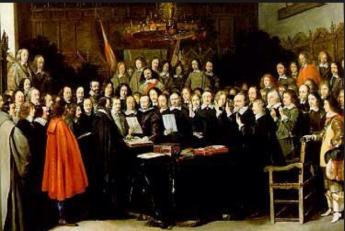
|
| Peace Treaty of Westphalia 1648 |
Europeans, long accustomed to providing Americans with cultural models, sometimes have a little trouble acknowledging the emerging European Union is based on the American design of 1787 Philadelphia. So perhaps it is tactless to emphasize they might encounter some of the same problems. The success of our design is a good reason to imitate it, and may, in fact, be a chief reason to boast about it. But look at it another way. Since we are uncertain why many provisions work so well, we are reluctant to change them; but the proud Europeans cannot be expected to adopt them for a vague reason like that. The main point is to maintain the right degree of vigilance and flexibility, a difficult measurement to make or to transfer to different circumstances. Our Constitution is more right than wrong, so it was intentionally made hard to change. Technically the Constitution has been amended twenty-seven times. Omitting the Bill of Rights, minor technical changes leave us with only five substantial amendments in two centuries, mostly enlargements of the voting franchise. But notice on top of a small base, we have built a legal structure of 100,000 pages of Federal statutes, almost a million pages of regulations, and at least double that number of state laws. Our legal system has many flaws, but smaller ones are easier to change. The great danger for Europeans lies in taking a similarly huge body of multi-nation statutes, then attempting to cram them into a constitution which by definition has been made hard to change. James Madison was not in a position to see this point. Looking for it in The Federalist Papers is futile because they were written to persuade New York to ratify the Constitution, and contain a moderate amount of slant. Add to all that a recognition that the U.S. Supreme Court makes a hundred little amendments every year. It follows it would be bold indeed to list a handful of examples of what the Europeans should avoid at all costs, or omit at their peril. One point seems undeniable, consolidating a number of former colonies is easier than consolidating sovereign nations. Nations start with more sovereignty, so they individually have more power to lose in a consolidation.
|
The success of our design is a good reason to imitate it, and may in fact be the chief reason to boast of it.
|
The people in power in the individual nations of Europe, and the political factions which elected them don't really want to give up power to a central government in Strasbourg and Brussels. They wouldn't be human if they did. Much the same reluctance inspired our thirteen colonies in the Eighteenth Century, and we circumvented it by excluding state officials from the ratifying conventions. Imagine telling that to the Prime Minister of Great Britain. Having multiple sovereignties breeds jealousies, particularly when the issue is governance. Our ratifying process was rancorous, and echoes of it still reverberate. If transitions are too rapid, even from a bad system to a good one, changes can prove disruptive. For ousted incumbents, all transitions are too rapid. The Europeans additionally have a big problem we didn't have, of multiple languages, so harmony will be slower to arrive -- try to imagine a common market in the Tower of Babel. By lacking multiple languages to rally around, we stumbled into a two-party system, which is actually a big improvement over more-or-less proportional representation by multiple parties. Without having any foresight on the issue, we established a system in which "deals" are made internally and voluntarily, between the extremists within each of the two major parties before the November elections, because by then the central issue has become whether the party might not win with a particular candidate standing on a particular platform. The policy positions of the nominees of both major parties draw closer together, and we don't get a revolution when one of them does win, even by a single hanging chad or questionable mortgage. Unfortunately, the candidates are usually so close to the haphazard process of pre-election compromise that they often consider it less binding than the public does. But by major contrast, in an overtly multi-party system a coalition is formed after the election is over, so the "deals" between splinter parties must also be made after the election is over; voters are completely cut out of the most important decision-making. Splinter parties are an easy recourse for nations with many minorities and are to be avoided at all costs. If a unified nation really cannot be constructed without such recourse, perhaps they would be better off with a King. Since political parties were not mentioned in the American Constitution, this advantage of a two-party system has never been widely debated.
Our experience teaches one more important principle, unwritten in the Constitution. The outstanding message of the American experience from 1787 to 1850, especially the twenty year period after Washington's presidency (and quite unforeseen by the Founding Fathers), is that no party in power can see any merit to the rights of the minority until it has itself spent some time out of power. Nor can any party of complainers and reformers see any merit in prudent caution until it has itself spend some time wielding power. Let's suggest a rule to the Europeans: every political faction is untrustworthy until it has spent two terms in office, and then two terms out of office. It would appear it takes even longer for political parties to mature than it does for governments. We achieved this hat trick by starting out with an Electoral College that didn't work very well, most particularly in the tied election of 1800. Once the Electoral College served its purpose of effecting compromise at the Constitutional Convention, we have largely ignored it as a result of the 1800 fiasco. Perhaps another approach is to change it in stages, considering the Articles of Confederation as a preliminary step to enacting a Constitution, as it were. Unfortunately, most European nations can point to several constitutions in their past, without significant progress toward continental unity. It even seems likely the main problem is not in the Constitution at all, but in wider differences between components at the outset. And a long history of struggles in the past, which we forgot when we crossed the ocean because so few wanted to repeat the stormy voyage.
Maybe even that assessment is too generous to our own history; after all, in 1860 we had our Civil War. You'd certainly hate to think it was essential to have one of those until you reflect that Europe really has had four or five major wars during the past two hundred years. Could it actually be true that a peaceful union leads to further peace? George Washington denounced standing armies, while Dwight Eisenhower warned of the military-industrial complex. Perhaps both of them were warning that war-like behavior leads more quickly to war, by eliminating preliminary steps.
REFERENCES
| The Records of the Federal Convention of 1787 | Farrand's Records |
| Chart of the Thirteen Original Colonies | American History |
| U.S. Constitution | Legal Encyclopedia |
Rescuing International Finance?
Let's begin this discussion of international finance by relating the story of how the United States solved the same problem in 1913. This wasn't a ho-hum bit of history, it set the pattern the world is now about to adopt or reject. Remember, our current lame duck President comes from Texas.
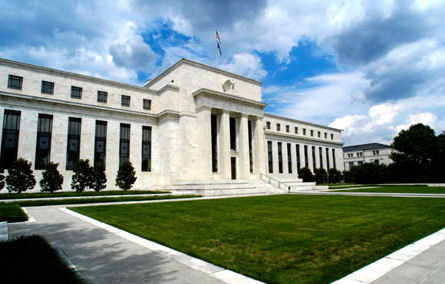
|
| Federal Reserve Building |
In 1913, the Federal Reserve system was created. It had various purposes, but it essentially stripped the state governments of the ability to adjust interest rates and placed that power in Washington DC. The appointment process to the Fed board was tinkered with to achieve as much independence from politics as possible, although it was unrealistic to think politics would be totally excluded. Politicians never give up power voluntarily, but in this case, they also escaped blame for the unpleasant things a central bank is occasionally called on to do, so it was a deal. The remaining uncertainty thus became the question of whether the states would yield to federal authority on interest rates, something they had consistently resisted ever since the Constitution was ratified. The first resister was Texas.
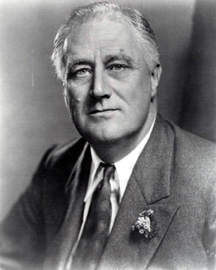
|
| Franklin D. Roosevelt |
It suited the Texas economy to have lower interest rates than other states, but the fledgling Federal Reserve decreed that the nation as a whole needed higher rates. In a fairly typical Texas style, Texas just lowered rates anyway. Almost immediately, nobody would deposit money in Texas banks, who were flooded with requests for loans from the rest of the country. That situation couldn't last more than a few days, so Texas capitulated, and no state has defied the Federal Reserve since then. In this little story lies the hope that a similar international banking arrangement can be devised, and announced shortly after November 15. That would probably put George W. Bush in a class with George Washington and Abraham Lincoln in the history books, his current low popularity not withstanding. For that reason alone, there is cause for concern about the newly elected incoming President. The worrisome historical model at this level lies in the refusal of newly elected Franklin D. Roosevelt to cooperate with the lame duck Herbert Hoover during a similar economic crisis of 1933. On the level of "practical" politics, Roosevelt got away with this deplorable behavior, by enacting many of Hoover's proposals six months later and taking full credit. The country was much worse off as a result, but Roosevelt nevertheless seems to have achieved enduring historical praise for his imaginative ideas. This time, one would hope that fear of the blogosphere, the London Economist and the Wall Street Journal would make such behavior politically unprofitable for either Obama or the maverick McCain. But you never know.
|
| Henry Paulson |
Now, to return to the present crisis. In a sense, every type of financial institution from banks to hedge funds, every nation from America to Zimbabwe, and every expert from Hank Paulson to Barney Frank -- has been tested, and occasionally failed quite visibly. People are scared, have every reason to be. But on the other hand, sound reasoning will never defeat politics and financial greed, except in a rare crisis containing obvious general danger. So, this mess represents an opportunity for the think tanks to be given a chance at leadership, just as John Maynard Keynes was listened to respectfully at Breton Woods in 1944. It was just about the last time a guru got his way without the use of financial power or an overwhelming voter mandate. As Franklin Roosevelt is reported to have said, "I don't understand a word the man says, but we must do something."
|
| Barney Frank |
Let's use a few examples out of a great many available. Ireland issued a guarantee for all the deposits in its banks. Immediately, money poured into Irish banks from British depositors, unsettling the British banking system. So the United Kingdom had to issue the same guarantee, and then other nations followed. America rescued Bear Stearns, Fannie Mae, and AIG, and finally called a halt at Lehman Brothers. Other nations copied this approach of rescuing institutions in trouble until the Bank of England copied the Swedish approach of 1991 of reversing this approach. If you are in a sinking lifeboat, you want to rescue the best rowers, not the weakest. But there are some small countries with big banks, like Switzerland and Iceland, where it would be impossible for a small government to rescue a huge international bank within its borders. Conversely, the Eastern European countries have essentially no local banks. In the case of Hungary, most home mortgages were held in Austrian and Swiss banks. When the flow of funds forced a devaluation of the local currency, the cost of almost every mortgage in Hungary doubled, and the national government could do nothing about it.
Let's mention what may well be the largest such factor in this international banking game, the so-called Japanese carry trade. When the overheated Japanese stock market collapsed fifteen years ago, the Ministry of Finance responded by lowering interest rates to one or two percent. Taking into account the inflation rate, Japanese banks were paying the borrower to take their money. So, the international banking community promptly responded by borrowing money in Japan at 2% and lending it out in Germany at 8%. Amounts of money in the trillions churned through this money machine. An unknowable but large amount of this money originated in China, which was trying to prevent its surpluses from provoking a revolution with inflation. The Japanese carry trade is at an end except in reverse, as money is flowing back to the now seemingly safe Japanese economy. Perhaps even a casual reader can look up from the World Series and the presidential election, to realize that absolutely everybody is scared, and possibly scared enough to do something cooperatively. It means loss of national power and sovereignty for everybody, a reconsideration of the European Common Market, and setting aside any disruptive schemes to discipline Premier Putin's behavior as a hidden by-product. As Frank Roosevelt said, we don't understand a word of it, but we must do something.
|
| The World Bank Logo |
Among the small practical ideas advanced, one of the most promising is to persuade the Chinese government to float its currency. We have historically tolerated small primitive countries when they try to struggle out of poverty by artificially cheapening their currency. In China's case, and before that in Japan's, cheapening the currency in order to stimulate exports has been politely referred to as "pegging the currency to the dollar". Pegging it low, that is. But Japan and China are no longer barefoot and aspire to become important figures in international finance. China is said to resist this proposal on the grounds that it needs 7% annual growth to prevent social unrest leading to a revolution. To some extent, this is probably just bargaining talks, and the counter-proposal offered is to strengthen Oriental power within the International Monetary Fund, as part of the process of increasing the power of the now-indolent IMF. We will have to wait for November 15 to see if clever little schemes like this one will suffice for the purpose. Much depends on China's willingness to cooperate, but even more, depends on the validity of blaming present messes on currency manipulation for the purpose of mercantilism. Beggar thy neighbor behavior has certainly been common; the question is whether it was the main cause.
If all those think tanks led by the Bank of England, have found the stone whose removal will start a benevolent avalanche, a second Breton Woods conference might just get us out of the soup; within two years we should be pleased with the way our cleverness restored the world to prosperity. If not, more grandiose ideas must be desperately considered. Europe must abandon all those silly five-hundred-page constitutions and form a national union. In our own case, that worked for eighty years and then we had a civil war, but even a repetition of all that sounds better than what we now face. If Europe simply cannot seize the moment, it is very likely to retreat into insignificance. Under those changed circumstances, the world economy will amount to three nations: China, India and the USA. We have yet to learn whether the Chinese and particularly the Indian governments can summon up enough domestic leadership to deserve a place in international leadership. And that presently is far from certain.
Mercantilism Dies Hard
|
| Mercantilism to Americans |
Whatever mercantilism was supposed to mean can be debated by captive college students; mercantilism to Americans is and was just a bad thing having to do with economics, mentioned only when the speaker is searching for an epithet. Our present understanding of the mercantilist term is that brutal government action, even war, was employed to benefit favored citizen merchants, while the economics of a whole nation of consumers was subverted toward enhancing state power. All of this rapacity was for the betterment of one nation at the expense of its neighbors, and at the expense of its colonies. The surprisingly vague but more modern term of fascism is often substituted, to denote evil uses of government to promote the interest of combined military and industrial elite, to the general disadvantage of everyone else. Because so many opponents of mercantilism were upset about specific forms of mercantilist activity, Adam Smith is associated with the idea that mercantilism was the opposite of international free trade, and the American founding father are associated with the idea that mercantilism embodied everything we disliked about colonialism. Some prominent 18th Century leaders constructed a body of theory to defend mercantilism and firmly established the idea that the whole approach was founded on long-discredited sophistry. In recent times, the only reputable economist to defend parts of mercantilism was John Maynard Keynes, who approved of the idea of emphasizing third-world exports in order to assist developing countries into a modern economy. Whatever is the underlying idea behind this mercantilist idea that has caused so much trouble, and includes so many disconnected features?
Allow an amateur theory. In my view the fundamental misconception underlying mercantilism was the idea that economic relations between individuals and nations are a zero-sum game; what I gain must be at the expense of someone else's loss. Almost every child believes that many or even most everyday transactions seem to confirm it, and vast multitudes of mankind believe it to the end of their days. But as part of the Industrial Revolution, the counter-intuitive realization began to spread that cooperative behavior, within limits, could sometimes result in all participants becoming better off, harming no one. Perhaps it was even a universal idea. Adam Smith popularized the idea that when two parties freely participate in the free trade of a marketplace, each one can come away from the trade feeling better off; one party would rather have the goods, the other party would rather have the money, and they trade. Multiplied millions of times, the expansion of free trade would enrich whole nations, even the whole world. George Washington may not have understood all that, but he did know that England was injuring him with rules about insisting British subjects must conduct all foreign trade in British sailing vessels, must not manufacture locally, must do this, must not do that.
Exporting was good, importing was bad, manufacturing was to be concentrated in the mother country, consuming was to be discouraged -- what was the unifying theory behind all this? It would seem to have been the gold standard. Gold was durable, and its supply was limited. It had certain undeniable advantages, but its overall effect was to restrain industrial progress. If the economy is constantly expanding, but the supply of gold is relatively limited, the price or value of everything will go steadily down over time. In George Washington's time that was particularly irksome with regard to the value of his plantation, and his vast land holdings of Ohio land. It was also true of everything else that was reasonably durable. If everything is measured in gold, and gold is limited, then the accumulation of gold is ultimately the only way to accumulate wealth. The English nobility who were profiting from the system might not perceive it, but the colonists could perceive it in their bones. Small wonder that modern banking, economics and innovative finance took root in the American colonies. If not first, at least most vigorously. Small wonder we had a revolution men would die for, while the British were merely annoyed and mystified.
Vast areas of Asia, Africa and the Middle East are still committed to the idea that the only way to get rich is to steal from others; since everyone wants to get rich, everyone steals. Someone has reduced this idea to a simple game theory called the Prisoner's Choice. If two prisoners tattle on each other, both will be severely punished. If both prisoners refuse to testify, both will go free. If one tattles and the other remains mum, the tattler will go free and the loyal comrade will get hanged. Reduced to its simplest level in a series of repeated games, the theory states that it's better for everybody to cooperate most of the time, but you must be willing to play tit for tat if the other party cheats. Be cooperative as much as you can, but never forget to wallop a cheater, and then forgive him later so he can have a chance to play nice. Lots of people will think you are a sucker if you play nice, so, unfortunately, it is necessary to retaliate -- swiftly and painfully -- when someone cheats. Centuries of American history are explainable with this simple game theory.
And not just with tribesmen and Nazis. When Winston Churchill finally realized that the Bretton Woods Conference was going to mean the end of the British Empire, he was almost tearfully plaintive with his friend Frank Roosevelt, but he said he understood.
And six years later, when Churchill's protege Anthony Eden invaded Egypt over the Suez Canal, Dwight Eisenhower the hero of the Normandy Invasion that saved England, suddenly turned nasty. England would immediately abandon that invasion, or Eisenhower would foreclose on British debts and ruin them.
That was the end of British colonialism, and in a sense, it was the final end of the Revolutionary War.
Constitutionality of the Monetary System
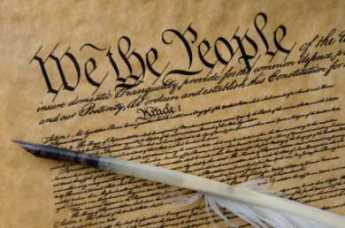
|
| The Constitution |
In noting that our Constitution has lasted for over two centuries, we assert that this simple short document has largely anticipated everything important to anticipate, including the Industrial Revolution, atomic warfare, and the Information Age, to name a few. When an occasional issue arises that is not only unmentioned in the Constitution but where no one is certain what to do, our system leaves us spiritually adrift. Such an issue is found in o0ur monetary system, where we have been wandering for two hundred years.
The founding fathers worried a great deal that popular majorities would abuse minorities, particularly in the case of the majority poor people voting themselves the property of minority rich ones, or that debtors in the majority might dishonor the rights of creditors. Although we have developed a welter of laws about debt and creditors, bankruptcy and taxation, they are if anything too specific. What is lacking is a few general words in the Constitution about the principles of credit and money. The problem now is the same as it was in 1787; we don't know what to say.
|
|
| Albert Gallatin |
For a very long time, some very well educated people were strongly opposed to the creation of a bank, later to mean a banking system. Alexander Hamilton's proposition that a "national debt is a national treasure" was greeted with horror by several Presidents, as well as by Albert Gallatin, one of the most sophisticated financial thinkers of the time. Underlying this perplexing reaction to the simple proposal to create a bank was surely the perception that making the Federal Government into a substantial debtor creates a powerful ally to all debtors in their eternal struggle with all creditors; the outcome of such an unequal struggle would inevitably be to the disadvantage of creditors. In common parlance, the word capitalist seems to imply a creditor. It took a very long time for it to become understandable that debtors, too, were essential beneficiaries of a capitalist system, but that idea still often meets with dissent. However, when millions of the world population belong to religions which prohibit the payment of interest, it should not be surprising to find many Americans who cannot get their heads around the idea that debtors and creditors need each other to an equal degree.
In the case of inflation, governments have always been somewhat favorable to debauching the currency. Naturally, a major debtor hopes to repay its debt with cheaper money. Since it has more or less always been necessary to use police powers to maintain a common currency, Kings and governments have long been in control of money, whether that means gold bars or beaded wampum. And for the same length of time, governments have been discovered bending the rules in favor of themselves. Bronze has been substituted for gold, the edges of coins have been shaved, the printing presses print paper money unrestrainedly, and the consumer price index has been manipulated to encourage inflation. Political parties have sought votes from debtors by promising to regulate banks, promote silver as a substitute for gold, disadvantage foreign competitors, inhibit or manipulate the value of the currency on foreign exchanges.
|
| Alan Greenspan |
For forty years we have operated without any fixed standard for money. Money for all that time has lacked any physical representation or discipline. Money has become a computer notation. At first, it was based on calculations of monetary aggregates, a bewildering concept promoted by Milton Friedman. More recently, it is entirely based on inflation targeting as promoted by Alan Greenspan. With a target of maintaining steady prices, an inflation rate of 2% is set as a specific target for the Federal Reserve. If inflation falls below that target, more money is created; if it rises above that level, less money is created. How much there is of it does not matter; it's beyond calculation. Although this simplified description fills almost any listener with doubts, it seemed vindicated by seventeen years without a notable recession. Even though events beginning in 2007 raise pretty serious doubts, it may still prove to be the best possible monetary system.
Even though this most fundamental of all commercial issues cry out for a simple principle to be stated in the Constitution so that neither populist congressmen not rapacious financiers can ruin us, it is not presently possible even to imagine what a new Constitutional amendment would, should or even could say. Meanwhile, some immense power rests in the hands of shadowy figures whom we blindly trust, for lack of a better idea about how we should select them or what we should instruct them to do.
Rancocas Valley: Mt. Holly, Eayrestown, Medford

|
| Rancocas River |
The southern half of New Jersey, once called the Province of West Jersey, is sandy and flat, mostly not more than twenty feet above sea level. So, there is an extensive lacy network of slow-moving branches to the several creeks and rivers draining the area. Some of these rivers drain toward the Atlantic Ocean, some drain the other way to Delaware; it scarcely makes much difference. Almost as soon as the Quaker proprietors settled the area in the Seventeenth century, the broad Rancocas River (draining into Delaware) stood out as a wonderfully protected region to settle. The Rancocas wanders through the woods but is tidal all the way to Mt. Holly, which later even became a shipbuilding center. That's now the centrally located county seat of Burlington County, from which several branches extend in various directions. One southerly branch drains the water coming from Medford Lakes, once a summer cottage community miles deep in the Pines, now a place for fancy houses with lakes in the backyard. The cute little nearby town of Medford has a Braddock Tavern, reminding visitors that General Braddock stopped off here on his way to his own ambush at Fort Duquesne in the French and Indian War. The Medford-Mt. Holly Road follows the southern branch of Rancocas creek, running through somewhat broken ground greatly resembling Northern Virginia. And, that resemblance is enhanced by a number of horse farms with white-board fences, many of them looking quite historical, and very well manicured. Here's a drive worth taking, especially in late April when the trees are just budding out, the grass is green, and the azaleas are blooming. Starting in Mt. Holly, which is recognizably colonial but unfortunately somewhat under-maintained, you can recognize that the road once started at the Three Tun Tavern, of colonial fame. The confluence of creek branches made a natural place for a farmers market in the center of the road. A short distance down one of the branching streets of Mt. Holly is the red-brick home John Woolman built to keep his daughter from moving away with her Philadelphia husband. We talk more about John Woolman in another section of Philadelphia Reflections.
|
| Rancocas Map |
One of the interesting features of the "lost" colonial community along the Mt. Holly-Medford Road grows out of the Rancocas curving east toward the ocean and then branching south. That means that if you drive from Haddonfield or Camden to the ocean beaches you go through the pine woods and then come upon this ancient Medford community before you re-enter the pine barrens and go on toward the ocean. That gives the impression the Medford area was somehow a lost frontier, when in fact it was a part of one of the oldest settlements in the state. It's a strip community, running along the banks of the Rancocas from Medford to Mt. Holly; houses along the banks, farmland stretching behind the houses. Most people on the way to the shore just go through the traffic light and keep on going without realizing what they are missing. And, indeed, if all that traffic stopped to browse, it would quickly ruin the place.
Along the Medford-Mt. Holly Road is seen an occasional McMansion, with "Atlantic City" sort of written all over it, but in general, the houses are pretty upscale and restrained. There is a nursery farm which must stretch a full mile, full of flowering shrubs and trees, looking very manicured and attractive. To some extent, a nursery improves a neighborhood, since it supplies lots of flowering shrubbery ideal for the local soil conditions. But in a larger sense, a nursery is almost always bad news for a neighborhood. Every time a plant is dug up and sold, it takes away a bushel of topsoil. No farmer would normally consent to such treatment of his most valuable asset, so the sale of property for nurseries is a sign the farmers are selling out, urban development is looming. Unfortunately, this certainly also means the novel hidden river community in the pines is on the brink of being wiped out. Tourist visits are, well, now or never.
REFERENCES
| The Pine Barrens: John McPhee: ISBN-13: 978-0374514426 | Amazon |
Three Revolutions at Once, Maybe Four
The rise of the Tea Party movement in 2010 reopens a lifetime question in my mind. What was the American Revolutionary War all about; surely, a tax on tea isn't outrageous enough to go to war over, is it? It only aggravates curiosity to learn this particular law passed by the British Parliament, actually lowered the price of tea.
A somewhat different importance for the 21st Century is, of all the dozens or even hundreds of little civil wars that have popped up in the past two centuries, this American one seems to have had the biggest impact on the thoughts and behavior of the civilized world. The French Revolution comes close, but we meant to speak of persuasive influence on serious minds, not merely bloodiness and lasting grievance. Here are three suggestions, maybe four.
In retrospect, we can see the outlines of three major revolutions, coming together at the end of the 18th Century. The first is the Industrial Revolution, which had its beginnings in England around the city of Manchester. That was a region of major Quaker concentration, many of whom migrated to William Penn's social experiment in seeing what peace could do. The Industrial Revolution flourished in Great Britain far more readily than in France, and in a sense more than in America. But of the three major countries, America had the largest amount of unsettled land and the greatest natural resources of the three major countries. America was able to think bigger and broader, necessarily requiring broad support from an immigrant population. Diversity was often later to prove a mixed blessing, but in the Industrial Revolution it was vital.
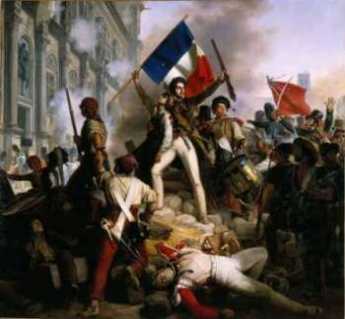
|
| Dissent, French Style |
The second major revolution taking place at that time concerned the place of property in the life of every citizen. Up until that time, the King owned all the land and could redistribute it to suit his political needs. What critically mattered was not who formerly owned the land, but rather what was the latest King's latest word on who owned it right now. The American system gravitated to the notion that when the King or any other owner sold the land, it was no longer his; we now think that's quite self-evident. Each successive owner can sell it to his neighbor or bequeath it to his heirs, and at that moment it is no longer his, either. This idea of private property spread throughout the world, but in America, it was a clean sweep. Adopting the rather brutal rough justice of the frontier, the Indian prior ownership just didn't count. They had sided with the British in our revolution and were insistently resistant to assimilation. And anyway, Pope Nicholas in the 13th Century had established the notion of first discovery, which applied to Christians, only, and so Indians didn't count. Fair or unfair, this was going to be the way it was, from that point forward from 1787 when the Constitution was enacted. The longer the situation lasted, the more unlikely it became that it would ever change. America had so much land and so little coinage, that land itself became a sort of monetary standard. The particular American advantage was there was so much land that early settlers and landed gentry could not monopolize it; from meaning land at first, property soon meant any valuable possession. No King, particularly not George III, was going to take this away from the whole population on this side of the Atlantic. England could do as it pleased with its land and its King. If we needed Independence to preserve a general right to hold private property, plenty of men were willing to die to achieve it. And the whole Western world soon followed our example.
The third revolution was the one you read about, Lexington and Concord, Bunker Hill and the Tea Act. That whole chain of events chronicles how America came to be Independent but somehow fails to explain why we wanted Independence. The Industrial and the Property revolutions explain it better, but such theorizing would certainly mystify the Revolutionaries themselves.
And finally, one begins to wonder if we aren't toying with a reversion to the ideas underlying monarchy when we examine some currently widespread views. There's a notion going about that everybody owns everything, which if carried to an extreme means no one owns anything. When you can notice people who live on the 70th floor of a Manhattan apartment building, proclaiming a right to tell Alaskans whether or not they can drill for oil, you behold this monarchy of the many. And when you see prosperous educated adults shouting at rallies, you can see Alaskans, for example, want to tell New Yorkers to mind their own business. This land, they seem to say, isn't everybody's at all, it is mine.
It never really was entirely the King's, either. The King was a single person, sometimes a rather brutal one who wasn't likely to tolerate advice from his subjects. At times of crisis, somebody has to make a decision, any decision, and act on it. But most of the time, kings seemed to be in the position of that Czar. The one who said, "I don't rule Russia. Ten thousand clerks rule Russia."
Restoring the Gold Standard by Levering Judges' Salaries
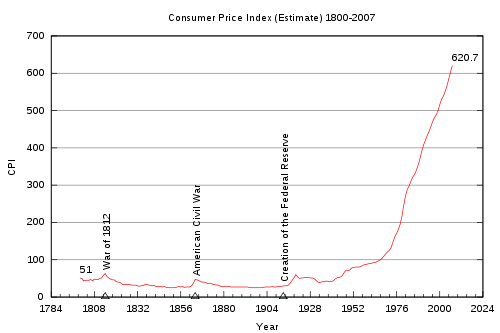
|
| Gold Inflation |
Generally speaking, creditors hate inflation and favor a gold standard because they fear debtors -- who outnumber them at the polls -- will dishonor their debts by inflating the currency. And debtors generally are rather serene about the risk of inflation, for the same reason in reverse. Since governments are almost invariably debtors, the combination of government and debtors on the side of promoting inflation represents a dishearteningly strong force for creditors to combat. It is plain for everyone to see that inflation has been steadily moving ahead. But it is something for everyone to ponder that leaving creditors with only one recourse is almost certain to translate that particular recourse into action. Creditors will raise interest rates in anticipation of inflation, and the economy will suffer for debtors as well as everyone else.
So, hard-money advocates like the Paul family of Texas have been rather nonplussed to discover that Federal Judges have handed them in 2010 a very effective weapon they had long overlooked. It should be no surprise that it came from that direction; judges are long accustomed to looking backward to the historical origins of the laws they are charged with interpreting. In this case, the defining statement is found in the Declaration of Independence.
Parenthetically, conservatives are reluctant to include the Declaration in an explanation of the Constitution, since it is plainly true the Constitution was written to correct the weaknesses of the Articles of Confederation, which was much more closely defined by the circumstances of the Declaration. The almost immediate response to any such logical jump over the Constitution, particularly those of Abraham Lincoln, is to thump the maxim that The Declaration of Independence is not Law. And it isn't; it's just in this case it makes a concise statement of a major reason we were offended by the King of England:
"He has made judges dependent on his will alone, for the tenure of their offices, and the amount and payment of their salaries."
Note the operative phrase dependent on his will alone , which takes us back to the Magna Carta, where even the King must obey the Law. If judges are the umpires, it isn't in accord with deeply felt British culture that the King could force the umpires to favor his wishes in their official decisions, by threatening punishment on their persons. No, thousand times no. Anyone can see that.
Furthermore, the determination of underlying intent is so difficult to prove, and so easy to deny, that it is scarcely mentioned in the debate. If two motives seem possible, the other party will assert the high-sounding one and deny the ulterior one. The offended party will instinctively suspect the reverse and will brush aside any protestations to the contrary. Since that is bound to happen, please skip the preliminaries and get on with the evidence. So it is in this case; any reduction in the judge's salary is treated as an attempt to influence official decisions. The Administration maintains a reduction of Federal judge salaries is necessary for budgetary reasons. Please don't insult my intelligence that way. You aren't allowed to reduce the salaries of judges for any reason.
From this rather easy position to take, it is only a short step to say that refusing to raise judge salaries during inflation is a reduction of salary in real terms, after adjusting for inflation. Your paper money is phony; I want to preserve my purchasing power. Your refusal to adjust for inflation is even more clearly a salary reduction since the link to gold was severed during the Nixon and Johnson administrations. We are not on anything remotely resembling a gold standard; we are on a monetary standard which is by law adjusted to inflation, and just about nothing else. Hubert Humphrey may have thought he was creating a loophole by mandating concern with unemployment, but just try to convince the judges of the Supreme Court of that one.
And so, it seems predictable that Judge Beer of the Eastern District of Louisiana, and his fellow judges, will achieve an effective gold standard for Federal Judges if they have the fortitude to tough it out. After that, it gets harder, Congressman Paul. You have to push the concept that what is fair for Federal Judges is fair for everyone else. You should assume that judges will vote in their own favor, and therefore reasonably assume that the public will vote in its own favor, too. If that be treason, said Patrick Henry, make the most of it.
Causes of the 2007 Crash: Political and Technological
Dealing with a topic as complicated as the causes of the 2007 financial crisis, it's quite possible for two viewpoints to be entirely in agreement, until abruptly coming to different conclusions. In this paper, we consider the relative merits of blaming government housing subsidies in various forms, relative to blaming the unanticipated effects of the computer revolution. The subsidy argument has just been succinctly and effectively argued by a lawyer, Peter J. Wallison. Agreeing with every word he writes, I nevertheless hold the perspective that the disruptive effects of the computer revolution were equally responsible, if not more so. Politics versus technology, choose your poison.
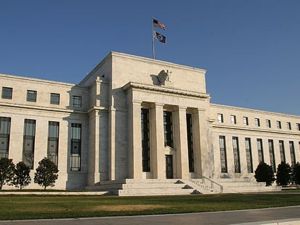
|
| Federal Reserve |
Mr. Wallison served as a lawyer in the financial loins of Washington, and thus has the perspective of a Reaganite who sees government as the main problem; with the significant distinction that his proposals for solution also lie in government corrective action, particularly "covered bonds" and step-wise privatization of the Federal Housing Authority (FHA). While agreeing with both reform proposals, my concern here is about too little general recognition in the analysis of how vulnerable the banking system has become, to revolutions made possible by even primitive computers of the 1960s. Such revolutions soon grew many times magnified by the inexpensive high-speed internet. If that analysis is correct, it predicts mere legislative action for the housing industry will prove inadequate; banking has taken a radical new direction.
Mr. Wallison's argument in the January 3, 2011 edition of the Wall Street Journal is admirably succinct. He points out the New Deal Federal Reserve deliberately suppressed interest rates to the benefit of the housing industry, but made a significant exception for the Savings and Loans. (It was forced to abandon that approach by the innovation of money market funds, in turn, made feasible by the widespread adoption of the IBM 360 computer.) When the collapsed, that segment of the market was awarded to the GSEs (Fannie and Freddy Mac, insured by FHA). In 1992, Congress imposed the goal of promoting "affordable housing" on the GSEs, which is to say the subsidization of "subprime" (i.e. high risk) mortgages. By 2007, half of all mortgages were subprime, and by September 7, 2008, Fan and Fred were insolvent, effectively replaced by the Federal Reserve (i.e. the taxpayers) as the final guarantor against national insolvency. It will take a decade to restore the economy from its present setback, but Mr. Wallison's proposals do indeed have some chance of eventually leading to a viable economy. He proposes the threshold for "jumbo" mortgages be reduced by $50,000 every six months until mortgages are effectively privatized. And he also suggests we create a pool of mortgage assets as security for a bond issue, thus privatizing existing mortgages in the way Europeans describe as a "covered bond" system. Go ahead, do it; it might work, and nothing else is on offer.
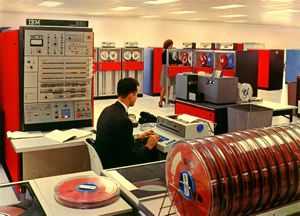
|
| IBM 360 Computer |
Meanwhile take a look at banks; we seemingly can't get along without them. But other institutions are undermining them, with cheaper products made possible by computers. For two centuries, banks transformed short-term borrowing into long-term loans; no one else could do it. It's a simple idea, and it works, that a constant or even rising pool level can be maintained by a steady inflow of short-term deposits. But it is risky; the risk is that some event will precipitate a sudden rush of withdrawals, a run on the bank. Sooner or later, the law of averages catches up. The risk is real, it happens every few years. A price in the form of interest must be imposed to maintain reserves against occasional bank runs, and collectively the whole nation must maintain a central "bank", charging interest to maintain reserves against simultaneous runs on multiple banks. No device has ever been created for a nation to protect against a universal bank panic, which is as effective as placing the risk in the hands of private bankers who can expect to be stripped and shorn if things get out of control. Robert Morris demonstrated this point in 1779, and the nation seemingly must re-learn it every few decades. The IBM 360 computer made it possible to transform short-term into long-term in greater volume and lower cost by allowing banks to get bigger; but it could also perform the short-long transformation in cheaper ways than depository banks do, and from there the bank-competitive process we know as securitization has gone on to commercial credits, auto loans, credit cards, high-velocity stock trading, and mortgage-backed securities. These approaches are often cheaper and more convenient than the trusty old banking system and Credit Default Swaps show its power isn't exhausted; any legislation to prohibit CDS is sure to to be circumvented. Insurance is also on the edge of being threatened. An industrial revolution of this magnitude takes decades of tweaks to become stabilized, but it will suffice for now, if we can establish reasonable protections against the risk shifted into the securitization or investment banking arena. As risk shifts, remuneration for accepting risk must shift as well. This new system for generating capital must not be starved because depository bankers resist the loss of their share of profitability; politics will have much to answer for if that happens.
Most likely, the main obstacles to getting this system fixed will come from overseas. Fifty years of disillusionment with the United Nations will make nations, the United States chief among them, resist loss of sovereignty in something so vital as finance. But that's for the future. For nearly a century, the past has been disrupted by idle notions of the fairness of coerced redistribution, in ways Mr. Wallison has succinctly described. But meanwhile we almost willfully ignore technological upheavals which everyone welcomed but no one fully anticipated.
Foreground: Parliament Irks the Colonial Merchants
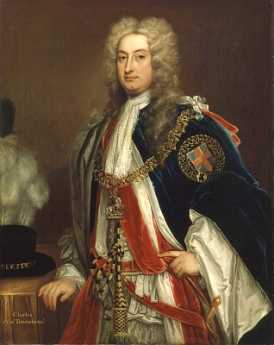
|
| Charles Townshend |
Charles Townshend, Chancellor of the Exchequer under King George III in 1766-67, had a reputation for abrasively witty behavior, in addition to which he did carry a grudge against American colonial legislatures for circumventing his directives when earlier he had been in charge of Colonial Affairs. His most despised action against the Colonies, the Stamp Act, seems to have been only a small part of a political maneuver to frustrate an opposition vote of no confidence. The vote had taken the form of lowering the homeland land tax from four to three shillings (an action understood to be a vote of no confidence because it unbalanced the budget, which he then re-balanced by raising the money in the colonies.) The novelist Tobias Smollett subsequently produced a scathing depiction of Townshend's heedless arrogance in Humphry Clinker, but at least in the case of the Stamp Act, its sting was more in its heedlessness of the colonies than vengeance against them. One can easily imagine the loathing this rich dandy would inspire in sobersides like George Washington and John Adams. After Townshend was elevated in the British cabinet, almost anything became a possibility, but it was a fair guess he might continue to satisfy old scores with the colonies. When King George's mother began urging the young monarch to act like a real king, Townshend was available to help. On the other hand, the Whig party in Parliament had significant sympathy with the colonial position, as a spill-over from their main uproar about John Wilkes which need not concern us here. Vengefulness against the colonies was not widespread in the British government at the time, but colonists could easily believe any Ministry which appointed the likes of Townshend might well abuse power in other ways before such time as the King or a more civilized Ministry could arrive on the scene to set things right. It was vexing that a man so heedless as Townshend could also carry so many grudges. Things did ease when Townshend suddenly died of an "untended fever", in 1767.
Whatever the intent of those Townshend Acts, one clear message did stand out: paper money was forbidden in the colonies. Virginia Cavaliers might be more upset by the 1763 restraints on moving into the Ohio territories, and New England shippers might be most irritated by limits on manufactures in the colonies. But prohibiting paper money seriously damaged all colonial trade. Some merchants protested vigorously, some resorted to smuggling, and others, chiefly Robert Morris, devised clever workarounds for the problems which had been created. Paper currency might be vexingly easy to counterfeit, but it was safer to ship than gold coins. In dangerous ocean voyages, the underlying gold (which the paper money represents) remains in the vaults of the issuer even if the paper representing it is lost at sea. Theft becomes more complicated when money is transported by remittances or promissory notes, so a merchant like Morris would quickly recognize debt paper (essentially, remittance contracts acknowledging the existence of debt) as a way to circumvent such inconveniences. In a few months, we would be at war with England, where adversaries blocking each other's currency would be routine. By that time, Morris had perfected other systems of coping with the money problem. In simplified form, a shipload of flour would be sent abroad and sold, the proceeds of which were then used to buy gunpowder for a return voyage; as long as the two transactions were combined, actual paper money was not needed. Another feature is more sophisticated; by keeping this trade going, short-term loans for one leg of the trip could be transformed into long-term loans for many voyages. Long-term loans pay higher rates of interest than short-term loans; it would nowadays be referred to as "riding the yield curve." This system is currently in wide use for globalized trade, and Lehman Brothers were the main banker for it in 2008. And as a final strategy, having half the round-trip voyage transport innocent cargoes, the merchant could increase personal profits legitimately, while cloaking the existence of the underlying gun running on the opposite leg of the voyage. If the ship is sunk, it can then be difficult to say whether the loss of such a ship was military or commercial, insurable or uninsurable. In the case of a tobacco cargo, the value at the time of departure might well be different from the value later. Robert Morris became known as a genius in this sort of trade manipulation, and later his enemies were never able to prove it was illegal. Ultimately, a ship captain always has the option of moving his cargo to a different port.
Other colonists surely responded to a shortage of currency in similar resourceful ways, including barter and the Quaker system of maintaining individual account books on both sides of the transaction, and "squaring up" the balances later but eliminating many transaction steps. Wooden chairs were also a common substitute as a medium of exchange. But "Old Square-toes," Thomas Willing, experienced in currency difficulties, and his bold, reckless younger partner Morris displayed the greatest readiness to respond to opportunity. Credit and short-term paper were fundamental promises to repay at a certain time, commonly with a front-end discount taking the place of interest payment. The amount of discount varied with the risk, both of disruption by the authorities, and the risk of default by the debtor. This discount system was rough and approximate, but it served. Quite accustomed to borrowing through an intermediary, who would then be directed to repay some foreign creditor, Morris, and Willing added the innovation of issuing promissory notes and selling the contract itself to the public at a profit. Thus, written contracts would effectively serve as money. A cargo of flour or tobacco represented value, but that value need only be transformed into cash when it was safe and convenient to do so.
The Morris-Willing team had already displayed its inventiveness by starting a maritime insurance company, thereby adding to their reputation for meeting extensive obligations; they established an outstanding credit rating. Although primarily in the shipping trade, the firm was also involved in trade with the Indians. There, they invented the entirely novel idea of selling their notes to the public, essentially becoming underwriters for the risk of the notes, quite like the way insurance underwriters assumed the risk of a ship sinking. Their reputation for ingenuity in working around obstacles was growing, as well as their credibility for prompt and reliable repayment. In modern parlance, they established an enviable "track record." A creditor is only interested in whether he will be repaid; satisfied with that, he doesn't care how rich or how poor you are. The profits from complex trading were regularly plowed back into the business; one observer estimated Robert Morris's cash assets at the start of the Revolution were no greater than those of a prosperous blacksmith. It didn't matter; he had credit.
In the event, this prohibition of colonial paper money did not last very long, so profits from it were not immense. But ideas had been tested which seemed to work. Today, transactions devised at Willing and Morris are variously known as commercial credit, financial underwriting, and casualty insurance. In 1776, Robert Morris would be 42 years old.
Fort Wilson: Philadelphia 1779
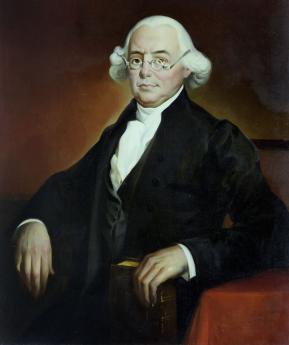
|
| James Wilson |
OCTOBER 4, 1779. The British had conquered then abandoned Philadelphia; an order was still only partially restored. Joseph Reed was President of the Continental Congress, inflation ("Not worth a Continental") was rampant, and food shortages were at near-famine levels because of self-defeating price controls. In a world turned upside down, Charles Willson Peale the painter was a leader of a radical group of admirers of Rousseau the French anarchist, called the Constitutionalist Party, leaning in the bloody direction actually followed by the French Revolution in 1789. Peale was quick to admit he had no clue what to do with his leadership position and soon resigned it in favor of painting portraits of the wealthy. Others had deserted the occupied city, and many had not yet returned. The Quakers of the city hunkered down, more or less adhering to earlier instruction from the London Yearly Meeting to stay away from any politics involving war taxes. About two hundred militia roamed the city streets making trouble for anyone they could plausibly blame for the breakdown of civil order. Philadelphia was as close to anarchy as it would ever become; the focus of anger was against the pacifist Quakers, the rich merchants, and James Wilson the lawyer.
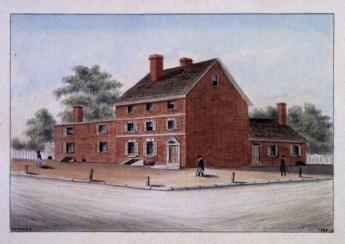
|
| Fort Wilson |
Wilson had enraged the radicals by defending Tories in court, much as John Adams got in trouble for defending British troops involved in the Boston Massacre; Ben Franklin advised Wilson to leave town. It is still possible to walk the full extent of the battle of Fort Wilson in a few minutes, and the tourist bureau has marked it out. Begin with the Quaker Meeting at Fourth and Arch. A few wandering militiamen caught Jonathan Drinker, Thomas Story, Buckridge Sims, and Matthew Johns emerging from the Quaker church, and rounded them up as prisoners. The Quakers were marched down the street for uncertain purposes when the militia encountered a group of prominent merchants emerging from the City Tavern. Unlike the meek Quakers, Robert Morris and John Cadwalader the leader of the City Troop ordered the militia to release the prisoners, behave themselves, and disperse; Timothy Matlack shouted orders. It was exactly the wrong stance to take, and about thirty prominent citizens were soon driven to retreat to the large brick house of James Wilson, at the corner of Third and Walnut, known forever afterward as Fort Wilson. Doors were barred, windows manned, and Fort Wilson was soon surrounded by an armed, shouting, mob. Lieutenant Robert Campbell leaned out a third story window and was soon dropped dead by a lucky bullet. It remains in dispute whether or not he fired first. Crowbars were sought, the back door forced open, but the angry attackers scattered after fusillades from inside.
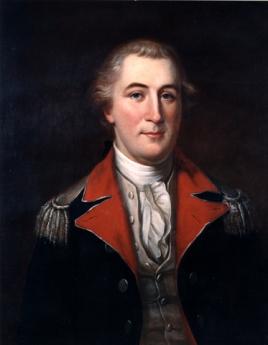
|
| Joseph Reed |
Down the street came President Reed on horseback, ordering the militia to disperse, with Timothy Matlack at his side; both men were well-known radicals, here switching sides to maintain law and order. The City Troop arrived, an order was given the cavalry to Assault Every Armed Man. The radicals were finally dispersed by this makeshift cavalry charge, cutting and slashing its way through the dazed militia. When it was over, five defenders were dead and about twenty wounded. Among the militia, the casualties were heavier but inaccurately reported. Robert Morris took James Wilson in hand and retreated to his mansion at Lemon Hill; Wilson was the founder of America's first law school. Among other defenders huddled in Fort Wilson were some of the future framers of the Constitution from Pennsylvania: General Thomas Mifflin, Wilson, Morris, George Clymer. Equally important was the deep impression left on radical leaders like Reed and Matlack, and Henry Laurens, who could see how close the whole war effort was to dissolution, for lack of firm control. Inflation continued but the center-productive price control system was abandoned and never revived; the Patriots had a bad scare, and the heedless radicals forced to confront the potentially disastrous consequences of their own amateur performance when entrusted with the power and responsibility they had just been demanding. It was one of those rare moments in a nation's history when the way suddenly opens to previously unthinkable actions.
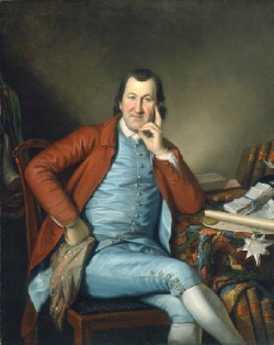
|
| Timothy Matlack |
The Battle of Fort Wilson was the only Revolutionary War battle fought within Philadelphia city limits; a revolution within a revolution, every participant was a Rebel patriot. Reed and Matlack were the two most visibly appalled by the whole uproar, forced by circumstances to attack the forces of their own political persuasion. But it seems very certain that Robert Morris and the other prosperous idealists were also left with an indelible conviction that even a confederation must maintain central command and discipline with an iron will, or all might be lost. A knowledgable French observer estimated that Robert Morris then owned assets worth eight million dollars, an almost unimaginable sum for the time. But he would lose every penny if effective political control could not be restored. A few days later in the October election, he and all the other Republican (conservative) officials lost their seats. It did not matter; Morris then knew what to do, and his opposition didn't.
The Revolution is Over, Every Man for Himself
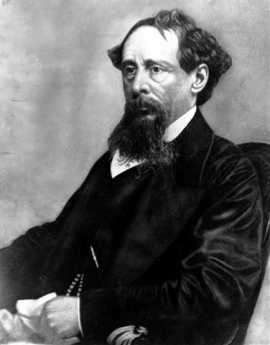
|
| Charles Dickens |
A DOZEN episodes from American revolutionary times might be called pivotal, but a single debate in the Pennsylvania Legislature seems to have begun our political parties in their present form. Two debaters, their topic, and its consequences all rise to dramatic, even operatic, heights. In another place, we intend to explore the clashing philosophies of the Eighteenth century, with Hegel and Hume at the apex, but two quotations from Adam Smith are more intelligible. Charles Dickens nearly ran away with the topic in his novel A Tale of Two Cities, but Charles Brockton Brown and Hugh Henry Brackenridge were local authors, Pennsylvanians present at the scene. John Adams and Thomas Jefferson debated for decades about which of them was the main protagonist. But all of that is the background for one operatic scene at Independence Hall, where the real David and Goliath were William Findlay and Robert Morris.
|
| Robert Morris |
Robert Morris, it must be remembered, was probably the richest man in America, a signer of the Articles of Confederation, the Declaration of Independence, and the Constitution. He was one of three men, including Ben Franklin and George Washington, about whom it could be said: the Revolution could not have been won without them. Morris essentially invented American banking, founded the first bank, the Pennsylvania Bank, invented investment banking, corporate conglomerates, American maritime insurance, and dozens of financial innovations. His merchant house probably had 150 ships sunk by the enemy. George Washington lived in his house for years. Today, he is mostly remembered for going bankrupt at the end of a busy life.
|
| William Findlay |
William Findlay, on the other hand, was a Scotch-Irish frontiersman with a flamboyant white hat, elected by others like him from the Pittsburgh area to promote inflation through state-issued debt paper, so as to finance land speculation in the West. He had no education to speak of, no accomplishments to mention. He made no secret of his self-interest in land speculation, and therefore no secret of his opposition to rechartering the Bank of North America, which Morris had founded for the purpose of restraining inflation and speculation. Findlay wanted the bank to disappear, get out of his way, and he boldly denounced Morris for his self-interest in promoting a bank where he owned stock. He utterly denied that Morris had any motive other than the profit he would make for the bank, so in his opinion, they were equal in self-interest. Let's vote.
Prior to that time, Findlay had politically defeated Hugh Brackenridge, using the two strong arguments that Brackenridge had gone to Princeton, and written poetry; how could such a person possibly represent the hard-boiled self-interest of frontier constituents?
|
| Hugh Brackenridge |
Morris was positively apoplectic at this sneering at everything he stood for. As for the country's lack of trust in a man who had risked everything to save it, well, what has he done for us, lately? America had lately thrown off the King, but what it had really discarded was aristocracy. Every man was as good as every other man, and each had one vote. Under aristocratic ideals, a man was born, married and educated in a leadership class, expected to be utterly disinterested in his votes and actions, scrupulous to avoid any involvement in trade and commerce, where temptations of self-interest were abundant. Washington never accepted any salary for his years of service and even agonized for months when he was awarded stock in a canal company, wanting neither to seem ungrateful nor to make private profit. John Hancock, who came pretty close to having as much wealth as Morris, gave up his business when he was made Governor of Massachusetts. Benjamin Franklin was only accepted into public life when he retired from the printing business, to live the life of a gentleman. That's how it was, everywhere; every nation had a king and depended on rich aristocrats to supply the leadership for war and public life. But, now, America had become a republic where every man was equal. Morris and the Federalists he represented wanted to turn the clock back to an era that would never return.
Goaded too far, Morris impulsively resigned his business interests, to prove he had the nation's interest at heart in opposing inflation. It didn't help. Findlay won the vote, and the Bank of North America was closed. America was ashamed of how it behaved after the Revolution, but not ashamed enough to change.
REFERENCES
| Robert Morris: Financier of the American Revolution: Robert Morris: Charles Rappleye: ISBN-10: 1416570926 | Amazon |
Funding the National Debt
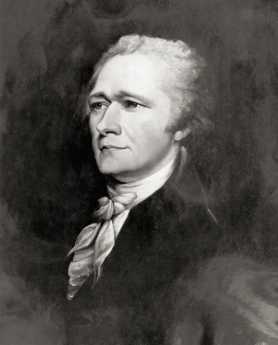
|
| Alexander Hamilton |
Although Alexander Hamilton's arresting slogan that "A national debt is a national treasure" has diverted attention to the underlying idea toward him, Robert Morris had introduced and argued for the same insight in the preamble to his 1785 "Statement of Accounts". The key sentence was, "The payment of debts may indeed be expensive, but it is infinitely more expensive to withhold payment." This fatherly-sounding advice was surely a distillation of a long life as a merchant, and the gist of it may have been passed down to him as an apprentice. Failure to pay your debts promptly and cheerfully results in the world assigning a higher interest rate to your future credit; it is not long before compounded interest begins to drag you down. It doesn't exactly say that, but that's what it means.
|
| Liberty Bond |
Another way of looking at this folk wisdom is that it leads to a simplified method of organizing the finances of an organization. Because higher rates of interest are demanded of long-term borrowing than short-term, it becomes efficient to segregate them. That is, to establish a cash account for every-day transactions, and a separate bond account for a long term, or capital, debt. As bills arrive, they need only be verified for accuracy and sent for payment from either a cash account or a capital account. The original responsibility for agreeing to such debts lies with top management, not the treasurer. The job of the treasurer's office is to pay legitimate bills as quickly and cheerfully as possible, ignoring any imprudence of earlier agreeing to them; rewards will come from lower interest charges and improved credit rating. An unexpected benefit of thus organizing institutions and governments is to make the accounting profession possible. Accountants perform the same function in every business, whether the business is selling battleships or parsnips. The accounting profession made itself computer-ready, two hundred years before the computer was invented.
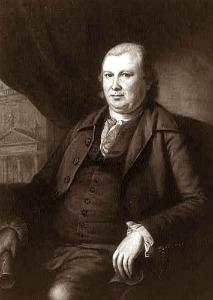
|
| Robert Morris |
In the same document, the retiring national Financier was advising the wisdom of "funding" the war debts, which were largely owed to France, with whom relations were rapidly souring. Lump them all together into a fund, issue bonds and sell them as representations of the nation's capital at the time of issue. Disregard what the money was used for, by either the debtor or the creditor. In spite of appearances, money sequestered in a fund for later payment belongs to the creditor the moment it is promised, not the moment it is transferred. Morris and Hamilton discovered that the fund itself had the property of a bank, in creating money. As long as the creditor did not cash your bonds, he could use them as money, in effect doubling the amount of money you yourself can spend. It was this discovery which so exhilarated Alexander Hamilton, causing him to over-praise the methodology to an already suspicious Congress. Tending toward the teachings of Shakespeare's Polonius, Hamilton's excitable manner caused them to remember, neither a borrower nor a lender is. But Congress was eventually persuaded. The federal government lumped the states' debts together in an "assumption of debts" , consolidated all these various little debts into a single "funded debt", and made the deal work with changing the "residency" of the nation's capital from Philadelphia to the banks of the Potomac. It was called the Great Compromise of 1790.
Morris well understood that a funded system requires some final payor of last resort. Such a payor need set aside only a small portion of the debt for dire contingencies, but his name gets first attention on the list presented to prospective creditors. In 1778 Morris had offered his own personal wealth as that last resort, which the public at the time trusted far more than the Treasury of the United States. Over the next twenty years, he came to realize that the last resort of established nations, no matter what the paper said, was the aggregate underlying wealth of the whole nation. With a vast continent stretching to the West, and countless immigrants clamoring to join from the East, the wealth supporting the debt of the United States in 1790 seemed endless. After two hundred years we have finally begun to accumulate a national debt which equals our Gross Domestic Product, and have only begun to pull back as we observe what happens to other nations who got to that point sooner. Let's hope devising an automatic check and balance does not require a second Robert Morris. Men like him can be hard to find, so limit your debts -- or your nation's debts -- to sixty percent of your assets. Financial geniuses are invited to devise a better debt limit, if they can.
Morris at the Constitutional Convention
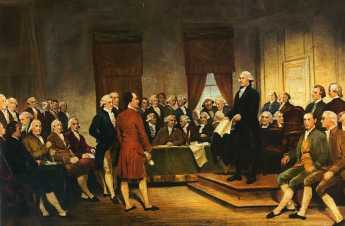
|
| Constitutional Convention 1787 |
TRUE, George Washington was the presiding officer of the Constitutional Convention. But Pennsylvania was the host delegation, so the role of presiding host should have fallen to Benjamin Franklin, the President of Pennsylvania. However, Franklin was getting elderly and turned the job over to Robert Morris, who among other things was rich enough to host some necessary parties. The rules of decorum at that time thus kept Washington and Morris out of the floor debates. The proceedings were, in any event, kept the secret, so occasional frowns or encouraging smiles are not recorded for history.
But Morris had been an active debater in the Assembly and other meetings, so he knew enough to line up a consensus in advance for the matters he thought were essential. Obviously, Morris was strongly in favor of giving the national government power to levy taxes for defense purposes, and Washington whose troops had suffered severely from the inability of the Continental Congress to pay them also regarded this taxing power as the central reason for changing the rules. By making it the central argument for holding the convention at all, Washington, Franklin, and Morris had made taxation power a foregone conclusion. And by giving them what they wanted from the outset, the rest of the convention was in a position to do almost anything else it wanted without open comment from the Titans. The sense of this trade-off was captured by Gouverneur Morris, the editor of the Constitution, in Article I, Section 8:
The Congress shall have Power To lay and collect Taxes, Duties, Imposts, and Excises, to pay the Debts and provide for the common Defence and general Welfare of the United States; but all Duties, Imposts, and Excises shall be uniform throughout the United States;This formulation had the effect of greatly empowering James Madison, the only participant who had studied the inside details intensively and cared about every comma. It also encourages the military to believe that federal taxation was mainly their entitlement, whereas those whose main goals are defined as "the general Welfare" tend to regard defense spending as an unnecessary deduction from their share.
|
| Pawn Broker Sign |
Most of the convention delegates had experience with state legislatures, and Franklin and Morris had spent decades struggling with the weaknesses of legislators. A wink or a quip in a tavern was as good as an hour's speech for reminding the delegates what they already knew about human nature. What was designed as a dual system of powers of taxation, with federal oversight of balanced state budgets combined with federal power to tax on its own in emergencies or unforeseen situations. Since the members of the first few congresses after 1789 were largely the same people as the members of the constitutional convention, many details of this balance were worked out over a few following years. State powers to tax and borrow were tightly constrained, only the federal government could tax and borrow without limit. Since government borrowing is merely the power to defer taxes until later, the borrower of last resort was the U.S. Congress, alone empowered to encumber the wealth of the whole nation in a federal pawn shop window called the funded National Debt. For almost two centuries, this pawn shop window seemed able to support any imaginable expense. Today, we monitor this as the ratio of national debt to Gross Domestic Product (GDP), and we now have a clearer idea what level of that ratio flirts with hopeless inability to pay the federal government's debt. The experts say it's close to a 60% ratio, and unfortunately, almost every nation on earth now exceeds that limit. The system continues to lack an unchallenged definition of its limit, but the system is nevertheless still Morris's system, wrapped in a mountain of descriptive detail by Alexander Hamilton. If a nation borrows more than that and clearly will never repay it, that nation is to some degree a slave to its creditors, with war its only hope if creditors are unrelenting. Perhaps another way to refine the thought is to say that if the nation wishes to mortgage everything it owns down to the last shoe button, the creditors will only accept additional debt if it is proposed by someone with the power to pawn the last shoe button. To foreigners, the proof of who has what power is much more certain if written down. Morris's protege Alexander Hamilton went even further: "credit" is established when creditors can see that somebody is in the habit of getting the nation's bills paid, and "credit" is injured whenever anyone in charge, welches.
Implicit Powers of the Federal Government
<The two highest achievements of James Madison, had been and still remain, the writing of the Bill of Rights, and acting as a close collaborator with George Washington in fleshing out the role of the President in the new government. The Ninth and Tenth Amendments made it clear that the federal government was to be constrained to a limited and enumerated set of powers, while all other activities belonged to the states. This was already clear enough in the main text of the Constitution, which Madison also dominated after close consultation with Washington before the Constitutional Convention. So he had battled and successfully negotiated one matter twice, before the most powerful and distinguished assemblies in the nation. As to the second matter, circumstances had promoted a shy young bookworm into the role of preceptor to the most famous man in America. In the earliest days of the new republic, certainly during the first year of it, Washington and Madison worked closely together in defining the role of the Presidency.
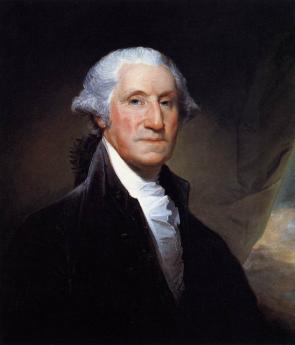
|
| George Washington |
During the first weeks of that exploratory period, Washington induced Congress to create a cabinet and the first four cabinet positions, even though the Constitution did not mention cabinets. It all was explained as an "implicit power", inherently necessary for the functioning of the Executive branch. Soon afterward, Alexander Hamilton as Secretary of the Treasury proposed the creation of a national bank. Madison and his lifelong friend Thomas Jefferson were bitterly opposed, using the argument that creating banks was not one of the enumerated powers granted by the Constitution. Hamilton's reply was that creating a bank was an "implicit power" since it was necessary for running the federal government. Of course, Hamilton and Jefferson both had other unspoken motives for their position: for and against promoting urban vs. rural power, for and against the industrialization of the national economy, and dominating the states in matters of currency and financial leadership. It empowered a national rather than a confederated economy.
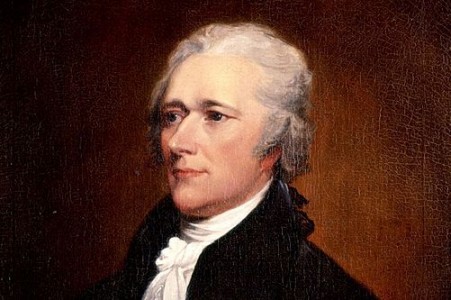
|
| Alexander Hamilton |
For Madison, the legalism probably carried considerably more weight than it did for Jefferson and Hamilton because it demonstrated the enduring consequences of being vague about the boundaries of any constitutional restriction. If this loophole got firmly established, it might reduce the whole federal system to a laughingstock. In order to promote the "general welfare", anything at all could be called an implicit power, and both separation of powers and enumerating federal powers would soon become quaint flourishes. The whole Constitution might fall apart in endless debates. On a personal level, Madison's highest achievements would have to be supplanted by something more practical. Besides which, Madison was a Virginian, a rich slave-holding farmer, and a young politician, seemingly on the verge of a promising career which might easily lead to the presidency for himself. Hamilton his most visible opponent, was already proposing a tax on whiskey which would almost surely antagonize farmers to the west, and assuming the Revolutionary debts of the states was equally divisive.
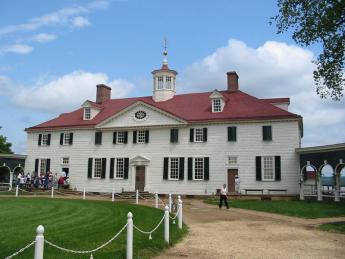
|
| Mt. Vernon |
As matters eventually worked out, the main disputants made ostensible constitutional arguments, while the real political dispute would be settled by a political deal struck at a dinner. It traded relocation of the national capital to Virginia, for the assumption of the debts of all states (when Virginia had already paid off its debt.) Location of the capitol opposite George Washington's home at Mt. Vernon also took care of difficulties coming from that direction. By the time the uproar about this arrangement subsided, the precedent for settling the inherent conflict between enforcing Constitutional limitations versus enlarging their boundaries had been set. The most opportune time for stricter interpretation was fading while the most likely advocates of it were restrained by their own example. The negotiation was a little unseemly, and probably encouraged similar decisions to migrate to a less conflicted body, which eventually John Marshall would define as the U.S. Supreme Court.
Why Jefferson Hated Banks and Hamilton Loved Them
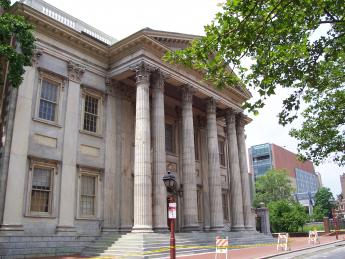
|
| First Bank of Philadelphia |
Some things are easier to understand when they start before they get complicated. That's true of banking, where it can now be puzzling to hear there was a strong inclination to forbid banks by law. While we were still a colony, the British discouraged bank formation, fearing strong concentrations of wealth at a great distance could lead to ideas of independence. Anti-bank sentiment was thus a Tory characteristic, although as the Industrial Revolution progressed, Karl Marx and Fredrick Engels stamped it permanently with a proletarian flavor. Large owners of farmland were displeased to see their power weakened by urban concentrations of wealth, while poor recent settlers of America wanted to buy and sell land cheaply, so they favored a currency that steadily declined in value. People with wealth have an incentive to keep money stable, but people with debts have an incentive to pay them off with cheap money. After these battle lines clarified and hardened, the debate has transformed from an original dispute about banks, into catfights about a strong currency. As Rogoff and Reinhart have pointed out, inflation is a way for governments to cheat their citizens, devaluation is a way of cheating foreigners. Naturally, politicians prefer to cheat foreigners, but national tradition curiously seems to favor one style more than another. Essentially, they are the same thing with the same motive, although outcomes may be different. One is restrained by fear of revolution, the other by fear of an international currency war.
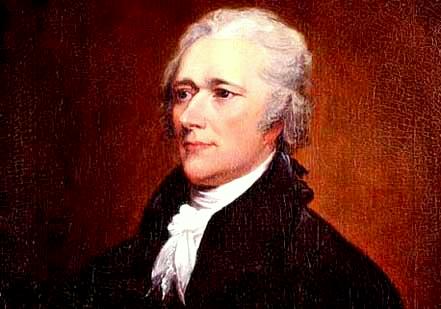
|
| Alexander Hamilton |
While George Washington was America's first president, Alexander Hamilton was Secretary of the Treasury and Thomas Jefferson was Vice President; the cabinet contained only four members. Although Hamilton was born poor, the bastard brat of a Scottish peddler in the view of John Adams, he had learned about practical finance in a counting-house, and later gained Washington's confidence on the headquarters staff; Washington eventually made him a general. Jefferson was part of the slaveholding Virginia planter elite, elegant in writing style and knowledge of art and architecture, sympathetic to the French Revolution; eventually, he died bankrupt. Early in the Washington presidency, Hamilton produced three long and sophisticated white papers, advocating banks and manufacture. Jefferson was opposed to both, one facilitating the other, which we would today describe as taking a green, or leftish position. Banks were described as instruments for accepting deposits in hard currency, or specie, and lending it out as paper money. The effect of this was a degrading of gold into paper money, or if not, an inflationary doubling of currency. Banks would be able to create money at will, a capriciousness Jefferson felt should be confined to the sovereign government. Just keep this up, and one day some former banker from Goldman Sachs would be able to tell the President of the United States, "The bond market won't let you do that." In this sense, the bank argument became a dispute about public and private power.
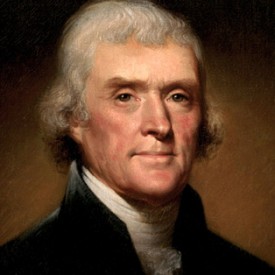
|
| Thomas Jefferson |
Hamilton, a former clerk of a maritime counting house, could observe that sending paper money on a leaky wooden boat kept the real gold in the counting-house even after the boat was lost at sea. To him, prudent banking transactions enhanced the safety of wealth, reducing risk rather than enlarging it. Later on, he learned from Robert Morris that a bank floating currency values on the private market disciplined the seemingly inevitable tendency of governments to water the currency. Once more, banks should enhance overall safety in spite of being vilified for creating risk. To both Hamilton and Jefferson, all arguments in an opposing direction seemed specious, designed to conceal ulterior motives.
Banks came and went for a century. By the time they almost were a feature of every street corner, banks were taking paper money (instead of gold and silver) as deposits and issuing loans as paper money, too; the gold was kept somewhere else, ultimately in Fort Knox, Kentucky. With experience, deposits could stay with the bank long enough that only a rare run on the bank would require more than 20% of the loans to be supported by physical ownership of gold. By establishing pooling and insurance of various sorts, banks persuaded authorities it was safe enough for them to hold no more than 20% of their loan portfolio in reserves. By this magic, loans at 6% to the customer could now return 30% to the bank. A few loans will default, a reserve for defaults was prudent, so the bank with a 2% default rate could settle for a 20% return rate. A bank which was deemed "too big to permit it to default" was invisibly and costlessly able to trim its reserves, and thus receive a 25% return by relying on the government to bail it out of an occasional bank crisis. With this sort of simple arithmetic, it is easy to see why multi-billion dollar banks were soon arguing that 5:1 leveraging was too small, a reserve of gold and silver was unnecessary, and the efficiencies of large banks were needed to compete with big foreign banks. By the time of the 2007 crash, many banks were leveraged fifty-to-one, which even the man on the street could see was over-reaching. The ideal ratio was uncertain, but 50:1 was certain to collapse, probably starting with the weakest link in the chain.
|
| Alan Greenspan |
This brings banking arguments more or less up to date. Except in 1913, an "independent" Federal Reserve Bank was created. It was a private reserve pool balanced by a public partner, the government. In time, the need for gold and silver was eliminated entirely, by the wartime Breton Woods Agreement, and the Nixon termination of it. The predictable inflation which could be expected to result from a world currency without physical backing was prevented by allowing the Federal Reserve to issue, or fail to issue as necessary, the currency in circulation. This substitution was deemed possible by having the Fed monitor inflation, and adjust the flow of currency to maintain a 2% inflation rate. Although 100% paper money was an historic change, it has endured; it has withstood efforts by the politicians to re-define inflation, undermine the indices of its measurement, and brow-beat the vestal virgins appointed to defend the value of the dollar. The old definition of money has changed: it is no longer a store of value, it is only a medium of exchange. The store of value is a nation's total assets. Jubilant politicians have added an additional burden of preventing unemployment, to the original one of defending price stability. In practical terms, the goal is defined as maintaining a 2% inflation rate, while achieving a 6.5% unemployment rate. It remains to be seen whether the two goals can exist at the same time, particularly if the definitions of inflation and unemployment become unrecognizably undermined.
And it even remains to be seen whether the black-box system can be undermined from within. The Federal Reserve is so poorly understood by the public that his enemies now accuse Alan Greenspan of causing the present recession. It is argued that the eighteen years of banking quiet which his chairmanship enjoyed, was only gradual inflation, deeply concealed. It is contended that the unprecedented steady rise of the stock market during those eighteen years was financed by a small but steady loosening of credit by the Federal Reserve. Perhaps what this means is: the definition of inflation must be tightened so its target can be made and adjusted, not to 2%, but to some number slightly less than that, measured to three decimal places. Or that the 6.5% unemployment target must be jettisoned in order to preserve the dollar. With that prospect including international currency wars as its corollary, it will be an interesting debate, and immigration policy is related to it. Because one alternative could become the abandonment of the fight against inflation, in order to sustain the new objective of reducing unemployment, Jefferson would have won the argument.
REFERENCES
| The History of the United States: Course 8500, 15 Hamilton's Republic: ISBN: 156585763-1 | The Great Courses |
| This Time Is Different: Eight Centuries of Financial Folly: Kenneth Rogoff, Carmen M. Reinhart: ISBN-13: 978-0691152646 | Amazon |
Gold Standard Substitutes
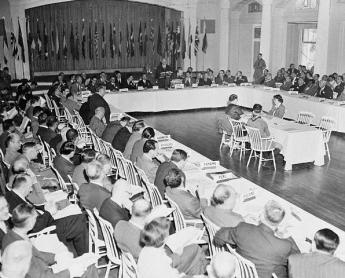
|
| Bretton Woods conference in 1944 |
Make-shift proposals to address international monetary crises after 2007, particularly confiscation of bank deposits suggested briefly in 2013 for the Mediterranean island of Cyprus, stimulated a search for a better monetary system. A gold standard sufficed for thousands of years, but the Industrial Revolution increased world economies faster than gold metal was discovered, constantly driving prices downward. It became increasingly difficult to manage the rapid growth of debt, as happens in wartime. The crisis which led to the 1944 Bretton Woods Conference was the inability to accommodate the massive national debt rearrangements of the Second World War. With the United States owning two-thirds of the world gold supply, international trade was seriously impaired.
Bretton Woods created the International Monetary Fund and the World Bank, which can be ignored for present purposes. It established the United States dollar as a "reserve currency", alone able to be exchanged for gold. Other nations were allowed to exchange their money for United States dollars. Supplemented at the Bretton Woods conference in 1944 by this gold-standard-once-removed (the U.S. dollar as a "reserve currency"), this expedient only prospered as long as the United States could maintain a positive trade balance. After 1960, the outflow of gold from Fort Knox was relentless, and in 1971 the United States was forced to abandon its buffering between gold and the world's banking systems. After 1971 the world's currencies would supposedly trust their central banks to be "lenders of last resort", but in the financial crises after 2007 many could not sustain that obligation. What they could do was devalue their currency, and even that expedient was blocked by the rules of the eurozone. Put to the test, the European Central Bank became uncertain it wanted the role of lender of last resort. At one time, the gold standard had provided the one backing for a currency which was independent of all governments' temptation to inflate away their debts. The U.S. reserve-currency buffer extended the system for several more decades, but after President Nixon cut the link to gold, the post-1971 system only provided a promise of a government rescue, without the universal ability of governments to live up to the promise. In a sense, governments backed their currency with a mortgage on the nation, and many mortgages were already overextended. For those nations, variants of the gold standard had been replaced by no standard at all. Since governments which had historically been the cause of inflation were now expected to be the source of its restraint, the private sector urgently needed to devise a new system to force the public sector to accept a new and unwelcome role.
Money on a gold standard was formerly both a storehouse of value and a means of exchange. The world supply of gold was unable to keep pace with the world's increasing wealth for more than a century, so prices were driven down, disrupting long term debts. Rising prices were just as bad; what commerce needed was price stability. What was devised for the 1971 disruption was inflation targeting. The Federal Reserve and to some extent the other major central banks, issued or withdrew currency to achieve a 2% inflation rate, thus hoping to maintain stable prices with a 2% growth rate. Skipping over the details of central banking, the Federal Reserve could safely count on the government to promote inflation at almost all times; the need was to restrain it to 2%. Unfortunately, contraction at 2% takes about as long as expansion at 2%, frustrating the hope of the public to have booms last as long as possible and depressions to be over as soon as possible. Periodic episodes of deflation are a problem. From time to time the economy expands its production capacity faster than consumption can grow, and the inevitable resulting panic not only impairs the ability of banks to lend but frightens the public away from borrowing. Without a gold standard, prices then fall even farther and faster than with gold support because money no longer has any intrinsic value. Our problem thus reduces itself to two requirements.
Without a gold or other monetary standard, and seeking to preserve the inflation-targeting system, how can we induce prices not to fall in a depression? And, how can we induce a booming economy not to increase its production capacity beyond what it can consume or sell, so that every boom period stops being followed by an uncontrollable crash? That is, much of the problem of keeping production from falling, is to prevent it from going so high it has to fall. That's not so easy in a democracy; if you stand in the way of making money when making money is easy, you will very likely be voted out of office. Price controls, by the way, have been tried many times; they always fail. The practical problem is thus pressed into the mode of forcing savings into some sort of escrow fund, during boom times. Meanwhile, the practical politician must persuade a suffering public that, once you overbuild capacity, it will probably only wear out at the same 2% rate that it took to grow so big. These are not new sentiments; the public must learn self-restraint during booms, something it has repeatedly resisted.
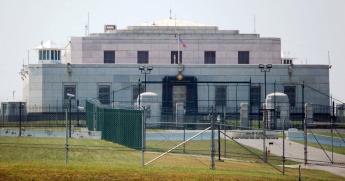
|
| Fort Knox, KY |
Features particularly irritating to the private sector about the Cyprus proposal had several sources, all of them heightened by annoyance that the bureaucracy would immediately try to force the private sector to pay for administrative design blunders. A gold standard permits international trade in defiance of government wishes; a currency without a physical store of value cannot exist without workable rules for international trade. If satisfactory rules cannot be made, voices will demand a return to the gold standard. No one said the Greeks and the Turks should love each other; no one said the Russians must respect private property. What is stated is if workable rules are not forthcoming, private alternatives will arise.
Ben Bernanke is not only the chairman of the U.S. Federal Reserve, but he is also one of the recognized academic experts on managing depression. He has spent his life studying this particular problem and occupies the most powerful position among the group charged with doing something about it. His innovation in the management of a financial crash is QE, quantitative easing. Essentially, this amounts to the creation of a fund managed by the Federal Reserve, generated by purchasing bonds with money created by the Fed. The content, size, and purpose of the fund have varied in the past few years, to the point where it amounts to a gigantic fund at his disposal, as needed, Initially, it injected funds into markets frozen with fear, and successfully unfroze them, making a profit for the Treasury along the way. He next used the fund to manage a gigantic Keynesian effort to stimulate the private economy with a federal fund. While it is possible this stimulus averted some worse disasters, the net effect was not outstanding and is generally regarded as a failure. His current effort, titled QE3, amounts to an enormous effort at what is termed "good bank, bad bank" in financial jargon. Because so many good bonds are undervalued in a recession, it is believed they will return to true market value if the truly bad bonds are removed from the market place. In Victorian days, this was accomplished by bankruptcy, but it is thought to be more humane to buy up and remove them temporarily from the marketplace. The humane approach, of course, has the disadvantage that the bad bonds may reappear later, and some critics say it is only a variant of "kicking the can down the road." It seems to have worked well for the Scandinavians however, and the final verdict cannot yet be issued. For the purposes of the present discussion, the essential point is that a three-trillion dollar discretionary fund has been put in the hands of the most powerful and most knowledgable person involved in international finance. At the moment, the fund contains most of the dubious bonds in circulation, but there are signs that Bernanke plans to replace them with U.S. Treasury bonds, thought to be the safest investment available. He can essentially do anything he pleases with this fund, subject only to the approval of the rest of the Board.
It must have occurred to Bernanke, that this multi-trillion dollar fund of the safest investments on earth would make a highly suitable substitute for gold, if it ever becomes clear that the world needs to return to some tangible commodity to back its currency, or become the new lender of last resort, if we choose to put it that way. Mr. Bernanke essentially needs no one's permission to create this fund, but to use it in some novel way would require the permission of politicians, acting in some way identifiable as the will of the American public. If it should come to that, a few suggested limitations immediately come to mind.
In the first place, one of the main purposes of imposing a gold standard on spendthrift Kings was to keep the King from spending it and substituting his own worthless paper money. Three variants of this threat, inflation, devaluation and confiscation, all amount to the same thing, which would get us back to our present predicament quite quickly, indeed. Mr. Bernanke must realize that our Constitution was written by Founding Fathers who were intensely fearful of entrusting as much power to one person as Mr. Bernanke would likely possess if this idea moved to implementation. To put it bluntly, the first action after it is done should be to surrender the ability to do it. To take another lesson from Constitutional history, it might be remembered that the functions of the Legislative Branch were established in six months, those of the Presidency evolved in the first five years of George Washington's office, and those of the Supreme Court required forty years to evolve. During all of that time, the ability to destroy the Constitution's main purposes had to be shielded from unbelievers, and an apparently unnecessary Bill of Rights had to be appended to reassure the remaining doubters. The main risk to this technical monetary reconfiguration is not monetary, but political.
|
| Financial Crisis |
But there are technical issues, as well. Because they are technical, it is more difficult to depend on wise public opinion, and thus it enhances feasibility when technical issues can be translated into political speech. Because events have demonstrated it is much more difficult to reverse a depression than a bubble, thought should be given to devising ways to use this new vehicle to reverse depression. Obviously, it should be used to unfreeze a frozen market; that's an important lesson from the success of 2009. Furthermore, the revenue from three trillion dollars of bonds is appreciable and should be used to finance tax reductions in a recession. More importantly, it should be withheld from government treasuries to restrain a developing bubble, more or less forcing governments to raise taxes during a bubble. Perhaps standards are necessary for expansion and contraction of the fund itself to supplement the use of the fund's income in those extreme situations. Indeed, to forbid the use of principal for those end-purposes might leverage the effectiveness of changing the fund balance, because it would force larger swings of principal to be adjusted. Most of these considerations come into play when a bubble is being restrained because it is easier to restrain a growing bubble than to repair the damage once it bursts. Restraining a growing bubble is not easy, and picking the right time is still less easy. Better to make most of it automatic, and related to defined market benchmarks. Benchmarks may be inaccurately chosen, but at least something is learned for the next time.
Mr. Bernanke's QE fund is not the only one which could take the place of gold in a new monetary standard. Commodities of various sorts would not be much different from gold and might soften the volatility of the mining supply. Land could be used, or fresh water, or petroleum; perhaps we could divide up the ocean in some way. Among the more attractive candidates would be world index funds of stocks or bonds; bonds seem perhaps more suitable, perhaps not. But at the moment, no one seems to be exploring any substitute monetary standard other than gold or the QE fund. Perhaps the disadvantages of each would cancel out in a basket of all the suggested standards. Perhaps inflation targeting can be improved, and no other benchmark is needed; perhaps international branch banking could cover the requirements. And perhaps it is all an academic exercise, but it would still seem helpful if academia would explore a little further, just in case we need them.
Enforcing the Constitution: Civil Monetary Penalties (CMP)
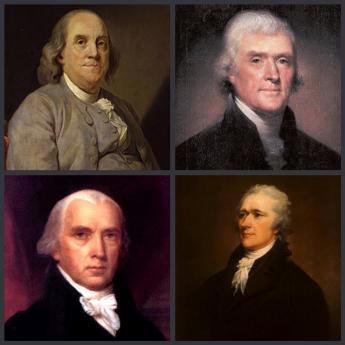
|
| Founding Fathers |
The 1787 Constitution created three branches of government along with their defined powers but described no remedy for a branch overstepping its boundaries. Gradually, a system evolved for declaring some laws unconstitutional, one by one, clarifying individual issues along the way. By contrast, the founding fathers viewed the President as an agent of Congress, expecting Congress to devise controls if needed. George Washington had an intense distaste for monarchs, and eight years as Commander in Chief had exposed no taste for conflict with the Continental Congress. Unfortunately, this has proven to be unusual for Presidents, especially as popular sovereignty appears to expand the Presidential mandate. Moreover, Washington himself developed more friction with Congress during his two terms as President.
In retrospect, the main factor behind Presidential restlessness is the experience of misinterpreting the meaning of a broader electoral mandate, which can more properly be traced to hasty repair of the defects of the 1800 election process. Experience has shown that while ignoring rules invites anarchy, the impeachment of a President usually seems too drastic a remedy for unwelcome innovation while impeaching the whole Legislative Branch for failure to supervise in a general way, is incomprehensible. The President needs some sort of supervision. While the original intent was to have Congress do the supervising, the Supreme Court is now probably better suited for judging the issue of unconstitutional behavior, except for the awkwardness that the President appoints the Supreme Court. These are the simple ingredients of a solution, preferably unwritten and revolving around conferring special "standing" in special circumstances.
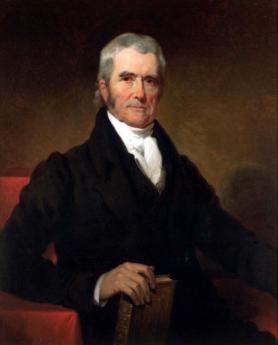
|
| Chief Justice, John Marshall |
At present, grievances tend to accumulate until someone acquires "standing" by being injured. At present it is generally true a grievance scarcely matters if no one is injured, but the exception is the lack of redress for injury to the Constitution, whereby everyone may be injured. Furthermore, actual experience with creeping boundary encroachment has mostly proved to be nuanced, rather than confrontational, gradual rather than abrupt. The descriptive example is that of a frog in a gradually heated pan of water, whereby the frog is cooked faster than he realizes he is in danger. Otherwise, the courts have evolved an unspecified balance which has proved remarkably serviceable.
It took thirty years for John MarshalI to formulate the general approach needed. In Marbury v. Madison , his first action after becoming Chief Justice, John Marshall suggested a writ of Mandamus (i.e. "We command...") from the Court might well be the first step in what he coyly described as only a hypothetical situation. Only lawyers were expected to recognize fully that If the President ignored the writ, then the grounds for impeachment might escalate, with the President forced into the role of flouting a decision of the Court. Regardless of how it stood on the original issue, the public would likely support a Court in performing its duty to make difficult decisions.
One way or another, the national issue would become one of whether the nation wished to continue with its Constitution; Marshall had only outlined the steps the process would probably take. At several points along the way, the Chief Justice would have a chance to back off. But Marshall's lifelong hatred of his cousin Thomas Jefferson was so well known there was little doubt he was serious. Knowing of his cousin's hatred for him, President Jefferson let the matter drop; subsequent Presidents followed his example. Generations of lawyers have studied this case and pondered its implications. The solution to the problem of extending it from unconstitutional laws to unconstitutional behavior, probably already exists in many minds.
| Posted by: David Joy | May 15, 2013 10:07 PM |
38 Blogs
Quakerism and the Industrial Revolution
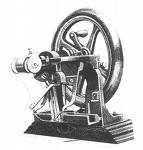 The Industrial Revolution extended over two centuries and was more important than all the wars, governments, and agitations of its time. Quakerism began at the same time, in the same place. Was that only coincidence?.
John Head, His Book of Account, 1718-1753
 The equivalent of the rosetta stone for colonial commerce had been sitting on George Vaux's shelf for six generations.
Monetary Causes of the American Revolutionary War
For the only time in our history, the government didn't print enough money, The British found that was just as bad as printing too much,
Alexander Hamilton, Celebrity
He had the kind of taudry private life and flashy public behavior that Philadelphia will only tolerate in aristocrats, sometimes.
National Debt, National Blessing
National surplus is the opposite of national debt. Sounds good, but can it even be contemplated?
After the Convention:Hamilton and Madison
Two of the main authors of the Federalist Papers -- and hence of the Constitution -- ultimately proved to be acting on entirely different sets of principles, aiming for widely different goals.
Second and Market to Sixth and Walnut
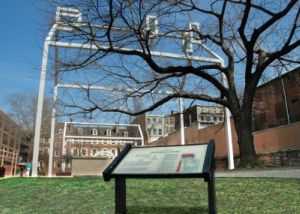 Millions of eye patients have been asked to read the passage from Franklin's autobiography, "I walked up Market Street, etc." which is universally printed on eye-test cards. Here's your chance to do it.
Stephen Girard 1750-1831
Stephen Girard was blind in one eye and never went to school. But he was a successful sea captain, then a successful merchant, then a successful banker. In the last year of his life, he grasped the essence of the Industrial Revolution, made a successful plan for the next century, and wrote a truly remarkable will.
Our Federal Reserve : Biddle's Bank (2)
Nicholas Biddle was a cultured gentleman who invented a lot of the structure of modern banking. But he got in Andrew Jackson's road.
Our Federal Reserve: Okayed (3)
Martin van Buren of Old Kinderhook invented a lot of what
Sixth and Arch to Second and Arch
When the large meeting house at Fourth and Arch was built, many Quakers moved their houses to the area. At that time, "North of Market" implied the Quaker region of town.
Gallatin, Part 1
We present here the outline of a five act play in Shakespearian style about the Whiskey Rebellion of 1794.
Gallatin Part II
 When Jefferson won the deadlocked election of 1800, Albert Gallatin was the obvious choice for Treasury Secretary. But having destroyed Hamilton's Bank, he had the humiliating duty to reverse position to fight the War of 1812. A five-act play, with duels.
Albert Gallatin: Enigma Furioso
A man in constant motion for 88 years, Albert Gallatin almost defies description. America's longest-serving Secretary of the Treasury also founded New York University and the Chase National Bank and negotiated the Treaty of Ghent. Having led the charge in denouncing Hamilton's bank, his greatest achievement was to persuade Jefferson not to close it down.
Constitution-tampering is Unwise
Working paper: The voluntary union of sovereign states is so rare as to stand unique if successful. Since the secret of the U.S. Constitution seems to be its delicate internal balance, tampering with its provisions is to be resisted. That's not strict constructionism, it's fear of disturbing successful equilibrium.
Economics of La Cosa Nostra
Organized crime in Philadelphia has always seemed a little quaint. The most famous local godfather seems to have designed an organization that made lots of money without annoying the public.
Making Money (8): Virtual Money
 When money was tangible you had to guard it, now that it's mostly virtual you have to verify it. Hardly anybody can, and that's a problem.
August, 2007: Sudden Financial Jolt
 Calmer heads may have seen financial problems building for a decade. The rest of us only noticed a volcano eruption.
Bank Accounting Off the Books
 Recent waves of mergers, one-bank holding companies, and subsidiaries have tangled the assessment of losses in the credit crisis, slowed the acknowledgment of losses, had an inflationary effect, and the appearance of illegality in an environment of blame seeking.
Bye, Bye, Banks
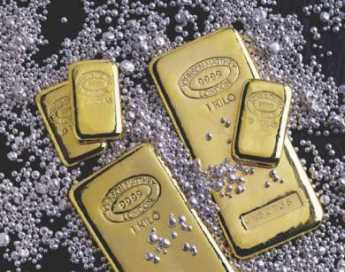 We're off the gold standard. For only a couple of decades, it seemed safe to replace gold with inflation targeting, whatever that is.
The Coming Baby Boomer Retirement Problem
 In a few years, the baby boomers will retire and two things will happen. They will have to retire later in life, and the country will have to borrow money to pay for the rest.
Unwritten Lessons For the European Union
The Europeans, trying to unite 27 countries into one, should study America's problems uniting 13 colonies in 1787. It isn't easy, and it gets harder with increasing the numbers of participating states.
Rescuing International Finance?
On November 15, 2008, the world financial managers are meeting, either to resolve the whole currency mess -- or to plunge us into unimaginable chaos.
Mercantilism Dies Hard
Diplomacy has been described as war by other means. It's possible to regard both war and diplomacy as economics by other means, a general attitude called mercantilism.
Constitutionality of the Monetary System
 The Constitution fails us when no one is certain what to do about an important issue.
Rancocas Valley: Mt. Holly, Eayrestown, Medford
The many branches of the Rancocas River spread out within the forests of southern New Jersey once supported a hidden colonial community. It was once considered for historical restoration but lost out to Williamsburg.
Three Revolutions at Once, Maybe Four
 Asking the cause of the American Revolutionary War may be a little simplistic; civil wars pop up, all over the place, all the time. The more important question to ask, is why did this American Revolution have such a dramatic effect on the whole world?
Restoring the Gold Standard by Levering Judges' Salaries
Advocates of a gold standard may just have found an effective "gotcha".
Causes of the 2007 Crash: Political and Technological
After 4 years, we are gradually piecing out the causes of the second great crash. It seems two main causes were government subsidies of cheap housing in one form or another, and the impaction of computers on banking.
Foreground: Parliament Irks the Colonial Merchants
The Townshend Acts, upsetting trade and hated by Americans, bordered on economic warfare. The British tested tea, stamps and manufactures, but the most effective economic pressure points proved to be paper money and gunpowder. The Americans reacted to all this as second-class citizenship.
Fort Wilson: Philadelphia 1779
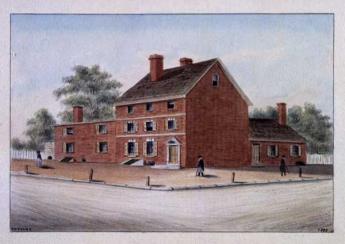 History was made at 3rd and Walnut, but so far, is unmarked.
The Revolution is Over, Every Man for Himself
 Although his personal wealth in modern equivalents approached that of Bill Gates today, Robert Morris abruptly quit his business after a debate in the Legislature, just to show he had no personal bias. It ruined him, but John Hancock and George Washington did much the same thing. Ben Franklin agreed, but was shrewder about it.
Funding the National Debt
Funded debt, otherwise known as Capitalism, was a gift to the nation from Robert Morris, Jr.
Morris at the Constitutional Convention
 Robert Morris knew that credit is only extended to someone with a reputation for paying his bills.
Implicit Powers of the Federal Government
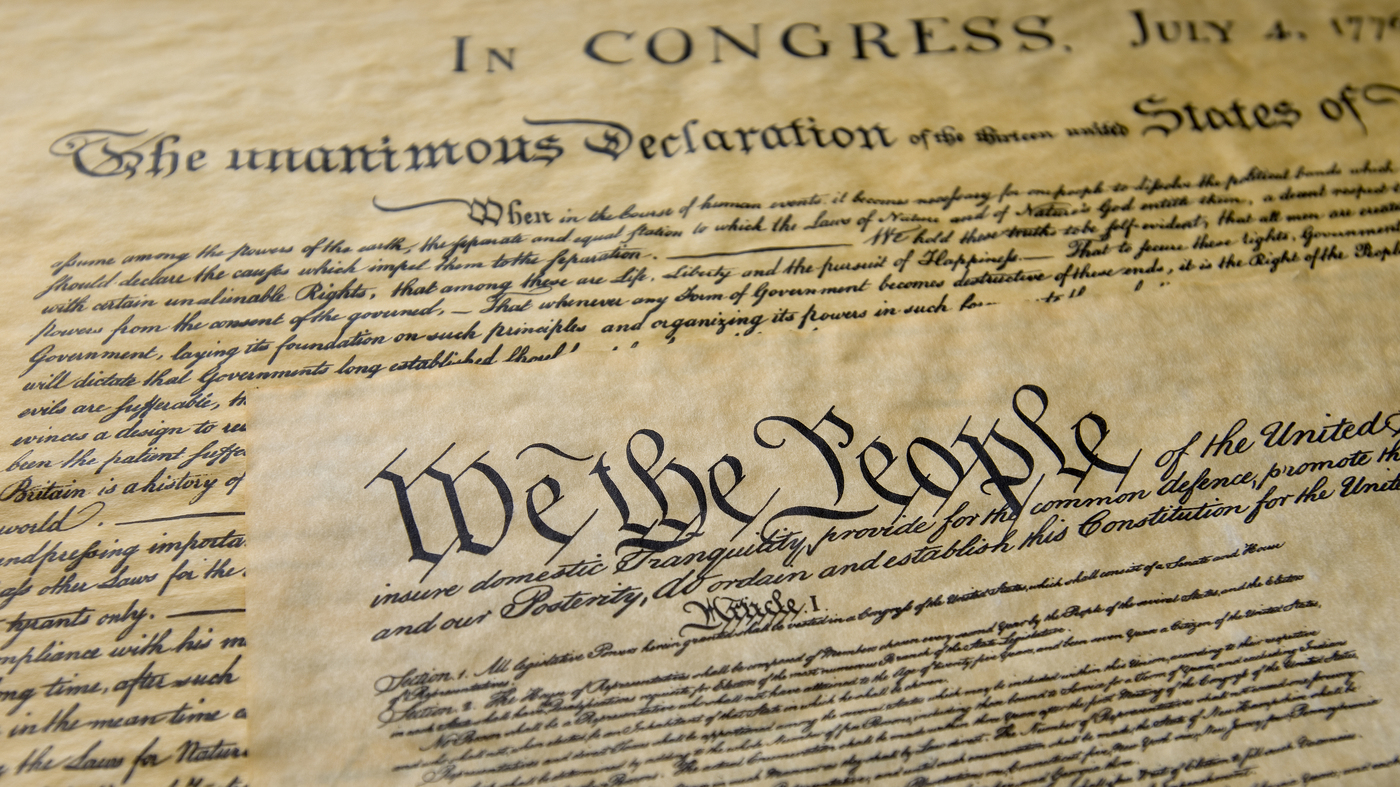 The Constitution strictly limited the number of federal powers, but did not define their boundaries. Intending to be flexible, it opened a permanent loophole.
Why Jefferson Hated Banks and Hamilton Loved Them
For centuries, Americans have quarreled about whether banks are good or evil. Some of the arguments are good and bad, but hardly any are new.
Gold Standard Substitutes
The monetary crisis which continues since 2007 keeps financiers searching for a better monetary system.
Enforcing the Constitution: Civil Monetary Penalties (CMP)
The Constitution does not define penalties if one branch of government oversteps its grant of authority. But starting with writs of mandamus , the U.S. Supreme Court has left the other two branches with little alternative but compliance.