Related Topics
Downtown
A discussion about downtown area in Philadelphia and connections from today with its historical past.
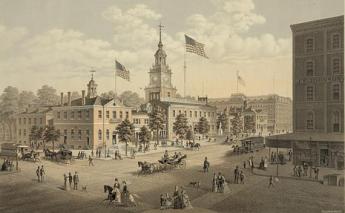
North of Market
The term once referred to the Quaker district along Arch Street, and then to a larger district that had its heyday after the Civil War, industrialized, declined, and is now our worst urban problem area.
Quakers: The Society of Friends
According to an old Quaker joke, the Holy Trinity consists of the fatherhood of God, the brotherhood of man, and the neighborhood of Philadelphia.
Investing, Philadelphia Style
Land ownership once was the only practical form of savings, until banking matured in the mid-19th century. Philadelphia took an early lead in what is now called investment and still defines a certain style of it.
Quakers: All Alike, All Different
Quaker doctrines emerge from the stories they tell about each other.
Nature Preservation
Nature preservation and nature destruction are different parts of an eternal process.
Architecture in Philadelphia
Originating in a limitless forest, wooden structures became a "Red City" of brick after a few fires. Then a succession of gifted architects shaped the city as Greek Revival, then French. Modern architecture now responds as much to population sociology as artistic genius. Take a look at the current "green building" movement.
Right Angle Club 2007
A report, to the year 2007 shareholders of the Right Angle Club of Philadelphia, by the outgoing president.
Volunteerism
The characteristic American behavior called volunteerism got its start with Benjamin Franklin's Junto, and has been a source of comment by foreign visitors ever since. It's still a very active force.
Gardens Flowers and Horticulture
Gardening, flowers and the Flower Show are central to the social fabric of Philadelphia.
Quaker Values and Service
New topic 2016-12-03 20:19:53 description
Quaker Gray Turns Quaker Green
|
| American Friends Service Committee Logo |
Miriam Fisher Schaefer, at one time the Chief Financial Officer of the American Friends Service Committee, had to cope with the economics of renovating the business headquarters complex for various central Quaker organizations. They're housed in a red-brick building complex, naturally, located on North 15th Street right next to the Municipal Services Building of the Philadelphia City Hall complex. The original building within the complex is the Race Street Meetinghouse, funds for which were originally raised by Lucretia Mott. The Quakers needed to expand and renovate their offices, a nine million dollar project. Miriam, a CPA, calculated that the job could be made completely environment-friendly for an extra $3 million. The extra 25% construction cost explains why very few buildings are as energy-efficient as they easily could be. However, in the long run, a "green" building eventually proves to be considerably cheaper. Not only would a green Quaker headquarters be a highly visible "witness" to environmental improvement, but it would also pay for itself in reduced expenses after about eight years. That is, if friends of the environment would provide $3 million in after-tax contributions, they would provide a highly visible example to the world, and reduce the running expenses of the Quaker center by a quarter of a million a year, indefinitely. Effectively, this is a charitable donation with a permanent tax-free investment return of 12%, quite nicely within the Quaker tradition of doing well while doing good.
|
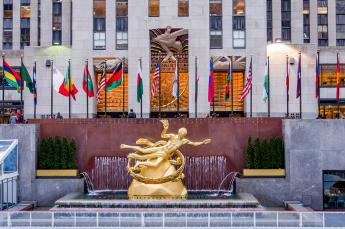
| Rockefeller Center |
Energy efficiency isn't one big thing, it is a lot of little things. If you dig a well deep enough, its water will have a temperature of 55 degrees, and only require heating up another 15 degrees to be comfortable in winter, or cooling down thirty degrees to be comfortable in the summer; that's described as a heat pump. Then, if you plant sedum, a hardy desert succulent plant, on the roof it will insulate the building, slow down rainwater runoff, and probably never have to be replaced. Rockefeller Center, you might be interested to learn, has a "green roof" of this sort, which has so far lasted seventy years without replacement. The Race Street Meetinghouse was built in 1854 and has so far had many roof replacements, each of which created a minor financial crisis when the need suddenly arose.
The ecology preservation movement is full of other great ideas for city buildings because buildings --through their heating, ventilating and air conditioning -- contribute more carbon pollution to the atmosphere than cars do. For another example, fifty percent of the contents of landfills originate in dumpsters taking construction trash away from building sites. What mainly stands in the way of more recycling of such trash is the extra expense of sorting out the ingredients. Catching rainwater runoff allows its reuse in toilets, eliminating the need to chlorinate it, meter it, and transport it from the rivers. And so forth; you can expect to hear about this sort of thing with great regularity now that the Quakers have got stirred up. You could save a lot of air conditioning cost by painting your roof white. At first, that would look funny. But do you suppose oddness would bother the Society of Friends for one instant? No, and you can expect them to make it popular, in time. People at first generally hate to look funny, but with the passage of time they grow to like looking intelligent.
A lot of people want to save the planet. So do the Quakers, but they have come to the view that the public is more easily persuaded to save money.
Originally published: Sunday, April 22, 2007; most-recently modified: Monday, June 03, 2019
| Posted by: g4 | Jun 12, 2008 9:34 PM |
| Posted by: Janet Soderberg | Jun 9, 2008 10:07 AM |
Miriam Fisher Schaefer
Vice President for Finance and Administration
215-873-8243
mschaefer@chemheritage.org