Related Topics
The British Attack Philadelphia
Fighting in the Revolutionary War lasted eight years; for two years (June 1776 to June 1778) Philadelphia was the main military objective of the British.
Sights to See: The Outer Ring
There are many interesting places to visit in the exurban ring beyond Philadelphia, linked to the city by history rather than commerce.
Historical Motor Excursion North of Philadelphia
The narrow waist of New Jersey was the upper border of William Penn's vast land holdings, and the outer edge of Quaker influence. In 1776-77, Lord Howe made this strip the main highway of his attempt to subjugate the Colonies.
New Jersey (State of)
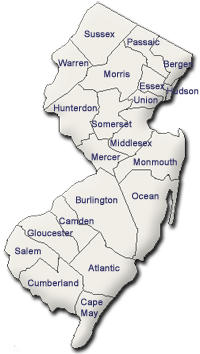 The Garden State really has two different states of mind. The motto is Liberty and Prosperity.
Pacifist Pennsylvania, Invaded Many Times
Pennsylvania was founded as a pacifist utopia, and currently regards itself as protected by vast oceans. But Pennsylvania has been seriously invaded at least six times.
Revolution in New Jersey
Early, brief but significant.
British Headquarters: Perth Amboy, New Jersey, in its 1776 Heyday (B 608)
Not many now think of the town of Perth Amboy as part of Philadelphia's history or culture, but it certainly was so in colonial times. Sadly, the town has since declined to a condition of a quiet middle-class suburb. There are quite a few Spanish-language signs around and some decaying factories. The little house of the Proprietors on the town square and the remains of the Governor's mansion overlooking the ocean are about all that remain of the early Quaker era.
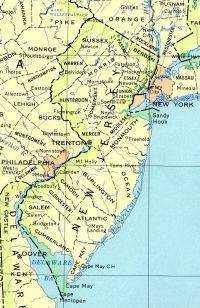
|
| NJ MAP |
To understand the strategic importance of Perth Amboy to Colonial America, remember that James, Duke of York (eventually to become King James the Second) thought of New Jersey as the land between them North (Hudson) River, and the South (Delaware) River. This region has a narrow pinched waist in the middle. It's easy to see why the land-speculating Seventeenth Century regarded the bridging strip across the New Jersey "narrows" as a likely future site of important political and commercial development. The two large and dissimilar land masses which adjoin this strip -- sandy South Jersey, and mountainous North Jersey -- was sparsely inhabited and largely ignored in colonial times. The British in 1776 developed the quite sensible plan that subduing this fertile New Jersey strip would simultaneously enable the conquest of both New York and Philadelphia at the two ends of it. It was a clever plan; it might have subjugated three colonies at once.
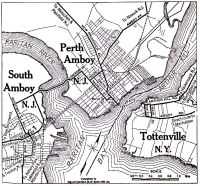
|
| PERTH AMBOY MAP |
Perth Amboy is a composite name, adding a local Indian word to a Scottish one because East Jersey had been intended for Scottish Quakers. Like Pittsburgh at the conjunction of three rivers, Perth Amboy's geographical importance was that it dominated the mouth of Raritan Bay (Raritan River, extended) as it emptied into New York Bay just inside Sandy Hook. Two of the three "rivers" of the three-way fork are really just channels around Staten Island. Viewed from the sea, Perth Amboy sits on a bluff, commanding that junction. Amboy became the original ocean port in the area, although it was soon overtaken by New Brunswick further inland when increasing commerce required safer harbors. Perth Amboy was the capital of East Jersey, and then the first capital of all New Jersey after East and West were joined in 1704 by Queen Anne. The Royal Governor's mansion stood here, as well as grand houses of Proprietors and Judges overlooking the banks of the bay. The main reason for the Nineteenth-century decline of the state capital region was the narrowness of the New Jersey waist at that point; its main geographical advantage became a curse. Canals, railroads and astounding highway growth simply crowded the Amboy promontory into an unsupportable state of isolation. The same thing can be said of Bristol, Pennsylvania, and New Castle, Delaware, but local civic pride has somehow not risen to the challenge to the same degree.
Originally published: Thursday, January 13, 1994; most-recently modified: Wednesday, May 15, 2019
| Posted by: jerri | Mar 19, 2008 3:16 PM |
| Posted by: David of Meeting | Aug 15, 2007 7:47 AM |