Related Topics
Colonial Philadelphia (Pre- 1776)
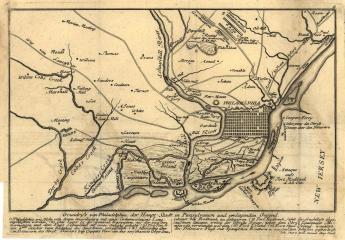 It's surprising to most Americans to learn the American Revolution was not the beginning, but almost half-way through the European settlement. And before the Revolution, there were thousands of years of settlement by non-European tribes. We know more about non-European settlers than we did fifty years ago, but records are still very poor or non-existent, and not likely to catch up very rapidly. History will begin in 1492 for a very long time. Long before that, it isn't history, it's anthropology.
Philadelphia Medicine
The first hospital, the first medical school, the first medical society, and abundant Civil War casualties, all combined to establish the most important medical center in the country. It's still the second largest industry in the city.
Philadelphia Physicians
Philadelphia dominated the medical profession so long that it's hard to distinguish between local traditions and national ones. The distinctive feature is that in Philadelphia you must be a real doctor before you become a mere specialist.
Quakers: The Society of Friends
According to an old Quaker joke, the Holy Trinity consists of the fatherhood of God, the brotherhood of man, and the neighborhood of Philadelphia.
Medical Economics
Some Philadelphia physicians are contributors to current national debates on the financing of medical care.
City of Rivers and Rivulets
Philadelphia has always been defined by the waters that surround it.
Customs, Culture and Traditions
Abundant seafood made it easy to settle here. Agriculture takes longer.
Volunteerism
The characteristic American behavior called volunteerism got its start with Benjamin Franklin's Junto, and has been a source of comment by foreign visitors ever since. It's still a very active force.
Indigents
With a long history of welcoming and assisting the poor, Philadelphia has always risked swamping the lifeboat by attracting more of them than it can handle.
Quaker Values and Service
New topic 2016-12-03 20:19:53 description
Nation's First Hospital, 1751-2016
|
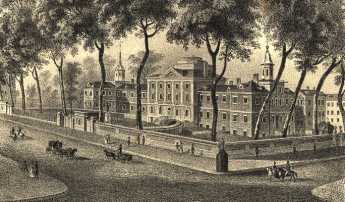
| Pennsylvania Hospital |
As commonly stated in medical history circles, the history of the Pennsylvania Hospital is the history of American medicine. The beautiful old original building, with additions attached, still stands where it did in 1755, a great credit to Samuel Rhoads the builder and designer of it. The colonial building on Pine Street stopped housing 150 patients around 1980, supposedly at the demand of the Fire Marshall, although its perpetual fire insurance policy still owes the hospital several thousand dollars a year as an unspent premium dividend. There may have been one small fire during two centuries of use, but its true fire hazard would be difficult to assert. It was just out of date. The original patient areas consisted of long open wards, with forty or so beds lined up behind fluted columns, in four sections on two floors. The pharmacy was on the first floor, the lunatics in the basement, and the operating rooms on the third floor under a domed skylight. It was entirely serviceable in 1948 when I arrived as an intern doctor. Individual privacy was limited to what a curtain between the beds would provide, but on the other hand, it was possible for one nurse to stand at the end of the award and recognize any distress among forty patients immediately. In this trade-off between delicacy and utility, the utility was certain to be preferred by the Quaker founders. Visitors were essentially excluded, and if a patient recovered enough to be unnaturally curious about neighboring patients, well, he had probably recovered enough to go home.
Located between two large rivers, South Philadelphia up to ten blocks away was essentially a swamp until the Civil War. So, there were seasonal epidemics of malaria, yellow fever, typhoid, and poliomyelitis at the hospital until the early twentieth century. Philadelphia was a port city, so sailors brought in cases of venereal disease, scurvy, even an occasional case of anthrax or leprosy. During the Industrial Revolution of the nineteenth century, tuberculosis, rheumatic fever, and diphtheria were part of clinical practice. But underlying the ebb and flow of environmental effects, there was a steady population of illness which did not change a great deal from 1776 to 1948. These patients were all poor, because the rules in Benjamin Franklin's handwriting restricted service to the "sick poor, and only if there is room, for those who can pay." In 1948 there was a poor box for those who might feel grateful, but no credit manager or official payment office. The matter had been considered, but the cost of collection was considered greater than the likely revenue. When Mr. Daniel Gill was offered the position as the hospital's first credit manager, it was suggested that he be given a tenth of what he collected. To his lifelong regret, Dan Gill regretted that he refused an offer that he had felt he could not afford to accept.
So, the wards were filled with victims of the diseases of poverty, punctuated by occasional epidemics of whatever was prevalent. And a second constant feature of the patients was their medical condition forced them to be housed in bed. For centuries, physicians dreaded the news that a new patient was being admitted with "dead legs".
Originally published: Friday, April 11, 2008; most-recently modified: Sunday, July 21, 2019
| Posted by: How to get free followers | Feb 13, 2012 9:58 AM |
| Posted by: cheapostay discount | Feb 13, 2012 9:36 AM |
| Posted by: esalerugs | Feb 13, 2012 9:15 AM |