3 Volumes
Culture: The Flavors of Philadelphia Life
Philadelphia began as a religious colony, a utopia if you will. But all religions were welcome, so Quakerism mainly persists in its effects on others, both locally and in America, in Art, clubs, and the way of life.
Sociology: Philadelphia and the Quaker Colonies
The early Philadelphia had many faces, its people were varied and interesting; its history turbulent and of lasting importance.
Nineteenth Century Philadelphia 1801-1928 (III)
At the beginning of our country Philadelphia was the central city in America.
Subcultures
E pluribus unum refers to thirteen colonies peacefully becoming a single nation. But it applies to Philadelphia in a different sense. Philadelphia is a city of neighborhoods.
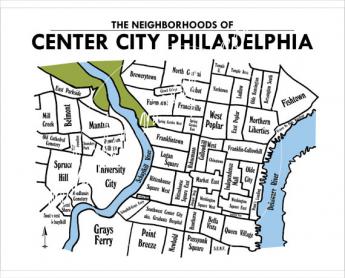
Philadelphia is a fantastic collage of peoples and cultures, from the Italian Market to the Museum of Art and Boathouse Row.

Military School
|
| VFMS Crest |
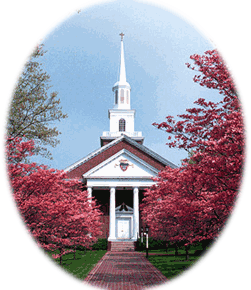
In the middle of the pacifist Quaker farm region, in fact in the middle of William Penn's Quaker Welsh Barony, sits Valley Forge Military Academy. Its location seems even stranger when you consider the nearest town, within easy walking distance, is Wayne, PA described by David Brooks in Bobos in Paradise as the East-Coast epicenter for yuppie education-based elitism, with all its air of entitlement. In fact, Brooks does not mention the Academy once in his three hundred page book about the town. What is VFMA and why is it located where it is? Three names, Baker, Mellon, and Annenberg pretty much explain it. Lieutenant General Milton Baker, a great friend of the Eisenhower family, was passionate about Valley Forge, its history, its parks, its military hospital, its renovation, and its preservation. If Baker founded a school (in 1928), it was going to be here. The money was Mellon and Annenberg money, but Baker was their man.
|
| Military school |
Military schools are now in a period of decline. A flurry of a building after the Civil War created about 600 of them, in recognition that the North nearly lost the Civil War to the Confederate States who had a much stronger military tradition, especially in Virginia. It's therefore not surprising that Valley Forge wanders from Southern traditions, and is consciously modeled after Sandhurst, the British Royal Military College. Valley Forge competes with Canada, Australia and Great Britain for foreign students, while the Southern schools are more provincial. There seem to be two main reasons to send your son to a military boarding school.
The first is the tradition of military aristocracy, traceable in a sense to feudalism and the Knights of the Round Table. There's little patience with a politically correct speech in the military, who readily tell you that many rich families encourage their daughters to marry career military officers, as a way of strengthening loyalties between these two power groups. During the formative years of the American republic, the resounding emphasis was placed on having no standing army. That was a cloaked way of restraining a military aristocracy and seems to have provided the main reasoning behind the constitutional Second Amendment, which projects a general right of all citizens to bear arms. It follows the model of Switzerland where military service is universal, as contrasted with limiting firearms to specialists, whether police or military. If that was the goal, it seems to have been effective; military elites now seem most appealing to foreign cultures, like Latin America, Korea, Saudi Arabia. Tony DeGeorge, the current president of Valley Forge, tells of an astounding phone call from one Saudi prince, who responded to an alumni fund-raising appeal by offering to buy the whole school. The Saudi noticed one supposes, that "Storming' Norman" Schwarzkopf, the hero of the First Gulf War, was an alumnus of Valley Forge.
The other main reason to send your son to military boarding school, is because he's too unruly to handle at home. Here is another seemingly delicate matter the school makes no bones about. All new entrants must spend six weeks as "plebes", enduring a ferocious hazing discipline that weeds 'em out. The solution to cell phones and Internet games is to forbid them. Valley Forge confronts the matter of recreational drugs head-on. All students are subject to random drug testing, and a positive test means get off the school grounds -- permanently -- within four hours. The exercises program is not only mandatory, but it is also rigorous beyond description. The result is that fifteen alumni are currently playing professional football in the NFL, the polo team is regularly the national champion. Somewhere General Baker got the idea that playing music helps your mathematical ability, so every single 9th grader plays the violin. The marching band is internationally famous, and by gad, it better stay that way. Only about a third of the graduates go on to a lifetime military career, but another third of the alumni are CEOs of companies. Even what happens to the remaining third bears some thought.
|
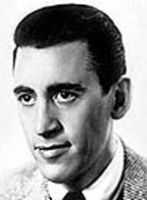
| J.D. Salinger |
J.D. Salinger and Edward Albee were both alumni of Valley Forge Military Academy. True, General Baker told Salinger that The Catcher in The Rye was rubbish, and one need not speculate much on how he would have reviewed Who's Afraid of Virginia Woolf? Nevertheless, it cannot be denied that the collision between these two social misfits and the plebe hazing experience contributed significantly to the depth and power of the serious literature they produced. It is not easy to name two alumni of Andover, Exeter or Lawrenceville who have contributed as much to 20th Century American fiction. Salinger and Albee hated the place, but it made them what they became. "Whatever that was," you can almost hear the other two-thirds of the alumni mutter.
In a day that echoes No Child Left Behind, it is a little hard and it is certainly politically incorrect, to give this devil its due. But all Armies live by the slogan, that if you must take an objective, you must take some casualties.
Block Captains
|
| Ed Asner |
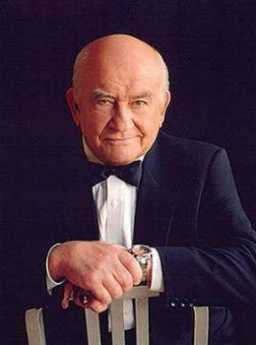
A block captain is not a ward leader, at least not most of the time. The block leaders of Philadelphia are mostly self-appointed, de facto captains, and yes, they are mostly middle-aged black ladies. Their attitude is that politicians are there to serve the community, not the other way around. At a recent meeting, the leader of the Block Captain's Association called out to the nodding, approving group, "Call your councilman. We elect those people, put 'em to work!"
This enthusiastic group of several hundred grass-roots leaders meets several times a year in, of all places, the hallowed auditorium of the Philadelphia County Medical Society, but doctors are not running this show. Nor is the City Health Department, nor the Department of Streets, nor the various mental health and social service agencies that send representatives. The federal government expressed considerable gratitude in being able to address this group because their new Medicare prescription card was so terribly hard to explain (i.e. it was terribly hard to understand). The genius of the block captain movement is that it appoints leaders to understand what the establishment is trying to say, and then figures out a way to say it. You can make free flu shots available, even take them to the home or workplace, but most people won't accept them unless it is explained by someone they trust. Dead birds don't spread disease, mosquitoes do, but that really sounds a little unlikely. To believe that, you first need the word of a respected local leader. The U.S. Army is built around its sergeants, in the same way. That's in fact how things work at every social level, but in Philadelphia's black communities, it is finally becoming organized. For example, they like pamphlets. Pamphlets are what give sergeants credibility back in the neighborhood.
Success has a thousand fathers, failure is an orphan, so it's now hard to know who started this. Eve Asner, the sister of Ed Asner the movie star, can claim credit for starting a group called Philadelphia More Beautiful, dedicated to cleaning up the messes of the slums, and applying social pressures of a loud and effective sort to irresponsible neighbors. And then, along came the Deputy Health Commissioner Larry Robinson with HEAT. During a hot summer, it was possible for a hundred children and old folks to die of heat prostration because they were confused by dehydration and did things which made matters worse for themselves. The block captains were ideally situated to know who was in danger, who hadn't appeared outside in a day or two, and thus who might need to be forced to drink water or go to an air-conditioned movie. Training the block captains to recognize the signs of trouble fit nicely into the Health Department's ability to measure results with computers. Last year, only seven people died of heat prostration, and everybody knows whose block they lived in.
The Medical Society pays for everybody's lunch at the block captain's meeting, and it is a calculated policy. Every doctor knows how useless it is to talk in terms of calories, carbohydrates, high unsaturated fat content, and water-soluble vitamins. Pamphlets help, but what really works is to serve the block captains a lunch and tell them, now this is what we're talking about. Heaven only knows how that gets translated back in the neighborhood, but surely the first step is to give the block captain an unmistakable message. The Medicare bureaucrat looked visibly relieved when her painfully convoluted explanation of the Medicare prescription card was reduced to about two sentences by questioners in the audience: If you have Medicaid coverage, forget it. If you don't, that card's worth about $600. And this here pamphlet proves I know what I'm talking about.
There did not seem to be a scrap of ideology or power hunger or self-serving -- the usual hallmarks of politics as we commonly observe it. The over-riding principle on which these highly disparate groups are operating together is, pick a problem, and solve it.
Brewerytown
|
| Beer Wagon |
After the Civil War over a hundred breweries serviced by a large German population, concentrated around the Schuylkill River between Spring Garden and Girard Avenues. Lager beer requires ice, and Brewerytown by 1880 reversed the usual Philadelphia population growth pattern by spreading East from the Schuylkill caves and ice vaults toward the Delaware River wards as electric refrigeration made that practical. There were more breweries along the Schuylkill than could be accommodated anyway. Prohibition in 1919 then abruptly killed the beer industry, Brewerytown became a slum. A large real estate developer is now trying to gentrify that area, laying down rather arbitrary borders to a brewery area after all breweries have disappeared. Some heated but pointless arguments are heard about which block is, or is not part of Brewerytown; the fact is, it's hard to say.
After World War II the area was filled with deserted houses, Skid Rows, and questionable characters. The worst Skid Row was at the base of the Ben Franklin Bridge along the edge of Franklin Square, probably not within any reasonable definition of Brewerytown but certainly affected by the brewery upheaval. After this blight had been brutally cleared away, a strip between Vine Street and Fishtown/Kensington became mostly a no-mans land of vacant lots, awaiting a developer. Or an expanded Chinatown, or whatever else will eventually be drawn into large parcels of land quite near the center of the city. The vacancy rate is unusually high because of the barrier of the cross-town Vine Street Expressway, but it can't last; whatever fills this vacuum is going to make a big impact on the future of Philadelphia. Meanwhile, it's patchy, sort of like London after the blitz.

But what's behind the rise and fall of the breweries?
Beer was known to the ancient Egyptians, and mentioned by Aristotle, Herodotus, Pliny, and Tacitus as the "wine made out of barley". Grain grows better in rainy Germany, while grapes grow better in dry Mediterranean regions, so beer has long been more popular among Central European people than Latin ones. The beer itself changed very little until the time of the American Civil War when Lager beer was introduced. Ale, porter and brown stout are brewed at room temperature, but lager beer must be kept very cold from start to finish. And that's the underlying fact driving the massive expansion of beer consumption. People like cold lager beer much better than the warm stuff. In 1863, Americans consumed 3 million barrels of warm stuff, but in 1883, they consumed 18 million barrels of cold lager. Enter, Philadelphia.
At first, cold lager was brewed in caves, and only in the winter. If you wanted to go for big volume, you had to haul in tremendous amounts of ice and build massive fortresses to hold all the weight. Pictures of 19th Century Philadelphia are astonishing for the huge size of the breweries, the associated stables, and beer gardens. These things needed railroads and harbors nearby to ship out the product, and to ship in the grain, ice, glass bottles. And coal.
The underlying principle was that breweries had to generate their own electricity in order to run the refrigeration units, and the refrigeration industry itself was stimulated to develop nearby. It's probably no accident that the science of electrical engineering was largely developed in Germany during this time. Another factor required was good water, supplied by Artesian wells going down to the Raritan aquifer. And finally steam was a big ingredient, used to sterilize the bottles, brew kettles, and floors of the brewery. Cleanliness was not just a necessity, it was a fetish. Even the horses were cleaned by steam, a mass production effort requiring two minutes per horse. Lots of horses and lots of Teamsters. So many in fact the dairymen were the main audience for the local professional baseball teams.
Three things killed the breweries.
Philadelphia water became notoriously bad, and conservation movements began to protect the aquifers from excessive penetration. The cheapest refrigerant was ammonia, and its use was prohibited by local ordinances, concerned by gas warfare in World War I. But the biggest killer was prohibition. Distilled spirits were easier to smuggle in from Canada (to Boston), ounce for ounce of alcohol content. Little copper stills could be hidden in the Jersey Pine Barrens, or the hills of Appalachia, but lager breweries were here in the first place because they were so enormous and industrial. Prohibition lasted long enough to change American tastes from beer gardens to speakeasies, from beer to booze. During that period, the huge industry sort of collapsed and never revived. It's certainly true that fickle American tastes, guided by the tax laws, have once more turned from distilled spirits to fermented ones. But now it's grape wine, not barley wine that has engaged the excitement of young things on both coasts. What beer industry it is left has migrated to the center of the country, the so-called red states, and grape versus barley has become a social-political issue to be decided every four years, on the first Tuesday in November. Trace out the local liquor taxation rates if you doubt it.
Georgetown Oyster Eat: Separate but Equal

|
| Oyster Knife |
It's a source of some regret never to have attended the Georgetown Oyster Eat. It occurs in the middle of February when the days are dark and short, and the weather is uncertain for driving.
Local citizens of Sussex County, Delaware, report no one alive remembers when or how the custom began. In the nature of such things, a certain amount of historical inaccuracy is thus to be expected. It certainly did start out as an all-male event, taking place in the firehouse. One inflexible requirement is that a participant must bring his own oyster knife, which is a very heavy chunk of iron with a short blade attached, sort of like a screwdriver. The ones I have seen are all one piece of iron, suggesting they have been hammered out in a blacksmith shop. The flattened-out blade serves as an eating utensil, as well as a wedge to pry open the oyster shell. The oysters are eaten raw and whole, often with some sort of condiment, like horseradish sauce. Some eaters favor a whole lot of ground pepper, and various other ancient remedies are said to make an appearance. The main beverage is beer, lots of beer.
Beyond that, not much is known or divulged to the public, although a party attended by nearly a thousand tipsy people can't keep very many secrets. Before the party, the windows of the firehouse are covered with brown wrapping paper, sealed with tape. Kegs of oysters and kegs of beer are rolled into the firehouse before other things get rolling, and a lot of loud noises and laughter emerge almost all night. The sponsors claim to bring a thousand bushels of oysters to each party, although it is hard to imagine very many people eating their quota of a bushel apiece. The per-person beer consumption is a statistic kept confidential. The ladies of the neighborhood report numerous husbands eventually returning home, with their glasses broken, and suspicious red bruises on their faces. Aside from that, nobody knows nothing'.
About ten or fifteen years ago, feminism reached the Delmarva Peninsula, and the ladies started their own brawl. Renting the Grange Hall and brown-papering the windows, they make a lot of noise come out all night. Because of some sort of oyster virus, oysters are not nearly so plentiful any more. There's a more elaborate accusation that excessive fertilizer on the farm fields runs off and stimulates a bloom of algae, which depletes the oxygen of the river and kills a lot more than oysters. Anyway, the oysters are in short supply. If the local firehouse custom dies out, it won't be from lack of enthusiasm, however.
Falstaff Without Prince Hal
|
| W. C. Fields |
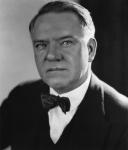
William Claude Dukenfield was born in Philadelphia in 1880, the eldest of five children of Cockney immigrant parents. He spent four years in school, was roundly abused by his parents, and left home at the age of 11 after being hit on the head with a shovel. During a self-taught adolescence, W.C. Fields slept in jail many times but learned to be such an accomplished pool player and juggler that he became the toast of Vaudeville. When silent movies made their appearance, he was successful in a second career, and then again when talkies came along. He was one of the ten or twenty most famous actors of the golden age of motion pictures, and, following the legend of the Great Depression, lived in a Hollywood mansion in great style.
Although he was a great natural comic, and had a sharp piercing wit, the image he was destined to project was that of the great alcoholic reprobate, during the period of national Prohibition. It was wicked that he was so lovable with his unashamed praise of gin martinis. And, of course, his outrageous defiance was a very thinly disguised symbolism of the growing public feeling that perhaps the Volstead Act had been a mistake.
It has not been made clear whether his repeated insults aimed at Philadelphia were fundamentally bitter or fundamentally just rough expressions of affection for a home town that never welcomed him. He constantly insulted just about everything and everybody. If it was a bitter war, he probably won it. His jibes and caricatures of the hometown have endured, long after his death in 1946.
"I once spent a year in Philadelphia. I think it was on a Sunday."
" I can love almost anything, except children and small dogs."
Hangman: "Any last words?" W.C.: "Yes, I'd like to see Paris before I die. (Pause) Philadelphia will do."
His famous recommendation for an epitaph: " On the whole, I'd rather be in Philadelphia."
The Jews in Colonial Philadelphia
|
| Haym Salomon |
The word Sephardi is derived from the Hebrew word for Spain, where Jews were a prominent part of the Arab community for several hundred years. The Christian monarchs Ferdinand and Isabella, regarding the Sephardim as pro-Arab, drove them out of Spain and Portugal in 1492. They scattered widely, and only a small portion eventually got to the Western hemisphere. It is also helpful to know that Askenazic is the Hebrew word for German since this other main branch of the religion did not emigrate to America until later in the Nineteenth century in response to the suppression following the 1848 Revolutions. There are some important differences in liturgy, and occasional episodes of bad feeling between the two Jewish groups, some of it kept alive by issues arising in Israel. Historically, the Sephardim have had a greater tendency to assimilate in local cultures, both generally and particularly in Philadelphia. However, the most prominent Jew in the American Revolutionary War was Haym Salomon, who was born in Poland.
On leaving Spain, many Sephardim had gone to Amsterdam, and from there to the Dutch colonies hat accounts for their presence in the Delaware Bay as part of the Dutch settlements which preceded William Penn's arrival. The British conquest of the Dutch accounts for their subsequent local disappearance. However, it paradoxically also accounts for an influx from Curacao and other Caribbean Dutch colonies conquered by the British, usually favoring New York as a place to settle. Presumably, Sephardic feelings about the English were cautious at best. When the British occupied New York in the early days of the American Revolution, many Sephardim fled to Philadelphia, but largely returned to New York after the end of the Revolution. There was thus a double process of filtering out those who were unsympathetic with the British, and those who were attracted by seeing what Philadelphia represented.
Records were poorly kept in those days, and in civil wars, there are often reasons to be vague about your sympathies and activities. We know that Haym Salomon came to Philadelphia in 1774, grew very rich in association with Robert Morris, but died in poverty after a few years, now lying in an unmarked grave. It is a little unclear how he became rich, although all merchants involved in shipping did a little privateering, often described as piracy by the victims. It is also unclear how he became suddenly poor, although speculators in currency and land often make serious misjudgments. Robert Morris is himself a prime example.
The matter becomes of greater interest when Haym Salomon is sometimes referred to as one of the main financiers of the Revolution. Partly because of the ease of counterfeiting with the primitive printing technology of the time, the British had forbidden the use of paper money in the colonies as part of the Townshend Acts. While understandable, it caused great pain to unbalanced trade partners, and metal coins quickly migrated back to England, almost paralyzing colonial economies for lack of cash to transact local business. It probably caused a different sort of a pain to Benjamin Franklin, who derived much of his income from printing the currency of New Jersey. In particular, it kept cargoes trapped in port for lack of payment, which the annoyed British merchants mistook as an implementation of John Dickinson's proposal for deliberate "non-importation". In any event, Jewish merchants and bankers were well situated to find ways around currency blockages, sometimes using precious gems as substitutes for specie, and utilizing informal family networks scattered around the world. In civil wars, guns have to be bought and paid for, legalities get swept aside. There is said to be evidence that our ambassador to France, Benjamin Franklin, utilized Salomon to translate the French loans he had negotiated into the munitions which colonials needed. There is incidentally reason to believe that the Rothschild family established its great wealth by similar commodity dealings at the time of the Battle of Waterloo.
Just what it was that went so drastically wrong for Haym Salomon at the conclusion of our war for independence has not yet been made clear, perhaps never will be. He may have been caught in the uproar over the worthless Continental currency, his ships may have been captured, or he may have been trapped by the land speculation which ruined Robert Morris. But those were rough, tough times. We have the word of those who should know, that Salomon's service was essential to our achievement of Independence.
Put Down That Lid!
 |
| Emily Post |
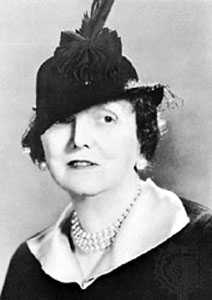
Indoor plumbing, which the British call the loo, has been around for a couple of centuries without stirring up much dissension. Recently, however, attention has been drawn to the outrageousness of the male habit of leaving the lid up. Popular television or something similar has put it about that walking away from the loo requires some statement of etiquette on the point of leaving the lid up or down, depending on knowing the gender of the next person in line for the facility and courteously anticipating the correct up-or-down requirements. Apparently, it's like holding a door open for someone who follows you (rather than letting it slam in their face), except it requires a degree of prediction that some people might think gets a little presumptuous. Furthermore, there is an intimation that only males are now to be required to make the proper gesture. A little thought on the matter would indicate that graceful anticipation might reasonably be suggested to either gender using a common loo. Emily Post is now regarded as fussy and outmoded, but she always offered some commonsense explanation for her rules of behavior, while this seems just a little mixed up.
 |
| Toilet |
Putting considerable thought into this new discussion topic, one important issue does pop up. If the bathroom owner happens to be a single lady, finding that her lid has been left up would seem to imply that the lady had recently had a visitor. Perhaps we are really on to something, here.
And then, there are the ladies of a certain age, whose habits are firmly fixed. Being occasionally in a great hurry, they might not notice that some ill-mannered brute has left the lid up, and suddenly find they were in cold water. It could indeed happen, but raises the question of just who has failed to develop proper habits or receive sensible training in childhood. Since the consequences might well be getting stuck, or at the least needing to get completely undressed to take a shower, perhaps outrage is somewhat justified. Certainly, one has to sympathize with the need to keep the matter secret from waiting for dinner guests. Boiling with rage at the thoughtless person who has done this to her, the frustration of being unable even to mention the matter without being ridiculed -- must be painful indeed. Most brutish males would think it was a pretty stupid situation, possibly a hilarious one. Particularly unfeeling ones might even hint this ought to be heeded as the first sign of Alzheimer's disease.
Philadelphia Mafia: The First Fifty Years
 |
| General Giuseppe Garibaldi |
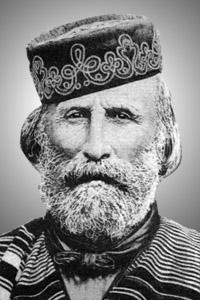
General Giuseppe Garibaldi unified Italy, but a great many Italians either didn't want to be unified, or emigrated to America after 1860 to escape the turmoil. The far western tip of Sicily was the most remote place in Europe, protected by mountains and volcanoes, speaking its own language, and loyal to no government except its own informal one. Over a period of centuries, secret traditions of feudalism and invisible governance had protected Sicily from invaders of various sorts. Although religion was a powerful force, theirs had traces of the Greek Orthodox Church; allegiance to the Vatican faded out as the local priesthood got closer to it. These people mostly wanted to be left alone, and dealt with outside authority in various devious ways, not stopping with murder if necessary. Informal taxes were collected as "paid protection" since a secret army costs money if only to support funerals and soldiers' widows. Rank within the underground army was identified by various degrees of "honor", which could sound vague but were in fact quite unambiguous. Central to the code of the Sicilian underground government, like all guerilla movements was a strict rule of silence, "omerta". As an intern in a hospital accident room, I have seen members of this organization actually go to their deaths, grimly repeating the mantra, "I don't know nuthin."
 |
| Benito Mussolini |
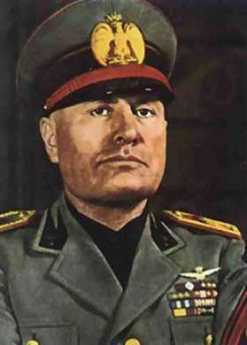
Italy may have been unified by Garibaldi in the sense of being freed of French, Austrian and Papal domination, but unification was far from peaceful and contented, with losers often choosing emigration. A second wave of emigration was provoked by the harsh rule of the dictator Benito Mussolini, who determined to squelch underground resistance once and for all.
Western Sicilians originally chose New Orleans as their new home, which unfortunately for them already had its own secret society, the Ku Klux Klan. A prompt reaction to the "Italians" with ten or twelve lynchings soon convinced the Sicilians to resettle elsewhere. It seems possible that some of the later techniques of the Mafia were learned from the Klan. In any event, the Sicilians split into two main groups, one going to New York and the other to Philadelphia. Offshoots of the New York group moved to the mining areas of Luzerne County in central Pennsylvania (Hazelton), while another early group migrated to Norristown. There were, of course, links of intermarriage among these groups, but in the early years they drifted apart as separate colonies.
Italian immigrants were no exception to the common tendency of new immigrant groups to gravitate into crime. Records of the Pennsylvania police and jail systems for three centuries show successive waves of inmates with surnames identifying Scottish, then German, then Irish, and eventually Italians. At present, seventy percent of prison inmates are black. Almost without exception, the main victims of immigrant predation have been members of their own immigrant group. Immigrants are easily victimized, somewhat defenseless, and uncertain of the assistance of local law enforcement. Among the most famous of the lawless predator groups among the Italians was the Black Hand, whose specialty was extortion with notes signed with a black hand symbol, enforced by putting bombs under porches. Locals will show you a place on Ninth Street a couple of blocks from the Pennsylvania Hospital where the Black Hand blew things up. The Black Hand, however, was not the Mafia; it exemplified what the Mafia was formed to control.
The Italian community for fifty years was centered on Christian Street, mostly between Eighth and Ninth, gradually migrating westward toward Eleventh Street. Christian Street had been named by the Swedish Philadelphia colony after their monarchs, but the original Swedes tended to remain in Queen (Christina) Village, along Delaware, while the newer migrants drifted to newer areas. During the Civil War, northern railroads heading south ended in Camden. In time, the main Civil War traffic ferried across the Delaware River to wharves at the foot of Washington Avenue. South Street was the honky-tonk area, with a black community growing along with it. After the War, an immigration station was constructed in the Washington Avenue wharf, and the new Italians tended to settle nearby. As the streets were extended westward, the street names were also extended, but the region of Eighth and Christian was largely open fields when the Italians moved into the area, and never had been Swedish. Although there were forty or more murders in the block of Christian from Eighth to Ninth in ten years after the first World War ("Murderers Row"), in modern times the neighboring region is prized by Italian residents as an extremely safe place to live, because the Don likes it nice and quiet.
While it is probably true this safety net quality might not be so evident to blacks and Vietnamese, the safe streets for Italians feature are universally attributed to the Mafia. The Sicilian group quickly reestablished the secret army of "soldiers" and "dons" (usually one don overseeing ten soldiers), started collecting taxes in the form of protection money from the local residents, and putting one "capo" in overall command. You had to be a Sicilian, and a Western Sicilian at that, to be eligible for membership in this secret army. The hierarchy was secret but could be surmised by the elaborate "respect" paid by one to another.
My office partner, Dr. Robert Gill, tells a story illustrating the paying of respect. He was called in consultation to an Italian home by Dr. Baglivo, a highly respected general practitioner in the Italian community. The two of them walked down Eighth Street, and as they passed a barber shop, Dr. Baglivo suggested they both go in for a haircut. Evidently, the patient to be visited was a very important person, and as they went in the shop, Dr. Baglivo introduced Dr. Gill to the group of assembled loiterers as the big doctor from the Pennsylvania Hospital, come to visit you-know-who with the last name ending in a vowel. The group jumped to their feet, in respect, and the barber turned to the lathered-up, half-shaved man in the barber chair. "You!", he cried out, "Get out of that chair! Let the Doctor have a haircut.!" The man dutifully scrambled out of the chair with shaving cream dripping, and humbly sat in a waiting chair, while the big doctor got his haircut. As they left the shop, payment for the haircut was elaborately refused. The point, of course, is not so much one of respect for the medical profession, as respect for someone who had been chosen to attend a capo.
The Mafia was thought to do a fair amount of slashing and breaking of kneecaps, but killing was not permitted except at the order of the boss, or capo. The police could be fairly tolerant of informal methods of law enforcement, but dead bodies brought newspaper attention where even paid-off politicians might not be able to shield the Organization from "heat". For the first forty years, members of the Mafia were sort of volunteer firemen, earning their living as tradesmen and laborers; Mafiosi were paid protection money but were not generally wealthy. The identity of the capo was for forty years a complete mystery to the non-Sicilian community.
But then, along came Prohibition.
 |
| Prohibition |
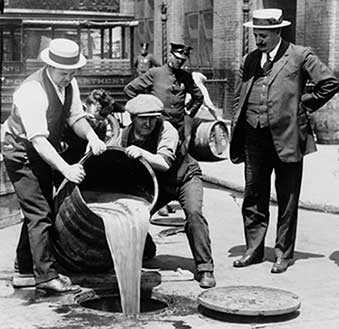
Prohibition created big money fairly safely, so bootleggers proliferated widely. It was soon no longer possible for one tightly-knit fraternal organization to intimidate a whole host of petty criminals acting alone or in small groups, so the Mafia was forced to control the bootlegging industry through dominating its sources of supply. As a general rule, "rum-running" involved bringing in conventional brand liquor from Canada. That route made Chicago, Boston and New York the major entry and distribution points for "good stuff". From Philadelphia south, most illegal liquor was "moonshine" or other illegally distilled products. Some liquor was distilled in abandoned buildings and garages, but a substantial amount was distilled in the Pine Barrens of nearby New Jersey. The colorful history of the Teamsters Union can be traced in part to the transportation network established for conveying one form of bootleg or another to its retail destinations. Trucks were often hijacked, so paid protection took a new motorized form. The manpower required soon exceeded the number of Sicilian neighbors related by intermarriage. Local groups had to be coordinated with national groups, requiring the establishment of syndicates and governing councils. Even then, one group of recognized Mafia might collide with another; the resulting murders had to be negotiated through a quasi-judicial appellate system.
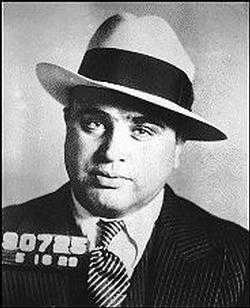 |
| Al Capone |
Philadelphia appears to have had a share of gangland warfare, but mainly that was based in Chicago and New York. In one year, Chicago experienced four hundred gangland murders, Philadelphia only forty. Al Capone came to visit Philadelphia, for reasons unknown, was assured he was most unwelcome and got himself put in jail, for his own protection. Eastern Penitentiary likes to show off his well-decorated cell, to which meals were apparently catered. What was really going on remains a mystery. A group of ten Philadelphia Mafiosi is now known to have gone to New York to participate in the "Castellammerese Wars", where two large New York Mafia groups engaged in a fierce battle for supremacy in what was now a source of vast riches. Occasional lurid episodes like this surfaced in Philadelphia, but the Mob was determined to remain as obscure as possible, and many details are missing or deliberately misrepresented. The essence of it all was that Prohibition had transformed the Mafia from a little vigilante group who imposed law and order on a lawless immigrant community, into a tightly organized army of killers, who mostly devoted their war efforts to exterminating rival tribes, while their daily activities consisted of running marginally tolerable criminal activities like gambling and loan sharking.
sting book by Celeste A. Morello called Before Bruno. In 1927, the Mafia decided they could no longer tolerate the Zanghi gang of four or five or a somewhat larger gang of Lanzetti brothers. On Memorial Day, 1927, several Zanghi members were standing on the corner of Eighth and Christian, when they were approached by several men in black overcoats. Down the street came a car with several others carrying shotguns. After the smoke cleared, three Zanghi (one of them the uncle of Mario Lanza the singer) were lying in a pool of blood, and the car went careening down Christian Street with four Mafiosi, including Salvatore Sabella, crouched on the running boards. "Musky" Zanghi, who was intended as another victim, emerged from the neighboring building and acted like a crazy man. "Sabella," he cried, "Sabella did it!". And he continued to squeal, right into the police station and newspapers. The unthinkable had happened; someone ratted. As it turned out, Sabella was revealed as the Capo himself, and general consternation ensued. Just how this information got circulated is unknown, but a story has it that $50,000 was paid to Musky to shut his mouth, Musky failed to appear in court as a witness, the court system was persuaded to blame the whole thing on an unknown underlying named Quattrana (who went to jail for eight years), everybody else was not guilty, Sabella retired as capo at the remarkably young age of 40 and lived for years in Norristown. In fact, because of the 1929 crash, Sabella the capo had to work as a butcher in Norristown, receiving small gifts as a pension. And, as these undocumented stories would have it, it took fifteen years but eventually someone, surely a friend of Sabella, "got" Musky Zanghi, who was hiding out in New York.And the Lanzetti brothers? Well, they got eliminated, reputedly by Sabella's successors in the organization, but the violence triggered extensive Grand Jury investigations led by Judge Edwin O. Lewis, later the father of Independence Mall. Thereafter, mob rubouts became considerably less frequent. Although newspaper and FBI activity had been extensive, and apparently effective, a more detached view makes it more likely that repeal of the Volstead Act was the major factor causing mob activity to subside.
REFERENCES
| Blood and Honor: Inside the Scarfo Mob, the Mafia's Most Violent Family George Anastasia ISBN-13: 978-0940159860 | Amazon |
| Before Bruno: The History of the Philadelphia Mafia Book 2 C. A. Morello ISBN: 978-0967733425 | Amazon |
| The Last Gangster George Anastasia ISBN-13: 978-0060544232 | Amazon |
| The Last Mouthpiece: The Man Who Dared to Defend the MobRobert F. Simone ISBN-13: 978-09401596932 | Amazon |
REFERENCES
| The Pine Barrens: John McPhee: ISBN-13: 978-0374514426 | Amazon |
Tony Junker: Tunnell's Boys

|
| Henry Hudson |
When you take the ferry across the mouth of Delaware Bay from Lewes to Cape May, you are out of sight of land for half an hour. But the Army Corps of Engineers have thoroughly dredged it out. By contrast, when Henry Hudson first discovered the river while searching for a Northwest passage to the Indies, it was so full of snags and shoals that he just gave up and sailed on to what is now New York harbor. So, for centuries the river pilots were an essential part of ocean commerce to Philadelphia. As you might well imagine, the earliest pilots were members of local Indian tribes. Eventually, a proud colony of professional pilots grew up at Lewes, Delaware. Since radio communication is a comparatively recent development in this ancient trade, they had to devise ways for an incoming ship to select a pilot, and establish rules to be enforced by the Port Wardens about how to go about it.
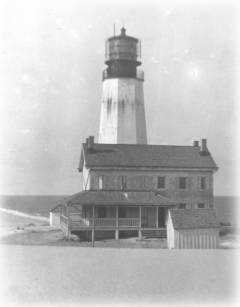
|
In the mid-Eighteenth Century, the system was to hang a black ball from the Cape Henlopen lighthouse whenever a ship was sighted. Little companies of ten or fifteen pilots would then jump into very fast schooners designed for the purpose, and race to be first out to the ladder hanging from the incoming ship's side. The rule was, the first to arrive and present his certificate got the job. Tony Junker, an actively practicing Philadelphia architect has immersed himself in tales and adventures among the pilots, and Tunnell's Boys is an exciting new novel about this dangerous, wet and uncomfortable, profession.
Wall Art in Philadelphia
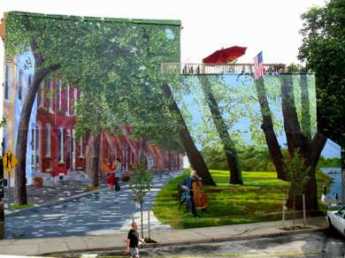
|
| Seasons |
At last count, Mural Arts program of the city government of Philadelphia has sponsored and paid for 2700 large paintings on the walls of buildings around town, and several hundred more have appeared spontaneously. Comparatively few art museums have that many on display, so people are proud of the Philadelphia effort.
This program is now nearly thirty years old, beginning to emerge as a national treasure. Looking back, it is pleasing that it had humble, even deplorable, origins. As American cities lost their industrial focus, many homes in the neighborhood of former factories have been abandoned, getting torn down in random patterns. Industrial cities of the East Coast were tightly packed to save land costs and time commuting to work; the fashion of "row houses" evolved without any space between neighbors sharing a "party" wall. When a row house was torn down, there emerged a scabrous ghost, because the wallpapered interior walls were exposed and looked pretty hideous. It eventually became illegal to leave a scabrous building, leading to elaborate legal conventions about responsibility for the cost of covering exposed surfaces with concrete stucco. During the last half of the Twentieth Century, stucco was generally an improvement.

|
| Graffitti |
Meanwhile, during World War II it became clever for American military to inscribe "Kilroy was here" on unprotected public surfaces at home and abroad as a gesture of American triumphalism. Opinions differ about whether this started originally as an allusion to a certain line of 19th Century romance poetry, or whether there was in fact a John J. Kilroy, inspector of riveting in wartime shipyards, marking riveted materials with his name to enable piecework payment for shipyard tasks. Eventually, this Kilroy joke became a little tiresome, but soon was replaced by stylized decorations using cans of spray paint, until "graffiti" painting, in turn, became a public nuisance. It is true some graffiti artists were quite talented, but the associated vandalism of teenagers added a threatening quality to public defacement of property belonging to others. By implication, an area with graffiti was a home of lawlessness and that implication cast a negative shadow on the city economy. Public opinion demanded something effective be done to stop it.
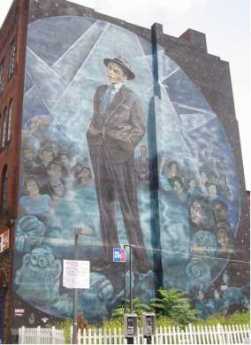
|
| Frank Sintra |
Since graffiti vandalism has declined nationwide in the past twenty years, it is difficult to claim that one public initiative in Philadelphia cleaned it up. But it might be true. Then-Mayor Wilson Goode formed an antigraffiti Network, essentially a think tank for concerned citizens, floundering about for a solution to an appalling problem. Somehow the inspired idea arose that the graffiti artists might be channeled into better directions if given professional art lessons, and working materials. A West-Coast artist named Jane Golden was hired to supervise what has become a multimillion-dollar project, overseen by some sort of guiding hand pushing the whole city into becoming part of a gigantic art project. Guides tell visitors that there are fifty employees involved in publicity and legal work, organizing artists, fundraising, organizing teams of painters at all levels of competence, helping oversee the general appropriateness of what is happening. And at the head of this team is Jane, a tornado of energy.
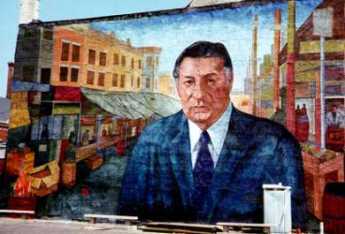
|
| Frank Rizzo |
It costs forty to seventy thousand dollars to produce one of these works, and since they are exposed to the weather, they only last about fifteen years. There are several techniques for transforming a small artwork into a big outdoor copy, some of them tracing back to Michaelangelo. Most of the Philadelphia murals are produced by dividing the original small artwork into squares and transferring numbered squares to the wall, one inch to one foot. As you can see by reviewing some of the websites devoted to the topic, a piece of art which is quite appealing can sometimes change into a drab mess when its size is blown up to three-story height. The problems of lighting such work are quite different from the lighting of a gallery painting. The surface is seldom smooth, so the bumps and grooves of the underlying scabrous "canvas" can destroy, or sometimes dramatically enhance, a salon painting. If you get too close, you can't see all of it, and that may be a problem. It's probably not entirely predictable what will come out in the final product.
There are inevitably political problems as well. The best examples are the several paintings of former Mayor Frank Rizzo, who is a hero to the Italian neighborhoods where they stand, but provoke riotous feelings in near-by black districts. Luck alone has confined the antagonisms to graffiti on the murals, viewed by some groups as enhancements on what begins as graffiti. No wonder the committees assigned to approving locations can take a long time to come to a decision.
There's another problem, which seems to be embedded in the situation. In the central city skyscraper district, you don't have scabrous buildings. Nor can mural art be placed in the historic square mile. Just a few blocks in either direction from central city there are plenty of demolitions and scabrous walls, but, close to downtown, these are areas of gentrification and urban renewal. It doesn't make sense to spend fifty thousand dollars to paint a wall which will be demolished in two or three years. The net effect is that the city may have three thousand paintings all right, but only fifty at most are within a tourist ride of Independence Visitors Center. If half of these fifty are concerned with celebrating local heroes unfamiliar to tourists, there can be disappointment which would disappear if a selection of fifty outstanding products could be culled from three thousand -- and grouped together for exhibition.
A solution to these issues will surely emerge with time, but it will evolve, not be envisioned.
Quaker Efficiency Expert: Frederick Winslow Taylor 1856-1915
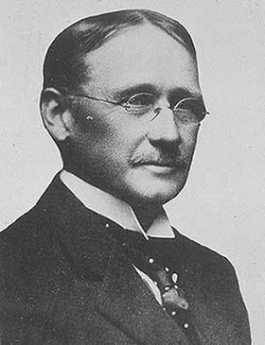
|
| F.W. Taylor |
For at least seventy-five years after Fred Taylor turned it down, any rich smart Philadelphia Quaker attending Phillips Exeter would have been automatically admitted to Harvard. We don't know why he did it, but instead F.W. Taylor just walked a few blocks down the hill from his Germantown house and got a job at the Midvale Steel Company as an apprentice patternmaker. During the twelve years, while he rose to become chief engineer of the company, he took a correspondence course for a degree in mechanical engineering at Stevens Institute and invented a process for making tungsten steel, called high-speed steel. That made Midvale Steel rich, but Taylor was going to make Philadelphia rich, and after that, he was going to make America rich. When he died, he was widely hated.
Evidently his lawyer father greatly admired German efficiency, having sent little Freddy to a famous Prussian boarding school where he was in attendance at the time of the
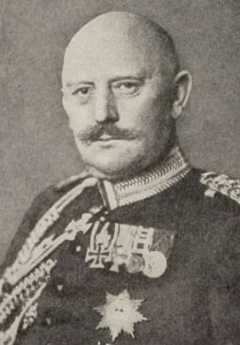
|
| General von Moltke |
Battle of Sedan. General von Moltke had used Prussian efficiency and discipline to defeat those indolent lazy French, and Fred Taylor evidently absorbed and retained these stereotypes for the rest of his life. Whatever he was looking for at Midvale Steel, what shocked him most was to find workers "soldiering on the job". That's a Navy term, by the way, invented by sailors to describe the useless shipboard indolence of any Army they were transporting. Taylor later went to Bethlehem steel, reduced the number of yard workers from 500 to 180, and was promptly fired. It seems that most of the foremen at the plant were owners of local rental houses, which were emptied of tenants when Taylor reduced the workforce. Even management came to mistrust Taylor. When the railroads wanted a rate increase, Louis Brandeis defeated them with the argument that they wouldn't need higher rates if they adopted Taylor's system of efficiency. In his later years after he became enormously rich, he toured the country giving speeches without fees, promoting the doctrine of finding the one best way and then doing everything that way.
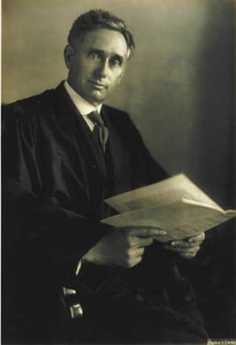
|
| Louis Brandeis |
Over time, Frederick Taylor had come to see that the industrial revolution had proceeded to the factory stage by merely bringing craftsmen indoors, each one treasuring his little trade secrets. Bringing the point of view of the company's owners onto the shop floor, Taylor could see how vastly more profitable the steel company would be if all those malingering tradesmen would stop soldiering on the job. No doubt the young Quaker soon learned that little was to be accomplished by remonstrating with workers, just as bellowing foremen had learned that bullying was also useless. Out of all this familiar scene emerged Taylorism, the idea of paying financial incentives to those who produced more, splitting the rewards of efficiency with the management. It sort of worked, but it didn't work enough to satisfy F.W. Taylor. When he walked around with a stopwatch, he collected the data showing how much more might be produced if the workers were perfectly efficient. Not only did that create the stereotype of the stop-watch efficiency expert, but it also provoked Congressional hearings and federal law against stopwatches which stayed on the books from 1912 to 1949. Although management responded by forming dozens of Taylor Societies to honor the approach, the unions invented the term "Taylorism" and bandied it about as the worst sort of epithet. Curiously, the Taylor approach proved to be enormously appealing both to Lenin and Stalin, who applied it as a central part of their five-year plans and general approach to industrialization. As we now all recognize, the Communist approach was a two-tier system instead of the three-tier system that was needed. It isn't enough to have a class of comrades called planners and another called workers; you need a layer of foremen, sergeants and chief petty officers in the middle. In addition to the elaborate time and motion studies leading to detailed written procedures, there needs to be an institutional memory for the required skills of the trade. In a funny sort of way, Fred Taylor the Quaker may have organized the downfall of the communist state before it was invented.
|
| Herbert Hoover |
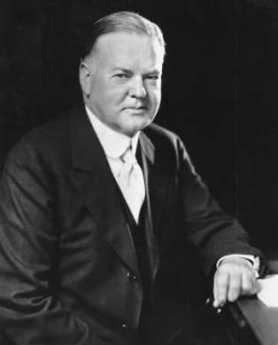
Another peculiar outgrowth of Taylorism may be the partisan lines of our own political parties. If you trace the American ideological divide to the 1932 election of Franklin Roosevelt, you can see we are still fighting the battles of the depression. It happens that Herbert Hoover, another Quaker, was totally captivated by Taylorism. Not only that, he was adamant that to get rid of the depression all the country needed was to return to self-reliance, individual responsibility, and hard work. Those were qualities Hoover himself had in superabundance. One telling remark that he probably regretted saying but nonetheless firmly believed was, "If a man hasn't made a million dollars by the time he is forty, he can't amount to much." Franklin Roosevelt had the million all right, but his family had given it to him. The Cadburys and Clarks could have given it to Fred Taylor, too, but he chose to make it himself.
www.Philadelphia-Reflections.com/blog/1296.htm
Community Volunteers in Medicine
|
| Comm Volu In Medicine |
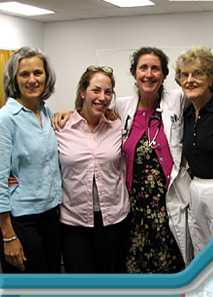
Mary Wirshup has a very different medical background from mine, but she's my kind of doctor. I couldn't help wishing, as she addressed our urban luncheon club, there could be thousands more like her, even while understanding more fully than she seems to, the reasons why doctors are driven from her behavior model. As we parted, it felt like saying a last goodbye to the Spartans marching to Thermopylae.
As 46,000 medically uninsured persons in Chester County get sickness and injuries, they know that a Federal Law prohibits a hospital accident room from refusing to see them, so ways are found to shunt patients to the CVIM free clinic, run by volunteers. This law is, in turn, a response to a government-created situation where a hospital which "accepts" patients must keep them. Any economics teacher can tell you that supply/demand issues are best addressed by price adjustment, so price controls in whatever guise lead to shortages. I must say I have little sympathy with the devious strategies which hospitals often employ to disguise their rejection of uninsured patients. At the same time, I know a lifeboat will sink if too many climbs aboard. Nevertheless, the semantic switch from lack of insurance to lack of care implies that only more insurance can surmount the barriers to care, which is absurd. For one thing, I know too many hospital administrators who are paid a million dollars a year, and one who is paid two million. And at least two health insurance executives are in the newspapers with a net worth over a billion -- yes, that's billion with a b. We have reached a point where reducing all physician income to zero would only reduce "healthcare" costs by 10%. As I look at Dr. Wirshup's modest clothing I can only surmise she plans to continue her modest living until she is 80 years old, after which her savings might see her out. Squeezing physician reimbursement is not intended to save significant money, nor intended to restore physician incomes to more equitable levels. It is intended to address the oversupply of physicians without confronting either the universities or the foreign trained lobby.
The elite tranche of medical schools do their part to relieve physician oversupply without reducing class size, through the encouragement of their students to go into research. I was well along at the National Institutes of Health before I finally decided I had not gone into medical school with that goal, and returned to teaching and patient care in a more satisfying model not too different from CVIM's obviously Pennsylvania Dutch spirit. The Amish at the far western end of Chester County reject the whole idea of insurance; their most characteristic statement is "Don't send me no bills." That attitude is rather a contrast with the shiny housing and automobiles in the Silicon Valley developments of Southern Chester County, or even with some rather bewildered Quaker farm families scattered over the rest of the county next to the horsey set. Chester County is America.
On Second Street in Society Hill, next to the park where William Penn's house stood and a few feet from Bookbinders, is the house of Dr. Thomas Bond. Bond conceived the idea of building the first hospital in America and with Franklin's publicity machine succeeded in getting it built, to care for the "sick poor". Dr. Bond started a second enduring tradition as well. When the Legislature expressed doubt that the institution was sustainable, he pledged to convince the local medical profession to serve the poor without charge. Some of the legislators who voted for the measure did so in the belief that charity care would never appear so the gesture would be without cost. The physicians did indeed come forward, in sufficient numbers to run many institutions for two hundred years. In 1965 health insurance made its national appearance and has regarded the benchmark low costs of charity care as a threat, ever since.
No Laborer Left Behind
 |
| Ivy League |
The top thirty American colleges have ten times the applicants they have room for. Demand vastly exceeds supply, prices are essentially fixed; shortages result. Can-do is the American way, so our first reaction is to build a lot more colleges and beat them over the head if they aren't first-rate. To bring this down to a local scale, implications are that Philadelphia has a moral duty to build eighteen more Ivy-League universities.
 |
| Cosa Ricians Roofers |
Let's think about that, in a back-of-the envelope way. Since the rest of the country is going to be similarly driven, we can't attract Americans to run those universities. Philadelphians who are doing other things must staff those universities; people inclined to become professionals of a different sort are going to have to be trained to be university professors. Students now being rejected will be admitted, since that's the purpose of the thing. Unless we somehow increase academic productivity, every man, woman and child from Trenton to Wilmington is going to be in a college classroom in some capacity or other. We here confront the extrapolation fallacy; a new problem must be addressed in more productive ways than just more of the same.
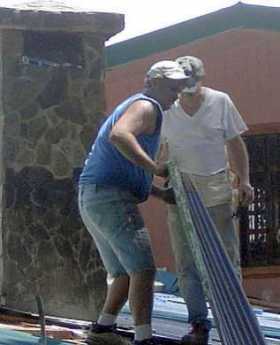
Curiously, the readjustments to this overall shift from an industrial to a service economy are first making their appearance in things like roof repairs and ironing shirts. When my house needed a new roof, I found I had a choice of workgangs composed of Costa Rican, Puerto Rican, or Polish roofers. The Costa Ricans made the best bid and went to work immediately. They started pounding on my roof at 6 AM, and we're still pounding after I went to bed at night; I have grave doubts that American roofers would approach that work standard. I am told that the entire building industry, on which our current prosperity rests, would collapse if we banned illegal immigration. In a different industry, Philadelphia's convention hall cannot attract visitors unless we build more hotels. But the hotel industry cannot find nearly enough people who speak English to make the beds. For one purpose or another, we have imported 12 million illegal immigrants who mostly remain invisible because they are so hard at work.
We are going too recklessly fast with what is fundamentally a useful transformation of our society. Americans want to go to college because statistics show that will make them prosper. But that's only half of their transformation. The other half is a resulting shortage of labor in the jobs which do not require college. Normally, you would expect wages to rise, but they are suppressed -- deflated -- by substituting immigrant labor, legal and illegal. Impose an effective barrier to immigrants, and you would quickly see inflation like you wouldn't believe. Combat inflation by raising interest rates and the housing market would quickly collapse. That would prove to be a painful way to make the immigrants decide to go back home, although it would be effective. And so on, and so on, and so on.
Slow down, America. You're going in the right direction, but exceeding the speed limit.
Unexpected Benefits of a Lurid Past
 |
| Map of Barnegat Bay |
Centuries came and centuries went, while a Quaker shipyard went on about its business along the shore of Barnegat Bay. Next door there was a notable roadhouse after the second World War, rumored to have formerly been a secret speakeasy during the days of Prohibition. In time, the only occupant of the roadhouse was a wealthy widow, who mostly minded her own business and grew to be an affable neighbor to the Quakers next door. As rowdy days of Prohibition faded into the background of decades past, the old lady felt free to recall some of the less tawdry features of her past, to the Quakers who in turn felt free to chuckle about them. Ancient history, perhaps a little varnished and polished up. It was, however, a little disquieting to hear her say that the liquor for the speakeasy was often supplied by sailors from the Coast Guard, who routinely diverted 20% of the cargo of rum Runners they had captured, into commercial channels. Exciting times, those were.
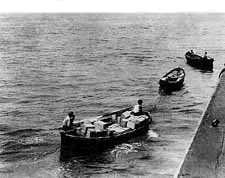 |
| The Coast Guard out looking for Rum Runners |
One day when the widow was ninety-six years old, the lights of her house stayed on, without other signs of activity. The neighbor eventually walked over to the back door and looked through the window, where it could be seen that the old lady was lying on the floor, rather motionless. He might have called the police, or broken into the house, but there was another option.
He went down to the basement, entering a rather dusty but quite elaborate barroom. Following old directions, he walked to a closet and climbed up a stepladder leading into another closet on the floor above. Stepping out, he found the lady was still breathing, called her relatives, and watched her be taken off to a nursing home to end her days. No one seemed to ask very many questions.
Neopolitan Right Angle
|
| Warren Buffett |
The Right Angle Club of Philadelphia recently heard from a former member, Merrill Roth, who has moved to Naples, Florida. Such retirement places are populated by people from all over the country, all anxious to show the merits of where ever they came from. So, Merrill decided to transplant one of Philadelphia's jewels to the West Coast of Florida; he started a Right Angle Club of Naples, meeting monthly in the Vanderbilt Club. By great good luck, he discovered that one day a week was Ladies Day at the golf course, an ideal circumstance for founding a men's club. Before he knew it, he had a hundred members, filling up the dining room to capacity.
So, being Merrill, he started a second one, which has now grown to thirty members. One of the central themes of these clubs is that Naples has a great many cultural events and institutions, but newcomers have trouble locating them. So his clubs fill a local need.
Since he started the clubs, he had to arrange for the speakers, and shouldering this burden for the rest of his life now seems a little daunting. So, it was useful to remind him that the Philadelphia Right Anglers of the Mother Church assign that task for only a year since most everybody can find forty friends who can speak, but nobody wants to do that forever. Other clubs encounter the same issue, and one solution has been to hire an executive director of the club and have him get the speakers. Since nobody knows an infinite number of entertaining speakers, that soon gets to be too much; and so the executive director hires a program director. Pretty soon that gets expensive, and the club starts going to agencies. The whole thing eventually loses its character as a voluntary fraternal group, gets unaffordable, and the programs wander away from the interests of the members. The only thing worse is to own your own clubhouse. The seeds of the club's destruction are sown by failing to appreciate these realities of club dynamics. Warren Buffett tells investment advisors to eat their own cooking. The club variation of that sage advice, is, get your own speakers.
Please Touch
|
| Please Touch Museum |
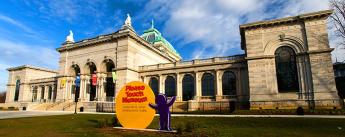
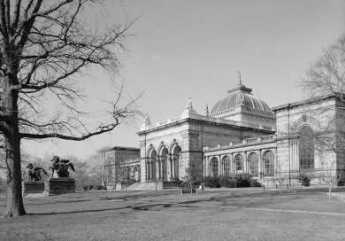
There had been rumors for some time that the Please Touch Museum was planning to move from 21st Street to larger quarters, but recently its Executive Director Laura Foster appeared at a luncheon at the Franklin Inn Club to announce definite plans. The Museum moved into Memorial Hall in West Fairmount Park in the fall of 2008.
|
| Memorial Hall Fairmount Park |
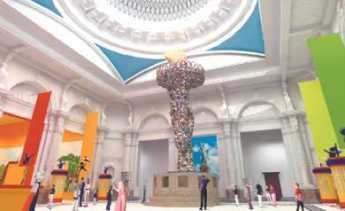
There are over 400 children's museums in the world, and the first one was started in Brooklyn in 1899. Just why Philadelphia waited until the Bicentennial Celebration in 1976 to start one, is not clear. It's particularly unclear when you hear of its explosive success. Growing rapidly during an era when museums of all sorts are seeing declining attendance, the Please Touch Museum will be making its fourth move in thirty years, each time to larger quarters because they needed more room. Sooner or later, expansionism will get its comeuppance of course, and Memorial Hall is one awfully large building to fill. And to heat, and to paint, and to air condition. The price is right, however. The City Administration, which approached the museum with a proposal, has offered an 80-year lease for a dollar. When you hear that they have occasionally had 1500 visitors in a single day, however, and annual attendances approaching 200,000, almost anything seems possible.
|
| Liberty Torch |
There are certain limits. Nothing frightens a 4-year-old like a herd of 10-year-old boys racketing about, so there are segregations necessary. In other situations, these little kids not only can't touch, but they also can't see and they want to see badly. And the sociology is interesting. The kids may well clamor to come when they hear other kids talking, but in general, it is the parents who get the idea that a museum trip would be fun. And the parents seem motivated by theories of upward mobility, of giving their child a "leg up" on the competition. The museum is certainly filling a need, but you have to wonder where our society is headed if a picnic in the park is mainly a good idea if it gives junior a leg up.
Meanwhile, keep tuned. To fill up that monstrous Memorial Hall will take publicity, and these gals sound as though they mean to have a lot of it.
Quilts, Patchwork Style
 Although quilting can be found in the tombs of ancient Egypt, American farm women are correct that they invented an art form. 
|
| Dr. Fisher |
In the days when transport was primitive, art forms were invented in many places at once, mostly responding to new materials and new technologies. It's irrelevant to the genius of creation, for archivists to pounce on evidence that an art form surfaced a decade or two earlier in one place than another. Creative art could easily have been -- and often was -- invented by five or six people in different regions, each with a just claim to inventing without copying. In the case of quilts, there is a semantic wrinkle, too. If you define quilting as the process of anchoring three layers of cloth together with stitches, then quilts have been found in ruins of ancient China and ancient Egypt. The underlying principle was that three layers of cloth were warmer and stronger than single sheets of cloth or animal skins, so quilting was used for shoes, pants, jackets, and underneath suits of armor. Mary Queen of Scots spent a lot of time in confinement, and examples still survive of tapestries she made with the quilting process. None of this is what American farm women mean when they say that "quilts" are an American invention, and a new art form.

|
| Quilt, Patchwork Style |
What they mean is patchwork-quilting of bedspreads or counterpanes. To make that specific kind of quilt, you pretty much have to wait for the industrial revolution to provide decorated cotton cloth, then for it to become cheap enough to be used as sacks for flour. That attracts frugal farm wives salvaging material for dresses and shirts, and later re-salvaging pieces of it for patches. Somewhere the idea caught on that decoration was needed for the tops of beds; if these ornaments were usable for extra warmth it was even better. And so, we got patchwork counterpane quilts, incorporating different colored patches into designs. They start appearing around 1750 but gained real popularity around 1830. Since no one was keeping records, it's hard to know if the common diamond design was an outgrowth of the Scotch-Irish street "diamond", or an outgrowth of the hex signs which are commonly believed to have originated in the monastery in Germantown. The path of westward migration would have carried such traditions to the rest of the country, so this analysis has some plausibility. However, the ideas are so simple it would surely be impossible to trace them. What is so unique about this folk art is that the design can be oriented around a piece of a favorite grandparent's shirt or dress, evoking that person's presence and personality in a manner largely incomprehensible to anyone except the immediate family. This intimate quality is easily lost, even in third and later generations of the family, although family traditions can be maintained in the designs and by hearsay.
There may be other traditions of folk art evoking a particular individual who is unrecognizable to outsiders. They might admire features of the design but have no way of knowing the personality of the person celebrated, or making associations with the piece of cloth. But this quilt art becomes established as a family heirloom as almost nothing else could be. Its sweetness is oblivious to the fashion police who contribute a rather aggressive undertone to so much of the art world. For example, in the period between the first World War and the Korean War, it was just about impossible to have a non-modernist painting accepted for a juried show. The same juries who enforced such competitive dictates seemed to forget they denounced the "conservative" academics who excluded impressionist painting a century earlier. During the modernist period, disk jockeys and band leaders likewise serially enforced the various fashions of jazz music; classical music was totally banished. Book reviewers, now a dwindling race, similarly laid down standards of obedience for authors and playwrights on behalf of a style now commonly praised as "liberal". Publishers and producers defied such dictates at their peril, and now must reorient to the coming new standard, called post-modernism.
By contrast, the isolated troubadours of home quilting artistry continue to create as they please, primarily speaking to their families and selling a few less treasured products -- to uncomprehending strangers.
Onward, Christian Soldiers
Among the ten largest cities in the United States, Philadelphia at 24% has the highest poverty rate. Why that should be so, and what should be done to change it, are questions for another article. Meanwhile, many helpless hopeless people need immediate help with problems of daily survival. No doubt, Philadelphia's long history of practical charity has acted as a magnet for victims of social problems caused elsewhere, and many of our locals who deserve some blame have moved away to more promising environments. For those who remain and want to help the immediate need, these things don't matter, just so long perhaps as emergency measures do not interfere with long-term solutions.
|
| Salvation Sign |
Among many private relief efforts, the Salvation Army is widely acknowledged to be the most efficient and most effective, as well the largest. Before the big event in 2004, it had a $3 billion budget and 3 million volunteers; an army, indeed. Except for Quaker charities, which mean to spend nothing on solicitation except through their own example, the Army spends a notable record of 91% of its budget for direct relief. In Philadelphia, they have 9 community centers, 8 residential centers, and 2 children's shelters. This is the largest charity in the United States, with branches in 110 other countries. There are 65,000 homeless people sheltered, every night.
|
| William Booth |
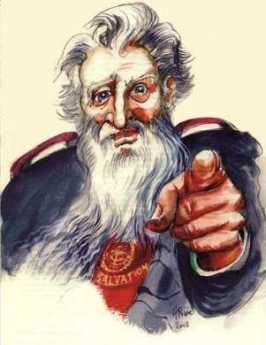
A moment should be spent on the history of the Army. It was founded by William Booth, who was a London pawnbroker before he became a Methodist minister. Sir Arthur Sullivan wrote "Onward, Christian Soldiers" in 1871 a decade before it became so aptly associated with the Salvation Army, and indeed before it became attached to the words of Sabine Baring-Gould . Originally the music had to do with St. Gertrude. The militarism of the organization has offended some people, even elders of the Methodist Church, and the Christian emphasis offends non-Christians. United, or Community, Funds are miffed that the Army usually will not agree to limit its solicitations to their umbrella, and modern sophisticates scorn the 19th Century traditions of Christmas Kettles, and such like. Since the main emphasis of the Army has been on relieving the problems of the Industrial Revolution, like alcoholism, drug addiction, prostitution, some see an implied criticism of modern progress, or of capitalism, or the entertainment business in general. Some people don't like the fact that most of the causes of poverty could be described as self-inflicted. You simply can't satisfy everybody. But when the rehabilitation of alcoholism and drug addiction generally carries a success rate of 25%, the Salvation Army approach -- no matter what you may think of its symbols -- is able to defend the claim of 65% success. If you don't like "Human Needs in Jesus' Name", just try "Practical Success in a Difficult Field" for a subtitle.
|
| Joan Kroc |
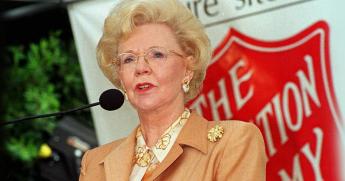
It thus becomes understandable that when in 2004 Joan Kroc, the widow of the founder of McDonalds Hamburger chain, decided to leave her estate of $1.5 billion to relief of the poor, she chose the Salvation Army to run things for her. Her interesting will divide the country into four parts, with 28 cities to receive $36 million grants for the construction of community centers, plus an equal amount for the endowment to run them. The size of the grants was calculated to force the local cities to match them (Philadelphia still has $20 million to go) and the endowments specify no income to be derived if the amount falls below the original $36 million, or otherwise to be limited to a 5% spending rule. She was perhaps optimistic that investment advisors could regularly produce a 17% return, and really truly optimistic if she believed our government could restrain inflation within those bounds. But a sharp business mind shines through these covenants, a very necessary ingredient of successful philanthropy.
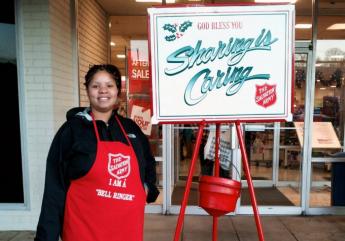
|
| Salvation Workers |
Mrs. Kroc wanted these centers to be located in the areas of worst need; that explains the choice of a 12-acre plot in Nicetown, at the corner of Wissahickon and Hunting Park Avenues. The area now surrounding a former factory for the Budd Company has a 35% poverty rate. But after 2009 it will have an aquatic center of several swimming pools, gyms and fitness centers, a computer laboratory, arts and performing theater centers, and other more traditional Salvation Army facilities. It will also have 27 other American cities with comparable centers to share experiences with, to compete against, and to be put to shame by Philadelphia's superior ideas. We hope.
www.Philadelphia-Reflections.com/blog/1425.htm
Furniture for the Horse Country
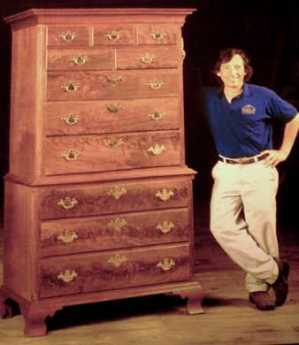
|
| Douglas Mooberry |
Low-end furniture for America is now mostly made in China, and seldom made of wood. Truly American cabinet making tends to be high-end, and high priced. That tendency goes to some sort of extreme around Unionville in Chester County, where a 25-year old company named Kinloch Woodworking holds pride of place. The owner, D. Douglas Mooberry, picked the name Kinloch at random from a map of Scotland, but his selection of southern Chester County was not an accident. The influence of nearby Winterthur has infused that whole region with an interest in fine furniture craftsmanship, and museums like the Chester County Museum and others throughout the nearby Pennsylvania Dutch country provide an ample source of authentic pieces to serve as examples. There's one other factor at work. As Doug Mooberry quickly noticed, people with money usually have lots of it. There really is a market for $28,000 tall case clocks, $18,000 highboys, and $12,000 tables -- if you can convince people in Chester County you are really good.
Although this 12-person company repairs antique pieces, it does not make exact reproductions. It produces new pieces in the old style of the region, based on careful analysis and evaluation of museum pieces from earlier times. Kinloch once aspired to equal the quality of the early artisans, but now aspires to surpass them in quality of materials and workmanship. The more conventional stance of fine artists is to attempt to excel in today's current style, whatever that may be, probably "post-modern". Kinloch artists, however, choose to excel in the style of a long-past era, taking care not to claim the product is antique. Artisans grow up in cooperative clusters; there's a world-famous veneer company nearby and a pretty good hardware company, although the best craftsmen of furniture hardware are still found in England.
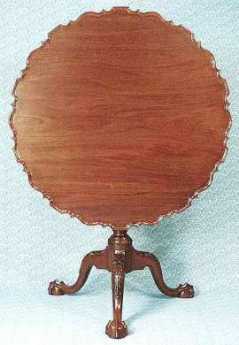
|
| Chippendale Table |
The characteristic style of Chester County furniture in the Eighteenth Century was a mixture of two neighboring cultures, Queen Anne, Chippendale, ball and claw Georgian style of Philadelphia; and the "line and berry" inlay style of the Pennsylvania Germans. If carefully executed, this hybrid style can be very pleasing, and you had better believe it requires painstaking craftsmanship. Others will have to explain the significance or symbolism of intersecting hemi-circles in the lines, and the inlaid wood hemispheres, the berries, at the end of the lines. But the technical difficulty of laying strips of 1/16 inch wood in curved grooves only a thousandth of an inch wider, or the matching of 3/8th-inch wood hemispheres into hemispheric holes gouged out of the main piece -- making the surfaces of the inlays perfectly smooth -- is immediately obvious to anyone who ever tried to whittle. Ultimately, however, true artistry lies in combining two unrelated styles without producing an aesthetic clash. By the way, you would be wise to wax such furniture once a year.
The factory is on Buck and Doe Run Road, and here's another culture clash. At one time, Lammot du Pont cobbled a 9000-acre estate out of several little country villages. In 1945 it was sold to the Kleberg family of Texas, the owners of the King Ranch. Robert Kleberg was an admiring friend of Sam Rayburn but treated the oafish Lyndon Johnson as his personal political gofer. From 1945 to 1984 Buck and Doe was used as one of several remote feedlots for Texas Longhorns bred to Guernseys, the so-called Santa Gertrudis breed. Originally, Texas cattle were seasonally driven to Montana for fattening, then on to railheads for the stockyards. As farmers began to build fences interfering with the long drive over the prairies, it became cheaper to fatten cattle closer to the markets. So satellite feedlots like Buck and Doe Run were developed. You can pack more cattle in a rail car when they are younger and smaller, and advantage can be taken of price swings by suppliers who are close to the market. In this case, the markets were in Baltimore. Since the King Ranch is larger than the state of Rhode Island, such 9000-acre farms were pretty small operations in the view of the Texas Klebergs, an opinion they did not trouble to conceal from the irritated local gentry. The point was even driven home in high society circles by holding large parties at Buck and Doe Run, allowing guests to wander around the roads, unable to find the house of their host even though they had been on his property for most of an hour. In 1984 the Buck and Doe was sold to Art DeLeo, who is busily converting it into a nature conservancy.
War Dance
History Footnote: Before the white man came, the Iroquois "nation"devised rules still characteristic of our modern political parties. At various times, there were five, six, or seven tribes in the Iroquois confederacy headquartered in upstate New York, allied to each other with fluctuating loyalty. Philadelphia's tribe were Delawares or Leni Lenape, but the most warlike and dominant tribe were the Mohawks. Confederations work best when allied against a common foe. The rest of the time, member tribes mostly beat and cheat each other.
The Philadelphia Democratic Party appeals to a number of minority groups and recent immigrants, but it is more meaningful to think in terms of players. For example, university professors are mostly Democrats, but the teachers union is an active political player. Minorities generally vote Democratic, but the Black Ministers are players. Lawyers are rather evenly divided between Republicans and Democrats, but Plaintiff Trial Lawyers, the ones who sue people for a share of the award, are players.
Some people are players but keep it quiet. Certain rich donors are players but don't want to be known as such. The chiropractors and optometrists claim to be players but would rather not have the truth known. The news media and utility companies come close to denying they are players in spite of abundant evidence otherwise.
Well, the local players had a war dance just before the November 2005 elections; the timing was no accident, and it was publicly described as a SEPTA contract negotiation. The issues had mostly been settled in advance, but the real deal-breaker was health benefits, Blue Cross health insurance paid by the employer to escape income tax and to make the pay packet appear smaller to the taxpayers. Step by step for twenty-five years, employers in the form of the Republican politicians had been keeping up a steady drumbeat, trying to reduce the incentive to overspend health insurance because it seemed free, with resulting increase in employer costs. Slowly, business management convinced a majority of the public that "first-dollar coverage" was a villain, since the person covered by the insurance has no skin in the game. Even party loyalists had to admit that it looked as though the tax exemption of health insurance was injuring the image of labor. That concept carried the slogan of "sending jobs to China", or killing the goose that lays golden eggs in the Rust Belt. Five million Health Savings Accounts were sold in 2005 in spite of state laws hampering this form of health insurance, and from experience it seemed certain that five times that many would be sold if early-adopters reported satisfaction. The surrogate was deductibles and employee contribution to health insurance; just about everybody recognizes the need to make some token contribution to health insurance in order to have skin in the game and keep costs down. But not the SEPTA workers. In 2005, the brotherhood of Septa workers would go on strike for fifty days rather than pay one penny of "give-back" for health insurance. Their energy level was high, they were waving their arms, they were ready to overturn ashcans.
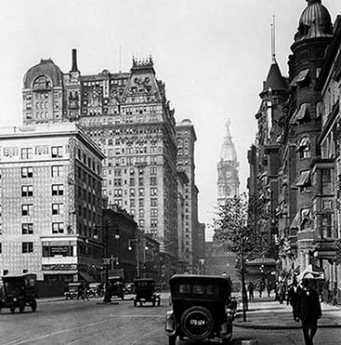
|
| Bellevue |
When union contract negotiations go on for days, all day, the public gets an idea the negotiating table is a shouting match the whole time, with "negotiators" carrying on with tom-toms and tomahawks in an even more physical and extreme model for their supporters on the street corners. For about ten minutes a day, that's true. But then the television people can turn off their lights and the war hawks fan out to talk with their supporters outside the room, which in this case happened to be in the Bellevue Stratford Hotel. Perhaps you didn't know the Pennsylvania Governor has quite a nice set of offices there. Perhaps you haven't noticed that all the parking spaces on the side alleys near the Bellevue "belong" to various politicians. Just try parking there yourself to learn a few facts of Philadelphia life.
In negotiating classes, they teach you never to make the first concession. By that reasoning, no negotiation would ever end. The more practical advice is to forget about any serious bargains until the last day of the contract, or even a couple of days after that. The hard reality is that no one will make a concession while there is time for some invisible player to back out; no one wants to give his constituents time to realize he has sold out their trust or violated their loud, insistent, wholly unrealistic demands. And so in 2005, after the shouting had gone on for some time, and even a real strike began, the Governor finally sauntered into his nice Philadelphia office. Time to get to work.
|
| Ed Rendell |
Those who didn't know him made the comment they could almost believe he was a victim of Attention Deficit Disorder. He talked all the time, moved all the time, and apparently showered all the time. That is, he was in and out of sight all night, but invariably reappeared with fresh shirts, clean shaves, and sharp creases. His aides confided he wasn't very good at "detail work", which is to say he conducted the whole affair on a primeval level of dominance, bluster, charm and implied threat. Don't bother me with facts. Mayor Street, on the other hand, would come in and mumble something incoherent, and then had to leave for an important engagement. Word came in that the school teachers felt they really had to pay a small health insurance deductible, and it wasn't so bad. Foo, no guts.
Somewhere along the line, the newspapers started to echo that deductibles had their merits. Foo, bunch of Communists. The black ministers were reported to feel that if their people all had to pay deductibles, why couldn't the transit workers. Bah, bunch of muddleheads. In the hubbub, someone asked what Andy Stern thought. The trial lawyers didn't have as much to say as they once did; SEPTA had reduced liability costs by $87 million through adamantly refusing to settle any case without going to court. Paper tigers. What about chiropractic benefits, we demand the inclusion of chiropractic benefits. No, said SEPTA, we aren't going to agree to any of that sort of thing. Well, what about twenty visits a year to chiropractors?
One by one, the other players deserted the SEPTA workers. The message from the other tribes in the confederation seemed to be, get what you can for SEPTA, but stop the strike by election day. The Governor produced the razzle-dazzle, a loan to the city to pre-pay the Blue Cross premium, in return for which Blue Cross would reduce the premium. The effect of that was to produce enough cash to appear to add ten cents an hour to the pay packet. We'll have to wait a year to see how this money gets restored to Blue Cross, but that's the general idea.
The strike was over, hurray. The next day, the Democrat party elected Democratic governors in New Jersey and Virginia, defeated some California amendments which would have hurt the trial lawyers and teachers unions. Surely, someone in the Democrat party nationally was telling himself that caving on the Philadelphia transit strike was a small price to pay for that.
SCORE
|
| Mark Maguire |
Frank Pace, formerly Secretary of the Army, founded SCORE, the Service Corps of Retired Executives, in 1964. Philadelphia was one of the main founding chapters but tended to dwindle as business large and small dwindled after the bombing of West Philadelphia by the then-Mayor; former executives living in the suburbs lost interest. In December 2006, Mark Maguire took charge and gave SCORE a new direction. This former executive of Rohm and Haas is not related to the baseball home-run king, but at least his name is easy to remember.
The new sociology of center city demanded that more small businesses be started by minority residents, who have very little family and cultural experience in this sort of activity, which nevertheless is recognized as the main source of job creation in any area. It turns out that the main source of energy in the minority community is among minority women, who are particularly unfamiliar with the problems of small business. So, SCORE needs to dispel a number of misconceptions and unrealistic ambitions, and familiarize these budding entrepreneurs with the tax and regulatory headaches ahead of them, and teach them to be watchful of common traps and obstacles, learn to cope with fair competition, and how to recognize the signs of fraud before it happens to them.
The usual vehicle for teaching these elements of commercial life is to induce the writing of a detailed business plan, which executives can criticize for lack of realism or inadequate capitalization, suggesting ways to succeed in a field that experiences 50-60% failure in the best of circumstances. Some of this requires face-to-face discussions, lectures, and required reading. But much of it can be handled with weekly email consultations, a favorite tool of Philadelphia's SCORE chapter. Much of it can be addressed by referring the client to the proper agency or service business, or bank. SCORE has a strict ethical code for its volunteers, including a prohibition of becoming a vendor or participant in the business.
In addition to the changing nature of new small businessmen, there is a changing demographic of the volunteer executives who do the advising. Over 80% of them describe themselves as retired, but in fact, it is rare for one to be totally retired from all business activity. These guys really like to work, and a thirty-year vacation is not their goal in life. Just by acting as an example, they are establishing an important goal for the young businessmen and women who look to them for guidance. Work is how you accomplish something in life, and work, believe it or not -- is fun.
www.Philadelphia-Reflections.com/blog/1430.htm
Trenton's Tomato Pie Cult
|
| Trenton's Tomato Pie |
The ingredients of a pizza pie are so simple it comes as a shock to learn the Italian community of Trenton, New Jersey, is fanatic about putting the cheese on the dough first, and then tomatoes on top. That's the way an authentic Trenton pizza is supposed to be made, rather than the conventional method of tomatoes first, cheese on top. To emphasize the point, these pizzas are determinedly referred to as tomato pies. And to tell the truth, there is a minor difference in the taste of the product made that way. As this more or less trivial issue is dissected and debated in great detail, an important fact about ethnic food emerges.
Be patient while each ingredient is examined. The crust will rise more in the warm summer than the winter, so it's thicker after it's baked. There is a faint fermentation taste which is more pronounced with a thick crust, but everyone in Trenton agrees this is a minor point. Everyone is also in agreement that most brands of Mozzarella cheese taste about the same. Tomatoes with seeds or without, or homogenized or chunky, make a minor difference. What is ultimately the essence of a Trenton tomato pie is that the cheese is put on top of the dough first, the tomatoes next spread on top, and the pie is then baked in the oven? Not everyone would notice the difference in taste, but it's definite, and in Trenton it's important. However, the locally acknowledged historian states his opinion that the thing that makes Trenton pies distinctive is not the ingredients, but the customers.
The employees of the shop know and respect the regulars, who tend to come to the same shop at least once a week, and call out the bakers by name as they enter. When they order a tomato pie, they give the name meaningfully, almost threateningly. According to the local historian, when the sons and grandsons of the shop owners move out to the suburbs and start a pizza shop in the strip mall, it isn't long before the tomatoes go on first, cheese on top. That's the way teenagers in the burbs are used to pizzas, and that's the way they expect to get them. As John Wanamaker used to say, the customer is always right, so the social rule which emerges is that ethnic food is not shaped by ethnic cooks, but by ethnic customers. To carry the idea a step farther, ethnic food isn't food, it's the old school tie.
Acorn Club of Philadelphia
.JPG)
|
| Trish Brown |
Trish Brown visited the Right Angle Club recently, and told us about our club's feminine neighbor at 1519 Locust Street. She's the charming, witty new club manager of the Acorn Club, who often left this audience of men a little nonplussed about whether she was twitting us. For example, she told us that her club's policy about publicity. The policy states in one place that publicity is welcome, but in another place mention it must not mention the club's name.
.JPG)
|
| Acorn Club |
The Acorn is the oldest club for women in America, having been founded by Mrs. Thomas Biddle in 1889. The ladies of the neighborhood had taken to having walks together, and out of this association came the club, which soon found it needed a place to come in out of the rain. It started at 1642 Pine Street and was in five different locations until the present building was built in 1956. At one time it had 900 members, now has 700, of which 200 live more than 50 miles away. Unlike men's clubs, which are seeing a migration from lunch to dinner, the Acorn heavily favors lunch, usually on the days of local art, musical and literary events. It's one of two Platinum Clubs in Philadelphia, a quality designation for the top 200 (of 6000) national clubs. If you are interested in their cuisine, it may be sufficient to know that the top favorite dessert is creme brulee.
The club dining room seats 110, with 80 seats in other rooms, and has a staff of 11. There's definitely a dress code, but for women that's a little hard to define. Trish observes that it seems to lean toward pearls.
There's a cross-over alliance with the Philadelphia Club, where the husbands of many Acorn members belong. Both clubs are doing their best to adjust to changing times and customs, but Alfie Putnam once noticed a seemingly enduring feature. The flag, he said, is mostly at half-mast.
Frida Kahlo
|
| Frida Kahlo |
The central exhibition of the Philadelphia Museum of Art in 2008 was a collection of the paintings of the Mexican, Frida Kahlo, who was badly injured in a bus accident, spent several years in bed, followed by a lifetime of pain. Lacking formal training in art, she nevertheless worked at it hard and threw herself at her demigod Diego Rivera, the much older but famous painter of murals with a Communist theme. She was semi-bedridden, had a slight mustache, eyebrows that grew across the bridge of her nose, was alcoholic and drug addicted. Diego weighed nearly three hundred pounds and enjoyed a constant succession of philandering experiences. Frida also had a large sexual experience in both sexes; evidently, venereal disease was just an ordinary part of this household. They divorced, remarried, and all that sort of thing. One of her lovers, if that is the term, was Leon Trotsky. These people invented Haight Asbury long before the Hippies of the sixties.
|
| Diego Rivera |
Well, what about her art? Largely confined to bed, Frida tended to paint small canvases, using both herself and her cats as models, sometimes daubing the picture frame with blood. You find extremely fine detail when you get up close, but the canvas maintains a primitive simplicity of tones with great luminosity at a distance. When the viewer does get close, the small details often concern repellant, even disgusting features. Diego never bothered with little details, slapping large chunks of colored fresco on the murals celebrating downtrodden workers with hammers or glorifying Communist leaders with flags. Frida's pictures have much the same color scheme at a distance, but up close are blood and guts, disease, torment and suffering with an unreal organization. Somehow, these people were popular with Hollywood, actresses and models, and the literati like Clare Booth Luce. Evidently, they were excited to know.
|
| Me Generation |
Modern painting abandoned both beauty and representational features during the lifetime of the Rivera family and skipped on to post-modernism, defined as blurring the distinction between real and unreal. Both Diego and Frida were strictly representational throughout their careers but crossed over into the unreal rather earlier than most. The one constant in Frida's work, the one thing she was really interested in -- was herself. Consequently, her attraction for what has become known as the "Me Generation" is easy to understand.
WRTI, Classical Music and Jazz
|
| Susan Lewis |
Susan Lewis recently entertained the Right Angle Club with a description of her life as the scriptwriter for WRTI, the local classical music station. WRTI could be described as one of three local affiliates of National Public Radio, the network content provider headquartered in Washington DC. The other two are WHYY, a talk station, and WXPN, the University of Pennsylvania station devoted to folk, rock, blues and root music. Another way of describing WRTI is that it took over the role formerly served by WFLN before it was sold, incorporating it into Temple University's jazz station. It plays classical music from 6AM to 6PM, and then plays jazz in the evening. Philadelphia thus really only has half a classical music station, when most cities who are home to a major orchestra have at least two. It is not clear whether this anomaly is a comment on the local radio climate or the future of its musical one.
|
| Philadelphia Opera House |
The question came up as to just what is classical music since there are turf boundaries for the affiliates of National Public Radio. Susan Lewis, who has the surprising background of being a former corporate lawyer has apparently given this some thought. She offers the opinion that classical music overwhelmingly consists of music with multiple performers. Orchestras, opera, chorales, and chamber music characterize the topic more than pre-contemporary origins. A brand new symphony would naturally fall into the classical music category, while songs by Frank Sinatra would not, even though excited announcers might call his songs classics. Following this theme, classical music seems to fit with jazz, which consists of several soloists working on variants of a common theme. The sad question thus comes up whether Philadelphia's declining interest in classical music might in some way reflect social fragmentation within a metropolitan community which historically has highly valued cooperation and consensus. One hopes that's not the case.

|
| WRTI RADIO |
Playing a succession of recorded musical selections sounds as though it would be a low-budget operation, but WRTI costs $3.6 million to run, annually. The scriptwriter gets up early, reads the day's artistic news and events, and some auto traffic reports, and records one-minute vocal interludes between the pieces of music. About once a week, a special seven-minute segment is assembled from excerpts from interviews or interludes relating to a theme in the artistic world. One taped recording of carillon music and commentary proved to be quite charming and entertaining, including the news that the carillon in Holy Trinity Church is the oldest in America. Since a bell is a variant of a tuning fork, the bells of a carillon chime with a very long period of decay, creating a problem for both composer and performer to avoid successive notes which conflict unless there is a long pause. These magazine-like pieces of hers are always organized around a main emotional "hook" of some sort, and Susan finds they are very time-consuming to assemble. That leads to a constant succession of inflexible deadlines, just like lawyers' briefs before a legal deadline, generating an excitement strangely exhilarating to the participant, and highly mystifying to outsiders.
As the central focus for dozens of emails and text messages about the goings-on of the local artistic world, the job of town gossip for the art world is an ego trip only suitable for a person who revels, with affection, in the endless wealth of art and anecdote in Philadelphia. As bloggers also know, this job constantly surfaces interesting news tidbits that surprise and please many people. Like the fact that William Penn's hat on top of City Hall is filled with graffiti. Or that a secret colony of Lenni Lenape Indians still exists in town. Or that the forthcoming HP radio standard produces outstandingly high quality.
Ms. Lewis is an asset to our town.
www.Philadelphia-Reflections.com/blog/1521.htm
New Museum of Chemical Heritage
|
| Arnold Thackray |
Eighty percent of the ethical drug industry is located within a hundred miles of Philadelphia, and the whole chemical industry has had its center here for two centuries. The chemical industry is the region's largest manufacturer, now that locomotives and beer brewing have come and gone, but its profile remains low. In fact, chemists personally have a low profile too and harbor a smoldering annoyance about it. No one has been more determined to change that nerdy image than Arnold Thackray, the recently retired President of the Chemical Heritage Foundation. He's not only a big idea man but bubbles with energy and persuasiveness. That largely accounts for the fact that CHF has the second largest endowment among public institutions in Philadelphia, the best library of chemical history in the world, and a growing reputation for fine art concentrated in the field. That's not enough for him, so it came about that a new museum was envisioned, funded and created. But not built; building it was assigned to Miriam Schaefer, a famous go-getter who had the unusual qualification of being squeamish about chemistry. It was her assigned task to find a way to make chemistry exciting to people who were not instinctively excited by it, just exactly because she was the world's authority on that point of view. What was vital was that she was the sort of person who can't resist a challenge, and was capable of thinking, well, big.
With the unlimited backing of Arnold and his board and their almost unlimited financial support, Miriam set about soliciting big ideas from uninhibited people all over the world, and some of their suggestions were even a little too wild to be acceptable. But since the whole idea was to awaken the enthusiasm of anybody, however sullen, who happens to shuffle through the museum, many outlandish suggestions were forced through the filter of a skeptical, conservative, Philadelphia establishment. The result is a series of pleasant surprises, ranging from fine art with a focus on alchemists trying to make gold out of lead, to astonishing computerized graphic displays of the elements of the periodic table fifty feet high, to depictions of Joseph Priestly known as the father of chemistry, a personal friend of Benjamin Franklin, the founder of the Unitarian Church, and a resident of Philadelphia. There's Arnold Beckman's original Beckman spectrophotometer which made hundreds of millions of dollars, was a major factor in the Twentieth century blossoming of biochemistry, and is here shown to be a clever elaboration of a simple idea. Meanwhile, the museum is housed in a massive old bank building, with it is interior reamed out and replaced with as much transparent glass as could support the weight. Inga Saffron the architectural critic, more than foamed over with praise in her review of just the structure itself. Don't neglect to notice the stunning portrait of Gay-Lussac, the man who discovered that water is H2O. The pigments of his portrait were mixed with beeswax, and with clever lighting have an astonishing luminosity.
The museum is part of an emerging conference center, which should attract audiences of chemists for decades. But that's not entirely the whole idea. The underlying vision is to convince those skeptical, non-chemical bozos that not only are chemists rather richer than the rest of us, and smarter, but clever and fascinating, too. Go visit this museum, before everyone else does.
 |  |  |
 |  |
Citywide Social Calendar
|
| Ruth Seltzer |
During the Twentieth Century, the society editor of the Philadelphia Inquirer, Ruth Seltzer, got fed up with trying to attend six or seven weddings on the same day and decided to do something about it. She established a social calendar, where hostesses could list their planned events after first checking to see if there was significant competition for the date. The book, or "The Book", was kept at Caldwell's Jewelry shop across the street from City Hall, and was no doubt good for their business as well. Caldwell's alas is gone, and so is the book.
But the need for a central clearinghouse remains, and some of the same issues continue to surface. There are many more weddings in June than other months, many more Christmas parties at Christmas than other seasons of the year. Unofficial rules were laid down and tactfully suggested by the nice lady at Caldwell's. It was suggested that charity benefits might usefully avoid taking place during the United Fund drive, just as an example. And of course, people will rush to reserve a date far in advance, but then back off if a big Kahuna comes along and squats on the same date. Big Kahunas are a problem if they have already staked out the right to a certain night between Thanksgiving and Christmas. If you have the brass, you can go ahead and schedule a head-on collision with the big Kahuna; if you triumph, you are now recognized as the new bigger Kahuna. If you fail, you have to eat canapes for a month.
Philosophy Means Science in Philadelphia
|
| American Philosophical Society Seal |
In the age of the Enlightenment, science was called natural philosophy; that accounts for the present custom of awarding PhD. degrees in chemistry and botany. The sort of thing which interested Ralph Waldo Emerson was called moral philosophy, and you will have to visit some other place than the A.P.S. if that is what interests you. Roy E. Goodman is presently the Curator of Printed Material (some would say he was chief librarian) at the American Philosophical Society, founded in 1743 by Benjamin Franklin who was clearly the most eminent scientist of his day, having discovered and explained the nature of electricity.
|
| Roy E. Goodman |
Roy Goodman is descended from cowboys and rodeo stars, but in spite of that he gave an entertaining talk recently at the Right Angle Club about this society devoted to useful knowledge, this oldest publishing house and scholarly society in America, once the home of the U.S. Patent Office, and scientific library and museum. They have many rare items in their collection, but the unifying theme is not a rarity, but curiosity. You might say some of the items reflect the whimsy of Franklin, but it would be fairer to say it is an enduring monument to Franklin's universal curiosity about all things.
|
| Nobel Prize Medal |
There are about 900 members of APS, about 800 of them Americans, about 100 of them winners of a Nobel Prize. Let's just make a little list of a very few notables in the past and present membership. Start with the first four Presidents of the United States, add Alexander Hamilton and Lafayette, David Rittenhouse and Francis Hopkinson and you get the idea that Founding Fathers got in early. Robert Fulton, Lewis and Clark, Alexander Humboldt, John Marshall were early members, and more recent ones were Madame Curie,
Wagner Free Institute of Science
|
| Wagner Institute Logo |
William Wagner emigrated to Philadelphia as a prosperous merchant shortly after the nation was formed, becoming a friend affiliated in business with Stephen Girard, although never a partner. Business took him around the world, where he pursued his hobby of collecting scientific specimens. The collection grew until it needed a museum to house it, accordingly built on the family farm somewhat north of the city limits, now 1700 Montgomery Street. A woodprint shows a game of baseball in play in the fields, with the museum recognizably looming in the background. Those fields are now filled with Nineteenth century red brick Philadelphia rowhouses, built later to support the activities of the Museum. Unfortunately, a need for a parking lot was not anticipated in 1848, but the place is quite safe to visit because land directly across 17th Street, also part of the original Wagner farm, was given over to the 22nd District police station. It's even possible the parking issue has since been considered since nearby land was deeded to a Unitarian Church on condition of reverting to the museum if it stops being a church.
|
| William Wagner |
William Wagner became the first director of his museum, following the ideas of his friend Girard a few blocks to the south. Stephen Girard had left his estate to the education of poor white orphan boys; Wagner extended the idea of offering free scientific education to the working public. The example ofBenjamin Franklin's discovery of the nature of electricity with only a second-grade education is a locally dramatic example of the important truth that science can be enjoyed and even skillfully performed without academic preparation or advanced degrees. Science in the early Nineteenth century evolved from Natural Philosophy to what we now call Natural Science, heavily weighted toward geology, botany and zoology with a strong dose of Charles Darwin. Today, those ideas are having a reawakening in the Green (Environmental) Movement, so perhaps a resurgence of interest really is about to appear. The museum might be called a historical record of Nineteenth-century science, although its lecture series are wider ranging and, of course, up to date. Reflecting the intended science education of the working public, many of the lectures are given in the evening and on weekends. Many are given in other locations, like the Free Library branches. The Wagner resembles the Barnes Museum in the sense that two museums once intended to illustrate educational innovations have come to overshadow the public's perception of the educational programs, whereas the cost of maintaining museums grew far faster than the income from endowments. It all resembles academia in general in getting progressively more expensive to provide for.
|
| The Wagner Museum |
The Wagner museum was formally opened in 1854, about the time of the City-County consolidation which relieved the population pressure needing to fill up surrounding fields with redbrick rowhouses, and eventually with Temple University. The formal Institute directorship was transferred to the professional management of Joseph P. Leidy, a dynamo of a man who received the informal title of The Last Man Who Knew Everything. When Leidy retired at the end of the Nineteenth century, the museum was closed to further acquisitions. For those who can remember natural science museums around 1930, the Wagner is strongly reminiscent, but over time it has become one of the few, perhaps the only, surviving example of the type. The building next door is a scientific library, available to scholars by appointment. The Athenaeum and the Mutter Museum are also surviving museum monuments, but even those two have been elaborately modernized. The Wagner resolutely adheres to looking as much like the original as maintenance will permit. The structure is as interesting as the contents; only the lecture topics move forward with the times.
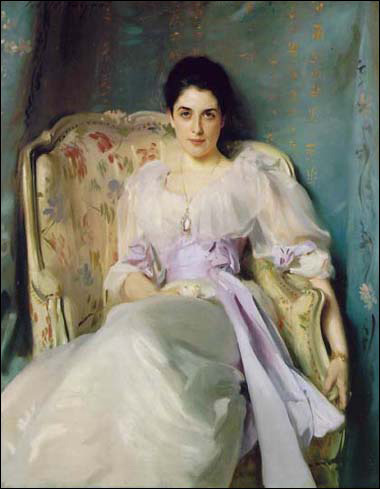
|
| Anna Karenina |
The Institute drifted away from the Wagner family, but a few Wagners of the present generation became attracted by the connection to their name, and have struggled to keep it alive. The board has a few Wagner family members, who do their best to spark the enthusiasm of others who value the lectures, the scientific educational movement, and historical quality of an expensive but unique museum in a difficult neighborhood. Quite a few loyalists throng around the evening lectures with a happy air of joint participation and tradition. It would be hard to overlook the sincerity and courtesy that hovers around the edges of a shared cultural belief. It's a family activity, all right, but it is no longer a Wagner family but a Wagner Museum family. Participants are unmistakeably really happy that visitors have come to see it. The opening lines of Tolstoy's Anna Karenina declare that all happy families are happy in the same way, but that's wrong. The Wagner Museum family are obviously happy but in a unique way. In a nation which so universally prizes the future, here's one group who have seen the merit of having some institutions grow in value by seeming to stay just the way they began.
Molly Maguires of Pennsylvania (2)
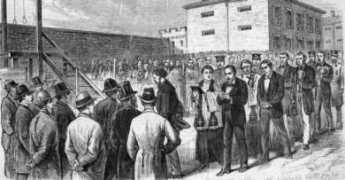
|
| the Mollie threat in the coal regions |
IT was in their interest for both the Molly Maguires and their chief enemies to exaggerate the Mollie threat in the coal regions. Mollies hoped to achieve more pay for less work by intimidating employers, the more intimidation the better. The management of the mines and railroads more shrewdly hoped to mobilize public sympathy to their side, in the newspapers, courts, and legislature, by exaggerating the undoubtedly real menace of lawless, unpatriotic behavior. There have since been great strides in the art of slanted propaganda, and it takes more finesse to mobilize modern opinion. Having watched Hitler and Stalin in action, and noticing our political parties going in the same direction, we would now regard the behavior of 1870 to be crude, and therefore less effective. But there was one very public rebuttal to what the Mollies were claiming. Although they portrayed themselves as oppressed Irish in an English dominated world, their main enemy was himself a well known Irishman.
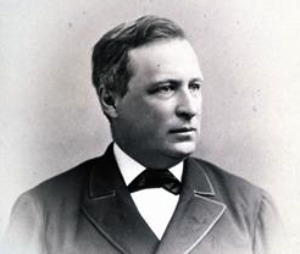
|
| Franklin Benjamin Gowen |
Franklin Benjamin Gowen, President of the Reading Railroad from 1870-1886, was both Irish and definitely larger than life. As one illustration of his extraordinary energy, he died at the age of 53 but had risen from moderate circumstances to control what would become the largest railroad in America by age 34, ultimately being forced from office by J.P. Morgan while still only 50. By some measures, in those sixteen years, he had made the Reading into the largest corporation in the world, even though he had comparatively little interest in and no training in railroading. Although born in Mt. Airy, he apprenticed himself to a lawyer in Pottsville, and at age 26 became District Attorney in the coal region during the first outbursts of Molly Maguire violence. Although he had never gone to law school, he seemed to love the courtroom and continued to work as an independent trial lawyer all during the time he was president of the railroad. One commentator remarked that to read his speeches in cold type was still enough to jeopardize one's judgment. During his later battles for corporate dominance, he twice filled the Academy of Music with stockholders, holding them spellbound for three-hour speeches. On this evidence alone, one. supposes he had a lifelong tendency to stretch facts.
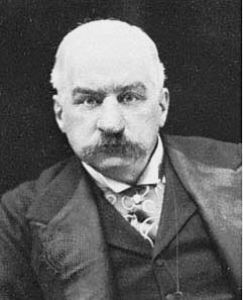
|
| J.P. Morgan |
Following the Civil War, labor relations in this rough coal region became temporarily peaceful. The prosperity of a post-war boom was probably mainly responsible, but it was also true that the labor movement was pretty well smashed by the response to patriotic feelings, slavery was no longer an issue, and huge casualties in the war had created labor shortages. However, these same factors made dominance of the coal and railroad industries more attractive. Franklin Gowen set about merging the small railroads in the coal region into an empire, and used his control of freight costs to force the coal distributors and the coal producers into subservience or forced sales. The charter of the Reading Railroad inconveniently prohibited the railroad from owing mines, but other competitors were legally permitted to do so. Using the fairness argument and probably both bribery and threats, he "persuaded" the legislature to permit a new corporation to own mines, and permitted railroads to own the new corporation. The Reading then promptly owned the mines in a two-step arrangement, couched in bewildering legal language. Gowen had no compunction about doubling freight rates and then doubling them again until he got what he wanted. Anthracite coal was the driving engine of America's Industrial Revolution, and Gowen controlled it. He was a wild and reckless spender, he thought big, and was ready to smash any opposition. His ambition set him to building a transcontinental trunk line which would compete with the Pennsylvania and New York Central lines, both under the control of J. P. Morgan or his allies. This venture failed and became the basis for the present Pennsylvania Turnpike . Ultimately, Gowen's ambitions were thwarted by his reckless spending putting him at the mercy of English bankers, allied to the Morgan interests. Underlying this was an economic fact: Henry Frick had found a way to make bituminous coal into coke, which was a cheaper fuel for steel making than anthracite. Financed by Morgan and organized by Andrew Carnegie, the steel industry moved to Pittsburgh.
|
| John Sidney, founder WBA |
Meanwhile, what happened to the Molly Maguires? The financial panic of 1873, started by the collapse of Jay Cooke's financial company, precipitated layoffs and cost-cutting and stimulated a new rise of labor unrest. The Mollies shot some mine managers, but most of the labor organized under a fairly moderate union called the Workingmen's Benevolent Association. More moderate or not, they still threatened strikes and demanded concessions, and Gowen set about to wipe them out. As headstrong and impulsive as he was it's even possible he believed the Molly Maguire movement was stronger than it really was. But it would not have mattered. The Pinkerton agency was hired, detailed studies were prepared of the nature and leadership of the Molly movement, evidence of wrong-doing was collected, and some of the right people were hanged. Once more, the labor movement was crushed, largely by characterizing all labor unions as lengthened shadows of the Molly Maguires. And labor has never forgotten or forgiven. Even a century later, any sort of labor ruthlessness especially in Congress, is proclaimed justified since any capitalist, or even any Republican, is a covert Franklin B. Gowen. And quite possibly either English or protestant, as well, even though Gowen happened to be as Irish as any of the Mollies.
It's a great pity that seemingly the last opportunity for national adoption of the Whig philosophy of upward social mobility was exiled from American political discourse. Everybody is better off with peace, law and order; given time, our political system does offer everyone at the bottom of the heap a fair opportunity to rise to the top. After a couple of centuries, it thus ought to be obvious that class warfare hurts everyone, helps no one. But at election time, both parties feel compelled to characterize each other as either a Franklin Gowen, or a Molly Maguire.
As a footnote, Frank Gowen died from a gunshot in Washington DC in 1889. An extensive investigation was conducted, and there is almost complete certainty that no Molly Maguire was responsible. But the bullet came from a strange angle, there was no suicide note, and it remains possible that someone else, not suicide, was responsible. Gowen had plenty of other enemies.
Harvard Progressives in Philadelphia
|
| Theodore Roosevelt |
The Progressive movement of the early 20th century is most concisely viewed as a futile social reaction to the vast changes in America caused by urbanization and industrialization after the Civil War. The transcontinental railroad threatened to destroy the wild, wild West, but the enduring environmental movement had overtones of even greater hostility toward industrialization, the cause of it all. In this sense, it joined forces with socialist and labor reform movements, in hating the newly rich, the spoilers, the Robber Barons. It briefly shared sympathies with anti-immigrant groups, while simultaneously expressing great sympathy with the decisions of the people, as opposed to corrupt politicians. There was a strong Calvinist streak in Progressivism, linked back to New England and Harvard its intellectual center. Regardless of any other contradiction, it reflected the viewpoint of Theodore Roosevelt. Teddy Roosevelt, "that damned cowboy" in the view of conservatives, did not invent the ideas of Progressivism, but he surely personified them, illustrated them in action. This confused turmoil of resentments was knocked off the front pages by a real threat to European civilization, the First World War. A terrifyingly well organized German war machine took the place of Robber Barons as a symbol of what was wrong with the world. The crash of 1929 and its ensuing long depression finally put an end to older controversies; it pushed the "reset" button.
|
| Henry Brooks Adams |
To understand the position of Philadelphia's upper crust during the Progressive era, four or five names need to be fleshed out. Owen Wister and J. William White would be important Philadelphia links to the Bostonians Henry Adams and Henry James. All of them were leading literary figures, and all of them were close friends of Teddy Roosevelt. Roosevelt, it might be recalled, was the author of thirty-four books. This little group of literary giants were members of the leading families of Boston, New York, and Philadelphia; what they said, mattered. Although today Owen Wister is mainly known as the author of The Virginian, the first of the cowboy stories of the Wild West, he was, in fact, an observer of the social climates of not only the West, but the deep South (Lady Baltimore ), and the East Coast ( Romney). Some idea of his political leanings can be gleaned from his presidency of the Immigrant Restriction Society, and the authorship of an article called Shall We Let the Cuckoos Crowd Us From Our Nest . Wister has been called "the best born and bred of all modern writers", referring to his descent
Tour of Duty in 'Nam
|
| Vietnam War |
Col. Dan McCall talked to the Right Angle Club about wartime experiences in Vietnam recently. He really didn't want to, though he was being asked to talk about retirement planning, or asset allocation, or something else he knew something about. But the Program Chairman this year is also a Colonel, and wasn't about to be talked out of it; he wanted Vietnam, sir, and nothing else. So, for the first time in forty years, he did. He hadn't talked about it with his family or, during a career rising from Lieutenant to Colonel, with his associates in the National Guard.
Perhaps a little slow and fumbling at first, we heard of going to a place where it's 120 degrees in the shade, every day. Where he fainted from a heat stroke on the first day off the plane in Saigon, and soon found that it happened to everyone. Within thirty days, every single person had dysentery. The plane that lands troops in Saigon doesn't turn off the engines, and takes off as soon as the last man deplanes. As well it might because it attracts sniper fire as it takes off. Once there, the only form of transportation for anyone going anywhere is by helicopter; plenty of peasants with chickens in their laps are taken along, too.
|
| Ho Chin Minh Trail |
His unit, the 82nd Airborne, was deployed to the west of Hue, the ancient capital. The country is near the border with North Vietnam, and the land is a fairly narrow strip between the ocean and the Laotian border. The Ho Chi Minh trail, where the enemy comes from, is just over the border inside Laos. Our troops never go there, but B-52 bombers go there plenty, leaving impressive craters in the ground. The unit was mortared every night, and rockets made an impressive noise as they went overhead toward Hue. The American forces almost never went out at night. Deployments in the jungle lasted 45 days, without baths or toilets; mostly, you walked into the enemy by accident on the trail. One of the prizes was a Chinese officer, carrying much better maps of the region than the American Army had. One night, sniper fire seemed to be coming from a small island in the river, and the response was to send thousands of shells back, filled with 3-inch steel darts. The next morning, every tree on the island was normal enough on the Laotian side, but nearly covered with steel darts on the Vietnam side. Although the command from headquarters was to report a body count, there were no bodies to count. At the end of one 45-day deployment, there had been no food or water for three days. When the "ships" came to take them out, there was a celebration with rice wine. You make rice wine by soaking stalks of rice in water, letting it ferment. The water is pretty murky, to begin with, and gets worse as it ferments; you have a good time, anyway, with the villagers bringing in a pig to roast.
|
| 82nd Airbourne Patch |
The CIA had its own private army, Rangers and Special Forces. There were local mercenaries, mostly from Thailand. The 82nd Airborne - The All American Division - had a tradition of parachute jumping in every military engagement since World War II, but in the jungle there was no place for, or point in, jumping. But at the end of their deployment, they jumped once, anyway. When you got home, the movies were kind of a joke, but Apocalypse Now came close to giving the right feeling. Although of course people asked what it was like, you didn't talk about it. No one did.
One member of the Right Angle Club who had spent a year there, muttered an answer. "And people didn't really want to hear about it, either."
Food
In one of those intervals when several casual acquaintances are detained together, awaiting the beginning of some ceremony, there was desultory conversation, jumping from topic to topic. The recently retired President of the University probably had a delayed lunch on his mind. "The older I get, he said with a smile, the more important food seems, and the less important sex does." The considerably younger group knew how to respond to this sally, which was with broad but inaudible smiles, and no comment. This was, after all, the President of the University making a faux pas.

|
| Women Cooking |
In retrospect, it seems remarkable the rest of us could be so obtuse. During the working years of life, meals are fitted around the workday; the employer defines the day's structure, and meals fit around it. That pattern persists on non-workdays, imposing its schedule even on those who do not go to work. In Haddonfield, the town whistle blows at noon, in Philadelphia the clock opposite City Hall booms twelve. However, in a hospital, nursing home or retirement community the eight-hour day for the cooks sets mealtime. Breakfast comes at 9 AM, dinner comes at 5 PM. The wait staff starts clearing tables ninety minutes later because they want to go home. To working-class families, this sort of schedule is not objectionable. A man who does heavy manual labor wants his dinner ten minutes after he gets home at night. The remarkable docility of his wife contains a faint hint that he can get grouchy or worse if he has to wait for a jot for dinner. There are others who respond well to institutional mealtimes; you can see them crowded around the locked entrance of the dining hall, waiting for doors to open. Diabetics, too, have learned the wisdom of regular meal hours. All of these people can be expected to rally around the administration if someone starts to urge more flexible and leisurely meals; they would have trouble understanding the issue. What's lacking, of course, is the deference one comes to expect when dining out. At a restaurant, the diner sets the time he wants the meal to start and makes the decision when to call for the check and declare the meal is over. If the waiter hustles you, cut his tip. In a restaurant, the meal is a special occasion, caters to your wishes. In an institution, the purpose is to get people fed. In general, people go along with this because they are on a budget, and understand quite well the dining organization wishes to minimize complaints, but only within the constraint of minimizing labor costs.
|
| Breakfast |
If that's the system we live by, it really would seem reasonable to contemplate a return to having the big meal of the day at noon, in the style of the Victorian era or the hotter siesta countries like Spain, Greece, and southern Italy. Commuting twice a day is probably the problem that switched American custom to having a big meal in the evening. But in retirement, all this is no longer an issue. It takes time for customs to change, but it almost takes a century to change breakfast habits. For half a century, we have denounced high-fat breakfasts, and breakfast still responds slowly. There was a time of my childhood when breakfast consisted of fruit, cereal with heavy cream, fried or scrambled eggs with bacon, two glasses of rich milk, two pieces of toast and butter. Right now, it has settled on quick foods before train time, orange juice with one slice of toast and coffee; a so-called continental breakfast. But a Frenchman wants a croissant, a German wants a sausage, a Spaniard wants eggs with tomato sauce. An Englishman wants kippered herring with his breakfast tea. And an Australian insists on tomatoes for breakfast, so help me. Now that many women are working late hours, there is more eating supper in restaurants, and lunch is mainly a quick lunch. But most people prepare breakfast for themselves, at home. They buy the ingredients for old favorites at the same place, usually once a week, and once a pattern is established, it seldom changes. So if you retire to a CCRC, it would be wise to leave your habitual breakfast without tampering. Switching the main meal of the day to noontime, however, could create the opportunity for leisurely dining, even recreational dining. And the staff could get home for their TV program without hustling people to finish their supper. That is unless golf is a big feature of the place.
|
| Cowboy Casserole |
One of the major reasons couples enter retirement communities, is that the woman of the pair has become tired of cooking. It's a little hard to know what they mean when they breeze past that comment, because it may really mean that some serious illness has come along, which they would prefer not to discuss with strangers. Or it may reflect early Alzheimer's Disease, usually manifested by repeatedly walking away from a heated frying pan with smoke or even fires above it. Substituting an electric stove lessens this home hazard for a while, but eventually, it leads to a demand that something drastic must be done. There are even a few upper-crust families who have always had their own cook. That has its limits, however, and in one case I know a former college football hero went to cooking school and learned some special dishes to entertain his guests. Somehow, that always seemed just a little strange, until the subject of kitchen restoration came up with his wife. Not interested in that nonsense, harrumphed this lady who could obviously afford to restore a dozen kitchens if she chose. And then she uttered the phrase which unlocked the whole situation. "My mother," she said with finality, "Never set foot in the kitchen."
The sort of food that bachelors and widowers eat is apt to bring tears to your eyes. The only for-sure case of scurvy I ever saw in a long practice of medicine afflicted the Treasurer of my own hospital. It proved easier to give him vitamin pills than to reform his pizza-for-breakfast habits, regardless of how grateful he was to have his teeth stop falling out. Nevertheless, when I became a widower after sixty years of marriage, I was still puzzled by the question, asked twice by two old friends, "Have you been getting any casseroles, lately?" As time goes along, the meaning of this question gets clearer, but the problem got solved in a strange way. I share a cleaning lady with the family next door, where the lady of that house is a truly outstanding French cook. The cleaning lady started bringing me some outstanding dishes, the source of which was soon clarified. She had begged the famous chef lady to teach her how to cook these fancy things and was quite proud of her new accomplishments. However, the grim fact emerged that her working-class husband absolutely wouldn't touch that stuff, and so she brought it to me rather than stop the cooking lessons. By this route, we get to a dinner conversation held at a table for eight in a nearby retirement village. Three women and five men, far from an average assortment in a predominantly female environment. One extroverted lady, the center of all activities, made an exciting proposal. Why don't we set up a table for eight men and go into the kitchen and cook special things for the poor dears? The idea, however, was immediately squelched by another lady at the table. "Why in the world would you want to concentrate what few men we have, all in one place?"
Tales of the Troop
 |
| Dennis Boylan |
Dennis Boylan, the former commander of the First Troop, Philadelphia City Cavalry, has been poking around in the archives up at the Armory, and was invited to tell the Right Angle Club about it. In all its history, there have only been 2500 members of the troop, but they have been a colorful lot, leaving lots of history in bits and pieces. The troop boasts that it has seen active duty in every armed conflict of America, and means to continue to fight as a unit of the Pennsylvania National Guard. However, we have lately had so many actions, the troop has had to split off units to be able to go to the Sinai Peninsula, Bosnia, Kosovo, Iraq, Afghanistan and whatever is going to come next. An eighteen month tour of active duty takes a lot out of a citizen soldier's life, but no one is complaining, and there is no fall-off in volunteers.
Although most troopers are polite and taciturn, it is probably hard to remain unaffected by association with people like A.J. Drexel Biddle, a pioneer of the bayonet and hand-to-hand fighting, much sought after for training other units of the military. Or George C.Thomas, who was a golf course architect, but also a seaplane expert, responsible for the seaplane ramps next to the Corinthian Yacht Club along Delaware. Or Rodman Wannamaker, responsible for aeronautic development, also down in the marshes where the Schuylkill joins Delaware. Robert Glendinning, who was notable for other adventures, was also an early pioneer in airplanes. As a matter of fact, Henry Watt had himself flown from Society Hill to Wall Street in a seaplane, when he was President of the New York Stock Exchange.
It's hard to believe, but a former trooper named Eadweard Muybridge distinguished himself in the art world, as a result of a bet with Leland Stopford, that a horse at a gallop reaches a point where all four feet are simultaneously off the ground. The consequence was a famous set of rapid-sequence photographs which are quite famous at the Pennsylvania Academy of Fine Arts. There are elephants, horses, people in various states of undress which remain as interesting artworks as well as scientific evidence that horses feet do indeed leave the ground. But in case anyone believes that Muybridge was some sort of sissy from the art world, there is the story that he caught his wife in an affair and shot the other man dead. As one might expect, the jury found him not guilty, on the grounds of justifiable homicide. With a name like Eadwaerd, it's probably necessary to demonstrate your manliness.
Robert Glendinning, class of 1888 at Penn, became Governor of the New York Stock Exchange, founded Chestnut Hill Hospital and the Philadelphia School for the Deaf. And Thomas Leiper makes a pretty good claim for starting the first railroad in America. It was only 2 miles long, in Swarthmore, and built because he was not permitted to extend his canal for the purpose of transporting stone from upstate quarries. The railroad developed into the Pennsylvania Railroad; Leiper's house, "Strathaven" is still an important Delaware County landmark.
 |
| Tank in Philadelphia |
And then, there's the story of the salute to the QE2. When the liner made a tour up the Delaware, a search was made for cannons to provide a proper salute, and the call came to the Troop. Well, they had a tank, and they could fit a simulator on the tank's gun. So, the tank rumbled down Broad street to do its duty. South Philadelphia responded in character, too. Instead of stopping to admire the novelty of a moving tank, the drivers just honked their horns and drove around it.
The Republican Court
|
| Elizabeth Schuyler Hamilton |
A popular legend of our founding fathers depicts a sudden 18th Century flowering of talent, even genius, establishing a new nation. More recently, historians have searched for personal material about the individual founders, humanizing them with warts, so to speak. A question nevertheless arises how a nation with the present population of Detroit could produce such outstanding leadership in what was then a scattered colonial frontier region. Men, that is. In our legends, the founders were all men.
Long before the feminist movement gathered momentum, historians like Rufus Wilmot Griswold and Abigail Adams Smith had chronicled the impact of the high society of George Washington's term of office as president, which was in part a conscious effort by Washington to show the new republic to the world, cutting just as fine a figure as the nations of old Europe. Martha Washington, soon called Lady Washington, was an uncomfortable central figure in the new social scene, and her dismay at being the President's wife, her anxiousness to retire from prominence as soon as his term was over, suggest the idea for a Republican Court probably did not start with her. Elizabeth Schuyler Hamilton, Alexander Hamilton's wife, might seem more likely but the real originator is not known. For present purposes, a plausible theory is that soldier George Washington and bachelor James Madison had the concept but couldn't pull it off; and then some determined ladies of the court soon showed them all, what was what.
|
| George Washington |
George Washington began the process by instituting formal receptions for visiting males and Martha cooperated by holding Friday evening receptions, at which she was introduced to the wives of important political figures. The regular weekly events of the Presidency soon consisted of a reception by George Washington for new foreign ambassadors and other important foreign visitors, with a formal state dinner with a politically balanced invitation list on Thursday evening, and Lady Washington's reception on Friday with primarily a social purpose, leaning somewhat in the direction of letting the wives of important politicians shine in the social limelight. While the receptions were usually conducted with scripted formality, some notable exceptions were thought worthy of comment. Over twenty years earlier, Washington at Valley Forge had danced for three hours with Cathy Greene, the wife of Nathaniel Greene. When the widow Greene passed through one of the much later presidential levees, Washington suddenly bent over and kissed her, as "an impromptu act of spontaneity." The effect of the levees was to unite the elites of wealth and power, coming to Philadelphia from all thirteen colonies, now risen to statehood. Plantation owners from the South, ship owners, and merchants from the North met the daughters of socially prominent families and quite frequently married them. A courteous and civilized environment unified the new nation at its pinnacle by having local leaders mixing with other local leaders, becoming national leaders in the process. A politician in this new nation could rise to being someone of consequence socially. To be skillful in the social graces, particularly if there was wealth associated, was to advance in politics; to be boorish or loutish was to drop down somewhat in the scale of political influence, slowly but surely losing power to those who did have such graces. Put a backwoods politician into new formal clothes, force him to behave in an unaccustomed way in the midst of those more skillful at it, enlist the fearsome pressure of his ambitious wife to shine in the spotlight; and the fear of looking foolish soon enough pushes him toward conformity.
|
| Anne Willing Bingham |
After the first year, then the developing Republican Court. Martha Washington, of course, had her own mansion at Mount Vernon, but Anne Bingham had one within easy walking distance of Independence Hall. The Wife of the richest man in America, Anne Willing Bingham was the daughter of Thomas Willing the head of the most prominent merchant family in Philadelphia. Anne's husband William Bingham had achieved richest-man status at the age of 28 (by running a large privateer fleet in the Caribbean)and was not only able to build a splendid mansion patterned after that of a London aristocrat at 3rd an Spruce Streets,but had taken his young and beautiful wife on an extensive tour of the royal courts of Europe which lasted several years. It is said that Robert Morris later contributed to his own bankruptcy by attempting to match the Bingham mansion with a Morris mansion at 7th and Market, which had to be torn down for lack of money before it was completed. Since most of the wealthy hostesses attempting to achieve prominence in the newly forming Court had never been to Europe, there was no choice but to accept the judgment of Mrs. Bingham in such matters, especially since she had the biggest showplace in town. While the truth of a story about her is uncertain, it accurately illustrates the flavor of the social atmosphere that it could be said that the Dauphin, heir to the throne of France, once went to her father to request her sister's hand in marriage. The young prince was then living in exile at 4th and Locust, in temporarily impoverished circumstances. Old Tom Willing, as the story goes, said No. "If you do not become the King of France, you will be no match for her. And if you do become the King, she will be no match for you."
It does seem to be true almost every prominent lady in the Republican Court was described by contemporaries as astonishingly beautiful, but at least in the case of Anne Willing Bingham, her surviving portraits support this description. John Adams, who had his brilliant wife Abigail for comparison, was overwhelmed by Mrs. Bingham's ability to hold her own on political subjects at the dinner table. And George Washington, who loved to dance with the prettiest lady available, greatly favored Anne as a partner. In time, she asserted herself to the extent of pestering Washington into having his portrait painted by Gilbert Stuart when the painter was in town. Washington ordinarily disliked having his pictures painted, avoiding it when he could. There are nevertheless a great many pictures of Washington on display, crossing the Delaware and whatnot, all showing the same grim face. After his death, it became necessary for most of the many new pictures of him to attach the same Gilbert Stuart head to a variety of imaginary depictions. Benjamin Franklin, by contrast, seemed to enjoy the experience of being a sitter so there are many more portraits of him actually drawn fro life. Add Washington's social sponsorship an almost unlimited personal budget for parties, and Anne Bingham quickly established herself as the reigning queen of the court without even provoking Martha Washington's hostility. This was a busy ladies' world; one new arrival in Philadelphia described herself as exhausted by having to return the courtesy visits of ninety different ladies during her early weeks in town. The expense of such competition emerges from brief reflection on the variety of clothes needed to keep up with changing styles, and the elegance of carriages, footmen, etc.
|
| The Chew Sisters |
Anne Willing Bingham was soon joined at the center of things by two Chew sisters, naturally referred to as astonishingly beautiful, who not only had their own mansions, but also Cliveden the summer place in Germantown as available venues for parties. It was commonly stated to be "social suicide, not to be home when the Chew sisters came to call." Delicious gossip was, of course, a strong undercurrent in such a social whirl, and Harriet Chew Carroll made a significant contribution. This daughter of Benjamin Chew the former Chief Justice (and Son of William Penn's personal lawyer)had married the son of very rich Charles Carroll of Carrollton, Maryland, but had to drop out of society because of notoriety associated with her abusively alcoholic husband. Similarly, Catherine Alexander Duer, who had married the son of the New Jersey patriot Lord Stirling, lost her social standing when her husband got deeply into debt in ventures with Robert Morris to the tune of today's equivalent of $40 million. As a Treasury official, there was a question of Duer's using public money to speculate privately, although he died in debtors prison before matters were completely clarified. His wife, who was known for having fifteen different wines on the dinner table, ended up her days running a boarding home to support herself. No doubt other transgressions were suppressed or covered up, while the political process was sufficiently advanced even in the early days of the Republic, to introduce some deliberate falsehood into the gossip mill. No doubt, one of the strongest drinks at the receptions was the bubbly wine of knowing all the inside scoop. And meanwhile, the potential disgrace of falling from favor was immensely powerful in enforcing conformity among those who might otherwise think themselves immune to it.
Some People were left out for various reasons, even if they could keep up financially or politically. It's always a little hard to identify why some people are social duds. Abigail Adams Smith seems to have been one of these, a constant source of adverse commentary about the extravagance, hypocrisy, etc., etc. English literature at this time has Jane Austen and William Makepeace Thackery, Pope Swift, and Dr. Johnson to satirize and constrain the social whirl, but American seems to have produced little more than correspondence and hushed remarks. The feeling of resentment was constantly growing in Republican circles, however, feeding a growing undercurrent of hostility undermining something so elitist and therefore somehow UnAmerican. After ten years in Philadelphia elegance, the District of Columbia was discovered to be scarcely more than a dismal swamp when the capital moved there, a place quite unsuited to high society. Dolley Madison revived things somewhat while acting as hostess for the widower Thomas Jefferson, and when her husband became the next President, opened her receptions to the general public. One can easily imagine the intense hostility of Andrew Jackson to any of this, however. Washington DC has since evolved a pallid political social whirl because America still has politically ambitious rich folks and plenty of money for indirect lobbying. But it hasn't ever been the same as the glory days in Philadelphia, and probably never will be. Present members of the financial/political elite who now work in Washington are in a great hurry to leave town every weekend, abandoning its empty office building to the tourists and civil servants.
|
| The Republican Court |
The Republican Court served an important role in helping America unify thirteen colonies into a single nation. Because Philadelphia was for a time the center of the country, economically, socially and politically, all people of prominence in here, wanted to know each other. Variations of wealth and breeding stratified the women somewhat differently from the Variations of wealth and power of their husbands, ad constant mixing of the two strata unified the leadership of the new nation in ways that would have developed more slowly without it. The forced conversations of the receptions stratified independently but helped all the newcomers to the scene to adapt to the realities more comfortably. Each group, private and public watched a constant parade of aggressive climbers sort themselves out and searched for how they had made out; wealth got you to the top in one group, private and public, watched a constant parade of aggressive climbers sort themselves out and searched for how they had made out; wealth got you to the top in one group, power got you there in the other. But in both groups, the cruelties of social striving made the iron rule clear that such things as wit, gracefulness, physical attractiveness, education and breeding were qualities that floated you to the top of the soup of any flavor. When you are forming a new nation, perceptions of that sort are important to acknowledge. The American aristocracy could be circumvented among the many ways to the top, could be sneered at by those who lacked its unattainable features, and could be sniggered at by real aristocrats of real aristocracies in Old Europe. But it served well enough as a role model for a constant stream of new immigrants, and set a pattern for new communities of the interior, also seeking a sense of cultural direction. Like the breeding of horses and dogs that is such a constant upper-class avocation, there is a genetic message, too. Rich men marry beautiful women, so their children or grandchildren tend to be handsome. Handsome or not, gracefulness in social circles is learned at home. Darwin teaches you one thing, Adam Smith's hidden hand teaches another; both are worth attending to. Given eight or ten generations, this sort of evolutionary pressure forms a community, then a nation. It has certainly left major imprint on Philadelphia.
|
| Abigail Adams Smith |
On the rest of the nation as well, but in different ways. Along the East Coast, first families tend to persist and went to school so to speak in Philadelphia during Washington's presidency. Mary Ann Goodrich was a witty and Wealthy wife of a Connecticut political leader. Elizabeth Schuyler Hamilton was the famously vivacious wife of Alexander Hamilton of New York. Alice De Lancey Izard was the toast of Charleston, South Carolina. Patsy Jefferson Married Thomas Randolph of Virginia. Mary White Morris of Philadelphia had a bumpy trip as the wife of Robert Morris. In East Coast high society, the ladies usually have middle names.
Over three centuries, three main streams of immigrants plodded their way across the continent to the West and then merged. There were westward pioneers from north of Philadelphia with a certain kind of accent, from South of Philadelphia with another, and from Philadelphia with the normal way of talking. Each of them was following role models within its own cultural pattern, but the significance of middle names is now only a tip-off to insiders. There are patches of country, like Appalachia we are Texas, which brush off any allegiance to distant origins. But to the degree we are unified, the Philadelphia mixing bowl of the Social Scene during George Washington's presidency is a big part of how we got that way.
Heron Rookery on the Delaware
 |
| Great Blue Heron |
When the white man came to what is now Philadelphia, he found a swampy river region teeming with wildlife. That's very favorable for new settlers, of course, because hunting and fishing keep the settlers alive while they chop down trees, dig up stumps, and ultimately plow the land for crops. As everyone can plainly see, however, the development of cities eventually covers over the land with paving materials; it becomes difficult to imagine the place with wildlife. But the rivers and topography are still there. If you trouble to look around, there remain patches of the original wilderness, with quite a bit of wildlife ignoring the human invasion.
 |
| Heron Nests |
Such a spot is just north of the Betsy Ross Bridge, where some ancient convulsion split the land on both sides of the Delaware River; the mouth of the Pennypack Creek on the Pennsylvania side faces the mouth of the Rancocas Cree on Jersey side. In New Jersey, that sort of stream is pronounced "crick" by old-timers, who are fast becoming submerged in a sea of newcomers who don't know how to pronounce things. The Rancocas was the natural transportation route for early settlers, but it now seems a little astounding that the far inland town of Mt. Holly was once a major ship-building center. The wide creek soon splits into a North Branch and a South Branch, both draining very large areas of flat southern New Jersey and making possible an extensive network of Quaker towns in the wilderness, most of whose residents could sail from their backyards and eventually get to Europe if they wanted to. In time, the banks of the Rancocas became extensive farmland, with large flocks of farm animals grazing and providing fertilizer for the fields. Today, the bacterial count of Delaware is largely governed by the runoff from fertilized farms into the Rancocas, rising even higher as warm weather approaches, and attracting large schools of fish. My barber tends to take a few weeks off every spring, bringing back tales of big fish around the place where the Pennypack and Rancocas Creeks join Delaware, but above the refineries at the mouth of the Schuylkill The spinning blades of the Salem Power Plant further downstream further thin them out appreciably.
Well, birds like to eat fish, too. For reasons having to do with insects, fish like to feed at dawn and dusk, so the bottom line is you have to get up early to be a bird-watcher. Marina operators have chosen the mouth of the Rancocas as a favorite place to moor boats, so lots and lots of recreational boaters park their cars at these marinas and go boating, pretty blissfully unaware of the Herons. Some of these boaters go fishing, but most of them just seem to sail around in circles.
 |
| As Seen From Amico Island |
Blue herons are big, with seven-foot wingspreads as adults. Because they want to get their nests away from raccoons and other rodents, and more recently from teen-aged boys with 22-caliber guns, herons have learned to nest on the top of tall trees, but close to water full of fish. And so it comes about that there is a group of small islands in the estuary of the Rancocas, where the mixture of three streams causes the creek mud to be deposited in mud flats and mud islands. There is one little island, perhaps two or three acres in size, sheltered between the river bank and some larger mud islands, where several dozen families of Blue Herons have built their nests. One of the larger islands is called Amico, connected to the land by a causeway. If you look closely, you notice one group of adult herons constantly ferries nest building materials from one direction, while another group ferry food for the youngsters from some different source in another direction. At times, diving ducks (not all species of ducks dive for fish) go after the fish in the channel between islands, with the effect of driving the fish into shallow water. The long-legged herons stand in the shallow water and get 'em; visitors all ask the same futile question -- what's in this for the ducks? The heron island is far enough away from places to observe it, that in mid-March its bare trees look to be covered with black blobs. Some of those blobs turn out to be heroes, and some are heron nests, but you need binoculars to tell. When the silhouetted birds move around, you can see the nests are really only big enough to hold the eggs; most of the big blobs are the birds, themselves. There are four or five benches scattered on neighboring dry land in the best places to watch the birds, but you can expect to get ankle-deep in the water a few times, and need to scramble up some sharp hills covered with brambles, in order to get to the benches. In fact, you can wander around the woods for an hour or more if you don't know where to look for the heron rookery. Look for the benches, or better still, go to the posted map near the park entrance south of the end of Norman Avenue. There are a couple of kiosks at that point, otherwise known as portable privies. Strangers who meet on the benches share the information supplied by the naturalists that herons have a social hierarchy, with the most important herons taking the highest perches in the trees. That led to visitors naming the topmost herons "Obama birds", and the die-hard Republicans on the benches responding that the term must refer to dropping droppings on everybody else. That's irreverent Americans for you.
There is quite a good bakery and coffee shop just north on St. Mihiel Street (River Road), and the new diesel River Line railroad tootles past pretty frequently. That's the modern version of the old Amboy and Camden RR, the oldest railroad in the country. It now serves a large group of Philadelphia to New York commuters, zipping past an interesting sight they probably never realized is there because they are too busy playing Hearts (Contract Bridge requires four players, Hearts are more flexible). However, there's one big secret.
The birds are really only visible in the Spring until the trees leaf out and conceal them. Since spring floods make the mud islands impassible until about the time daylight savings time appears, there remains only about a two-week window of time to see the rookery, each year. But it is really, really worth the trouble, which includes getting up when it is still dark and lugging heavy cameras and optics. Dr. Samuel Johnson once remarked that while many things are worth seeing, very few are worth going to see. This is worth going to see.
And by the way, the promontory on the other side of the Rancocas is called Hawk Island. After a little research, that's very likely worth going to see, too.
Cushman Club for Lonesome Actresses
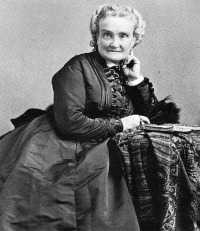 |
| Charolotte Cushman |
Lydia Ellicott Morris was married to another member of the Quaker colonial aristocracy, George Spencer Morris; both of them were active members of many organizations, including the Philadelphia Savings Fund Society, Friends Hospital, and several of the clubs on Camac Street. Their home for many years was located at 225 South Eighth Street. George Morris was a senior partner of Morris and Erskine, Architects. One day, Lydia was riding on a trolley car.
On the trolley, she overheard two young actresses fretting over the problem that traveling actresses were forced to live in hotels and boarding houses along with traveling salesmen. This circumstance forced them to experience much-unwanted attention and made being an actress a difficult occupation for respectable women. Lydia promptly got off the trolley and formed an organization raising funds to create in 1907 a boarding home to provide safe, respectable, inexpensive lodgings for actresses in traveling shows, playing in Philadelphia. It was named after Charlotte Cushman, the first internationally famous American actress, and located at 1010 Spruce Street. Charlotte Cushman had no connection with the club, but her fame can be appreciated from the fact that in 1874 after her final performance, 15,000 people were reported to have serenaded her outside of New York's Fifth Avenue Hotel. The Ninth Regimental Band played, while fireworks illuminated Madison Square. Ms. Cushman died in 1876.
Another major donor to the club was a Mr. Peterson, otherwise unidentified, who gave them $50,000. Further funds were raised at five annual teas. In 1925, Philadelphia was a major center for the film industry, and much Charlotte Cushman Club early history relates to movie associations. Much of the early endowment was unfortunately lost in the 1929 stock market crash, however, and the club continued only a subdued presence for a number of years. By 1999, it was clear that the original purpose was not really needed, and the club was disbanded. Its possessions, including the last of several clubhouses, the collections, and a rather valuable library, were sold off, and most of its other belongings were donated to the Franklin Inn Club. The club began a new existence as the Charlotte Cushman Foundation, first endowing the Charlotte Cushman Board Room and Exhibit, at the University of the Arts, and then in 2001 began making grants to local nonprofit theatre groups. At present, the Foundation dispenses an income of about $45,000 yearly among 43 non-profit theatrical societies which continue in Philadelphia. Present dominant activity is to select the Leading Actress in a Play, as part of the annual Barrymore Awards. The rise of the club reflected the vibrant downtown social life of Philadelphia at a time when almost all Philadelphians were residents of the center city. And its decline parallels the loss of civic-minded center city residents following the spread of household automobiles and the continuing wreckage of traditional civic feeling following the 1929 crash.
The Foundations's website is www.charlottecushmanfoundation.org, and its email address is CharlotteCushmanFoundation@gmail.com
Special Education, Special Problems

|
| School Bus |
President John Kennedy's sister was mentally retarded; he is given credit for immense transformation of American attitudes about the topic. Until his presidency, mental retardation was viewed as a shame to be hidden, kept in the closet. Institutions to house them were underfunded and located in far remote corners of a state. Out of mind. And while it goes too far to say there is no shame and no underfunding today, we have gone a long way, with new laws forcing states to treat these citizens with more official respect, and new social attitudes to treat them with more actual respect. We may not have reached perfection, but we have gone as fast as any nation could be reasonably expected to go.
However, any social revolution has unintended consequences; this one has big ones, surfacing unexpectedly in the public school system. For example, the king-hating founding fathers were very resistant to top-down government, so federal powers were strongly limited. So, although John Kennedy can be admired for leadership, the federal government which he controlled only contributes about 6% of the cost of what it has ordered the schools to do, and the rest of the cost is divided roughly equally between state and municipal governments. As the cost steadily grows, special education has become a poster child for "unfunded mandates", increasingly annoying to the governments who did not participate in the original decision. We seem to be waking up to this dilemma just at a time when the federal government is encountering strong resistance to further spending of any sort. The states and municipal governments have always been forced to live within their annual budgets, unable to print money, hence unable to borrow without limit. As Robert Rubin said to Bill Clinton when he proposed some massive spending, "The bond market won't let you."
The cost of bringing mentally handicapped individuals back into the community is steadily growing, in the face of a dawning recognition that we are talking about 8% of the population. Take a random twelve school children, and one of them will be mentally handicapped to the point where future employability is in question; that's what 8% means. Since they are handicapped, they consume 13% of the average school budget and growing. The degree of impairment varies, with the worst cases really representing medical problems rather than educational ones. Small wonder there is friction between the Departments of Education and the Medicaid Programs, multiplying by two the frictions between federal, state and municipal governments into six little civil wars, times fifty. An occasional case is so severe that its extreme costs are able to upset a small school budget entirely by itself, tending to convert the poor subject into a political hot potato, regularly described by everybody as someone else's responsibility. There are 9 million of these individuals in public schools, 90,000 in private schools. They consume as much as 20% of some public school district budgets.
All taxes, especially new ones, are bitterly resisted in a recession. Unfortunately, the school budgets are put under pressure everywhere by a growing recognition that our economic survival in a globalized economy depends on getting nearly everybody into college. Nearly everybody wants more education money to be devoted to the college-bound children at a time when there is less of it; devoting 13% of that strained budget to children with limited prospects of even supporting themselves, comes as a shock. Recognizing these facts, the parents of such handicapped children redouble their frenzy to do for them what they can, while the parents are still alive to do it. It's a tough situation because a simultaneous focus on specialized treatment for both the gifted and the handicapped is irreconcilably in conflict with the goal of integrating the two into a diverse and harmonious school community, with equal justice to all.
As school budgets thus get increasingly close scrutiny by anxious taxpayers, handicapped children come under pressure from a different direction. It seems to be a national fact that slightly more than half of the employees of almost any school system are non-teaching staff. Without any further detail, most parents anxious about college preparation are tempted to conclude that teaching is the only thing schools are meant to do. And a few parents who are trained in management will voice the adage that "when you cut, the first place to cut is ADMIN." Since educating mentally handicapped children requires more staff who are not exactly academic teachers, this is one place the two competing parent aspirations come to the surface.
Unfortunately, the larger problem is worse than that. When the valedictorian graduates, the hometown municipal government is rid of his costs. But when a handicapped person gets as far in the school system as abilities will permit, there is still a potential of state dependence for the rest of a very long life. The child inevitably outlives the parents, the full costs finally emerge. We have dismantled the state homes for the handicapped, integrating the handicapped into the community. But when the parents are gone, we see how little help the community is really prepared or able, to give.
America's New Theater Capital
|
| Gene Terruso |
In the Elizabethan era, London experienced a remarkable burst of legitimate theater; Shakespeare was only one part of it. There were fifty-five theaters in London at a time when only two were open in Paris; no one is certain why that happened. Similarly, no one is sure why Philadelphia has decided to have a flourishing theater scene, but if you look around it is true. After 1929, Philadelphia became a "try-out town" for plays hoping to go to New York; we were in a class with New Haven CN and Washington DC. Home-grown talent languishes in competition for audiences who would rather see famous visiting stars. The try-out image is harmful and must disappear before local talent can develop. Once established, however, audiences rather like a theater company with a deep bench; fresh young aspirants at every level, as contrasted with one famous star surrounded by hacks in the lesser roles. The same reaction is seen in minor-league baseball. And no doubt union seniority systems are partly designed to protect the hacks from competing young aspirants. A certain amount of amateurism is forgiven for inexpensive amateurs; when they get expensive it's better to watch movies. The Right Angle Club was pleased to have it all described if not explained by Gene Terruso, the Professor of Drama at the University of the Arts on Broad Street where the old Ritz-Carlton used to be.
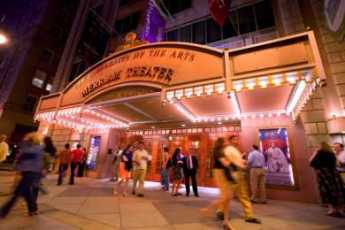
|
| The Merriam Theater |
As far as inside gossip is concerned, the Merriam Theater is owned by the University of the Arts but is sort of doomed to shabby prosperity for the next 13 years by a lease which is too lucrative to modify. That's why the seats are a little uncomfortable, the lobby dilapidated, and comparatively few student productions are on the stage. The University would like to have more student presentations but isn't in a financial position to displace the tenants generating such high revenue. The best that can be made of the present arrangement is to encourage the visiting professionals to mingle with the drama students, bedazzling and advising them how to advance in the Big Time. It's been a fairly successful compromise.
Until recently, Chicago seemed to have the most successful regional theater experience, but now is thought to be on a par with Los Angeles, Seattle, and Cincinnati whereas Philadelphia has supplanted it as the very best place to be. Going backstage, the kids express little interest in going to Broadway, where overpriced theater seems to them to be just part of the tourist industry. Television is regarded as old-fashioned, so Hollywood is unattractive to them, too. If that's all the future holds, these kids would rather become accountants and computer engineers. And stay right here if they can; that seems to be a central motif. Gene Terruso says there is an "Iceland phenomenon" in Philadelphia, a wonderful hidden place to live, so tell everybody else it is cold and dreary and they will stay away and not ruin it.
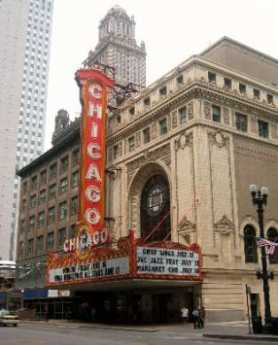
|
| The Chicago Theater |
The fact seems to be that Chicago is seen to have a great many "hole-in-the-wall" theaters, while Philadelphia has well over thirty flourishing theater troupes. The professor in him prompts Gene Terruso to postulate that the secret of our success is for each repertory troupe to specialize in something, get good at it, and bank on the motto Be clear about your mission; the audiences will follow. Therefore, we have Shakespeare companies, musicals companies, Restoration comedy companies, and so on. Some specialties are obviously more popular than others. Somewhere in this business school analysis is the likelihood that artsy craftsy people are seldom very good at running a business, so theater success does depend on non-actors who are business-oriented minding the store, and possibly not much good at acting. It's a lesson many idealists and liberals need to learn, and not just in the theater.
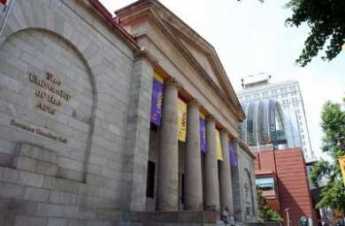
|
| University of the Arts |
Professor Terruso does ruefully admit that the University of the Arts is a conservatory, by which he means a trade school. Its graduates are more likely to know how Hamlet should run a sword through Polonius without killing the other actor than to discuss the place of Shakespeare in our cultural heritage. To have a successful theater, however, there has to be an enthusiastic audience. Somewhere, our universities have found it easier to provide a liberal education to one group of people and impart the tricks of the trade as a specialty of someone else. If the two talents merge at all, it is in the profession of Dramaturge, but all in all, it would be better if both sides of the footlights understood each other somewhat better. Going to the theater really isn't a specialty, and it isn't a secret society, either. That's part of the response to city leaders who greatly desire a thriving theater, but wish we didn't have to see so many of those artist types walking around town. Both groups need to understand "There's plenty of room at the top, but no room at all at the bottom."
Powel House, Huzzah!
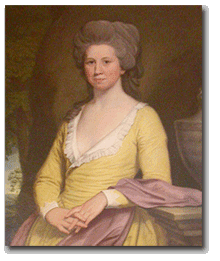
|
| Elizabeth Powel |
If George Washington were still alive he would no doubt be a Republican, but the term Republican Court actually has nothing to do with R's and D's. It was a scheme deliberately cooked up by Washington and Madison to enlist support by the new government's important ladies for a modified version of a European royal court, to make thirteen colonies into a cohesive nation. A most remarkable thing about it was its frank imitation of the royal courts, something only the Father of His Country could pull off in former colonies which had just fought an eight-year war to be rid of the monarchy. It is one more great testimony to the faith of Americans in George Washington; but it also testifies to the power of enthusiastic women, once they agree on a project. Chief among the leaders in this court was Elizabeth Powel, along with her niece living around the corner on Spruce Street, Anne Willing Bingham. Recently, the Peale Society of the Academy of Fine Arts held a candlelight dinner in Mrs. Powel's magnificent second-floor dining room, while scholars of the history of the Republican Court told assembled notables of Philadelphia what had once been what, during the first ten years of the Republic.
|
| Dining Room |
Members of the early Congress were largely the same men as the founding fathers of the Constitutional Convention, hand-picked by Washington and Madison to persuade the legislatures of their colonial states to give up state sovereignty, for a unified nation. There was the difference that now they brought their wives to live in Philadelphia during sessions of Congress. Those women wanted to know each other and wanted to have something exciting to do together in the largest city in the nation. Their husbands knew well how politically useful it was to be socially acquainted in this way, so everybody liked the idea of suddenly becoming nationally connected. The initial idea proved unworkable. Martha Washington was supposed to become Lady Washington, reigning over weekly receptions.
|
| In Our Cups |
But Martha, unfortunately, wasn't up to the task, and Anne Bingham whose rich husband had taken her on lengthy tours of European royal courts, moved right in and took charge of this project. Besides her cousin Elizabeth Powel, notable members of this social whirl were the two daughters of Chief Justice Benjamin Chew, Alexander Hamilton's wife, and various members of the Shippen and Willing families. Members of the family of Lord Sterling of New Jersey, Charles Carroll of Carrolton, Maryland, Cadwaladers of various sorts, and a number of other names famous from then until even today joined their affiliations with ladies from other states through parties and even some weddings. John Adams was particularly awestruck by the poise and beauty of Anne Bingham, although Abigail Adams may not have been quite so infatuated. It was a dizzy whirl, with dinner parties the central activity just as they are in Philadelphia even today. Country bumpkins had to learn how to dress, to talk and to eat with the right spoon and keep their elbows off the table; those who could tactfully show them what was what were friends for life. Centuries later, Emily Post made a fortune writing books about these rules.
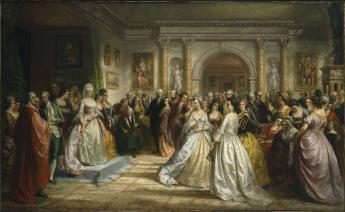
|
| Republican Court |
In those days, they even had their war cry, which was to raise a glass and shout back "Huzzah" in response to the proposer of a toast, who had raised his glass starting the warcry. It wasn't "Skol" or "Cheers" or "Here, here" if you knew what was what; it was "Huzzah". Most fashionable dinners had at least twenty courses, but the ladies didn't eat them. It was a whispered instruction among the ladies that they should eat before the dinner, so they could gracefully decline to gobble up goodies, and spend their time in gay conversation or waiting to be asked to dance. Drinking and eating, especially drinking, was for the men at the party, although naturally the many courses of the banquet were put in front of the ladies to be airily ignored. When George Washington was present as he often was, or even La Rochfoucault himself, it was important to remember every spoken word.
And, you know, it worked. When these important people went back home, they took the customs of the Republican Court with them. The American diplomatic corps found the equivalent of minor-league training for their efforts on behalf of the country abroad. Politics was easier if you personally knew your adversaries as well as your allies. The persistence of the same family names in the Social Register, the lists of The Four Hundred and other compilations of high society show that Anne Bingham and Elizabeth Powel did indeed know what they were doing, and for that matter, so did George Washington. If anyone else had been at the top of this heap, Thomas Jefferson stood ready to attack with all his might.
|
| Amity Button |
But he and even Patrick Henry didn't dare attack Washington. The aristocrats of Old Europe probably did sneer at this amateur effort, and in some circles still, do. But the inability of absolutely any other group of nations, whether European, Asian or South American, to unite peacefully is a thumb in the eye of anyone who mocks George Washington's little Philadelphia creation. And to think it all began right here, right here in the Powel House, right here in the dining room on the second floor. For that, folks, one thunderous "Huzzah!"
REFERENCES
| A Portrait of Elizabeth Willing Powell: 1743-1830 David W. Maxey ISBN-13: 978-0871699640 | Amazon |
Mennonites: The Pennsylvania Swiss
|
| On the Wall of the Mennonite Heritage Center |
Anabaptism, originally attributed to Ulrich Zwingli around 1525, centers around believing a baby is too young to understand baptism, so adults need to be re-baptized. The idea arose independently in Switzerland and Holland, and probably thousands of believers were unmercifully martyred for holding the belief. Because the worst persecutions took place during the War of Austrian Succession (1740-50), they are often attributed to the Roman Catholic Inquisition, but Magisterial Protestants, believing in the separation of church and state, were often also responsible. Many seemingly unrelated issues were introduced locally, and this period of unrest is known as the French and Indian War in America; its major battle took place in Louisburg, Nova Scotia, although George Washington's skirmish around Fort Duquesne (Pittsburgh) has acquired local fame as a major American manifestation.
The Swiss adherents moved to the Rhineland Palatinate, and from there were among the first to accept William Penn's offer of religious freedom. They were the settlers of Germantown, but have mainly moved a few miles west to southern Montgomery County, where the confusion about Pennsylvania Dutchmen is further confounded by the fact that they were Swiss. Menno the Dutchman gave his name to the order, but they themselves regard their true ethnic background as Swiss from the Zurich region. That, by the way, is not to be confused with Calvinism, which also comes from Switzerland, but by way of Geneva, not Zurich. The pacifism of the Mennonites made them mutually attractive with the English Quakers, who had made an appearance fifty or so years later in the region around Manchester, England; each group seems to have adopted some of the features of the other.

|
| Franconia Mennonite Meetinghouse |
Determined use of the German language has always held the Mennonites apart, however. From the start, it was really necessary to be somewhat bilingual in Montgomery County, using English for business conversation, and German at home and in the church. The idea of using a foreign language is based on the hope it would thus maintain a sense of distinctiveness or even remoteness from non-believers, without adopting the least hostility to them. It almost inevitably follows that the group has used its own schools, attached to their meeting houses. This sense of remoteness has persisted for almost four hundred years, surrounded by entirely different cultures. Starting only around 1960, this attitude has gradually softened, however, and it is widely assumed that in another few decades Mennonites will come to resemble the people in their environment a great deal more than they do at present. If you want to know where to find them, Harleysville is a good place to start. As the tinge of Pennsylvania Dutch accent gradually fades, and fewer of them wear the old costumes, a curious remaining hallmark of their presence can be noticed: an avoidance of foundation planting around their houses. The Mennonites themselves seem to be entirely oblivious to this unintended distinctiveness, which is however quite striking to non-Mennonite passers-by. Those who work in the fields all day have little interest in digging around their houses for decoration; those who have moved away from farming have seemingly adopted the bush-less style as a natural way of arranging things. There's no particular reason to change it, and so, there's no particular reason to notice it.
Locating Corporate Headquarters
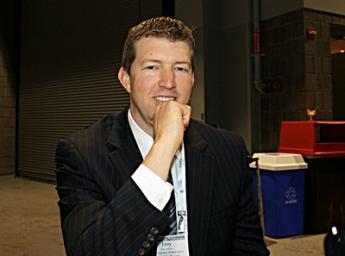
|
| Troy Adams |
The Right Angle Club was recently entertained by a director of the Greater Philadelphia movement, Troy Adams. One of their main purposes of spending several millions of dollars annually is to try to attract new businesses to Philadelphia. The money, interestingly enough, is contributed by other businesses, many of whom would be competitors of the newly attracted ones. What's the value of this? How do you go about doing it, even if it is a splendid idea?
From the viewpoint of the city government, attracting new businesses means attracting new sources of taxation. It is not surprising therefore that the Chamber of Commerce tends to believe the main obstacle to attracting new business relocations is the tax structure of the locality. That's what the officers of companies under investigation ask about. By and large, the unattractiveness of Philadelphia to such inquiry is not the size of taxes, but their complexity. New businesses are turned off by learning of new types of taxes they had never heard of. It raises suspicion, and existing local businesses are quick to confirm that some of these strange-sounding taxes are objectionable mainly because you forget about them, and then get fined for not submitting a form to pay a small amount. If you get summoned to a hearing, it is even worse than paying the bloody thing. We have, say a lot of companies, branches in dozens of different cities, and we never heard of a tax like that. Of course, a famous sage once remarked that when someone complains it isn't the cost, it's the principle of the thing, well, it's the cost.
|
| Chamber of Commerce |
Regulations, requirements, prohibitions, deadlines, reporting requirements and all of that drive you crazy when you are trying to run a business. The cost of the taxes to a businessman is a simple question: do my competitors have to pay the same amount? If it's a level playing field, businesses ordinarily don't care about the money, since they can just raise the prices to the customer to cover it. Businesses, dear friends, don't look at costs the way the rest of us do. For that reason extended a little, businesses are strongly repelled by the existence of corruption, because corruption may or may not be applied equally, on a level playing field.
All of this sounded quite plausible to the Right Anglers until Buck Scott spoke up. " I beg to disagree, " he said. He remarked that in his experience the decision to move corporate headquarters to a city is determined by one person, or at most four. Whether the decision-maker is the CEO, a big stockholder, or a flunky assigned the task, the decision is usually not made on sensible economic grounds. It is based on the fact that the wife of the decision-maker grew up in Radnor or Chestnut Hill, and likes it here. If you are looking for access to ocean ports, railheads, Interstate Highways, airports, or proximity to big-city labor pools, Philadelphia has everybody beat. That sort of stuff is a given, and so what matters is that the decision maker wants to live here. To a certain extent, our proximity to New York and the District of Columbia is a handicap, since the lady of the family can live here while the corporate headquarters is not too far away, although too far away to be taxed. Buck Scott brought the discussion to a halt because it was obvious to everyone that he had a strong point.
.jpg)
|
| Philadelphia Ports |
On another level, however, there is still debate. The question is whether Philadelphia gains a great deal by having the corporate headquarters located here. The CEO may have invisible value by his socializing frequently with the CEOs of other corporations, but no one was able to defend that as having serious advantages. Since the competitive corporations are paying for this effort to attract new corporate headquarters to the region, there may well be advantages to them which are not immediately evident. What's clearly of value is locating large numbers of employees to the region, since they do generate business activity and hence taxes. Upscale companies have employees who are anxious to find good local schools, crime-free areas in which to live, and an improved environment; getting more of them into our voting pool will result in a better city, without question. Maybe, just maybe, locating the corporate headquarters in the region is a first step in enticing the rest of the company to come here. But it has not yet been demonstrated. Quite possibly, enticing the wives of decision makers to join the social whirl is the first step, and locating the factory here is only a secondary one which follows. Somehow, it begins to seem likely that the people who can influence one step, aren't talking to the people who determine the other.
Medical Generation Gap
|
| Miriam Schaefer |
To understand the dynamics of the following medical anecdote, the reader should understand the thrust of Miriam's First Rule of Management. Miriam is my oldest daughter, with long experience managing many firms, large and small. Her rule is that when an employee starts misbehaving for no good reason, eliminate the position. Invariably, well almost invariably, an employee who starts acting out doesn't have enough work to do. If you are managing a large organization, you should also consider firing the supervisor of that person, on the grounds the supervisor should have noticed there was not enough work for the employee to do and was probably covering up.
My anecdote concerns a session at the 2006 annual meeting of the American College of Physicians, ostensibly devoted to the conflict between generations of doctors. It didn't take long before the meeting turned into an uproar about the new work rules which prohibit a resident physician from working more than 80 hours a week. That's supposed to protect patients against mistakes of sleepy doctors, although some suspect it is mainly an outgrowth of a gap between what they do and what they expected to do. From the time they entered high school, future doctors have been taught to expect workaholic employment conditions, and while more normal people haven't been taught that message, that's irrelevant. The situation is aggravated by the increased admission of women to the profession, who for their part have been taught to expect a breathless race between finishing their work and getting home to relieve the babysitter. Perhaps in time the newly invented specialty of "hospitalists" will get established and accepted, along with accident room work as another harrowing occupation which abruptly ends its day by the clock rather than the backlogs. At the moment the pioneers must overcome the suspicion, only partly fair, that Miriam's First Rule applies to them.
If not, that Rule clearly does apply to the youngsters who now must go home to spend quality time with their families, because they are not allowed to exceed the new work rules. At the ACP meeting, a dozen of us Civil War veterans were treated to an appalling amount of teenage mumbo jumbo apparently emanating from unsuspected warfare between Generation X and the Baby Boomers, their supervisors, mentors, and colleagues. All of us Civil War veterans held the private opinion that Baby Boomers were a little self-indulgent, but in the eyes of Gen Xers the boomers are workaholic fanatics, incapable of relaxing even for a moment in order to enjoy the life of the good, the true and the beautiful.
As we passed out of the room at the end of the session, one of the silent gentlemen with white hair came over to me. We didn't know each other, but we recognized the signs of a silently shared opinion. The old doctor leaned over to me and muttered, "They offer nothing, but they want everything." I smiled, and we parted. I guess I might have told him about Miriam's First Rule, but it would have taken too much explaining.
The Revolution is Over, Every Man for Himself
|
| Charles Dickens |
A DOZEN episodes from American revolutionary times might be called pivotal, but a single debate in the Pennsylvania Legislature seems to have begun our political parties in their present form. Two debaters, their topic, and its consequences all rise to dramatic, even operatic, heights. In another place, we intend to explore the clashing philosophies of the Eighteenth century, with Hegel and Hume at the apex, but two quotations from Adam Smith are more intelligible. Charles Dickens nearly ran away with the topic in his novel A Tale of Two Cities, but Charles Brockton Brown and Hugh Henry Brackenridge were local authors, Pennsylvanians present at the scene. John Adams and Thomas Jefferson debated for decades about which of them was the main protagonist. But all of that is the background for one operatic scene at Independence Hall, where the real David and Goliath were William Findlay and Robert Morris.
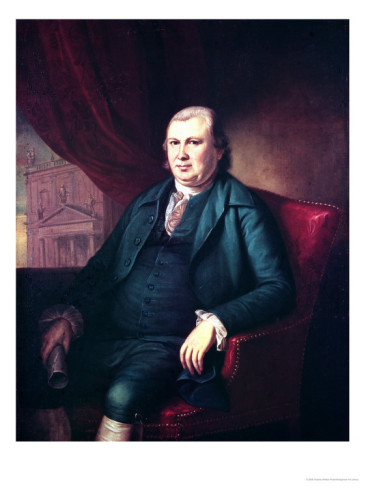
|
| Robert Morris |
Robert Morris, it must be remembered, was probably the richest man in America, a signer of the Articles of Confederation, the Declaration of Independence, and the Constitution. He was one of three men, including Ben Franklin and George Washington, about whom it could be said: the Revolution could not have been won without them. Morris essentially invented American banking, founded the first bank, the Pennsylvania Bank, invented investment banking, corporate conglomerates, American maritime insurance, and dozens of financial innovations. His merchant house probably had 150 ships sunk by the enemy. George Washington lived in his house for years. Today, he is mostly remembered for going bankrupt at the end of a busy life.
|
| William Findlay |
William Findlay, on the other hand, was a Scotch-Irish frontiersman with a flamboyant white hat, elected by others like him from the Pittsburgh area to promote inflation through state-issued debt paper, so as to finance land speculation in the West. He had no education to speak of, no accomplishments to mention. He made no secret of his self-interest in land speculation, and therefore no secret of his opposition to rechartering the Bank of North America, which Morris had founded for the purpose of restraining inflation and speculation. Findlay wanted the bank to disappear, get out of his way, and he boldly denounced Morris for his self-interest in promoting a bank where he owned stock. He utterly denied that Morris had any motive other than the profit he would make for the bank, so in his opinion, they were equal in self-interest. Let's vote.
Prior to that time, Findlay had politically defeated Hugh Brackenridge, using the two strong arguments that Brackenridge had gone to Princeton, and written poetry; how could such a person possibly represent the hard-boiled self-interest of frontier constituents?
|
| Hugh Brackenridge |
Morris was positively apoplectic at this sneering at everything he stood for. As for the country's lack of trust in a man who had risked everything to save it, well, what has he done for us, lately? America had lately thrown off the King, but what it had really discarded was aristocracy. Every man was as good as every other man, and each had one vote. Under aristocratic ideals, a man was born, married and educated in a leadership class, expected to be utterly disinterested in his votes and actions, scrupulous to avoid any involvement in trade and commerce, where temptations of self-interest were abundant. Washington never accepted any salary for his years of service and even agonized for months when he was awarded stock in a canal company, wanting neither to seem ungrateful nor to make private profit. John Hancock, who came pretty close to having as much wealth as Morris, gave up his business when he was made Governor of Massachusetts. Benjamin Franklin was only accepted into public life when he retired from the printing business, to live the life of a gentleman. That's how it was, everywhere; every nation had a king and depended on rich aristocrats to supply the leadership for war and public life. But, now, America had become a republic where every man was equal. Morris and the Federalists he represented wanted to turn the clock back to an era that would never return.
Goaded too far, Morris impulsively resigned his business interests, to prove he had the nation's interest at heart in opposing inflation. It didn't help. Findlay won the vote, and the Bank of North America was closed. America was ashamed of how it behaved after the Revolution, but not ashamed enough to change.
REFERENCES
| Robert Morris: Financier of the American Revolution: Robert Morris: Charles Rappleye: ISBN-10: 1416570926 | Amazon |
Children Playing With Matches
|
| Playing with Matches |
THERE are still a lot of people secretly re-fighting the Vietnam War, which in retrospect was rebellion against the draft and allegiance to the idea that America just doesn't start wars. But times change, and those who now suppose the secret sympathizers with the anti-draft movement will automatically join a second call to rebellious duty, are probably going to be disappointed with how conservative the baby boomers have become. The boomers find themselves parents, defending their own authority from attack by their children. As King Lear ruefully observed in the same reversed situation, let them feel how sharper than a serpent's tooth it is, to have a thankless child. We now define our present world problem as overleveraging, not compulsory military service, and estimate it may take as long as fifteen years to sort itself out -- until yet another judgmental generation comes over the hill behind the rebels. The aggregate debts of the European Union, using present-value calculations, are said to be three times as large as the Gross Domestic Product of Germany; now, that's really a problem. When you consider the only sure cure for excessive leverage is "growth", and that the code word of growth really means stuff wearing out, getting used up, and getting obsolete, it is not hard to see it taking 15 years to go away -- much more lasting than any draft dodger issue. When I go to restaurants they are crowded and expensive; people are living on their reserves, but there seem to be lots of reserves so this problem will last a long time.
But, four generations back, I can remember 1937 when there were no reserves, and plenty of homeless people actually froze to death. Plenty of people were then talking Communist who nowadays are talking McCarthyism, hoping no one notices the switch. I used to ride up and down the elevator of a hospital with Harry Gold, the thermonuclear spy no less. So what worries me about the present uproar is that it comes too soon, before very many people get really scared enough to do really stupid things, then recognize their folly.
I think it was Abbie Hoffman, not Jerry Rubin, who climbed up into the visitors' gallery of the New York Stock Exchange and threw handsful of dollar bills, salted with just a few hundred-dollar bills to bring trading to a halt. Big joke; just see who was scrambling on the floor. That's what the sixties seemed like to most of us; a big joke. But out at Kent State, some kids with crew cuts were information, under orders that at the last moment the gun barrels must come level -- and the live rounds slide home.
Statement of Accounts, March 1785
|
|
| Robert Morris |
AFTER resigning his position as Financier of the United States, Robert Morris worked for five months laboriously summarizing and detailing his official activities, and then he paid for printing five hundred copies of it. The document had a five thousand word preamble and over two hundred printed pages of detailed accounts, a prodigious effort. And a rather unprecedented one in an environment of traditional national secrecy about its accounts, except for the pioneering efforts of Necker in France. His reward at first was an infuriating discovery five years later that the government had not released his report to the public, and continued throughout this time to investigate Morris's earlier activities on the Secret Committee. The standard of bookkeeping for a secret committee engaged in smuggling arms before the Declaration of Independence was understandably obscure, and to have it flogged for failing to uphold the improved standards of government accounting which Morris later devised for the new nation was such a mixture of ingratitude and slyness that the behavior seemed well beyond infuriating. Nevertheless, it must have been gratifying to end the report with a positive balance of $21,000 even after eight years of struggle, war, and improvisation. The magnitude of this achievement was not lost on others in a position to see the contrast with earlier efforts, encapsulated by James Madison whose committee report concluded, "It appears to the committee that the regular official examination has already been made, and it would be inexpedient to incur the expense of a re-examination."
Madison by this time was evolving into a political opponent of Morris, but Samuel Osgood was a declared opponent of his approach to government accounts. Osgood's assessment of his opposition to the approach was prefaced with a ringing statement of its effectiveness: "I will tell you very freely, that in mere money transactions, he has saved the United States a very large sum... I am also of the opinion that much more regularity has been introduced into the keeping of accounts than ever before existed. This is a matter in my mind of very great importance. And without the strictest attention to it, the several states ought not to trust Congress with a single farthing of their money."
|
| Samuel Osgood |
The supreme irony of this situation was that by imposing strict accounting standards where none had previously existed, Morris was offering to his enemies a club to beat him with. Instead of recognizing that Morris was both too diligent and too rich to bother with cheating, there emerged a duel in which his enemies took unusual behavior to be a sure sign of wickedness, while Morris absolutely courted personal disaster, supremely confident he was unchallengeable.
There are two enduring truths to both positions. It is absolutely true that a well-informed public has a perfect right to do anything it pleases, regardless of the existing rules of government, regardless of the opinions of predecessors, heedless of the opinions of anyone else, past present or future. If a republic has supplanted a monarchy, the republic in a sense has the same divine rights. It's just unwise to act that way in anything but extreme circumstances.
On the other hand, it is also absolutely true that stability, peace, and prosperity are most likely enhanced by avoiding the mistakes of the past, following the accepted rules of conduct, and avoiding the counsel of loud and unstable leaders. Once in a while, a genius does appear and his discoveries should be adapted for future use as rules. Once in a while, a treasured maxim needs to be discarded. In a limited way, these evolutions of the rules of the road are an application of Galileo's invention of the scientific method, applied to the Common Law by Sir Francis Bacon. Make a likely conjecture, then verify it. And the second source of societal wisdom is the constant pressure of Society's Hidden Hand, as described by Adam Smith. The American Revolution was not so much an overthrow of a boisterous king, as it was incompletely successful incorporation of existing principles into a Constitutional system of government.
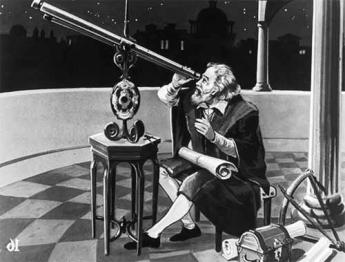
|
| Galileo's invention |
Considering the convulsive upheaval caused by its principles, the 18th Century colonists must be forgiven for misjudging their situation when confronted with a genius like Robert Morris. In barely a moment of time, Morris assembled these ideas into a vastly improved system of government management, immediately proved that it made the country rich, and demonstrated that he had the common sense to make himself rich using the same ideas. Even the idea usually attributed to his friend George Washington, that honesty is the best policy, sounds more like Morris than Washington, and certainly more like Morris than Alexander Hamilton. Only the likes of John Adams protested that honesty came from God. Morris did not deny that was possible, but acted as though it was irrelevant.
Pay attention to the voice of consensus, be quick and alert to occasional innovation, and don't waste your time being crooked. With these three rules, Morris got rich and made his country rich, enraging those who do not think riches should be a universal goal. Don't want to be a millionaire? Plenty of other people will take your place.
Our two-party system began in Appalachia, and one poor soul found himself marooned there. Hugh Henry Brackenridge, a representative of Western Pennsylvania, cried out, "If they would let Mr. Morris alone, he would make Pennsylvania a great people. But they will not suffer him to do it!" Brackenridge was never elected again.
REFERENCES
| Robert Morris: Financier of the American Revolution: Robert Morris: Charles Rappleye: ISBN-10: 1416570926 | Amazon |
State in Schuylkill Fishing Club
|
| Richard Romm |
Richard Romm, a rising historical scholar with a special interest in early Philadelphia, recently educated the Right Angle Club in the history of the Schuylkill Fishing Club in the State in Schuylkill, and was immediately accepted into membership. Of the Right Angle, that is, which is an old club by some standards, but scarcely a hundred years old in the eyes of the really old, old clubs.
The State in Schuylkill is an eating club, originally a fishing and eating club, apparently organized around the annual shad run up the river. The clubhouse, or Castle, was moved several times, in response to damming of the river, and is now located on the grounds of, or adjoining the edge of, Nicholas Biddle's estate on the Delaware River called Andalusia. One by one, the Atlantic Ocean rivers of America have been dammed and their annual shad migrations brought to an end, except through the city of Richmond, Va, so there was little point in moving The Castle to follow the fish. It remains, overlooking Delaware in spite of its name.
There seems to have been several name changes, the most important of which was to change the Colony of Schuylkill to the State of Schuylkill for obvious reasons. Originally, the Castle was roughly opposite the falls of Fairmount on the West Bank of the Schuylkill at about Girard Avenue; thus, from 1732 to 1822 located on Baron Warner's property called Eaglesfield. In 1822 it moved to Rambo's Rock (the Rambo family is said to be the oldest European settler family in Pennsylvania) opposite Bartram's Gardens, then finally in 1887 to Andalusia, Nicholas Biddle's country estate. The club was founded in 1732, and dates of movings are possibly hazy, possibly somewhat because of the reluctance of club officers to return the calls of inquiring historians. The State in Schuylkill claims to be the oldest organized men's club in the world, an honor contested by White's in London. The roots of this argument are found tangled in the vital issue of whether their age should be based on the formal organization of the clubs, or on the establishment of the coffee houses which housed the original clubs. Four books are said to have been written about club history, but we depend here on Mr. Romm.
|
| Chief Tammenend |
There is also an unclear relationship with Chief Tammenend, possibly traceable to the shad run, but in any event to the Indian chief depicted with William Penn in the paintings by Benjamin West and Edward Hicks. May 1 is St. Tammany's day, growing into the fancy that he was the "Patron Saint of America", before a branch of the nation-wide Tammany association opened in New York and sort of tarnished up the name. Other traditions of the Fishing club have to do with wearing Mandarin hats, possibly having to do with the export of ginseng which was once abundant in our colonial suburbs, with a return cargo of Chinese dishware. All of the cooking is done by official citizens of the club. The quantities of food are remarkable; one 19th Century menu listed eleven pounds of meat per member. The club drink is a punch, the famous Fishhouse Punch, widely recognized to be rather strong. Its inventor is reputed to be Edward Shippen Willing, on the occasion of the first visit to the clubhouse by women guests. The quantity of alcoholic beverage at these events is especially remarkable in view of the Quaker origins of many original members of the club, but not necessarily of the guests. Among the various guests were Generals Grant, Meade, and McClellan. Dinner begins with two traditional toasts: to George Washington, and to Captain Sam Morris. Washington was appropriate enough, having a history of drinking a bottle of Madeira every day at lunch. But Sam? Captain Sam the Quaker?
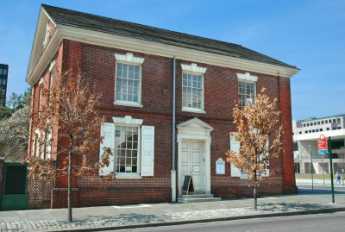
|
| Free Quaker Meetinghouse, Fifth and Arch Streets |
Somewhere in this tradition are allusions to the Free Quakers, Quakers who abandoned the peace testimony to fight the British. There is also the tradition of hostility to British rule which antedates the Revolution and may have some connection to the fanciful contention that their little state was not really part of Penn's colony. Captain (of the City Troop) Sam was a stalwart, possibly the sole founder, of the Gloucester (N.J.) Fox-hunting club. The history is passed down that 22 of the original 26 members of the First City Troop were members of the fox-hunting club, and many if not most were Quakers. The first "Governor" of the State in Schuylkill was Thomas Stretch, but the second Governor, from 1766 until his death, was Captain Sam. He was repeatedly referred to as the life of the club and held in the highest esteem by all. He was "read out" of the main Quaker Meeting, not so much for his drinking as for his flouting of Quaker belief in pacifism. He reputedly led a saber charge at the Battle of Trenton and was a leader of the City Troop in that revolution within a revolution at James Wilson's house, which rescued at least four future signers of the Constitution from a mob of militia which momentarily turned Jacobin.
Naturally, descendants of Quakers on both side of this uproar have been reluctant to say much about it. But somewhere within the history of Samuel Morris must be some important clues about the 18th Century splits within the Quaker Church, to say nothing of the revolt of the three Quaker colonies against British rule.
Espionage in the Revolution
|
| John Nagy |
Both sides fighting the Revolutionary War predominantly spoke English as a native language, so it seemed deceptively simple to pick up a little cash for a tidbit of information or two. John Nagy, who has written several books on spies in the Revolution, recently addressed the Right Angle Club about this interesting topic. According to him, Quakers were favorites as spies because they were widely split in their sympathies, and as pacifists were abundant in the civilian societies of the time. Others have commented that the main difference between Conservatives and Free Quakers was that the Free Quakers were mostly of the artisan class and sympathetic to the Revolution, while the Conservatives were mainly of the merchant class, and Tories. But there were many exceptions, and the plain dress Quakers were hard to tell apart and passed freely through the military lines. No doubt many readers will be incensed by such comments, for which we take absolutely no responsibility.
|
| Beaumarchais |
The one main exception to the English-language generalization were the French, who were still smarting from their defeat in the Seven-Years (French and Indian) War. The playwright Beaumarchais was quite active in the French movement to make trouble for the hated English and seems to have stirred up King Louis XVI to be interested in financing rebel trouble-makers, if not to become active combatants. In any event, a wary King thought it was best to send a spy to look over the situation. As detailed in a little pamphlet called The Spy in Carpenter's Hall the Americans were tipped off about the plot. Accordingly, the spy named Bonvoloir was hidden up on the second floor of Carpenter's Hall, while the colonists put on a belligerent falsified performance on the first floor. It is claimed their performance was a convincing one, having the desired effect of creating a report to the King that the colonists were belligerent, warlike, numerous and united. After the Battles of Trenton and Saratoga, the timing was good for using this sort of report to provoke the King into doing what he was mostly of a mind to do, anyway.
|
| Johann de Kalb |
The French were unusual in favoring aristocrats as spies and Johann de Kalb was anther who snooped around, returning later in the form of General de Kalb of military note. The names of British spies, aside from Major Andre, tended to have a Quaker sound to them, like Dunwoody, Cadwalader Jones and the like. It would take deep research to know whether these were Quaker stalwarts or merely black sheep of some family; there is little doubt that sympathies changed with the changing fortunes of battle. Another feature was the careless lying which took place for propaganda purposes. The famous story of Lydia Darragh, a Quaker who allegedly overheard the British officers plotting the surprise attack on Whitemarsh on December 5, 1777, and walked many miles in the snow to warn Washington -- is apparently a much dressed-up version of what happened. The whole Darragh family was engaged in regular spying, and the evidence is that Lydia's brother William was the one who was the messenger. He apparently carried messages under the cloth covering of the buttons on his coat.
.jpg)
|
| Joseph Galloway |
Two types of spying have a greater ring of authenticity. The British needed pilots to guide their ships up the Delaware past fortifications and obstacles. Maps were nice, but it seemed simpler to enlist the efforts of two ladies of easy virtue, Ms. O'Brien and Ms. McCoy, to hang out in taverns and entice local ship pilots to enlist to guide the British ships into Philadelphia. The British spymasters even had the ingenuity to entice a member of the Continental Congress, Joseph Galloway, to turn over the commentary records from which troop strength could be estimated from the food consumed. It is not recorded whether suitable adjustments were made for starving troops, stolen supplies, or fraudulent charges, however.
|
| Benedict Arnold |
Two prominent officials were accused of selling out the side, but an accusation of this sort is easily made, hard to prove. When the examples of Benedict Arnold and Peggy Chew can be verified, however, there is always doubt cast on everyone which some will believe. The system of double signatures was used, so there were two co-treasurers of the United States, Joseph Hellegas and George Clymer. Letters have been produced indicating that one or the other sold the commissary records. Hellegas' home is still today the residence outside Pottstown of a prominent Philadelphia surgeon, and his portrait appears on the ten-dollar bill. In so doing, he started a tradition of Secretaries of the Treasury on the ten-dollar bill, presently occupied by Alexander Hamilton. George Clymer, for his part, was a signer of the Constitution and a favorite of George Washington. Are these stories true? Who knows, but in an eight-year war, John Nagy has accumulated evidence that there were over five hundred documented spies. The essential question remains one of whether to believe the documents.
A Time to Read Books
|
| Retirement Reading |
BEFORE we talk about retirees reading books in a retirement community, reflect for a moment about reading in your own home during the working years. Most suburban homes do not have many books in evidence. It's possible to stand in the center of most suburban living rooms unable to see a single book, while it's hard not to see a television set. Increasingly, a home computer is only a few steps from the front door, but the evolution from desktop to laptop to portable telephone to tablet is too rapid to make generalizations. Everyone says books are going to disappear soon, and newspapers maybe even sooner. But there are still said to be a million books constantly in transit on 18-wheeler trucks between print shops and wholesale depositories, night and day. Right now, the producers, publishers and merchandizers of printed material are in turmoil and decline, so they talk about it a lot. But ultimately it is the reading public which will decide what it wants and force the suppliers to give it to them.

|
| reading |
It seems to me that what the reading public wants most is to find time to read. The suburban home has so few books because the sort of person who lives in the suburbs to be near the school system, just doesn't have time to read after the day's work and commuting. Helicopter parents spend a lot of time hauling the kids to mandatory kid entertainments, as can easily be seen by driving past a high school in the afternoon and observing the lines of cars with waiting mothers. They make the best of it as a social occasion for mothers with shiny cars, but they really do it to be sure the kids don't get mixed up with recreational drugs. Anyway, they do it, and it all eats up their discretionary time for reading. Meanwhile, their's no local bookstore to buy books, even unread books. They may think they will catch up on their reading after they retire, but that's becoming increasingly unlikely in my observation. They are getting out of the habit of reading. By the time they retire, they will find it's almost like going back to school. You must find other readers, readers groups, conversations about books over the bridge table, books lying about. The first economy a struggling news paper makes is to cut down the size and number of book reviews, because there are no bookstores to take out advertising, and advertising is what pays for newspapers. There's one good feature about that; what book chatter there is, is not so confined to recent books. Some people are bookish and other people are golf-ish, and a growing number of people are simply TV-ish. It's a struggle to find time for work and the family, and books on top of that. No matter what level of reading the working people may be doing, it's declining in favor of deferred reading when they finally retire.
|
| Retirement Community |
Having visited quite a number of retirement communities, I find the community's library is a good place to assess the institution and its typical inhabitant. When it's newly built, a library area is set aside, usually without many books. The first few waves of residents quickly fill up the space with books they brought from home. During the first ten years it is possible to guess what sort of person lives there by the books they brought and deposited, or died and left to the library. The space, more or less empty at first, gets full and something must be discarded. Enlarging the library is an economic issue, so the size at which it halts will to considerable degree reflect the willingness equilibrium to pay for new construction, both by the book lovers, and by the book enemies, the golfers and the administrators. Ultimately book congestion gets to the point where someone simply must cull out some old books to make room for the new. In another essay I have described the use of volunteers to exchange books of no lasting interest for more books of real interest to real residents, through a used-book exchange. But someone must organize the process, often recruited by an administrator who has learned to be horrified of construction which cannot be rented, but must be cleaned and cared for. If passive resistance is a new term to you, this is the place to learn about it. The residents have short memories, lack drive and follow-through. So inertia tends to win, and lack of reading feeds on itself because there is nothing to read. What's apparently needed here is an organization of bookish people that extends to all retirement communities, probably with a paid staff, an annual meeting, Internet connections. And therefore an immortality which can outlive and outlast the passive resistance. Good ideas then have a means to spread and help support other good ideas; somehow the costs must be supported until a few True Believers in Books can write a bequest in their wills to sustain it. And activate their intention, so to speak.
One of the largely unrecognized reasons for the success of the American Revolution was that the Colonies had a higher level of literacy than the Mother Countries. Thomas Paine, for example, printed 150,000 copies of Common Sense on the rickety old printing presses of the 18th century, when there were fewer than three million white inhabitants of the thirteen colonies. And who was mainly responsible for that? It was Benjamin Franklin with his invention and popularization of the lending library. If Ben could find time to start libraries in 1742, and Andrew Carnegie was later found willing to pay for dozens of them, surely the time and energy can be marshaled in the 21st century to establish a first-class library system throughout the retirement communities of the nation.
Bones in Duffy's Cut
THE Right Angle Club was recently honored by a talk by Professor William Watson, who teaches history at Immaculata University in Malvern, Pennsylvania. Although it is hard to find much memorial recognition of it, Immaculata is on the site of the Battle of the Clouds, of the Revolutionary War. Washington's army was retreating from the advancing British invaders from Elkton, Maryland, who were headed for the occupation of Philadelphia, in 1778. Although Washington had been outflanked at the biggest battle of the war at Brandywine Creek, he regrouped near Paoli and prepared to defend Philadelphia where the Continental Congress convened. A tremendous rainstorm, possibly a hurricane, hit the two armies as they formed for battle, and everyone's gunpowder was soaking wet. By mutual consent, the battle was called off. The Malvern area was also the site of the Paoli massacre, where General Anthony Wayne overestimated his understanding of the local area, and British troops attacked at night with orders to use bayonets, only.

|
| Duffy's Cut |
Professor Watson was, however, speaking about another massacre in the area, at Duffy's Cut. The Cut now belongs to Amtrak, but it was originally built in 1832, from Columbia on the Susquehanna River eastward, as the Philadelphia and Columbia RR, using horse-drawn rail carriages. That essentially means it went from Scotch-Irish Cumberland County, through the Pennsylvania Dutch territory, to Quaker Chester County and Federalist Episcopalian Philadelphia. The builders of the railroad contracted out mile-long sections of the construction to contractors, one of whom was Philip Duffy, who naturally imported southern Irish laborers to do the digging. As a sidelight, Duffy lived in Port Richmond, where he was buried, allegedly a very rich man. His work site was nearly 60 miles east of Columbia, the most expensive contract on the railroad because it involved more cutting and filling of the hilly countryside: Duffy's Cut.
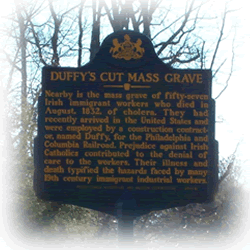
|
| Duffy's Cut Marker |
Sanitary conditions at the dig site were probably pretty primitive, ideal for the spread of fecal-borne illnesses like cholera (and hepatitis, amoebic dysentery, Salmonella, and Shigella), which are characteristic of concentration camps, prison camps, army encampments, and the like. Many later epidemiologists now trace the introduction of cholera to Canada, with downward spread along the Susquehanna, but fifty years before Pasteur there was no sure way to make the diagnosis and no knowledge of its epidemiology. The Irish encampment at Duffy's Cut might just as well have died of bacillary dysentery, but it would have made little difference to know; they just died, and it was said to be cholera that did it. It was probably some kind of fecal contagion, but modern archaeology has recovered eight or ten skulls with bullet holes at the site, and historical investigation of the more usual type has recovered letters by President Clement of the Pennsylvania Railroad, ordering a cover-up. The rest of the story is necessarily conjectural, and we have to be uncertain whether Clement was concerned about hushing up cholera in the region, or ethnic riots, and if so whether he wanted to avoid scaring away replacement laborers, or avoid stirring up local antagonisms. Professor Watson describes considerable difficulty with getting cooperation from politicians and news media in pursuing his studies, where it is hard to see any non-railroad motive, except the motive of wanting to let sleeping dogs lie.
If so, it is a serious concern. It must be recalled that the Scotch-Irish of central Pennsylvania were located there as a result of the activities of James Logan, the agent of the Penn family. The Penns wanted to sell land to settlers and felt that fear of hostile Indians was inhibiting immigration. Logan, who was himself a Scot from Northern Ireland, suggested that the protestant Scotch Irish of that region were tired of combating their Catholic neighbors to the south, and were definitely the equal of the Indians in combativeness. This is the reason the Scotch Irish of Pennsylvania were located to the west of the German settlements of Dauphin and Lancaster Counties. It is also the cause of numerous clashes with the Indians (the Paxtang Boys), the Connecticut invaders of the three Pennamite Wars, and most notably -- the Irish Catholic Molly Maguires of the Pottsville region. Throughout all of these overtly military disputes ran the readily observable fact that the Scottish tribes were accustomed to guerrilla warfare in the woods. They mainly are responsible for winning the Revolutionary War, at least in the Appalachian regions stretching as far to the south as Georgia. They leave us a heritage of bagpipes, country music, very rough football, and airplane pilots. Unfortunately, rough behavior provokes rough behavior in return, and much of the unfortunate features of the labor conflicts of our national politics can be traced to the scars and antagonisms of the Molly Maguire episode of railroads and coal mining. This may or may not have been on Clement's mind when he tried to suppress the news of Duffy's Cut massacre, but it should have been, and to some extent it probably was.
There is no excuse for shooting people in the head or killing them with an ax. But the sixth or seventh generation descendants of the victims are urged to reflect that a campful of male laborers far away from home are apt to exhibit unfortunate behaviors. Remember that no one knew the cause of cholera, but it was new, and it certainly looked contagious. The laborers may or may not have brought it with them, but somebody introduced it to the region, and it looked as though the contagion would continue to spread as long as the laborers continued to be there. There might well have been some unfortunate economic incentives at work, like the disappearance of the Conestoga wagon industry among the Pennsylvania Dutch when the railroad came through. And the obvious concern of the railroad owners that the region has a peaceful, healthful, reputation. The almost total approval of slavery by the Pennsylvania Irish during the Civil War provoked Lincoln to send ten thousand troops to the area during the Civil War. And on, and on. There is almost no part of this region which does not have some remote history of savage behavior. Let's be careful not to stir it up.
One Big Brewerytown

|
| Rich Wagner |
RICH Wagner, the author of Philadelphia Beer, recently visited the Right Angle Club. It's hard to imagine that Philadelphia was once the American center of beer production, with hundreds of breweries and their associated bottlers, beer gardens, brewing equipment, and horse-drawn beer delivery systems, dominating the city scene. Equally hard to imagine that the last Philadelphia brewery closed in 1987, and the biggest American brewer, Budweiser, was sold to the Belgians in the past year. What's this all about?
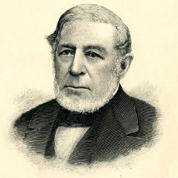
|
| Francis Perot |
In the early wilderness days, water supplies were tainted and unsafe, so most prosperous Quakers had their own little brewery just to avoid typhoid fever. The first American brewery was started by Anthony Morris (the second Philadelphia Mayor) in 1687, in a little brewery on Dock Creek, which became the early Brewerytown of the city, with several dozen brewpubs for sailors and the like. In 1797 there were over a hundred breweries in Philadelphia, and in 1840 there were over three hundred of them. Perot's brewery was prominent for a long time since an early Perot married a daughter of Anthony Morris. Since Philadelphia developed the first and famous city water supply in 1800, beer drinking lost its position as a safe beverage in an unsafe city, and gradually water-drinking became the dominant beverage for the strict and upright. At one time in the early Eighteenth century, gin was cheaper than beer, so even the intemperate multitudes deserted beer for a while, although the effect of the higher alcohol content of gin was apparently fairly dramatic.
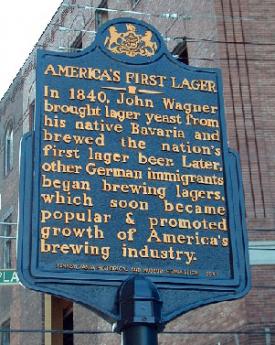
|
| John Wagner Marker |
In 1840 John Wagner imported the yeast for lager beer from Bavaria, at considerable personal risk if he had been caught at it. Prior to 1840, Philadelphia beer was either stout or Porter, a very dark and bitter dose, or else ale, which had the advantage of storing fairly well and thus was popular for sailing vessels and among sailors. The yeast for ale floats to the top and ferments, whereas lager yeast sinks to the bottom of the barrel and requires some refrigeration to slow it down. In all forms of beer, the suds are created by later adding some unfermented beer to the barrel for the purpose of generating carbon dioxide. That's what is going on when you see the bartender in a British pub pulling on a lever to pump it up from the basement. Lager tastes much less beery than other beer and is by far the dominant form of beer in consumption -- a considerable improvement, in the view of most people. But it has to be cooled, and Philadelphia had a system. Brewerytown moved to Kensington, dominating the local scene. It was produced in barrels which were trucked to the east bank of the Schuylkill where ice formed on the surface of the river, stilled by impoundment above the Fairmount Dam. Caves were dug in the banks of the Schuylkill where the barrels full of fermenting beer were hauled to be cooled by the ice for the rest of the process. From there, it was trucked again to bottlers in a general ratio of one brewer for thirty bottlers. More directly, it was trucked to the beer gardens of Spring Garden to Girard Avenue, which gave that area a different sort of reputation as a brewery town. By this time, most of the breweries had moved to the region between 30th and 33rd Streets, near Girard, and most of them still survive, made into condominiums by rehabilitation money. One by one, many sections of downtown Philadelphia acquired a beer environment. A dramatic moment in this process was the advent of the 1876 exposition, which caused many of the Schuylkill fermenting vaults to be acquired by eminent domain. A second momentous change was introduced by the invention of refrigeration, apparently invented in Germany near Berlin, but imported and refined by York and Carrier. Philadelphia was particularly suitable for the importation of coal to fuel the heating of the brew, and the chilling of the fermentation. All of this required large numbers of brewers, bottlers, makers of bottles and inventors of brewing equipment. It took many horses to haul all this material around town, and many teamsters to drive the horses. This was a beer town, until Prohibition.
During the long period of beer ascendency, the advantages of big breweries over small ones were gradually making this a major industry, rather than a local craft. Prohibition completed the destruction of the small craft brewers and brew-pubs. Only 17 of the major brewers survived Prohibition, and then even the big ones went out of business, ending with Schmidt's in 1987, almost exactly three hundred years after the first little one started by that famously convivial Anthony Morris on Dock Street. Evidently, the same competitive disadvantages continue as even Budweiser moves to Brussels, where you would ordinarily expect the wine to be the popular drink. Changing tastes have been cited as the reason for this shift, but differential taxes seem more probable as an explanation. In most industries, you are apt to find that most of the competition takes place in Washington and Harrisburg, rather than the saloons of Main Street or the salons of Madison Avenue. But perhaps not. We hear that little Belgium is about to have a civil war because the Flemish can't get along with the Walloons. And somebody in Portland, Oregon got the idea that beer was trendy, and started up the growing phenomenon of craft brewers, usually flourishing in brewpubs. We are apparently going back where we started in 1687.
REFERENCES
| Philadelphia Beer: A Heady History of Brewing in the Cradle of Liberty: Rich A. Wagner: ISBN: 978-1609494544 | Amazon |
Musical Theatre at the 11th Hour
|
| Michael O'Brien |
Philadelphia is having a theatrical revival, very likely leading the cities of America in that regard. One of the central movers and shakers of that movement visited the Right Angle Club recently. Touting his own company, without a doubt, but nevertheless illuminating a movement which seems pretty central to Philadelphia's future. Michael O'Brien is the Producer and Artistic Director of the 11th Hour Theatre Company, which had its origin eight years ago in the Studio of the Walnut Street Theatre, and has since spread out to many venues within Philadelphia. Since Mike O'Brien got his start in theater at the Walnut, it is only fair to say the Walnut Street Theatre was a parent of the 11th Hour. The 11th Hour is a 501(c) (3) nonprofit corporation, so it sort of sounds as though the William Penn Foundation was somewhere in the background, at least at one time.
The 11th Hour Theatre Company is one of 1200 theater companies now active in Philadelphia but is the only company dedicated exclusively to musicals. More finely tuned than that, it specializes in small productions with five or six members of the orchestra, and about the same number of actor/singers on stage. It happens there aren't very many such productions to chose among, so someone must stimulate more composers to pay attention, or the 11th Hour could run out of musicals to produce. Some of this is economic. The kind of big-time musical comedy which makes a gazillion dollars with a huge cast, huge orchestra, huge scenery is very expensive to produce, and probably soon runs out of audience members who are willing to pay huge ticket prices for anything except a huge production success, produced at huge financial risk. For the most part, the national market will only profitably support one or two of those a year, with the consequence that lots of people lose a lot of money on the ones which fail, and most of the successes are rescued by movie and television revenue, which involve further financial risk-taking. Apparently, the successful composers either try to claw their way to the big brass ring or else look for other lines of work. Someone may eventually figure out a way to start with a small musical and then scale it up to the big-time, but what has happened seems to be that actors and musicians who shrug off the big time, cluster together and try to produce a career which prefers a normal sort of home life, to the neurotic struggling which seems inherent in those who consider themselves big-time theatrical material. Somehow, the dictionary definition of the 11th Hour -- the time when most creativity appears -- has instant appeal to the sort of person who prefers to live a normal life within a close circle of like-minded friends and finds that to be a possibility in Philadelphia. We'd like to remind him you can't fill the seats of a theater without an enthusiastic audience, but it's nice to hear our town is a congenial place to live and be an actor.

|
| 11th Hour Theater |
Michael O'Brien regards the theatrical revival of Philadelphia to be part of the restaurant revival of the 1980s. Just as the nightlife of Philadelphia was once centered around coming to town to go to the movies, Mr. O'Brien regards the theater as the centerpiece of an evening in town for a couple who want to come for exotic food, plus some entertainment. We have night clubs and celebrity concerts for the dating set, but a quiet dinner followed by the theater appeals to a different, somewhat older set. Once this movement gets started, performers arrive from out of town and discover they like the sort of life entertainers enjoy here, so they stay. And many graduates of local colleges and universities grow up close enough to the scene that they decide they never want to leave. Naturally, a producer and artistic director has the perspective of the performing community and tends to emphasize the attractiveness of Philadelphia to performers. In addition to that, of course, enough dumb old plain citizens have to be attracted to the theatrical product, in order to provide audiences for 1200 theatrical companies; and novelty alone is not enough to sustain that. Some such mutual need was once provided by the sudden Elizabethan flowering of the theater of London, and five hundred years later no one has completely explained it. But for comparison, in Shakspere's day, there were fifty-nine London theaters at the height of the Elizabethan boom, but only two in Paris.
Inscrutable Chinese
The Scotch-Irish In the Revolution
|
| Dr. Witherspoon |
The most eminent Scotsman in Colonial America was the Reverend Dr. Witherspoon, an eminent Presbyterian minister and President of the College of New Jersey, later Princeton University. Already at the top of the academic heap in Scotland, he was recruited for Princeton on the advice of Benjamin Franklin, who knew his political sentiments well. From England, Witherspoon made the following exhortation to his future compatriots at the critical moment of the Declaration of Independence:
|
| Scottish Pipers |
"To hesitate at this moment is to consent to our own slavery. The noble instrument on your table, which insures immortality to its author, should be subscribed this very morning by every pen in this house. He who will not respond to its accents and strain every nerve to carry into effect its provisions is unworthy the name of freeman. Whatever I may have of property or reputation is staked on the issue of this contest; and although these gray hairs must descend into the sepulcher, I would infinitely rather that they descend hither by the hand of the executioner than desert at this crisis the sacred cause of my country."
On the humbler level of popular doggerel, was the following:
"And when the days of trial came,
Of which we know the story,
No Erin son of Scotia's blood
Was ever found a Tory. "
It may not be quite true that the Scotch-Irish immigrants started the Revolution, or led it, or did most of the serious fighting. But in Pennsylvania their role was decisive. New England started most of the trouble, the aristocrats of Virginia quickly rose to the challenges of chivalry, but Pennsylvania was not so darned sure about this business. The back-country Germans were perfectly content to farm the richest topsoil they ever heard of, the Quakers were peaceful and prosperous just as they were. It was the Scotch-Irish of the frontier, needing no pretext of Tea Taxes or Stamp Acts to hate the English King, who were ready to take the musket off the wall at the slightest provocation.
It is indeed puzzling in retrospect to wonder what the English Kings were trying to achieve. Having driven the Scots out of their Scottish homeland into Ireland where they would be less bother, they subsequently drove them out of Ireland as well. The short explanation has been offered that James II who was to be driven off the throne for his Catholic leanings, had seen Ireland as a fall-back refuge in case of trouble and wanted it safely Catholic. So in anticipation of what did indeed happen under William and Mary, he wanted the Presbyterians out of there.
There is perhaps some logic to this, but try telling it to a Scot.
Mussolini in South Philadelphia
|
| Sicily |
The western tip of Sicily is as mountainous and remote from the heart of Europe as the Hebrides in Scotland. Like the Highland Scots, the western Sicilians ran their own informal government out of sight and out of reach. Even the Church in that region of Sicily had a sense of kinship to Eastern Orthodoxy rather than to Roman hierarchy. The flavor of the local culture can be sampled in Tomasi di Lampedusa's classic novel The Leopard which, among other things, helps explain why so many Italians hated Garibaldi, mostly known to the rest of us as Italy's great unifier. Mussolini was in the same class.
At the time of the great Italian immigration early in the Twentieth century, Italy was in near-chaos. Benito Mussolini presented himself as a welcome strongman who put down crime and disorder, particularly Communist disorder and made the trains run on time. Most of his efforts took place in the urban centers of Italy, paying little attention to rural regions like the far tip of Sicily until rather late in his rule. Meanwhile, western Sicily had its own traditional medieval way of maintaining order. The Mafiosi contained elements of the old feudal nobility, following secret activities similar in ceremony and brutality to the southern American Ku Klux Klan. Most of the inhabitant families had been living in the same villages for centuries, and by intermarriage had become very cohesive. They knew who was who, and who could be trusted. Secrecy, omerta, was their rule, murder a regrettable tradition. In this way, the stable community protected itself against roving brigands, local psychopaths, and thieving government officials. There were competitive bands who needed to be warned against; the "Black Hand" was a notorious group of local extortionists who employed dynamite as their signature. Although murder and mysterious disappearance were common enough, the Mafia had their official secret nobility, and murders were not condoned unless they were authorized by the legitimized but secret nobles. It was this secret competitive government that Mussolini decided to stamp out.
Meanwhile, back in Philadelphia clusters of immigrants from the same immigrant groups formed organizations based along the same lines. Every wave of immigrants from whatever country has always brought a crime wave with them to America, prison records document these immigrant waves, and most of the victims of each crime wave are almost always fellow immigrants. In the case of the Italians, the organizations were already in existence. For a while, the Black Hand terrorized the slums. And then the Mafiosi got themselves together, steadily eliminating trouble makers but only after a certain amount of due process authorizing the rubouts as justified. As has been true of every immigrant wave, the police were not trusted to see that justice was done, and gradually withdrew to let the informal government govern in the neighborhoods. The established American government would certainly not tolerate a rival nation within its borders, but rendering unto Caesar was moderately tolerable. Soldiers were appointed to an ununiformed militia, the victimized immigrants were coerced to contribute to the cost of their own protection, just like taxation in the more open community. The original and most enduring source of revenue for the Mafiosi was the one that was traditional back home in Sicily -- paid protection.
So when this group learned that back home Mussolini was waging war against the Mafia, the ties of loyalty to Italy were readily severed. Fascism, whatever that strange word meant, was a bad thing. Maybe the American government wasn't so bad, even when there was a war against Italy.
Chinese North
Mary Scott was recently introduced to the Right Angle Club by Buck Scott her father (and last year's program chairman.) Mary is fluent in Mandarin, lives in Beijing, and has a PhD. from Princeton. Although her luncheon talk had some of the features of a very polished travel talk with slides, it was considerably deeper than that.
|
| Forbidden City |
We learned the exiting news, easily confirmed by Google Earth, that the streets of both Beijing and Philadelphia are laid out in north-south, east-west squares. As we have noticed, Philadelphia was laid out with a magnetic compass, so Broad Street is 6 degrees off true North. Beijing, on the other hand, is almost exactly true North and South. While it is unclear how this was done two thousand years ago, it seems a likely conjecture that the Chinese architects probably used the North Star as a guide. This would have been in keeping with their notion of the Forbidden City as the center of the universe. Everything revolves around the Emperor, just as all other stars revolve around the Polestar.
|
| Great Wall |
With primitive communication, and possibly even with the modern electronic variety, it is difficult to maintain control of a large empire without decentralizing. The ancient Chinese method was to put the many sons of the Emperor in charge of local districts, which got them out of Beijing where they were only making trouble, and assigned them the job of fighting with the neighboring Mongol tribes which would keep them busy. For this reason, the Great Wall is really many great walls, as the frontier advanced and retreated. When the Emperors died, there was always a major problem of succession, but at least each son had a military and administrative track record which reduced the number of aspirants to a handful of the biggest baddest ones.
|
| Han Dynasty |
The Great Wall resembled a dragon, the symbol of the Emperor. It thus projected the image of his power out to the edges of the Empire. It had a road running on its top, greatly facilitating the shifting of defensive troops. As a defensive barrier it was only fair, having been breached many times, and on one occasion the Mongols even took the Emperor prisoner for ransom. However, the Wall's underlying purpose was to inhibit immigration, where it was probably reasonably effective. While at first the Han dynasty was mostly concentrated around the capital city, the Han Chinese gradually drove out, starved out or frightened out the others throughout the entire Empire. It is possible to see this relentless process in the recent treatment of Tibet. The underlying thought has been that if you don't exterminate them, eventually they will exterminate you.

|
| Tibetan Buddhism |
The Chinese prescription for domination has always been cultural as well as military. The Emperor was divine, far above other men. The symbolism of the dragon, of the golden color, and even the imposition of coherent architectural design on the city suggested his presence everywhere. Conversely, Tibetan Buddhism was a cultural threat from abroad, to be stamped out whenever it was safe to do so. And the recent policy of one child per mother leads to depopulation, which in turn will surely make the fecundity of neighbors a threat to China.
For thousands of years, the Chinese have worked out a system for just about everything except for peaceful succession of its rulers. That continues to be the case today, and we all better hope they eventually figure something out.
Molly Maguires of Pennsylvania (1)
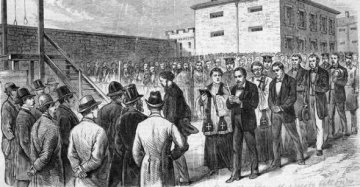
|
| Pottsville Hanging |
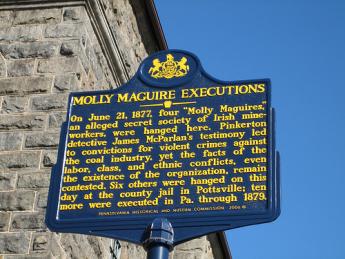
|
| Historical Marker |
However, resistance to conscription during the Civil War gave newcomer clannishness more serious consequences. This was particularly true when it inserted a surprising pro-slavery (or at least anti-emancipation) protest into the very center of the Northern Union, around Pottsville, Pennsylvania. Whatever the South was fighting for, the North was primarily fighting to preserve the economic benefits of greater trade in larger markets -- a concept loosely described as "preserving the union". A second twist to anti-Mollie repression was later added after the war was over, when the 19th Century Industrial Revolution created another untamable tribe, the Robber Barons, for whom uncooperative behavior was a tendency not to be trifled with.
Basic behavior of the Molly Maguires in action followed a simple pattern. Males dressed as females in blackface made extortion threats against members of the dominant society, protesting that their own subsequent violence was merely justice for heartlessness toward widows and orphans. Since the Mollies out of costume mingled cheerfully with those they secretly called oppressors, for actual assassinations they either called in the help of distant outsiders or drew lots to choose the assassin locally. The community would then unite to provide a vocal alibi and profess to be offended by the accusation. To increase intimidation, death threats were pinned to the door.
Azilum: French Asylum on the Susquehanna
Off with their heads!, she said. They have refused my cake in preference of moldy bread, by God"
Passage to India
.JPG)
|
| Palace on Wheels |
Journalists tactfully intone that India has fallen behind in its infrastructure. Translation: it's often at real risk of your life to cross a street. The Indian road system is overwhelmed by avalanches of rickshaws, tick tocks (motorcycle rickshaws), little cars, big cars, buses, trucks, and motorcycles. All vehicles seem to be driven by teenaged maniacs, honking their horns and driving straight at you; the motor accident rate in India is among the worst in the world. It's not just a statistic. One tour bus we were riding bashed into a motorcyclist, and just kept on going even though the passengers yelled and banged on the windows. Conclusion: airplanes and trains are the only reasonably comfortable ways to travel in India today. In another twenty years, things will surely improve or India must strangle, but right now you better save your pennies to afford the Palace on Wheels. That's a tourist train making a big continuous loop through the main tourist attractions of central India, beginning and ending in New Delhi every Wednesday.
|
| Taj Mahal |
You would have to be pretty aloof to avoid acknowledging the other seven passengers who share a sleeping car with you: four bedrooms, two houseboys, and a living room. And you soon enough know the busload (thirty passengers) in your guide group. Ours was the Pink Group, definitely not named for its political leanings. With the passengers from four bedroom cars, you also share a bar car, arranged in a facing circle of overstuffed furniture, (just as you see extended families in Bollywood movies), a sitting in one of the dining cars, and one tour bus with a Pink sign in the window. Thus organized, the twenty-car train with three trailing buses carries a hundred tourists with well-practiced efficiency in the style which claims to treat each passenger as a maharajah. It is true these modern rajahs do not have three hundred concubines or twelve wives, as the real ones did. But the briefest reflection confirms that no sane man would want twelve wives or more than, say, twenty concubines. So the tourist's condition could in a way be held superior to that of any real maharajah. The central point at the moment, however, is that the arrangement of this brief collection of strangers lends itself to gossip and reckless self-description, sort of like a rolling girls' boarding school. There's really nothing much to talk about except each other, and only eight members in the conversation group.
|
| The Pink Group |
While it was hard to overlook the mixed-ethnicity elderly couple in our midst, it was, of course, the ladies of the party who quickly assembled the essential bits of intelligence available. These two, an elderly Indian man with a broad smile and broader paunch, plus a thin wisp of a little white lady with the grace and social command of a duchess, had been friends in a Canadian nursing home where their children had placed them, had both lost their spouses, and then eloped to freedom. By escaping from the hateful nursing home they saved $9000 a month, so it really must have been a pretty upscale CCRC, or retirement village. In Canada, there is lots of snow, cozy like an igloo all winter, but unquestionably confining. A little bit of scientific background allowed me to estimate the life expectancy of these two to be about eight more years, or perhaps seven if you subtract the dismal last year that everyone should be glad to skip. These two had apparently counted up their resources, found they could afford better things than a nursing home and decided to make a dash for freedom to spend their last seven years in playland while they had the chance. The ladies in our group obviously thought this adventure was just about the most exciting thing ever and grinned approvingly at every new detail. Although our travel group overall seemed to have its fair share of boors, no one, absolutely no one was boorish enough to ask if there had been a wedding.
Like pimpled teenagers, the two would slip their hands together with the hope that if they didn't look at their hands, no one else would notice. So, from time to time, the gentleman would slide his hand onto her thigh. And she, with the practiced skill of a high school cheerleader, would wait thirty seconds and with a big smile aimed at no one in particular, brush his hand away. She was having a perfectly wonderful time because she knew very well that every other lady was watching every movement.

|
| Palace Train |
At about the same age, Ben Franklin once moved with the fast set in Paris in his eighties. In fact, Franklin probably moved with a fast set wherever he was at any age. He seldom discussed the topic directly except in that famous letter to his son which concluded, "And son, they are so grateful". In our present society which claims such infinite sophistication, Ben might now have expanded on the misdirected pressures of inheritance laws which thwart re-marriages. Or on new-found freedom, the age-related indifference to complicating children, which some couples miss more than others. In fact, Franklin's famous letter to his (illegitimate) son enumerates a list of other advantages of love affairs with older women which could just as easily have been listed by John Milton or Cotton Mather. At least one gentleman has given the opinion that Franklin was all mischievous talk and no action. But I dunno. That remark about how grateful they are surely carrying some implication of personal experience.
Anatomy of an Urban Political Machine
|
| One Big Family |
The Franklin Inn Club meets every Monday morning to discuss the news, and recently it discussed the upcoming local political campaign. The discussion went on for fifteen minutes before a newcomer asked if we were talking about the primary or the general election. The question was met with broad smiles all around because of course, we were talking about the primary. Voter registration is 6:1 in favor of the Democrats in Philadelphia, so the general election is just a required formality. The election, that is, consists only of the Democrat primary; election of the Democrat nominee in the general election is a foregone conclusion. Someone idly remarked on the number of politicians who are blood relatives of other politicians, someone else said that was true of union officers, too. So, skipping from the inside baseball of the election, we took a little time to discuss the anatomy of an urban political machine.
The first step in consolidating control of a city by a political machine is to eliminate the issue of the general election by making the other party's chances seem hopeless. That converts an election which typically turns out 40% of the voters into an exclusively primary election, turning out 20% of the voters, or even less in an off-year. In some "safe" districts a winner needs far less than 10% of the eligible voters to win.
The second step is to run as a prominent member of a local ethnic or religious group, preferably the largest of such groups within the district. If possible, an election is almost assured by being the sole candidate associated with the largest ethnic group. Here's where family connections work for you. If your father held the same seat, or some other family member had been prominent in the district, it helps assure everybody that you are really an ethnic member and not just someone whose name sounds as though it would be. Your relative will know who is important in locally local politics, the members of large families or people are known to be the "go-to guy".
Assembling all that, the final step is to get everyone else who is a member of the ethnic group to drop out of the primary, and to encourage other ethnic groups to field as many candidates as possible, splitting up their vote. Getting other members of your religious group to drop out, consists of having your relative approach them and tell them to wait their turn. The implicit promise underneath that advice is probably next to worthless, unless it is specific and witnessed, and the other fellow's ability to deliver it is credible. If all else fails, the resistant opponent is muscled in some way, verbally at first, and then increasingly threatening. The consequence of this ethnic/religious influence is more involvement in government by clergy than is healthy for either one of them. Now, that's about all there is to achieving permanent incumbency, but the minority party should be mentioned, as well as the flow of money.
It quite often happens that the minority party in the big city, hopeless in its own election chances, finds itself with a Governor and/or Legislature of their party. The patronage of state jobs becomes available to the foot soldiers who have no chance of local election. Much of the wrangling within state legislatures revolves around whether appointive patronage jobs should be lodged in state agencies, or local ones; at the moment, the Parking Authority and the Port Authorities figure prominently as jobs for which a local Republican could aspire. The coin of this trade is maintaining influence in the state nominating process and paying off with increased voter turn-out in elections which have no local effect but may be important at the state or national level. Since party dominance at state and national levels changes frequently, the local machine finds it useful to continue this system. Where they have nothing to lose in local elections, they may even encourage it.
Money is the mother's milk of politics. Except for safe districts no one can get elected without it. And various degrees of corruption provide money to be "spread around" the clubhouse, sometimes to induce people to drop out of primary races, sometimes to console "sacrifice" candidates who run hopeless campaigns just to make the party look good, and sometimes just to enrich the undeserving. The politically connected parts of the legal profession participate a good deal in the flow of funds, sometimes in order to get government legal work, sometimes to obtain judgeships, sometimes to launder the money for clients. One particularly lurid story circulates that professional sports teams are expected to make seven-figure contributions in return for lavish new stadium construction, from which they, in turn, are able to generate various sorts of compensating revenue.
But, as the old story goes, if you eat lunch with a tiger, the tiger eats last.
Societies and Clubs
|
| President Zabriskie |
A former president of the Holland Society of America recently explained the difference between a Society and a Club. Most of us supposed there was no difference, but it seems that a Society is permitted to be discriminating in its membership, while a club is not. In this quarrelsome age, that probably makes an important difference, but you will have to get a lawyer to explain exactly what it is.

|
| The Holland Society |
As best it can be made out, a Society is permitted to be an organization with a certain composition, which would be quite illegal if done by a club. The fine points of the distinction have to do with what is in its Constitution, as distinguished from what is in its By-Laws, another distinction which would puzzle most non-lawyers. And it would appear it is helpful to state a reason for the discrimination in the Constitution as well. In the case of the Holland Society, the constitution limits membership to descendants of Dutch Americans of the male line who immigrated before 1675. And the reason for this discrimination is to preserve the family names. Women are allowed to be associate members, however. Have you got that straight, ladies?
And now, we are all left floundering for an explanation of what an Association is, and why it isn't the same as a Society or a Club.
Psychiatry: Last Cow in Philadelphia
The present problem with PSYCHIATRY can be summarized as follows: At the suggestion of the American Hospital Association, Congress introduced the DRG system of paying for inpatients by diagnosis, rather than itemized services. It worked well except for psychiatry, where the diagnosis usually implies little relation to the later costs it generates, so an exception was made. The dual system of payment created loopholes which unfortunately overpaid psychiatric hospitals and were described as exploitation. Congress over-reacted in a way that was unsustainable, and essentially all of the psychiatric hospitals of the nation were forced to close. This is not a history for anyone to be proud of, and the lack of outcry is also a disappointment. However, after twenty years without reform, evidently, nothing is going to be done without an outcry.CONVENE BLUE RIBBON COMMISSION TO REPAIR PSYCHIATRIC INPATIENT CARE. The 1983 BRA switched hospital inpatient reimbursement to payment by diagnosis (DRG). Abuse of the psychiatric exclusion then led to "corrective" legislation which has essentially reduced American's psychiatric inpatient care to an underfunded national disappointment. The problem is not an easy one, so a commission should devise a workable methodology for psychiatric hospitals, relying neither on present approaches nor on DRG. But overpayment is a better outcome than no care at all. Homeless people sleeping in cardboard boxes on downtown steam grates are the consequence any visitor to the area can observe at night after the commuters go home. Psychiatric social workers readily recognize their daytime patients in the boxes.
* * * * *
|
| Daniel Blain, M.D. |
Daniel Blain, M.D. (1898-1981) was just about the most important psychiatrist in America. He was the Physician in Chief of the Institute of the Pennsylvania Hospital at 49th and Market, the first and in many ways the most prestigious psychiatric hospital before it was closed. Before that, he was the first Medical Director of the American Psychiatric Association, itself the first (1844) medical society in America. His fame rested on organizing the disorganized psychiatry of the Veteran's Administration into a chain of advanced "Dean's Hospitals", a huge and very important achievement. Before that, he had achieved considerable fame as the man who took the dilapidated State Psychiatric Hospitals with a reputation as "snake pits" and made them a respectable part of the medical community. And before that, he had been born in China as the son of missionaries. As a matter of fact, even before that, he was a descendant of General Mercer of Revolutionary War fame.
Dan was an outstanding example of the peculiar fact that Psychiatry was dominated by social upper crust psychiatrists in Philadelphia for a very long time. In fact, Benjamin Rush of the 8th Street branch of the Pennsylvania Hospital is known in some circles as the "Father of Psychiatry", while in other circles he is known for signing the Declaration of Independence. That isn't true in other cities, and it definitely isn't true in New York City, where the psychoanalytic school of Sigmund Freud took that city by storm, and essentially drove every other school of psychiatric thought out of town, out of medical schools, out of psychiatric hospitals. The famous sixteen-year psychoanalysis of Woody Allen is an example of the extremes of that fad. Every profession has petty civil wars of that sort, best left undiscussed in public. But in the case of psychiatry, it was indirectly a material contributor to the present disappearance of inpatient psychiatry, and the related appearance of lots of homeless people on steam grates. Let me give a biased view of what is a massive human tragedy, which someone else can "rectify" if he chooses.
|
| APA |
It starts with a Budget Reconciliation Act of the 1980s, which brought us the DRG (Diagnosis-related) system of paying for hospitalized patients. The idea was that appendicitis resulted in essentially 7 days in the hospital, give or take a couple of days, and the bills for admission for appendectomy were for more or less the same amount. If you had fifty or a hundred cases a year in your hospital, the high bills balanced the low bills, and the overall hospital reimbursement was essentially the same without itemizing the bandages and whatnot. Congress bought this package, and after it got going, just about all hospital bills were reimbursed at one of three hundred prices, the cost to the government was the same, and there was a whole lot less bookkeeping and accounting cost. It was a success, except for a few cases where the costs did not closely line up with the diagnosis, and psychiatric hospitals were where they concentrated. So, psychiatric hospitals were excluded, and psychiatric bills skyrocketed. This experience has been carelessly cited as an example of the evils of payment by service ("fee for service"), when in fact the duration of psychiatric hospitalization is related to features of the condition, like danger of suicide, rather than the diagnosis itself. Psychiatric leadership at the time contained many in a subset of physicians who did not think much of inpatient psychiatry in the first place and even less of lobbying, and they underestimated the severity of the assault on the specialty. Apparently, no workable formula for pricing inpatient psychiatry has since been brought forward to be approved by a Congress which is more accustomed to getting its lobbying in the form of one-liners. And would you believe it, psychiatric inpatient care soon disappeared.
|
| Pennsylvania Hospital |
That's right, if someone in your family needs psychiatric hospitalization, I wouldn't know where to tell them to get it -- at any price. From considerably overpaying for psychiatry inpatients to paying scarcely anything for them, this little change of the regulations caused every psychiatric hospital I know of by name, to close. It helped balance some state budgets, but it also was a considerable factor in filling the steam grates of American cities with people who sleep on cardboard boxes. And what it illustrates is that this is what political society always seemed to do, before Dan Blain and a small group of upper-crust psychiatrists were temporarily able to shame them into something better. In fact, if there is any tattered remnant of good inpatient psychiatric care left in America today, it is in the Veterans Hospitals that Dan was able to straighten out.
Dan Blain will probably eventually be bypassed as a curiosity, like his wife. She was a Wister Logan Blain, descended from families who ruled Philadelphia a hundred years before even General Mercer came along. So the Blain couple lived on an enormous farm plot, centered at 20th and Olney right next to LaSalle University, which is built on their property. It also contains the Peale House, where Charles Willson Peale lived as the elected president of the rebel faction of the American Revolution. Peale didn't know what he was supposed to do, so he resigned and painted portraits of people. The Blains enjoyed keeping a cow on their land, the last cow in Philadelphia, and the LaSalle students enjoyed stealing the cow and leaving it on the top floor of a dormitory, for laughs. Meanwhile, the Blain couple had cocktail parties on their front porch for visiting dignitaries. They usually wore blue jeans, and Mrs. Blain, the absolute Queen of Philadelphia society, was occasionally observed to pour vodka into her glass of beer. That sort of background may well have been useful when psychiatry needed to be built up and humanized, but it became a liability when the rest of inpatient psychiatry failed to appreciate what was knocking on its door.
Bring Your Own Hammer
Stonehenge in England is a ring of big stones standing on the edge, but only recently has it been discovered that they chime when you hit them with a hammer. The British didn't discover the phenomenon, however. Long ago the Quakers of Pennsylvania knew they had ringing rocks in a moraine dumped at the edge of a receded glacier in Bucks County. The County has made it a recreation park which is mostly deserted, except when a drove of cars appears, bearing dozens of Cub Scouts or other excursionists.
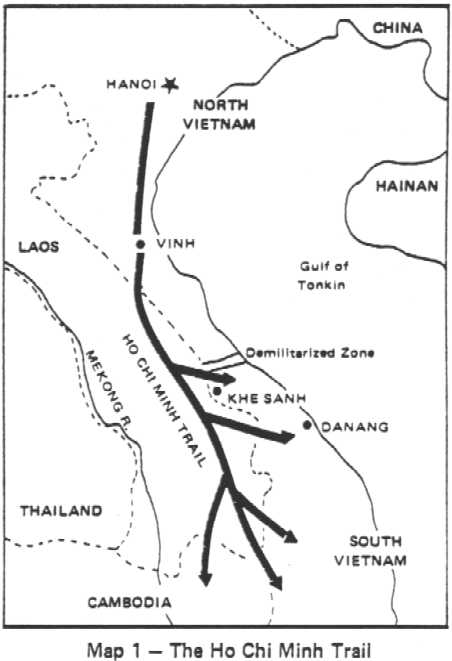
|
| Ho Chi Minh Trail |
Just what makes these boulders chime when you hit them with a hammer, isn't entirely clear. It's certainly a good topic for a geologist to use for a thesis, but right now none of the visitors to the park cares very much. It can easily be seen that the moraine marks the edge of the fertile plain surrounding Philadelphia, to the north of which the ground breaks up and has mining as its main industry. The farms suddenly become smaller and less prosperous on the moraine plateau, and fancy exurban restaurants yield place to auto dumps and parks of pickup trucks. In certain seasons, it is possible to imagine the gun racks above the front seats. Some of the areas suit itself for summer cottages in the hot weather, usually close to a stream or lake. This is the area where the Shenandoah Valley extended, narrowing down to the Delaware Water Gap. George Washington didn't just cross Delaware once near here, it was a sort of a Ho Chi Minh Trail out of reach of the British Fleet during the Revolutionary War. The main arsenal of the Revolution was in Reading. The valley meets what used to be an industrial area along Delaware, coming up from Philadelphia. Before that, the Seneca Indians had made it their headquarters, and after that, people like Stephen Girard discovered and exploited the minerals once exposed by the glaciers to the north. There's a "wind gap" (cleft in the mountain without water at the relatively high base), and the water gap. William Penn terminated his line separating East from West Jersey at Dingman's Ferry within this region, and later his sons' agents cheated the Indians with the Walking Purchase nearby. The politics of Bucks County are easily imagined by looking at prosperous Doylestown and comparing it with nearby rundown Easton. This is really just the center of Bucks County, half of which extends to the North, and all of which must have an interesting political history.

|
| Ringing Rocks County Park |
Abruptly, turning a corner amidst the summer cottages, is a neat little park, the Ringing Rocks County Park. At times it is deserted, at other times you can hardly find a place to park your car. Fields of boulders, three to ten feet in diameter, extend down the hill to the river. It's easy to go down, not so easy to get back up to your car. People pile out of their cars, carrying brand-new hammers, and you can see dozens of (probably disappointed) pockmarks on the rocks near the parking area. If you thought it was going to be easy, you are quickly disappointed.

|
| Japanese Beetle |
But the legions of cub scouts, happily swinging their hammers, swarm down on the rock piles, hitting every rock as they go. If there are enough of them, you hear plenty of clunks, but also an occasional ringing chime is heard, and the other cubs soon swarm around. At a rather daunting distance from the edge of the rock field, one cub scout after another discovers a rock that chimes like a cowbell. He attracts his friends, who have a whack at it. The chimes never quite outnumber the clunks, but the music rises as the scouts swarm over the property on agile little feet that soon defeat their elders' lumbering climb. A sudden thundershower made the rocks too slippery even for kids, and the place quickly emptied out. When we got back to the top of the hill, soaking wet, there were only a few cars still there.
"Sir"
In 1938 when I was 14 years old, I entered a new virtual country with its own virtual language. That is, I went to an all-male boarding school during the deepest part of the worst depression the country ever had.
|
| Boarding School |
identified While it should be noted I had a scholarship, there is little doubt I was anxious to learn and emulate the customs of the world I had entered. My life-long characteristic of rebellion was born here, but at first, it evoked a futile attempt to imitate. Not to challenge, but to adopt what I could afford to adopt. The afford part was a real one because the advance instructions for new boys announced a jacket and tie were required at all meals and classes, and a dark blue suit with a white shirt for Sunday chapel. That's exactly what I arrived with, and let me tell you my green suit and brown tie were pretty well worn out by the first Christmas when I came home on the train for ten days vacation, the first opportunity to demand new clothes. First-year students were identified by requiring a black cap outdoors, and never, ever, walking on the grass. The penalty for not obeying the "rhine" rules was to carry a brick around, and if discovered without a brick, to carry two bricks. But that's not what I am centered on, right now. The thing which really bothered me was unwritten, equally peer-pressured by my fellow students, the custom of addressing all my teachers as Sir. The other rules only applied until the first Christmas vacation, but the unwritten Sir rule proved to be life-long.
|
| Sir |
And it was complicated. It was Sir, as an introduction to a question, not SIR!, as a sign of disagreement. You were to use this as an introduction to a request for teaching, not as any sort of rebuke or resistance. Present-day students will be interested to know that every one of my teachers was a man; my recollection is, except for the Headmaster's secretary, the Nurse was the only other female employee. The average class size was seven. Seven boys and a master. Each session of classes was preceded by an hour of homework, the assignment for which was posted outside a classroom containing a large oval maple table. Needless to say, the masters all wore a jacket and tie, most of the finest style and workmanship. They always knew your name, and always called on every student for answers, every day. Masters relaxed a little bit during the two daily hours of required exercise, when they took off their ties and became the coaches, but were just as formal the following day in class. I had been at the head of the class of what Time Magazine called the finest public high school in America, but I nearly flunked out of the first semester in this boarding school. It was much tougher at this private school than I felt any school had a right to be, but they really meant it. Over and over, the Headmaster in the pulpit intoned, "Of those to whom much is given, much is expected."
I had some new-boy fumbles. Arriving a day early, I found myself with only a giant and a dwarf for a company at the dining table. I assumed the giant was a teacher, but he was a star on the varsity football team. And I assumed the dwarf was a student, but he was assistant housemaster. One was to become a buddy, the other a disciplinarian, but I had them reversed, calling the student "Sir", but the master by his first name. Bad mistake, which I have been reminded of, at numerous reunions since then.

|
| Yale |
When I later got to Yale, I began to see the rules behind the "Sir," rule. In the first place, all of the boarding school graduates used it, and none of the public school graduates, although many of the public school alumni began, falteringly, to imitate it. Without realizing it, a three-year habit had turned out to be a way of announcing a boarding school education. The effect on the professors was interesting; they rather liked it, so it was reinforced. It had another significance, that the graduates who said "Sir" acquired upper-class practices, the red-brick fellows seldom did. The only time I can remember it's being scorned was eight years later, by a Viennese medical professor with a thick accent, and he was obviously puzzled by the significance. Hereditary aristocracy, perhaps. Indeed, I remember clearly the first time I was addressed as Sir. I was an unpaid hospital intern, but the medical students of one of the hospital's two medical schools flattered me with the term. In retrospect, I can see it was a way of announcing that graduates of their medical school knew what it meant, while the other medical school was just red-brick. Although the latter had mostly graduated from red-brick colleges, their medical school aspired to be Ivy League.
If you traveled in Ivy League circles, the Sir convention was pretty universal until 1965, when going to school tieless reached almost all college faculties, thus extending permission to students to imitate them. Perhaps this had to do with co-education, since the sir tradition was never very strong in women's colleges, and denounced by the girls when the men's colleges went co-ed. Perhaps it had to do with the SAT test replacing school background as the major selection factor for admission. Perhaps it was the influx of central European students, children of European graduates for whom an anti-aristocratic posture was traditional, and until they came to America, largely futile. Perhaps it was economic. The American balance of trade had been positive for many decades before 1965; afterward, the balance of trade has been steadily negative.
In Shakespeare's day, "Sirrah" was a slur about persons of inferior status. In Boswell's eighteenth Century day, his Life of Johnson immortalized his characteristic put-down with a one-liner. It survives today as a virtually text-book description of how to dominate an argument at a boardroom dispute. "Why, Sir," was and remains a signal that you, you ninny, are about to be defeated with a quip. It's a curious revival of a new way of immortalizing small-group domination, and a very effective one at that, which even the soft-spoken Quakers use effectively. Whatever, whatever.
The 90-plus years of tradition of addressing your professor as "Sir," is gone, probably for good, except among those for whom it is a deeply ingrained habit. Along with the tradition of female high school teachers, followed I suppose by male college professors.
| Posted by: Ronnie Patch | Aug 4, 2008 9:21 PM |
| Posted by: Peter M. Ranoia | May 16, 2007 6:21 PM |
| Posted by: neil pasquale | Apr 11, 2007 4:24 PM |
64 Blogs
Military School
Valley Forge Military Academy takes rambunctious boys and makes them into leaders. Even some of the misfits and dropouts seem to benefit from the difficult experience.
Block Captains
A remarkable group of volunteers look out for their neighbors.
Brewerytown
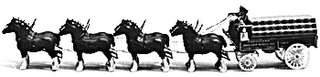 Brewerytown is an unofficial term for the North Philadelphia area which filled with a hundred breweries and ethnic German residents after the Civil War. Prohibition destroyed that industry and created slums. Gentrification is now in progress.
Georgetown Oyster Eat: Separate but Equal
The Delaware Bay once teemed with Oysters, and local firehouses were supported by annual oyster festivals. A few places bravely keep up the tradition.
Falstaff Without Prince Hal
The parents of W.C. Fields didn't treat him very well, but he always acted as though Philadelphia didn't treat him well. Philadelphia's main crime was probably that it disliked the Volstead Prohibition of Alcohol Act somewhat less than Fields disliked it.
The Jews in Colonial Philadelphia
Sephardic Jews came to Philadelphia quite early as part of New Amsterdam, with a second influx when the British occupied New York. They seem to have played an important role in financing the Revolution.
Put Down That Lid!
The toilet, or loo, has been around for centuries. Only recently has the lid become an issue.
Philadelphia Mafia: The First Fifty Years
For forty years after 1880, The Philadelphia Mafia was a small vigilante group secretly protecting Sicilian immigrants from marauding gangs of local Italians, which were definitely not the same thing. Prohibition transformed the whole nature of the underworld.
Tony Junker: Tunnell's Boys
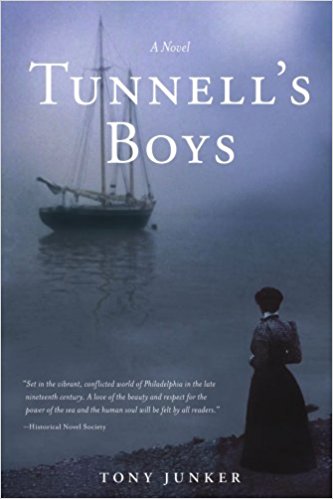 Pilots once had to race from the mouth of Delaware Bay to meet incoming ships. First one there got the job.
Wall Art in Philadelphia
Several thousand Philadelphia buildings now display outdoor paintings by local artists, encouraged and funded by the City government. In the summer, bus trips with guides tour around the town, explaining things.
Quaker Efficiency Expert: Frederick Winslow Taylor 1856-1915
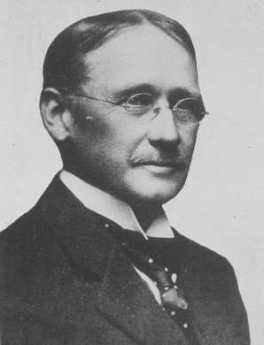 A rich Germantown Quaker boy became the world's symbol of the efficiency expert with a stop-watch, hated by Labor Unions but admired by Lenin and Stalin. He enriched the Midvale Steel Company with his invention of high-speed steel but was fired by Bethlehem Steel for eliminating too many employs. 000..0ees. Peter Drucker placed him in the class of innovators beside Darwin and Freud.
Community Volunteers in Medicine
A little group of medical volunteers in Pennsylvania's Chester County may not understand the underlying issues very well, but they just pitch in and do what they can about the medically underserved.
No Laborer Left Behind
Expanding prestige universities to fill American academic demands, unexpectedly provoke inflation obscured by illegal immigration.
Unexpected Benefits of a Lurid Past
The legal prohibition of liquor caused corruption of society which was worse, and lasted longer, than the problems it might have solved. Here and there, some surprising advantages lasted a long time, too.
Neopolitan Right Angle
A transplanted Philadelphian plants a metastasis in Florida.
Please Touch
The Please Touch Museum, a roaring success story, is planning to move too much larger quarters in the Fall of 2008.
Quilts, Patchwork Style
Although quilting can be found in the tombs of ancient Egypt, American farm women are correct that they invented an art form.
Onward, Christian Soldiers
Like a fairy godmother, Jane Kroc has dropped a spectacular gift on the poor of North Philadelphia, and the Salvation Army. Opening in 2009.
Furniture for the Horse Country
Fine art is generally the product of rich people demanding something special from a nearby artisan community. Furniture making in Chester County is sort of like that.
War Dance
 The Iroquois had politics figured out long before the White Man arrived
SCORE
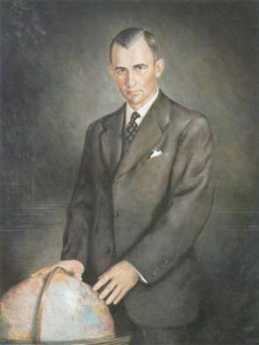 The Service Corps of Retired Executives has taken a new turn in Philadelphia, primarily serving minority start-ups, a majority of which are founded by black women.
Trenton's Tomato Pie Cult
The capital of New Jersey teaches an important lesson about ethnic food.
Acorn Club of Philadelphia
The Acorn Club is the oldest club for women in the United States. Men are welcome, but they come in through the side door on the neighboring alley.
Frida Kahlo
The crippled, suffering wife of Diego Rivera was herself a painter, often of surrealistic portraits of herself. She didn't want to be liked, she wanted to be noticed.
WRTI, Classical Music and Jazz
For a city with such a strong musical presence, it is surprising that Philadelphia has only one classical music radio station.
New Museum of Chemical Heritage
 There's a stunning new museum on Chestnut Street, right across the street from Carpenters Hall. It's intended to convince everybody that chemistry is fascinating, particularly those who incline to doubt it.
Citywide Social Calendar
Every city needs a central clearinghouse for timing social events, perhaps a different one for sports events, a third for conventions. And so on..
Philosophy Means Science in Philadelphia
 At least until he met Madame Helvetius, Benjamin Franklin displayed little interest in moral philosophy. His interest was in science, which was called natural philosophy in the Eighteenth Century. The American Philosophical Society is America's oldest and most prestigious society of scientific scholars. If investing is a science, the APS is good at that, too.
Wagner Free Institute of Science
The Wagner science museum may not be the oldest museum in Philadelphia, but it is certainly the only one that is exactly the same as it was in the Nineteenth Century. It's a museum museum.
Molly Maguires of Pennsylvania (2)
Almost everything the Molly Maguires said about their ruthless enemy the mine owner was accurate. Unfortunately, much of what he said about them was also accurate. And both sides said things that were pure fabrications.
Harvard Progressives in Philadelphia
 The Progressive movement of the early 20th century was a strange hodge-podge of political reformers, nostalgic aristocrats, would-be socialists, and anti-immigrant. The central figure was Theodore Roosevelt, traveling in strange company like Owen Wister, Robert M. LaFollette, Henry James, and Henry Adams. The Philadelphia link seems to have been through Harvard.
Tour of Duty in 'Nam
>Veterans of the Vietnam conflict are famously reluctant to talk about their experiences. It's hard to know what that means, and whether it's a good thing or a bad thing.
Food
The Meals are fitted around work schedules for working-age folks, even when they aren't going to work. In retirement, meals are themselves pivotal events.
Tales of the Troop
 Dennis Boylan is collecting stories from the archives of Philadelphia's First City Troop. Someday, it should result in a great book.
The Republican Court
An aristocratic court may seem a peculiar place to unite a republic, but the female-dominated social circle of 1790-1800 nevertheless united a new nation. Its definition of who is socially prominent still persists, in SR -- the Social Register.
Heron Rookery on the Delaware
Two or three miles from Philadelphia City Hall, a large flock of Blue Herons with seven-foot wingspreads are nesting in the trees, largely unnoticed.
Cushman Club for Lonesome Actresses
One of the ancient Camac Street clubs has closed its doors, to become a charitable foundation.
Special Education, Special Problems
Until recently, mentally retarded children weren't even considered in school budgets. But in recent decades, they have become one of the biggest challenges.
America's New Theater Capital
New York's professional theaters have mostly become a tourist industry. The new capital of legitimate theater in America is -- Philadelphia.
Powel House, Huzzah!
On 3rd Street in Philadelphia's Society Hill, stands the finest surviving Georgian House of what Washington and Madison called the Republican Court. A great many traditions of American high society were formed in the second-floor dining room of this house.
Mennonites: The Pennsylvania Swiss
Mennonite Pennsylvania Dutchmen actually came here from Switzerland. The book of their religious martyrs is more than a foot thick since they practice non-resistance, a belief significantly more pacifist than non-violence. Nevertheless, they prosper abundantly in Montgomery County.
Locating Corporate Headquarters
Every year, millions of dollars are spent by cities to induce corporations to relocate their headquarters. Does it work? Is it a goal worth pursuing?
Medical Generation Gap
Under a new rule, hospitals are forbidden to let house doctors work more than an 80 hour week. It is the cause of violent social uproar.
The Revolution is Over, Every Man for Himself
 Although his personal wealth in modern equivalents approached that of Bill Gates today, Robert Morris abruptly quit his business after a debate in the Legislature, just to show he had no personal bias. It ruined him, but John Hancock and George Washington did much the same thing. Ben Franklin agreed, but was shrewder about it.
Children Playing With Matches
We are not a strongly ethnic nation. You are not an American because of who your ancestors were; you are an American because of what you believe.
Statement of Accounts, March 1785
At the conclusion of Robert Morris' term of office as Financier, he did an unusual thing by submitting a complete accounting of his term. As things turned out, it was a good thing he did so.
State in Schuylkill Fishing Club
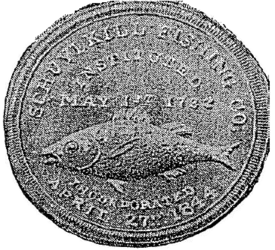 Unless you listen to some quibbles from White's in London, the Schuylkill Fishing Club of the State in Schuylkill is the oldest organized men's club in the world. And even if that exception is admitted, it's the oldest men's club in America. It's no secret, but it's very private.
Espionage in the Revolution
 Almost everyone in the American Revolution could speak English, so it is not surprising to hear of many spies.
A Time to Read Books
Retirement is a good time to read all those books you meant to read. But certain things stand in the way.
Bones in Duffy's Cut
They are digging up bones in Malvern, finding evidence of murder. Some people are uneasy about perpetuating ethnic strife.
One Big Brewerytown
 It's hard to realize that Philadelphia was the center of beer production in America until fairly recently. It's been argued it is still the center of consumption.
Musical Theatre at the 11th Hour
There are 1200 theatrical companies in Philadelphia, but only one devoted to musicals. Does that say something about the audiences, the unions, or the musicians?
Inscrutable Chinese
American tourists in Tian a men Square never even knew they were present at one of the great revolutionary riots of the century.
The Scotch-Irish In the Revolution
English Quakers and Rhineland Germans were eternally grateful to the British Monarch for offering them an American refuge. By contrast, the Scotch-Irish, although energetic frontiersmen, harbored lasting resentment against the English Kings who had driven them here.
Mussolini in South Philadelphia
The American public had scarcely heard of Benito Mussolini before World War II, but Italian immigrants in South Philadelphia were agitated by news from the old country.
Chinese North
Like Philadelphia, Beijing has its streets laid out in squares. Take a look from a space satellite to see how the main aisle of the Forbidden City runs due north and south..
Molly Maguires of Pennsylvania (1)
The main features of the Molly Maguires of Pennsylvania can be found in the Molly Maguires of Ireland, and perhaps far earlier than that.
Azilum: French Asylum on the Susquehanna
The French Revolution and the slave revolt in Haiti created the need for a French-speaking refuge for fleeing aristocrats, and some francophile Philadelphians organized one, including a futile effort to rescue Marie Antoinette.
Passage to India
There's a rumor that romance can flower at senior citizen retirement communities.
Anatomy of an Urban Political Machine
If Philadelphia is typical, here is how urban machine politics works.
Societies and Clubs
Most of us recognize no difference between a Society, and a Club. But essentially, a club must not discriminate in admitting members, but a society can do so. You will have to ask a lawyer to explain that.
Psychiatry: Last Cow in Philadelphia
Daniel Blain, just about the most famous psychiatrist in America, lived at 20th and Olney, West. Not only was that the place he lived, but he also kept a cow there. And this was within living memory.
Bring Your Own Hammer
 Pennsylvania has 120 State Parks, but this is a Bucks County Park. The exposed bedrock is in an eight-acre park of great big boulders, a few of which chime when you strike them. The rest just give out a clunking noise.