2 Volumes
Tourist Trips: Philadelphia and the Quaker Colonies
The states of Pennsylvania, Delaware, and New Jersey all belonged to William Penn the Quaker in one way or another. New Jersey was first, Delaware the last. Penn was the largest private landholder in American history.
Regional Overview: The Sights of the City, Loosely Defined
Philadelphia,defined here as the Quaker region of three formerly Quaker states, contains an astonishing number of interesting places to visit. Three centuries of history leave their marks everywhere. Begin by understanding that William Penn was the largest private landholder in history, and he owned all of it.
Custom Tour of Private Philadelphia
Philadelphia Hospitality, a non-profit group, puts together the following tour for visiting bigwigs. A good guide to what's best around here.
For three decades, a non-profit organizstion called Philadelphia Hospitality has dedicated itself to showing Philadelphia's private treasures to important visitors.
Among their many varied activities is arranging tours of interesting places, and in that way they discover what is particularly interesting to visitors. What follows is a little virtual tour through the popular points on Philadelphia's compass, as listed in Philadelphia Hospitality's brochure.

Albert C. Barnes, M.D.
A private investor has the general goal of accumulating enough wealth so, come what may, there will be a little left when he dies. If he has dependents or heirs, he needs somewhat more. Either way, he is not planning for perpetuity or thinking in astronomical time periods. Albert C. Barnes (1872-1951) had to switch his investment goals, in the 1920s, from investing for a comfortable retirement to investing for a perpetual art foundation. Perpetual.
|
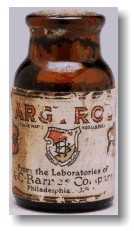
| A bottle of Argyrol |
Having graduated from medical school (University of Pennsylvania) in 1902, and then writing a doctoral thesis in chemistry and pharmacology at the Universities of Berlin and Heidelberg, Barnes invented a patent medicine that quickly made him rich. Argyrol was a mildly effective silver-containing antiseptic with the unfortunate tendency to turn its users permanently slate-gray. The advent of antibiotics has since made Argyrol almost sound like quackery, but it was effective enough at the time to require factories in America, Europe, and Australia, and Barnes became immensely rich with it. The American Medical Association strongly disapproves of physicians who patent remedies, so Barnes was never held in high regard by his colleagues; but it could well be argued that he had as much training as a chemist as a physician, and spent his entire professional life as a chemist, manufacturer, and investor.
|
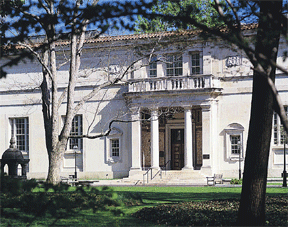
| The Barnes Gallery |
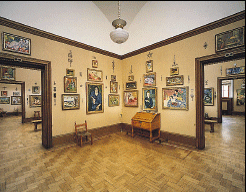
Barnes was eccentric, all right, but on Wall Street, the saying goes, "What everyone knows, isn't worth knowing." Guided by that principle, in 1929 he sold his company at the very peak of market euphoria, getting out of common stocks at the top of the market. It is small wonder that he soon instructed his Foundation to invest its endowment entirely in bonds. During the 1930s, commodities were extremely cheap because no one had any money. Barnes, of course, had a potful of money and bought hundreds, even thousands, of artworks very cheaply. He also bought 137 acres of Chester County, PA, real estate, and a 12-acre arboretum in Merion Township on the Main Line. Although he is famous for acquiring hundreds of French Impressionist paintings with the advice of Gertrude Stein and her brother Leo, he also bought great quantities of Greek and Roman classical art, African art, and the art of the Pennsylvania German community. He picked up a notable collection of metallic art objects. Most of these "losers" are down in the basement because he had so many Renoirs, Matisse, and Picasso (some of them may be worth $200 million apiece) that the upstairs galleries were pretty well stuffed with them. Viewed from the perspective of an investor with a goal of perpetuity, of course, the things in the basement just happen to be temporarily out of fashion, just like those bonds in the portfolio.
|
| A view inside the Barnes gallery |
Since the Foundation is currently strapped for ready cash, Judge Stanley Ott of the Montgomery County Orphans Court is now being urged to allow the Foundation to break Barnes' will in some way or other. Move the museum to downtown Philadelphia where it can attract more paying visitors. Sell some of that land. Sell some of those paintings in the cellar. Fire some of those employees. But all of these suggestions are short-term solutions, which may injure the long term. Everybody has an idea of what Barnes the rich eccentric would have done if he were alive to do it, but I suspect he would have rejected the whole lot. Barnes the shrewd investor would have taken the most expensive painting off the wall, and sold it to the highest bidder. Buy low, sell high, and the niceties of non-profit professionals are damned. Barnes wasn't in love with one single painting, or one particular school of painterly interpretation, he was in love with Art.
Investment theory has improved in the past fifty years; there have even been some Nobel prizes awarded for new insights. But it still isn't possible to put an investment portfolio on autopilot for perpetuity. Every museum, university, and the foundation has the same problem, with the result that the landscape is littered with the bones of perpetual organizations destroyed by following a fixed formula. With the singular success that Barnes displayed, it isn't surprising that he went a little too far with instructing his successor trustees in what to invest in. Never sell the paintings or the real estate, avoid the common stock, were ideas that worked brilliantly, and may even work most of the time. But sooner or later, the institution will be endangered by following them too literally. Somebody has to have some flexibility. But there is something else that is inevitable, too. Sooner or later, whether it takes fifty years or five hundred years, sooner or later someone will be given the responsibility and the necessary flexibility -- but will try to run off with the boodle, for himself. The balance between necessary prudence and necessary flexibility is impossible to maintain forever, and the Judge will surely have a hard time deciding what Barnes would have decided.
Powel House, Huzzah!
|
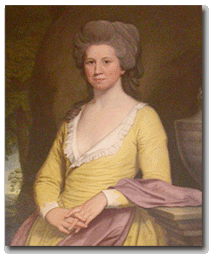
| Elizabeth Powel |
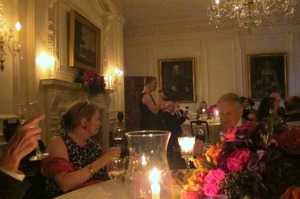
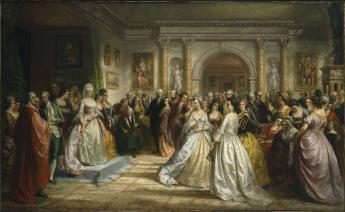
If George Washington were still alive he would no doubt be a Republican, but the term Republican Court actually has nothing to do with R's and D's. It was a scheme deliberately cooked up by Washington and Madison to enlist support by the new government's important ladies for a modified version of a European royal court, to make thirteen colonies into a cohesive nation. A most remarkable thing about it was its frank imitation of the royal courts, something only the Father of His Country could pull off in former colonies which had just fought an eight-year war to be rid of the monarchy. It is one more great testimony to the faith of Americans in George Washington; but it also testifies to the power of enthusiastic women, once they agree on a project. Chief among the leaders in this court was Elizabeth Powel, along with her niece living around the corner on Spruce Street, Anne Willing Bingham. Recently, the Peale Society of the Academy of Fine Arts held a candlelight dinner in Mrs. Powel's magnificent second-floor dining room, while scholars of the history of the Republican Court told assembled notables of Philadelphia what had once been what, during the first ten years of the Republic.
|
| Dining Room |
Members of the early Congress were largely the same men as the founding fathers of the Constitutional Convention, hand-picked by Washington and Madison to persuade the legislatures of their colonial states to give up state sovereignty, for a unified nation. There was the difference that now they brought their wives to live in Philadelphia during sessions of Congress. Those women wanted to know each other and wanted to have something exciting to do together in the largest city in the nation. Their husbands knew well how politically useful it was to be socially acquainted in this way, so everybody liked the idea of suddenly becoming nationally connected. The initial idea proved unworkable. Martha Washington was supposed to become Lady Washington, reigning over weekly receptions.
|
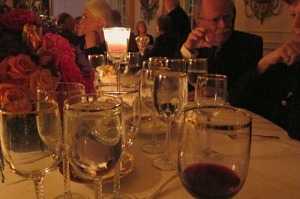
| In Our Cups |
But Martha, unfortunately, wasn't up to the task, and Anne Bingham whose rich husband had taken her on lengthy tours of European royal courts, moved right in and took charge of this project. Besides her cousin Elizabeth Powel, notable members of this social whirl were the two daughters of Chief Justice Benjamin Chew, Alexander Hamilton's wife, and various members of the Shippen and Willing families. Members of the family of Lord Sterling of New Jersey, Charles Carroll of Carrolton, Maryland, Cadwaladers of various sorts, and a number of other names famous from then until even today joined their affiliations with ladies from other states through parties and even some weddings. John Adams was particularly awestruck by the poise and beauty of Anne Bingham, although Abigail Adams may not have been quite so infatuated. It was a dizzy whirl, with dinner parties the central activity just as they are in Philadelphia even today. Country bumpkins had to learn how to dress, to talk and to eat with the right spoon and keep their elbows off the table; those who could tactfully show them what was what were friends for life. Centuries later, Emily Post made a fortune writing books about these rules.
|
| Republican Court |
In those days, they even had their war cry, which was to raise a glass and shout back "Huzzah" in response to the proposer of a toast, who had raised his glass starting the warcry. It wasn't "Skol" or "Cheers" or "Here, here" if you knew what was what; it was "Huzzah". Most fashionable dinners had at least twenty courses, but the ladies didn't eat them. It was a whispered instruction among the ladies that they should eat before the dinner, so they could gracefully decline to gobble up goodies, and spend their time in gay conversation or waiting to be asked to dance. Drinking and eating, especially drinking, was for the men at the party, although naturally the many courses of the banquet were put in front of the ladies to be airily ignored. When George Washington was present as he often was, or even La Rochfoucault himself, it was important to remember every spoken word.
And, you know, it worked. When these important people went back home, they took the customs of the Republican Court with them. The American diplomatic corps found the equivalent of minor-league training for their efforts on behalf of the country abroad. Politics was easier if you personally knew your adversaries as well as your allies. The persistence of the same family names in the Social Register, the lists of The Four Hundred and other compilations of high society show that Anne Bingham and Elizabeth Powel did indeed know what they were doing, and for that matter, so did George Washington. If anyone else had been at the top of this heap, Thomas Jefferson stood ready to attack with all his might.
|
| Amity Button |
But he and even Patrick Henry didn't dare attack Washington. The aristocrats of Old Europe probably did sneer at this amateur effort, and in some circles still, do. But the inability of absolutely any other group of nations, whether European, Asian or South American, to unite peacefully is a thumb in the eye of anyone who mocks George Washington's little Philadelphia creation. And to think it all began right here, right here in the Powel House, right here in the dining room on the second floor. For that, folks, one thunderous "Huzzah!"
REFERENCES
| A Portrait of Elizabeth Willing Powell: 1743-1830 David W. Maxey ISBN-13: 978-0871699640 | Amazon |
Rubberneck Tours of Philadelphia (1)
|
| Center City Philadelphia |
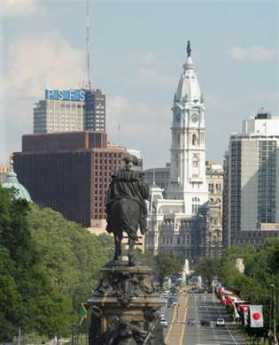
To qualify as a rubberneck tour, a route can be traveled in two hours by car, avoids the unsightly parts of town, strings together a lot of interesting sights which are of interest to visitors from out of town -- and educates the life-long residents as well. Several tours qualify, and it's a pity you can't go to someplace near City Hall and select one of them from a line of buses. Perhaps in time tourism will reach the point where this is possible.
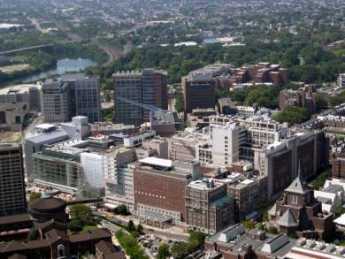
For a start, go West from the center of town, out Walnut Street to 33rd Street, turn right. You won't see all of the University of Pennsylvania, but you will see a lot of it, followed by the campus of Drexel University. This was once a very elegant district, and many Victorian mansions can be seen as you go out to the Zoo. Navigate around a little with a map and get on Belmont Avenue. Be sure to get a glimpse of Sweet Briar mansion, peeping through on the right. You will be able to see Memorial Hall and other remnants of the 1876 Exhibition, soon to be the site of the Please Touch Museum. Keep going on Belmont, past the Ohio House which dates from the Exhibition, and on out Belmont Avenue to City Line Avenue. Here's the surprise.
Cross over City Line Avenue into Montgomery County and keep going. You will go past some lovely houses on the left, and the borders of Laurel Hill Cemetery on the right. You are going downhill now, through the woods, and you sweep around the right to the bridge over the Schuylkill. Didn't expect to go out of the city into the woods so abruptly, did you?
And now, crossing the Schuylkill, turn abruptly right on to Main Street in Manayunk. Another scenic shock, as you emerge from a country lane onto several miles of a gentrified abandoned factory town. In the summer, there are an awful lot of people sitting at sidewalk tables, talking about who knows what. Perhaps they are mostly resting their feet from shopping, whatever that means, in all the little stores now selling shoes and kerchiefs, apartment furniture, and knick-knacks. After a while, Main Street turns into Ridge Avenue, which eventually leads you back to the Benjamin Franklin Parkway, and back to City Hall. A somewhat prettier drive is closer to the river, with the landscaping and boathouses of the Schuylkill Navy.
|
| Fairmount Park |
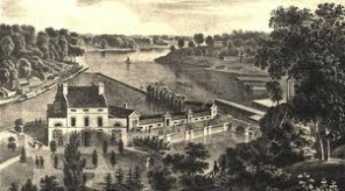
But continuing on Ridge Avenue allows you the option of an abrupt turn left on Schoolhouse Lane, where it's admittedly a little hard to find and navigate a left turn, scooting you abruptly back up a steep hill and into the woods again. Turn right on Vaux, right again on Warden Drive, and then left to Midvale, following it down to rejoin Ridge Avenue at the bottom of the hill. This little side-trip allows you to see some pretty unexpected woody suburbs, and if you have been told where to look, the former home of Grace Kelly, and the homes of Senator Spector and Governor Rendell.
|
| UPENN |
Give it a few years, and Ridge Avenue at this point is sure to get gentrified like Main Street, back up that hill in Manayunk. Now, either take Kelly Drive back into town, or continue down Ridge past old (East) Laurel Hill Cemetery and a brief spin into Sedgely and the mansions along the cliff in East Fairmount Park. Or a brief detour over the Girard Street bridge to the edge of West Fairmount Park is worth a few minutes, returning by the Spring Garden Street bridge to the back of the Art Museum, and then down the Parkway.
You've just had a pleasant two-hour tour, researched and designed by the history department of the University of Pennsylvania to illustrate Philadelphia's role in the days of the Civil War. Back then, the area roughly enclosed by our rubberneck tour #1 was just beyond the edge of the town, an ideal spot for many training camps for the Union Army. Further south on the Schuylkill at that time was a collection of factories known as the "arsenal of the North". This more northerly part of town, now filled with thousands of brick row houses, was once let us say, the boot camp of the North.
Armonica, Momentarily Mesmerizing
|
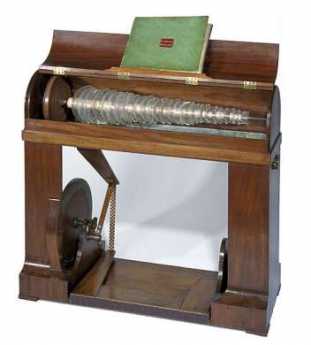
| Ben Franklin's Glass Armonica |
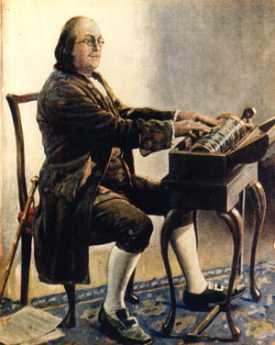
Everyone knows Ben Franklin spent a lot of time holding a wine glass. Evidently, he noticed a musical note emerges if you run your finger around the open mouth of the drinking glass, and systematically studied how the tone can be varied by varying the level of liquid in the glass. The same variation in emitted tone relates to variations in the thickness of the glass. So, he set up a series of different sized glasses impaled on a horizontal broomstick, enough to cover three octaves, rotated the broomstick with a treadle like those used for spinning wheels -- and made music. The tone has a haunting penetration to it, which induced both Beethoven and Mozart to write special compositions for the harmonica, and the Eighteenth Century went wild with enthusiasm.
|
| Glass Armonica |
Unfortunately, a number of the young ladies who played the armonica went mad. We now recognize that since the finest crystal glass was used, with very high lead content, the mad ladies were suffering from lead poisoning after repeatedly wetting their fingers on their tongues. As a matter of fact, port wine at that time was stored in lead-lined casks, resulting in the same unfortunate consequences, which included stirring up attacks of gout. Franklin himself was a famous sufferer from gout, which was more likely related to the port wine than playing the harmonica, in his particular case.
Anyway, the reputation for inducing madness added to the spooky sort of sound the instrument made, attracting the attention of a montebank named Franz Anton Mesmer, who falsely claimed to be the father of hypnotism. Mesmer enhanced the society of his stage performances by hypnotizing subjects while an assistant played the harmonica, meanwhile relating all sorts of wild tales about animal magnetism. This was pretty sensational at the time until a young man in an audience suddenly died. It is now speculated that the victim probably had an epileptic seizure, but the news of this public fatal event pretty well finished Mesmer as an evangelist and the harmonica as a musical instrument.
|
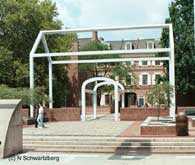
| Franklin Court |
There's a replica of an armonica on display in the Franklin Court Museum around 3rd and Chestnut, which we are vigorously assured is not made with leaded crystal glass. The Park Rangers put on two daily performances by request, at noon, and 2:30 PM.
West Fairmount Park
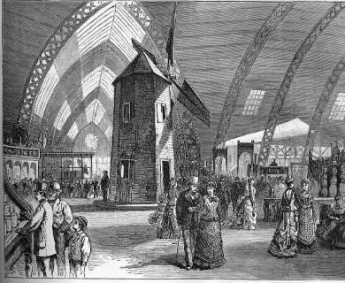
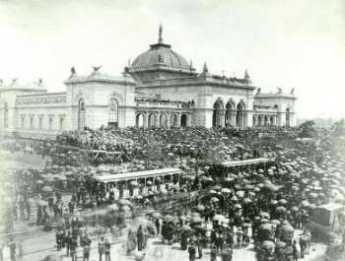
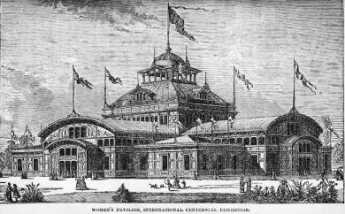
Fairmount Park is considerably larger on the west bank of the Schuylkill than on the east, and the points of interest are somewhat more diluted by woods and pasture. Partly, that is a consequence of being the site of the 1876 Centennial Exhibition , and partly that urban growth had not encroached so much into the farmland at the time the park was created. On the west bank at the time of the Revolution, there were still 300-400 acre farms, whereas the east bank farms had been cut up into gentleman's
|
| Centennial Exhibition |
estates. The Schuylkill takes two 90-degree turns within the Park limits, leaving a point of high land on either side of the river. On the east side, the East Park reservoir is at the apex, and on the west side, the dominant point is Belmont Mansion. For a while, there was a restaurant at Belmont, but at the moment it's a pity but little advantage is taken of a very scenic view. Two judges once lived in the mansion, William Peters, and his nephew Richard Peters. William was a Tory and had to flee to England. Richard made a better guess and as a rebel, therefore could live on in scenic splendor.
For orientation, the West Park mansions extend in an arc from The Solitude in the south to Chamonix in the north. For the moment limiting our list to houses present when the Park was created, there is Sweetbrier, The Pig-Eye Cottage, Belmont, Ridgeland, Greenland, and the Lilacs. The last three houses belonged to three well-known Philadelphia families, Garrett, J.B. Lippincott, and Walnut, who established themselves in 19th Century commerce rather than 18th Century politics. Sweetbrier was one of those centers of French Philadelphia, when Samuel Breck continued his father's close relationship developed as the fiscal representative of French Forces in America, entertaining LaFayette and other such friends of the new Republic. The Pig-eye cottage is used by the Park administration, and closely resembles the Caleb Pusey house, but otherwise has no remarkable history. Solitude, on the other hand, really was the retreat for John, then Richard, then Granville. John Penn entertained George Washington here while he was presiding over the Constitutional Convention.
|
| fair |
Fairmount Park is notable for some buildings which are unfortunately no longer there, and some other buildings that were transplanted there. The East Park is a historical monument, while the West Park is more a house museum. Governor Mifflin's house is gone from the Falls area, Powelton is gone, and Lansdowne the estate where the Proprietor John Penn was seized by rebel soldiers. His family was later paid less than a penny an acre for the 21 million acres of Pennsylvania land they clearly owned. Sedgley is also gone, and all of these places have a place in history. On the other hand, it is well to remember that all of the industrial slums along the river were cleared away to be replaced by the charm of Boat House Row.
|
| Exhibition |
It keeps being repeated that Fairmount Park is the largest urban park in America, but the fact is it is bigger than the city can afford to maintain, just as a monument to the colonial style of life. It was a grand place to have a World's Fair in 1876, and Memorial Hall remains, along with the Japanese pavilion, a truly priceless reproduction of Japan under the Shogun. Fairmount Park has the first Zoo in America, still a place of note in zoological circles, and many ballparks, summer music halls, and other modern recreational attractions. It contains Cedar Grove, a splendid Quaker homestead in Welsh style, transported from its original location in Frankford. The Letitia Street House was too fine an example of 17th Century urban architecture to lose, so it was moved to the Park from Letitia Street, approximately 2nd and Market Streets. William Penn lived for a while on Letitia Street, named after his daughter, but it is not entirely clear who lived in this particular little house. There doesn't seem to be anything you can do about people calling it the William Penn House.
Fairmount Park is the largest urban park. It doesn't have roley coasters, but we don't miss them, and it doesn't have Mickey Mouse, at least so far. There is absolutely nothing like it anywhere. Anyway even if there were, Philadelphians wouldn't notice.
Reservoir on Reservoir Drive
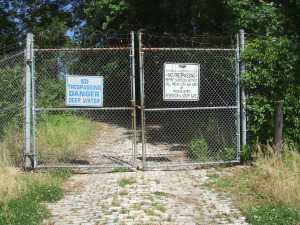
William Penn planned to put his mansion on top of Faire Mount, where the Art Museum now stands. By 1880, long after Penn decided to build Pennsbury Mansion elsewhere, city growth outran the capacity of the new reservoir system which had then been placed on Fairmount. An additional set of storage reservoirs were placed on another hill across East River (Kelly) Drive, behind Robert Morris' showplace mansion now called Lemon Hill (Morris merely called it The Hill); the area was eventually named the East Park Reservoir. In time, trees grew up along the ridge and houses got built; the existence of these reservoirs right in the city was easily forgotten, even though the towers of center city are now plainly visible from them. These particular reservoirs were never used for water purification; that's done in four other locations around town, and the purified water is piped underground to Lemon Hill, for last-minute storage; gravity pushes it through the city pipes as needed.
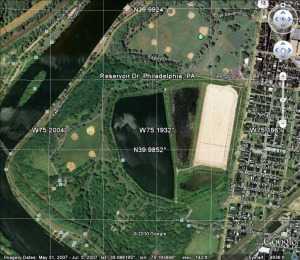
Now, here's the first surprise. Water use in Philadelphia has markedly declined in the past century. That's because the major water use was by heavy industry, not individual residences, so one outward sign of the switch from a 19th Century industrial economy to a service economy is -- empty old reservoirs. Only one-quarter of the reservoir capacity is in active use, protected by a rubber covering and fed by underground pipes. The rest of the sections of the reservoir are filled by rain and snow, but gradually silting up from the bottom, marshy at the edges. Unplanted trees have grown up in a jungle of second-growth, attracting vast numbers of migratory birds traveling down the Atlantic flyway. Although there are only a hundred acres of water surface here, the dense vegetation closes in around the visitor, giving the impression of limitless wilderness, except for the center city towers peeping through gaps in the forest. It's fenced in and quiet except for the birds. For a few lucky visitors, it's easy to get a feeling for how it must have looked to William Penn, three hundred or more years ago, and Robert Morris, two hundred years ago. In another sense, it demarcates the peak of Philadelphia's industrial age, from 1880 to 1940, because that kind of industrialization uses a lot of water.
The place, in May, is alive with Baltimore Orioles. Or at least their songs fill the air and experienced bird watchers know they are there. Even a beginner can recognize the red-winged blackbirds, flickers, robins, and wrens (they like to nest in lamp posts). The hawks nesting on the windowsills of Logan Circle suddenly makes a lot more sense, because that isn't very far away. In January, flocks of ducks and geese swoop in on the water surface, which by spillways is kept eight feet deep for their favorite food. Just how the fish got there is unclear, perhaps birds of some sort carried them in. The neighborhoods nearby are teeming with little boys who would love to catch those fish, but it's fenced and guarded much more vigorously since 9-11. In fact, you have to sign a formal document in order to be admitted; it says "Witnesseth" in big letters. Lawyers are well known for being timid souls, imagining hobgoblins behind every tree. However, there are some little reminders that evil isn't too far away. Just about once a week, someone shoots a gun into the air in the nearby city. It goes up and then comes down at random, with approximately the same downward velocity when it lands as when it left the muzzle upward. That is, it puts a hole in the rubber canopy over the active reservoir, which then has to be repaired. No doubt, if it hit your head it would leave the same hole. So, sign the document, and bring an umbrella if the odds worry you.
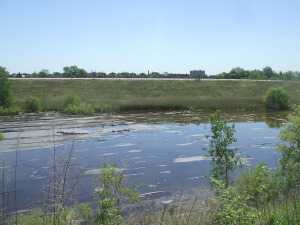
A treasure like this just isn't going to remain as it is, where it is. It's hard to know whether to be most fearful of bootleggers, apartment builders or city councilmen, but somebody is going to do something destructive to our unique treasure, possibly discovering oil shale beneath it for example, unless imaginative civil society takes charge. At present, the great white hope rests with a consortium of Outward Bound and Audubon Pennsylvania, who have an ingenious plan to put up education and administrative center right at the fence, where the city meets the wilderness. That should restrict public entrance to the nature preserve, but allow full views of its interior. Who knows, perhaps urban migration will bring about a rehabilitation of what was once a very elegant residential neighborhood. And push away some of those reckless shooters who now delight in potting at the overhead birds.
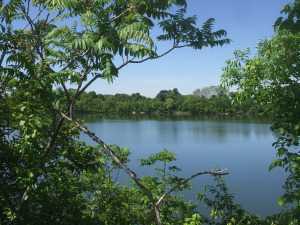
This whole topic of waterworks and reservoirs brings up what seems like a Wall Street mystery. Few people seem to grasp the idea, but Philadelphia is the very center of a very large industry of waterworks companies. The tale is told that the yellow fever epidemics around 1800 were the instigation for the first and finest municipal waterworks in the world. There's a very fine exhibit of this remarkable history in the old waterworks beside the Art Museum. But that's a municipal water service; why do we have private equity firms, water conglomerates, hedge funds for water industries, and other concentrations of distinctly private enterprise in the water? One hypothesis offered by a private equity partner was that the success of the municipal water works of Philadelphia stimulated many surrounding suburbs to do the same thing; it was surely better than digging your own well. This concentration of small and fairly inefficient waterworks around the suburban ring of this city might well have created an opportunity for conglomerates to amalgamate them at lower consumer cost. Anyway, it seems to be true that if you want to visit the headquarters of the largest waterworks company in the world, you go about seven miles from city hall and look around a nearby shopping center. If you are looking for the world's acknowledged expert in rivers, you go to the Academy of Natural Sciences of Philadelphia on Logan Square and look around for a lady who is 104 years old. And if you have a light you are trying to hide under a barrel, come to Philadelphia.
6 Blogs
Albert C. Barnes, M.D.
Impressionist paintings grew more valuable, faster than the patron's endowment for their maintenance.
Powel House, Huzzah!
On 3rd Street in Philadelphia's Society Hill, stands the finest surviving Georgian House of what Washington and Madison called the Republican Court. A great many traditions of American high society were formed in the second-floor dining room of this house.
Rubberneck Tours of Philadelphia (1)
A very enjoyable two-hour drive, up to one side of the Schuylkill and down the other, encircles dozens of points of interest. Even if you don't know and don't care that this area was once the training ground for most of the Union Army.
Armonica, Momentarily Mesmerizing
The harmonica was a musical instrument invented by Ben Franklin, who else. Beethoven and Mozart wrote music for it. It made people sick and may even have killed someone.
West Fairmount Park
Fairmount Park, west of the river, is the largest part. The 1876 Centennial was held there.
Reservoir on Reservoir Drive
Philadelphia has a wildlife treasure within a mile of City Hall. The birds know all about it, but citizens need to search a little.