Related Topics
Benjamin Franklin
A collection of Benjamin Franklin tidbits that relate Philadelphia's revolutionary prelate to his moving around the city, the colonies, and the world.
Revolutionary Philadelphia's Patriots
All kinds of people were patriots in 1776, and many of them were all mixed up about what was going on and how they stood. Hotheads in the London Coffee House stirred up about an inoffensive Tea Act, Scotch-Irish come here to escape the British Crown, the local artisan class and the local smuggler class, unexpectedly prospering under non-importation, and the local gentry -- offended to be denied seats in Parliament like other Englishmen. Pennsylvania wavered until Ben Franklin stepped forward with a plan.
Causes of the American Revolution
Britain and its colonies had outgrown Eighteenth Century techniques of governance. Unfortunately, both England and America lacked the sophistication to make drastic changes smoothly.
Poor Richard Plays Hardball
Several distinguished biographies of Benjamin Franklin have recently skirted his January 1774 confrontation with the British government in the "Cockpit" of Whitehall. Presumably, the exquisite details are too fancy and complicated for easy description, or possibly the cardinal significance of this intellectual duel is underestimated. It seems possible the American Revolution was declared by one man's making up his mind. A mind made up in one particular hour in one particular room, irrevocably, in front of the whole British Establishment.
The Archbishop of Canterbury was there, and so were Edmund Burke and Joseph Priestley. So were all the Privy Council, and most of British high society, giggling and hissing at his discomfort. Poor Richard stood there silent and impassive. The Enlightenment thought they were deciding his fate, but he was deciding theirs.
|
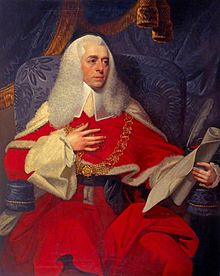
| Lord Alexander Wedderburn |
Franklin had published some letters he had promised not to publish, but they showed the British government in a very bad light. Alexander Wedderburn the Solicitor-General had deliberately orchestrated the meeting to shift the emphasis to Franklin's broken promise and away from British provocation of it. The room had been packed with highbrows promised a delicious treat, and Wedderburn's speech was meticulously planned as an entertainment for the intelligentsia. The man who discovered electricity was mocked as "conducting" the letters. And a famous man of letters was reminded that the ancient Athenians would brand three letters on the back of the hand of a thief: FUR, the name for a thief, an elaborate 18th Century pun making reference to fur hats and collars, which were the traditional symbol of printers. Wedderburn roused himself to the climactic announcement that the famous Roman, Plautus, had invented the famous derivative epithet, "Homo, triumph literarum," portentously meaning a three-letter man. The galleries of Whitehall tittered and applauded this thrilling attack. Franklin continued to stand, his face perfectly inscrutable to the end.
|
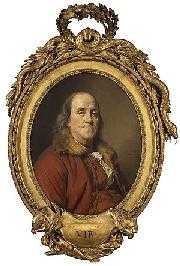
| Deplessis Portrait of Benjamin Franklin |
In his report back to the Massachusetts Legislature, Franklin used dismissive understatement to show he had not been asleep while he was impassive. He had been, he said, "the butt of his invective ribaldry for nearly an hour." After that, Poor Richard seemed to disappear from British society for nine months, seeing only close friends in his house, and then he sailed home to America, becoming a member of the Continental Congress the day he stepped off the boat. Meanwhile, he had arranged to have his portrait painted by Duplessis, the most distinguished painter in France, eventually to have it hang next to a painting by the same artist, of the King of France. To the original sketch for the portrait had been added a fur collar, the traditional emblem of the painter's guild. At the bottom, where a motto ordinarily would be found, was the single, three-letter Latin word, "VIR," or man, which would today be equivalent to he-man. And just so everyone would get the point, Franklin sent an otherwise anonymous letter to the newspapers, signed "Homo Triumph Literarum" in which he taunted that the friends of Mr. Franklin would have to agree he was a thief, as in the famous line of poetry that "He stole the lightning from the skies." But old Ben wasn't just bragging. Anticipating the baseball player Dizzy Dean by two hundred years, he was in effect saying "It ain't braggin' if you really have done it."
On Feb. 6, 1778 he and Silas Deane went over to the French palace to sign the Treaty of Alliance with the King of France. Instead of his usual brown suit, Franklin was wearing a faded blue one, and Deane questioned why he wore old clothes to such an important ceremony. "To give it a little revenge," was the answer. "I wore this suit on the day Wedderburn abused me at Whitehall." The true depth of Franklin's feelings would never have been known if Deane had not asked.
As a reminder, the Treaty they were signing said, "The essential and direct end of the present defensive alliance is to maintain effectually the liberty, sovereignty, and independence of the said United States. . . ." All in all, not a bad academic performance for a man who never went past the second grade in school.
REFERENCES
| The Invention of Air: A Story of Science, Faith, Revolution,and The Birth of America, Steven Johnson ISBN: 978-1-59448-852-8 | Amazon |
Originally published: Thursday, December 11, 1997; most-recently modified: Friday, September 20, 2019