4 Volumes
Tourist Trips: Philadelphia and the Quaker Colonies
The states of Pennsylvania, Delaware, and New Jersey all belonged to William Penn the Quaker in one way or another. New Jersey was first, Delaware the last. Penn was the largest private landholder in American history.
Regional Overview: The Sights of the City, Loosely Defined
Philadelphia,defined here as the Quaker region of three formerly Quaker states, contains an astonishing number of interesting places to visit. Three centuries of history leave their marks everywhere. Begin by understanding that William Penn was the largest private landholder in history, and he owned all of it.
History: Philadelphia and the Quaker Colonies
Philadelphia and the Quaker Colonies
Historical Motor Excursion North of Philadelphia
The narrow waist of New Jersey was the upper border of William Penn's vast land holdings, and the outer edge of Quaker influence. In 1776-77, Lord Howe made this strip the main highway of his attempt to subjugate the Colonies.
The present trip strikes a compromise between following a historical theme, and simply seeing what's appealing in your path between early breakfast and five o'clock cocktail; it's a little of both. We propose you start by driving for an hour to Princeton. In the course of wandering around what must be the world's most charming place to live, do notice the Revolutionary battlefield and the University. Then look reflectively northeast up Route 1 along the Raritan River to New Brunswick and Perth Amboy. On this trip there isn't time to go there, but nevertheless recall that is the valley the British swaggered down as far as Trenton on their way to Philadelphia, and back up which they retreated in a panic when Washington made things too hot for them at Trenton and Princeton. A charming and popular state park runs for sixty miles along the Delaware and Raritan Canal as a canoeing and wildlife corridor, with headquarters at Somerset and parking spaces at just about every road crossing; do plan to come back some day and try it. The region north of Princeton also offers the Monmouth battlefield, Doris Duke's show gardens, Morristown where Washington spent a cold winter near the British fleet at Perth Amboy, all of which are just a little too far from Philadelphia to include on a one-day trip. The Lindbergh mansion site of the famous kidnapping is also in the area, but visitors are currently not entirely welcome.
On this trip, leave Princeton and go down the road to Lawrenceville (Route 206, a piece of the Kings Highway) past one of the most sumptuous but prestigious boarding schools in the world. This is the road the British took on their second trip, while Washington was sneaking back behind them on a parallel back road. Just south of Princeton is Drumthwacket, the gorgeous mansion used by the Governor. A few hundred yards beyond the Lawrenceville school get on Interstate 195 North to Washingtons Crossing by exiting at Exit 1 and continuing along the Jersey side of the river. The crossing is from a charming village on the Pennsylvania side (over a very narrow bridge). It might be a good place to have a liesurely lunch.
Then, turn left going south along the old river road on the Pennsylvania side, taking care to notice the better parts of Trenton across the river. Keep going through Morrisville to Pennsbury, a restoration of William Penn's magnificent estate on the riverbank. It's best to call ahead to Pennsbury, because sometimes there are thousands of school children on tour. They usually don't stay very long. Pennsbury's bookstore is unusually well-stocked with Penn and related material. After Pennsbury turn south, close along the Delaware River, going to Bristol. There's a purpose to directing visitors to follow this route through what Philadelpians now mistakenly imagine is an industrial slum. In the late Nineteenth Century, the Pennsylvania Railroad (now Amtrak, of course) crossed the river at Trenton and roared down to Philadelphia on the Pennsylvania side. The charming villages along the river are thus cut off from the hinterland, paradoxically preserved, a pleasure to visit. Bristol, which once aspired to become the main city on the river, is now an isolated but splendid little town, just waiting to be ruined by gentrification.
Continue south from Bristol a couple miles on State Road to Street Road, and thence to Andalusia, the country estate of Nicholas Biddle. Nearby is Glen Foerd, the estate of the Foerderers, and a Drexel estate once belonging to a daughter of Anthony Drexel who became first a nun, then a saint. On a one-day trip, you might only have time to visit one of these showplaces, depending on how much time you spend at Pennsbury, which is the premier site along here. These mansions illustrate a way of life that flourished for a century along the upper river, surrounded by boating, fishing and duck hunting on the river side, and fox hunting on the land side. The gentlemen went to town on the steamboat, and the ladies presided while they were gone to their clubs.
That's it for one day. Turn up to Interstate 95 and on your way.
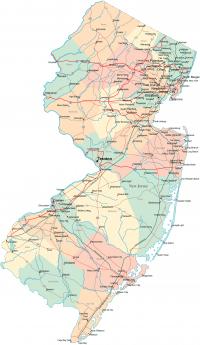
Jersey
|
| Map of New Jersey |
Once you notice the oddity of salt water in the lower reaches of the Delaware and Hudson rivers, it gets easier to understand the current theory that southern New Jersey was once an island. Like Long Island, it was separated from the mainland by a sound, but in the Jersey case the sound silted up from Trenton to New Brunswick, creating a new peninsula of "West" Jersey by uniting the island with the mainland. The colony was named after the island of Jersey off the coast of England, a gesture for Sir George Carteret, who was given the American area out of gratitude for once sheltering the exiled royal brothers Charles II and James from Cromwell, in that other Jersey. Cape May was probably a second distinct island later joined to the larger one by the transformation of the silted ocean into the bogs of the Maurice River. Cape May started as a whaling community, populated by Quakers from New York and New England, who always maintained a social distance from the Philadelphia Yearly Meeting. The long Atlantic beaches of New Jersey now repeat the main geological process, with successive generations of barrier islands first heaved up by the ocean and then packed against the mainland, filling up the brackish bay. The cycle of forming and packing successive barrier islands takes about three hundred years before a new one starts. In a larger sense, the process consists of the former mountains of Pennsylvania crumbling into the ocean and then responding to wave action.
It's no mystery, therefore, why southern New Jersey is flat, broken up by turgid meandering streams which casually empty in either direction. The head of Timber Creek, which flows into Delaware, is only eight miles from the head of the Mullica River, flowing toward the ocean. During the Revolutionary War, the British found it too dangerous to sail up these winding creeks, since at any moment they might make a sharp turn and be facing a battery of cannon on the shore. An arrangement quickly grew up that buccaneers would build ships in the center of heavy oak forests and sail them out to Barnegat Bay, thence out one of the inlets of the barrier islands into the blue water. The financiers of Philadelphia, many of them with names now in the Social Register, would come from the rear, sailing up the Delaware River creeks, and walking the last mile or two to privateer headquarters on the Atlantic-flowing creeks. Auctions were conducted, in which the ships were examined, the captain interviewed, and the crew observed in target practice. If you bought a small share you would be rich when the ship returned; and if it never returned, well, you had to invest in a different one. New Jersey is indignant of the opinion that these privateers were mainly responsible for winning the Revolution, but given little credit for it. Many more British sailors were lost to the privateers than soldiers were lost to Washington's troops and the economic loss to Great Britain of the ships and cargoes eventually became serious. Since much of the profit from privateering was recycled into the American war effort by Robert Morris, the British found themselves facing an enemy much more formidable than just the ragged frozen troops at Valley Forge on the Schuylkill. Meanwhile, William Bingham was conducting a similar privateering operation in partnership with Morris but based on the island of Martinique, but that's another story.
In later centuries, the traditions and geography of the Jersey Pine Barrens suited themselves to smuggling and bootlegging during the era of alcohol Prohibition, and even after Repeal, high taxes on liquor kept bootlegging profitable. As late as the 1950s, there were divisions of FBI men prowling the woods of South Jersey, on the lookout for trucks carrying bags of cane sugar, or coils of copper tubing. After housing developments started to invade the forests, the hardball politics of South Jersey reflected a Mafia culture thought more characteristic of South Philadelphia. Near Vineland and Atlantic City, it isn't just a culture, it has the accent, because it also has some of the ancestry.

REFERENCES
| New Jersey, A Historical Account of Place names in the United States: Richard P. McCormick: ISBN-13: 978-0813506623 | Amazon |
British Headquarters: Perth Amboy, New Jersey, in its 1776 Heyday (B 608)
Not many now think of the town of Perth Amboy as part of Philadelphia's history or culture, but it certainly was so in colonial times. Sadly, the town has since declined to a condition of a quiet middle-class suburb. There are quite a few Spanish-language signs around and some decaying factories. The little house of the Proprietors on the town square and the remains of the Governor's mansion overlooking the ocean are about all that remain of the early Quaker era.
|
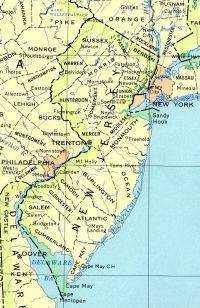
| NJ MAP |
To understand the strategic importance of Perth Amboy to Colonial America, remember that James, Duke of York (eventually to become King James the Second) thought of New Jersey as the land between them North (Hudson) River, and the South (Delaware) River. This region has a narrow pinched waist in the middle. It's easy to see why the land-speculating Seventeenth Century regarded the bridging strip across the New Jersey "narrows" as a likely future site of important political and commercial development. The two large and dissimilar land masses which adjoin this strip -- sandy South Jersey, and mountainous North Jersey -- was sparsely inhabited and largely ignored in colonial times. The British in 1776 developed the quite sensible plan that subduing this fertile New Jersey strip would simultaneously enable the conquest of both New York and Philadelphia at the two ends of it. It was a clever plan; it might have subjugated three colonies at once.
|
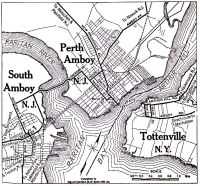
| PERTH AMBOY MAP |
Perth Amboy is a composite name, adding a local Indian word to a Scottish one because East Jersey had been intended for Scottish Quakers. Like Pittsburgh at the conjunction of three rivers, Perth Amboy's geographical importance was that it dominated the mouth of Raritan Bay (Raritan River, extended) as it emptied into New York Bay just inside Sandy Hook. Two of the three "rivers" of the three-way fork are really just channels around Staten Island. Viewed from the sea, Perth Amboy sits on a bluff, commanding that junction. Amboy became the original ocean port in the area, although it was soon overtaken by New Brunswick further inland when increasing commerce required safer harbors. Perth Amboy was the capital of East Jersey, and then the first capital of all New Jersey after East and West were joined in 1704 by Queen Anne. The Royal Governor's mansion stood here, as well as grand houses of Proprietors and Judges overlooking the banks of the bay. The main reason for the Nineteenth-century decline of the state capital region was the narrowness of the New Jersey waist at that point; its main geographical advantage became a curse. Canals, railroads and astounding highway growth simply crowded the Amboy promontory into an unsupportable state of isolation. The same thing can be said of Bristol, Pennsylvania, and New Castle, Delaware, but local civic pride has somehow not risen to the challenge to the same degree.
Perth Amboy to Trenton (2)
|
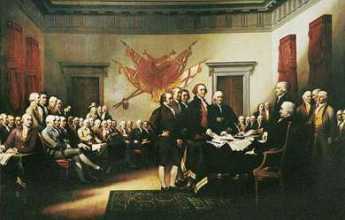
| Declaration of Independence |
The Revolutionary War had been raging for a year in New England before the Declaration of Independence, a point that never ceased to bother John Adams whenever Thomas Jefferson or his devotees took credit for "starting" the Revolution -- a year after the Battle of Lexington and Concord -- with a piece of paper nailed to a lamp post. To be fair, this interval of a year allowed for the organization of the Continental Army, and Washington's growing military maturity by the summer of '76. But it also explains the landing of Sir William Howe's army on Staten Island at the end of June 1776. A month or so later, his brother Admiral Howe landed some more troops. By September 1776, not all of the signers had yet put their names to the Declaration of Independence, but there were about 40,000 British troops parading around the essentially uninhabited Staten Island in New York harbor, in plain sight of the inhabitants of New Jersey's capital in Perth Amboy, scarcely a mile away.
The British were quite shrewd in selecting New York harbor as the center of their operation, since their Navy was able to move quickly from New Jersey to Rhode Island, up and down the Hudson as far as Albany, and around the considerable expanse of Long Island, not to mention Manhattan. Meanwhile, Washington was faced with crossing numerous rivers to defend hundreds of miles of shoreline, and moving foot soldiers to the necessary position. He tried to defend New York, it is true, but the battles on Brooklyn Heights, Harlem, Fort Washington, and Fort Lee were essentially unwinnable, and the best he could do with the situation was escape with an undestroyed army.
By the fall of 1776 Howe had consolidated his hold on New York, and Washington was reduced to scattering clusters of troops around the places Howe might next choose to invade at any time. In early December, he started landing in New Jersey and marched toward New Brunswick. Washington thought that meant he was going to head for Trenton, and then down Delaware to Philadelphia. There was not much to stop him except skirmishers and Minute Men, but it was not safe for Washington to move his troops from the New York region until the intentions of the British were really clear, by which time it would probably be too late to stop the advance.
Since the Raritan Strip along which Howe and Cornwallis were advancing, was prosperous and Tory, things went pretty well for the British. After two weeks march, they finally arrived in Trenton around December 20. In this triumph, they failed to appreciate the significance of several things, however. Washington was hurriedly summoning about six little colonial armies of five hundred to a thousand men each, to join him now that the intentions of the enemy were clear. Furthermore, the Whigs or rebels of New Jersey were aroused in the Pine Barrens of the South and the hills of the North; New Jersey was not as Tory as it seemed during the initial march down along the Raritan. And, finally, the British and Hessian mercenary soldiers had ravaged the countryside almost as much as the spinmeisters of the Whig patriot cause shouted out they had. The Quaker farmers were particularly upset by the activities of the camp followers, who pillaged curtains and other things not normally attractive to marauding soldiers. And the sharpshooters, loyalist, and rebel were close enough to their own homes to dispose of another booty. It was a cakewalk from New Brunswick down to Trenton, but it was not going to be the same coming back.
Washington got ready to defend the Capitol in Philadelphia, and the wide Delaware river was the best place to do it. When Howe and Cornwallis reached Trenton, they found no boats available for miles up and down the New Jersey side of the river, artillery was planted in strategic places on the Pennsylvania side, ice was beginning to form on the river, it was cold and the December days were short. To the British commanders, Washington posed no particular military problem with his naked ragamuffins. Howe had some lady friends in New York, while Cornwallis was planning to spend a month in London before the spring military season. So the British generals made an overconfident miscalculation, and posted their troops in winter quarters, strung out in outposts from Perth Amboy to Trenton and down to Bordentown. A thousand Hessians were quartered in Trenton. By December 20th, it looked like a peaceful but boring Winter.
REFERENCES
| The Pine Barrens: John McPhee: ISBN-13: 978-0374514426 | Amazon |
Disorderly Retreat: From Trenton Back to Perth Amboy
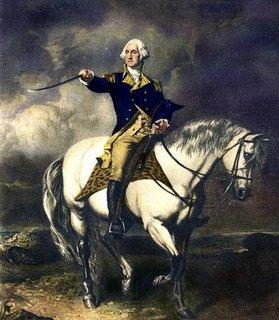
|
| George Washington on a Horse |
A week later, they got a bad jolt; Washington declined to play by their winter rules. At the Battle of Trenton, Washington was 44 years old, six feet four inches tall or more, a horseman and athlete of outstanding skill, and as the husband of the richest woman in Virginia, accustomed to housing, feeding, transporting and getting cooperation from two hundred slaves. All of those qualities may have been of some use in the battle. But after the Battle of Trenton, Washington also emerged as a remarkably bold and creative General. In the Battle of Trenton ca-----------------999999 seen the elements of audacity, timing and courage that were notable in Stonewall Jackson, George Patton -- Virginians, both -- the Normandy Invasion, and the Inchon Landing. He forged, if he did not create, the American military tradition of inspired risk-taking. And he did it with a collection of starving amateurs, up against the best Army in the world at the time. Probably without realizing it, his coming victory at Trenton also gave Benjamin Franklin in Paris a major enticement for the French King to support the American cause. Washington produced a significant achievement, but just to make sure, Franklin exaggerated it just as much as he could.
On December 21, Washington thought Howe was immediately going to sweep on through Trenton to Philadelphia. In a day or two, he saw that wasn't the plan, organized the famous re-crossing of Delaware in bad weather, and caught and captured a thousand Hessians with a three-pronged attack which cut off their retreat and made resistance useless. The main military feature of this attack was not Christmas drunkenness among the Hessians, but the fact that General Knox had somehow transported eighteen cannon to the occasion. Nowadays, the event is marked by a reenactment on Christmas Morning, although it took place on December 26, 1776. The timing did not have to do with religious observance, it had to do with hangovers. To the great disappointment of his troops, he made them abandon the great stores of booze in Trenton because a second detachment of Hessians was in nearby Bordentown, and meanwhile, he retreated back to the Pennsylvania side of the river. As might be imagined, Howe's Cornwallis promptly came charging down from New Brunswick to exact bitter vengeance. Instead of trying to rescue their comrades in Princeton, the Bordentown Hessians took off for New Brunswick. Defiantly, Washington taunted his enemies by again recrossing Delaware to the New Jersey side, put up fortifications, just waited for them to make something of it.
Well, that's the way it was meant to seem. On the night of January 2, the two armies were facing each other with about five thousand men on both sides, but with the British much better trained and equipped. The Americans had the advantage of not being exhausted by a fifty mile forced march, except for about a thousand who had been deployed forward to skirmish and delay the British advance with sniping from the bushes. The Americans made a great deal of noise and lit many bonfires behind their fortifications. But when they advanced the next morning, the British found out where the Americans really were -- by hearing distant cannon fire coming from Princeton, ten miles back toward the north.
Washington had slipped five thousand men wide around the enemy flank during the night and had taken a parallel country road to Princeton where he defeated a rear guard of British at the Battle of Princeton. An infuriated Cornwallis wheeled his army around in pursuit, and the race was on for the supplies left undefended in New Brunswick. Washington might have been able to get there first, except his men were too exhausted, and he was afraid to risk his long-run strategy, which was to avoid head-on collisions with the main British Army.
So Washington went into winter quarters in Morristown still further to the north, and thousands of British soldiers were thus bottled up in winter quarters in Perth Amboy and New Brunswick, where scurvy, lack of firewood and smallpox gave them a few months to consider their miscalculations. But the most important action of all was getting the news to Benjamin Franklin in Paris, to tell the French king of the victory. Franklin even dressed it up a little.
REFERENCES
| New Jersey in the American Revolution: Barbara J. Mitnick: ISBN-13: 978-0813540955 | Amazon |
Perth Amboy Revisited
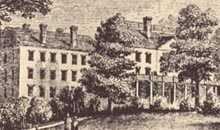
|
| Perth Amboy |
It's now moderately complicated to find Perth Amboy, New Jersey, even after you locate it on a map. Like New Castle DE it flourished early because it was on a narrow strip of strategic land, and like New Castle, eventually found itself cut off by a dozen lanes of highways crowded together by geography. It's an easy drive in both cases only if you make the correct turns at a couple of crowded intersections. Both towns were important destinations in the Eighteenth century, but by the Twentieth century, both were pushed aside by traffic rushing to bigger destinations. Industrialization hit the region around Perth Amboy somewhat harder than New Castle, destroying more landmarks, and bringing to an end its brief flurry as a metropolitan beach resort. If you aspire to preserve your Eighteenth-century glory, it's easier if you don't have too much progress in the Nineteenth. In Perth Amboy's defense, it must be noted that Jamestown and Williamsburg, Virginia had just about totally disappeared when noticed by Charles Peterson and John Rockefeller, but neither of those towns was run over by Nineteenth century industrialization. So, while New Castle has treasures to preserve and display, Perth Amboy seems to have only the Governor's mansion like the one notable building to work with. William Franklin, the illegitimate son of Benjamin, was the royal governor installed in this palace shortly before 1776.

|
| Governor's mansion in Perth Amboy |
While it is true that some wealthy local inhabitants did a lot to restore and maintain New Castle (and Williamsburg), the Governor's mansion in Perth Amboy was bought and made the home of Mathias Bruen, who is 1820 was thought to be the richest man in America. If Bruen had only had the necessary imagination and generosity, this was probably the best moment for Perth Amboy to have had a historical restoration. Instead, he added some unfortunate features to the mansion; it later became a hotel, and later on, an office building. Public-spirited local citizens are now trying to set things right, but the costs are pretty daunting. Someone has to find an inspired Wall Street billionaire like Ned Johnson to make over an entire town. Occasionally, a state government will do it, as has been done with Pennsbury. Or a national organization might become inspired, as happened with Mt. Vernon and Arlington. Its present state of peeling paint and makeshift repairs suggests uninterest in Perth Amboy's Governor Mansion by the State, and the absence of whatever it is that occasionally inspires fierce and determined local leadership. Perth Amboy needs some help and needs to forget about its handicaps. Sure, it's hard to commute anywhere, it's even hard to drive across the highways to the countryside. The bluff on the promontory was once quite arresting, now a rusting steel mill occupies that spot. Other than that, it doesn't look ominous or dangerous at all. It's just forgotten.
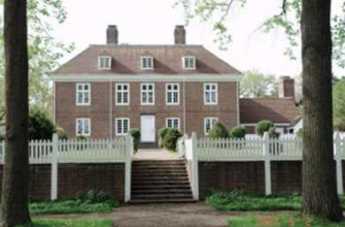
|
| Pennsbury Mansion |
Aside from the Royal Governor's former mansion, it is hard to find a historical marker or monument in this scene of former prosperity and glory, but there is one. Down on the beach is a bronze plaque, commemorating the 150th anniversary of the founding of -- Argentina. So there's a clue, which is not difficult to associate with all of the Hispanic names on the stores, and the Hispanics in evidence on all sides. They all seemed to know that this was once the capital of New Jersey, seemed pleased with it, and could point out the famous building. They are pleasant and friendly enough. Perhaps even a little too comfortable. Because, as William Franklin's famous father once said, all progress begins with discontent.
South Amboy Explodes
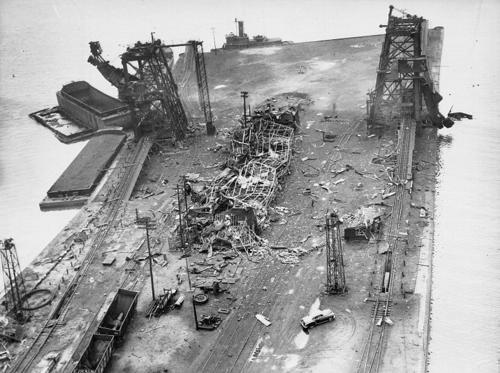
|
| Explosion |
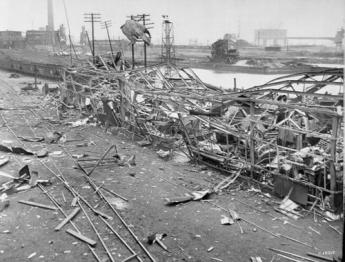
South Amboy, New Jersey, is a waterfront industrial town on a remote promontory behind Staten Island, jutting into lower New York Bay. It's across the Raritan River from historically important Perth Amboy, but it's fair to say that few people ever heard of South Amboy until sunset on May 18, 1950, when they suddenly heard a lot. An entire freight train, five lighters, and a railroad pier suddenly exploded and disappeared. About twenty-five people were never seen again; the largest piece of metal from the explosion was only about a foot in length. A significant part of the town was leveled, steeples were knocked off churches, and windows were broken in five surrounding counties. Considering what caused it, it seems remarkable that so few people were killed. The explanation usually given is that the explosion blew straight up and straight down; the distant windows were smashed by pressure implosion.
When Pakistan split off from the rest of India, there were bloody migrations in which millions of people died. So Pakistan bought the rights to the design of certain land mines to protect its new borders and contracted with a firm in Newark, Ohio to manufacture the mines. Two trainloads of these explosives were shipped from Ohio to a railroad pier owned by the Pennsylvania Railroad in South Amboy, to be lightered out to a waiting cargo ship and sent to Pakistan. The first of these two shiploads sailed off uneventfully, and on May 1, 1950, the second shipment had already left Ohio and was underway, when the Coast Guard suddenly declared the South Amboy pier to be closed and forbidden. As the train chugged slowly eastward, frenzied negotiations took place with Admirals in Washington. There was plenty of time, because the train moved very, very slowly and it was detoured over six different railroads to Wilmington Delaware, where the Hercules Powder Company had packed two freight cars with dynamite, which were to be hooked onto the end of the train as it inched its convoluted way to South Amboy.
|
| South Amboy Explodes |
The method of packing the land mines was of some importance during the huge litigation which inevitably followed. Land mines were packed in cardboard boxes about six feet long, divided into six compartments. Our own Army regulations about such things state that never, never should fuse be packed in the same carton with the mines. However, this particular shipment had five mines to a carton, with the fuses in the sixth. It was later argued that this particular arrangement proved harmless in the first of the two Pakistan shipments, but there was the testimony that defective fuses were removed from those boxes and passed back up the line, where those deemed satisfactory were re-packed in the cartons which were in this, the second shipment. A fuse, by the way, does not quite describe these objects, which were screwed into a hole provided on the bomb part. They contained a spring and a steel ball in a tube; when the gadget was cocked it was held by a hare-trigger. The idea was that the pressure of stepping on the mine shot the steel ball into the ball of explosives, and boom.
The railroad ammunition pier, for some reason called The Artificial Island, consisted of two rail lines extending a quarter mile from land, but no structures. Stevedores transferred the boxes from the train to the lighters, and then five lighters took the partial shipments out to the anchorage where the ocean freighter was waiting. The deck of the lighters was lower than the train tracks, so a wooden ramp was laid from the freight car to the lighter, resting on several mattresses on deck. It all worked on the first shipment, didn't it?
Well, it didn't work this time, and we have no way of knowing who stumbled or dropped something; we only know it all went sky-high. For this, the ship-owners were delighted because it is a well-established principle of Admiralty law that unless the ship was in contact with the owners, their liability is limited to the value of the damaged vessel. Under conditions of total disintegration, that means the lighters had a liability of zero. But there were six railroads, the Pakistani government, the Coast Guard and the two manufacturers of the explosives available to sue. Everybody had insurance, so a dozen insurance companies were involved. All of the victims and hundreds of people with property damage, all had lawyers; everyone agrees that many lasting friendships were established among lawyers who were milling around. Finally, the judge declared this case just had to be settled, or else it would continue for the rest of everybody's lifetime. The total amount of the claims submitted came to $55 million. Obviously, the settlement would be for less than that, but settlements are kept secret and you are not supposed to know how it turned out.
So, the question that remained was this. If everybody was insured, why not let the insurance companies haggle about who owed what to whom. Why did all of those railroads have lawyers hanging around? Well, the answer is a lesson for all of us. You need a lawyer to watch your insurance company's lawyer, because once a claim action begins, you and your insurance company develop a conflict of interest.
www.Philadelphia-Reflections.com/blog/1482.htm
Unintended Consequences for Advanced Placement
The Nov. 23, 2004 Wall Street Journal writes that "Elite High Schools Drop AP (Advanced Placement) Courses," thus taking me back to 1943, when I guess I started the idea now being dropped.
|
| Allan Heely |
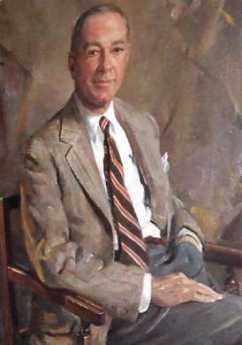
The then Head Master of The Lawrenceville School, Allan V. Heely, came around to Yale to visit recent graduates in their college freshman year. For secondary school principals that would, in itself, be quite a novelty today. We certainly considered it a novelty to have him actually buy us a beer, since six months earlier we would have been instantly dismissed from school without hope of appeal, just for one provable beer. The alcohol issue to one side, I can see in retrospect that the Head Master made a serious effort to socialize with his senior students, inviting them to tea every afternoon, and coffee after Sunday chapel. What might sound like quaint Victorian ceremonies to an outsider were in fact conscious efforts to create a role model of the mythical Renaissance Man. He and the school chaplain played piano duets and sang witty songs of their own composition. He brought in famous guests from New York and Philadelphia and made them perform as conversationalists. Jacques Barzun and John Erskine were memorable examples. I can even see in retrospect he was displaying his elegant talented wife as an example of the sort of woman we were urged to marry. To visit his graduates in their early formative years in college was entirely in keeping with his concept of education as the basis for character development. There was even a quote from J. P. Morgan: "Brains don't make success, character does."
Well, for all his effort to be friendly, when the Head Master visits you at college it's a little hard to know what to talk about. So, to be helpful, I pointed out that the science courses were not smoothly integrated between secondary school and college. An example was the contrast between my roommate (Peter Max Schultheiss, now Professor Emeritus of Electrical Engineering at Yale) and me. Pete had scored 100 -- no mistakes on any quiz, all year -- in both Chemistry and Physics, whereas I had not taken either course at Lawrenceville at all. Yet, here were both of us in the same Freshman introductory courses at Yale, required before more advanced courses could be taken. Naturally, Pete had an easier time of it, but at the end of the year we were at the same point, and we both felt he had wasted his time taking the same courses twice. Why couldn't Lawrenceville make an arrangement with Yale to waive the requirement for some introductory courses, saving educational time for something else?
Mr. Heely did a lot better than that. At that time, ninety seniors from Lawrenceville went to Princeton every year, a hundred seniors from Andover went to Yale, and about the same number went from Exeter to Harvard. A pleasant dinner was arranged for the three headmasters and the three University presidents, at the conclusion of which the deal was done. Advanced placement was put into effect. As I understand it, the AP system gradually spread, and last year 14,900 secondary schools offered Advanced Placement courses. You could play around with those numbers and conjecture several million college person-years of education were put to better purposes over the last 62 years. It's a really nice feeling to believe that one twenty minute conversation by two eighteen-year-old boys could have such a useful effect.
So, now what's the problem with these elite high schools, that want to drop AP courses? It's hard to speak on their behalf, but I'm in a unique position to know the original idea has twisted out of shape a little. The original purpose was to eliminate mandatory repetition of introductory college courses, but nowadays competition for admission is so ferocious that repetition is considered a very smart thing, to beat the system. It works up and down the educational system, awarding a high score for coasting through a course the second time. Advance placement thus becomes a bribe not to do that, and the power of the bribe is prestige for admission to some higher level. With 15,000 high schools (like Garrison Keillor's Lake Wobegon) claiming to provide superiority, there has to be accreditation, and for that, there has to be a standardized test. Before long, the curriculum is dominated, not by what the teacher thinks is superior, but by what is likely to be on the accreditation test. In effect, we get a French-like system in which the bureaucracy dictates what is best for the Leaders of Tomorrow. That's quite different from the time when outstanding secondary schools produced an unusually good product, and colleges were asked to recognize it. It's hard to say who's been corrupted here; probably everybody, because it's mass-produced accreditation. If you want to evaluate whether to permit more or fewer waivers for a certain school, you need to evaluate earlier waivees when they reach Junior or Senior level in whatever college had previously done some waiving. Only at that longitudinal point in the process is it possible to conclude whether the waiving of repetitious introductory courses had been useful or harmful.
Underneath all of this is the self-fulfilling prophesy that graduation from a handful of elite colleges will assuredly lead to success in life. If what we need are leaders who are vicious competitors, practiced in circumventing hurdles on the way to getting to the top, credentialism is perhaps a regrettable necessity. But if, as Mr. Morgan said, it's character that matters, gaming the system is not a completely ideal way to promote it.
Advanced Placement Gains Attackers and Defenders
An abridged extract of what

|
| Naomi Riley |
Naomi Schaefer Riley writes in the October 6, 2006 Wall Street Journal, follows:
"... The rat race complaint is that AP courses put a strain on students-too many facts to memorize, too much reading. And teachers complain, too. They say that AP courses force them to teach to test.. .
"Conceived in the early 1950's by educators from three prep schools (Andover, Exeter, Lawrenceville) and three universities (Harvard, Princeton, Yale),
|
| SAT's |
the AP curricula demand that students acquire real knowledge. Unlike the SAT's which measure mental aptitude, the AP tests ask students hard questions on the history exam require students to place quotations and documents in their correct context and to identify events, dates, historical figures, and ideas....
"Why? Because college increasingly offers a crazed social experience at the expense of rigorous study. But high school does better: It is often the last time that students are forced to learn something...."
Ms. Riley goes on to imply that colleges have deteriorated into little more than binge drinking hide-outs. Since I am 62 years away from personal observation of the college scene, I can't comment or even know for certain whether things have changed much in this respect.
But on the topic of resistance to Advanced Placement, Ms. Riley explains enough to justify comment. The SAT revolution, which took place at the same time and much the same place, effectively converts the old college entrance based on genetic probabilities into the new college entrance based on mental aptitude. Since raw mental aptitude seems to be in oversupply, the final decisions are winnowed by extra-curricular success. It would appear to me that the extra-curricular success industry is threatened by proofs of academic achievement. And more importantly, since grade inflation has destroyed the value of high school transcripts, the AP courses serve as a surrogate for effective nerdiness and bookishness. In other words, the AP tests are a threat to the entitlements created by the SAT, one of which is grade inflation.
If grade inflation is under attack, that puts more pressure on high school teachers to teach, school districts to raise their salaries, and taxpayers to pay. Before that happens, there will be pressure to cut the cost of sports and other extracurricular expenses.

|
| Bill Gates |
And, come to think of it, if more nerds are admitted to prestige colleges, perhaps their social inadequacies will reduce college socializing that now appears to alarm, Ms. Riley. For proof of that trade-off, I enclose a photograph of some overachievers of 1978, two of whom dropped out of Harvard because it was unchallenging. Mr. Gates is lower left, Mr. Allen lower right.
Lindbergh Baby Kidnapping Trial
 |
| Lindberg |
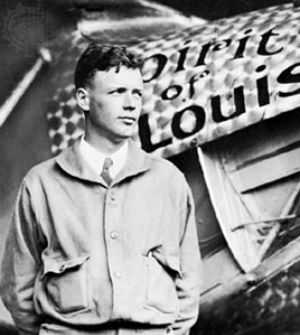
In 1935, Bruno Hauptmann was executed for kidnapping the baby of America's "Lone Eagle". Swarms of competing police and reporters made chaos of the scene, and Charles Lindbergh made it all worse by dealing directly with the crime underworld. Even today, some question the guilt of Hauptmann, and even whether the baby is really dead.
We are indebted to George Hawke, who went to prep school near the scene of the crime, for becoming an expert, perhaps the preeminent expert, on the Lindbergh Baby Kidnapping Trial. Charles Lindbergh, the son of a midwest pro-German congressman, flew an airplane alone across the Atlantic in 1927. He became instantly famous, wrote a best-seller called Alone, became Colonel Lindbergh, married Anne Morrow the daughter of Senator Morrow of New Jersey. That's how in short order they came to settle in Englewood, New Jersey, and also could afford an elaborate country place in Hopewell, Hunterdon County. That put them physically at the northern edge of the Philadelphia region at least on weekends, although psychologically they remained part of the New York scene, where many people attracted to publicity seem to gravitate. In 1932 they had a 19-month old son, John, who one evening disappeared from Hopewell, apparently kidnapped.
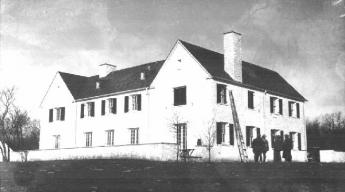 |
| Charles Lindberg Home |
What followed was a Keystone Kops Komedy in the midst of a publicity storm. The local, county, and state police, plus the FBI struggled with each other for the fame of solving the case. Newspaper reporters from all over the country swarmed down the little country road to set up shop. To illustrate the consequences, a home-made ladder was found sixty feet from the house, but no fingerprints were found by the first investigators. By the time the last investigators were done, the ladder had 150 sets of fingerprints on it. Police involvement on all levels can be summarized as a frenzy to be first to solve the case, followed in time by a frenzy to avoid being known for failing to solve it.
Although most of us eagerly following the case were unaware of it, the Colonel decided to take matters into his own hands. As a new celebrity, he was surrounded by many new best friends, and it was suggested to him that he should put out feelers into the Underground, the Mafia Mob. He would pay a ransom, and no questions would be asked. Somehow, a Bronx school principal, Dr. John Condon, was designated to respond to feelers, among them a particularly likely one, from a man who demanded to be met in a cemetery at night. As proof that the baby was still alive, the cemetery lurker sent Dr. Condon the baby's sleeping suit. Ransom was then paid in cash, unmarked, but entirely in gold certificates which had stopped being issued after President Roosevelt took us off the gold standard. The serial numbers carefully recorded. The extortionist then disappeared from sight, and the baby was never heard from again.
As time passed, two things happened. A partially decomposed baby's body was found buried a couple of miles from Hopewell, although it must be admitted it was only a quarter of a mile from an orphanage. The baby's pediatrician could not identify the body, although at the trial others claimed to make such identification. The baby's skull had been fractured, but several detectives had been seen turning it with sticks. The other development was that gold certificates bearing the recorded serial numbers began turning up in the Bronx.
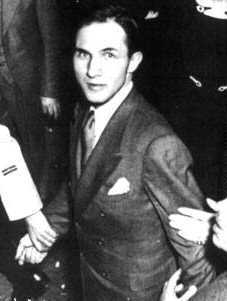 |
| Bruno Richard Hauptmann |
Bruno Richard Hauptmann was apprehended at a filling station after passing a ten dollar bill of the ransom money, and when his house was searched, $14,000 more was found hidden. The police had their man. To say that the house had been searched thoroughly was quite an understatement, but a number of detectives said there was no visible disturbance in the attic. Later on, a rung of the homemade ladder found at Hopewell was found to have exactly the same grain pattern as a piece of attic floorboard, now found to be missing in the Bronx house. Although there was testimony that Hauptmann had been beaten with a hammer, he was deemed a highly suspicious character. He had a criminal record in Germany, and was in this country illegally after jumping ship.
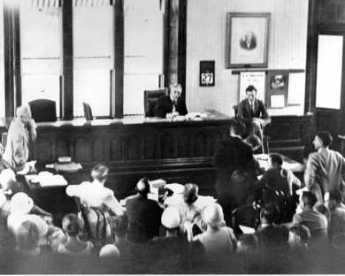 |
| Lindberg Trial |
The Trial of Bruno Hauptmann in the Hunterdon County Courthouse at Flemington was a tumultuous circus. The state of New Jersey spent well over a million dollars on the prosecution, while Hauptmann spent $2900 on his defense, most of it provided by a newspaper, and most of it spent on a defense lawyer who appeared before a jury of farmers dressed in a cutaway, wearing a Carnation and Spats, and who told people in a bar that Hauptmann was anyway guilty. That lawyer seemed visibly inebriated much of the time, and often walked down the main street with a girl on both arms. Miles of new telephone wire were strung into the courthouse area for the reporters, and two switchboards were provided.
There were legal difficulties. At that time in New Jersey, kidnapping was only a misdemeanor, so accidental death in the course of kidnapping was not a capital offense. The Lindbergh Kidnapping Law was hastily enacted to make kidnapping a federal felony, but for the purposes of this trial, it was necessary to prosecute Hauptmann for the crime of Burglary of the sleep suit, with accidental death in the course of that burglary. Hauptmann steadfastly, and to some convincingly, denied everything. He was keeping the gold certificates for a friend.
The jury was understandably confused by all this, but it looked to them as though Hauptmann was surely guilty of something, perhaps extortion, and for all the jury knew Congress would now pass a special law about that, too. The defense did not make enough of the sleep suit, but all the jurors surely knew that such garments could be bought in any department store. There was even some question whether the Lindbergh Baby might not be dead at all, but the fact remained that Hauptmann was definitely guilty of something. He was electrocuted, and the newspapers made a great fuss about that, too.
New Jersey: A Keg Tapped at Both Ends (2)
 The New Jersey legislature first fought for Independence, then about debts, then railroads and corporations, and now -- about debt, again. 
|
The New Jersey legislature ratified the Declaration of Independence in the Indian King Tavern of Haddonfield, then moved to Princeton and ever since has been in Trenton. The Statehouse in Trenton is the second oldest in the nation, after the one in Annapolis, although it has grown like a snail with the original building nestled inside many additions. In one sense it is totally unique; it's the only state capitol in the nation where you can look out a window and see another state. It's right on the water's edge of Delaware, a hundred yards from those Hessian barracks that Washington surprised in 1777.
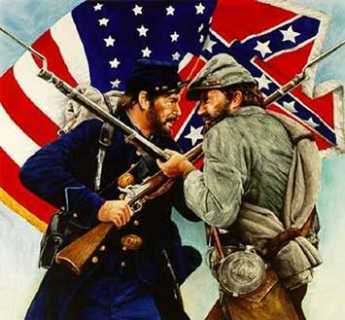
|
| Rivals, North and South |
In its early years the legislature concerned itself with raising troops during the Revolution. After that, it spent a great deal of time settling debts to pay for the Revolution. From that arose the traditional rivalry, even hostility, between the northern and southern halves of the state. To some degree, this reflects the two original provinces of East Jersey (Scottish Quakers) and West Jersey (English Quakers), but the Quaker character persisted much longer in West Jersey. The northern half, with many Dutch settlers spilling over from New York and Congregationalists from Connecticut, evolved into mainly a population of debtors; debtors enjoy inflation because it cheapens the cost of their repayments. The southern half of New Jersey, persistently Quaker in the settlement, was where creditors lived; creditors want to recover the value of the money they risked, so they hate inflation. The Mason Dixon line, extended, would cross southern New Jersey. However, it was the northern half of the state which favored the Confederacy during the Civil War, whereas the Quakers in the south were strongly opposed to slavery. Later on, irritation over permitting Atlantic City gambling was one of the various issues which eventually prompted South Jersey to try to secede from the northern spendthrifts; the secession proposition was actually on the ballot in the late Twentieth Century. Up until 1966 the Republicans always dominated the Senate, but that was because each of the 21 counties had one senator, and you can't gerrymander county lines. Then, it was deviously proposed that the state should be re-divided into 40 numerically equal Senatorial districts (i.e. instead of counties); the Senate has had a Democratic senatorial majority more or less ever since, in spite of numerous Republican majorities in state-wide elections. The legislative districts in the Assembly are reapportioned every ten years to respond to the new census; it is close to the facts that the subsequent gerrymandering of that decennial reapportionment effectively forecloses the politics (and predicts the agenda outcome) within the Assembly for each subsequent decade. In recent years, state Congressional delegations have all become increasingly polarized as a result of partisan gerrymandering. New Jersey leads the way in this unfortunate process: the Assembly and the Congressional delegation are polarized in what has become a national pattern, but in addition, its state Senate is permanently gerrymandered by substituting "districts" for "counties", and redrawing the boundaries in the state constitution.
|
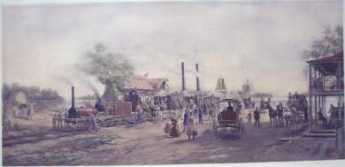
| The Amboy and Camden Railroad |
Over time, the early legislature devoted most of its time to chartering corporations, because there were no universal corporation laws and each new corporation required a separate legislative charter. During the early Industrial Revolution, a great many new businesses sought the authority to limit investor liability. Each corporation had its own enabling act and hence its own deal, its own set of rules and conditions open to limiting amendments by competitors or favorable restatement at the urging of lobbyists. Along came the first railway in America, Stevens's conception of the Amboy and Camden Railroad. The New Jersey legislature, no doubt persuaded by private inducements, not only gave the Amboy and Camden permission to use eminent domain to acquire its right of way, but also conferred a perpetual tax exemption, and perpetual railroad monopoly. For the next fifty years, the legislature then concerned itself with hardly anything except railroad matters. As Willie Sutton said about banks, that was where the money was.
Perpetual is a pretty unambiguous adjective, of course, and it might be an interesting topic in judicial gymnastics to observe how the state would get itself out of the impossible economic straight-jacket of conferring a perpetual monopoly on only one railroad. It proved achievable, however, when the proprietors of a new Stanhope Railroad slipped exemptions and enabling legislation for itself into one of the thousands of corporation bills which flooded through the legislature, unread by anyone except the authors. After the Governor who also hadn't read the bill, signed this sleeper into law, the uproar was predictably loud and accusatory. In a sense, the wrangle about New Jersey railroads was not finally settled by the legislature at all but by the Pennsylvania Railroad, which crossed Delaware at Trenton, and went south to Philadelphia along the Pennsylvania side of the river. New Jersey had not only lost the advantage of railroad competition, but it had also essentially lost all of the main North-South railroad traffic made possible by improved bridge construction methods. Almost all rail traffic was East-West, and the Pennsylvania RR soon captured national dominance. Among other things, railroads thus avoided the expensive hidden costs of going before the New Jersey Legislature. New Jersey preferred to seek a new constitution with a new organization of matters, but one thing about New Jersey never seems to change. Between eleven and twelve thousand bills are still introduced every year. Overloading the attention of the legislators creates the main opportunity for corrupt politics in all legislatures, and is the central strategy for its concealment. It's even worse than New Jersey actually passes about 300 laws a year by sitting for a hundred hours in plenary session: the legislature sits for 30 or 40 three-hour sessions in the afternoon each year, usually Monday and Thursday, from November to May. We try to be a nation of laws and not of men, but it would be hard to praise the application of that truism in New Jersey, where quite obviously the Governor does most of the governing, and deciding, and dispensing. Recent Governors have evidently preferred to borrow money rather than pay any attention to balancing a budget, since New Jersey has gone during fifty years from having no income or sales tax to having the highest of them both, and the highest property taxes, plus $50 billion in debt. Let's repeat the central point: the thing which will matter for a decade is how the legislature gerrymanders the voting districts after the 2010 census. The second source of corruption is the severe limitation of individual political contributions, combined with a lack of limits of donations to the County political machine; the machine totally dominates all New Jersey nominations, and by gerrymandering can ignore the general elections. The public has discovered that this process leads to the second-highest state tax rate in the nation, and wealthy people are fleeing to other states in noticeable numbers. Since wealthy people pay a disproportionate share of taxes, the disappearance of this tax source throws a major tax burden onto those with lower incomes. As this process spirals out of control, something about it must change.
Roebling
|
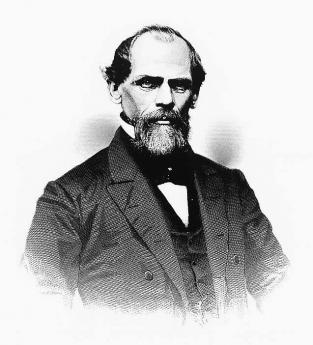
| John Roebling |
The common image of John A. Roebling comes across a little hazy about details, but seems to consist of going down with the Titanic at the age of 31, with being born in Prussia in 1837, with getting the "bends" while building the Brooklyn Bridge, and first sighting General Robert E. Lee's invading army from a balloon, then dragging a cannon up Little Round Top. The obvious inconsistencies in this image do not prove they are fictitious, they prove that Roebling was several people. Mostly this composite centers on Johann Augustus Roebling and his three sons, but spreads out to a large and highly talented family. Roebling achievements are not those of a bee, but of a beehive.
Johann was a younger child in a large Prussian family living a hundred miles south of Berlin. The region had been ruled under Napoleon for seven years, creating much of the centralized governance we now call "Prussian". Following centralized orders, its school had been designated to be an expert in science and engineering. Johann was particularly good at math and was singled out for intensive training in math and science, later sent to Berlin for advanced training in engineering. While there, he fell under the influence of the philosopher Hegel, who proclaimed that anyone could be anything he wanted to be, but opportunities were particularly good in America. Since Berlin went on to become the world center of electrical engineering, the world would probably have heard more of Johann Augustus Roebling even if he had remained at home; but he was going to do big things in the steel industry, so off he went to Pittsburgh. Things went rather well for him there, especially after he substituted wire rope for hemp rope in pulling canal boats over the Allegheny mountains. From that point on, John A. Roebling concentrated on perfecting and manufacturing wire cable, on which he held several key patents, and moved his business to the head of the Delaware Bay at Trenton, strategic in sales location between New York and Philadelphia.
|
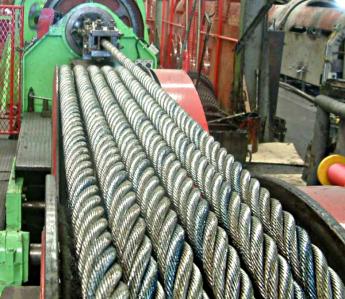
| Wire Rope Factory |
Although his company would eventually build an open hearth steel mill, the Roebling enterprise always retained a central focus on steel cables made of steel wires bound together for flexibility and strength. The plant next door in Trenton, the Cooper, Hewitt Co., created the steel I-beam and thus was central in the construction of skyscrapers. Roebling supplied steel cable for elevators, without which skyscrapers would have been limited to six or eight stories. The wires within the cables start from what we can now visualize as the child's toy Slinkies (also a Roebling product, by the way). The trick to making such coils into cables was to find a way to straighten them out, which Roebling devised and patented, using a wheel arrangement to twist the wire as it unwound. Later, the wires were galvanized and compressed together. If the cables were used to carry electricity, it was necessary to cover the cable with rubber insulation as part of the manufacturing process. Eventually, over fifty different processes needed to be perfected and employed to create large quantities of non-brittle uniform cable product at low prices. Apparently, the central problem in manufacture was to smooth off burrs in the wire and meanwhile keep the assembly scrupulously clean. Roebling learned how to overcome all of the many problems in this deceptively simple-looking process, which eventually meant that the main problems remaining were in designing factories rather than designing cables. During the taming of the west, he produced barbed wire; during the rise of mass agriculture, he devised ways to use wire binders for sheaves of wheat. During the rise of electricity, he provided insulated wire and cable, first for the telegraph and then for the telephone. He even recognized the best business model; make huge profits during the first few years of a new product, then cut prices. By far the most famous product of the Roebling company was the suspension cable in suspension bridges.
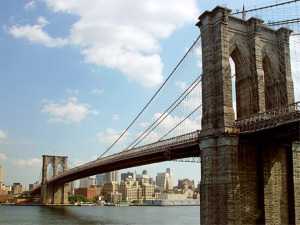
Indeed, many people associate the Roebling name with bridge building, even though wire cable was and continued to be the central activity of the company. It was characteristic of the Roebling energy and engineering skill that he saw that if he wanted to sell cable, he had to show others how to use it, and he essentially took over the design and construction oversight of the twelve largest suspension bridges in the country. Unfortunately, his foot was crushed in a construction accident and when he died, the building of the Brooklyn Bridge had to be turned over to his son Washington Roebling. Washington, in turn, became badly crippled by caisson disease, the "bends", and hands-on oversight was conducted in large part by his wife, following meticulous instructions by her partially blinded husband.
|
| Brooklyn Bridge |
The work of building and designing factories for the company fell to Washington's brother Charles, and since the company was constantly changing focus in order to exploit new product lines, it was a prodigious task, always under time pressure. What's more, the main factories burned to the ground at least six different times, probably from arson in at least several cases. The Roeblings all worked like dogs for endless hours, well into old age. There was comparatively little ostentatious display of wealth, and when US Steel offered to buy them out, they declined an offer equivalent to one-fifth of the value of US Steel itself. That was during an economic downturn; Roebling was probably worth half of the value of US Steel. Andrew Carnegie might sell out, but not the Roeblings.
George Washington once reversed the Revolutionary War just up the street from the Roebling plant, and John Roebling's son was named after him. Roebling was a patriot and an active Republican. But there was enough Prussian in him to prefer German workmen and to hate unions. When the company grew large, he was forced to hire immigrants from what he called the Hapsburg Empire, although he never completely trusted them. Judging from his writing, he regarded unions as merely trying to take away control of the company without investing in it, certainly without earning it. Surviving numerous fires, recessions, and wartime demands for expansion without profit, it was plainly obvious that when times were tough and money had to be raised, there was no one except the owner to produce it. It is not difficult to imagine the hatred in the minds of union leaders, confronting a family that regarded lowered wages during the depression as normal and necessary. In the Roebling view, standing up to worker protests in such circumstances was simply a test of character, something an owner simply had to find the courage to do.
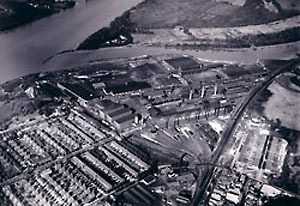
|
| Roebling Village 1930 |
When it became necessary to build a huge new plant at some distance downriver, the Roeblings had to contend with a shortage of labor in a region without houses. So they built a company town which they declined to name Roebling but the railroad named the stop Roebling anyway. Using engineering skill that had made Roebling the world leader, the homes were inexpensive but elegant for the time and even today. The company had to build stores, streets, schools, and everything else a town needed. The new headaches of this project took time and attention away from the central business of making steel cables, and Washington Roebling once wrote it was enough to drive you crazy.
So, guess what, the unions felt they had to take the lead in complaining and forcing the Roeblings to make changes. Guess what happened next; the Roeblings just sold it and walked away.
REFERENCES
| The Company Town: The Industrial Edens and Satanic Mills That Shaped the American Economy, Hardy Green ASIN: B003XKN7MW | Amazon |
Washington Lurks in Bucks County, Waiting for Howe to Make a Move
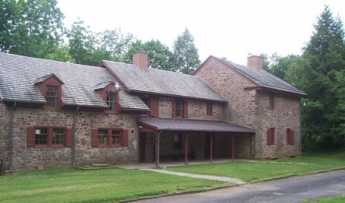
|
| Moland House |
Although Bucks County, Pennsylvania, is staunchly Republican, it has been home to Broadway playwrights for decades; this handful of Democrats have long been referred to as lions in a den of Daniels. One of them really ought to make a comic play out of the two weeks in August 1777, when John Moland's house in Warwick Township was the headquarters of the Continental Army.
John Moland died in 1762, but his personality hovered over his house for many years. He was a lawyer, trained at the Inner Temple and thus one of the few lawyers in American who had gone to law school. He is best known today as the mentor for John Dickinson, the author of the Articles of Confederation. Our playwright might note that Dickinson played a strong role in the Declaration of Independence, but then refused to sign it. Moland, for his part, stipulated in his will that his wife would be the life tenant of his house, provided -- that she never speak to his eldest son.
Enter George Washington on horseback, dithering about the plans of the Howe brothers, accompanied by seven generals of fame, and twenty-six mounted bodyguards. Mrs. Moland made him sleep on the floor with the rest.
Enter a messenger; Lord Howe's fleet had been sighted off Patuxent, Maryland. Washington declared it was a feint, and Howe would soon turn around and join Burgoyne on the Hudson River. Washington had his usual bottle of Madeira with supper.
A court-martial was held for "Light Horse Harry" Lee, for cowardice. Lee was exonerated.
Kasimir Pulaski made himself known to the General, offering a letter of introduction from Benjamin Franklin, which letters Franklin noted had been requested by Pulaski himself. As it turned out, Pulaski subsequently distinguished himself as the father of the American cavalry and was killed at the Battle of Savannah.
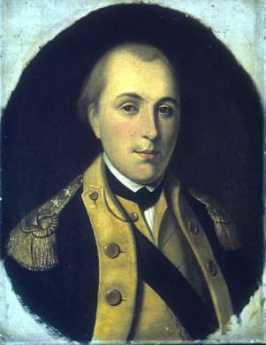
|
| Lafayette |
And then a 19 year-old French aristocrat, the Marquis de Lafayette, made an appearance. Unable to speak a word of English, he nevertheless made it clear that he expected to be made a Major General in spite of having zero battlefield experience. He presented a letter from Silas Deane, in spite of Washington having complained he was tired of Ambassadors in Paris sending a stream of unqualified fortune hunters to pester the fighting army. Deane did, however, manage to make it clear that the Marquis had two unusually strong military credentials. He was immensely rich, and he was a dancing partner, ahem, of Marie Antoinette.
In Mrs. Moland's parlor, Washington sat down with Lafayette to tap-dance around his new diplomatic problem. It was clear America needed France as an ally, and particularly needed money to buy supplies. But it was also clearly impossible to take a regiment away from some American general, a veteran of real fighting, and give that regiment to a Frenchman who could not speak English and who admitted he had no military experience. Fumbling around, Washington offered him the title of Major General, but without any soldiers under his command, at least until later when his English improved. To sweeten it a little, Washington seems to have said something to the effect that Lafayette should think of Washington as talking to him as if he were his father. There, that should do it.
It seems just barely possible that Lafayette misunderstood the words. At any rate, he promptly wrote everybody he knew -- and he knew lots of important people -- that he was the adopted son of George Washington.
Well, Broadway, you take it from there. At about that moment, another messenger arrived, announcing Lord Howe at this moment was unloading troops at Elkton, Maryland. General Howe might have been able to present his credentials to Moland House in person, except that his horses were nearly crippled from spending three weeks in the hold of a ship and needed time to recover. Heavy rains were coming.
(Exunt Omnes).
Suggested Stage Manager: Warren Williams
William Penn: Visionary with Persuasiveness
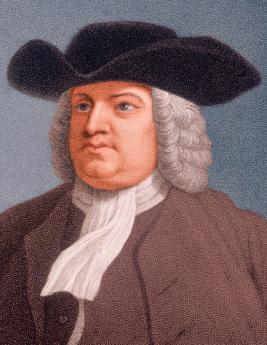
|
| William Penn |
It was a signal and blessed providence which first induced so rare a genius, so excellent and qualified a man as Penn, to obtain and settle such a great tract as Pennsylvania, say 40,000 square miles, as his proper domains. It was a bold conception; and the courage was strong which led him to propose such a grant to himself, in lieu of payments due to his father. He besides manifested the energy and influence of his character in court negotiations, although so unlikely to be a successful courtier by his profession as a Friend, in that he succeeded to attain the grant even against the will and influence of the Duke of York himself who, as he owned New York, desired also to possess the region of Pennsylvania as the right and appendage of his province.
"This memorable event in history, this momentous concern to us, the founding of Pennsylvania, was confirmed to William Penn the Great Seal on the 5th of January, 1681."
-John F. Watson,
Annals of Philadelphia and Pennsylvania in the Olden Time
The Heirs of William Penn
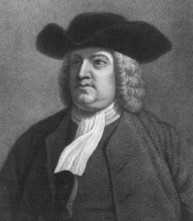
|
| William Penn |
Freedom of religion includes the right to join some other religion than the one your father founded; William Penn's descendants had every right to become members of the Anglican church. It may even have been a wise move for them, in view of their need to maintain good relations with the British Monarch. But religious conversion cost the Penn family the automatic political allegiance of the Quakers dominating their colony. Not much has come down to us showing the Pennsylvania Quakers bitterly resenting their desertion, but it would be remarkable if at least some ardent Quakers did not feel that way. It certainly confuses history students, when they read that the Quakers of Pennsylvania were often rebellious about the rule of the Penn family.
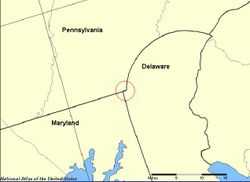
|
| Delaware |
Such resentments probably accelerated but do not completely explain the growing restlessness between the tenants and the landlords. The terms of the Charter gave the Penns ownership of the land from the Delaware River to five degrees west of the river -- providing they could maintain order there. King Charles was happy to be freed of the expense of policing this wilderness, and to be paid for it, to be freed of obligation to Admiral Penn who greatly assisted his return to the throne, and to have a place to be rid of a large number of English Dissenters. The Penns were, in effect, vassal kings of a subkingdom larger than England itself. However, they behaved in what would now be considered an entirely businesslike arrangement. They bought their land, fair and square, purchased it a second or even third time from the local Indians, and refused to permit settlement until the Indians were satisfied. They skillfully negotiated border disputes with their neighbors without resorting to armed force, while employing great skill in the English Court on behalf of the settlers on their land. They provided benign oversight of the influx of huge numbers of settlers from various regions and nations, wisely and shrewdly managing a host of petty problems with the demonstration that peace led to prosperity, and that reasonableness could cope with ignorance and violence. When revolution changed the government and all the rules, they coped with the difficulties as well as anyone in history had done, and better than most. In retrospect, most of the violent criticism they engendered at the time, seems pretty unfair.
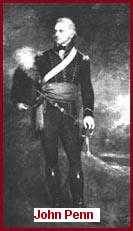
|
| John Penn |
They wanted to sell off their land as fast as they could at a fair price. They did not seek power, and in fact surrendered the right to govern the colony to the purchasers of the first five million acres, in return for being allowed to become private citizens selling off the remaining twenty-five million. Ultimately in 1789, they were forced to accept the sacrifice price of fifteen cents an acre. Aside from a few serious mistakes at the Council of Albany by a rather young John Penn, they treated the settlers honorably and did not deserve the treatment or the epithets they received in return. The main accusation made against them was that they were only interested in selling their land. Their main defense was they were only interested in selling their land.
As time has passed, their reputation has repaired itself, and they bask in the universal gratitude which is directed to their grandfather and father, William Penn. Statues and nameplates abound. Nobody who attacked them at the time appears to have been really serious about it, except one. Except for Benjamin Franklin, who turned from being their close friend to being their bitter enemy. Franklin tried to destroy the Penns, traveled to England to do it, and after twenty years seemed just as bitter as ever. Something really bad happened between them in 1754, and neither the Penns nor Franklin has been open about what it was.
Trenton's Tomato Pie Cult
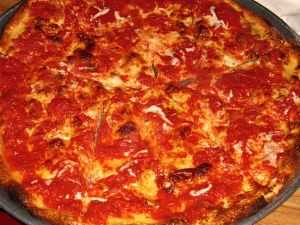
|
| Trenton's Tomato Pie |
The ingredients of a pizza pie are so simple it comes as a shock to learn the Italian community of Trenton, New Jersey, is fanatic about putting the cheese on the dough first, and then tomatoes on top. That's the way an authentic Trenton pizza is supposed to be made, rather than the conventional method of tomatoes first, cheese on top. To emphasize the point, these pizzas are determinedly referred to as tomato pies. And to tell the truth, there is a minor difference in the taste of the product made that way. As this more or less trivial issue is dissected and debated in great detail, an important fact about ethnic food emerges.
Be patient while each ingredient is examined. The crust will rise more in the warm summer than the winter, so it's thicker after it's baked. There is a faint fermentation taste which is more pronounced with a thick crust, but everyone in Trenton agrees this is a minor point. Everyone is also in agreement that most brands of Mozzarella cheese taste about the same. Tomatoes with seeds or without, or homogenized or chunky, make a minor difference. What is ultimately the essence of a Trenton tomato pie is that the cheese is put on top of the dough first, the tomatoes next spread on top, and the pie is then baked in the oven? Not everyone would notice the difference in taste, but it's definite, and in Trenton it's important. However, the locally acknowledged historian states his opinion that the thing that makes Trenton pies distinctive is not the ingredients, but the customers.
The employees of the shop know and respect the regulars, who tend to come to the same shop at least once a week, and call out the bakers by name as they enter. When they order a tomato pie, they give the name meaningfully, almost threateningly. According to the local historian, when the sons and grandsons of the shop owners move out to the suburbs and start a pizza shop in the strip mall, it isn't long before the tomatoes go on first, cheese on top. That's the way teenagers in the burbs are used to pizzas, and that's the way they expect to get them. As John Wanamaker used to say, the customer is always right, so the social rule which emerges is that ethnic food is not shaped by ethnic cooks, but by ethnic customers. To carry the idea a step farther, ethnic food isn't food, it's the old school tie.
Washington's Circular Letters
ONCE Cornwallis surrendered to Washington at Yorktown in 1781, there emerged the usual reluctance of troops on both sides to get killed for a dispute that was already settled. The British monarchy had ample experience with wars and fully expected to exploit this trait of exhausted soldiers at the end of one. It was clear to the British the colonies could neither be reconciled nor forcibly subdued. What was not clear was how much national advantage might still be extracted from a peace conference. Bluffs and intransigence might still achieve what bayonets could not. Seasoned diplomats are accustomed to such manipulation, but the new American nation only had Benjamin Franklin grown equal to it, representing Pennsylvania and Massachusetts with the British Ministry for several years. Beyond that, however, a particularly American trait was emerging to quit the game before the last card is played. During the Nineteenth century, anticipating and resisting that irresolute temptation came to be called, Character.
The American Revolutionary Army was seldom well-fed, never well armed. Hardly anyone expected a war lasting eight years, or the British regulars to be so mean and effective. Major General Benedict Arnold had seemed like our perfect soldier but turned traitor while in charge of a major defense position at West Point, New York. Conditions for wives and children at home were bad. And the Congress in Philadelphia was willing to inflate the currency, hold back soldiers' pay, pinch pennies on supplies. Other colonies frequently promised to send more soldiers than they actually supplied. Not that they were proud of themselves; they skulked. Surely, some state legislatures and representatives were better than others, but they are almost impossible to identify, now. They all must have been somewhat complicit, or we would have heard more of them denouncing each other. It must have been supremely painful for Washington to receive promises of troops and supplies that he privately doubted, and then to be obliged to assure his troop's help was forthcoming. Inevitable disillusionment discredited him more than the Governors who put him in that position. The British troops surely shared their enemy's reluctance to get killed for a war that was over. They partied and roistered in New York, but who knows what general in London might suddenly order an attack on Washington at Newburgh, just to make overall British defeat seem less humiliating.
|
| Headquarters, Newburgh NY |
During sixteen months of this agony, Washington wrote many letters to state Governors, keeping them informed while asking for their help. The custodians of the Headquarters museum proudly show the various tables and chairs for his aides to translate French and Spanish, to make thirteen copies of just about everything, and careful files of all correspondence. Washington was an organized person, they say, or else his chief of staff was organized. Someone like Alexander Hamilton, perhaps. Out of all this headquarters communication system gradually emerged the system of Circulars. The General was in a position to see huge deficiencies in the government system for which he dedicated his life, and apparently grew haunted by the idea that all this suffering would be for nothing if the government which emerged was anything like what he was now seeing. His Circulars to the governors began to take on the style of outlining what kind of government the United States ought to have. It must, for example, acquire federal power; the states must turn over more of their own power to the decisions of a single executive. It must pay its debts; a mighty nation does not chisel its creditors. It must suppress the inclination to squabble and think the worst of one another. It must, in his phrase, be virtuous.
Two emphatic views of the new country emerged from Washington's time in Newburgh. The inability of the government to pay its soldiers, suffering or no suffering, was particularly agonizing. And the close call he had with threatened mutiny made it much worse. Robert Morris had run out of tricks and instructed him the central issue was for the Federal government to be able to levy taxes for servicing the debt, which would make it possible to borrow still more through leverage. Washington never forgot this episode, and at several points, during his later presidency, it guided him well. The other episode which made a lasting impression was to some degree his own fault. He was so impassioned in his hatred of monarchy that his closest friends, Hamilton and the two Morrises -- who had never seen much to criticize in a monarchy -- essentially gave up on trying to persuade him, and took the side of General Gates the hero of Saratoga in a planned mutiny. Washington put it down with nothing but the power of his personality and a little play-acting with his bifocals, but he almost lost the confrontation in an instant. Washington had many close calls with death on the battlefield, but these two near-defeats pretty much shaped the rest of his life as our first President. Indeed these two hatreds, of debt and monarchy, continue to characterize many Americans to a degree that others would describe as unreasonable.
And then he made a mistake. As a way of proving his lack of personal motive, he announced in advance he would be leaving public service forever. Today, every lame duck knows that's a bad idea, even when you mean it. And while he may have sincerely thought he meant it at the time, events show he really didn't. Although he probably didn't want to be indispensable, circumstances made him so. He discovered how little he knew of the technical details of government, and thus how much he needed James Madison's help. Washington lacked skill in managing finance; having depended on Robert Morris throughout the war, he needed Alexander Hamilton at least to handle a peaceful economy. But there was no running away from the central issue; he would be forced to recognize how much he overshadowed anyone else in demeanor, and so, how unlikely it was that anyone else could bully others into cooperating. He was a great-souled person, in Aristotle's phrase. Franklin alone perhaps understood and privately doubted that even Washington could pull it off. Washington's Circulars were driving him straight toward seeking the Presidency he widely proclaimed he did not want and would not accept. And thereby he threatened the one thing in life he prized more than any other: his word of honor to keep his promises.
Look Out For That Ship!
|
Tales of the Sea abound, even a hundred miles from the ocean.
|
We are indebted to the President of the Maritime Law Association of the U.S., Richard W. Palmer, Esq. (who unfortunately died in March 2017 at the age of 97), for both a strange definition and an amusing story. An "allusion" is a collision between a ship and a stationary object, such as a bridge or a dock. As you might imagine, the ship is almost invariably at fault, mainly through errors of the pilot, although hurricanes and other severe weather conditions can make a difference. Moving ships have been running into stationary objects for many centuries, and almost every allision contingency has been explored. Ho hum for maritime law.
The Delair railroad drawbridge over the Delaware River at Frankford Junction is just a little different. It was built in 1896 when the Pennsylvania RR decided it needed to veer off from its North East Corridor to take people to Atlantic City. For reasons relating to the afterthought nature of the bridge, the tower for the drawbridge is located half a mile away, out of a direct vision of the ships going through. Also, a late development in the history of the river was the construction of U.S. Steel's Morristown plant, bringing unexpectedly huge ore boats from Labrador to the steel mill. The captains of the ships pretty much turned things over to the river pilots, for the last hundred miles of the trip.
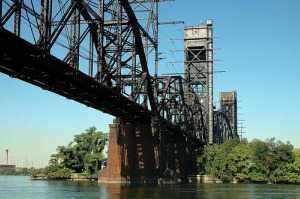
|
| Delair Railroad Drawbridge |
Shortly after this iron ore service was begun, the inaugural ore boat Captain had a little party with some invited guests. So it happened that the Commandant of the Port, the Admiral in Charge of the Naval Yard, and other equally high ranking worthies like the head of the Coast Guard were on the bridge of the ore boat, taking careful notes of the procedure.
The ship tooted three times, the shore answered back with three toots. In real fact, they were connected by ship-to-shore telephone for most of the real business, but this grand occasion called for an authentic nautical ceremony. Three toots, we're approaching your bridge. Three toots back, come ahead, the coast is clear. The admirals scribbled it all down.
As the ship approached the point of no return, beyond which it could no longer stop or turn in time to avoid an "allusion", the people on the bridge were appalled to see a train crossing the bridge ahead. Several toots, loud profanity on the ship to shore phone.
No worry, answered the bridge, we'll lift the drawbridge in plenty of time. But half a minute later the bridge controller made the anguished cry that the drawbridge was apparently rusted and wouldn't open, to which the captain shouted, "This ship is going to take away your blankety-blank bridge and sail right through it".
At this point, the pilot took matters into his own hands, and violently threw the rudder hard left, swinging the ship sideways, soon nudging the bridge with some damage, but nothing like the damage of a head-on allision. The lawsuit, as one might imagine, was the outcome.
The attorneys for the railroad were pretty high-powered, too, and had piles of legal precedents to cite. But they were quite unprepared for Dick Palmer to put the Commandant of the Port on the witness stand, reading slowly and painfully from his very detailed notes about the conversations on the bridge, about the approaching drawbridge.
And so, Philadelphia can now claim to have experienced one of the very few instances where a ship ran into a bridge -- and the court found the bridge to be entirely at fault.
The Walking Purchase
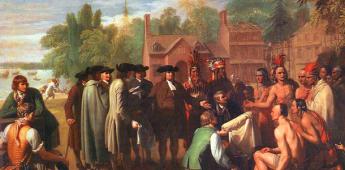
|
| William Penn and the Indians |
Any fair discussion of Quaker relations with the Indians must emphasize that almost all other colonists of the time regarded Indians as subhuman components of the local wilderness. Only William Penn was careful to treat the Indians as fellow human beings, entitled to fair play, dignity, and respect. Like a good politician, he entered into their games with enthusiasm and definitely earned their respect by outdoing them all in the broad jump contests. Even though he had bought the land from King Charles II, he took care to buy it a second time from the Indians, and for many decades was able to enforce the wise rule of never permitting settlers on the land before the Indians agreed to its purchase. After Penn's death, however, and particularly from 1726 to 1736, a major wave of German and Scotch-Irish immigration created an overwhelming population pressure on the seaboard areas, resulting in much unauthorized pioneering and settlement. Since William Penn spent only a few years in the colonies his agents chiefly James Logan, had long set the tone.
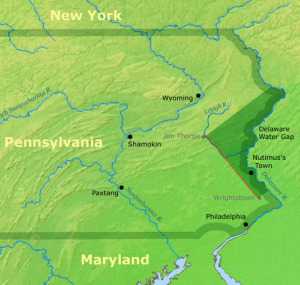
|
| Walking Purchase |
Logan had been equally famous for his many efforts to treat the Indians fairly, and the grounds of Stenton, his manor house, were often filled with Indians come to pay their respects. Against all this evidence of the benign attitudes of both Penn and Logan, there stands the episode of the Walking Purchase of 1737. No doubt about it, the Indians were treated badly.
In the triangle between the Neshaminy Creek and the Delaware River, the Delaware Indians agreed to a sale with the third side of the triangle established at a distance from Wrightstown, as far as a man could walk northward toward the Wind Gap in a day and a half. That was a common form of boundary for Indian land sales, and its distance was fairly well understood. In anticipation of pacing out the distance, the colonists sent out explorers to find the easiest path, then sent out woodsmen to clear a path in the forest, and selected three of the fastest runners in the colony to do the running. The pace was so fast that two of the runners had to drop out, and the third one nearly did so. The resulting boundary was nearly twice as far into the wilderness as was commonly accepted for the measurement, taking advantage of the sharp bend in the river which widened the land in question by a great deal. The Indians were so disgusted they refused to leave the territory. Logan had already made an agreement with the Iroquois nation, to whom the Delawares were subject, and the Delawares only surrendered the land when the Iroquois began to look as though they really would act as enforcers for the bargain. Although serious Indian warfare did not break out for another twenty years, the Walking Purchase went a long way toward convincing the Delaware tribe that the Quakers were no more trustworthy than the settlers in other colonies, and is said to have been on their minds when twenty years later they helped the French decimate General Braddock's army.
There will probably never be a clear resolution of the paradox of Quakers, particularly Logan, behaving in this reprehensible manner within a very long history of the unusually honorable treatment of the Indians. With William Penn now dead and gone, no doubt Logan was caught in a squeeze between the two rather dissolute sons of William Penn, neither of them Quaker, who had over-indebted themselves with high living and were pressing their agent to make land sales to pay for it. Then there was the pressure of the new German and Scotch-Irish immigrants, brought to the New World by real estate promises, and stranded in the seaport unable to complete their land purchases. Under this pressure, Logan may have been unduly persuaded that the 1684 treaties with the Indians, along with many other treaties and understandings, were all the legal justification he needed. Whatever the specifics of the situation at the time, it is now clear the Walking Purchase was a blot on the Quaker record that can never be entirely justified within the Quakers' own standards of fairness. Within the Society of Friends, whatever other English colonists might have done in their position, let alone what French and Spanish regularly did to the Indians, doesn't matter in the slightest.
Doylestown
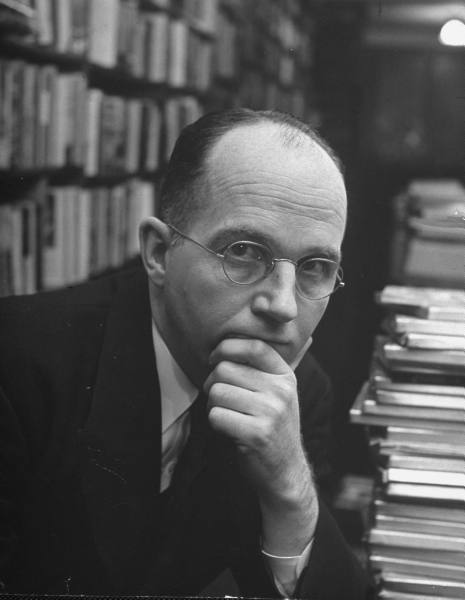
|
| James Michener |
Caught between the expansion of two metropolitan areas, Bucks County is inevitably doomed to extinction as a culture. Chester County and Bucks are in similar situations, as the suburbia devours exurbia, in this case, the Quaker farm communities. So you better go have a look, while they still survive to some degree.
The political unit of the area has been the county, and the county seat is in Doylestown, population about 8000. Within a few decades, it seems safe to predict the county population will approach a million. The town has lots of pride in itself and is just as cute as any town could possibly be. New Castle, Delaware has been preserved with the same pride but is uniform of a single period of architecture; Doylestown is a carefully preserved jumble of styles and periods, sizes and shapes. Like Princeton, NJ, and Odessa, DE, it is so attractive it brings hordes of visitors, which in turn quickly strangle it with traffic and lack of available parking space. There is an attempt to rescue the town with a by-pass highway, and blessings on the attempt. But the problem for these exurban jewels is not that people want to go around them, the problem is they are the main destination.
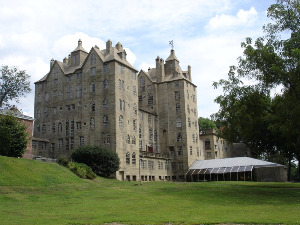
|
| Mercer Museum |
Doylestown was created in 1745 when William Doyle built a tavern at the crossroads. The county seat brings the courthouse with eleven judges and who knows how many lawyers, and the hospital. Henry Chapman Mercer brought three astonishing buildings, his 44-room mansion on 70 acres in the center of town, his famous Mercer tile factory in his back yard, and his multi-story museum of tools and crafts. All three of Mercer's buildings are made of concrete, built by craftsmen and himself with essentially unlimited personal funds derived from fabric manufacture in New England. And then this last bastion of the crafts movement embraced the artist colony established by Redfield at New Hope, and both of them attracted all those rich Broadway stars and publishing moguls. Right in the center of town, the Mercer crafts museum sits across the street from the James A. Michener Art Museum, small but very tasteful, the museum home of the Pennsylvania Impressionist school of art. The essence of this style is a smooth careful background, overlaid with quick thick foreground brushwork, producing a strong three-dimensional effect.
Schoolchildren in buses delight in the dolls house aspects, tourists admire the very fine art, everybody likes the cute little jumble of well-preserved eclectic buildings. It's all in a setting of Quaker farmhouses for the time being, but the split-levels and the McMansions by the thousands are coming. Visitors throng to see, and the residents are proud of what they have. But, really, does everybody have to bring his car?
James A. Michener (1907-1997)
|
|
| James A. Michener |
James Michener seemed headed for a recognizably Quaker life until show business rearranged his moorings. He was raised as a foundling by Mabel Michener of Doylestown, Pennsylvania, under circumstances that were very plain and poor. Many of his biographers have referred to his boyhood poverty as a defining influence, but they seem to have very little familiarity with Quakers. When the time came, this obviously very bright lad was offered a full scholarship to Swarthmore College, graduated summa cum laude, went on to teach at the George School and Hill Schools after fellowships at the British Museum. And then World War II came along, where he was almost but not exactly a conscientious objector; he enlisted in the Navy with the understanding he would not fight.
While in the Pacific, he had unusual opportunities to see the War from different angles, and wrote little short stories about it. Putting them together, he came back after the War with Tales of the South Pacific. Much of the emphasis was on racial relationships, the Naval Nurse who married a French planter, the upper-class Lieutenant (shades of the Hill School) who had a hopeless affair with a local native girl that was engineered by her ambitious mother, as central characters. Michener himself married a Japanese American, Mari Yoriko Sabusawa, whose family had been interned during the War. There are distinctly Quaker themes running through this story.
And then his book won a Pulitzer Prize, Richard Rodgers and Oscar Hammerstein made it into a Broadway musical hit, then a movie emerged. The simple Quaker life was then struck by the Tsunami of Broadway, Hollywood, show biz and enormous unexpected wealth. Just to imagine this simple Bucks County schoolteacher in the same room with Josh Logan the play doctor is to see the immovable object being tested by the irresistible force. Michener retreated into an impregnable fortress of work. He produced forty books, traveled incessantly, ran for Congress unsuccessfully, and was a member of many national commissions on a remarkably diverse range of topics. Although he lived his life in a simple Doylestown tract house, he gave away more than $100 million to various charities and educational institutions.
In his 91st year, he was on chronic renal dialysis. He finally told the doctors to turn it off.
Lambertville and Lewis Island
 |
| Atlantic Shore Railroad |
Recall that open Atlantic shoreline once stretched from Perth Amboy to New Castle, Delaware. Glaciers pulverized the nearby mountains and dumped a huge moraine of sand into the ocean, creating southern New Jersey as an offshore island in geological times. The bay silted up and eventually attached that island to New Jersey. The silting-up probably would have continued for another sixty miles, making Philadelphia a land-locked inland city, except that the true
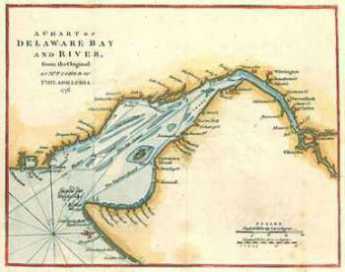 |
| Delaware River |
Delaware River came tumbling down from the mountains to Trenton, turning sharply right and then maintaining an open shallow channel to the sea. From Lambertville to Trenton, the river drops over a series of small falls or rapids, easily visible except when heavy rains "drown" them.
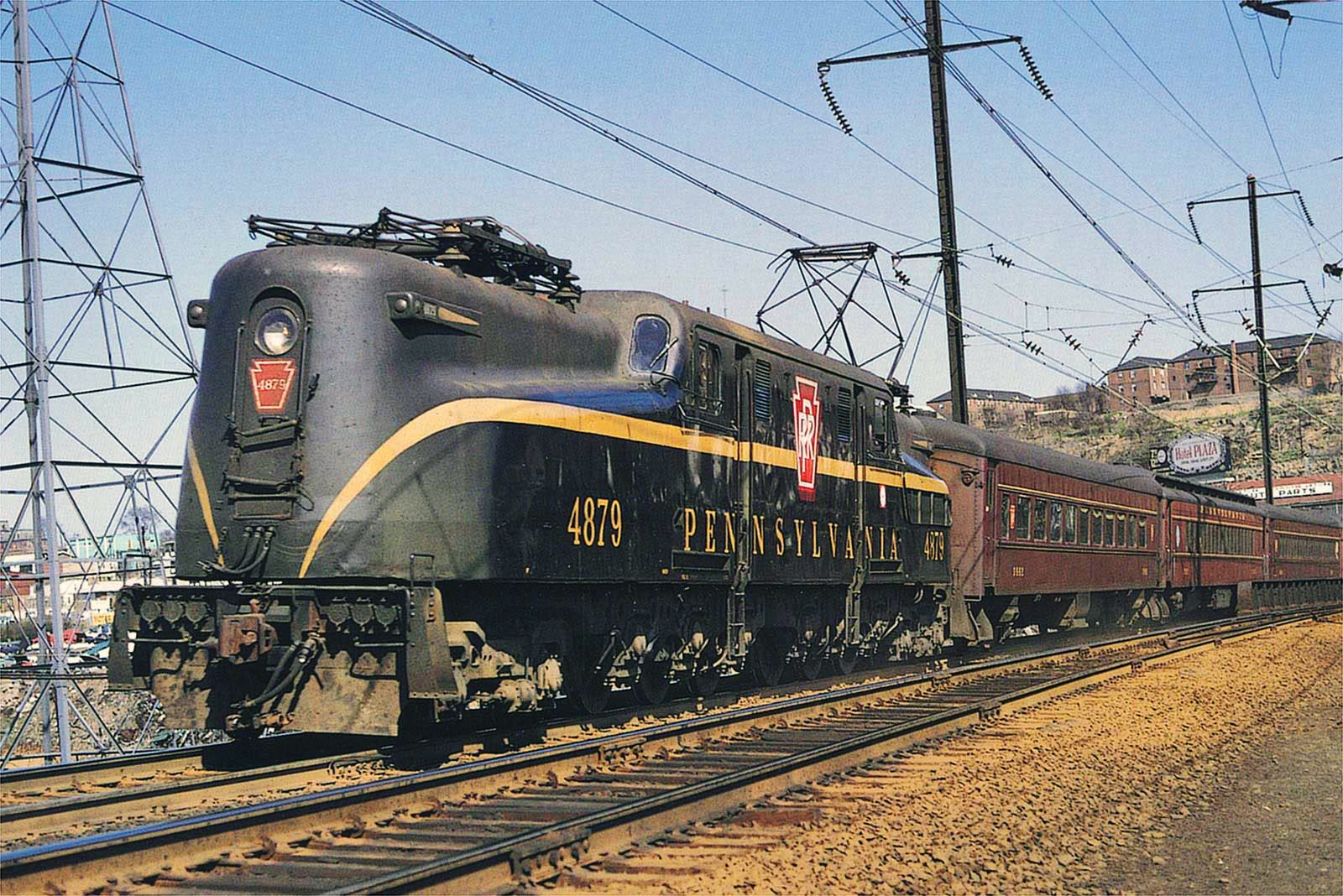 |
| Pennsylvania Railroad |
So, geography accounts for the scenery and early history of the upper end of Delaware Bay. It's still a beautiful hilly countryside with small antique villages, sparsely populated in spite of two nearby cities. Water power at the Fall Line, and then anthracite from the upstate mountains once encouraged early industry in an area that was rather poor farm country. But the Pennsylvania Railroad then rearranged commerce so that a blossoming New Jersey industrial area withered into quaintness. The early railroads mostly all ran East-West along the rivers, since investors in Atlantic port cities obtained both finance and protection from their state legislatures; railroads had almost reached the Mississippi before any were able to establish North-South connecting spurs. A seaboard trunk line was almost impossible to imagine. Finally, a consortium organized by
J.P. Morgan bullied through the main trunk line running through the bituminous coal areas of Pennsylvania and on to the West, with the major port cities connected by the great Northeast Corridor of the Pennsy. This corridor would run on the Pennsylvania side of Delaware. Industry on the bypassed New Jersey side would just wither and decline, and eventually so would the anthracite cities. Since the original colonies and states all ran from the ocean to the interior, each had a vital political interest in resisting this outcome. Only a strong and brutal corporation could bring it off.
When George Washington was circling around Trenton to attack it on Christmas, a narrow spot up-river with a dozen houses on either side was called Coryell's Crossing or Ferry. That's now Coryell Street in Lambertville, linked to the other side of the river at New Hope, after first crossing a narrow wooden bridge to Lewis Island, the center of shad fishing, or at least shad fishing culture.
The Lewis family still has a house on Lewis Island, and they know a lot about shad fishing, entertaining hundreds of visitors to the shad festival in the last week of April. The river is cleaning up its pollution, the shad are coming back, but they, unfortunately, took a vacation in 2006. At the promised hour, a boatload of men with large deltoids attached one end of a dragnet to the shore, rowed to the middle of the river, floated downstream and towed the other end of the net back to the shore. The original anchor end of the net was then lifted and carried downstream to make a loop around the tip of Lewis Island, and then both ends were pulled in to capture the fish. There were fifty or so fish in the net, but only two shad of adequate size; since it was Sunday, the fish were all thrown back.
But it was a nice day, and fun, and the nice Lewis lady who explained things knew a lot. Remember, the center of the river is a border separating two states. You would have to have a fishing license in both states to cross the center of the river with your net; game wardens can come upon you quickly with a power boat. But the nature of fishing with a dragnet from the shore anyway makes it more practical to stop in the middle, where shotguns from the other side are unlikely to reach you. An even more persuasive force for law and order is provided by the fish. Fish like to feed when the sky is overcast, so there is a tendency on a North-South river for the fish to be on the Pennsylvania (West) side of the river in the morning, and the New Jersey (East) side in the evening. During the 19th Century when shad were abundant, work schedules at the local mills and factories were arranged to give the New Jersey workers time off to fish in the afternoon, while Pennsylvania employers delayed the starting time at their factories until morning fishing was over.
Somehow, underneath this tradition one senses a local Quaker somewhere with a scheme to maintain the peace without using force. Right now, there aren't enough fish to justify either stratagem or force, but one can hope.
Pennsbury Manor
|
| Fairmount |
William Penn once had his pick of the best home sites in three states, because of course he more or less owned all three (states, that is). Aside from Philadelphia townhouses, he first picked Faire Mount, where the Philadelphia Art Museum now stands. For some reason, he gave up that idea and built Pennsbury, his country estate, across the river from what is now Trenton. It's in the crook of a sharp bend in the river but is rather puzzlingly surrounded by what most of us would call swamps. The estate has been elegantly restored and is visited by hosts of visitors, sometimes two thousand in a day. On other days it is deserted, so it's worth telephoning in advance to plan a trip.
|
| Gasified Garbage |
After World War II, a giant steel plant was placed nearby in Morrisville, thriving on shiploads of iron ore from Labrador, but now closed. Morrisville had a brief flurry of prosperity, now seemingly lost forever. However, as you drive through the area you can see huge recycling and waste disposal plants, and you can tell from the verdant soil heaps that the recycled waste is filling in the swamps. It doesn't take much imagination to foresee swamps turning into lakes surrounded by lawns, on top of which will be many exurban houses. How much of this will be planned communities and how much simply sold off to local developers, surely depends on the decisions of some remote corporate Board of Directors.
However, it's intriguing to imagine the dreams of best-case planners. Radiating from Pennsbury, there are two strips of charming waterfront extending for miles, north to Washingtons Crossing, and West to Bristol. If you arrange for a dozen lakes in the middle of this promontory, surround them with lawns nurtured by recycled waste, you could imagine a resort community, a new city, an upscale exurban paradise, or all three combined. It's sad to think that whether this happens here or on the comparable New Jersey side of the river depends on state taxes. Inevitably, that means that lobbying and corruption will rule the day and the pace of progress.
Meanwhile, take a trip from Washingtons Crossing to Bristol, by way of Pennsbury. It can be done in an hour, plus an extra hour or so to tour Penn's mansion if the school kids aren't there. Add a tour of Bristol to make it a morning, and some tours of the remaining riverbank mansions, to make a day of it.
Houses of the Penn Family
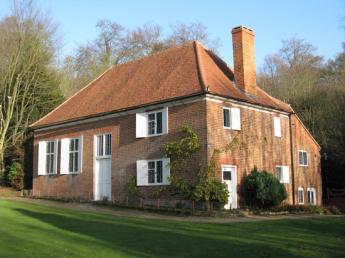
|
| Jordan Meetinghouse |
The name Penn seems to be derived from the Welsh name for hill; hills are abundant in Wales. There is a reason to suppose the family was of royal descent. William's birthplace is now disputed, possibly in London near the Tower, possibly in Ireland at Sharry Estate, possibly the Church of All Hallows, Barking, England. Much better known and much-visited is Jordans, the place where he is buried in the simple buying ground of the Jordans Meeting House in Buckinghamshire, on a by-road running between Chalfont St. Peter and Beaconsfield. The present grave markers were added later since early Friends generally declined to have their names on tombstones. He lived most of his life and actually died in the family estate in Berkshire called Ruscombe where he had usually attended Friends Meeting in nearby Reading. At the time of his death, his fortunes were much reduced, having been betrayed by his steward Ford, and imprisoned for nine months.
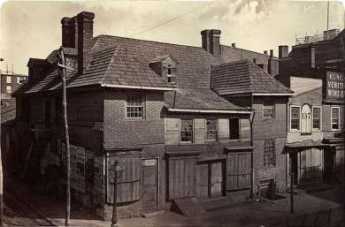
|
| Slate Roof House |
When he lived in Philadelphia, William lived in the "Slate Roof House" on Second, between Chestnut and Walnut (a small park commemorates the building lot), and the Letitia Street House. His plans originally were to build a manor house where the Art Museum stands today, on Faire Mount, but somehow he changed his mind and moved to Pennsbury on the Delaware River near Trenton. This manor also did not survive, but its careful restoration is now well worth a visit.
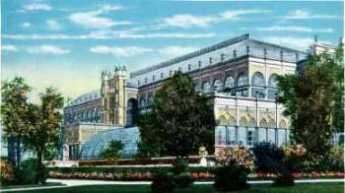
|
| Horticultural Hall |
William Penn had thirteen children, a circumstance adding much difficulty for genealogists. John Penn, the nephew of William's son Thomas, was the grandson who acted as Proprietary Agent and Governor prior to the American Revolution, although Thomas remained in London as a close friend of the King, and exercised firm control of the policies of the Proprietorship. John built a fine mansion on the Schuylkill called Lansdowne at the site of what was to become Horticultural Hall in the 1876 Centennial. About all that can now be visited is the glen on the estate, over which a bridge is still usable. It was here that he was apprehended by Revolutionaries, and taken to house arrest in New Jersey.
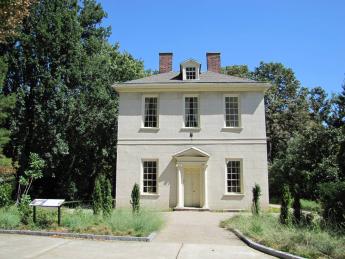
|
| Solitude House |
Lansdowne burned in the early 19th Century and pictures of it are hard to find. A smaller house of John Penn's, called Solitude, still stands near what is now the Zoo. John was arrested by rebel troops while living at Lansdowne and held prisoner at another house confusingly called Solitude, on the grounds of what became Union Forge, later the Union Forge Ironworks, subsequently the Taylor Iron and Steel Company. All of this is located in High Bridge, New Jersey, where subsequently five generations of the Taylor family lived until 1938. The Union Forge Heritage Association/Solitude House Museum welcomes visitors.
|
| Stoke Mansion |
A different John Penn, who called himself John Penn of Stoke, inherited a much larger portion of the final payment for the Proprietorship lands in Pennsylvania in 1789 because he was the son rather than the nephew of Thomas Penn. Thomas had purchased the historic Manor House in Stoke Poges in England. Although this splendid palace dated back to 1066 and Elizabeth I had visited it, it was by 1790 so dilapidated that John Penn demolished three-quarters of it. In its place, he built a proper palace, called Stoke Park. The family fortunes seem to have declined after that, perhaps because of the extravagance of an estate he could not afford.
Line Dividing East from West Jersey
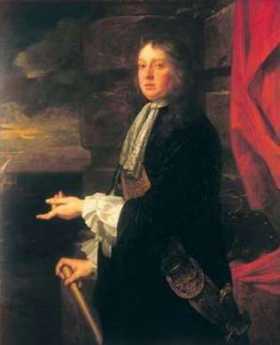
|
| William Penn |
At this point William Penn entered the picture as one of three Quaker trustees for Byllinge, who had gambling debts. A tenth of this share was given to John Fenwick, the 1675 settler of Salem, to settle his part of the disputes with Byllinge; the rest of it constituted what was to become the oldest American stockholder corporation, The Proprietors of West Jersey. The arrangement up to this point was firmly settled for the southern half of New Jersey by a Quintipartite Deed of July 12, 1676, , signed by the three Quaker trustees plus Byllinge and Fenwick. Aside from establishing the Proprietorship, the main point of this deed was the separation of West Jersey from East Jersey (the Carteret part) by a North-South line which still persists as the upper border of Burlington County. The right to govern this land was fully restored in 1680 by a Confirmatory Grant from James, probably after considerable lobbying in London by William Penn.
Presumably in pursuit of this final confirmation, Penn had negotiated a hundred-page agreement with prospective settlers which outlined his plans for governing, called the Concessions and Agreements of March 14, 1677, . Although its original purpose was mainly a real estate marketing tool, this landmark document seems not only to have persuaded the Duke of York but so shaped the thinking of the English colonies that many of its features are readily recognized in the American Constitution of 1787.
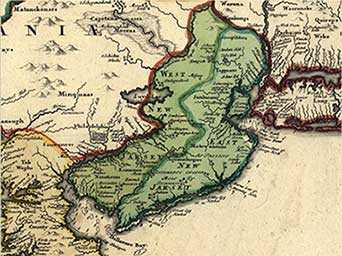
|
| The line dividing West and East NJ |
The land mass between the North and South Rivers (Hudson and Delaware) only came completely and legally into the hands of Quakers in 1681. At that time Carteret's widow, Lady Elizabeth, sold the northern half (East Jersey) to twelve Quaker proprietors, while the southern half (West Jersey) was already held by thirty-two other Quaker proprietors under the effective leadership of William Penn. It is somewhat uncertain who orchestrated this final consolidation, but there is a strong presumption that it was Penn. Since the main purpose of these business proprietorships was to sell land to immigrants, it was vital to minimize land disputes with accurate records and accurate surveying. With a history behind them of fifteen years of bickering, everybody concerned was surely ready for some peaceful organization. Both groups of proprietors, East and West, found it useful to delegate authority to a council of nine executive proprietors, whose main agent under the circumstances was logically the Surveyor General. For the next three hundred years, the surveyor generals were the men running things in New Jersey. The right of the Proprietors to govern was revoked by Queen Anne in 1702, but their land rights remain undisturbed to the present day, notwithstanding the intervening transfer of national power to the United States of America in 1776-83. Underneath all of this hustling and arranging, with exquisite attention to details, seems to be found the hand of William Penn. Almost immediately after New Jersey was packaged and delivered, King Charles paid off his family debt by turning over the far larger combined land mass of Pennsylvania and Delaware to William Penn, urging him to make himself a vassal king in the process. The Quaker instantly declined such a thing, but the power continues to reside in the final Royal Charter. It's only a conjecture, but it might help explain the strange acquaintance between a dissolute king and an abstemious Quaker to notice that the New Jersey tour de force astoundingly demonstrates how Penn was a man who really could be trusted to get complicated things done with dispatch.
Today, for practical purposes it all amounts to a company named Taylor, Wiseman, and Taylor; but we are getting a little ahead of ourselves. To go back to 1684 a surveyed line was clearly needed between the two proprietorships, as declared by the following resolution:
"Award we do hereby declare, that [the line] shall run from ye north side of ye mouth or Inlet of ye beach of little Egg Harbor north northwest and fifty minutes more westerly according to natural position and not according to ye magnet whose variation is nine degrees westward."
To clarify those quaint words, the survey was not to make the mistake made in the layout of Philadelphia, whose streets had intended to be true north and south but by using Magnetic North are actually twelve degrees off from that. Another important point is probably unclear to modern readers, who know the town of Egg Harbor on the mainland of Barnegat Bay but are largely unaware that the "beach of Egg Harbor" was what we now call Long Beach Island, on the east side of Barnegat Bay. The southern anchor of The Line was in what we now call Beach Haven, on the north side of the inlet, although beach erosion has put the southern anchor about two miles out to sea, locating a temporary marker in Beach Haven. Hardly anyone seems to be aware of it, but reread the sentence and observe the meaning is actually quite clear. The intent of the northern end of The Line (? the Delaware Water Gap ?) is buried in the obscurity of compass markings, but comes out slightly above Trenton on the Delaware River, extending beyond the river into Pennsylvania until it reached the river again in a crook on the far side of the Delaware Water Gap. Word of mouth has it that William Penn wanted to have both sides of the river although this triangle of Pennsylvania was eventually surrendered. It seems fair to say, the line was roughly intended to run from the Beach Haven ocean inlet to the Delaware Water Gap.
|
| John, Lord Berkeley |
For its time, the survey of The Line was also a significant engineering achievement. The general plan was to lay out the course of the line in the wilderness until it hit a big boulder or anything else that was large and heavy. This became a marker along a line of 150 markers which could be used for local surveys and boundaries. After several less accurate attempts, the West/East line was surveyed by John Lawrence in 1743 and stands as the Official Province Division Line. A few years ago, a group of volunteers tried to locate all of the original markers and found 55 of them. The historical project took ten years.
All of the deeds of property in the State of New Jersey still depend on the original survey and the meticulous notes kept by the Surveyors General of these two Quaker organizations, without whose private records every title to every property would be clouded. With the passage of time, and especially the warfare of the Revolution, other copies of the surveys have disappeared. So, without the need to get ugly about it, these soft-spoken courteous folks retain a form of power it would be hard to match with sticks and stones, guns, threats or legalisms -- the only surviving record of everyone's title to his land. There is little reason to inquire further why these Proprietorships durably survived the revolution which overthrew King George III, and why no one has seen fit to enter the serious challenge to their claim of owning the whole state except for what they had already specifically sold.
Let's go back to a point made earlier. In all the complexities of the English Royal Court and uncertainties of uncharted wilderness, how did a little band of Quakers find themselves with uncontested ownership of a whole American colony? Some of the chaos of the age probably helped. King Charles unleashed his brother's armies in 1664. Also in 1664, Parliament passed the Second Conventicle Act, which provided that not more than five persons were permitted to worship together otherwise than according to the established ritual of the Anglican Church of England. This act might be described as an improvement on the First Conventicle Act of Queen Elizabeth, which provided that no one at all could so worship. However, this prohibition was so extreme it was ignored, whereas the Second Conventicle probably had some popular support. It thus can be imagined why Quakers were suddenly interested in leaving England, and not hard to understand how young William Penn was propelled into leadership by successfully overturning that Act in the Haymarket Case. Penn was both the defendant in the case and the defense lawyer, inventing the common law principle of jury nullification that has so confounded tyranny ever since. To go on with events current at the time, the Great Plague took place in 1665, making London an undesirable place for anybody to live. And finally, George Fox, the founder of Quakerism, took a journey to the new world in 1672, noting that the place now called Burlington, New Jersey was "a bravest country". Taken altogether, it is not hard to suspect this group of fairly wealthy, fairly well-educated people developed a collective resolve to buy up the pieces, assemble the parcel, and go away to live on it. Their organization into monthly local meetings, quarterly regional meetings, and annual national meetings was surely great assistance. From what we know of the broader vision of William Penn, it is fair to speculate his enthusiasm for this communications network first suggested by George Fox, or at least he's having a pretty quick recognition how it would assist the emigration venture.
|
| George Carteret |
George Carteret's widow was the last to sell out her land parcel to the East Jersey Proprietors, presumably drawn from the 1400 immigrants who had arrived in Burlington on five or six ships between 1678 and 1681. In particular, the ship Kent sailed from the Thames in 1677, bearing 230 Quakers, half from Yorkshire, the other half from London settling further south in West Jersey. Before that, Lord Berkeley had sold his half for a thousand pounds to John Fenwick and Edward Billynge, who arrived in Salem on the ship Griffin in 1674. These two soon fell out, with Fenwick taking a tenth of the land and settling around Salem. Billynge got into unspecified difficulties, probably gambling, and turned his property over to his three main creditors, William Penn, Gawen Lawrie, and Nicholas Lucas, who assembled the Proprietorship of West Jersey. Penn's remarkable talent for leadership again emerged in his statement of "Concessions and Agreements" with the Indians and new inhabitants. In another place, we discuss the reasons for thinking this document created the effective basis of the U.S. Constitution. By infusing it with the unspoken word of compromise, Penn created the main model explaining why the ratification of the Constitution remains the only time in history when thirteen independent nations voluntarily gave up sovereignty for the purpose of creating a larger vision -- which then held together for two centuries. But the voluntary union of East and West Jersey certainly has a claim to being earlier, although its claim to sovereignty is weaker.
Perhaps so, but since their interest in power was weaker, their achievement in peaceful negotiation with a secretly Catholic King was surely much greater. If some small group of religious dissidents should today emerge as having quietly and systematically bought up an entire state, however legally, the word conspiracy would be on every tongue. In this case, however, the reaction was peaceful consensus.
Bristol, PA
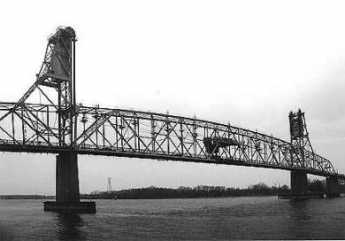
|
| Burlington Bristol Bridge |
In 1681, Samuel Clift activated a local land conveyance, written to go into effect as soon as King Charles II signed the overall land grant to William Penn. In this way, Bristol claims to be the oldest settlement in English Pennsylvania; Clift got here before Penn did. He chose the narrowest spot in the river as an excellent place to run a ferry which was only replaced by the Burlington Bristol Bridge in 1930. A ferry landing is an excellent place for an Inn, which he also built there. The town he founded was called Buckingham, and the surrounding county became Buckinghamshire, Bucks for short. The name later changed to Bristol. The New Jersey town on the other end of the ferry ride was called Bridlington, later Burlington. North of this narrow spot in the river was a several-mile extent of marsh and swampy inlets, and then the river turns abruptly northwest at what used to be called the falls at Trenton.
William Penn had considered building his house sixty miles south of there at the Southern end of Philadelphia Bay, at Chester, then pondered building it on the Faire Mount where the Philadelphia Art Museum now overlooks the Schuylkill. In the end, he built a Philadelphia house near Dock Creek (subsequently covered over and renamed Dock Street) and a palatial manor house, Pennsbury, in the swampy marshes above Bristol, where a tourist visit is now a valuable experience.
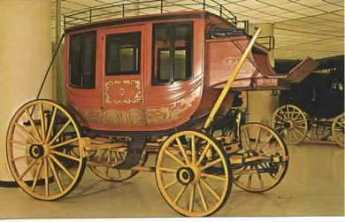
|
| Stagecoach |
No doubt being near the Proprietor's estate gave Bristol some class, but it was also half-way on a two-day stagecoach ride from Philadelphia to New York. A succession of inns and resorts grew up in Bristol, and it became a busy transshipment place, a good place to build schooners. A local Captain John Cleve Green is celebrated as first to carry the American flag to China, although it must be admitted his cargo included opium; Green is regarded as the financial founder of the nearby Lawrenceville School. The terminus of the Delaware canal brought coal from the anthracite region in 1827; more prosperity ensued as coal was loaded on ships in Delaware, or utilized instead of water power for the Bristol Mills which had been founded by Samuel Carpenter in 1701. John Fitch invented the first steamboat and tried it out here; more prosperity ensued, although not for poor Fitch, who committed suicide. Little Bristol gradually filled up with imposing waterfront mansions, the declining shells of which can still be admired.
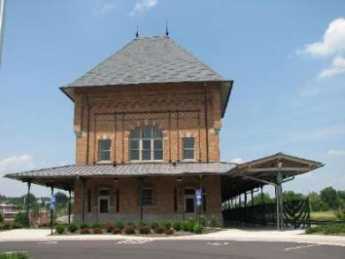
|
| Bristol Railroad |
The advent of the railroad isolated Bristol when it cut off the corner of the bend in the Delaware River. Four-lane highways eventually consolidated the isolation of the little river town, but the turning point was around the time of the Civil War. For nearly a century, between the Revolution and the Civil War, Bristol was the booming little queen of northern Philadelphia Bay, and the Bay itself was an American Lake Como, lined with Federalist and Victorian mansions, their lawns sweeping down to the water's edge. Small wonder there was so much social interaction between the railroad-isolated Bristol, and planters of Chesapeake Bay. The strip of quiet charm begins at Pennsbury Manor and pretty continuously extends to Bristol, where you can go under the rail embankment and on to Philadelphia, or alternatively cross the Burlington Bristol Bridge to New Jersey. A couple of miles further south, the river edge is a little ragged but includes some yacht clubs and several famous mansions, notably Nicholas Biddle's Andalusia, the Foerderer family's Glen Ford, and the former mansion of Saint Katherine Drexel.
The Bristol area has had moments of fame. George Washington had originally planned to attack Trenton from both the north and the south simultaneously. He came over what is now called Washington's Crossing amid the ice floes on the north side of the Pennsbury delta, and General Cadwalader was to cross Delaware at Bristol, on the south side of the marshes. As it turned out, the ice was worse at Bristol and the river wider, so Cadwalader was late for Trenton but caught up with Washington to help with the battle at Princeton. President Tyler's daughter married a dashing gentleman from Bristol. Republican politicians from Bristol teamed up with some others in West Chester to decide that favorite-son Seward couldn't win, so they backed Abraham Lincoln for the presidential nomination, and Pennsylvania was therefore in time richly rewarded for its political acumen. Despite the arts and crafts group that moved in around New Hope PA, Bucks County has remained a Republican stronghold ever since. The region's influence was long symbolized by Joseph P. Grundy, the gentle Quaker manufacturer from Bristol whose name struck terror in Republican politicians as well as Democrat ones, but for opposite reasons.
The Burlington Bristol Bridge is now getting a little narrow and ancient, but is still serviceable. It long charged only a dime's toll because that was enough for painting and upkeep. Together with the Tacony Palmyra Bridge, which charged the same low toll, these locally owned bridges stuck a thumb in the eye of the tax-and-spend folks who owned the Philadelphia bridges and who wanted to charge three dollars toll, spending most of it on non-bridge activities. As Tacony Palmyra Bridge rests on both sides of the river, the local politics gradually shifted enough to permit a restoration of toll "equity".
Life On The River (3)
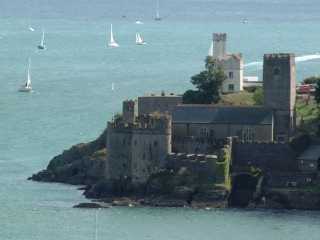
|
| Darth Mouth Castle |
All over Europe the scene is repeated: a market town and seaport at the mouth of a river, with many miles of riverbank castles in the hinterland. The seaports had to be fortified against pirates, the hinterland against marauding brigands. But the two flows of commerce consisted of baronies upriver feeding the seaport, while secondarily their seaports carried on trade with nearby river-organized economies. From time to time, someone like Julius Caesar, Napoleon, Bismarck or Hitler would try to unify the various river economies, usually unsuccessfully. In fact, the same pattern was seen along the Pacific Coast of South America, until the Incas figured out how to go along the mountain ridge in the far interior, and then come down the rivers from the sparsely populated areas to the maritime settlements at the mouth of the river, whose defenses were planned for enemies from the sea. Philadelphia followed the commercial pattern, but without fortresses and castles.
Because of the vagaries of King Charles II, and underneath that, because of marshes and their mosquito-borne diseases, the Delaware Bay was settled fairly late in colonial times -- and almost entirely by Quakers. The Dutch were interested in fur trading rather than settlement, the Dutch were anyway too few, their sovereign too indifferent, and William Penn took care of the Indians. So the English settlers had no one to fight except other Englishmen, once the French stab at Inca-like strategy was put down in 1753. After 1783, or perhaps 1812, the world finally left us alone. The Delaware Bay and River are essentially free of fortresses, Philadelphia has no castles. The peaceful sixty miles of upper Delaware Bay became lined with big farmhouses, or big Federalist and Victorian mansions. For a century, from the Revolutionary War to the Civil War, and even for a time after that, the history of this peaceful pond reads like a novel by Jane Austen.
As a playground for menfolk, it would be hard to improve on Victorian Delaware Bay. The river was full of fish, notably shad. In the fall, the migrating ducks and geese made for marvelous hunting. In the countryside behind the riverfront, houses were found all the sports having to do with horses; fox hunting, racing, horses shows. The kids could putter around in small sailboats, the adult sailors could sail a yacht to Europe if they wanted to. After John Fitch invented the Steamboat, it was possible to take a daily commute to the best male game of all -- trading, investing and gambling in the financial and commercial center of Philadelphia.

|
| Shad |
Marion Willis Rivinus and Katherine Hansel Biddle wrote a little book in 1973 called Lights Along the Delaware which tells the river story from the female point of view. The woman of the house was sort of the mayor of a little city, organizing the staff, supervising the garden, educating the children, planning the household, and organizing the dinners and social events. Educated and trained to the role, she knew what to do and enjoyed doing it. Jane Austen wrote the handbook. And while the menfolk were essential members of the cast of characters, women were the managing directors. The men were off with their horses, or sailboats, or fishing rods, or their faraway big-deal mergers and acquisitions. True, it was not a notably intellectual community, there was no Edith Wharton, Abigail Adams or Emily Dickinson. You might find some of that in Germantown, perhaps. The professions, law, and medicine, lured the more studious male members away from Society, but the international diplomatic circle was seen as the ideal career for any truly graceful graduates of this environment.
|
| Riverbank Railroad |
As the riverbank was gradually destroyed by railroads and expressways, only a few mansions like Andalusia remain in good repair. Curiously, what endures best are the clubs. The fishing club variously called the Fish House, the Castle, the Colony in Schuylkill, or the Schuylkill Fishing Company of the State in Schuylkill, has moved as many times as the name has changed. Started in 1732, it is the oldest continuously existing men's club in the world. It moved to the Delaware River from the Schuylkill when the Fairmount dam was built, and to its present location at Devon, the estate of William B. Chamberlain in 1937. New members do the cooking, cleaning, and serving, older members tell stories. When the river pollution is finally controlled, they may go back to catching the fish as well as cooking them. There's the Philadelphia Gun Club, which before 1877 was the Public Holiday Shooting Club of Riverton NJ. And then there's the Gloucester (NJ) Fox Hunt, which during the Revolution turned into First Troop, Philadelphia City Cavalry. After escorting George Washington to the battles of Boston Harbor, The Troop has been an active fighting unit of the National Guard (most recently in Bosnia) as well as a devoted center of male horsemanship between wars. The Farmer's Club, the Agricultural Society, and the Horticultural Society all reflect the rural interests that once predominated just behind the riverfront estates, still thriving aloof after 150 years of suburbia, exurbia and urban revival.
|
| Philadelphia Gun Club |
Although the riverfront industrial slums which destroyed the Philadelphia branch of Jane Austen's gracious living subculture are themselves declining and seem about to go away, it would take a real visionary to imagine how the Grand Life on the River will ever return. The banks of Delaware are much lower than the bank of the Hudson, for example. They make a great place to put high-speed rail lines and even higher speed interstate highways. The patrons of Hyde Park, West Point, and Poughkeepsie are much higher up a cliff and can overlook the river without much noticing an occasional whoosh. The mansions along Delaware have to look right at the tracks. Except for a few places like Bristol which have become isolated on the river side of the tracks and highway, it's not easy to see how you would get from here to there, or when.
Shad
Nowadays, we have fresh fruit and vegetables all year Shadround. When produce isn't in season locally, we get it from Florida and California. When even those places are out of season, we bring it in from Chile. But the supermarket and its attendant supply chains are recent phenomena. Before the two World Wars, our food was pretty drab and monotonous during the winter. The first sign of the culinary joys of spring was shad.
|
| Shad |
Everybody loved, which everybody ate in its various forms. Shad was cheap because it was abundant; indeed, it seems difficult for the modern fisherman to imagine the huge quantities of fish that came up the rivers in early March. There was even a special term for fish weighing less than three pounds; at the fish market, such fish were thrown in, free. The term "Bushwacker" referred to the practice of beating the fish in the water to catch them. There once was a time when everybody knew how to use a shad dart, everyone could filet the bones, everyone had fried shad roe for breakfast. Spring, it was acumen in.
Unfortunately, the diversion of fresh water from upper Delaware to New York City, the dumping of waste from the oil refineries near Marcus Hook, and heaven know what other pollution, wiped out the annual shad run. Once a river's shad run is depleted, the main obstacle to getting it revived is the striped bass, who feast on the fingerlings coming back downriver from the spawning areas. You can still catch a few shad at the place where Amtrak crosses the Susquehanna, and a few hardy pioneer fish are starting to make it all the way to Lambertville. But the bulk of shad in Philadelphia markets now comes from North Carolina, and you better be alert to your timing or even they will be all gone before you've had any. There once was a time when a diner could be identified as a boorish stranger picking gingerly at the strong-tasting fish, or messing around dubiously with the unfamiliar roe served on toast. Nowadays, even lifelong Philadelphians will occasionally behave like that. You put lemon juice on the roe, dummy.
And you filet the fish. The bones of a shad are complex, going both forward and back within the flesh, so you have to be experienced to take a very sharp knife, twist, and turn, duck your shoulders and flip the fish, to produce boneless" shad0. If you don't know how to do that, you may have to bake the fish for hours to melt the bones and make it edible, but tasteless. Such products can be rescued by stuffing them with bread crumbs and spices. When things reach the point where no butcher knows how to produce boneless shad, our culture is on the edge of extinction. The big center for wholesale boned shad is Dill's in Bridgeton, NJ. There is, right now, only one place where you can obtain planked shad. That's the Salem Country Club (if you look respectable they let nonmembers in) out at the point on the Jersey side where Delaware takes a big bend before it flows down to the sea. A shad is planked by splitting it open and nailing it to a board, which is then placed before an open fire in the fireplace. Snap, crackle and wow.
Maybe the conservationists can get these fish back for us. The Eagles will certainly like that; had used to be what mainly sustained the American bird, and the depletion of the shad is part of the near-extinction of eagles. And maybe we can swallow our pride and teach the West Coast how to treat shad with respect. Shad was always an East-coast, Atlantic fish, and there is hardly a river left which has much shad. But someone transported some shad to the Sacramento, California area a century ago -- and they have flourished. Where the fish ladders of the Columbia River used to teem with salmon, nowadays they teem with shad. California likes to think it invents everything in America. Brace yourself for being told they invented shad.
Where Do Shad Go, When They Aren't Around Here?
|
| BAY OF FUNDY |
Some day, we're going to clean up our rivers, and then maybe the shad will come back. Since every female shad produces a couple hundred thousand eggs a season, when the shad come back, there could be a lot of them. We now know some things George Washington didn't know about shad. For example, they all go to the Bay of Fundy, once a year. All of them, whether they spawn in North Carolina, the Delaware, or the Connecticut River.

By tagging them, it was learned that shad swim at a depth of several hundred feet, apparently seeking a certain amount of darkness, which is in turn related to the growth of algae and plankton, their favorite food. So, when the surviving shad go back down a spawning river to the ocean, they head North in a huge counter-clockwise ocean rotation, adjusting their depth to the degree of darkness. Just about the time summering Philadelphians start packing for Bar Harbor, the shad also reach the Bay of Fundy, which is muddy and dark. Fundy is famous for its unusually high tides, so the turbulent water achieves the shad's desired degree of murkiness at about thirty feet instead of the normally deeper waters of the cyclic migration in the open ocean. People who know about these things say that just about every shad on the East Coast passes through the Bay of Fundy in late spring. In the fall, the fish turn around and start to go South again, maybe following the sun, maybe seeking a desired temperature, or both. Somehow or other, this pattern of migration helps them escape predator sharks and seals, as judged by that wholesome entertainment, the examination of stomach contents. Look out for sharks and seals in the open ocean, but striped bass are the big enemies of fingerlings in the spawning rivers. The Hudson River curiously has lots of striped bass lurking among the abandoned piers, and so does the Chesapeake. The Delaware also has a few stripers around the mouth of the Rancocas Creek; go ahead and fish 'em out.
All of this brings us to a suggestion for our tourist bureau. Shad don't eat much when they are on a spawning run, but they will strike at a lure. That is, you don't use worms, you do fly-casting. If we ever got anything approaching the old shad runs in the Spring, you could expect thousands and thousands of eager fly-casters to flock to the Delaware, filling up our marinas, hotels, restaurants, and cabarets. You wouldn't need to advertise a river teeming with eight-pound action-eager fish; the news would spread like magic. The best proof of this claim can be found on the only river on the East Coast which continues to have a classic shad run. The existence of this river was told to me as a sworn secret, but the invitation to try it was given with the assurance that "every single cast results in a strike".
And here's the zinger. Except for that one secret stream, the Delaware is the only major river on the East Coast that doesn't have a dam between the ocean and the spawning grounds. Once these fish have picked a river, they keep coming back to it, forsaking all others. The situation positively cries out for Federal assistance, and the lure-casting fishermen of America demand no less. Presidential elections have been won and lost on less important issues than this one. But just one dedicated congressman could do it, particularly if he sits on the Committee on Fisheries. Bring back our shad and get rewarded with lifetime incumbency that even Gerrymandering can't dislodge.
Helis the Whale
|
| Beluga Whale |
Helis the beluga whale, male, 12 feet long, said to be 30 years old in a species with a life expectancy of about 35, made an appearance in the upper Delaware River in the spring of 2005. A scar on his back was recognized as having been seen on the St. Lawrence River, where Beluga whales are more commonly observed. Needless to say, there was a local sensation, with crowds of whale-watchers along the banks of the river, sharing binoculars, and buying special whale cookies, t-shirts and the like from opportunistic vendors. Helis arrived April 14, 2005, in time to pay income taxes, go to Trenton, cruising Trenton to Burlington and back, eating shad. Experts saying he is happy as a clam, shad fishermen grumbling a little. Crowds of excited people tried to take snapshots of themselves with Helis in the background.
He stayed with us another week, going back and forth between Burlington and Trenton. Not many other events took place, so the newspapers had front-page stories by Beluga whale experts, sought out for fifteen minutes of fame. Will he come back? How big do Belugas get to be? Frantic calls by reporters obtained the information that Belugas like icy arctic waters, seldom travel alone or this far south. The suggestion was made that Helis may have been banished by the male whales he usually swims with, but others pointed out the unusually good shad run this year and conjectured Helis was an adventurous loner who had discovered a private river of goodies.
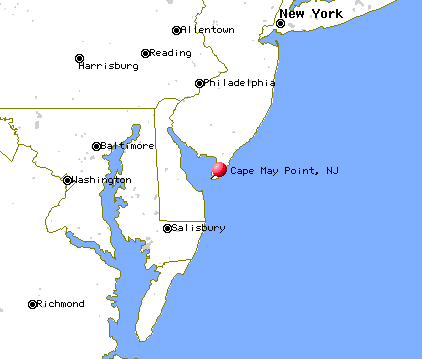
|
| Cape May NJ |
We were informed that lots of whales are sighted off Cape May every year; there's a rather large whale sight-seeing industry. Mammals don't breathe the Delaware pollution, but like other mammalian swimmers, they swallow some. So here's a sign that river pollution maybe can't be too bad.
The French Canadians call him "ee-lus" but don't expect that to catch on around here. What's helis mean, anyway? This seems to be the most southern sighting of a Beluga. Reminds us that Kingston New York, a hundred miles up the Hudson, used to be a big whaling port. that Ahab of Melville's Moby Dick was a Quaker, Nantucket variety. Cape May Quakers are related to them more than to Philadelphia Yearly Meeting. After all, Philadelphians are whale-lovers.
Unless someone harpoons Helis, we are all hoping he will bring back lots of his friends next year. Even the shad fishermen recognize that if the whales are searching for shad, there have to be a lot of shad to be attractive. And the whale-memento industry will surely be ready for them.
Fort Washington, PA
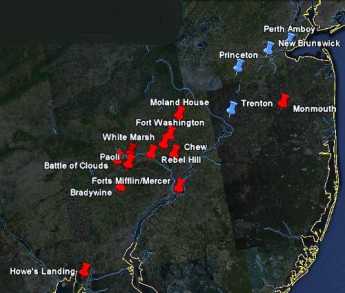
|
| British Campaigns |
The Revolutionary War lasted eight years, so there are a half dozen Fort Washingtons, in several states. Pennsylvania's Fort Washington gets free advertising from being a stop on the Pennsylvania Turnpike at the intersection of the East-West branch and the North-South branch, near some very large shopping malls. Nevertheless, the suburbs haven't reached it yet, and it is on a series of wooded mountain ridges discouraging housing development. Another way of describing its location is that it is several miles north of Chestnut Hill along the Bethlehem Pike, a road which begins in the center of Chestnut Hill at Germantown Avenue. The Pike is quite old, with many surviving colonial-era houses and inns to liven up the trip.
A third way to describe Fort Washington is that the headquarters were at the point where Bethlehem Pike crosses the Wissahickon Creek. How's that again? How does the western Wissahickon Creek then flow uphill to Chestnut Hill? Of course, it doesn't, but the appearance takes some explaining. The northwestern end of Philadelphia is reached by two ancient roads running on ridges quite close together like the split tail of a fish. Germantown Avenue runs up one ridge, and Ridge Avenue runs up the second ridge closer to the Schuylkill. The Wissahickon runs in the gully between these two ridges and tumbles down the hill at Wissahickon Avenue, or Rittenhousetown if that is more understandable. The ridge of Ridge Avenue is essentially cut off by the creek, but engineers have put Ridge Avenue on a high arching bridge as it crosses the creek far below, and by this magic Ridge Avenue and Germantown Avenue are at about the same height most of the way. The Wissahickon Creek is really running downhill the whole way, but sort of disappears from sight and reappears as it twists through the gorges, misleading the casual visitor (or commuter). As happened so often during the Revolutionary War, Washington showed his understanding here of geography in the service of guerrilla warfare.
Since the British were headquartered in Germantown, and the Americans have camped a few miles away on the same creek, it was inevitable there would be some sort of battle in the region. Washington launched a three-pronged attack on the British soon after arriving at Fort Washington, but his troops fired at each other in the fog, and apparently, two prongs more or less got lost in the gorges. The Americans retreated, and the British consolidated their conquest of Philadelphia. They did launch one surprise attack on the American encampment (the Battle of Whitemarsh), but that was mainly a reconnoiter, given up after a few days when it became clear Washington's troops held the high ground. It really is high ground (hawk-watching platforms and all) for reasons already stated. Chestnut Hill is a pinnacle sticking up on the west side of the Creek, with the Wissahickon snaking around its base.
This really was a perfect place for Washington to aim for after the Brandywine Battle, close enough to threaten the British, located in a bowl-like valley for camping, but terminating at the top of a mountain ridge in case the British counter-attacked. And with plenty of running water from the Wissahickon. However, it was a little too close for comfort, and he withdrew across the Schuylkill into Valley Forge as a more substantial natural fortress. Valley Forge is also on a hilltop, but one sitting in the middle of the Great Valley (Route 202 to Wilmington), as the center of an angel food cake tin. No doubt, the advantages of this new location became evident to him at the earlier skirmishes of the Battle of the Clouds, and the Paoli Massacre, which occurred nearby.
In retrospect, these maneuvers and skirmishes were of little military significance, except for the major Battle of Brandywine. The lost opportunity was the chance to catch the British Army without supplies or access to the Navy, aborted by what was probably a hurricane, the so-called Battle of the Clouds. Philadelphia was lost, and the opportunity to win the war early by smashing a third British army was gone for good. The defeat of the Hessians at Trenton, the loss of Burgoyne's army at Saratoga, and a victory on the outskirts of Philadelphia might together just have finished the War. But things didn't work out, the British similarly missed some opportunities, and the war was to last another five years. Once the French allied themselves, their wealth and naval strength tended to make French priorities dominate strategy.
Nevertheless, a perfectly splendid tourist trip awaits the history buff who travels from Elkton, Maryland, where the British landed, to the Battle of Brandywine battlefield, up the Great Valley to Immaculata University where the Battle of the Clouds took place, over to the Battlefield of the Paoli Massacre, crossing the Schuylkill and going to Whitemarsh, then to Fort Washington, and back up Bethlehem Pike to Germantown Avenue, and down to the Chew Mansion. The campaign for the conquest of Philadelphia ended with the fall of Ft. Mifflin when the British fleet was finally able to re-supply Howe's army. This direct auto tour is a little out of chronological sequence, but it can be done in one day if you don't dawdle. If you slow down and spend an extra day, you can include the Moland House where Washington waited to see where General Howe was going. At the right season, there's hawk watching on the ridge at Fort Washington Park, and maybe on to Trenton, or even up the New Jersey waist to Perth Amboy on lower New York Bay, where the Howe brothers began and ended their Philadelphia adventure. That would take you past Princeton and New Brunswick, or even include a trip to the Monmouth Battleground. With this extension, you have traveled much of the extent of the Revolutionary War in the Mid-Atlantic states.
| Posted by: Loida | Feb 13, 2012 11:20 PM |
30 Blogs
Jersey
Understanding New Jersey means understanding its unusual geography, and its Quaker origin as one of the three colonies owned by William Penn.
British Headquarters: Perth Amboy, New Jersey, in its 1776 Heyday (B 608)
Now dispirited and forgotten, Perth Amboy was once the glamorous capital of New Jersey. Its harbor and neighboring Staten Island were headquarters for the Admiral Howe's British fleet during most of the Revolution.
Perth Amboy to Trenton (2)
Lord Howe landed troops on Staten Island, and from there launched his first attack on Philadelphia by crossing the narrow waist of New Jersey.
Disorderly Retreat: From Trenton Back to Perth Amboy
At the Battle of Trenton, George Washington established his military reputation for all time.
Perth Amboy Revisited
Perth Amboy was once the capital of New Jersey and the entry point of General Howe's invasion of the rebellious colonies. Except for one old building, you might never guess.
South Amboy Explodes
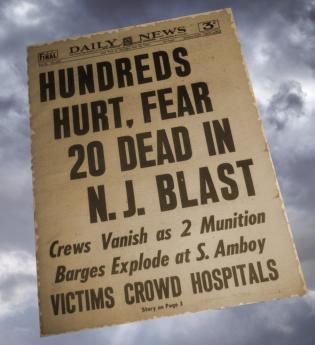 On May 18, 1950, South Amboy, New Jersey blew up, breaking windows of five counties in its neighborhood.
Unintended Consequences for Advanced Placement
The story of how the author complained to his head master about preparation for college and how it led to the concept of Advanced Placement courses in high schools.
Advanced Placement Gains Attackers and Defenders
College admission is so competitive it creates vested interests. Everything is questioned, even the value of college itself.
Lindbergh Baby Kidnapping Trial
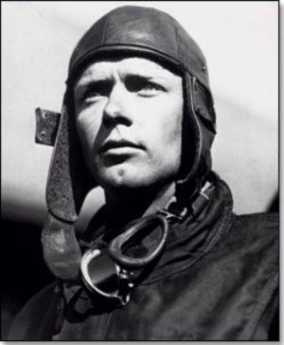 Bruno Richard Hauptmann was surely guilty of something, although it remains doubtful if he deserved to be electrocuted for the death of Charles Lindbergh's baby.
New Jersey: A Keg Tapped at Both Ends (2)
The New Jersey legislature began by ratifying the Declaration of Independence in Haddonfield, then moved to Trenton and concerned itself with debts, then with railroads, then corporations, and now -- with debts, again.
Roebling
Some millionaires of the 19th Century are called Robber Barons, but the Roeblings deserve to be called Titans of Industry.
Washington Lurks in Bucks County, Waiting for Howe to Make a Move
Washington, LaFayette, and twenty-seven other famous heroes of the Revolution spent a week in this Bucks County farmhouse, waiting for the British to make a move. Washington had a bottle of Madeira every day for lunch, but Mrs. Moland made him sleep on the floor, and pay for cleaning up when they left.
William Penn: Visionary with Persuasiveness
Even when we know how it eventually turned out, it is hard to imagine how William Penn would dare to suppose the King might give him Pennsylvania, and even harder to understand how he managed to negotiate the agreement.
The Heirs of William Penn
The death of William Penn left his heirs the largest land holdings in America. Although they managed it fairly well, it proved to be more than a single family could cope with.
Trenton's Tomato Pie Cult
The capital of New Jersey teaches an important lesson about ethnic food.
Washington's Circular Letters
During the dismal days of 1782-3, Washington was confronted with the first of many examples of the American tendency to quit a war before it is completely won.
Look Out For That Ship!
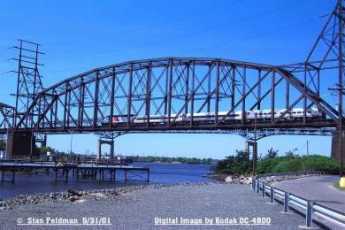 Tales of the Sea abound, even a hundred miles from the ocean.
The Walking Purchase
Quaker treatment of the Indians had been exemplary before 1737 and has been highly sympathetic ever since then, too. However, James Logan totally destroyed the trust of the Delaware Indians by using hired runners to establish boundaries of the Walking Purchase, north of the Neshaminy Creek.
Doylestown
Doylestown is trapped between the steadily advancing edges of New York and Philadelphia, and must soon submerge. For now, the town's a lovely little jewel.
James A. Michener (1907-1997)
< James A. Michener was a birthright Quaker from Doylestown, Pennsylvania, where he made his home when he wasn't traveling. He wrote 40 books, most notably "South Pacific", but lived a fairly simple smalltown life, meanwhile giving over $100 million to charity.
Lambertville and Lewis Island
As Philadelphia and New York City gradually expand until they meet, they could meet at Lambertville.
Pennsbury Manor
The Delaware River takes an abrupt right turn at Trenton, creating extensive wetlands for miles around. Whatever its environmental drawbacks, the river delta is moving toward landfill and "development". Come back in fifteen years and be amazed.
Houses of the Penn Family
Some idea of the social position of William Penn can be gathered from the houses of his family.
Line Dividing East from West Jersey
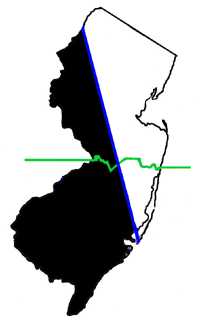 Although England had owned New Jersey for 17 years, it was unsettled until purchased by Quakers. By 1684 ownership was totally in the hands of two Proprietorships, or corporations, of Quakers. The boundary separating East from West Jersey was a line of 150 boulders from Beach Haven to Trenton. Every land title in the state is based on this survey.
Bristol, PA
Bristol is at a narrow point of the river, long the main crossing point for New York-to-Philadelphia traffic. William Penn placed his mansion nearby and for decades Bristol was a flourishing social center. The Pennsylvania Railroad cut it off, just as it cut off New Castle, Delaware, and both towns are now essentially museums.
Life On The River (3)
Until just a few decades ago, Philadelphia life was life along the river, with the gentry building houses upriver from the port. They were surrounded by abundant fishing, hunting, and all the sports of horsemanship.
Shad
The rivers once teemed with these big fish every springtime. They are making a hesitant comeback.
Where Do Shad Go, When They Aren't Around Here?
 The Bay of Fundy.
Helis the Whale
In the spring of 2005, a solitary Male Beluga whale made his way up the Delaware River, causing great excitement. He hung around for a week or so, presumably searching for shad.
Fort Washington, PA
Fort Washington PA was never much of a fort, and nothing of it remains to be seen. Rather, it was mostly a large campground north of Philadelphia between the Battle of Brandywine and the Battle of Germantown. An interesting visit, nonetheless. A side-visit to Hope Mansion would add some local color.