3 Volumes
Culture: The Flavors of Philadelphia Life
Philadelphia began as a religious colony, a utopia if you will. But all religions were welcome, so Quakerism mainly persists in its effects on others, both locally and in America, in Art, clubs, and the way of life.
Sociology: Philadelphia and the Quaker Colonies
The early Philadelphia had many faces, its people were varied and interesting; its history turbulent and of lasting importance.
Nineteenth Century Philadelphia 1801-1928 (III)
At the beginning of our country Philadelphia was the central city in America.
Customs, Culture and Traditions
Abundant seafood made it easy to settle here. Agriculture takes longer.
The First and Oldest Hospital in America
|
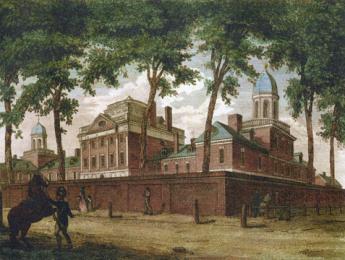
| South East Prospect of Pennsylvania Hospital |

There is a painting of the region around 8th and Spruce Streets in the 1750s, depicting a pasture, with cows, and three or four buildings between 8th and 13th Streets. When the Pennsylvania Hospital moved there in 1755 from its temporary location in a house located a block from Independence Hall, there were complaints that it was now located so far out in the woods that it was difficult and dangerous to go there. Still another description of the area is evoked by the provision which the Penn family placed in the deed of gift of the land, strictly forbidding the use of the land as a tannery. Tanneries have always been notorious for giving off noxious odors, so most people wanted them to be somewhere else, anywhere else. In any event, the main activity of Penn's "green country town" at that time was concentrated closer to the Delaware River, and the nation's first hospital was definitely placed in the outskirts. Two blocks further West the almshouse was already in place, but not much else. We are told that Benjamin Franklin had flown his Famous Kite at 9th and Chestnut, using a barn there to store his materials. It might be recalled that the population of Philadelphia, although the second largest English-speaking city in the world, was only about twenty-five thousand inhabitants at the time of the Revolution, and in 1751 was even smaller.


In any event, the first and oldest hospital in America was built on 8th Street between Spruce and Pine, and the Eighteenth Century buildings on Pine Street still present a breathtaking view at any season, but particularly in May when the azaleas are in bloom, and fragrance from the flowering magnolias fills the evening atmosphere for blocks around. Although some people today mistake the Pennsylvania Hospital for a state hospital, it was founded in the reign of George II, decades before there was such a thing as the State of Pennsylvania. The Cornerstone was laid by Benjamin Franklin, with full Masonic rites. Most doctors regard a hospital as a mere workshop, but the affection with which many Pennsylvania physicians regarded their special hospital is indicated by the number who have requested that their ashes be buried in the garden.
For two hundred years, beginning with the first American resident physician Jacob Ehrenzeller, the interns and residents were paid no salary, so they had to live on the grounds. An Internet was just that, interned within the four walls for at least two years. Because the resident physicians had no money, they stayed in the hospital at night and on weekends, playing cards and swapping stories. The hospital was home for them, as it was for the student nurses, likewise unpaid but more strictly confined and supervised. This penury seemed acceptable because the patients were mostly charity ward patients, otherwise unable to pay for their own care. Ehrenzeller finished his medical apprenticeship and went to practice for many decades in the farm country of Chester County, but gradually upper-class Philadelphia moved from 4th Street westward to and beyond the hospital, and two of the richest men in American history, Morris and Biddle, had houses within a block of the hospital, although Morris never lived in his house, having more pressing matters in debtor's prison. Therefore, later resident physicians at the hospital had the potential of setting up a private practice in the area and becoming society doctors as well as academically prominent ones. Being a charity hospital in a rich neighborhood created the potential for volunteer work by the town aristocrats and large bequests for charity. The British housed their wounded in the hospital during the Revolutionary War and shot deserters against the red brick wall of the small cemetery to the north. A century later, there were a couple of dozen rooms for private patients in the hospital for the convenience of the doctors and the neighbors, but everyone else was a charity patient. And a century after that, the hospital still did not have an accounting department to collect bills and tended to regard people who asked for a bill as a nuisance. Benjamin Franklin is regarded as the Founder of the hospital, and his autobiography famously describes how he fast-talked the legislature into matching the donations of the public, not mentioning to them that he had already collected enough promises to see the project through. This seems in character; Franklin's biographer Edmond Morgan summed up that, "Franklin doesn't tell us everything, but what he does tell us, is straight." The idea for the hospital was that of Dr. Thomas Bond, whose house is now a bed and breakfast on Second Street, but it was characteristic of Franklin to be the secretary of the first board of managers of the hospital. In Quaker tradition, the clerk of a meeting is the person who really runs the show. It thus comes about that the minutes of the founding board were recorded in Franklin's own handwriting, among them the purpose of the institution, which is to care for the Sick Poor, and if there is room, for Those Who can pay. This tradition and this method of operation continued until the advent in 1965 of Medicare when charity care was displaced by concepts which the nation had decided were better. The Pennsylvania Hospital was not only the first hospital but for many decades it was the only hospital in America. Its traditions, sometimes quaint and sometimes glorious, cast a long shadow on American medicine.
REFERENCES
| America's First Hospital: The Pennsylvania Hospital 1751-1841 William Henry Williams Ph.D. ISBN-10: 0910702020 | Amazon |
Friends of Boyd
|
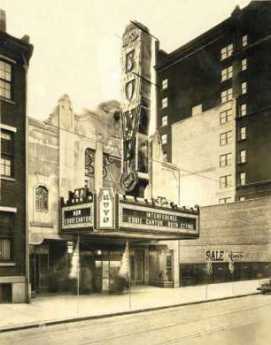
| Boyd Theatre |
Howard B. Haas a lawyer, and Shawn Evans an architect, are captains of a team trying to "save" the old Boyd Theatre at 1908 Chestnut Street. Since Clear Channel, the present owner has invested $13million in the property, and the preservationists agree that renovation of the movie palace to all its former glory would cost between $20million and $30million more, it's easy to understand why every other movie palace in central Philadelphia has been demolished. Furthermore, that area of town is having a resurgence of high-rise construction, so one use of the property must be balanced against others.
|
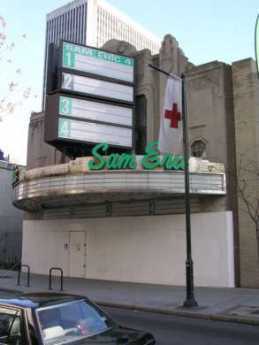
| Sam Eric |
The Boyd was built in 1928, just before the stock market crash, and closed in 2002. In fact, it changed its name to SamEric in its dying days, but the public remembers it as the Boyd, one of ten movie palaces in center city. The definition of a "palace" is arbitrary but is generally taken to be a theater with more than a thousand seats, normally with hyperbolic architecture to fit its hyperbolic advertising. Scholars of the matter say the earliest movie houses were constructed in Egyptian style, soon evolving into French Art Deco. Ornate, whatever it's called.
The palace concept developed in the era of silent films, with subtitles. Anyone who has experimented with home movies knows that the silent film sort of lacks something, particularly between reels and at times of breakdown in the projection. That's why brass bands played on the sidewalk outside, pipe organs played during intermissions, and all manner of vaudeville appeared on stage. Sound movies, or talkies, were immediately much more popular when they appeared in 1927, and had less need of the window dressing from other distractions which had grown into a moviehouse tradition which was slow to die.
The movie studios owned the films and soon built theaters to display them. The movie business was quite profitable from the start, so studios had the necessary finance to spread a network of very large theaters across the country quickly. The ability to concentrate hyped-up advertising with immediate display of the product in large captive theaters tended to drive the model of the "palace", which was able to sustain higher ticket prices than trickling a larger number of film copies to myriads of small "mom and pop" local theaters. In very short order, going downtown to see movies became at one time the largest reason for suburbanites to go to the center of town on public transportation, fitting in nicely with the concentration of huge department stores, also located there. Restaurants, bars, bowling alleys, and shops grew up to address the crowds. Furthermore, the economic depression of the 1930s slowed down what was to become a relentless automobile-flight to the suburbs. After the spread of free television at home in 1950, the downtown movie palaces were doomed. The legal profession helped, too. Small suburban theater operators eventually won an antitrust suit against what they described as monopoly power of studio-owned center city palaces, so a host of small sharks in the suburbs started to eat the whales downtown. Furthermore, the sound quality was easier to achieve in a smaller auditorium. To tell the truth, fire hazard was also lessened without the arc-lamps needed to project images across a long distance.
So, a new technology interacting with an old theatrical tradition quickly created the movie industry in its downtown movie palace form; more advancing technology quickly destroyed it, with a little help from economics and politics. Good luck to the friends of this historical epoch, who have a monumental task ahead to work up the public nostalgia and political strength required to overcome a huge economic obstacle of the "highest, best use of the land". In many ways, the most valuable contribution of this movie palace restoration movement is to dramatize in the public mind just how urban centers function. Department stores are gone, going in town to the movies is over. How else are you now going to get the couch potatoes to go downtown voluntarily, and often? Just imagine ten palaces simultaneously filling up with several thousand suburbanites apiece, seven nights a week. Without those additional drawbacks on ample display in Atlantic City and Las Vegas, please.
WWW.Philadelphia-Reflections.com/blog/1190.htm
Philadelphia Food: Traditional
|
| The Ritz Carlton |
New Orleans is famous for its cooking, and its residents claim it is impossible to get a bad meal in NOLA. New York is famous for its restaurants, where you can get things to eat that are available nowhere else, even though there is lots of bad cooking in that city. Philadelphia is famous for its food, which puts a slightly different twist on the matter. The Delaware Bay provides seafood, the Garden State of New Jersey provides fresh fruit and vegetables, the Pennsylvania Dutch Farm area provides meat and produce, the Diamond State of Delaware is famous for poultry, and lately, the shipping for Chile brings in fruit and vegetables out of normal season. Philadelphia is within easy distance of the very best and freshest of groceries. The city responded with bakeries, meat markets, fish markets, breweries, dairies. One by one, the latest ethnic arrivals brought in new recipes, quickly modified to fit the local style. All of this explains why Philadelphia can be famous for its ice cream, for example, even though it was not invented here as some local patriots carelessly contend.
Snapper soup is certainly one of the traditional Philadelphia dishes. To make it in the traditional way, you have to dedicate a stove for the process. New material is dumped in the top and today's soup is taken out the bottom, imitating the process for making sherry wine. The Old Original Bookbinder's restaurant had such a dedicated stove, but it has gone out of business, apparently leaving the Union League as the only traditional snapper soup source. Philadelphia Pepper Pot Soup is pretty much the same as Snapper soup, substituting tripe for the turtle as the meat base.
Scrapple is not to everyone's taste in this age of cholesterol fears, but it is certainly a locally famous dish, usually served as fried slices for breakfast. Scrapple is actually a mixture of cornmeal mush and Pennsylvania Dutch Puddin', a stew of scrap meats which is also sold as a chilled loaf. Puddin' is a dish for real traditionalists who have inherited low cholesterol to protect them from it. Only one or two old stands in the Reading Terminal market still carry it, and then only at butchering season. The Reading and Lancaster farmers markets are a more dependable source for Puddin', and Scrapple survives as more popular because it can be obtained in cans in the supermarkets. While you are there in a farmers market, you might get a loaf of head cheese, which substitutes gelatin for congealed fat as the binder for cooked meat chips with spices. Among the local heavy breakfasts must be mentioned stewed kidneys on waffles. The local belief is that this surprisingly delicious dish was introduced from Virginia, by steamboat vacationers to Cape May who mixed with Philadelphia vacationers at places like the Chalfonte Hotel, where stewed kidneys can/may still be obtained on Sunday morning.
Cinnamon buns, or Philadelphia Sticky Buns, are a local delicacy with the tradition of coming from Saxony in what is now Germany. The more butter and sugar the better, and real Philadelphians fry the sticky buns for breakfast. Out in San Francisco, they are famous for sourdough bread, while in Philadelphia the locally famous bread is black bread, a form of pumpernickel. Unfortunately, it is easily imitated by putting cocoa in white bread, so you need to lift a loaf before you buy it. Real black bread is as heavy as a cannonball, and about the same size and shape; it's even better with raisins in it. Toasted Crumpets are a Scottish introduction to the town's traditions, ambrosial if you can get fresh crumpets. Crumb cake is another traditional breakfast bun, known as coffee cake in the Dutch country, and imitated in commercial form as Tastykake.

|
| Snapper |
When turtles were more abundant, snapper stew, fried oysters and sherry were favorites, but now terrapin is such a rarity that it is saved for special occasions and special guests. It's usually served in a cream sauce in Philadelphia, whereas cream sauce is called abhorrent in Baltimore. Because of the availability problem, the party dish nowadays is apt to be fried oyster and chicken salad, and even oysters are getting a little scarce.
No one seems to challenge the idea that iced tea originated in Philadelphia, and in the Dutch Country, it is quite common to have iced tea 365 days a year, pitcher after pitcher. Let's not forget meatloaf, and corned beef hash with an egg, which is both perfectly delicious when served by someone who knows how to make them. They sound like leftovers, but it depends on where you get them. In the men's clubs, and in some Reading Terminal Restaurants, they are a star feature of the menu.

|
| Shad |
Around March 15, it is a good idea to ask if shad or shad roe is available. The trick is to get the fish with the bones removed. In recent years, shad is increasingly abundant, but it isn't so easy to find a butcher or chef who knows how to excise the bones while leaving the filet intact. At the moment, just about the only place that serves traditional planked shad is the Salem Country Club, out on the tip of the abrupt bend in the river above Salem, New Jersey. The ceremony is to split the big fish and nail it to a board, which is then placed in the open fireplace to cook, snapping and popping while its marvelous aroma fills the dining area. Owen Johnson once wrote a famous Lawrenceville book about The Tennessee Shad, so other towns must enjoy shad, too, but we wouldn't really know.

Special Philadelphia dishes may be a little hard for the tourist visitor to find. If you click on this link , you'll find a website put together by an enthusiast, who lists some of the better places for a wandering tourist to find local specialties. Philadelphia has quite a few high-toned fancy sit-down restaurants, too, but these are cheap, good, and easy to find.
Phillycarshare
 |
| Jerry Furgione |
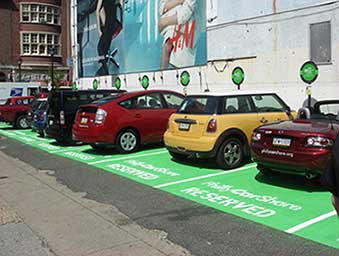
Jerry Furgione recently intrigued the Right Angle Club with what those small red cars are all about. A non-profit organization named PhillyCarShare has been able to grow a fleet of 400 autos to rent by the hour -- gas, insurance and washing included. Each car has a home base in some parking lot or garage or other accessible place, from which you take it, and back to which it goes when you are done with it. Reservations are handled by phone or internet, payment by credit card; a platoon of attendants come around at night to refill the gas and check on things.
|
| Philly Car Share Lot |
Now that's not quite as convenient as having the car delivered, or picking it up at one place and dropping it off at another, but it's workable. One of the technical secrets is a wireless system working a lock which can be controlled remotely. For a $25 onetime membership fee the customer gets identified with a particular lock, and the car keys are inside the car. That's a little kludgey (as trendy people say) because if you forget to lock the car when it's parked it can be stolen. No doubt technology could soon be developed to handle the whole business electronically, emitting signals that the car is parked but unlocked, issuing automated scolding and just-this-once remote locking and unlocking, and perhaps a dozen other engineering features. But that requires more volume than 400 cars, and it's early days. Present reliance is made on repeated reminders to lock the car when you aren't using it, backed up with a $100 fine if you forget. It's probably the biggest source of friction.
The rise in oil prices helped the car share business a lot, and enthusiasm among young early-adopters carries things quite a way, so the business is growing. It probably won't be possible to judge the future until competition appears and business levels off, at some stable point. If some of the rough spots can be fixed with gadgetry, this hourly rental system should have a permanent place in our environment. Since it's a non-profit, it will be of interest to see what variants the for-profit sector can provide.
|
| City of Philadelphia |
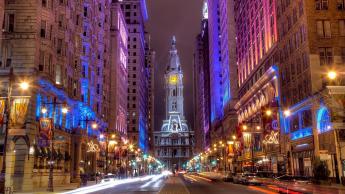
At the moment, the business has the nuisance of an average 6-months delay to get each new parking spot approved by the various ownership and licensing agencies. But the developers of high-rise apartments are learning that having rental cars headquartered at the building entitles the builder to provide fewer off-street parking spaces, so revenue potential starts to appear. Companies, and in particular the City of Philadelphia have taken to using this system to reduce the size of their car fleets; universities are nibbling at the idea of shared memberships. Hard to know where this will lead.
You learn some things the hard way. The cars once had a plastic card to use for filling up at a gas station, but too many cars were broken into to steal the cards, so this had to be curtailed. If you have an accident the company's insurance takes care of you, but then there are quarrels about renewals of insurance, both theirs and yours. People who are used to jumping into their own cars, and out of them whenever and where ever they please, tend to feel a little constrained by the need to make reservations and be prompt about them (because someone else might be waiting for the car).
Which brings you to the ultimate trade-off in this system. People want to have lots of cars sitting around, so they can use spur-of-the-moment planning. The business, on the other hand, wants every car to be in constant motion, every slot in the schedule filled up. Right now the cars average eight users a day and have comparatively little waiting for reservations, only because the typical user at present does not want the car during 9-5, five days a week hours. As business increases, it should emerge just what the break-even points are between too many cars and too few. From the customers' point of view, that means, "How much are you willing to pay to have a car immediately and invariably available?" At the equilibrium point between maximum customer convenience and minimum price, we'll soon see what the public really wants and will pay for.
Meanwhile, the experimentation goes on to explore the tastes and preference of the Philadelphia public, region by region. They have a few pickup trucks if you like, and even a few Lexus's. Although the original idea was developed in Europe, Philadelphia has here the largest hourly rental business in the world, and it's galloping along briskly.
Larger Clubs
|
| The Racquet Club |
Philadelphia has dozens -- perhaps hundreds -- of clubs, societies, associations and organizations. Many owe their formation to the Sunday Blue Laws, which once made it illegal to obtain liquor on Sunday except on the premises of a private club. Some clubs were formed around the tradition that the stock exchanges (hence, the banks and brokerage houses) were open for business on Saturday mornings, leaving the financial community available for a long lunch, a drink afterward and a free afternoon in town. But primarily, Philadelphia already had a long tradition of fraternal and volunteer associations. Benjamin Franklin helped found a great many juntos, associations and volunteer groups for some civic purpose. Although he was not a Quaker, Franklin was in the Quaker tradition of forming voluntary committees and groups to get some particular job accomplished. In Quaker circles, aimless griping and complaining are not tolerated; if you have a "concern", you propose a solution which a committee can put into action, and you will probably be expected to be its chairman. The Quakers even had to devise a formula for "laying down" a committee when its purpose was completed, since, after a while, the original purpose of the club may disappear, but habit and good fellowship cause it to continue as a social club. A good example is a certain club which was originally founded for life-saving on the river, but now continues as an ice-skating club on the Main Line.
Anyway, clubs continue to be a center of Philadelphia life at the present time, often with founding traditions that are a little unclear to many of the members. It isn't as true as it was when the Sunday Blue laws were effective, or before the restaurant revolution overtook us, but to live in Philadelphia without being active in several clubs is to feel that nothing ever happens in this town, while your neighbors at the same time are so busy going to their clubs they never think to invite you. Or perhaps fear that since everyone goes to so many, you might feel pestered if they invited you to join.
|
| Union League of Philadelphia |
There does exist a different sort of club entirely, however. The big-city in-town social club was started as a place to stay when transportation to the suburbs was tiresome, and large clusters of people had townhouses near the business district. A place to stay when your wife is visiting her relatives. A place for the local bachelors to congregate. A place where the CEOs can congregate fraternally, avoiding the isolation at work that comes from being the boss. A place where lawyers can have a long lunch while they wait for the phone to ring with the big case they can retire on. A place to loaf, play pool, get a haircut, get your shoes shined, play a game of squash. Or get a drink and a decent meal in comfortable surroundings. Jeff McFadden, the director of the Union League, describes these clubs as "day camps for adults".
Such clubs have had a hard time in recent decades. The ten-story Manufacturers and Bankers Club is now an office building, the prestigious Rittenhouse Club is shuttered, along with the Commerce Club, the Locust Club, and a dozen others. The most prestigious of all, the Philadelphia Club is in a decrepit neighborhood next to Broad Street, which it hopes will soon revive and make wrenching decisions unnecessary for the club. The interior is as close to an English city club as you could find, with immensely valuable paintings and furniture, creaking stairs and quaint bathrooms. You're not likely to find more than five members at lunch these days, but the food is excellent, the service superb, and the posted waiting list for membership quite comfortably long. The posted names tend to be a list of the cream of society, but most of them live thirty miles away. It's no longer possible to stay there overnight.
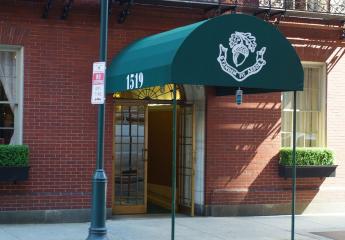
|
| The Acorn Club |
The Acorn Club is for women, quite frequently women whose husbands are members of the Philadelphia Club. If ever there were some political move to force the two clubs to abandon the men-only and women-only rules, a merger of the two would allow them to continue exactly as before as a single club with two facilities. The Acorn Club is just up Locust Street from the Academy of Music, and that is surely no accident. The place is immaculate, elegant, quiet, extremely well managed.
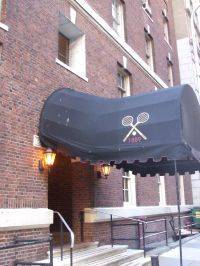
Around the corner on 16th Street is the architect Horace Trumbauer's turn-of-the-last-century Racquet Club. In some other city, it might be called the Athletic Club, which makes it more attractive to younger members than the other clubs, where billboards would be the extent of the exercise. Indoor swimming pools and gymnasia are extremely heavy and thus require expensive steel supports. This club not only has a pool, but it also has squash courts (both old-rule and new-rule), racquets courts (the thirty-foot walls are polished slate), and one of the five court tennis courts still in existence in the country. Court tennis is a strange game, of which it is said that "if you know the rules and own your own racquet, you are one of the top ten in the country". But the game originated in the Twelfth Century and was what people meant by "tennis" until 1878, when a game is known as "lawn tennis" was invented and took the world by storm. One of the other five court tennis courts is a few miles from the location of the hydrogen bomb factory on the Savannah River, eighty miles from Charleston. The DuPont Company put it there, and the location is no accident. > is having a hard time filling its space with members, but it would be so appallingly expensive to replace even a part of it, that superhuman efforts are justified to preserve it.
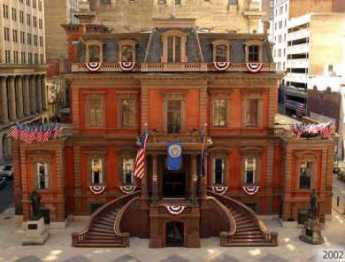
The Union League at Broad and Samson Streets, is the one outstanding exception to the decline of the center city men's club. When I joined it long ago, the strictest of rules prohibited women from any area except the women's dining room in the basement. I still remember the chairman of the admission committee, seated at the end of a long long table of gentlemen in the semi-darkness, intoning to me. "I'm going to ask you a question. And because I don't want any misunderstanding, I'm going to ask you twice. The question is, have you ever, even once, in any national, state or local election -- even once -- ever voted anything except straight Republican? Let me repeat, have you ever, even once. . . ?"
Well, the League lets in Democrats these days, and even quite a few women. But what has transformed the League from a declining relic into a thriving center of the Philadelphia social scene has been management. The League owns its own new parking garage across Samson Street from the side door, which is itself an innovation with a canopy. The dingy old members overnight rooms have been transformed into a four-star hotel, with concierge. The old steam rooms are now a modern exercise facility, and a dozen computers in the "business center" are always occupied. The menu has been upgraded, the service snappy instead of sleepy. The upstairs dining rooms usually have several hundred people for dinner when formerly they were deserted. Several times a year the League has an upscale dinner party for five hundred or so guests, that would be in a class with a reception for the King of England. Nobody any longer asks why they should be a member; they only ask whether they can afford it. Apparently, lots of people can, once they have a reason to.
|
| Cosmopolitan Club of Philadelphia |
Over in a nearby short narrow street (we hesitate to call it an alley) near the Racquet Club, is the Cosmopolitan Club, for women only, thank you. It's small, probably would have trouble accommodating more than a hundred at a time, but the food and service are great. The real reason for the existence of this club is the wish of professional and working women to have a place to gather and support each other's morale, listen to uplifting speeches, help along with the younger ones and that sort of thing. In some ways, the Cosmopolitan Club is the most typical of all Philadelphia clubs.
The Definition of a Real Philadelphian (1914)
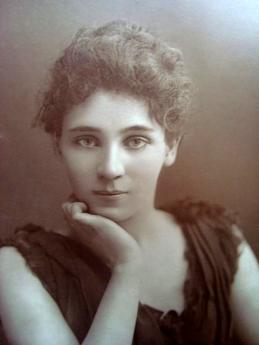
|
| Elizabeth Robbins Pennell |
There are several million people living in Philadelphia, but of course, not all of them are real Philadelphians. >Elizabeth Robbins Pennell, a friend and biographer of James McNeill Whistler, tells us the definition of a real Philadelphian in 1914.
"I think I have a right to call myself a Philadelphian, though I am not sure if Philadelphia is of the same opinion. I was born in Philadelphia, as my father was before me, but my ancestors, having had the sense to emigrate to America in time to make me as American as an American can be, were then so inconsiderate as to waste a couple of centuries in Virginia and Maryland, and my Grandfather was the first of the family to settle in a town where it is important, if you belong at all, to have belonged from the beginning. However, [my husband's] ancestors, with greater wisdom, became at the earliest available moment not only Philadelphians, but Philadelphia Friends, and how much more that means Philadelphians know without my telling them. And so, as he does belong from the beginning, and as I would have belonged had I had my choice, for I would rather be a Philadelphian than any other sort of American, I do not see why I cannot call myself one despite the blunder of my forefathers in so long calling themselves something else."
--Our Philadelphia, 1914
Mummer's Strut
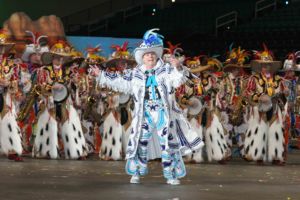
|
| Mummers |
For over a century, and maybe for two centuries, the Mummers Parade has strutted around Philadelphia on New Year's day. The Mummers have lots of tradition and oral history, but the authenticity of records going back to the early days of the parade do not meet very strict standards. There are those who say that the earliest mummers were "shooters" who coursed through town on the Fourth of July, shooting pistols in the air with one hand and carrying a bottle of booze in the other. Booze, by the way, was the name of a bottle manufacturer which became associated in common parlance around 1840 with the product most commonly found in the bottle. The name booze bottle was attached to a bottle in the shape of a log cabin, suggesting a possible link to the 1840 Presidential election of William Henry Harrison, Old Tippecanoe. The other historical origin was thought to be the annual parade of the guilds, the butchers, carpenters and similar. Somehow, these two traditions came together in the annual parade on New Year's day, with various ethnic clubs spending all year getting ready to compete with each other for attention. Many of the floats are reminiscent of the New Orleans Mardi Gras parade, some cubs specialize as "comics" in the style of the old shooters dressed up as clowns. The increasingly dominant part of the parade is found in the ten or twelve String Bands.
|
| Marilyn Monroe Effect |
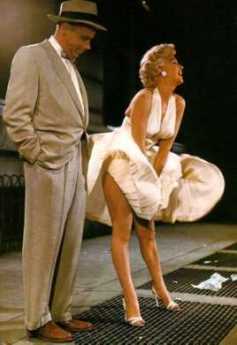
The main instruments of the String band are the banjo, with the tune carried by some saxophones and a peculiar instrument that looks like a xylophone held up on a pole. emitting an octave of piercing chimes.The old favorites are "Dem Golden Slippers" "Wait 'till the Sun Shines Nellie" and similar fast marches. The costumes tend toward ostrich feathers and gaudy colors, and in recent years the string bands all put on a little show or dance in front of the judging stands. Since it takes place in January, it is usually quite cold at a Mummer's parade, and since the parade goes along streets lined with tall buildings, the wind builds up quite a"Marilyn Monroe Effect". Until recent years, the mummers have always been male.
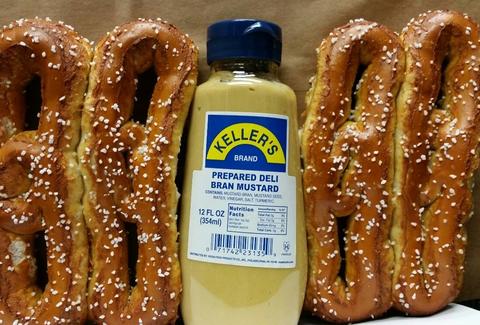
The mandatory traditional food at a mummers parade is a Philadelphia soft pretzel, smeared with mustard, sold by street vendors. Hot dogs, American flags, and soft drinks are for sale, as well, and other beverages are provided by the onlookers themselves. The parade itself is only an annual public display for the mummer's clubs that have traditionally met weekly in the ethnic neighborhoods, arguing hotly about next year's costume (a deep secret until the day itself), drinking, dancing and sewing the costumes, rehearsing the tunes and the dance steps. There is a traditional "Mummer's Strut, in which the participants and many onlookers participate spontaneously. In its fullest expression, the mummer will hold an umbrella in one hand while holding forward the lapels of his jacket with the other hand, bending forward at the waist, throwing back the head, and more or less keeping time with the music., and shaking the umbrella at the cheering crowd. There's a museum devoted to this sport, located on Second Street, otherwise known as "Two Street". It's all lots of fun, but it is usually too blamed cold to stay there long, and most people eventually retreat to a nearby television to watch the rest of it In the days when the parade went up Broad Street, it passed the Union League where another New Year's tradition was in progress, with the Republican members eating terrapin and drinking Fish House punch, quite comfortable in their warm quarters looking out of bay windows. Democratic Mayor Rizzo used to march in the parade, and when he passed the League, would ostentatiously turn his head away from it. Subsequent Democratic mayors have been even more polarized; the parade now goes up Market Street.
Philadelphia Food: Fast Food
|
| Philly Soft Pretzel |
Plenty of people in Philadelphia eat hamburgers and fried chicken at fast-food chain restaurants, so it can't be argued that Philadelphia hates manufactured food. But plenty of Philadelphians do deplore the calories, cholesterol, and grunge of these fast food franchise stands. The amount of Sugar that is poured into what we call ketchup is a disgrace, as is its advertising aimed straight at kids. At the same time, it is impossible not to admire the ingenuity inherent in engineering a frozen-food dinner. The just-in-time concept is carried to almost unimaginable extremes as the inventories of ingredients are timed to match the production of the product. Someone has to order aluminum foil from Canada at just the right moment to match the hatching of an egg which will grow into a chicken, alongside peas and potatoes planted and harvested, and cooked into the orderly production of those product-filled cartons that are loaded on trucks and shipped at night to the supermarkets of the country. It's truly an amazing process of coordination of a complex perishable product, quite cheap, and reasonably edible. Add to that the rather amazing fact that in times of normal interest rates, a supermarket sells its products at zero markups. All the profit is made from the interest float generated by cash business that delays paying its bills until the end of the month, or maybe a month longer than that. Who can compete with such a relentless economic machine?
Well, it is pretty hard to compete with the juggernaut if all you have is food that tastes good, so Philadelphia fast food is struggling to survive. Those franchise restaurants on the highway are an outgrowth of the diner, and the diner was invented locally during the twenties. Just which abandoned trolley car was the first is now unclear, although diners very probably started in southern New Jersey. There are still quite a few aluminum highway restaurants that call themselves diners, although they are no longer abandoned railway cars, but prefabricated special-purpose buildings. They specialize in huge portions of quite good conventional food, quite inexpensive. Truck drivers and others who travel the roads a great deal seek them out, and keep coming back to old friends behind the counter.
At another extreme, Philadelphia soft pretzels, smeared with mustard, are sold by street vendors who buy them wholesale by the hundred and hawk them at cold-weather events like the mummers' parade, but almost any parade will do. They go well with hot coffee, bottled soda, or beer. Beer is preferred at baseball games.
|
| Philly Cheese Steak |
As far as pizza is concerned, a disclaimer is needed to the effect that a pizza pie was invented in New Haven, Connecticut, in the Italian district there. The New Haven variety is produced in huge ovens and ladled out with long wooden paddles, in portions for six customers singing the Whiffenpoof Song. In Philadelphia, pizza is generally prepared on metal platters, of the size of a regular pie tin. The Greek community claims this version was their idea.
Hoagies are the local term (thought to refer to Hog Island near the Navy Yard) for what is called a submarine or sub by other regions and are essentially an Italian antipasto salad rolled up in a sandwich roll. The Pennsylvania Dutch take liberties with the concept, greatly increasing its bulk with the thickness of the ham and cheese slices, big tomato slices, and comparatively little lettuce.
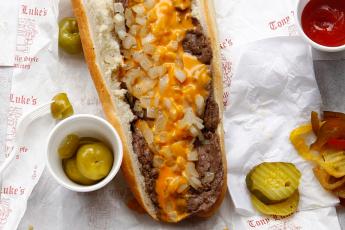
More recently, the chicken cutlet sandwich, Italiano, is coming on strong, with provolone cheese and spinach for interest. But the old standby is the Philly Cheese Steak. The meat is sliced and diced, onions added to taste, and Cheese Whiz squirted around before the whole thing is grilled and put in a sandwich roll. Bitter wars are fought by those who argue whether Pat's or Geno's is the first or the best, or some other less-known shop. Curiously, this sandwich industry began and remains near the site of the old Moyamensing prison at 10th and Passyunk Avenues. The concept has spread all over the country, but Philadelphians are certain the products produced outside of Pennsylvania are highly inferior imitations. At the risk of retaliation from outraged Italians, it really must be mentioned that southern Delaware steak sandwiches are made with real steaks, no onions, no cheese whiz. Steak has to be very tender to be eaten that way.


|
| Philly Water Ice |
Gelati, or Italian Water Ice, a form of sherbet, is very popular in the summer evenings in South Philly, and it too seems to be spreading internationally.

It's truly remarkable to encounter visitors from other cities who want to visit Philadelphia, see everything there is to see, but the first plink the Liberty Bell, and second have a cheesesteak.
The nearest non-Italian competitor to these specialties is the special sandwich. Probably Eastern European in origin, the word special refers to the addition of coleslaw and mayonnaise to thick roast beef or corned beef sandwich. It doesn't seem so distinctively Philadelphian as the other products, but that probably only reflects the present transient dominance of the Italian influence.
.
Elizabethan Accents in Philadelphia
|
| William Shakespeare |
The following is nearly verbatim recounting of a conversation which took place in Philadelphia, between two Philadelphians, in the year 2006, Elizabeth II reigning. The scene is the dressing room for the basement exercise area of a private club. There are about forty stalls for members to hang up their clothes before going into the gym. Although clothes are usually seen hanging in no more than three or four stalls, on this particular day there was only one empty stall, at the far end of the long corridor.
FIRST STRANGER: Well, we certainly have a lot of athletes in the club, today.
SECOND STRANGER: You're very generous with that description of our members.
FIRST STRANGER: Perhaps I ought to call them athlete-wannabees.
SECOND STRANGER: Yes, that's apt.
(Exeunt)
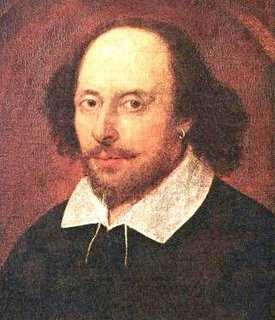
Shakespeare would have expressed it a little better, but anyone can recognize in this little exchange, the elements of those short interlude scenes in Shakespearean plays. The bit players create brief background while the stagehands shift scenery between major acts. Nobody actually has an Elizabethan accent these days, but in Quaker and Upper-Crust Philadelphia circles, the Elizabethan manner of speaking pops out at odd moments, as a coded way of asking strangers, "Are you a native Philadelphian? You sort of look like one." If the stranger doesn't seem to grasp the idea, well, let it pass.
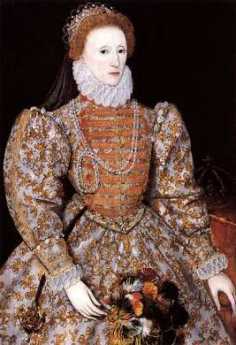
|
| Elizabeth I |
In the more remote sections of the Delmarva peninsula, it is claimed the natives often do speak in a pure Elizabethan accent. Somehow I am dubious of that, having listened for it over sixty years of travel in those regions. Rural Delaware talks with a softened version of a Southern accent, even softer than you hear in Tidewater Virginia. It's hard to believe that Marlowe and Shakespeare talked like that. But go into a roadside coffee shop and listen to the truck drivers joshing the waitress; it's not an accent but an Elizabethan manner of address that's recognizable. They self-consciously stop talking that way when obvious strangers come into the shop.
Because of Dr. Samuel Johnson's dictionary, Shakespearean adjectives pepper English speech in all regions of the world. Johnson was a theater critic in his early days, so when he needed familiar quotations to illustrate the words in his dictionary, he drew heavily from Shakespeare. William Shakespeare's tendency to invent likely vocabulary was thus enshrined by Johnson's dictionary as
Georgetown Oyster Eat: Separate but Equal
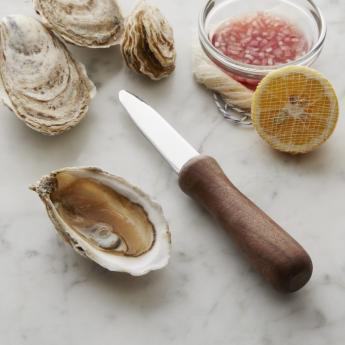
|
| Oyster Knife |
It's a source of some regret never to have attended the Georgetown Oyster Eat. It occurs in the middle of February when the days are dark and short, and the weather is uncertain for driving.
Local citizens of Sussex County, Delaware, report no one alive remembers when or how the custom began. In the nature of such things, a certain amount of historical inaccuracy is thus to be expected. It certainly did start out as an all-male event, taking place in the firehouse. One inflexible requirement is that a participant must bring his own oyster knife, which is a very heavy chunk of iron with a short blade attached, sort of like a screwdriver. The ones I have seen are all one piece of iron, suggesting they have been hammered out in a blacksmith shop. The flattened-out blade serves as an eating utensil, as well as a wedge to pry open the oyster shell. The oysters are eaten raw and whole, often with some sort of condiment, like horseradish sauce. Some eaters favor a whole lot of ground pepper, and various other ancient remedies are said to make an appearance. The main beverage is beer, lots of beer.
Beyond that, not much is known or divulged to the public, although a party attended by nearly a thousand tipsy people can't keep very many secrets. Before the party, the windows of the firehouse are covered with brown wrapping paper, sealed with tape. Kegs of oysters and kegs of beer are rolled into the firehouse before other things get rolling, and a lot of loud noises and laughter emerge almost all night. The sponsors claim to bring a thousand bushels of oysters to each party, although it is hard to imagine very many people eating their quota of a bushel apiece. The per-person beer consumption is a statistic kept confidential. The ladies of the neighborhood report numerous husbands eventually returning home, with their glasses broken, and suspicious red bruises on their faces. Aside from that, nobody knows nothing'.
About ten or fifteen years ago, feminism reached the Delmarva Peninsula, and the ladies started their own brawl. Renting the Grange Hall and brown-papering the windows, they make a lot of noise come out all night. Because of some sort of oyster virus, oysters are not nearly so plentiful any more. There's a more elaborate accusation that excessive fertilizer on the farm fields runs off and stimulates a bloom of algae, which depletes the oxygen of the river and kills a lot more than oysters. Anyway, the oysters are in short supply. If the local firehouse custom dies out, it won't be from lack of enthusiasm, however.
Fair Mount
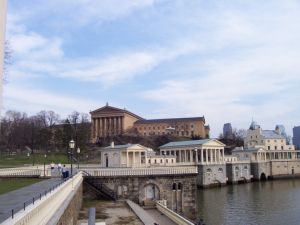 |
| THE FAIRE MOUNT |
Although the Art Museum now dominates the end of the Benjamin Franklin Parkway, the earlier focus of the acropolis once called Fair Mount is just down the hill behind it, in the old Grecian complex of the Philadelphia waterworks. When the Schuylkill was dammed at that point, the effect was to calm the rapids, drown the falls at Midvale Avenue upstream, and turn this portion of the river into a placid fresh-water lake. Fairmont Park was then created upstream in an effort (originally stimulated by the College of Physicians of Philadelphia) to reduce pollution of Philadelphia's water supply going into the pumps at the Waterworks, by replacing, with parkland, the wards, and industrial slums at the terminus of the canal bringing anthracite from upstate. The result was the creation of an ideal place for public boating and skating.
The transformation of this area can be seen in retrospect as an impressive civic response to economic upheaval. The War of 1812 (by cutting off ocean access to bituminous via the Chesapeake) had first forced Philadelphia to use anthracite hard coal, and the discovery of anthracite's superiority in making steel caused a continuing reliance on it and the canals
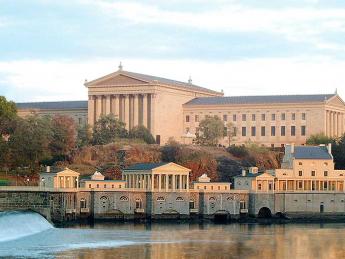
|
| Philadelphia's Water Works |
that brought it here. By 1850, the Philadelphia and Reading Railroad made the canals obsolete and created this splendid opportunity for urban renewal. The waterfalls had created a natural boundary between industry oriented to upstate coal and other industry oriented to oil and commerce coming up Delaware. It is a great pity that the lower section of the Schuylkill, once so famously beautiful, has never stimulated the same vision and imagination in response to the eventual decline of the industrialization which defaced it.
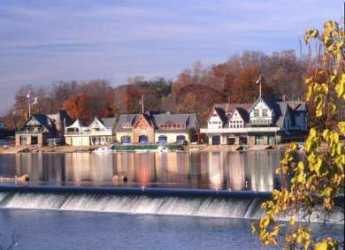
To return to Boathouse Row, a large azalea garden starts the Park, and then the East River Driver winds along the attractively landscaped riverbank. Just beyond the azalea garden, the first of ten Victorian-style boathouses starts the home of the Schuylkill Navy, an association of rowing clubs which are now a century and a half in residence there. When the Schuylkill auto expressway was created on the other side of the river, someone had the bright idea of decorating the rowing houses with lights along their edges in the manner used for Christmas decorations in South Philadelphia, especially on Smedley and Colorado Streets. Ever since the entrance to Philadelphia from the West has become one of its most arresting beauties.

 |
| BOATHOUSE ROW |
Add a few cherry blossom trees in the spring, and you have quite a memorable centerpiece. Rowing sometimes called crewing, or sculling, is a central focus of Philadelphia society, and is curiously not something in which the city can claim to be first or the oldest. As you might expect, "regatta" is a word invented in Venice five hundred years ago, there are records of rowing races as far back as 400 BC, and New York -- ye Gods! -- had the first American boating club. The Philadelphia Schuylkill Navy was formed as an association of rowing clubs in 1858, and the oldest member, the Bachelor's Barge, was only formed in 1856. The development was largely spontaneous and is said to have been briskly stimulated by a beer garden nearby, run by a former Philadelphia sheriff. About the same time, the British became crazy about the sport, having the Henley Races as the most famous regatta in the world, and both the Australians and the Bostonians occasionally have the largest, most expensive, most widely advertised regattas. Foo. Philadelphia has the Schuylkill Navy, and it is central to our existence.
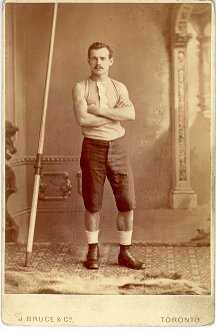
There are a couple of things which are unique about rowing. In the first place, it is hard to think of a way to cheat. You can hire engineers to redesign the shape and size of your boat, but engineering really doesn't make a lot of difference once the basic development of oarlocks and movable seats was perfected. A good boat can cost as much as $30,000, but that is large because all boats approach the limit of speed. If you have heavier or stronger oarsmen, it doesn't make that much difference. What matters is coordination, and in the longer boats, teamwork. Pull up with your shoulders, push with your legs, don't start with your buttocks, the art of rowing involves your whole body. The greatest champion of all time, Edward "Ned" Hanlan,
 |
| EDWARD HANLAN |
only weighed 155 pounds. Not only was he world champion from 1876 to 1884, he was undefeated in any race during the last four years. True, he was born in Toronto, and eventually he was thrown out of polite Philadelphia racing for deliberately ramming another boat, but those are private Philadelphia comments, not something you want to talk too much about. The whole secret of rowing is to manage the fact that the boat travels farther between strokes than while the oars are in the water; if you row too fast, you actually slow the boat. There are two other Philadelphia names associated with the Schuylkill Navy. One is Thomas Eakins, the great American painter, one of whose most famous pictures is that of Max Schmitt in a Single Scull (on the Schuylkill). The other name is Kelly.

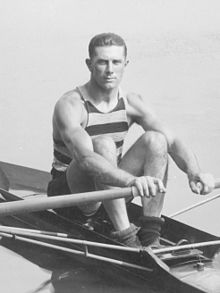
John B. Kelly of Philadelphia won two Olympic gold medals in 1920 and did it within one hour. He won a Third Olympic gold medal in 1924. But when he tried to race in the Henley Regatta, he was declared ineligible to row, because he had worked with his hands (summer work as a bricklayer), and thus could not really be called a gentleman. Anyone who has ever heard Irishmen talk about Englishmen can imagine the reaction this caused in the Kelly family. The resentment took the form of pushing his son, Jack, into racing, and in 1947 John B. Kelly, Jr. won the Diamond Sculls at Henley. Meanwhile, the father vindicated himself in other ways. The firm of Kelly for Brickwork was an enormous financial success, right up there next to Matthew H. McCloskey and John McShain, the political builders of the Pentagon and numerous other government buildings. John B. Kelly unsuccessfully ran for Mayor of Philadelphia in 1935 during the 75-year period when Philadelphia Mayors were always Republicans, but for decades was in the much more powerful position of head of the local Democratic party. The Republicans at that time would meet for lunch at the Union League, and so John Kelly reserved a lunch table at the Bellevue Hotel, next door, where he could be seen holding court every day.
|
| John B Kelly |
The result was not entirely favorable for the Bellevue; more than one wedding reception was rescheduled to some other hotel in order to avoid the Democrat taint. But you always knew where you could find Kelly at lunch, and it was fun to watch the various minions come forward to the table, almost as if they were in chains, to pay homage which involved provoking loud laughter from the great man with a salacious joke. The rowing clubs are mostly big barns with old boats high up on the walls, and silver cups and wooden memorial plaques lower down. They have lockers and showers, but no dining rooms, except at catered in the evening for parties. For a century, no women came there, but now almost half of the rowers are female. Membership is not difficult to obtain, although you have to be good to get on the club teams, and the dues are not expensive. If you show promise, you are expected to spend most of your waking hours working at it. Jack Kelly was famous for rowing three hours every morning, going to lunch, and then coming back for a couple of hours of more rowing. That doesn't leave much time in your life for anything else, so the friendships developed among active club members are very strong, just like the horsemen over at the City Troop. They sort of life in the past a little, with many anecdotes about a skull that broke apart and sank in the midst of a race, or a race that was lost because of too much recreation the night before. The lingo has to do with the fine points. A race can be between "eights" or "fours", or doubles, or singles. It can have a coxswain, or not, and be coxed or unboxed. When a pair of rowers have two oars apiece, it is the normal arrangement. A much more difficult boat to control has two rowers, with one oar apiece. Like Hercules or Achilles, stories are told of Hanlan, great Hanlan, who sometimes would win a one-mile race by eleven lengths. Or who would get so far ahead of his competitors that he would lie down in the boat and wait for another boat to catch up -- and then race ahead to beat him. This sort of person can be a little hard to take, and it is privately muttered that Hanlan was sent off to Australia, where people do that sort of thing more commonly.
Life On The River (3)
|
| Darth Mouth Castle |
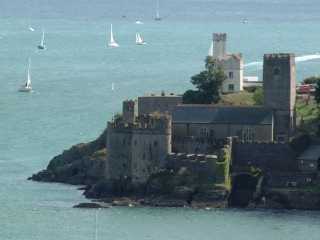
All over Europe the scene is repeated: a market town and seaport at the mouth of a river, with many miles of riverbank castles in the hinterland. The seaports had to be fortified against pirates, the hinterland against marauding brigands. But the two flows of commerce consisted of baronies upriver feeding the seaport, while secondarily their seaports carried on trade with nearby river-organized economies. From time to time, someone like Julius Caesar, Napoleon, Bismarck or Hitler would try to unify the various river economies, usually unsuccessfully. In fact, the same pattern was seen along the Pacific Coast of South America, until the Incas figured out how to go along the mountain ridge in the far interior, and then come down the rivers from the sparsely populated areas to the maritime settlements at the mouth of the river, whose defenses were planned for enemies from the sea. Philadelphia followed the commercial pattern, but without fortresses and castles.
Because of the vagaries of King Charles II, and underneath that, because of marshes and their mosquito-borne diseases, the Delaware Bay was settled fairly late in colonial times -- and almost entirely by Quakers. The Dutch were interested in fur trading rather than settlement, the Dutch were anyway too few, their sovereign too indifferent, and William Penn took care of the Indians. So the English settlers had no one to fight except other Englishmen, once the French stab at Inca-like strategy was put down in 1753. After 1783, or perhaps 1812, the world finally left us alone. The Delaware Bay and River are essentially free of fortresses, Philadelphia has no castles. The peaceful sixty miles of upper Delaware Bay became lined with big farmhouses, or big Federalist and Victorian mansions. For a century, from the Revolutionary War to the Civil War, and even for a time after that, the history of this peaceful pond reads like a novel by Jane Austen.
As a playground for menfolk, it would be hard to improve on Victorian Delaware Bay. The river was full of fish, notably shad. In the fall, the migrating ducks and geese made for marvelous hunting. In the countryside behind the riverfront, houses were found all the sports having to do with horses; fox hunting, racing, horses shows. The kids could putter around in small sailboats, the adult sailors could sail a yacht to Europe if they wanted to. After John Fitch invented the Steamboat, it was possible to take a daily commute to the best male game of all -- trading, investing and gambling in the financial and commercial center of Philadelphia.

|
| Shad |
Marion Willis Rivinus and Katherine Hansel Biddle wrote a little book in 1973 called Lights Along the Delaware which tells the river story from the female point of view. The woman of the house was sort of the mayor of a little city, organizing the staff, supervising the garden, educating the children, planning the household, and organizing the dinners and social events. Educated and trained to the role, she knew what to do and enjoyed doing it. Jane Austen wrote the handbook. And while the menfolk were essential members of the cast of characters, women were the managing directors. The men were off with their horses, or sailboats, or fishing rods, or their faraway big-deal mergers and acquisitions. True, it was not a notably intellectual community, there was no Edith Wharton, Abigail Adams or Emily Dickinson. You might find some of that in Germantown, perhaps. The professions, law, and medicine, lured the more studious male members away from Society, but the international diplomatic circle was seen as the ideal career for any truly graceful graduates of this environment.

|
| Riverbank Railroad |
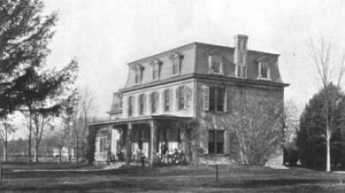
As the riverbank was gradually destroyed by railroads and expressways, only a few mansions like Andalusia remain in good repair. Curiously, what endures best are the clubs. The fishing club variously called the Fish House, the Castle, the Colony in Schuylkill, or the Schuylkill Fishing Company of the State in Schuylkill, has moved as many times as the name has changed. Started in 1732, it is the oldest continuously existing men's club in the world. It moved to the Delaware River from the Schuylkill when the Fairmount dam was built, and to its present location at Devon, the estate of William B. Chamberlain in 1937. New members do the cooking, cleaning, and serving, older members tell stories. When the river pollution is finally controlled, they may go back to catching the fish as well as cooking them. There's the Philadelphia Gun Club, which before 1877 was the Public Holiday Shooting Club of Riverton NJ. And then there's the Gloucester (NJ) Fox Hunt, which during the Revolution turned into First Troop, Philadelphia City Cavalry. After escorting George Washington to the battles of Boston Harbor, The Troop has been an active fighting unit of the National Guard (most recently in Bosnia) as well as a devoted center of male horsemanship between wars. The Farmer's Club, the Agricultural Society, and the Horticultural Society all reflect the rural interests that once predominated just behind the riverfront estates, still thriving aloof after 150 years of suburbia, exurbia and urban revival.
|
| Philadelphia Gun Club |
Although the riverfront industrial slums which destroyed the Philadelphia branch of Jane Austen's gracious living subculture are themselves declining and seem about to go away, it would take a real visionary to imagine how the Grand Life on the River will ever return. The banks of Delaware are much lower than the bank of the Hudson, for example. They make a great place to put high-speed rail lines and even higher speed interstate highways. The patrons of Hyde Park, West Point, and Poughkeepsie are much higher up a cliff and can overlook the river without much noticing an occasional whoosh. The mansions along Delaware have to look right at the tracks. Except for a few places like Bristol which have become isolated on the river side of the tracks and highway, it's not easy to see how you would get from here to there, or when.
Mussolini in South Philadelphia
|
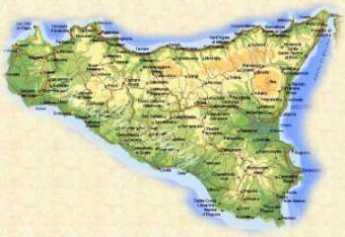
| Sicily |
The western tip of Sicily is as mountainous and remote from the heart of Europe as the Hebrides in Scotland. Like the Highland Scots, the western Sicilians ran their own informal government out of sight and out of reach. Even the Church in that region of Sicily had a sense of kinship to Eastern Orthodoxy rather than to Roman hierarchy. The flavor of the local culture can be sampled in Tomasi di Lampedusa's classic novel The Leopard which, among other things, helps explain why so many Italians hated Garibaldi, mostly known to the rest of us as Italy's great unifier. Mussolini was in the same class.
At the time of the great Italian immigration early in the Twentieth century, Italy was in near-chaos. Benito Mussolini presented himself as a welcome strongman who put down crime and disorder, particularly Communist disorder and made the trains run on time. Most of his efforts took place in the urban centers of Italy, paying little attention to rural regions like the far tip of Sicily until rather late in his rule. Meanwhile, western Sicily had its own traditional medieval way of maintaining order. The Mafiosi contained elements of the old feudal nobility, following secret activities similar in ceremony and brutality to the southern American Ku Klux Klan. Most of the inhabitant families had been living in the same villages for centuries, and by intermarriage had become very cohesive. They knew who was who, and who could be trusted. Secrecy, omerta, was their rule, murder a regrettable tradition. In this way, the stable community protected itself against roving brigands, local psychopaths, and thieving government officials. There were competitive bands who needed to be warned against; the "Black Hand" was a notorious group of local extortionists who employed dynamite as their signature. Although murder and mysterious disappearance were common enough, the Mafia had their official secret nobility, and murders were not condoned unless they were authorized by the legitimized but secret nobles. It was this secret competitive government that Mussolini decided to stamp out.
Meanwhile, back in Philadelphia clusters of immigrants from the same immigrant groups formed organizations based along the same lines. Every wave of immigrants from whatever country has always brought a crime wave with them to America, prison records document these immigrant waves, and most of the victims of each crime wave are almost always fellow immigrants. In the case of the Italians, the organizations were already in existence. For a while, the Black Hand terrorized the slums. And then the Mafiosi got themselves together, steadily eliminating trouble makers but only after a certain amount of due process authorizing the rubouts as justified. As has been true of every immigrant wave, the police were not trusted to see that justice was done, and gradually withdrew to let the informal government govern in the neighborhoods. The established American government would certainly not tolerate a rival nation within its borders, but rendering unto Caesar was moderately tolerable. Soldiers were appointed to an ununiformed militia, the victimized immigrants were coerced to contribute to the cost of their own protection, just like taxation in the more open community. The original and most enduring source of revenue for the Mafiosi was the one that was traditional back home in Sicily -- paid protection.
So when this group learned that back home Mussolini was waging war against the Mafia, the ties of loyalty to Italy were readily severed. Fascism, whatever that strange word meant, was a bad thing. Maybe the American government wasn't so bad, even when there was a war against Italy.
Tony Junker: Tunnell's Boys

|
| Henry Hudson |
When you take the ferry across the mouth of Delaware Bay from Lewes to Cape May, you are out of sight of land for half an hour. But the Army Corps of Engineers have thoroughly dredged it out. By contrast, when Henry Hudson first discovered the river while searching for a Northwest passage to the Indies, it was so full of snags and shoals that he just gave up and sailed on to what is now New York harbor. So, for centuries the river pilots were an essential part of ocean commerce to Philadelphia. As you might well imagine, the earliest pilots were members of local Indian tribes. Eventually, a proud colony of professional pilots grew up at Lewes, Delaware. Since radio communication is a comparatively recent development in this ancient trade, they had to devise ways for an incoming ship to select a pilot, and establish rules to be enforced by the Port Wardens about how to go about it.
|
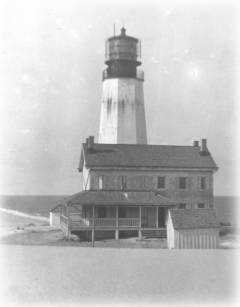
In the mid-Eighteenth Century, the system was to hang a black ball from the Cape Henlopen lighthouse whenever a ship was sighted. Little companies of ten or fifteen pilots would then jump into very fast schooners designed for the purpose, and race to be first out to the ladder hanging from the incoming ship's side. The rule was, the first to arrive and present his certificate got the job. Tony Junker, an actively practicing Philadelphia architect has immersed himself in tales and adventures among the pilots, and Tunnell's Boys is an exciting new novel about this dangerous, wet and uncomfortable, profession.
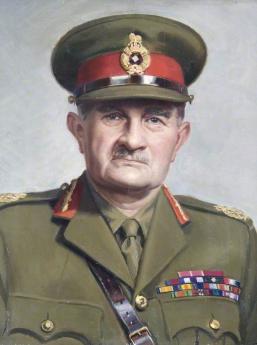
Field Marshal William Joseph Slim, 1st Viscount, Order of the Garter
|
| Field Marshall William Joseph Slim |
It's impossible to be accurate about such rankings, but it must mean something when Field Marshall William Slim is the only officer of World War II to be ranked among the ten greatest generals of all time. The historian Ray Callahan recently described Slim's career to the Right Angle Club, with particular emphasis on how unlikely it was for a man of his humble beginnings even to be a Lieutenant in the British Army before World War I, how he endured pretty insufferable snubs along the way up the ladder of command, and how at the end of his career to be Chief of Staff he finally revealed that he had noticed those snubs, all right. Americans would be astonished at such class distinctions in their own army, and even raise the question how the British Army could possibly conquer the world for two hundred years with so little emphasis on merit selection of its generals.
First, the military story of Bill Slim. Before World War I, officer candidates were expected to pay for their own training, and he managed to get through a local college Officer Training course without enrolling in the college. Even that much training suddenly was in very short supply as Britain mobilized for the War, and he was commissioned with the limitation of "hostilities only" to emphasize that he was not in the "regular" Army. Working through the Mesopotamian campaign, he rose through the Indian Army, which Winston Churchill regarded as definitely second tier, with his permanent rank always lagging several levels below his "temporary", acting, rank. At one point, he received an official rebuke for advocating air power for ground support, since that was the turf of the Air Force, and on another occasion for irritating the Navy by using boats. When World War II suddenly sent Japanese forces plunging through Malaysia and Indo-China, Slim distinguished himself by keeping the defeated Indian Army intact through a 900 mile retreat into Burma, justifying his later memoir of turning Defeat Into Victory. During that demoralizing time, he had ample opportunity to observe the repeated Japanese tactic of launching lightning attacks without an established supply line, intending to live on the abandoned supplies of enemies as they were outflanked or surrounded by rapid advances. Slim developed the idea that if he's surrounded troops could be resupplied by air and hold out, the attacking Japanese would essentially starve to death in the jungle. One attacking Japanese army unit of 87,000 men was reduced to 13,000 survivors by the application of this strategy, and as long as the Japanese kept using their technique, Slim kept using his. One reverse variant of this use of air supply was employed by Slim in the recapture of Rangoon by himself attacking from the rear without the usual overland supply line, but resupplying by air as an approaching monsoon cut off the expected resupply by sea. After the war was over, Winston Churchill's history of the war's events contained only the briefest mention of these victories. When Slim finally met Churchill, a close election was taking place, and Churchill said he hoped the overseas ballots were cast for him. "Well, Prime Minister, I must say that no officer in my command voted for you," was the reply he got. When Churchill's successor Clement Attlee was told by Bernie Montgomery that the Chief of Staff position was promised to someone else, the terse order was, "Well, unpromise him." And Slim got the job.
|
| Sir Francis Drake kneeling to Queen Elizabeth |
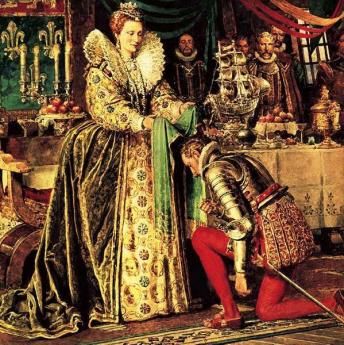
So, Ray Callahan the historian was asked the typically American question of however could the British Empire conquer Napoleon or plant the British flag over most of the world, using a system that would deliberately hold back an officer of Slim's talents, snubbing and intentionally humiliating most of the nation whenever one of the lesser orders was cheeky enough to aspire to military leadership. With great patience, Callahan replied that this system of placing aristocrats in charge of the military was designed to maintain civilian control against the military uprising. There might have been a time when King Arthur or King Henry V was personally in charge of the Army, but King Macbeth and General Cromwell both illustrate the disadvantages of a fully feudal system. Even before the Industrial Revolution, military skill did not translate well into the skills needed to run an industrialized country but nevertheless provided an easy route for a power-hungry military to seize the crown. It is true that America tends to elect prominent generals to be president after each of our major wars (Washington, Jackson, Harrison, Grant, and Eisenhower) and indeed most other presidents have had some military experience. But ever since George Washington made the principle clear, there has been a prevailing imperative about maintaining civilian control of the serving military, which even the American military seem to agree with. So it is not surprising that other nations with some more bitter experiences to recall insist on more than social pressure to maintain civilian control. Inherited wealth not only provides genetic advantages and a de-glamorized experience with power, but it tends to create its own local environment which regards power as scarcely worth striving for, power is what you have, not what you strive for, there's not a great deal to gain from overturning things. While not inordinately brilliant, hereditary aristocrats are not inordinately stupid, either; they produce their share of Wellingtons, Patton and Macarthurs.
In the first World War, however, the British discovered a serious flaw in the aristocratic system. Most defenders of that system will stress the high morale developed within the comradeship of a 1000-man regiment, carefully selected to choose individuals who "fit in". The British Army has been described as a "loose federation of regiments", collecting the history and traditions of the British Army in a way best understood in America by noting the special fervor of the U.S. Marine Corps. There is an undeniable disadvantage, however. In a mass mobilization, following a selective mass slaughter of volunteers (90% of British Regular Army officers were casualties in World War I), there simply may not be sufficient numbers in the historic regiments to run an effective mass army. That is the implied recognition behind the creation of officers for the duration of hostilities, only; get rid of that sort when the war is over because they can become a threat to cohesiveness. Some of that concern surely runs through the steady drumbeat to take guns away from the public, Second Amendment notwithstanding, repeal that damned thing if you have to. And the converse runs through the thinking of the Second Amendment supporters; you never know when some power freak might seize control of the military. The southern half of the country leans more strongly in that direction. They remember the experience of Reconstruction when official reins of power were in hostile hands. The Old South really likes the idea of its sons running all branches of the military at all levels. Makes a fellow more comfortable with having a strong government.
Quaker Efficiency Expert: Frederick Winslow Taylor 1856-1915
|
| F.W. Taylor |
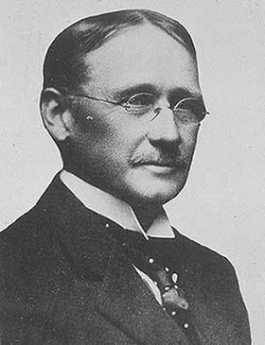
For at least seventy-five years after Fred Taylor turned it down, any rich smart Philadelphia Quaker attending Phillips Exeter would have been automatically admitted to Harvard. We don't know why he did it, but instead F.W. Taylor just walked a few blocks down the hill from his Germantown house and got a job at the Midvale Steel Company as an apprentice patternmaker. During the twelve years, while he rose to become chief engineer of the company, he took a correspondence course for a degree in mechanical engineering at Stevens Institute and invented a process for making tungsten steel, called high-speed steel. That made Midvale Steel rich, but Taylor was going to make Philadelphia rich, and after that, he was going to make America rich. When he died, he was widely hated.
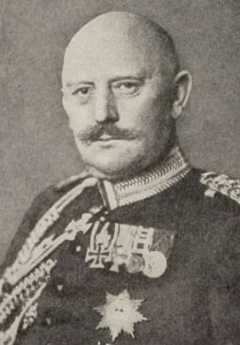
Evidently his lawyer father greatly admired German efficiency, having sent little Freddy to a famous Prussian boarding school where he was in attendance at the time of the
|
| General von Moltke |
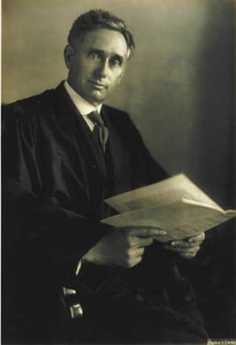
Battle of Sedan. General von Moltke had used Prussian efficiency and discipline to defeat those indolent lazy French, and Fred Taylor evidently absorbed and retained these stereotypes for the rest of his life. Whatever he was looking for at Midvale Steel, what shocked him most was to find workers "soldiering on the job". That's a Navy term, by the way, invented by sailors to describe the useless shipboard indolence of any Army they were transporting. Taylor later went to Bethlehem steel, reduced the number of yard workers from 500 to 180, and was promptly fired. It seems that most of the foremen at the plant were owners of local rental houses, which were emptied of tenants when Taylor reduced the workforce. Even management came to mistrust Taylor. When the railroads wanted a rate increase, Louis Brandeis defeated them with the argument that they wouldn't need higher rates if they adopted Taylor's system of efficiency. In his later years after he became enormously rich, he toured the country giving speeches without fees, promoting the doctrine of finding the one best way and then doing everything that way.
|
| Louis Brandeis |
Over time, Frederick Taylor had come to see that the industrial revolution had proceeded to the factory stage by merely bringing craftsmen indoors, each one treasuring his little trade secrets. Bringing the point of view of the company's owners onto the shop floor, Taylor could see how vastly more profitable the steel company would be if all those malingering tradesmen would stop soldiering on the job. No doubt the young Quaker soon learned that little was to be accomplished by remonstrating with workers, just as bellowing foremen had learned that bullying was also useless. Out of all this familiar scene emerged Taylorism, the idea of paying financial incentives to those who produced more, splitting the rewards of efficiency with the management. It sort of worked, but it didn't work enough to satisfy F.W. Taylor. When he walked around with a stopwatch, he collected the data showing how much more might be produced if the workers were perfectly efficient. Not only did that create the stereotype of the stop-watch efficiency expert, but it also provoked Congressional hearings and federal law against stopwatches which stayed on the books from 1912 to 1949. Although management responded by forming dozens of Taylor Societies to honor the approach, the unions invented the term "Taylorism" and bandied it about as the worst sort of epithet. Curiously, the Taylor approach proved to be enormously appealing both to Lenin and Stalin, who applied it as a central part of their five-year plans and general approach to industrialization. As we now all recognize, the Communist approach was a two-tier system instead of the three-tier system that was needed. It isn't enough to have a class of comrades called planners and another called workers; you need a layer of foremen, sergeants and chief petty officers in the middle. In addition to the elaborate time and motion studies leading to detailed written procedures, there needs to be an institutional memory for the required skills of the trade. In a funny sort of way, Fred Taylor the Quaker may have organized the downfall of the communist state before it was invented.
|
| Herbert Hoover |
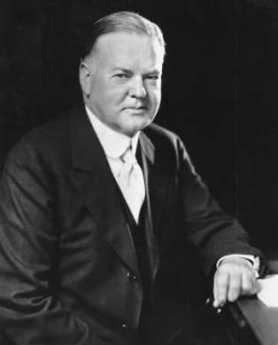
Another peculiar outgrowth of Taylorism may be the partisan lines of our own political parties. If you trace the American ideological divide to the 1932 election of Franklin Roosevelt, you can see we are still fighting the battles of the depression. It happens that Herbert Hoover, another Quaker, was totally captivated by Taylorism. Not only that, he was adamant that to get rid of the depression all the country needed was to return to self-reliance, individual responsibility, and hard work. Those were qualities Hoover himself had in superabundance. One telling remark that he probably regretted saying but nonetheless firmly believed was, "If a man hasn't made a million dollars by the time he is forty, he can't amount to much." Franklin Roosevelt had the million all right, but his family had given it to him. The Cadburys and Clarks could have given it to Fred Taylor, too, but he chose to make it himself.
www.Philadelphia-Reflections.com/blog/1296.htm
Philosophy Means Science in Philadelphia
|
| American Philosophical Society Seal |
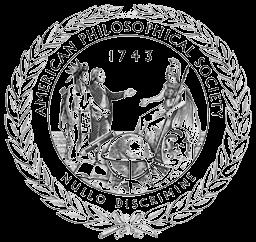
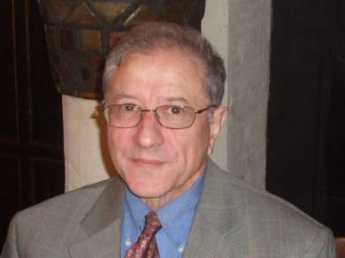
In the age of the Enlightenment, science was called natural philosophy; that accounts for the present custom of awarding PhD. degrees in chemistry and botany. The sort of thing which interested Ralph Waldo Emerson was called moral philosophy, and you will have to visit some other place than the A.P.S. if that is what interests you. Roy E. Goodman is presently the Curator of Printed Material (some would say he was chief librarian) at the American Philosophical Society, founded in 1743 by Benjamin Franklin who was clearly the most eminent scientist of his day, having discovered and explained the nature of electricity.
|
| Roy E. Goodman |
Roy Goodman is descended from cowboys and rodeo stars, but in spite of that he gave an entertaining talk recently at the Right Angle Club about this society devoted to useful knowledge, this oldest publishing house and scholarly society in America, once the home of the U.S. Patent Office, and scientific library and museum. They have many rare items in their collection, but the unifying theme is not a rarity, but curiosity. You might say some of the items reflect the whimsy of Franklin, but it would be fairer to say it is an enduring monument to Franklin's universal curiosity about all things.
|
| Nobel Prize Medal |
There are about 900 members of APS, about 800 of them Americans, about 100 of them winners of a Nobel Prize. Let's just make a little list of a very few notables in the past and present membership. Start with the first four Presidents of the United States, add Alexander Hamilton and Lafayette, David Rittenhouse and Francis Hopkinson and you get the idea that Founding Fathers got in early. Robert Fulton, Lewis and Clark, Alexander Humboldt, John Marshall were early members, and more recent ones were Madame Curie,
Skating and Humane
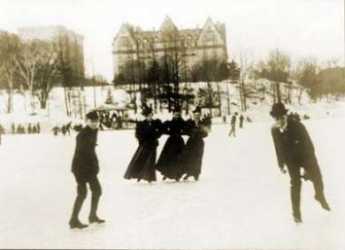
|
| Outdoor Ice Skating |
There was a time when ice skaters and rowing enthusiasts were having a little war on the Schuylkill, and the rowers won. We are indebted to our dear friend the late Elmer Hendricks Funk MD, a past president of the Philadelphia Skating and Humane Society, for some of the history.
Ice skating is both dangerous and seasonal. In the Eighteenth Century, ice skating was concentrated near the center of population on the Delaware River, and that's where you found the Skaters Club. You also found the Humane Society, whose main function was to pull drowning skaters out of the water. The Humane Society got to be quite rich because people were inclined to be sympathetic to lifesavers. In time, however, people moved away from Delaware and the two clubs, Skating and Humane, merged. No doubt the skaters thought they would be acquiring the substantial endowment of the life-saving club, but in fact, the Pennsylvania Hospital got most of the money in one of those genteel struggles that volunteer organizations sometimes get into. Skating moved from Delaware to the Schuylkill, and the club built a little house on what is now boathouse row, right next to the lighthouse.
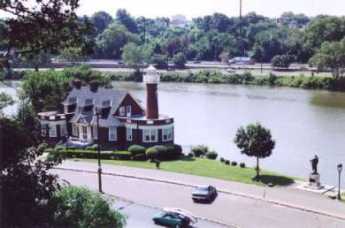
|
| Turtle Rock |
The lighthouses at Turtle Rock was useful for the southern terminus of the canal just across the river on the West Bank, and for many years there was a little canal house on the Westside, making it easier to see what this was all about. The lighthouse became incorporated into a boathouse for the first women's rowing club, but the club died out and this combined, Sedgley, is now a women's luncheon club. Next door was the Skaters and Humane, fighting to survive among all the rowers. Since rowing has a much longer season than skating, the skaters feared they would be overwhelmed. They passed a club by-law that no officer of the club could be a rower.
However, the skaters had another enemy in the ice companies, who tended to chop up the first and best ice to form in the area. And the final blow came when the Arena was built at 45th and Market Street with artificial indoor ice. So, the boathouse became the home, in 1938, of the Philadelphia Girls Rowing Club, and the skaters and lifesavers moved first to the Arena, and then to Ardmore. Haverford College was glad to sell them a swamp they owned there since it wasn't much good for a college but the local springs provided needed water for the skating rink. With a rink, skating became year-round, and there was a roof to protect against snow and rain. You can't fall through the ice in a rink.
The club had a number of lucky breaks by being first, constructing its building cheaply in the depression, being able to use ammonia as a refrigerant, and getting cheap land. There are other skating clubs, but few of them own their own rinks, and no other skating club has the national prestige of the Philadelphia Skating and Humane Society. It is the oldest, the first, the best, and the most famous. If you are anybody in skating, this is where you want to skate.
Philadelphia Food: Ingredients
|
| Super Market |
There was a time when locally grown farm produce was much more critical than it is at present. There were even resort hotels with their own farms that offered fresh vegetables as the main attraction for vacationers, but now almost any supermarket will supply reasonably good produce to most places in the country. Nevertheless, certain things like fresh corn on the cob must be cooked and eaten almost the same day they are picked, and such seasonal local produce is better around Philadelphia than any other metropolitan area.

|
| Campbell Soup Kids |
The states of Delaware and New Jersey were once Atlantic barrier islands, so the sandy loam is particularly favorable for growing asparagus, for example. An asparagus field is planted as perennials, with new shoots harvested by stoop labor fields of asparagus is difficult to plant and quite valuable once established. Tomatoes are annuals, which in their finest form will continuously produce all summer. It's only worth planting "steak" tomatoes, or so-called Jersey Tomatoes, if there is a local market willing to pay premium prices for the fact that the human picker can tell a green one from a red one. The tomato industry which once supplied Campbell Soup to the world has now mostly moved to California where improved varieties of soup-grade tomatoes all ripen simultaneously, thus can be harvested with machinery at a single pass. Lancaster County in Pennsylvania boasts the best topsoil in the country, although it must be admitted that the glaciers dumped topsoil fourteen feet deep around northern Illinois. Such topsoil is almost too valuable to be used for truck gardens. Lancaster County grows fodder for cattle, and the cattle are hidden away in barns where passersby never see them, just as you never see chickens when you drive through Delaware. What visitors see are silos in Lancaster County and chicken sheds in the lower counties, and acres and acres of animal-feed crops (field corn and soybeans) surrounding the farms. A century ago, all those Swamps("wetland") around Delaware Bay held lots of ducks, geese, quail, and other game, but the game is less popular than it used to be. Location, location is always the true source of value, and in this case, the source of good Philadelphia food is the local location of a vast variety of fresh produce.
|
| Brandywine Battlefield |
Somewhere, the story needs to be retold of the mushroom growers of Kennett Square. This little nondescript town near the Brandywine Battlefield at the top of the state of Delaware was the mushroom capital of the world. It stayed that way for generations, by keeping the secrets of the mushroom trade a strict family secret. Among the various oddities was the production around Thanksgiving time of the first crop of the season, which were often as large as grapefruit, and usually only given to members of the family or special friends actually to be carved at the Thanksgiving table next to the turkey. During the Second World War, Franklin Roosevelt (his daughter-in-law was Ethel DuPont, who lived nearby) personally appealed to the mushroom farmers to reveal their secret methods to the makers of penicillin, needed for the war effort. The farmers gave it up, penicillin saved thousands of lives. And nowadays, most mushrooms in American supermarkets are grown in Taiwan, flown in at prices the Kennet Square growers cannot match.
Real estate developers are doing their best to fill up those truck gardens with split-level houses, of course, and the lovers of good food are allies of the lovers of the environment. So, the individual householder needs to know how to find the Red, Blue and Green Dot roadside farm stands along the highway to the Jersey shore, when the Jersey corn, tomatoes, and melons are at their best, or earlier in the year when Jersey berries are available. You need to know about the Reading Terminal Marketplace, the South Philadelphia street markets, the ethnic neighborhood butcher shops and bakeries, the Kutztown Fair and the farmer's markets in Lancaster County. It's surprising what you can order over the internet, but for the really choice fresh produce in season, you have to hunt around a little.
The farmers of South Jersey have traditionally been Quakers. One Quaker family named Taylor has had a farm right next to the Delaware River in Cinnaminson, just north of the Tacony Palmyra Bridge, since the days of William Penn. Taylors signed the 1783 minute of the Yearly Meeting of Quakers to the Continental Congress, advocating an end to slavery. As the Cinnaminson area became built up, the Taylors had a thriving fruit and vegetable stand, which was left unattended. That is, Joe Taylor brought out the corn and other produce and left it on the stand, while the customers just came up and left their money in a box on the same table. No one stole the money for a century, just as no one in the neighborhood ever locked the door of his house. As things evolved, Joe Taylor, Jr. eventually won the 1993 Nobel Prize in Physics for discoveries helping to explain the force of gravity. But in time, the family decided to give up the farm and turned it over to the State as a nature preserve. Undoubtedly a major factor in the decision, if not the only deciding factor, was the repeated discovery that people were stealing the money from the vegetable stand box.
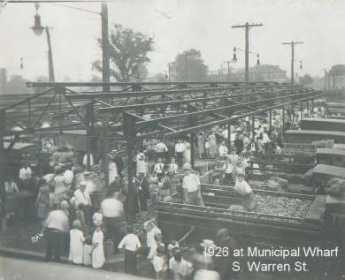
|
| Market on Spruce Street |
For the most part, however, the supermarkets and the chefs of Philadelphia's restaurant revolution nowadays just need to go to the South Philadelphia Food Distribution Center, down in the old filled-in swamp and garbage dump area at the foot of the Walt Whitman Bridge. This is Harry Batten's gift to his city. The former chief of the N.W. Ayer advertising agency made it a personal crusade to put across a remarkable transformation in his home town. Until well past the Korean War, wholesale food distribution took place in the streets of the former Society Hill, never mind how historic it is. Traffic was at a crawl, cartons of vegetables were strewn over the streets, the noise and stench of America's Most Historic Square Mile was a disgrace. The city was persuaded to set aside land for the purpose, and the wholesale grocers were persuaded to move their warehouses to one combined location with rail, bridge, highway and local access. Within months of opening, the wholesale grocery business had moved to the new location, where it became an international marvel. Meanwhile, Charles E. Peterson bought a Spruce Street mansion that once belonged to Stephen Girard from the old Spruce Street Osteopathic Hospital for $8,000.00, rehabilitated it in absolutely authentic style, and moved into the new home, himself. Society Hill Restoration had begun, Philadelphia's restaurant revolution had begun, a great many people became millionaires out of the commercial side of the process, tax ratables soared, tourists poured into the Independence Park area and Penn's Landing and the Camden waterfront. It's been a long time since Harry Batten's name was heard much, but he ought to have a bronze statue sixty feet high. As the Quakers say, you can do anything if you have leadership. And leadership is one man.
Cricket Fanatics Say Baseball is for Sissies!

|
| Alan Lawley |
Philadelphia still has six cricket clubs, and used to have more. The game of cricket was invented in 1200 AD and had its rules established in 1749 at the Marylebone Club. Baseball, on the other hand, was established in 1849 by Abner Doubleday of Cooperstown New York, with the convention of confining the runners to a diamond infield. Modern rules and established leagues of players only came along twenty years later. Actually, no one disputes that cricket is older. The question is one of manliness. Having listened for centuries to American jibes about tea and watercress sandwiches, the crickets have had enough. Their champion, Alan Lawley, recently threw down the challenge to baseball-crazy Americans at the Philadelphia Right Angle Club, where Lawley is Recording Secretary. Pardon me, blokes, but why do you tough guys consider it necessary to catch the ball with those big leather gloves? Don't you notice that cricket players catch the ball with their bare hands? Most of the excitement comes at that moment when the player is circling to catch the batted ball. He'll get it all right, but will he drop it? The essential inferiority of baseball to cricket has been documented for pages and pages by legions of British subjects, but the main point is about those gloves.
So the challenge is out. Let's see you gashouse beer drinkers take off those big protective mitts, and then try to catch the ball. And while you're at it, let's hear you pronounce Marylebone.
Rugby in Our Midst
|
| Cricket |
American sports fans are incorrigibly provincial. The rest of the English-speaking world plays cricket, but Americans play baseball, which is vaguely related. You wouldn't know it in America, but world-wide, cricket is much more widely played and followed. American football is a vague relative of rugby; here, it's a little harder to say which of the two is more popular. The complicated and expensive padded uniforms of football push the game into varsity and professional teams, with droves of spectators. Many more rugby fans, even reasonably elderly ones, are actual players. But both games are played with a funny-looking ball with two pointed ends, and both of them score points by drop-kicking or place-kicking the ball over the horizontal bar between two upright goal posts. In the case of both cricket and rugby, the players hardly stop playing for hours, while the Americans are forever stopping for time-outs. There's a question of manliness here, but very likely the stop-go nature of both American football, and baseball, is also a response to the need for commercials on television. Catching a hardball with a big leather protective mitt, like the wearing of heavy football equipment, is a little harder to defend on the manliness feature, but the usual response is that the American games are so much faster and rougher -- protective devices are justified by common sense.
Well, that's all as may be. The more scholarly approach to game analysis goes back to the custom of Nineteenth-Century British boarding schools of having their own rules. Rugby School definitely started the game of Rugby from its origins in football, which Americans call soccer. When two teams met, the captains would agree on the rules of the day, so it was fairly easy for such games to evolve in many directions. And eventually, you can see why it was necessary to freeze the rules into some sort of international agreement. Captains of two teams who are setting today's rules will naturally attempt to play by rules that give some sort of edge to particular players on their own team. Bookies won't stand for that.
Wall Art in Philadelphia
|
| Seasons |
At last count, Mural Arts program of the city government of Philadelphia has sponsored and paid for 2700 large paintings on the walls of buildings around town, and several hundred more have appeared spontaneously. Comparatively few art museums have that many on display, so people are proud of the Philadelphia effort.
This program is now nearly thirty years old, beginning to emerge as a national treasure. Looking back, it is pleasing that it had humble, even deplorable, origins. As American cities lost their industrial focus, many homes in the neighborhood of former factories have been abandoned, getting torn down in random patterns. Industrial cities of the East Coast were tightly packed to save land costs and time commuting to work; the fashion of "row houses" evolved without any space between neighbors sharing a "party" wall. When a row house was torn down, there emerged a scabrous ghost, because the wallpapered interior walls were exposed and looked pretty hideous. It eventually became illegal to leave a scabrous building, leading to elaborate legal conventions about responsibility for the cost of covering exposed surfaces with concrete stucco. During the last half of the Twentieth Century, stucco was generally an improvement.

|
| Graffitti |
Meanwhile, during World War II it became clever for American military to inscribe "Kilroy was here" on unprotected public surfaces at home and abroad as a gesture of American triumphalism. Opinions differ about whether this started originally as an allusion to a certain line of 19th Century romance poetry, or whether there was in fact a John J. Kilroy, inspector of riveting in wartime shipyards, marking riveted materials with his name to enable piecework payment for shipyard tasks. Eventually, this Kilroy joke became a little tiresome, but soon was replaced by stylized decorations using cans of spray paint, until "graffiti" painting, in turn, became a public nuisance. It is true some graffiti artists were quite talented, but the associated vandalism of teenagers added a threatening quality to public defacement of property belonging to others. By implication, an area with graffiti was a home of lawlessness and that implication cast a negative shadow on the city economy. Public opinion demanded something effective be done to stop it.
|
| Frank Sintra |
Since graffiti vandalism has declined nationwide in the past twenty years, it is difficult to claim that one public initiative in Philadelphia cleaned it up. But it might be true. Then-Mayor Wilson Goode formed an antigraffiti Network, essentially a think tank for concerned citizens, floundering about for a solution to an appalling problem. Somehow the inspired idea arose that the graffiti artists might be channeled into better directions if given professional art lessons, and working materials. A West-Coast artist named Jane Golden was hired to supervise what has become a multimillion-dollar project, overseen by some sort of guiding hand pushing the whole city into becoming part of a gigantic art project. Guides tell visitors that there are fifty employees involved in publicity and legal work, organizing artists, fundraising, organizing teams of painters at all levels of competence, helping oversee the general appropriateness of what is happening. And at the head of this team is Jane, a tornado of energy.
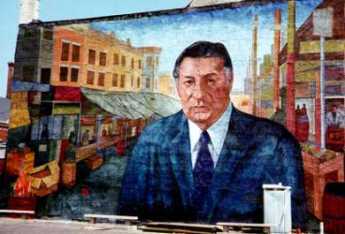
|
| Frank Rizzo |
It costs forty to seventy thousand dollars to produce one of these works, and since they are exposed to the weather, they only last about fifteen years. There are several techniques for transforming a small artwork into a big outdoor copy, some of them tracing back to Michaelangelo. Most of the Philadelphia murals are produced by dividing the original small artwork into squares and transferring numbered squares to the wall, one inch to one foot. As you can see by reviewing some of the websites devoted to the topic, a piece of art which is quite appealing can sometimes change into a drab mess when its size is blown up to three-story height. The problems of lighting such work are quite different from the lighting of a gallery painting. The surface is seldom smooth, so the bumps and grooves of the underlying scabrous "canvas" can destroy, or sometimes dramatically enhance, a salon painting. If you get too close, you can't see all of it, and that may be a problem. It's probably not entirely predictable what will come out in the final product.
There are inevitably political problems as well. The best examples are the several paintings of former Mayor Frank Rizzo, who is a hero to the Italian neighborhoods where they stand, but provoke riotous feelings in near-by black districts. Luck alone has confined the antagonisms to graffiti on the murals, viewed by some groups as enhancements on what begins as graffiti. No wonder the committees assigned to approving locations can take a long time to come to a decision.
There's another problem, which seems to be embedded in the situation. In the central city skyscraper district, you don't have scabrous buildings. Nor can mural art be placed in the historic square mile. Just a few blocks in either direction from central city there are plenty of demolitions and scabrous walls, but, close to downtown, these are areas of gentrification and urban renewal. It doesn't make sense to spend fifty thousand dollars to paint a wall which will be demolished in two or three years. The net effect is that the city may have three thousand paintings all right, but only fifty at most are within a tourist ride of Independence Visitors Center. If half of these fifty are concerned with celebrating local heroes unfamiliar to tourists, there can be disappointment which would disappear if a selection of fifty outstanding products could be culled from three thousand -- and grouped together for exhibition.
A solution to these issues will surely emerge with time, but it will evolve, not be envisioned.
Community Volunteers in Medicine
|
| Comm Volu In Medicine |
Mary Wirshup has a very different medical background from mine, but she's my kind of doctor. I couldn't help wishing, as she addressed our urban luncheon club, there could be thousands more like her, even while understanding more fully than she seems to, the reasons why doctors are driven from her behavior model. As we parted, it felt like saying a last goodbye to the Spartans marching to Thermopylae.
As 46,000 medically uninsured persons in Chester County get sickness and injuries, they know that a Federal Law prohibits a hospital accident room from refusing to see them, so ways are found to shunt patients to the CVIM free clinic, run by volunteers. This law is, in turn, a response to a government-created situation where a hospital which "accepts" patients must keep them. Any economics teacher can tell you that supply/demand issues are best addressed by price adjustment, so price controls in whatever guise lead to shortages. I must say I have little sympathy with the devious strategies which hospitals often employ to disguise their rejection of uninsured patients. At the same time, I know a lifeboat will sink if too many climbs aboard. Nevertheless, the semantic switch from lack of insurance to lack of care implies that only more insurance can surmount the barriers to care, which is absurd. For one thing, I know too many hospital administrators who are paid a million dollars a year, and one who is paid two million. And at least two health insurance executives are in the newspapers with a net worth over a billion -- yes, that's billion with a b. We have reached a point where reducing all physician income to zero would only reduce "healthcare" costs by 10%. As I look at Dr. Wirshup's modest clothing I can only surmise she plans to continue her modest living until she is 80 years old, after which her savings might see her out. Squeezing physician reimbursement is not intended to save significant money, nor intended to restore physician incomes to more equitable levels. It is intended to address the oversupply of physicians without confronting either the universities or the foreign trained lobby.
The elite tranche of medical schools do their part to relieve physician oversupply without reducing class size, through the encouragement of their students to go into research. I was well along at the National Institutes of Health before I finally decided I had not gone into medical school with that goal, and returned to teaching and patient care in a more satisfying model not too different from CVIM's obviously Pennsylvania Dutch spirit. The Amish at the far western end of Chester County reject the whole idea of insurance; their most characteristic statement is "Don't send me no bills." That attitude is rather a contrast with the shiny housing and automobiles in the Silicon Valley developments of Southern Chester County, or even with some rather bewildered Quaker farm families scattered over the rest of the county next to the horsey set. Chester County is America.
On Second Street in Society Hill, next to the park where William Penn's house stood and a few feet from Bookbinders, is the house of Dr. Thomas Bond. Bond conceived the idea of building the first hospital in America and with Franklin's publicity machine succeeded in getting it built, to care for the "sick poor". Dr. Bond started a second enduring tradition as well. When the Legislature expressed doubt that the institution was sustainable, he pledged to convince the local medical profession to serve the poor without charge. Some of the legislators who voted for the measure did so in the belief that charity care would never appear so the gesture would be without cost. The physicians did indeed come forward, in sufficient numbers to run many institutions for two hundred years. In 1965 health insurance made its national appearance and has regarded the benchmark low costs of charity care as a threat, ever since.
Please Touch
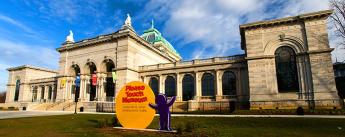
|
| Please Touch Museum |
There had been rumors for some time that the Please Touch Museum was planning to move from 21st Street to larger quarters, but recently its Executive Director Laura Foster appeared at a luncheon at the Franklin Inn Club to announce definite plans. The Museum moved into Memorial Hall in West Fairmount Park in the fall of 2008.
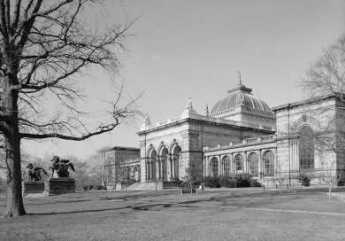
|
| Memorial Hall Fairmount Park |
There are over 400 children's museums in the world, and the first one was started in Brooklyn in 1899. Just why Philadelphia waited until the Bicentennial Celebration in 1976 to start one, is not clear. It's particularly unclear when you hear of its explosive success. Growing rapidly during an era when museums of all sorts are seeing declining attendance, the Please Touch Museum will be making its fourth move in thirty years, each time to larger quarters because they needed more room. Sooner or later, expansionism will get its comeuppance of course, and Memorial Hall is one awfully large building to fill. And to heat, and to paint, and to air condition. The price is right, however. The City Administration, which approached the museum with a proposal, has offered an 80-year lease for a dollar. When you hear that they have occasionally had 1500 visitors in a single day, however, and annual attendances approaching 200,000, almost anything seems possible.
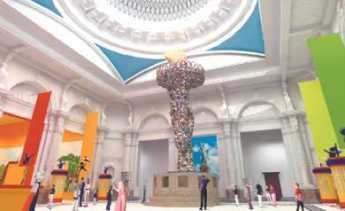
|
| Liberty Torch |
There are certain limits. Nothing frightens a 4-year-old like a herd of 10-year-old boys racketing about, so there are segregations necessary. In other situations, these little kids not only can't touch, but they also can't see and they want to see badly. And the sociology is interesting. The kids may well clamor to come when they hear other kids talking, but in general, it is the parents who get the idea that a museum trip would be fun. And the parents seem motivated by theories of upward mobility, of giving their child a "leg up" on the competition. The museum is certainly filling a need, but you have to wonder where our society is headed if a picnic in the park is mainly a good idea if it gives junior a leg up.
Meanwhile, keep tuned. To fill up that monstrous Memorial Hall will take publicity, and these gals sound as though they mean to have a lot of it.
Corinthian Epistle
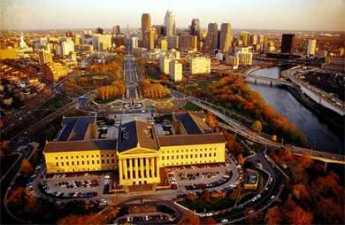
|
| Olympia |
Philadelphia had ups and downs as a maritime center. Right now, it's rather down, but what's bad for commercial shipping sort of encourages recreational boating. There was once a time when almost everyone in town had some connection with the sea, and there were a hundred sailing clubs, many of them quite rowdy. Out of this environment grew the Corinthian Movement of amateur sailors, sometimes stated as requiring the owner to sail his own boat. Wanamaker, Drexel, and similar names were once associated with the formation of sailing clubs that wanted to distance themselves from the characteristic rowdy behavior of professional sailors. Yachting thus acquired a snooty flavor. It also had to contend with the plain fact that people with enough money to own a big sailboat were often not agile enough to handle them. Corinth is not terribly far from Olympia in Greece, and it seems likely that qualification for entry into the Olympics was influential in the development of sailing club rules, which tend to emphasize the manner in which the sailor learned his skills. If you learned to sail as an amateur, you qualified, even if you were crewing on someone else's boat. Learning your skills in the Navy is also sort of an ambiguous situation, so membership in a Corinthian Yacht Club cleans up your Olympic credentials.

|
| Corinthian Yacht Club |
It thus happens there are quite a number of Corinthian Yacht Clubs in America, mostly unrelated to each other except competitively. Philadelphia has a Corinthian Yacht Club founded in 1892 out of the remnants of other clubs, and located in Essington on the grounds of former Governor Printz's estate. The food there is famously good, and sunset buffets at the head of Delaware Bay are quite memorable.



|
| J-Boat |
Unfortunately, there are only about fifteen J-boats moored there. Most of the members use some other harbor as their home port, and the blame is placed on the Philadelphia International Airport. The runway was extended out into the river, causing changes in the current to pile up silt outside the yacht club. The club has so far been unable to overcome the Governmental rules which prevent private dredging, so there is gridlock. One can also easily imagine a little class warfare with local politicians, who might not be enthusiastic about using taxpayer's money for the benefit of rich yacht owners, etc, etc.

A river full of lovely sailboats, or even an exciting river race, would greatly enhance the attractiveness of the city as a place to live. Just notice how residents and tourists flock to the riverbank to watch the Occasional visit of tall ships. To the extent that modified dredging and navigation rules would help the process, it certainly needs to be helped.

The American Friends Service Committee
Two things uniquely characterize the work of the Friends Service Committee (AFSC): it's often both dangerous and unpopular. That's not required for relief following Indonesian tidal waves perhaps, but the work that really needs someone to do is often both dangerous and controversial.
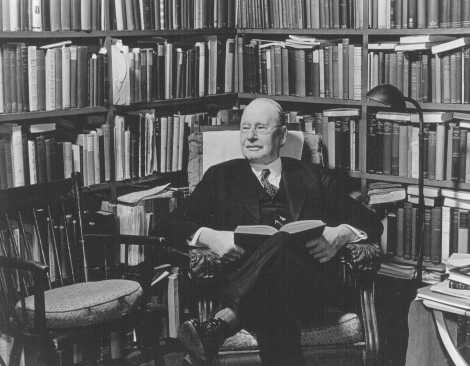
|
| Rufus Jones |
The Service Committee was founded in 1917, mostly by Rufus Jones and Henry Cadbury, as a way of helping conscientious objectors to World War I. The Mennonites, the Brethren, and the Quakers were opposed to all wars, not just that particular one, but two of those religions are of German ancestry, and lacked the same credibility of the English-origin Quakers in a war with English allies against the Huns, Boche, and Kaiser enemies. The early focus of the Committee was on the Field Service, or Ambulance Corps; which was plenty close to the action, and plenty dangerous. After the War, the defeated German population was starving, and the Quaker Herbert Hoover directed the relief effort with great credit to the Quaker name, and immense European gratitude.
|
|
Reinhard Heydrich was the primary organizer of the mass murder of Jews in the Third Reich. |
After that, when German Jews were suffering persecution by the Hitler administration, the Quakers initially responded in a uniquely Quaker way. Rufus Jones and two other Quakers went to see Reinhard Heydrich, to tell him the world disapproved of his behavior. They fully realized they represented a pool of important world opinion, particularly within Germany, and it was time to speak truth to Power. The Germans left the room to confer, and the three Quakers bowed their heads in silent prayer. Apparently, the room was tape recorded, and when the German officials returned, they did promise some efforts to improve matters. As the situation for the Jews soon got much worse, many Quakers risked a great deal to shelter and rescue the persecuted exiles. Relief to the defeated German populace had to be repeated after that war, as well. Each effort built up more credibility to be able to switch sides for the next effort, and the sincerity has seldom been seriously questioned.
|
|
U.S. government notices to American citizens or aliens of Japanese ancestry in May 1942 that they must move to internment camps. (Photograph by Dorothea Lange.) |
The Japanese were also our hated enemies in World War II, and once more a long history helped the relief effort. Nearly 100,000 American citizens of Japanese origin were interned on the West Coast as potential traitors in 1941, often under deplorable conditions. Clarence Pickett was a director of AFSC at the time, and his sister had spent years in Japan as a missionary, so his remonstrations with the American government were prompt and credible. One of the more active workers was Esther Rhoads, sister of the famous surgeon, who had spent time in Japan earlier. One of the ingenious efforts with the Nisei was to assist 4,000 of them to get into college and find them hostels and jobs while they were away at school. Many of these college students later became prominent in various ways, greatly assisting the post-war reconciliation between the two countries.
|
| Crown Prince Akihito and Elizabeth Gray Vining |
Two Quaker ladies at the AFSC made a totally unique contribution when a request was received to provide a suitable tutor for the Crown Prince, now Emperor. He didn't convert to Christianity, but he later married a Christian, and you can be sure he got a plenty good dose of Quaker style and belief from Elizabeth Gray Vining. This tall, strikingly handsome Philadelphia woman had Bryn Mawr written all over her and turned heads whenever she entered a room. When she went back home, she was followed as a tutor for seven years by, guess who, Esther Rhoads who by then was the director of the Tokyo girls school. It remains to be seen, of course, what the final outcome of this deeply emotional situation will prove to have been. At the moment, the main sufferer seems to be the immensely talented American-educated woman who married the Emperor. But we will see; these are all powerful women in a very quiet way, unaccustomed to losing. One wishes the royal family all the best in their sometimes difficult position.
And then the Service Committee did its work in Vietnam, in Iraq, in Zimbabwe, and Somalia on the unpopular side, in every case. There are stories of venturing into war zones with hundred-dollar bills scotch-taped to their torso, where every fifty feet there was someone who would cut your throat for a dime. One worker in Laos entertained a group of us tourists with tales of living for weeks with nothing to eat but grasshoppers and cockroaches. Dangerous, unpopular, and uncomfortable. It sounds like a wonderful outlet for someone who is a perpetual rebel without a cause, but if you can find one of those at the Service Committee, you must have done a lot of looking.
The Service Committee, like the Quaker school system, is mostly run by non-Quaker staff. That means that neither of them exactly speaks for the religion itself. This little religious group of 12,000 members is stretched thin to provide a vastly greater world influence than its numbers imply. Hidden in the secrets of the group is an enduring ability to attract sincere non-member adherents to their work. And a quiet watchfulness to avoid losing control to any wandering rebels without a cause.
REFERENCES
| Window for the Crown Prince: Akihito of Japan, Elizabeth Gray Vining ISBN-13: 978-0804816045 | Amazon |
Settlement Music School
|
| Jane Adams |
The Settlement Music School has six branches, fifteen thousand current students, an $8 million budget, and three hundred thousand alumni. It tells you something about Philadelphia that an organization this large can exist for 98 years, and yet remain almost invisible. So let's tell a few things about it.
The settlement movement began in England around 1880, and was brought to America by a Quaker lady named Jane Addams. Her most famous settlement was called Hull House, in Chicago. Jane Addams seconded the nomination of Theodore Roosevelt at the Progressive Party convention, and was active in the formation of National Association for the Advancement of Colored People, as well as the American Civil Liberties Union. She was a prominent suffragette, and as a Quaker, it might be expected that she was an outspoken pacifist. Remember, what we are talking about here is music.
|
| tenement districts |
Settlements were what nice upper-class ladies called the tenement districts, and a settlement House was a center for activist women to go help the immigrant groups typically found there. Since there is obviously a lot of difference in what needs to be done to help recent ex-slaves, Italian and Jewish immigrants, and all the different ethnic clusters, the Settlement movement is an archipelago of very different forms of social work. One of the ways to appeal to different groups is through the teaching of music, and the teaching on expensive bulky instruments like pianos is quite naturally shared in a school building. While it is true that a couple of Settlement students are admitted to the musical big time at Curtis Institute every year, only a small proportion of Settlement students go on to musical careers. The three most famous musical alumni of the Philadelphia Settlement Music School were Chubby Checker, who invented a dance called the Twist, Albert Einstein. who played the violin in various chamber groups, and former Mayor Frank Rizzo, who learned to play the clarinet.
The mission of the Settlement School has gradually become the spreading of musical appreciation, especially among "the masses", and it measures its success in the size of its audiences rather than by occupying the center of the stage. This function is readily thrust off on them by the eagerness of public school boards to cut expenses, although the School is scarcely in a financial position to go all the way and assume the role of teaching music classes to 250 public schools. Nevertheless, when financial stringency forces the school board to cut expenses, their choice between a music teacher and a football coach is no choice at all. At that moment, a free-standing music appreciation school ceases to be a competitor and becomes a safety valve. When you hear the Settlement School is in need of money, you are likely being told about stringency in the public school budget.
Although the tuition is quite inexpensive for a music school, the students collectively contribute about half of the annual budget. The rest comes mostly from private charity. You really can't expect cutting edge innovation from school children or endowed charities. But somehow this school leaves you with an impression of big missed opportunity in the truly American forms of music like jazz and folk singing. Symphony orchestra was invented in Vienna and flourishes there, so it has a faintly foreign air to it. It's not completely surprising that both the sponsors and the subjects of Americanization for the Slums are hesitant to promote symphonic role models, while the sponsors at least are a little lost in the world of Rock. Not surprising, but something of a pity.
Loaves and Fishes
|
| Philadelphia Food Bank |
Philadelphia is full of people and institutions that have done wonderful things without a lot of fanfare and hype, butPhilabundance and its executive director, Bill Clark, surely set some sort of record. The organization has been in existence for twenty years and is generally known as a nice charity that gives surplus food to poor people. And how.
With a four-million dollar budget, they distribute food at a cost of about ten cents a meal. From that, you can easily calculate they are both efficient and big, very big. For a long time, they collected left-over food from restaurants and caterers and gave it to poor folks in shelters. But that was before someone had the brilliant idea to hire an executive director who had formerly been an executive in the supermarket business, rather than a dietician or a social worker or a retired lawyer. Nowadays, Philabundance still takes the calls from restaurants and caterers but refers them to some local food bank to do the pickup. And it doesn't distribute food to the poor itself, instead, it helps new churches get established in poverty regions, showing them how to organize and run food distribution agencies, or stores or kitchens.
|
| Philabundance |
Philabundance is going for big deliveries, and cutting the big costs in the food chain. Clark knew who was dumping the food, by the carload, and it wasn't restaurants. He organized a system of collecting bread from major bakeries, fruit from major importers, meat from the food distribution center -- in carload lots. Someone from inside the food distribution system knows how tightly organized the shelf life is, and if he can get bananas to his eaters in five days, he can have them free from people who absolutely must have eleven days to get them through a delivery chain of fussy people picking and choosing what is on display before they buy. In a market system where food is routinely discarded in order to maintain stable prices (ask any farmer), someone who knows what he is doing can really get some bargains for the poor. You have to know about taxes, too. Donations of food are not just deductible at cost, but at cost plus half of the normal mark-up. A great many of the cargo containers arrive at Philabundance warehouse, unopened because they arrived too late for the weekend buying rush, and would otherwise have to be sold at low Monday prices. There's a lot to learn about this business.
|
| Food stamps |
Food stamps might be a better way to distribute food to the poor, but big cities have an acute shortage of supermarkets, as you soon learn if you live there. New York has an extensive system of neighborhood mom and pop groceries, but Philadelphia doesn't. It's hard to know whether mom and pop stores can't survive in Philadelphia for some reason, or whether New York's notoriously political-legal system is slanted in favor of them, along with rent-controlled apartments on Park Avenue. Supermarkets in center city are hampered by the underlying supermarket the assumption that there will be ample place to park a car at both ends of the shopping trip. Since it is easy to pay $300 a month to park in center city, and even then you find the attendant may have parked someone else in the aisles, you can see that the supermarket idea, which largely developed in Philadelphia in the first place, is more popular in the suburbs.
So, anyway if you are going to throw food away you might as well give it to the poor and get a tax deduction. And if you are going to give food to the poor, you might as well be efficient about it. No doubt there will be some who raise the point that making things free for the poor will attract more of them into the region, raising Medicaid costs and so on. Maybe that's why Bill Clark draws so little attention to the splendid job he is doing, but if so, we really must betray him.
Plain Speech

|
| Goofy Cartoon |
Philadelphians don't dislike New York; to them it's like an occasional visit to Disneyland. One day, a Main Line lady dressed her seven-year-old daughter in a little hat, shiny Mary-Jane shoes, and white gloves and the two went off to Gotham. The little girl kept her nose glued to the window of the taxicab.
They passed a midtown street corner of Fifth Avenue, where a cluster of young women, all painted up and overdressed, were waving at passing cars with one hand while brandishing a cigarette with the other. The little girl said, "Mommy, what are those ladies doing?" To which her mother replied, "Why, dear, they are waiting for their husbands to come to take them home."
At this point the cabbie turned around in the front seat and snarled, "Lady, why don't you tell your daughter the truth? You know those are Ladies of the Evening."
After a little silence the little girl asked, "Mommy, do Ladies of the Evening have any babies?"
"Yes, of course, Dear " replied the mother. "Where do you suppose taxi drivers come from?"
Charles Peterson and Amity Buttons
|
| Charles Peterson |
Charles Peterson, the famous architectural historian and preservationist, died just before his 98th birthday on August 19, 2004. It is to him we largely owe the redevelopment of Society Hill, and the design of the Independence National Park, as well as a host of restorations from the Adams Mansion of Quincy, Massachusetts, to the early French settlements along the Mississippi. He conceived of many national historic preservation projects, the most notable of which is the Historic American Buildings Survey (HASB) of the Department of the Interior.
|
| The Adams Mansion |
While he was most notable for large visions and huge projects, he also had a keen appreciation for fastidious accuracy in small matters, of which the Amity Button would be a vivid example. In the surviving Colonial buildings of Philadelphia, it is common to find a plain ivory coat button nailed to the top of the newel post of the main staircase. There's one in Independence Hall, another in the grand staircase of the Pennsylvania Hospital, and there is one in Charlie Peterson's own home, the one where he was the first Society Hill gentrification pioneer, a house originally built by Stephen Girard around 3rd and Spruce.
|
|
The Free Quaker Meeting House |
There is a strong tradition in Philadelphia that these strange buttons are Amity Buttons, nailed there by the Quaker builder at the moment when the new owner had fully settled his construction debt, symbolizing the amity between a willing buyer and a willing seller. Countless visitors to Society Hill have been shown these curious buttons, and it always seems to produce a warm glow of appreciation for the discovery. If you have one of these in your own house, you can be very proud.
Unfortunately, Charlie Peterson couldn't find any evidence for the truth of this fable, and you can be sure he subjected the matter to a totally dedicated search. You might think there would be some notations in the deeds, or in the correspondence of the day, or in the literature of the times. You would think that someone who repeats this tale would be able to relate where he got it, and that would lead to some letters in an attic, and that if you work hard enough, you will find it. But when the button matter came up, Mr. Peterson would suddenly become grim-lipped and sad, and repeat the mantra that there is no evidence to support the story. He even awarded prizes to architectural students for essays on newel posts, banisters, and stair rails, but no student essay ever turned up any authentication of the Amity Button story. Absence of evidence is of course not the same as evidence of absence, so it is remotely possible that the story will someday be vindicated.
Indeed, you have to believe there was something or other to start the story. Victor Failmetzger and his wife, who have a notable reputation for authenticating old house parts, relate that in Colonial Virginia it was common to have hollow newel posts on the stairway, and occasionally to find the deed to the house secreted in one of them. So the search goes on.
In fact, it always seemed likely that Charles Peterson very much wanted to believe the fable was true. But until some evidence turned up, he was going to go to his grave with the declaration that there existed no evidence for it.
Furniture for the Horse Country
|
| Douglas Mooberry |
Low-end furniture for America is now mostly made in China, and seldom made of wood. Truly American cabinet making tends to be high-end, and high priced. That tendency goes to some sort of extreme around Unionville in Chester County, where a 25-year old company named Kinloch Woodworking holds pride of place. The owner, D. Douglas Mooberry, picked the name Kinloch at random from a map of Scotland, but his selection of southern Chester County was not an accident. The influence of nearby Winterthur has infused that whole region with an interest in fine furniture craftsmanship, and museums like the Chester County Museum and others throughout the nearby Pennsylvania Dutch country provide an ample source of authentic pieces to serve as examples. There's one other factor at work. As Doug Mooberry quickly noticed, people with money usually have lots of it. There really is a market for $28,000 tall case clocks, $18,000 highboys, and $12,000 tables -- if you can convince people in Chester County you are really good.
Although this 12-person company repairs antique pieces, it does not make exact reproductions. It produces new pieces in the old style of the region, based on careful analysis and evaluation of museum pieces from earlier times. Kinloch once aspired to equal the quality of the early artisans, but now aspires to surpass them in quality of materials and workmanship. The more conventional stance of fine artists is to attempt to excel in today's current style, whatever that may be, probably "post-modern". Kinloch artists, however, choose to excel in the style of a long-past era, taking care not to claim the product is antique. Artisans grow up in cooperative clusters; there's a world-famous veneer company nearby and a pretty good hardware company, although the best craftsmen of furniture hardware are still found in England.
|
| Chippendale Table |
The characteristic style of Chester County furniture in the Eighteenth Century was a mixture of two neighboring cultures, Queen Anne, Chippendale, ball and claw Georgian style of Philadelphia; and the "line and berry" inlay style of the Pennsylvania Germans. If carefully executed, this hybrid style can be very pleasing, and you had better believe it requires painstaking craftsmanship. Others will have to explain the significance or symbolism of intersecting hemi-circles in the lines, and the inlaid wood hemispheres, the berries, at the end of the lines. But the technical difficulty of laying strips of 1/16 inch wood in curved grooves only a thousandth of an inch wider, or the matching of 3/8th-inch wood hemispheres into hemispheric holes gouged out of the main piece -- making the surfaces of the inlays perfectly smooth -- is immediately obvious to anyone who ever tried to whittle. Ultimately, however, true artistry lies in combining two unrelated styles without producing an aesthetic clash. By the way, you would be wise to wax such furniture once a year.
The factory is on Buck and Doe Run Road, and here's another culture clash. At one time, Lammot du Pont cobbled a 9000-acre estate out of several little country villages. In 1945 it was sold to the Kleberg family of Texas, the owners of the King Ranch. Robert Kleberg was an admiring friend of Sam Rayburn but treated the oafish Lyndon Johnson as his personal political gofer. From 1945 to 1984 Buck and Doe was used as one of several remote feedlots for Texas Longhorns bred to Guernseys, the so-called Santa Gertrudis breed. Originally, Texas cattle were seasonally driven to Montana for fattening, then on to railheads for the stockyards. As farmers began to build fences interfering with the long drive over the prairies, it became cheaper to fatten cattle closer to the markets. So satellite feedlots like Buck and Doe Run were developed. You can pack more cattle in a rail car when they are younger and smaller, and advantage can be taken of price swings by suppliers who are close to the market. In this case, the markets were in Baltimore. Since the King Ranch is larger than the state of Rhode Island, such 9000-acre farms were pretty small operations in the view of the Texas Klebergs, an opinion they did not trouble to conceal from the irritated local gentry. The point was even driven home in high society circles by holding large parties at Buck and Doe Run, allowing guests to wander around the roads, unable to find the house of their host even though they had been on his property for most of an hour. In 1984 the Buck and Doe was sold to Art DeLeo, who is busily converting it into a nature conservancy.
Trenton's Tomato Pie Cult
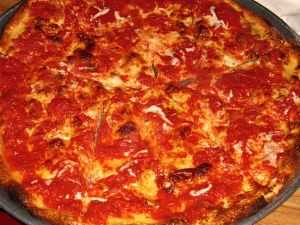
|
| Trenton's Tomato Pie |
The ingredients of a pizza pie are so simple it comes as a shock to learn the Italian community of Trenton, New Jersey, is fanatic about putting the cheese on the dough first, and then tomatoes on top. That's the way an authentic Trenton pizza is supposed to be made, rather than the conventional method of tomatoes first, cheese on top. To emphasize the point, these pizzas are determinedly referred to as tomato pies. And to tell the truth, there is a minor difference in the taste of the product made that way. As this more or less trivial issue is dissected and debated in great detail, an important fact about ethnic food emerges.
Be patient while each ingredient is examined. The crust will rise more in the warm summer than the winter, so it's thicker after it's baked. There is a faint fermentation taste which is more pronounced with a thick crust, but everyone in Trenton agrees this is a minor point. Everyone is also in agreement that most brands of Mozzarella cheese taste about the same. Tomatoes with seeds or without, or homogenized or chunky, make a minor difference. What is ultimately the essence of a Trenton tomato pie is that the cheese is put on top of the dough first, the tomatoes next spread on top, and the pie is then baked in the oven? Not everyone would notice the difference in taste, but it's definite, and in Trenton it's important. However, the locally acknowledged historian states his opinion that the thing that makes Trenton pies distinctive is not the ingredients, but the customers.
The employees of the shop know and respect the regulars, who tend to come to the same shop at least once a week, and call out the bakers by name as they enter. When they order a tomato pie, they give the name meaningfully, almost threateningly. According to the local historian, when the sons and grandsons of the shop owners move out to the suburbs and start a pizza shop in the strip mall, it isn't long before the tomatoes go on first, cheese on top. That's the way teenagers in the burbs are used to pizzas, and that's the way they expect to get them. As John Wanamaker used to say, the customer is always right, so the social rule which emerges is that ethnic food is not shaped by ethnic cooks, but by ethnic customers. To carry the idea a step farther, ethnic food isn't food, it's the old school tie.
Citywide Social Calendar
|
| Ruth Seltzer |
During the Twentieth Century, the society editor of the Philadelphia Inquirer, Ruth Seltzer, got fed up with trying to attend six or seven weddings on the same day and decided to do something about it. She established a social calendar, where hostesses could list their planned events after first checking to see if there was significant competition for the date. The book, or "The Book", was kept at Caldwell's Jewelry shop across the street from City Hall, and was no doubt good for their business as well. Caldwell's alas is gone, and so is the book.
But the need for a central clearinghouse remains, and some of the same issues continue to surface. There are many more weddings in June than other months, many more Christmas parties at Christmas than other seasons of the year. Unofficial rules were laid down and tactfully suggested by the nice lady at Caldwell's. It was suggested that charity benefits might usefully avoid taking place during the United Fund drive, just as an example. And of course, people will rush to reserve a date far in advance, but then back off if a big Kahuna comes along and squats on the same date. Big Kahunas are a problem if they have already staked out the right to a certain night between Thanksgiving and Christmas. If you have the brass, you can go ahead and schedule a head-on collision with the big Kahuna; if you triumph, you are now recognized as the new bigger Kahuna. If you fail, you have to eat canapes for a month.
Manna

|
| MANNA |
On 23rd Street, right next to the home of the First City Troops, is another organization of quite a different character. This is MANNA, which stands for Metropolitan AIDS/HIV Neighborhood Nutrition Alliance. This group was founded in 1990 by members of the Presbyterian Church at 21st and Walnut but has become independent and non-sectarian. It has an annual budget of over $3 million, a hundred paid employees, and a thousand volunteers. They deliver meals to people who have been referred to them by physicians as suffering from AIDS, and agreed by the social workers on the staff, to be poor. Last year, they delivered 650,000 free meals and spent a lot of effort fund-raising to do so. About half of the funds come from the government, quite a bit from private foundations and individuals, and a lot from six annual fund-raising events. One of the six events is to sell pies at holidays, one is a Ballet Performance. There's a black-tie dinner, and so on. So the organization is a curious mixture of Show Biz and earnest volunteerism of the old Philadelphia spirit and style.
One might suppose from all this that Philadelphia is riddled with AIDS, and of course we do have a discouragingly large number of afflicted victims. However, there are a million people in the USA with HIV, and only 20,000 are found in Pennsylvania By contrast, New Jersey has 50,000 victims. And all of that is almost trivial compared with 40 million known victims worldwide with probably a lot more who are unrecognized as sick. The World Health Organization has found cities in Africa, Mombasa for instance, where 90% of the babies born in the hospital test positive. It is reasonable to suppose that Africa will be totally depopulated in a decade if matters continue unchanged.
So, in the meantime, until someone figures out something better to do, Philadelphia is responding to its problem in a traditional and typical way. The writer Susan Sontag has been saying that nothing short of a religious crusade for monogamy will save the undeveloped world, and maybe she's right. At least, people are thinking about the problem and trying to do something, however inadequate, to help.
Wagner Free Institute of Science
|
| Wagner Institute Logo |
William Wagner emigrated to Philadelphia as a prosperous merchant shortly after the nation was formed, becoming a friend affiliated in business with Stephen Girard, although never a partner. Business took him around the world, where he pursued his hobby of collecting scientific specimens. The collection grew until it needed a museum to house it, accordingly built on the family farm somewhat north of the city limits, now 1700 Montgomery Street. A woodprint shows a game of baseball in play in the fields, with the museum recognizably looming in the background. Those fields are now filled with Nineteenth century red brick Philadelphia rowhouses, built later to support the activities of the Museum. Unfortunately, a need for a parking lot was not anticipated in 1848, but the place is quite safe to visit because land directly across 17th Street, also part of the original Wagner farm, was given over to the 22nd District police station. It's even possible the parking issue has since been considered since nearby land was deeded to a Unitarian Church on condition of reverting to the museum if it stops being a church.
|
| William Wagner |
William Wagner became the first director of his museum, following the ideas of his friend Girard a few blocks to the south. Stephen Girard had left his estate to the education of poor white orphan boys; Wagner extended the idea of offering free scientific education to the working public. The example ofBenjamin Franklin's discovery of the nature of electricity with only a second-grade education is a locally dramatic example of the important truth that science can be enjoyed and even skillfully performed without academic preparation or advanced degrees. Science in the early Nineteenth century evolved from Natural Philosophy to what we now call Natural Science, heavily weighted toward geology, botany and zoology with a strong dose of Charles Darwin. Today, those ideas are having a reawakening in the Green (Environmental) Movement, so perhaps a resurgence of interest really is about to appear. The museum might be called a historical record of Nineteenth-century science, although its lecture series are wider ranging and, of course, up to date. Reflecting the intended science education of the working public, many of the lectures are given in the evening and on weekends. Many are given in other locations, like the Free Library branches. The Wagner resembles the Barnes Museum in the sense that two museums once intended to illustrate educational innovations have come to overshadow the public's perception of the educational programs, whereas the cost of maintaining museums grew far faster than the income from endowments. It all resembles academia in general in getting progressively more expensive to provide for.
|
| The Wagner Museum |
The Wagner museum was formally opened in 1854, about the time of the City-County consolidation which relieved the population pressure needing to fill up surrounding fields with redbrick rowhouses, and eventually with Temple University. The formal Institute directorship was transferred to the professional management of Joseph P. Leidy, a dynamo of a man who received the informal title of The Last Man Who Knew Everything. When Leidy retired at the end of the Nineteenth century, the museum was closed to further acquisitions. For those who can remember natural science museums around 1930, the Wagner is strongly reminiscent, but over time it has become one of the few, perhaps the only, surviving example of the type. The building next door is a scientific library, available to scholars by appointment. The Athenaeum and the Mutter Museum are also surviving museum monuments, but even those two have been elaborately modernized. The Wagner resolutely adheres to looking as much like the original as maintenance will permit. The structure is as interesting as the contents; only the lecture topics move forward with the times.
|
| Anna Karenina |
The Institute drifted away from the Wagner family, but a few Wagners of the present generation became attracted by the connection to their name, and have struggled to keep it alive. The board has a few Wagner family members, who do their best to spark the enthusiasm of others who value the lectures, the scientific educational movement, and historical quality of an expensive but unique museum in a difficult neighborhood. Quite a few loyalists throng around the evening lectures with a happy air of joint participation and tradition. It would be hard to overlook the sincerity and courtesy that hovers around the edges of a shared cultural belief. It's a family activity, all right, but it is no longer a Wagner family but a Wagner Museum family. Participants are unmistakeably really happy that visitors have come to see it. The opening lines of Tolstoy's Anna Karenina declare that all happy families are happy in the same way, but that's wrong. The Wagner Museum family are obviously happy but in a unique way. In a nation which so universally prizes the future, here's one group who have seen the merit of having some institutions grow in value by seeming to stay just the way they began.
Edgar Allan Poe, 1809-1849
|
| Edger Allan Poe |
Between the Federalist period and the Civil War, Philadelphia quadrupled in population, mostly by Irish and black immigration responding to the urbanization induced by the Industrial Revolution. The social boundaries of this period were established by the U.S. Capital moving away to Washington, and at the other boundary, the constrained urban population was suddenly released to the suburbs by the City-County Consolidation of 1854. During that time, the Northern Liberties on the other side of Callowhillwere very close by, but nearly devoid of law and order. At least along the Delaware River, the scene was like Las Vegas as imagined by Charles Dickens. Within the increasingly congested boundaries of the city itself, tuberculosis, alcoholism, riots and religious revivalism are all mentioned prominently. While it was the time of Nicholas Biddle and the Bank, and the establishment of the Drexel empire, it was a gothic period quite adequately symbolized by Ethan Allan Poe, writing for Graham's Magazine. His father abandoned the family, his mother and later his wife died of tuberculosis, he was definitely an alcoholic and probably manic-depressive. He and Charles Brockton Brown invented the gothic novel, gothic poetry, the modern murder mystery. Poe only lived in Philadelphia for six years but lived in seven different locations, the most famous of which is now part of the National Park Service, even though it is located off Spring Garden Street. Yes, he was born in Boston but lived there only briefly, and yes, he died in Baltimore, by dropping dead in the street while traveling through. He was scarcely a prototypical Philadelphian, but he was certainly a symbol of his age.

|
| Grip the Raven |
There is a big stuffed Raven named Grip in the Free Library which belonged to Charles Dickens and is claimed to be the inspiration for Poe's Raven; it certainly has an ominous look, whatever its provenance. Poe offered his famous poem to Graham, who rejected it but gave him $15 as an act of charity. Another magazine paid him $9 to publish it. This poem was widely included in elementary school anthologies by the Philadelphia book publishing industry, and its simple repetitions with a scary atmosphere continue to be popular with children. The Murders in the Rue Morgue were the beginning of the modern murder mystery, and seem to have started Brockton Brown off on his establishment of the Philadelphia Gothic novel, echoing the whole dark and menacing Poe tradition. From the descriptions, Poe's alcohol problem was not so much related to the volume of consumption as to the violent manias which just a small quantity provoked in him. If your mother and your wife both died of tuberculosis, it's a fair bet you had it, too. At the age of 40, he was gone.
Philadelphia Drink
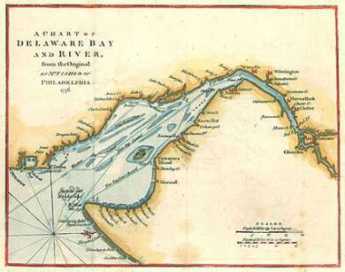
|
| Delbay |
Pennsylvania was founded as a religious colony, but it should not be assumed that the early Quakers were all tea totalers. The drinking water was suspect in all parts of the world, especially in the swampy Delaware Bay area. A great many colonial houses had brew-houses nearby and made no bones about it. Prohibition traces its more recent origin to a counter-reaction to the craze for gin which swept the country in the early 19th Century, leading successively to the Salvation Army, which was a Methodist movement, and to the Volstead Act. When all that settled down, Pennsylvania was left with a system of State Stores, a monopoly of packaged liquor by civil servants. As usually happens with such government adventures, the State Store system led to higher prices and less choice, famously poor service, and usually rude salespeople. If you wanted to develop a private wine cellar, you were pretty much out of luck, and it usually was not successful to come home from a foreign trip and ask for something new you had encountered abroad.
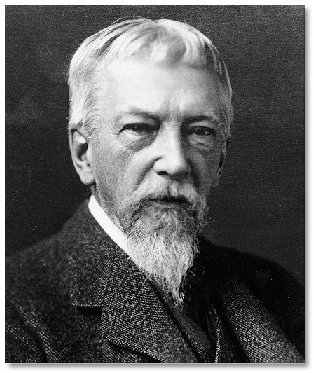
|
| Aid |
It thus happens that Philadelphia has only three traditional alcoholic drinks, and all three are sort of fading out. Madeira used to be the big party drink. Probably because of the trade routes, but possibly because of preference for the taste as compared with port and sherry, many parties were held for the sole purpose of opening a new keg of Madeira, and many annual celebrations had Madeira toasts as the official tradition. S. Weir Mitchell enshrined that tradition in a story, "The Madeira Party", and F. William Sunderman, who died at the age of 104 in 2003, wrote a similar ode to the Madeira tradition. Occasionally a hostess will go to the trouble of assembling a modern Madeira party, but it takes some effort to do so. Being quaint is not the same as being traditional.
|
| Fishouse |
The ingredients of Fish House Punch, on the other hand, are not difficult to obtain. A bowl of punch will do away with the need for a bartender and tends to assemble a jolly crowd around a table. The point was recently reaffirmed when the manager of the Union League converted one dining room to a luncheon buffet for regulars at the club tables. The idea was to allow businessmen in a hurry to get started with lunch without the delay of waitress service, but what quickly developed was that the buffet table became a greeting and gathering place, valuable in itself for enhancing the camaraderie of a club.
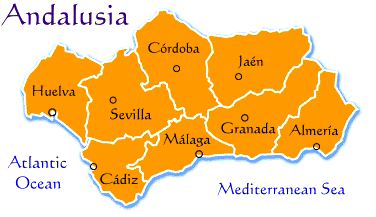
|
| Andalusia |
The Fish House referred to is now next to Andalusia along Delaware, although originally on the Schuylkill, and is one of those really traditional clubs where the members do the cooking and serving. The origins of many things are symbolized by the Tally Ho bowl of the Fish House, derived from the pre-Revolutionary Gloucester (NJ) Hunt and given by the First City Troop in honor of the joint membership of Captain Morris in both organizations. If you don't happen to have a Tally Ho bowl, any bowl will do.
The Union League has a similar drink, called the Union League Special*, which tastes much like a Whiskey Sour Punch, and is usually stored back of the bar in gallon jugs. Instead of a punch bowl, the Special is usually served in a tall glass. There is a general impression that the Special is stronger than the Fish House, but it is only a matter of personal opinion as to which tastes better.
* UNION LEAGUE APPETIZER ( Individual 6oz. Cocktail)
1 oz. RYE 1/2 oz. MYERS JAMAICAN RUM 1/2 oz. TRIPLE SEC 1 oz. LEMON JUICE 1 oz. ORANGE JUICE 1/2 oz. SUGAR
(Shake Well With Cracked Ice and Strain)
GALLON RECIPE
1 BOT RYE 16 oz. MEYERS JAMAICAN RUM 16 oz. TRIPLE SEC 36 oz. HALF LEMON & HALF WATER 26 oz. ORANGE JUICE 8 oz. SUGAR
(Stir with Block Ice or Cubes Until Cold )
There used to be several fine breweries in Philadelphia but they went away because of globalization, unions, or local taxes, or something, and it is probably true that there is no distinctively Philadelphia beer or wine. At parties, a large number of people are often seen walking around with a glass of clear liquid with some ice cubes in it. An onlooker can't tell, and it is intended that onlookers can't tell, whether the glass contains plain water, or gin, or vodka. None of your business, right?
To return to the point that Quakers have never all felt it is necessary to conform to a sour prohibitionist stance, there is a famous story of the Vaux family, whose country place used to be about where the Chestnut Hill Hospital now stands. Young Richard Vaux was attached to the American legation in London about the time of the inaugural of Queen Victoria and cut a rather fine figure. At the inaugural ball, he gaily danced with the new Queen, and word of it soon reached his mother in America. After summoning the young man to see her, she put down her sewing and came right to the point. "Richard," she said, "I do hope thee will not marry out of a meeting."
Blackball
It was once the tradition of many clubs that election to membership was only by unanimous consent of the existing members. The method of balloting was to pass around a wooden box with two compartments, one of which contained a mixture of white and black marbles, and the other started out empty. The white marbles were normally larger than the black ones, so a member could reach in and pick a marble without looking, drop it through a hole in the top into the voting compartment -- without enabling others to see what the choice was. Sometimes a black cloth was draped over the top to make the concealment secure. Duels to the death were not uncommon until the late Nineteenth century, so you wanted to be careful. Normally, a single black ball was enough to exclude a prospective member. This tradition traces back through Freemasonry to ancient Greece, where broken pieces of seashell were used for the purpose. The Greek word for such ballots is the stem for the term "ostracize".
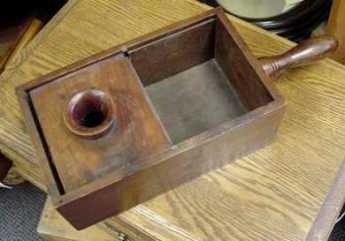
|
| Black Ball |
However old and traditional the practice might be, membership by unanimous consent is rapidly dying out. Most probably, the underlying idea of certifying a professional by electing that person to membership in some Society has been replaced by governmental licensing. You are a good lawyer or doctor or barber because the licensing Board says you are and gives you a certificate to that effect. The Licensing Board is entitled to do this by the act of the local state legislature, by sort of a reverse wording: "No person shall practice medicine in this state without a license so to do." That doesn't exactly say the licensed practitioner is a good one, but a licensed practitioner who was excluded from practice in some way would be quick to hire a lawyer. And a court would probably then be persuaded that non-governmentally sanctioned groups may not properly prevent a person from making a living. The right to tell a good one from a bad one has subtly passed from the self-selected leadership of a profession to politicians, using the Greek meaning of politics as "citizenry". To put it another way, the selection and discipline of professionals of many sorts have passed from local groups of distinguished practitioners to groups in the state capitol who may have somewhat different standards but who are at least not in economic competition with the applicants.
|
| Greeks |
Somehow, however, tracing ostracism back to the Medieval guilds seems inadequate to explain its attraction for social clubs, fraternities, debutante balls and the like. One suspicion has to be that these exclusivities are for the purpose of creating breeding pastures. Or at least a variant of arranged marriages, with an artful arrangement of propinquity to do the match-making. In this arena of a social contest, the aspirations of the parents are in conflict with the romantic concepts of the early Nineteenth century, which glorify unhampered choices by the participants. This triumph of eagerness over experience may, in turn, have been a result of the selective elimination of males by the Napoleonic and American Civil Wars, which inevitably created a surplus of marriageable females. Medical advances in preventing deaths in childbirth further expanded the female surplus during the last half of the Nineteenth century.
And then let's trace backward to the Greeks, who apparently originated the concept of ostracism by applying it to citizenship itself. The power of this approach is dramatized by the process of banishment, or denial of the privileges of citizenship. Some pretty important leaders like Themistocles were banished, and then restored to citizenship when it became evident that Athens needed them. The underlying question thus comes right up to the surface: do we need you more, or less, than you need us?
Dr. Cadwalader's Hat
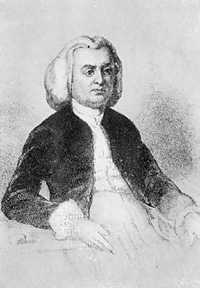
|
| Dr. Thomas Cadwalader |
The early Quakers disapproved of having their pictures painted, even refused to have their names on their tombstones. Consequently, relatively few portraits of early Quakers can be found, and it might, therefore, seem surprising to see a picture of Dr. Thomas Cadwalader hanging on the wall at the Pennsylvania Hospital. A plaque relates that it was donated by a descendant in 1895. Another descendant recently explained that the branch of the family which continued to be Quaker spells the name, Cadwallader. Dr. Cadwalader of the painting, famous for presiding over Philadelphia's uproar about the Tea Act, was then selected to hear out the tea rioters because of his reputation for fairness and remains famous even today for his unvarying courtesy.
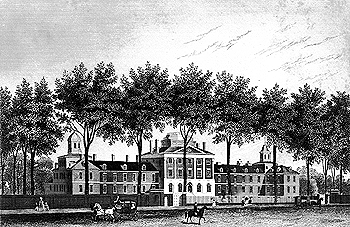
|
| Pennsylvania Hospital |
In one of the editions of Some Account of the Pennsylvania Hospital, I believe the one by Morton, there is a story about him. It seems there was a sailor in a bar on Eighth Street, who announced to the assemblage that he was going to go out the swinging doors of the taproom and shoot the first man he met. So out he went, and the first man he met was Dr. Cadwalader. The kindly old gentleman smiled, took off his hat, and said, "Good Morning, Sir". And so, as the story goes, the sailor proceeded to shoot the second man he met. A more precise rendition of this story comes down in the Cadwalader family that the event in the story really took place in Center Square, where City Hall now stands, but which in colonial times was a favored place for hunting. A man named Brulumann was walking in the park with a gun, which Dr. Cadwalader took as a sign of a hunter. In fact, Brulumann was despondent and had decided to kill himself, but lacking the courage to do so, had decided to kill the next man he met and then be hanged for murder. Dr. Cadwalader's courteous greeting, doffing his hat and all, befuddled Brulumann who went into Center House Tavern and killed someone else; he was indeed hanged for the deed.
I was standing at the foot of the staircase of the Pennsylvania Hospital, chatting to a young woman who from her tailored suit was obviously an administrator. I pointed out the Amity Button, and told her its story, along with the story of Jack Gallagher, whom I knew well, bouncing an empty beer keg all the way down to the Great Court from the top floor in the 1930s, which was then being used as housing for the resident physicians. Since the young woman administrator was obviously beginning to regard me like the Ancient Mariner, I thought one last story about courtesy was in order. So I told her about Dr. Cadwalader and the shooting.
"Well," she said, "The moral of that story obviously is that you should always wear a hat." There then is no point to further conversation, I left.
Georgetown Returns Day
|
| Georgetown |
Early in November, two days after each election, Georgetown Delaware puts on a festival called Returns Day. About two hundred years ago, there was a law that all ballots had to be cast in person at the courthouse in the county seat (Lewes, at that time), and it took two days to count the votes. Everyone, candidates included, would hang around at the courthouse to learn who had won. After a few elections, except in wartime when the ceremony was temporarily skipped, the popular tradition has continued even though of course the election results are known much earlier. Although the function of revealing election results has yielded to the news media, the ceremony has assumed importance for its own sake. Unless it rains pretty hard, the parade lasts three hours, with ten or twelve marching bands, and local amateurs struggling with bagpipes. The candidates, winner, and loser, ride gamely around the square in horse-drawn carriages. You can imagine what would happen to the political future of any candidate who declined to participate in what is now a mandatory public entertainment.
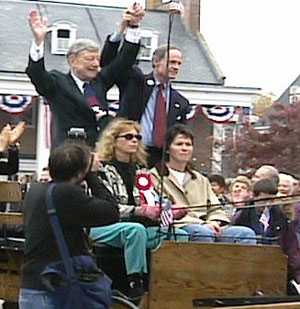
|
| U.S. Senator from Delaware |
Two features of this festival are especially notable. There is a hatchet-throwing contest, trying to get the flying hatchet to catch one corner in a post. It's not an easy thing to do. And then there is hatchet-burying, which is said to date back to the Nanticoke Indians. The traditional hatchet is brought from Lewes, as is the sand. This is all said to be the origin of the folk-saying about burying the hatchet, and it's really very heart-warming to believe the election is only an election, and the competition is over. It's probably not entirely true, of course, but it symbolizes what the public wants to believe is true. And what the public is telling politicians -- had soon better become true, again.
Kenneth Gordon, MD, Hero of Valley Forge
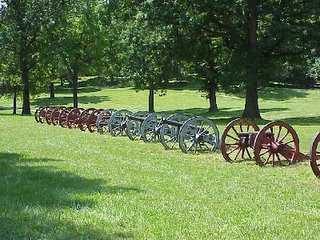
|
| Valley Forge |
There's no statue of Ken Gordon at Valley Forge National Park, although it would be appropriate. No building is named after him; it's probable he isn't even eligible to be buried there. But there would be no park to visit at Valley Forge without his strenuous exertions.
One day, Ken's seventh-grade daughter came home from school with the news that the father of one of her classmates said that Valley Forge Park was going to be turned into a high-rise development. That's known as hearsay, and lots of things you hear in seventh grade are best ignored. But this happened to be substantially true. At that time, the Park was owned by the Commonwealth of Pennsylvania, and Governor Shapp was finding the upkeep on the Park was an expense he needed to reduce. The historic area had two components, the headquarters area, and the encampment area. One part would become high-rise development and the other would become a Veteran's Administration cemetery. Although any form of rezoning has the familiar sound of politics to it, Dr. Gordon (a child psychiatrist) had the impression that Sharp was mostly interested in reducing state expenses, and had no particular objection to some better use of the historic area. At any rate, when Gordon went to see him, he said that he would agree to a historic park if Gordon could raise the money somehow. The Federal Government seemed a likely place to start.
Well, the sympathetic civil servants at the National Park Service told him how it was going to be. You get the consent of the local Congressman (Dick Schulze) and it will happen. If you don't get his consent, it won't happen. It seemed a simple thing to visit that Congressman, persuade him of the value of the idea, and it would be all done; who could refuse? After the manner of politicians, Schulze never did refuse, but somehow never got around to agreeing, either. It takes a little time to learn the political game, but after a reasonable time, the National Park employees told Gordon he was licked. Too bad, give up.
He didn't give up, he went to see his Senators, at that time Scott and Clark. They instantly thought it was a splendid idea, and instead of going pleasantly limp, they sent Citizen Gordon over to see Senator Johnson of Louisiana, the chairman of a relevant committee. Johnson also thought it was a great idea, and called out, "Get me a bill writer!" A bill writer is usually a government lawyer, tasked with listening to some citizen's idea and translating it into that strange language of laws -- section 8(34), sub-chapter X is hereby changed to, et cetera. Bill writers have to be pretty good at it, or otherwise, they will misunderstand the intent of the original idea, modified by the personal spin of the committee chairman, the comments of the authorizing committee, and later bargains struck in the House-Senate conference committee. Having negotiated all those hurdles, a bill has to be written in such a prescribed manner that it won't be found to have multiple loopholes when it later reaches the courts in a dispute. A good deal of the time of our courts is taken up with making sense of some careless wording by bill writers. That's what is known as the "Intent of Congress", an ingredient that may or may not survive the whole process.
|
| Dick Schulze |
Ken Gordon had to go through this process, including testimony at hearings, for three separate congressional committees. To get everybody's attention, he organized several hundred supporters to write letters and get petitions signed by several thousand voters. These supporters, in turn, influenced the media and started a lot of what is known as buzz. All of this is an awful lot of work, but there is one thing about this case that can make us all proud. Not once did a politician suggest a campaign contribution was essential in this matter.
In time, ownership of the Park did in fact migrate from the Commonwealth to the U.S. Department of the Interior, hence to the National Parks Service. Everyone agrees it has been well managed, and increasing droves of visitors come here every year. It is now clearly a national treasure. Unfortunately, the encampment area got away and has been commercially developed, although not nearly as high-rise as originally contemplated. Along the way, many discouraging words were spoken about the futility of fighting against such odds. The outcome, however, is the embodiment of two slogans, the first by Ronald Reagan. "It's amazing what can be accomplished, if you don't care who gets the credit for it." The other slogan is older, and Quaker. All you need, to accomplish anything, is leadership. And leadership -- is one person.
One day Ken Gordon, the very busy doctor, was asked how much of his time was taken by this effort. His answer was, ten hours a week, every week for five years.
City Troop
|
| First Troop, Philadelphia City Cavalry (FTPCC) |
On 23rd Street, just South of Market, stands a gloomy Victorian castle with big doors opening to the street. It's the armory, housing the First Troop, Philadelphia City Cavalry (FTPCC). The organization is a real fighting unit of the Pennsylvania National Guard, participating with distinction in every war America has fought. Originally a horse cavalry, the unit now drives tanks, except for recreation and on ceremonial occasions. It lays claim to being the oldest military unit in America, although there have been several minor name changes since the days when the City Troop accompanied General Washington to take command of the troops in Boston. Their dress uniforms are pretty splashy, especially on horseback, and they have to pay for them, themselves.

Furthermore, they are required to donate all of their military pay toward the upkeep of the unit and its activities. Although the first step in membership is to become a real member of the National Guard, election to the Troop itself is truly an election, carefully screened after prospective members have been observed and evaluated at invited Troop functions. These soldiers are wealthy, athletic, mostly pretty handsome, and almost invariably well-connected socially. You could almost make up the rest from these essential ingredients. This is the innermost core of Philadelphia society, and it is intensely and sincerely patriotic.
Others have noticed that National Guard duty itself takes up many weekends and much of summer vacation. Add to that the many Troop dinners, the horsemanship activities, the debutante balls, the Chesapeake sailing cruises, the national and local ceremonies, the weddings and funerals for members -- and actually fighting wars overseas. The members of the Troop spend so much of their time on Troop-related activities, that they become both intensely loyal to each other, and necessarily somewhat withdrawn from other people. They gravitate to polo, the Racquet Club, the Savoy, the Orpheus, and the financial world.
There may be an important insight into the generation turmoils to be derived from this. There was once a time when most professions likewise absorbed the lives of their members, with professional clubs and entertainments confining the social life of the member by leaving little time for anything else. But in recent years most occupational and professional societies are experiencing a loss of membership and enthusiasm, leading to the bewildering question of "Where are the younger members, any more?" The pre-fabricated answer is that younger people now want to devote their quality time to their families, but if you believe that, you will believe anything. Let's face it; when one activity absorbs all of your time, it confines you. There have to be some important benefits to being so confined, and even so, it chafes a little. Those of us who are not baby boomers can see that being a slave to intra-generational consensus is only to be a slave in a different way. The remarkable thing is that the baby boomers fail to see it, themselves.
Please Don't Lose Any Sleep Over This
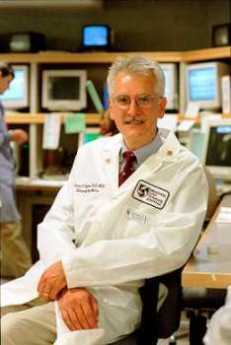
|
| Dr. Charles Czeisler |
The Institute for Experimental Psychiatry Research Foundation meets alternatively in Boston and Philadelphia, in recognition of its rather complicated historical relationship with Harvard and Penn. The Spring 2005 trustees meeting was held in Boston, with Dr. Charles Czeisler of the Brigham and Women's Hospital making a presentation of his work with sleepy resident physicians. Sleep is now a central focus of the work of the Institute, particularly the effect of lack of sleep on performance. Resident physicians are a group with lots of experience with sleep loss, so much that such experiences as residents are central imprinting in the lifelong brotherhood of the profession. The public tends to regard the torment of protracted craving for sleep as some kind of dangerous hazing inflicted on professional newcomers by sophomoric seniors. Every once in a while, someone gets hurt by these games. That seems to be a general public reaction. For the most part, by contrast, members of the profession who have themselves undergone the experience turn away silently from such unfeeling remarks. As the old contraceptive joke about the Pope has it, if you don't play the game, don't make the rules.
In the first place, it is wrong to suggest that resident physicians are somehow helpless victims of authority, abused slaves of somebody's profit motive, or warped masochists enduring the process in order to inflict it on someone else. Perhaps the example of my classmate Seibert is useful. As a freshman medical student, Seibert was so overwhelmed by the volume of facts he was expected to learn, that he decided to give up sleep entirely. Seibert, by the way, was no moron; he was an honors graduate of a very selective Ivy League university. And he actually did stop sleeping for more than two weeks until he collapsed and had to be stopped. This was his own choice, gamely adopted in spite of general ridicule. And to show that overachieving is not limited to physicians, there was my oriental patient, the daughter of the President of her country. She related that as a graduate student she did not go to bed for three years; during all that time, she sat at her desk, slapping her face to keep awake. What we are talking about here is a self-selected group of committed and dedicated people, perhaps overly shamed by the specter of failure.
The work of our Institute has helped document and understand the injurious effect of sleep loss on performance; no one can go very long without sleep before responses and vigilance begin to deteriorate. A great many vehicle accidents are caused by drowsy drivers; it is a concern that pilots of airplanes on long-distance flights are to some provable degree less competent to land the plane. Therefore, it is not completely surprising to find that interns on protracted duty do make 20% more errors in medication orders, and nearly 50% more diagnostic errors. It is jarring to discover a measurable increase in the number of intern auto accidents, particularly when driving home from work. Maybe we ought to pass a law about it.
Commiseration is one thing; proposals to interfere are quite another. For one thing, the time-honored protection against the harm of this problem is redundancy. The complex, fast-paced and dangerous environment of a hospital, like that of an airline cockpit, has very little tolerance for lack of vigilance. Our solution has been to do everything three times, with overlapping responsibilities and repeated opportunity for catching errors before they get through to the patient. Although the malpractice lawyer seeks to pin the whole blame on some person, particularly one who is covered by insurance, the reaction of doctors to adverse events is to presume that at least three people must have cooperated in letting it slip through. At night and on weekends, the reduced staff tends to weaken the defensive network. But by every assessment, the greatest threat to our protective screen of redundancy is cost control. Any manager of managed care can find duplication and overlap in ten minutes of searching for it in a hospital; redundancy is a big factor in the high cost of running a hospital. The law of decreasing returns will dictate that it becomes very expensive to eliminate the last one percent of errors. To state it in reverse: it is very tempting to save a bundle of money in a competitive world, by accepting only a small increase in the errors. Since it is a matter of opinion, physicians are grimly determined that it shall be physicians who strike that balance. Those who press for more punitive treatment of physicians in the matter of errors should reflect that it surely will convince physicians to flee the risk of responsibility for the decision of where to strike the balance.
If you bend metal repeatedly it will crack; if you stretch a rope too hard it will snap. These unfortunate events are not called errors, and it is improper to search for blame in them. The medical profession is aghast that the public does not seem to appreciate that average life expectancy has increased by thirty years in the past century. That's not ancient history; life expectancy has increased by three years in the past ten. A system that produces a result like that is entitled to a certain amount of tolerance for its errors if we must call them errors. In other environments, that's known as pushing the envelope. Anyone who thinks it's fun to stand on your feet for thirty-six consecutive hours -- hasn't tried it.
Surgeons are perhaps somewhat more conscious of the need to train young professionals to drive themselves beyond ordinary endurance. After all, if an operation is unexpectedly prolonged, the surgeon can't just quit, he must finish. Neurosurgeons, with their fourteen-hour procedures, are particularly vehement on the topic. But it is true of every physician, too. When the telephone rings in the middle of the night, will this young fellow haul himself out of bed, or will he tell the patient to take an aspirin and call again in the morning? Increasingly, we hear complaints from patients that other doctors didn't even take the trouble to examine them; the implication that we are somehow not like that is very flattering. Part of the training is forbearance, too. At three in the morning, it is very easy to feel sorry for yourself and to reflect that an administrator with four times your income is home in his nice warm bed. The fact is, that if the person who is up and on his feet doesn't do the job, no one will.
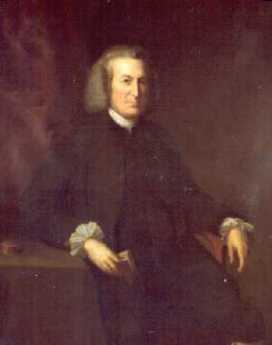
|
| Cadwalader |
Some incomprehension from bystanders must simply be endured with patience. Beyond that, it could be futile to seek a complete understanding. Quite recently, I was explaining to a young lady in a tailored suit who Thomas Cadwalader was. His portrait, beneath which we were standing, hangs in the great hall of the Pennsylvania Hospital. Although he died in 1789, Dr. Cadwalader is still famous for his remarkable, unfailing courtesy. A sailor in a tavern on Eighth Street once waved a gun and announced to the crowd he was going out the swinging doors to shoot the first man he met. The first man happened to be Dr. Cadwalader, who tipped his hat and said, "Good morning, sir." So, the sailor shot the second man he met.
The young lady in the tailored suit brightened up. "The moral of that story, " she said, "Is always wear a hat."
Police Athletic League
|
| pal |
T he Philadelphia chapter of the PAL is now almost sixty years old; that means its origins are to be found in the great industrial migrations and urban dislocations of World War II. Philadelphia has experienced many upsurges of crime in its long history, and almost without exception crime centers in new immigrant groups. Commentators on prison conditions over the centuries have always remarked on the over-representation of whatever is the most recent immigrant group among the inmates. Crimes related to recreational drugs may be an exception, just as crimes related to bootlegging were an exception during Prohibition. Or maybe not; perhaps issues of that sort merely affect the type of crime and the reason for committing it, while the criminals themselves continue to concentrate in the most recent immigrant population. It is merely to face the plain facts to notice that the war industries attracted large immigration to Philadelphia of African-Americans, so the recent-immigrant crime wave centered in them. There's actually hope in that if we keep calm about it. It means that crime can in time be expected to settle down, just as it did after the waves of immigration of Irish, Germans, and Scotch in earlier centuries. This wave of immigrants from the Southern states will surely be assimilated, too. Police records show that most crimes are committed by teenagers, committed between 3 PM and 9 PM. The aim of the Police Athletic League is therefore clear: keep teenagers busy and off the streets between 1 PM and 9 PM. The 27 centers of PAL, with nearly 30,000 participants between age 6 to 18, have a budget of over $2 million a year, all privately donated. The contribution of the City Government is to supply police officers to staff the centers, and that is an unexpectedly important thing to do. One might suppose hostile teenagers would be turned off by the presence of "the man", the stormtrooper of the enemy, and perhaps some are. But the presence of police in every center means that PAL is safe when very little else is safe for lower class teenagers. And of course, it is important for teenagers to learn that cops are people. Lots of cops are nice guys who will help you. Lots of cops used to be members of PAL, themselves. A men's luncheon club to which I belong donates the profits from a weekly lottery to PAL, and consequently, a speaker from the League is sent to thank us by giving a talk once a year. The Police Athletic League is clearly evolving. It started out with only programs in boxing and basketball, rather obvious choices. But now, the example of Tiger Woods has stimulated a great deal of interest in golf, which takes place on the loan of time at five local golf courses. Many famous civic leaders are involved in the governance of this organization, and recently the Lend fest family has been especially generous. You can look forward to a large well equipped PAL center soon, at Luzerne and 12th Streets, based on their generosity. It will have, among other things, squash courts, no less. Squash started out as a game in debtor's prison, but it currently has the image of upper-crust exclusivity. It's important to do things like that. And the activities of PAL have further evolved away from prize-fighting into computer classes. A popular new development has been a mathematics competition. It would go too far to say that PAL has saved a whole generation from living the life of the streets. But it's making progress which is very heartening to see.
A Few Rooms of Your Own
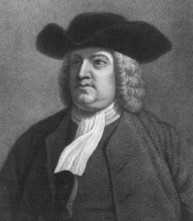
|
| William Penn |
If William Penn could revisit Philadelphia today, he would surely feel disappointed that the Greene Country Towne still hasn't materialized. Even a century after Penn's real visits, Philadelphia at the time of the Revolutionary War still nestled East of Fifth Street. There have been many conjectures about this, perhaps fear of Indian attack, perhaps lack of firewood, desire to be near the port, perhaps a number of things. Let's examine whether it's just the nature of a successful city to organize itself the way it does.
Ancient Athens, for example, was a nice warm place without much rain, which possibly accounts for the miserable little hovels where people lived, contrasting with the magnificent Acropolis, Parthenon, Stoa and other public buildings. It has been speculated that the architecture created the social system, not the other way around; the same contrast between big stone temples and little wooden huts is also seen in the Mayan cities of Yucatan. Hong Kong certainly isn't poor, but it's built like that. Japan cannot claim that lack of land forces the citizens to live in tiny apartments. It's hard to say whether the lowly social state of Japanese women accounts for the contrast between where they live and where their husbands spend most of their time because it's just as easy to believe the proposed cause is really an effect.
The more you look around the world, the more you wonder if it isn't the American suburb that's out of step with the world. When they can afford it, hardly any of the world seems to want to live in the suburbs; their homes are seldom their castles. There's New York City, of course. New Yorkers seem to like living in high-rises.
An architect friend makes short work of construction economics as a driving feature. According to him, it is unduly expensive to live in a high-rise. Just a pointless ego trip. The cost per square foot of usable floor space just keeps going up as the building gets taller, requiring more elevator shafts, more elaborate HVAC. That's heating, ventilating and air conditioning. Everything has to be built with a derrick, the traffic congestion at the base is horrific, high winds can break the window glass. The list rapidly grows convincing. Why does anyone pay all that extra money to live high in the sky? Not my idea of something to do, says Cole Porter.
Notice there is a major difference between sleeping in the suburbs as they do in Japan, and sleeping in apartments right near the center of town, as they do in Budapest, Berlin, Prague, and Vienna. The Orientals are staying close to work for longer hours, while the Central Europeans are staying close to the cafes and theaters to which they flock the moment work is over. Just what to think of the Spanish siesta system isn't clear, but it seems to have the main effect of bringing people back into the center of the town at night. You can't live very far away from work if you have to commute twice a day.
The Lord only knows where everybody in New York is going every Friday night, with return traffic jams in the other direction on Sunday night. The weekly exodus suggests they don't really luxuriate in their penthouses or flock to their entertainment district on weekends; apparently, a cabin in the woods is beckoning. As, by contrast, the empty nesters in the suburbs eventually look around for retirement villages to live, repeating the endless complaint about the nuisance of maintaining a big house and garden. Pennsbury looks like a comfortable place to live, but even William Penn seems to have tired of it. One really does have to wonder whether a heart's desire in architecture all too frequently leads to heart's discontent in lifestyle. Philadelphia appears to be trying a new approach; the suburbs are moving back downtown.
We'll eventually see if it changes our character and lifestyle so somebody can write sociology books about it.
Use the Internet for Your Club (2)
First, take a look at what you are trying to achieve, and a handy example would be
https://www.yahoo.com/. You will see it is not daily or weekly, it is continuous. The page of the newspaper is a montage of ten or twelve blocks on a page. For example, one block might give you the month's schedule, another shows the sports scores, another shows the stock market, etc. Each one of those blocks is probably updated at a different time, making this a continuous newsletter, and of course, there is a way provided to individualize the blocks of space, change the color schemes, etc. Since this newsletter is on the Internet, anyone can read it from anywhere in the world, at any time. That is, they can read it if they know the password, which some clubs want to keep private, and others prefer to skip because it is a nuisance when people forget what the password is.
What underlies this process is a technique known as RSS. Each block of space in the newspaper is operating on different scheduling, and each blocks "polls" a donor site every so often, for example, fifteen minutes. The polling program calls the URL of each donor site at a preset time, where a record is kept of the last time the site was modified. If the site has been changed since that last visit of the polling program, the new site is downloaded to the newsletter page. If there has been no change, the polling program simply goes on to the next-scheduled site. In effect, the polling program is acting as a "robot". Modifications of this system, with considerable elaboration, are at the heart of the Google robot and other robots for other purposes. Generally speaking, the ordinary user doesn't have to know how to construct one of these robots or modify one. No doubt, there will be an extensive elaboration of this concept in the near future, but that's essentially how you can construct a usable newsletter in short order.
Use the Internet for Your Club
Most clubs, family groups, or neighborhood associations are held together by one loyal volunteer who does all the work. This limits the scope of the club to what one person is able to do in spare time. When that central person gets tired of it or moves away, things tend to fall apart. In the spirit of encouraging more volunteerism, this article suggests some ways the home computer can easily automate the normal drudgery of running a club. Having just performed this task for the local computer society, I can report it takes about two hours to put it together. If I did it three times, it would take forty-five minutes. A rank beginner, who doesn't even know what the words mean, might take all day to do it, but no more than that.
Most of the programs a club would need were first developed for people on the go, like a salesman who visits several cities, or a college student who commutes. It's an easy step to imagine different club members in different places instead of one person in several places. Electricity travels so fast that connecting computers together over the whole world's Internet can be thought of as essentially creating one big computer. For practical purposes, it doesn't matter whether a piece of information is in two parts of one computer or in two different computers hooked together by the Internet. The whole process is so cheap it might just as well be free.

|
| The New Macintosh Mac Mini |
Selection of Computer and Operating System. Over ninety percent of the world's home computers are based on the Windows operating system, but Windows is having a lot of trouble right now with viruses and spam. Right now is Apple's big chance, because the Apple OS X operating system, based on Unix, seems to be immune to viruses and spam. So, if you are buying a new computer, I suggest you look at Apple's headless version. That's a little six-inch box to which you attach the monitor, keyboard, and printer that presumably you have left over from some Windows system. Times will change, but right now this five hundred dollar little headless job is worth the money. That's for the club secretary; all the club members can use any kind of machine they happen to have, at least for read-only use.
Router. If you have several computers on one telephone line, you need a router to send the right signals to each machine. Because the router changes the identification numbers every time it is restarted, it tends to foil the buccaneers out there who are trying to find your credit card. Therefore, it's not a bad idea to have a router attached, even if you only have it connected to a single computer. Security folks say it takes about fifteen minutes for some buccaneer to find a newly installed computer, and most banks get several hundred break-in attempts every hour. That's because everybody is getting automated these days, including criminals.
Choice of Browser. After you get set up and organized and all, you need to download the Fire fox browser, which right now is faster and more spam-proof than either Internet Explorer or Netscape. Go to some other browser and enter https://www.mozilla.org/products/firefox/. There's no harm in having several browsers sitting on your computer, including Opera if you like, but right now Firefox is the one to use. A browser, in case you care, is a program that takes a stream of Internet data and translates it into the image on your screen, sort of like translating Morse code into a telegram. Some browsers are lean, mean and fast, while others are loaded with a lot of bells and whistles that slow them down. If you can't see any difference by trying them, go with the one that gives you most spam protection.

|
| Yahoo Calendar |
Yahoo Calendar. There are lots of computer calendars, but right now Yahoo offers one that is somewhat better for public use by clubs. For an illustration, take a look at the Philadelphia Orchestra calendar that can be located on Philadelphia Reflections in the lower left column, by first clicking the Philadelphia Calendars button, and then clicking the link to the Orchestra's schedule. Naturally, the Orchestra doesn't want people changing their public schedule, so the calendar is read-only. You can create a calendar like this for your club or organization by going to www.calendar.yahoo.com and entering an identifier and password. You can only change the calendar if you have the password, so be careful who is allowed to have it. If you make a misjudgment about this, just abandon the calendar and start a new one. You can, of course, create a personal calendar for yourself; it would be nice to merge your calendar with organization calendars. Calendar-merge programs do exist but presently are a little primitive. Even nicer would be the ability to drag and drop individual events from one calendar to the other, but that's mostly on the wish list.
Yahoo Address Book. There are zillions of address books, but Yahoo provides a public one if you allow club members to know the password. On the one hand, it's a big convenience for the secretary to have everybody fill in his own data. It can take ten or fifteen minutes apiece to complete all that information. On the other hand, if just anybody can have all this data, you can expect to get lots of unwanted solicitations. Naturally, you want to keep intruders from altering the data, but whether or not you make your membership list public is your own decision. So, probably you want to transfer the data to a list that you keep private, using a system of letting people enter data, and then erasing it after it is transferred.
Listserv. A very handy tool is to create a listserv, which is a system of e-mail that is sent to everyone on the list, and everyone can chime in with comments. It makes for a lot of local excitement, and it keeps families together, including reunion classes from all the schools you went to, 'way back then. If the Rs and the Ds get to bashing each other on the Listserv, you will learn the value of designating some sober soul to be list master, given the power to exile people whose mouths get too noisy.
Minutes and History as Blogs. Most clubs keep minutes, and after a while, they start to record their history. It's a lot of work, and often gets lost; furthermore, it's hard for anyone but the author to read. We suggest you create a blog and hang it on the Internet.
While there are a dozen programs and systems for creating blogs (that's short for Web logs), Google has bought blogger.com from that company, and has pepped it up quite a lot. Like the rest of these ideas, this one is free, and there are several million of these in existence. Sometimes people write poetry in the form of blogs, and some other people put up some pretty raunchy pictures or commentary. Apparently, Google doesn't care, so they shouldn't mind if you publish the minutes of the East Whipswitch Cooking Society as blogs. It's very easy to do, and their canned templates produce some pretty elegant web sites in minutes. That's right, minutes in minutes.
Finances and Newsletters. Clubs typically collect dues or charge for luncheons, but financial stuff on the Internet is more complicated and must be dealt with in a later article. Similarly, you can publish a newsletter using RSS that is very spiffy indeed, but that's really hard to explain, and must be described in a separate article, too. Anyway, these preliminary items are enough to keep a new club busy for a few months.
Fast User Switching. Other operating systems will surely imitate it, but Apple is at present where you have to go to make a separate computer section for your club. Apple originally had the idea that several people would use the same machine, and want to keep their data secret from each other. So, they have a system in which you can click the upper right corner of the screen, and you can place yourself in a secret room with its own password. We suggest that it would be better to see this as a new desktop. All graphical interfaces of all computer operating systems use the metaphor of a desktop, which is what suggested to me that the club needs a desktop like my own. That is, it's littered with half-finished business of a dozen sorts, suddenly abandoned when the phone rings or a visitor arrives. You would like to be able to come back to your desktop and take up your work where you left off. For that, you probably need several desktops, and that's what fast user shifting provides you. Not vitally essential, but very convenient.
Favicons. Especially if you have fast user desktops specially designated by work topics instead of people, you can really use the favicon, or favorite icon, feature. A favicon is the little miniature do-hickey to the left of the webpage URL in the URL box. Maybe you never noticed it, but it's usually there. If you take your mouse and drag the favicon onto the desktop (you may have to shift something to create some blue sky desktop room) a new icon will appear on the desktop. Close up and click on that new icon, and you will open up a browser and go right to the page you were using when you created the icon. This is such a really neat feature that your desktop is apt to fill up quickly with a lot of web pages you happened to come across. It doesn't take long for the favicons to choke the desktop into uselessness, so this feature is at its best in a system where the topics of general utility to the user are sub-set by fast user switching.

|
|
Apache has the largest share of the market and is available for most computers. |
Your Own Website. Apache. Your club will soon get the idea that you need your own website, but in fact, you already have several of them. Your calendar, address book, club minutes blog, club history blog already add up to four websites. To most people, having their own website means consolidating all this material into one elegant page, with photos and artwork. You can do that, but it's much harder, and you first need to see if you really have a need for that. By far the easiest way for amateurs to have a website is to pay somebody a couple hundred dollars to write the code for it, and pay an Internet provider ten or twenty dollars a month to display it for you.
But for advanced players, like a club of computer professionals and particularly if that club runs a little on the snooty side and highly prizes its privacy, it might want to consider going all the way and becoming its own Internet provider. In that rather special case, it brings us back to Apple, since the OS X system includes a free copy of Apache, the program for running your own site on your own computer. Now, that's really a big undertaking, far beyond the average club. So if privacy of that order is mandatory, you may have to hire someone to set it up for you. But Apache sure makes it possible, if that's where you feel you want to go.
Your Own Newslettter. First, take a look at what you are trying to achieve, and a handy example would be https://www.yahoo.com/.

|
| Yahoo |
You will see it is not a daily or a weekly, it is continuous. The page of the newspaper is a montage of ten or twelve blocks on a page. For example, one block might display the month's schedule, another shows sports scores, another shows the stock market, etc. Each one of those blocks is probably updated at a different time, making this a continuous newsletter. Of course there is a way provided to individualize the blocks of space, change the color schemes, etc. Since this newsletter is on the Internet, anyone can read it from anywhere in the world, at any time. That is, they can read it if they know the password, which some clubs want to keep private, and others prefer to skip because it is a nuisance when people forget what the password is and call you up at home after midnight to ask for it.
What underlies this process is a technique known as RSS. Each block of space in the newspaper is operating on a different scheduling, and each blocks "polls" a donor site every so often, for example fifteen minutes. The polling program calls the URL of each donor site at a preset time, where a record is kept of the last time the site was modified. If the site has been changed since that last visit of the polling program, the new site is downloaded to the newsletter page. If there has been no change, the polling program simply goes on to the next-scheduled site. In effect, the polling program is acting as a "robot". Modifications of this system, with considerable elaboration, are at the heart of the Google robot and other robots for other purposes. Generally speaking, the ordinary user doesn't have to know how to construct one of these robots, or modify one. No doubt, there will be extensive elaboration of this concept in the near future, but that's essentially how you can construct a usable newsletter in short order.
www.Philadelphia-Reflections.com/blog/464.htm
HSP: Philadelphia's Attic
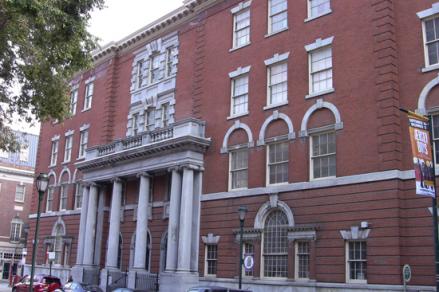
|
| Historical Society of Pennsylvania |
There was a time when the mission of the HSP (Historical Society of Pennsylvania) was clearly and proudly centered on the history of Philadelphia's old families. There generally comes a time in every family when its accumulation of stuff requires facing the fact that many possessions are too valuable to sell and too bulky to store. HSP in time became a place where families contributed these objects of memory and value, at least keeping them out of the hands of antique dealers when dusting and ensuring them became a burden. When many families entered into such a joint venture, the shared goals and experiences created a tradition over time which was reassuring to the donors. The famous lawyer Howard Lewis came to the board of HSP at a time when it was facing up to some of its own problems.
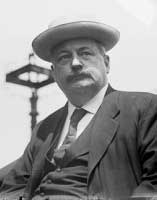
|
| Boies Penrose |
The then Board Chairman Boises Penrose came to the young lawyer one day and told him it was time he joined the board. Well, why? Because your grandfather was once Chairman of the Board; no other explanation was offered. Howard Lewis recounts that it was his introduction to a Philadelphia fact: some board appointments are hereditary. He dutifully joined.
It became apparent that HSP was a museum of immensely interesting artifacts, including decorations used at the Machianza of 1778, a copy of the handwritten originals of the Declaration of Independence and the Constitution, and ten thousand other curious of great interest. It was a place to visit one's family relics, it was a great place to hold a party. It had a three million dollar endowment in 1969. But it had a big problem: essentially no one visited the museum. It isn't hard to imagine the anguish waiting for anyone who stirred up the hornet's nest by pointing out the obvious problem. You can't fire hereditary directors, so hereditary directors don't budge in an argument. You can make hired staff into scapegoats and fire them; that doesn't accomplish much, although it is commonly tried. The Genealogy Society is a natural partner of Philadelphia's attic, but although the two partners were intimately mixed, natural partners who can't be fired add to the scene.
Things went on. Boies Penrose held board meetings which lasted precisely forty-five minutes. He had a train to Devon to catch at 5:15, so meetings ended at 4:45 PM, precisely. Even when a speaker was in mid-sentence, the gavel banged down at 4:45. Eventually this impasse was broken by reaching an agreement with the Atwater Kent Museum to the effect that historical three-dimensional objects would go to the Atwater Kent, freeing up 40% more library space for the two-dimensional papers, maps, and documents which were to become the main focus of the new HSP. More separation between HSP and the Genealogy Society was effected. Much of this was made possible by the extraordinary investment ability of Ralph Kynette, who had run the endowment up to $18 million, in spite of maintaining a spending rule of 9%. There are not many non-profit organizations which can match such a performance.
The reorganized HSP floundered a bit, and then it had the good fortune to enter into a merger with the Balch Institute. The Balch also had a store of valuable papers, but its main mission was educational. The addition of this educational effort to the more static museum and library functions has allowed the recruitment of ambitious staff, and a considerable redirection from Olde Philadelphia to the city as it now is.
In the course of the many reexaminations which all this reorganization stirred up, some familiar issues in non-profit administration had to be faced. The American Museum Association is firm in its principles that no asset in the archives of a museum may ever be sold, except to purchase some other asset which comes closer to the museum's stated mission. The underlying sense of this rule is plain: it would be unfortunate for paid staff to sell artwork for the purpose of sustaining or raising their own salaries. Unfortunately, in a great many instances, collection value has grown more rapidly than the size of the endowment to preserve the collection. That's about the size of the problem at the Barnes Museum, where collections worth many billions cannot be touched to raise money to protect and display them. It is confidently asserted that the Barnes has many objects in its basement which could easily correct its endowment imbalance, but the AMA rule prevents it. The Barnes must now be moved to a new county to overcome this impasse. It all seems like an awkward way to solve one problem by creating another, but the lawyer in Howard Lewis takes it in quite an unexpected direction.
It is his view that locking the museums of the nation in this position creates a constantly shrinking market in the artwork; when a museum acquires a piece of art it forces it to enter a one-way tunnel, never to reappear on the market. A constantly shrinking market of salable art raises prices, and it does so in a way that resembles a violation of the Clayton Antitrust Act, the beneficiaries of which are the art dealers, art collectors and artists of the world. Add to this injury to competition, the tax benefits of creating or holding a constantly appreciating market; and it really is an uncomfortable thing to consider in depth. The American Museum Association ought give serious consideration to finding alternative routes to its legitimate goals. One of the other probably unintentional results of this rule are that the donation of a valuable piece of art to a museum is very likely to lead to its instant sale for cash. The reasoning here is that the donation has not yet been "taken into the collection", and thus it can be sold without violating the Museum Association rule. People who wear wigs while sitting on a bench may consider this a valid interpretation, but when you set about trying to fashion a better museum rule, this rebuttal seems highly contrived.
If we should someday set about to re-examine what we are doing in the legal thicket of museums, we might consider how the principles of non-profit accounting for museums might be fundamentally modified. Since a non-profit is thought to generate no profits, its financial health cannot be measured by the size of its profits. Consequently, it is traditional to account for the finances of a non-profit by measuring whether its assets have grown or declined. However, conducting an annual appraisal of all the artwork in a museum that never sells anything is a monumental expense without any other purpose than to satisfy the accounting rule. Consequently, I'll tell you a little secret. Absolutely everyone ignores the issue, and the annual audits are totally uninformative if not misleading. Who's going to hang the bell on this cat?
Laurel Hill
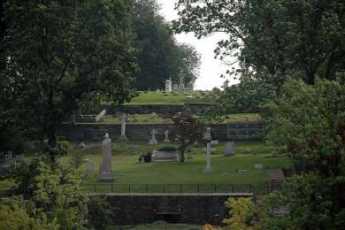
|
| Laurel Hill Cemeteries |
There are two Laurel Hill Cemeteries in Philadelphia, sort of. Although both are described as garden cemeteries, the older part in East Fairmount Park is more of a statuary cemetery or even a mausoleum cemetery. When its 74 acres filled up, the owners bought expansion land in Bala Cynwyd, which could come closer to present ideas of a memorial garden. Particularly so, when the older cemetery area started to fill in every available corner and patch and began to look overcrowded. The name was used by the Sims family for their estate on the original area. Since June-blooming mountain laurel is the Pennsylvania state flower and a vigorous grower, it seems likely the bluff overlooking the Schuylkill was once covered with it. Somehow the May-blooming azalea has become more popular throughout the region, particularly in the gardens at the foot of the Art Museum. If extended a little, merged with laurel on the bluff, and possibly with July-blooming wild rhododendron, there might someday arise quite a notable display of acid-loving flowering bushes from the Art Museum to the Wissahickon, continuously for two or three months each spring.
There are interesting transformations in the evolving history of cemeteries, best illustrated in our city by the traditions of the early Quakers when they dominated Philadelphia.
|
| Thomas Grey |
Objecting to the ornate monuments which Popes and Emperors erected for their military glory, and probably to the aristocratic custom of burying important people inside churches where they could be worshiped along with the stained-glass saints, early Quakers were reluctant to mark their own graves with headstones, or even to have their names engraved on such "markers". By contrast with the splendor accorded aristocrats, the common people in Europe were largely dumped and forgotten, providing an unfortunate contrast. During the early part of what we call the romantic period, Thomas Gray popularized these attitudes in Elegy in a Country Churchyard. To be fair about it, the early Christian Church had a strong tradition of collecting the dead of all classes into catacombs. The Romans were quite reasonably upset by the potential for spreading epidemics through people living within such arrangements, although feeding the Christians to the lions seems like an overreaction.
At any rate, and to whatever degree the French Revolution was what shattered previous traditions, the Victorian or romantic period produced a new vision: garden cemeteries in Paris.
|
| George Mead |
The concept soon spread to Laurel Hill, and thence to the rest of America. Acting with what probably had some commercial motivation, cemeteries then moved away from churches to suburban parks, promoted as places of great beauty in which to stroll and hold picnics, perhaps to meditate. The private expense was not spared in statues and mausoleums, which often became display competitions between dry goods merchants and locomotive builders. Revolutionary heroes were dug up from their original graves and transported here to be more properly honored, as were some private persons whose descendants wished for more suitable recognition than conservative church rectors had offered. The Civil War created the staggering number of 632,000 war dead; based on the proportion of the population, that would be equivalent to six million in today's terms. Since they were almost all male, there must have been at least a half-million surplus women as a consequence. The nation and this almost unbelievably large cohort of single women had an impact on society for thirty or forty years after The War. Eventually, this would lead to colleges for women, suffrage and other forms of feminism, but the initial manifestations of what we now call Victorianism took the form of formalized grief, particularly the 75 National Cemeteries of crosses row on row. But private initiatives also took a variety of forms, including Laurel Hill's statuary to honor the valor of the fallen, ranked by the number of generals buried there and visits by sitting Presidents of the United States. Laurel Hill, East, holds 42 Civil War Generals. It will be recalled that Lincoln's Gettysburg Address was delivered at a much larger final resting place for fallen soldiers, but Laurel Hill had the generals, including George Gordon Meade, himself. It is probably significant that Laurel Hill West, three times as large, was opened in 1867. At the headstone of each Civil War veteran is found a metal flag-holder, put there by the Grand Army of the Republic and marked with GAR surrounding the number 1. This is the home of Post Number One, the Meade Post, the original home of this organization responsible for many patriotic movements like the Pledge of Allegiance and commemorative reunion encampments and reenactments. The main purpose of the war was to preserve the unification of a continental nation, and the GAR sought to raise patriotic consciousness to a point where fragmentation would never again be conceivable.
|
| John Notman |
Two names stand out in the history of these cemeteries, Notman and Bringhurst. John Notman was one of the early architects who fashioned the look and feel of Philadelphia. His identifying feature is brownstone, as seen cladding the Athenaeum building on Washington Square, and St. Marks Episcopal Church at 15th and Locust. At Laurel Hill, the main entrance confronts a brownstone sculpture by Notman of "Old Melancholy", depicting a typical Victorian romantic vision; just about all other monuments in the cemetery are either of acid rain-eroded marble or indelible granite. Brownstone from Hummelstown PA provided the characteristic look of New York residential architecture during this era. Philadelphia brownstone probably came from the same place. The other name is Bringhurst, dating back to 17th Century Germantown, long associated with the underlying sanitary purposes of the cemetery. The family finally and gladly sold the undertaking business a few decades ago.
Somehow, the image of cemeteries has now transformed from public places of meditation and reverence to places that are "spooky". Their greatest surge of visitors, these days, occurs at Halloween.
House that Love Built: Ronald McDonald of Philadelphia
Kim Hill had the misfortune to develop leukemia, but the great luck to have Fred Hill of the Philadelphia Eagles football team for a father. Driven by gratitude for the treatment at St. Christopher's Hospital for Children
|
| Audrey Evans |
Fred demanded to be told what he could do and was referred to Dr. Audrey Evans. This world-famous pediatric oncologist was well known for her philanthropic activities and had frequently expressed the need for a temporary residence for families of children needing protracted medical treatments. Young children have young parents, whose savings are soon exhausted by travel, hotel and other non-insured costs related to a seriously sick child. The Hills had just been through such an experience and grasped the problem immediately, adding to it the discomfort and loneliness of families in such a situation. Fred Hill quickly enlisted the enthusiastic support of the whole professional football organization, and Jim Murray the Eagles' general manager recruited Don Tuckerman from their advertising agency, who got to Ed Rensi, the regional manager of McDonald's. Together, they got the project financed and started with a seven-bed facility near Children's Hospital of Philadelphia.
|
| Fred Hall |
In 25 years, the Philadelphia Ronald McDonald House has grown to a capacity of 44 families, in a century-old mansion at 39th and Chestnut Streets filled with Mercer tiles and the like. The operation uses eighteen volunteers at all times, runs two jitney buses, and is one huge teeming family home for people confronting a common issue, supporting each other through a wrenching emotional experience. Although it actually costs about $65 a day per family, the charge is $15 and over half of the clients cannot afford even that. Although an effort is made to have family cooking, the McDonald's restaurant chain supplies 20% of the budget along with generous help with exigencies and in-kind assistance with such things as clowns for the entertainment program, birthdays and the like. Although McDonalds's is probably the world's premier franchising corporation, every one of the 300 worldwide Ronald McDonald Houses is an independent local organization, run without a central headquarters or any sort of standards-setting and the like. Every one of the other 299 Houses got the idea from Philadelphia but proceeds in its own way. Philadelphia created it, but Philadelphia does not own the idea.
In this connection, it is probably worth reflecting on the history of this topic. When Benjamin Franklin and Dr. Thomas Bond started the Pennsylvania Hospital in 1751 at Eighth and Spruce Streets, it was the custom to be diagnosed, treated, be born and to die in your own house. The unique perception behind the nation's first hospital was that poor people generally did not have home facilities that were adequate to support home care. In Franklin's own handwriting the purpose of the Pennsylvania Hospital was stated to be "for the sick poor, and if there is room, for those who can pay." It was understood that poor sick people needed a place to take care of them, not merely for their surgery and overwhelming illness,
<but for convalescence and rehabilitation as well. Two centuries later, in the first thrill of founding the Medicare and Medicaid programs, it was imagined that things would remain exactly the same, only paid for by the Government. But after four or five years, it became abundantly clear that it was far too expensive to use hospitals in that way. The very act of federally paying for the program undermined its volunteer spirit, raised its mandated standards, and made it financially unsustainable. And so, although the 1965 Amendments to the Social Security Act insisted, and still pretend, that no change was to be made to the delivery of care, the delivery of care simply had to be changed. Not only was domiciliary and custodial care to be excluded, but heroic efforts were to be made to reduce the length of stay in the hospital to what would once have been regarded as special intensive care. In effect, if a type of service could normally be handled at home by non-indigent people, it was to be prohibited for everybody. Since the cost of care in hospital has continued to escalate far in excess of the cost of living, it seems unlikely we will ever go back to the days of rest and in-hospital recuperation.
So, just as Dr. Bond recognized the problem and went to Ben Franklin to handle the philanthropy, Dr. Evans had the idea and Fred Hill made it work. Around the Ronald McDonald house, the idea is frequently heard expressed that every hospital needs such a place nearby, for people of all ages. Perhaps that is workable, but it offhand seems more likely that Retirement Villages, so-called CCRC, will be called on to supply this badly needed service, at least for senior citizens. And that what we now call hospitals will evolve into the scientific "focused factories" so popular in the minds at the Harvard Business School.
Put Down That Lid!
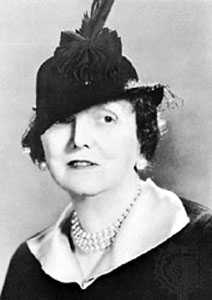 |
| Emily Post |
Indoor plumbing, which the British call the loo, has been around for a couple of centuries without stirring up much dissension. Recently, however, attention has been drawn to the outrageousness of the male habit of leaving the lid up. Popular television or something similar has put it about that walking away from the loo requires some statement of etiquette on the point of leaving the lid up or down, depending on knowing the gender of the next person in line for the facility and courteously anticipating the correct up-or-down requirements. Apparently, it's like holding a door open for someone who follows you (rather than letting it slam in their face), except it requires a degree of prediction that some people might think gets a little presumptuous. Furthermore, there is an intimation that only males are now to be required to make the proper gesture. A little thought on the matter would indicate that graceful anticipation might reasonably be suggested to either gender using a common loo. Emily Post is now regarded as fussy and outmoded, but she always offered some commonsense explanation for her rules of behavior, while this seems just a little mixed up.
 |
| Toilet |
Putting considerable thought into this new discussion topic, one important issue does pop up. If the bathroom owner happens to be a single lady, finding that her lid has been left up would seem to imply that the lady had recently had a visitor. Perhaps we are really on to something, here.
And then, there are the ladies of a certain age, whose habits are firmly fixed. Being occasionally in a great hurry, they might not notice that some ill-mannered brute has left the lid up, and suddenly find they were in cold water. It could indeed happen, but raises the question of just who has failed to develop proper habits or receive sensible training in childhood. Since the consequences might well be getting stuck, or at the least needing to get completely undressed to take a shower, perhaps outrage is somewhat justified. Certainly, one has to sympathize with the need to keep the matter secret from waiting for dinner guests. Boiling with rage at the thoughtless person who has done this to her, the frustration of being unable even to mention the matter without being ridiculed -- must be painful indeed. Most brutish males would think it was a pretty stupid situation, possibly a hilarious one. Particularly unfeeling ones might even hint this ought to be heeded as the first sign of Alzheimer's disease.
Neopolitan Right Angle
|
| Warren Buffett |
The Right Angle Club of Philadelphia recently heard from a former member, Merrill Roth, who has moved to Naples, Florida. Such retirement places are populated by people from all over the country, all anxious to show the merits of where ever they came from. So, Merrill decided to transplant one of Philadelphia's jewels to the West Coast of Florida; he started a Right Angle Club of Naples, meeting monthly in the Vanderbilt Club. By great good luck, he discovered that one day a week was Ladies Day at the golf course, an ideal circumstance for founding a men's club. Before he knew it, he had a hundred members, filling up the dining room to capacity.
So, being Merrill, he started a second one, which has now grown to thirty members. One of the central themes of these clubs is that Naples has a great many cultural events and institutions, but newcomers have trouble locating them. So his clubs fill a local need.
Since he started the clubs, he had to arrange for the speakers, and shouldering this burden for the rest of his life now seems a little daunting. So, it was useful to remind him that the Philadelphia Right Anglers of the Mother Church assign that task for only a year since most everybody can find forty friends who can speak, but nobody wants to do that forever. Other clubs encounter the same issue, and one solution has been to hire an executive director of the club and have him get the speakers. Since nobody knows an infinite number of entertaining speakers, that soon gets to be too much; and so the executive director hires a program director. Pretty soon that gets expensive, and the club starts going to agencies. The whole thing eventually loses its character as a voluntary fraternal group, gets unaffordable, and the programs wander away from the interests of the members. The only thing worse is to own your own clubhouse. The seeds of the club's destruction are sown by failing to appreciate these realities of club dynamics. Warren Buffett tells investment advisors to eat their own cooking. The club variation of that sage advice, is, get your own speakers.
Gardening Survives
Adam Levine, the author of a new book about the Philadelphia public garden scene was recently the featured guest speaker at the Franklin Inn. He's a charming person, and has given us a great book.
He draws to our attention that the Philadelphia region is pre-eminent in the garden world, and has been so for several centuries. While it is true that Philadelphia has a mild enough climate to be suitable to two climate zones, the early settlers came from a region of middle England that has been a garden center since Roman times. And they were Quakers, uncomfortable with the outward show in buildings and furnishings, but flowers were innocent instruments of the display. Although Chanticleer was created by a Pennsylvania German family, the great centers of public gardens are mostly traceable to the influence of Quakers, and the du Pont family. Since one or two years of neglect will ruin almost any garden, the essence of great gardens lies in the ability to survive.
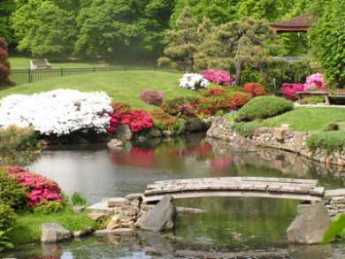
|
| The Horticultural Society |
In fact, the Philadelphia area contains hundreds of gardens which have decayed and virtually disappeared. The Horticultural Society is at the heart of garden preservation, financed in large part by the annual flower show, but even that thriving organization is hard pressed to do justice to the vast areas that need tending. Woodlands would be an example of an area needing tending, and Friends Hospital is an object lesson. When that venerable institution was sold to sharp pencil types from out of town, the Azalea gardens on the grounds were closed to visitors, except for two hours a year. It makes you tremble to imagine how long this famous azalea collection will probably survive. Meanwhile, Germantown's famous gardens are maintained in a minimal way, stretching the resources of the owners who have more urgent demands to meet in their buildings and furniture. Indeed, it is hard to name a really outstanding garden within the city limits, with the exception of the Morris Arboretum, which barely makes it within city boundaries. The area back of the Art Museum along Boathouse Row makes a brave attempt in the spring, but it's a pale reminder of the glory which used to be seen in East Fairmount Park, especially at Lemon Hill, Stenton, and Cliveden. Stotesbury is just a relic.
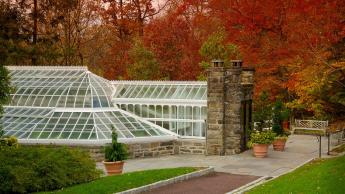
|
| Morris Arboretum |
Gardens have moved to the suburbs. Chanticleer, the Morris Arboretum, Longwood Gardens, Nemours, the Scott Arboretum at Swarthmore, West Laurel Hill, The University of Delaware in Newark, Cabrini College in Villanova, Haverford College Arboretum, Temple University's Ambler campus, and the Trenton Sculpture Gardens on the old fairgrounds -- all would demand mention in any list of outstanding gardens in America. But only a few of them aspire to the standards of an outdoor sculpture garden, where the goal was to surround each piece of sculpture with a garden in such a way that only one sculpture could be seen at a time. Now, that was gardening on the grand scale.
Hidden in a regional garden scene is the seed merchants, starting with John Bartram and famous under the Burpees, which make gardens possible. After all, there has to be a place to find these things. Perhaps the catalog stores, like Wayside Gardens, are the hope for the future. Every shrub or tree transported from a nursery takes up a ball of topsoil along with the specimen, and the appearance of nurseries around the periphery of a city is usually the first step in the development of housing projects. If there is an investment of topsoil in every garden, perhaps we ought to think a little bit about the way we let the investment dry up and blow away.
REFERENCES
| Gardens of Philadelphia and the Delaware Valley William Klein Jr. ISBN-10: 1566393132 | Amazon |
The Inky
 The Philadelphia Inquirer had a new, local, management. We wished it well. 
|
Brian Tierney, the then-new CEO of the Philadelphia Inquirer -- and Daily News -- recently addressed the Business Roundtable of The Union League. He's quite a peppy fellow, but unlike most fast-talking salesmen, appears to avoid slanting the truth in his reporting about his new job. He fired a lot of facts at the breakfast group in fifteen minutes, and in retrospect touched on several important issues.

|
| Brian Tierney |
First of all, corporate control. Because the New York Stock Exchange for years prohibited dual classes of ownership, most major newspapers listed their stock elsewhere rather than give up the tight corporate control by minority management. That seems like an unreasonable position at first; the sort of undemocratic tyranny that most editorialists would reflexly criticize. However, Knight Ritter, the former owner of the Inquirer, surrendered to high principle and listed on the NYSE by having a single class of stock. Mr. Tierney didn't explain just how this caused the newspaper chain to lose money, but was cited as an example of the reasons why the newspaper was changed to a privately held arrangement in which the shareholders agree not to sell for five years, and then give the right of first refusal to other members of the group. We'll have to wait for the passage of time to judge what the arguments are and their merits. It's apparently linked to another agreement with more intuitive reasonableness; the stockholders agree not to interfere with the journalism. We'll see in time whether this arrangement leads to journalistic integrity, or whether it leads to one of those famous uproars where an eminent editor lets it go to his head and gets fired amidst a loud chorus of criticism from the editorial pages of other newspapers.

|
| New York Stock Exchange |
And then there is the issue of unionism. Some 2000 of the 2600 employees of the Inquirer are members of some union, and this is the main source of the famous liberalism of the media. The corporations which own newsmedia get trapped into the position of proclaiming their concern for the rights of the working man so frequently that they cannot escape it in their own labor negotiations. In the case of the Inquirer, this tendency led to the conferring of full sick pay to the employees, for 42 weeks a year. While this provision is really intended to be a generous provision for extended rehabilitation from medical catastrophes, it leads to some flagrant abuses from time to time, grimly defended by a rather embarrassed union lawyer. The Inquirer was losing money and needed to lose some more to revive its position by investing in the future. No doubt there was some significant posturing by both sides when these contracts were re-negotiated by the new management. Ultimately, the fairness of the labor agreements, union or otherwise, will be judged by whether the newspaper is able to attract and retain outstanding employees. If not, it will not matter how fair the contracts appear to be.
Both television news and newspapers are slipping. Perhaps that is temporary, perhaps it does not greatly matter what medium delivers our information to us. People under the age of 30 seem to be most distracted by other amusements, and it is anybody's guess whether they will return to the news as they grow up. But one central fact about newspapers emerges. The Inquirer employs 460 journalists and pays $3 million a year to the Associated Press and other sources. The nearest competitor is KYW, which has 38. Whatever you may think about their viewpoints or the nature of the media, this is the main news collection agency in the region by a very large margin. News is created by reporters. If you don't believe that, just watch how the papers shrink during the summer and long holidays. We wish the new owners well, hope they make a ton of money, and hope they don't let success go to their heads.
Quilts, Patchwork Style
|
Although quilting can be found in the tombs of ancient Egypt, American farm women are correct that they invented an art form.
|
| Dr. Fisher |
In the days when transport was primitive, art forms were invented in many places at once, mostly responding to new materials and new technologies. It's irrelevant to the genius of creation, for archivists to pounce on evidence that an art form surfaced a decade or two earlier in one place than another. Creative art could easily have been -- and often was -- invented by five or six people in different regions, each with a just claim to inventing without copying. In the case of quilts, there is a semantic wrinkle, too. If you define quilting as the process of anchoring three layers of cloth together with stitches, then quilts have been found in ruins of ancient China and ancient Egypt. The underlying principle was that three layers of cloth were warmer and stronger than single sheets of cloth or animal skins, so quilting was used for shoes, pants, jackets, and underneath suits of armor. Mary Queen of Scots spent a lot of time in confinement, and examples still survive of tapestries she made with the quilting process. None of this is what American farm women mean when they say that "quilts" are an American invention, and a new art form.
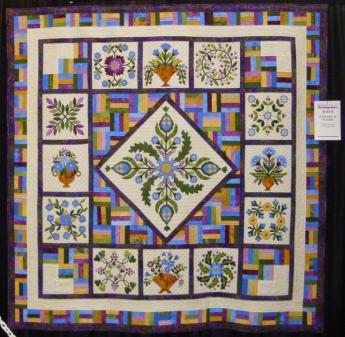
|
| Quilt, Patchwork Style |
What they mean is patchwork-quilting of bedspreads or counterpanes. To make that specific kind of quilt, you pretty much have to wait for the industrial revolution to provide decorated cotton cloth, then for it to become cheap enough to be used as sacks for flour. That attracts frugal farm wives salvaging material for dresses and shirts, and later re-salvaging pieces of it for patches. Somewhere the idea caught on that decoration was needed for the tops of beds; if these ornaments were usable for extra warmth it was even better. And so, we got patchwork counterpane quilts, incorporating different colored patches into designs. They start appearing around 1750 but gained real popularity around 1830. Since no one was keeping records, it's hard to know if the common diamond design was an outgrowth of the Scotch-Irish street "diamond", or an outgrowth of the hex signs which are commonly believed to have originated in the monastery in Germantown. The path of westward migration would have carried such traditions to the rest of the country, so this analysis has some plausibility. However, the ideas are so simple it would surely be impossible to trace them. What is so unique about this folk art is that the design can be oriented around a piece of a favorite grandparent's shirt or dress, evoking that person's presence and personality in a manner largely incomprehensible to anyone except the immediate family. This intimate quality is easily lost, even in third and later generations of the family, although family traditions can be maintained in the designs and by hearsay.
There may be other traditions of folk art evoking a particular individual who is unrecognizable to outsiders. They might admire features of the design but have no way of knowing the personality of the person celebrated, or making associations with the piece of cloth. But this quilt art becomes established as a family heirloom as almost nothing else could be. Its sweetness is oblivious to the fashion police who contribute a rather aggressive undertone to so much of the art world. For example, in the period between the first World War and the Korean War, it was just about impossible to have a non-modernist painting accepted for a juried show. The same juries who enforced such competitive dictates seemed to forget they denounced the "conservative" academics who excluded impressionist painting a century earlier. During the modernist period, disk jockeys and band leaders likewise serially enforced the various fashions of jazz music; classical music was totally banished. Book reviewers, now a dwindling race, similarly laid down standards of obedience for authors and playwrights on behalf of a style now commonly praised as "liberal". Publishers and producers defied such dictates at their peril, and now must reorient to the coming new standard, called post-modernism.
By contrast, the isolated troubadours of home quilting artistry continue to create as they please, primarily speaking to their families and selling a few less treasured products -- to uncomprehending strangers.
Chinese North
Mary Scott was recently introduced to the Right Angle Club by Buck Scott her father (and last year's program chairman.) Mary is fluent in Mandarin, lives in Beijing, and has a PhD. from Princeton. Although her luncheon talk had some of the features of a very polished travel talk with slides, it was considerably deeper than that.
|
| Forbidden City |
We learned the exiting news, easily confirmed by Google Earth, that the streets of both Beijing and Philadelphia are laid out in north-south, east-west squares. As we have noticed, Philadelphia was laid out with a magnetic compass, so Broad Street is 6 degrees off true North. Beijing, on the other hand, is almost exactly true North and South. While it is unclear how this was done two thousand years ago, it seems a likely conjecture that the Chinese architects probably used the North Star as a guide. This would have been in keeping with their notion of the Forbidden City as the center of the universe. Everything revolves around the Emperor, just as all other stars revolve around the Polestar.
|
| Great Wall |
With primitive communication, and possibly even with the modern electronic variety, it is difficult to maintain control of a large empire without decentralizing. The ancient Chinese method was to put the many sons of the Emperor in charge of local districts, which got them out of Beijing where they were only making trouble, and assigned them the job of fighting with the neighboring Mongol tribes which would keep them busy. For this reason, the Great Wall is really many great walls, as the frontier advanced and retreated. When the Emperors died, there was always a major problem of succession, but at least each son had a military and administrative track record which reduced the number of aspirants to a handful of the biggest baddest ones.
|
| Han Dynasty |
The Great Wall resembled a dragon, the symbol of the Emperor. It thus projected the image of his power out to the edges of the Empire. It had a road running on its top, greatly facilitating the shifting of defensive troops. As a defensive barrier it was only fair, having been breached many times, and on one occasion the Mongols even took the Emperor prisoner for ransom. However, the Wall's underlying purpose was to inhibit immigration, where it was probably reasonably effective. While at first the Han dynasty was mostly concentrated around the capital city, the Han Chinese gradually drove out, starved out or frightened out the others throughout the entire Empire. It is possible to see this relentless process in the recent treatment of Tibet. The underlying thought has been that if you don't exterminate them, eventually they will exterminate you.

|
| Tibetan Buddhism |
The Chinese prescription for domination has always been cultural as well as military. The Emperor was divine, far above other men. The symbolism of the dragon, of the golden color, and even the imposition of coherent architectural design on the city suggested his presence everywhere. Conversely, Tibetan Buddhism was a cultural threat from abroad, to be stamped out whenever it was safe to do so. And the recent policy of one child per mother leads to depopulation, which in turn will surely make the fecundity of neighbors a threat to China.
For thousands of years, the Chinese have worked out a system for just about everything except for peaceful succession of its rulers. That continues to be the case today, and we all better hope they eventually figure something out.
Social Disintermediation
|
A term borrowed from the banking world seems to explain the recent decline of local government, local clubs, and local news sources.
|
The growing speed of communication, especially the electronic sort, exacts its price. Western civilization spent several centuries building up valuable social structures intended to unite citizen opinion with that of their leaders. A lot of that now seems unnecessary. Most people now know how to read, write, type and press enter. A dozen systems attempt to catch up with Google in the art of telling people what they say they want to know. C-span lets us hear our leaders speak, more or less in person, and then answers our phone call, sometimes.
Quite a change from the days when people knew nothing and knew they knew nothing. Benjamin Franklin formed dozens of little clubs and societies for people of like minds to learn what was going on, and to magnify the force of their collective opinion to influence it. That's essentially why Philadelphia remains a city of clubs, but the diminishing need for such megaphones also goes a long way toward explaining the decline of clubs. The Bar Association has less importance for lawyers, the AMA less for doctors. One consequence that is noticeable is an ascension to power within such declining organizations of minority groups, fringe opinions, and other elements still desperately searching for a voice. The power elites now prefer to aspire to befriend and influencing national power centers directly, and in the process unconsciously augment the importance of centralized power. The upper layers of the government bureaucracy have become infiltrated with educated and high-minded graduates of elite schools, and toward them often go the appeals of former classmates with less plausible motivations. Quite rapidly for a social revolution, people are changing political sides, and the consequence is polarization.
Regardless of laments for the systems and institutions of the past, polarization is dissolving the old glue that binds the nation together, heedless of the new glue of electronics and instant communication with like-minded strangers. It's hard to know what people really believe about the polarizing effect of gerrymandering congressional and legislative districts because it brings people of like opinion together and people generally enjoy that. But professional analysts of the political scene focus on the effect of each ten-year census and claim that the elections of the next decade are easily predictable once you know how the revised census was gerrymandered. Contrast the difference in deportment between the scruffy members of the U.S. Congress with those of the U.S. Senate, where gerrymandering is impossible. The consequence often goes unnoticed, because gerrymandering means that people of the same opinion are more likely to find that everyone they know -- agrees with them. It's not entirely a new phenomenon. When Franklin Roosevelt defeated Alfred Landon in the greatest landslide in our history, many voices were raised that the election must have been fixed because everyone they knew voted for Landon. Something like that misperception affects many who voted in the two elections of George W. Bush, differing in these essentially tied elections only that both sides believe they were cheated. The buffering organizations, the clubs, ethnic groups, and even the political parties either no longer survive, or are dominated by die-hards.
How much of all this is just temporary disorientation, how much is a growing trend predicting the future, is unclear. The harsh and thoughtless oaths and demands which have become so disagreeably common may pass away when people get a grip on themselves, or they may escalate into our normal level of public discourse. Negative campaigning, experts say, is effective. Political campaigns get progressively harsher and dirtier as they approach election day. Money talks, and it talks by buying professional assistance to say what the buyer is ashamed to say. A political party wants to win elections above all else; those who lose elections are quickly hounded into oblivion. And yet, and yet. A slogan or two can still turn this sort of thing around. Just tell a loudmouth that he sounds like a junkyard dog, and see how quickly the listeners quiet down. It's a vicious thing to do, but it works, using vile attacks to silence vile remarks.
To a considerable degree it works because it draws attention to how little substance is to be found in these shouting matches. Someone who heard a major general gives a talk may be emboldened to offer a different opinion on combat strategy, but he still knows how little he knows and retreats at the first sound of answering fire. The person who just listened to the Chairman of the Federal Reserve talking about interest rates may claim to disagree but soon looks a fool if asked to document that opinion. The barroom orator, unrestrained by association with local opinion makers in person, is emboldened to rise to combat with the champions of the opposition. Most of us soon learn not to pick fights with the varsity, and there is at least some small hope that civility will eventually return when a few more noses get bloodied.
You can try soft reasoned analysis if you wish, but at the moment it isn't very popular.
Dog Days
Teddy Roosevelt was a great conservationist, promoting the outdoors life, establishing the National Park Service and so on. At the same time, the walls of Sagamore Hill his home on Oyster Bay were covered with the stuffed heads of big game animals he had personally shot for no better reason than it pleased him to shoot them. This paradox is a convenient symbol of the mixed-up ideas and conflicted attitudes of the public at large about animals. We love them, but we also eat them for dinner.
The two sides of this tension have at their extreme some pretty rich nut cases, or some pretty nutty rich folks, however, you wish to style them. One woman has bought half the country of Paraguay for a nature preserve. On the other extreme, it is said that one wealthy Philadelphia lady has contributed enough money to attract the solicitude the Governor, in the interest of animal rights legislation. Since his political enemies call him "Fast Eddie", that isn't his usual image. It is rumored that he loves his pet terrier, but the center city cynics gathered around lunch tables on Camac Street surmise that his really influential friends could be real estate developers. This all does require a little explaining, which is a full-time occupation in some circles.
Jim Scharnberg was entertaining Inmates the other day about his almost full-time avocation of hunting rabbits in Chester County with a pack of French hounds. Hounds, mind you, not dogs. There are thirty clubs in Chester County alone concentrated on packs of hunting hounds, not to mention all the other counties in the state, and not to mention the hunters on horseback, the fox hunters, the deer hunters, and lots of other kinds of hunters, sometimes with but mostly without guns. Most of these groups have frequent outings together in the countryside, followed by jolly dinners and gatherings, and with newsletters, websites, intermarriages and lots of other associations. Social scientists would call these networks, a trendy phrase, that..
To illustrate how easily networks are formed between hound lovers and politicians, Jim tells the story of living in Manhattan near Gracie Mansion, with his hounds of course. Hounds have to be walked, you see, and the New York police are not particularly friendly to the idea, nor are other inhabitants of the skyscraper canyons, who promote pooper scooper laws and encourage police harassment of hounds. One evening a dog belonging to a native New Yorker was attacked by 27 East River rats. Jim's hounds were unleashed, the dog was rescued. It turned out to belong to Mayor Lindsay, who was quickly persuaded to create special privileges for hounds in Carl Shurtz Park and other East Side grasslands.
|
| French Hounds |
Some members of hound packs are into the whole thing, as Jim is, but most members merely enjoy an excuse to wander in the outdoors with convivial company, or else enjoy the parties afterward; some people just like to write newsletters and send out meeting notices. Everybody likes to talk, that's one sure thing. These things flourish in the exurbs, the farm areas just beyond the edge of development. In Chester County, such farmland is quickly disappearing at the rate of 13,000 acres a year as real estate developers find it is cheaper to build in the countryside than where you have to tear down old buildings to build new ones. Inevitably, the people whose ancestors started the farms 300 years earlier are upset at seeing the old place go. There's an economic issue as well, because farmers need local canneries and wholesalers to take their farm products; these support systems tend to wither as farming gets sparser. And the new neighbors are not accustomed to farm sounds or farm smells. The idea of living next to a pig farm is not softened by the knowledge that the pig farm was there first. Perhaps you get the idea; conflict is how politics gets into it, and these are the networks who will prostrate themselves in the middle of the highway to preserve their heritage. All it takes is a couple of rich ladies to get excited enough to donate lobbying money, and wondrous inanities can get taken seriously. There is now a bill before the Pennsylvania Legislature which in other times would be referred to as a "tickle" bill, one of ten thousand annual bills submitted by legislators to placate constituents, but widely observed never to go anywhere. But put some serious money behind a tickle bill, hire a few consultants who know exactly which levers to pull and which clauses to include for support, and you could have a law to air condition all dog kennels, thus making Pennsylvania the laughing stock of the country's legislative circles. There can be rules governing the size and cleanliness of dog runs, rules about Fido's required breakfast content, and rules to sterilize every domestic animal so that in one generation we will be animal free.
Grown ups are actually saying such things, and legislators are growing afraid to oppose them. Back home in the real estate office, everybody can be all smiles. Because this is how you can get some nice zoning changes if you play your cards right.
Commercial Academic Think Tank
|
| Stephen P. Mullin |
Stephen P. Mullin recently addressed the Right Angle Club of Philadelphia about assorted economic subjects; he is certainly qualified. He was once the only Republican in Mayor Rendell's cabinet, acting first as Finance Director and then as Commerce Director. At first, he doesn't appear extroverted enough to be a politician but quickly demonstrated that he knew the first names of more of the members of the club than the president did, so maybe he does have the innate talents of a politician. Urban political machines don't usually respond cordially to graduates of Exeter and the Wharton School of the University of Pennsylvania. A number of University professors are consultants to the firm, which offers statistical economic advice to the many law firms in town, to philanthropic organizations considering public-interest projects in the region, to government agencies faced with regulating unfamiliar activities, and very likely to anyone else willing to pay for the service of academics, statisticians and analysts. It certainly sounds like a service that governments and philanthropies need, and which the region needs to avail itself of. In a way, it is probably something the University needs, as well. A friend of mine is now retired, but at one time I commuted on the train with an academic administrator of the Wharton School, who was quite obviously disturbed by handing diplomas to students who promptly took jobs which paid those graduates more than he was paid himself. Obviously, such a system cannot persist very long without creating a brain drain, so income supplementation by commercial consulting is a necessary and valuable support for academics. There are, of course, probably some negative features as well.
|
| The Wharton School |
It is interesting to hear from Steve how Philadelphia can be variously described. We have, for example, significantly less foreign immigration than other cities. New York, by contrast, has net immigration of about 700,000 persons a year; such forces can quickly transform a city in a variety of ways. The bombing of West Philadelphia during the Goode Administration was news for a while, then vanished from the papers. But it had a shattering effect on Philadelphia commerce, leading to a period of 8 or 9 years when there was essentially no private investment in the city. Philadelphia indeed now needs to have its municipal bonds issued by the state bonding authority, because our own bond rating is so low the extra cost of municipal debt is a significant one. And there is the cost of invisible shifting of power to Harrisburg. An unexpected result is that sales and real estate transfer taxes escalated to make up for property taxes which they could not possibly be raised as much as inflation. Real estate was in big trouble; whether ingenious strategies like the 10-year tax abatement for a new property will be successful in rescuing the real estate industry, remains to be seen. New office towers have been built, but they drain off tenants from older office buildings. We're seeing a massive conversion of older office space into residential apartments, an apparently successful maneuver. But that drains the older residential areas, which leads to -- well, who knows what it will lead to, but it could be slums.
|
| Mayor Michael Nutter |
The traditional hostilities between Philadelphia and its neighbors can be defined in a new way, too. For a century, Philadelphia contributed more tax money to the rest of the state than it received in state services. But in the past 20 years, Philadelphia city has become a net importer of an annual billion dollars -- from the rest of the state. Two or three billion go to the schools, which the rest of the state regards as a deplorable waste in view of the quality of the product. And yet, the most hopeful feature of the situation is the vigor and ingenuity of the attempts being made to rescue the situation. In a certain sense, Mayor Nutter is the candidate of the Wharton School. He may well have some innovative ideas, and academic places like the Wharton School will surely suggest others. It remains to be seen whether Nutter can combine idealism with sufficient ruthlessness to make the city function. Cynical oldtimers will grumble that a mayor has to employ a moderate amount of deception and corruption in order to accomplish his mission. Maybe that overstates things, but it is very certain he must be tough. He's dealing with construction unions who will certainly be tough, and whose interest in sacrificing their own agendas in order to help the schools or street crime -- always fairly small -- is even further impaired by the econometrics that 70% of them live in the suburbs. We wish our new mayor all the best, since he seems smart enough to know what needs to be done, and is definitely smart enough not to drop any bombs on houses. He's smart enough to see that extra city revenue derived from gambling might permit the lowering of wage taxes, and hence an urban business recovery. But is he tenacious enough to stay in office long enough to achieve the balanced result; or will the forces of evil simply kick him out of office before wage taxes can be lowered and gambling discontinued? He won't break his promises, but will they break them for him? Beyond being competent, a city mayor needs to be tougher than the convivial but very mean friends he needs to associate with. He must, for example, decline to run for national office, the traditional way that city machines rid themselves of pointy-headed reformers.
Durance Vile
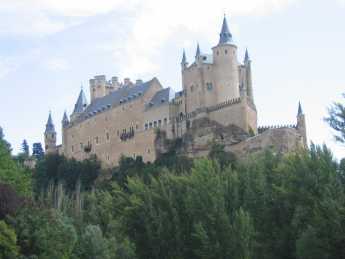
|
| Castle of Ferdinand and Isabella |
Visitors to the royal castle of Ferdinand and Isabella are routinely shown the iron grating beneath the throne, below which is a small dark hole for a couple of prisoners. By contrast, most American cities have prisons containing thousands of prisoners. At the time of the discovery of America, dungeons were places to hold a few important prisoners waiting for execution or ransom. What happened to other criminals is left to the imagination, and ranged from public flogging to public execution, often preceded by torture. Torture was not primarily a method for extracting espionage from a spy, it was a form of punishment, quite explicitly designed to horrify and intimidate others who needed the warning to prevent crime. Imprisonment was too expensive to be justified in the case of ordinary crime; in the Eighteenth Century, it was common to hang people for stealing a loaf of bread. Hanging alone might not be sufficiently awesome; the hanged criminal was often torn apart and the pieces of meat dragged through the streets by horses. In extreme cases, hanging was dispensed with and it was sufficient to draw and quarter the miscreant.
|
| Victorian Era Prison |
Without further unnecessary detail, the point must be made that imprisonment was originally devised as a humane improvement, an enlighted advance. It is nevertheless entirely true that prison conditions in every jurisdiction in every country -- are unspeakably bad. While it is probably true that public officials commonly take the view that if we must have these prisons, it is of some deterrent value to spread rumors that they are worse than they actually are. The central truth is that prisons are more expensive than most people want to spend on deterrence and punishment; so they are characteristically underfunded, and most evils grow out of the pinch-penny management which the taxpayers force on the wardens. Bleak, dank and dirty, usually a century or more old, with disgusting food, cramped quarters, and a pervasive atmosphere of suppressed violence, sometimes inadequately suppressed, these forgotten warehouses confine prisoners and jailers alike in a cloud of well-justified terror of each other. Add to this mess of the Victorian era, the more modern features of HIV, male rape and smuggled drugs, and everyone involved are ready for a new approach. If only someone could devise one.

|
| Allen Hornblum |
At the Franklin Inn recently, Allen Hornblum appalled the literary lights of the city with a description of one of the lesser but nevertheless unnecessary sins of the system, the recruitment of volunteer prisoners for medical experimentation. Forget that the prisoners are all convicted of serious crimes, often as a result of a psychopathic mindset; many of them are illiterate, bored to tears, and desperate for a little spare cash to spend on the prison luxuries of sex, cigarettes, drugs, protection from other prisoners, candy and prestige. The prisons themselves set the monetary exchange rate at $.25 a day for working in the laundry; pharmaceutical firms may be unnecessarily generous in paying a dollar a day for medical volunteers. As described in his two books, Acres of Skin and Sentenced to Science, this Temple professor felt skin experiments were particularly gruesome to behold. When the prisoners were often covered with many Band-aids over their patch tests and biopsies, it gave newcomers an immediate impression that they represented widespread fighting and violence, when of course they were mostly harmless. The language of the streets is magnified in prison, and it infects the speech of the clinical investigators no matter how hard they try to blend in while they do their work.
|
| Acres of Skin and Sentenced to Science |
Meanwhile, medical personnel in a prison are neither jailers nor prisoners, and commonly inject a worrisome outside observer status into the submerged civil war. Both prisoners and jailers court the nurses and doctors but occupy a dangerous ground. They can give out medical excuses, drugs, escape opportunities, and more or less impartial testimony if there is an outbreak of violence. Violence by the guards is observed without comment or intervention because the guards are the only hope of protection if the prisoner's riot. Guilty secrets are more or less kept inviolate, but both sides of the war distrust this ethical principle. Everybody, but especially a doctor or nurse, endures constant silent appraisal. Unattractive rumors abound.
Consequently, medical care in prison everywhere is unavoidably substandard. Although the jailhouse lawyers would love to sue somebody for something, it's hard to see what could be accomplished for more than a brief time. There seem to be a number of billionaires who would like to do something to help this situation, but what this problem needs is not more money, but a better idea. Should we really go back to flogging, branding irons and gouging out eyes? It would be cheaper, but if the reformers really want reform, they have to suggest something that would work. So we could all agree to do it.
July 4, 1776: Patients in the Pennsylvania Hospital on Independence Day
According to the records of the Pennsylvania Hospital, the following 48 persons were patients in the hospital on July 4, 1776:
| Richard Brinkinshire (Admitted 11/15/1775) | John Ridgeway (Admitted 12/26/1775) |
| James Chartier (Admitted 1/6/1776) | patient (Admitted 1/6/1776) |
| patient (Admitted 1/20/1776) | patient (Admitted 1/20/1776) |
| Mary Yell (Admitted 2/7/1776l) | John Beckworth (Admitted 2/7/1776) |
| Bart. McCarty (Admitted 2/10/1776) | John King (Admitted 2/10/1776) |
| Robert Alden (Admitted 2/17/1776) | William Patterson (Admitted 3/6/1776) |
| Elizabeth Hanna (Admitted 3/9/1776) | John McMahon (Admitted 3/13/1776) |
| Mary Burgess (Admitted 3/23/1776) | Mary Anderson (Admitted 4/10/1776) |
| John Hatfield (Admitted 4/15/1776) | Eliza Haighn (Admitted 4/17/1776) |
| Charles Whitford (Admitted 4/24/1776) | patient (Admitted 5/8/1776) |
| Susanna Carrington (Admitted 5/8/1776) | patient (Admitted 5/8/1776) |
| William Johnson (Admitted 5/13/1776) | Lazarus Chesterfield (Admitted 5/22/1776) |
| Mary Spieckel (Admitted 5/22/1776l) | William Edwards (Admitted 5/22/1776) |
| patient (Admitted 5/23/1776, Lunatic) | Jane White (Admitted 5/25/1776) |
| Charles McGillop (Admitted 5/29/1776) | ---Fitzgerald (Admitted 6/1/1776) |
| Michael Rowe (Admitted 6/6/1776) | patient (Admitted 6/6/1776) |
| John Hughes (Admitted 6/12/1776) | Joseph Smith (Admitted 6/15/1776) |
| Esther Munro Lunda (Admitted 6/15/1776) | Mathew Coope (Admitted 6/19/1776) |
| Anne Patterson (Admitted 6/19/1776) | Thomas Savoury (Admitted 6/20/1776) |
| Rebecca Winter (Admitted 6/26/1776) | Elizabeth Manning (Admitted 6/26/1776) |
| Negro (Admitted 6/24/1776) | Elex. Scanvay (Admitted 6/24/1776) |
| Fanny Stewart (Admitted 6/24/1776) | Peter Barber (Admitted 6/29/1776) |
| Catherine Campbell (Admitted 6/29/1776) | Ann McGlauklin (Admitted 7/3/1776) |
| Elizabeth Lindsay (Admitted 7/3/1776) | Ann Jones (Admitted 7/3/1776) |
The records indicate the following diseases were the reason for admission of those patients. Although in Colonial times there was no medical delicacy to avoid offending readers, present privacy standards require that we strip the diagnoses from the name of the patient and list them independently. There is some overlap, sometimes making it difficult to judge which disorder caused the admission.
- Sore, poisoned or ulcerated legs: 16 cases
- Lunacy, mind or head disorders: 10 cases
- Syphilis: 7 cases
- Fever and Rheumatic fever: 7 cases
- Dropsy: 5 cases
- Gunshot: 4 cases
- Diabetes: 1
- Blindness with clear pupil: 1
- Spitting blood: 1 case
- Dislocated arm: 1 case
- Inflammation of face: 1 case
- Scurvy: 1 case
- broken arm: 1 case
The following physicians were elected at the Managers Meeting dated 5/13/1776:
- Dr. Thomas Bond
- Dr. Thomas Cadwalader
- Dr. John Redman
- Dr. William Shippen
- Dr. Adam Kuhn
- Dr. John Morgan
Nation's First Hospital, 1751-2016
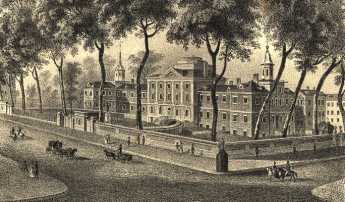
|
| Pennsylvania Hospital |
As commonly stated in medical history circles, the history of the Pennsylvania Hospital is the history of American medicine. The beautiful old original building, with additions attached, still stands where it did in 1755, a great credit to Samuel Rhoads the builder and designer of it. The colonial building on Pine Street stopped housing 150 patients around 1980, supposedly at the demand of the Fire Marshall, although its perpetual fire insurance policy still owes the hospital several thousand dollars a year as an unspent premium dividend. There may have been one small fire during two centuries of use, but its true fire hazard would be difficult to assert. It was just out of date. The original patient areas consisted of long open wards, with forty or so beds lined up behind fluted columns, in four sections on two floors. The pharmacy was on the first floor, the lunatics in the basement, and the operating rooms on the third floor under a domed skylight. It was entirely serviceable in 1948 when I arrived as an intern doctor. Individual privacy was limited to what a curtain between the beds would provide, but on the other hand, it was possible for one nurse to stand at the end of the award and recognize any distress among forty patients immediately. In this trade-off between delicacy and utility, the utility was certain to be preferred by the Quaker founders. Visitors were essentially excluded, and if a patient recovered enough to be unnaturally curious about neighboring patients, well, he had probably recovered enough to go home.
Located between two large rivers, South Philadelphia up to ten blocks away was essentially a swamp until the Civil War. So, there were seasonal epidemics of malaria, yellow fever, typhoid, and poliomyelitis at the hospital until the early twentieth century. Philadelphia was a port city, so sailors brought in cases of venereal disease, scurvy, even an occasional case of anthrax or leprosy. During the Industrial Revolution of the nineteenth century, tuberculosis, rheumatic fever, and diphtheria were part of clinical practice. But underlying the ebb and flow of environmental effects, there was a steady population of illness which did not change a great deal from 1776 to 1948. These patients were all poor, because the rules in Benjamin Franklin's handwriting restricted service to the "sick poor, and only if there is room, for those who can pay." In 1948 there was a poor box for those who might feel grateful, but no credit manager or official payment office. The matter had been considered, but the cost of collection was considered greater than the likely revenue. When Mr. Daniel Gill was offered the position as the hospital's first credit manager, it was suggested that he be given a tenth of what he collected. To his lifelong regret, Dan Gill regretted that he refused an offer that he had felt he could not afford to accept.
So, the wards were filled with victims of the diseases of poverty, punctuated by occasional epidemics of whatever was prevalent. And a second constant feature of the patients was their medical condition forced them to be housed in bed. For centuries, physicians dreaded the news that a new patient was being admitted with "dead legs".
A Woman's Work

|
| Feminism |
Whatever the gains and losses of the Industrial Revolution, reproductive need endures. Feminists who proclaim the advice to their sisters, "Have a baby; just don't have two." ignore some pretty simple arithmetic about population growth. What's perhaps worse, they fail to notice conflict with the goal of marrying rich. Rich men can afford a lot of things, but most of them can't afford a working wife. There's a fantasy in soap opera about meeting a fabulously rich man, one who owns motorboats and horses. How glamorous to be swept up by such a paragon; after all, every American hope to get rich.
|
| Big House |
, In fact, it takes training to run a big house, organize big parties, cope with artisans and servants, facilitate the complicated diplomacy of business and political affairs. A rich man expects his wife to run a big establishment, facilitate a complicated social life with those horses, sailboats and extensive travel. And she better maintains her personal glamor, too, because there are lots of younger women who toy with the idea of grabbing him in a weak moment. So even a fun time at the dress shops and hairdressers is obligatory. A man in an exalted position can't afford to have a wife who is employed in some dumb profession; the money she earns is a nuisance.
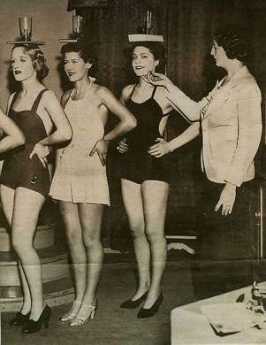
|
| Finishing School |
So that brings us to colleges and Quakers. A handful of elite women's colleges once tried to accommodate the finishing school with career preparation for blue-stocking women. The student could choose which path to follow but until recently finishing school was predominant, and comparatively few chose to be spinsters. Bryn Mawr College quickly grew to be the most prestigious college in the Philadelphia area, since both the finishing school and the bluestocking career had the needs of the upper class in mind. Quakers don't admit to an upper class but look at their colleges. Haverford was for Quaker males, Bryn Mawr for Quaker women, and Swarthmore for Quakers who fancied co-education. It was a nice arrangement, with Quaker students almost always in the minority, the rest either upper-class (read Katherine Hepburn) or brilliant scholarship students. Bryn Mawr was a little sniffy about the farm-boys at Haverford and the engineering nerds at Swarthmore. Much of that was an adolescent pose, but it created quite a rearrangement when Haverford went co-ed.
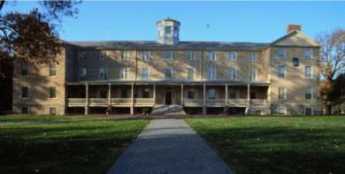
|
| Haverford College |
Almost overnight, women college applicants declared a preference for going to Haverford if there was a choice. Within a few years, Haverford students became 57% female, and Bryn Mawr suffered a decline in average aptitude scores. Why ever would girls prefer Haverford to Bryn Mawr? Indeed, if Haverford was headed in the direction of an all-female student body, Bryn Mawr would seem to be the better woman's college to pick. Somewhere buried in this adolescent stampede is probably some television-inspired confusion between the life of a suburban housewife and the life of a rich man's wife, but there certainly is a big difference in attitude about two-career families. On the other hand, there are lots more opportunities for the upper middle class than the lower upper class, both in the number of available mates and in the fall-back opportunity to try to make it as a career woman. Rich men are no longer invariably upper class, nudged by their chums to be wary of career girls. Anyway, college freshmen are pretty malleable; Haverford is a little safer bet if you aren't entirely sure of yourself.
Turtles and Bananas
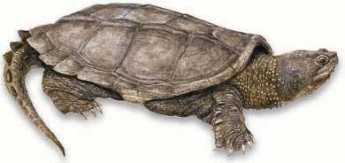
|
| Snapper Turtle |
Snapper soup, the old Philadelphia stand-by, probably got its name from snapping turtles. But for a century or two, the ingredient turtles came from the Caribbean or even further south. The huge tortoises of the Galapagos were once picked up by whalers, stored alive in the hold of the ship, to be used as needed by the sailors. Only the paws were edible. In time, the more usual imported turtle had a diameter of two feet and was picked up on South American voyages. By the end of the nineteenth century, the steamship trade was dominated by Moore-McCormack, United Fruit, and the Grace lines, who all sailed much the same kind of steamship, carrying a few passengers and a lot of cargo. Generally speaking, the cargoes going out of American East Coast ports consisted of machinery, while the cargoes coming back were bananas. If a ship carried more than twenty-five passengers it was required to have a physician on board, so passengers were either just a handful or about a hundred in number; it made for two general classes of vessel.
As a throwback to the Galapagos business of the sailing-vessel era, United Fruit would always bring home about fifty live turtles in the hold for the Waldorff in New York. It's now unclear who supplied Bookbinders and the Union League in Philadelphia, but it was apparently the same sort of arrangement: turtles came back with the bananas. It's getting hard to find snapper soup anymore; the explanation is probably mixed up with disturbances to this historical source.
www.Philadelphia-Reflections.com/blog/1481.htm
Lawn Tennis at the Cricket Club
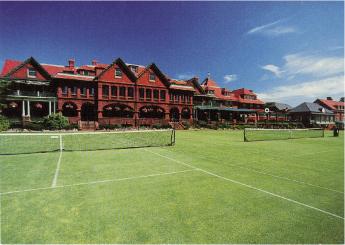
|
| Merion Cricket Club |
Lawn tennis isn't terribly ancient, having originated in England around 1880 as a variation of badminton which was brought back from India during the days of the British Empire. As the name suggests, it was originally played exclusively on grass courts, which proved hard to maintain. It was supplanted for a while by clay courts, and more recently by hard and artificial surfaces. Lawn tennis on lawns has largely become a game for the rich because of the cost and difficulty of maintaining a playable surface in hot weather.
If you wander into the Merion Cricket Club you'll find lawn tennis in the grand style, viewed from luncheon tables under a roofed porch. The long relatively narrow porch is right up against the grass courts, but it's also sort of a Peacock alley where well-groomed young ladies show their stuff, and everybody at the tables wishes to seem to know everyone else. There are times when the athletic entertainment becomes cricket out there on the field beyond the porch, but a larger proportion of the lunchers turn their backs on the field during that season than when exciting tennis championships are reaching the finals.

|
| "Lawn" Tennis |
In addition to being more expensive to maintain the courts, tennis on the grass is a different game from tennis on a hard surface, like clay or asphalt. The ball tends to skid when it hits the grass, so it is more effective to volley it before it hits or before it takes much of a bounce. The bounce tends to be more nearly straight up, while on harder surfaces the ball bounces at a low angle. Either way, the consequence is a tendency for a faster game on grass. The players run harder to get the ball at the bounce, and the advantage goes to those who serve hard and return the ball hard -- and fast.
|
| Cary Grant and Kathryn Hepburn |
The rather special nature of the game adds to the up-scale atmosphere. And makes it just as attractive for the Kitty Foyles at the tables, as for the Kathryn Hepburns, both of whom have their own attractions for the Cary Grants. The parking lot is also a good place to form an opinion about the latest in high-priced autos.
www.Philadelphia-Reflections.com/blog/1494.htm
Acorn Club of Philadelphia
.JPG)
|
| Trish Brown |
Trish Brown visited the Right Angle Club recently, and told us about our club's feminine neighbor at 1519 Locust Street. She's the charming, witty new club manager of the Acorn Club, who often left this audience of men a little nonplussed about whether she was twitting us. For example, she told us that her club's policy about publicity. The policy states in one place that publicity is welcome, but in another place mention it must not mention the club's name.
.JPG)
|
| Acorn Club |
The Acorn is the oldest club for women in America, having been founded by Mrs. Thomas Biddle in 1889. The ladies of the neighborhood had taken to having walks together, and out of this association came the club, which soon found it needed a place to come in out of the rain. It started at 1642 Pine Street and was in five different locations until the present building was built in 1956. At one time it had 900 members, now has 700, of which 200 live more than 50 miles away. Unlike men's clubs, which are seeing a migration from lunch to dinner, the Acorn heavily favors lunch, usually on the days of local art, musical and literary events. It's one of two Platinum Clubs in Philadelphia, a quality designation for the top 200 (of 6000) national clubs. If you are interested in their cuisine, it may be sufficient to know that the top favorite dessert is creme brulee.
The club dining room seats 110, with 80 seats in other rooms, and has a staff of 11. There's definitely a dress code, but for women that's a little hard to define. Trish observes that it seems to lean toward pearls.
There's a cross-over alliance with the Philadelphia Club, where the husbands of many Acorn members belong. Both clubs are doing their best to adjust to changing times and customs, but Alfie Putnam once noticed a seemingly enduring feature. The flag, he said, is mostly at half-mast.
Merging Cities With Their Suburbs
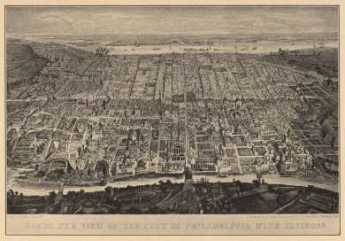
|
| Philadelphia 1854 |
When the City of Philadelphia turned into the County of Philadelphia (or vice versa) in 1854, the area had about 150,000 residents in 1850 but 500,000 in 1860. It qualified as one of the largest cities in America at the time, but what we today call middle-sized cities are about that same size. As a generalization, when a thriving American city approaches a size of about half a million, the business community often gets the idea that the city should expand its limits by annexing the neighboring districts. And, as a further generalization, the metropolitan newspapers are simply ecstatic about the idea of expanding their market reach, while the working classes of both the city and the region it proposes to swallow, are violently opposed. Since the business community typically feels that expansion would be good for business, labor unions are subdued. Leadership of the conservative middle-class rebellion is therefore generally led by the police and volunteer firemen, who are the most organized groups within the combative working class in a metropolitan region. Many citizens of all classes are of course quite indifferent about the matter. As history has turned out, only one such proposal in five will be successfully adopted, but it is almost unheard-of for a successful amalgamation to be reversed once it happens. In recent years, this general pattern has been followed in Indianapolis, Lexington, Jacksonville, Nashville, Baton Rouge, and Louisville. In countless other cities, the effort has been defeated by the voters.
It requires thriving prosperity for the business community to become politically dominant in a city, so the political context of these circuses amounts to a contest between the business "elite", often augmented by "carpet baggers from out of town" threatening comfortable lives within settled neighborhoods by merging them with culturally discordant residents in suburbs or countryside. On a political level, professional urban politicians favor expansion, because increasing the electorate generally makes it more expensive for an outsider to raise the funds to defeat them in an election. Exceptions to this rule occur when the two merging regions have different political parties in control, or when working-class city districts are so opposed that urban politicians fear to anger them. A symptom of this conflict for control of a city machine can be observed in the seemingly unrelated issue of a city charter with a "strong mayor" design. Cities with a strong city council generate greater ability to defeat the machine and are hence more reluctant to see mergers with suburbs. Nevertheless, the attraction which the business community can offer to the politicians is a larger tax base, although in the surrounding suburbs the dynamic is exactly the opposite. In the suburbs, it is the local businesses and professions who feel threatened, and who attempt to agitate the suburban politicians to protect their tax collections.
Although campaign rhetoric in these battles tends to exaggerate or distort the probable economic changes, academic studies find that the actual effect of city expansion is generally of modest subsequent growth, with modest increases in taxes. These effects seem comparatively weak since a metropolitan region is unlikely to produce a successful merger unless the economy is already growing fast enough to generate expansionism, and that vigor is likely to persist after the merger. These political uproars talk a great deal about economics, but in fact, the issue is primarily political. One commentator calls them "chess games pretending to be circuses", and the real force at work is usually an elaborate variation of gerrymandering. Urban minorities who usually vote Democrat can be swallowed up by suburban majorities who usually vote Republican. Or else a thwarted inner-city business community hopes to replace the urban machine with a more favorable suburban set of attitudes. There is seldom a uniform political gradient as the city border is approached from either side, so the chess game takes these patchwork population variants into detailed consideration. It is often argued that crossing a political boundary is unworkable, but since the thriving city of Atlanta is located in two different counties, that must not be a dispositive argument.
In their most elemental form, these expansion efforts have to do with political boundaries. It is therefore not surprising that the people most concerned are politicians. The battle cry is often to create a city without suburbs; failure to act leads to suburbs without a city. In fact, the underlying agendas are much more prosaic.
A Just Society
Recently, Chip Kelly prodded us into trying something new; it was a straight-faced rise-from-your chair discussion of the meaning of a just society. Perhaps that should be capitalized: A Just Society.
It could be that the club has for so long adopted a habit of fixed presentations, that members begin to look around for a mechanism, any mechanism, to create a general conversation among a group of fellows who have grown to know each other very well. But the tone of the ensuing remarks suggests something more is afoot, very likely growing out of the current economic Recession, with the new President calling for disruptive Change of a redistributionist sort. The old saw has it that politics and religion are best avoided in conversations among friends, but once every eighty years cannot do much damage.
|
| Bill of Rights |
Allusions to the Marxist doctrine of "from each according to his ability, to each according to his need" were actually offered, and praise was openly made of the Chinese Communist system. To which were rejoined remarks about the 40 million Chinese who died in the Cultural Revolution, and the apparent effort to add a new right to the Bill of Rights, this one called the right to a job. This suggested right implies that people have a right to insist that someone else start a business; that's not how businesses have been started in the past. That such a broad new entitlement could be suggested at a time when the nation is plainly unable to afford the existing health and retirement entitlements -- makes it clear this discussion is not entirely about economics. People in the general public are tentatively feeling each other out on these sensitive subjects, and not always pleased with what they discover. Although the demeanor is invariably civil and tentative, one has to worry that hot words are not far away.
|
| Plato |
Even more remarkably, a lawyer stood to warn against excessive lawyering; the physician who followed him pointed out that all Utopias since Plato's have suggested that physicians should run any utopia -- a questionable notion in view of the examples of Che Guevara, or Assad the current dictator of Syria, or the behavior of German doctors under the Nazi regime. In fact, the behavior of medical students has traditionally been rowdy. It isn't the training that makes the characteristic personality of a physician, it is the experience of practice. Put all doctors on salary, and you may not get the same result.
Singing Waiters
<There was a time when the Victor Talking Machine Company in Camden had not been absorbed by RCA, and so there was a Victor Records Store in South Philadelphia, run by the Di Stefano family. In 1933 after Prohibition was repealed, the record store obtained a liquor license and became Victor's Cafe. Nobody named Victor has ever worked there, and ownership has remained in the hands of the DiStefano's. The record store used to be filled with the sound of operatic arias, and now the Cafe continues with opera-singing waiters. They are susceptible to requests for favorite arias, but they also spontaneously break into song when pauses in the demands of customers give them moments of rest. The walls of Victor's Cafe are covered with autographed photos of operatic visitors; the bartender is particularly proud that Pavarotti visited there, twice. The Italian food served there is quite good, and moderately priced; the Chianti wine comes in minimum-size two quart bottles.
This isn't an advertisement, it's a review. But there is really lots of fun in trying out what is essentially a South Philadelphia hangout at 13th and Dickinson. It's Italian, all right, but it is also a Philadelphia tradition.
Globalization
|
| Peter Aloise |
The Right Angle Club recently heard from one of its own members about the complex issues involved in the topic of globalization. Peter Alois defined globalization as the development of an increasingly integrated world marketplace, although enthusiasts call it Free Trade, and opponents say it interferes with Fair Trade. Although there can be local exceptions, globalization generally leads to lower prices, so consumers are pleased, producers are worried. Since Free Trade can be defined as international commerce without government interference, globalization can also be defined as a general reduction of government influence in trade. But whether you love it or fear it, globalization is a reality; it is here.
Hindrances to trade can take many forms, including subsidies to local merchants, who then can underprice foreign competitors. Carrying things to an extreme, the French fairly recently prohibited the use of American words. While the reasoning used to justify this intrusion into private life was the preservation of the beauty of native French phonetics, this unfortunate government adventure calls attention to the possibility that one of the main functions of local languages is to make it difficult for foreigners to understand what is being said. The Anglo-Saxon response tends to note the large expense of teaching foreign languages in our schools, so why doesn't the rest of the world just stop the nonsense and start speaking English?

|
| Dubai Waterfront |
There does seem to be something about this issue related to fair play, a thoroughly Anglo-Saxon concept. When corruption of trade practices around the world is ranked, it is notable that both New Zealand and Canada, which are ranked at the top, are former British colonies. Somalia, certainly one of least British of countries, is ranked at the bottom. No doubt the French would be offended by this observation. It is also irksome to Fair Trade advocates (ie Globalization opponents) that national prosperity is also fairly parallel to Free Trade policies, absence of corruption, and so on. It was George Washington (probably ghost-written by James Madison) who most famously framed the American Doctrine: Honesty is the best policy.
Some of the members of the Right Angle Club, an outspoken lot, took up the other side of the proposition. Underpricing by foreigners leads to competitive advantage for them and loss of jobs for Americans. This dislocation is the unfortunate side of creative destruction, and a compassionate government should assist its wounded casualties. Whether it should go to the lengths of raising prices for other Americans by hobbling the foreigners, is a more open question. In the passion of argument, it was mentioned that this country was founded on such principles. Well, it would be hard to find anything written in the Constitution or spoken in its debates which supports that claim. But it must be admitted that the new nation wasted little time in creating new tariff protection for struggling new American manufactures, but took an awfully long time to get rid of what protective tariffs it already had. The confusions of the newly developing Industrial Revolution were perhaps not the best time to develop enduring principles of trade fairs, and thus we should not necessarily be held to them forever. But there is certainly room for the argument that a nation may need a certain set of policies when it is new and struggling, that are not necessarily appropriate when it becomes rich enough to claim to dominate world trade.
Block Captains
|
| Ed Asner |
A block captain is not a ward leader, at least not most of the time. The block leaders of Philadelphia are mostly self-appointed, de facto captains, and yes, they are mostly middle-aged black ladies. Their attitude is that politicians are there to serve the community, not the other way around. At a recent meeting, the leader of the Block Captain's Association called out to the nodding, approving group, "Call your councilman. We elect those people, put 'em to work!"
This enthusiastic group of several hundred grass-roots leaders meets several times a year in, of all places, the hallowed auditorium of the Philadelphia County Medical Society, but doctors are not running this show. Nor is the City Health Department, nor the Department of Streets, nor the various mental health and social service agencies that send representatives. The federal government expressed considerable gratitude in being able to address this group because their new Medicare prescription card was so terribly hard to explain (i.e. it was terribly hard to understand). The genius of the block captain movement is that it appoints leaders to understand what the establishment is trying to say, and then figures out a way to say it. You can make free flu shots available, even take them to the home or workplace, but most people won't accept them unless it is explained by someone they trust. Dead birds don't spread disease, mosquitoes do, but that really sounds a little unlikely. To believe that, you first need the word of a respected local leader. The U.S. Army is built around its sergeants, in the same way. That's in fact how things work at every social level, but in Philadelphia's black communities, it is finally becoming organized. For example, they like pamphlets. Pamphlets are what give sergeants credibility back in the neighborhood.
Success has a thousand fathers, failure is an orphan, so it's now hard to know who started this. Eve Asner, the sister of Ed Asner the movie star, can claim credit for starting a group called Philadelphia More Beautiful, dedicated to cleaning up the messes of the slums, and applying social pressures of a loud and effective sort to irresponsible neighbors. And then, along came the Deputy Health Commissioner Larry Robinson with HEAT. During a hot summer, it was possible for a hundred children and old folks to die of heat prostration because they were confused by dehydration and did things which made matters worse for themselves. The block captains were ideally situated to know who was in danger, who hadn't appeared outside in a day or two, and thus who might need to be forced to drink water or go to an air-conditioned movie. Training the block captains to recognize the signs of trouble fit nicely into the Health Department's ability to measure results with computers. Last year, only seven people died of heat prostration, and everybody knows whose block they lived in.
The Medical Society pays for everybody's lunch at the block captain's meeting, and it is a calculated policy. Every doctor knows how useless it is to talk in terms of calories, carbohydrates, high unsaturated fat content, and water-soluble vitamins. Pamphlets help, but what really works is to serve the block captains a lunch and tell them, now this is what we're talking about. Heaven only knows how that gets translated back in the neighborhood, but surely the first step is to give the block captain an unmistakable message. The Medicare bureaucrat looked visibly relieved when her painfully convoluted explanation of the Medicare prescription card was reduced to about two sentences by questioners in the audience: If you have Medicaid coverage, forget it. If you don't, that card's worth about $600. And this here pamphlet proves I know what I'm talking about.
There did not seem to be a scrap of ideology or power hunger or self-serving -- the usual hallmarks of politics as we commonly observe it. The over-riding principle on which these highly disparate groups are operating together is, pick a problem, and solve it.
Brewerytown
|
| Beer Wagon |
After the Civil War over a hundred breweries serviced by a large German population, concentrated around the Schuylkill River between Spring Garden and Girard Avenues. Lager beer requires ice, and Brewerytown by 1880 reversed the usual Philadelphia population growth pattern by spreading East from the Schuylkill caves and ice vaults toward the Delaware River wards as electric refrigeration made that practical. There were more breweries along the Schuylkill than could be accommodated anyway. Prohibition in 1919 then abruptly killed the beer industry, Brewerytown became a slum. A large real estate developer is now trying to gentrify that area, laying down rather arbitrary borders to a brewery area after all breweries have disappeared. Some heated but pointless arguments are heard about which block is, or is not part of Brewerytown; the fact is, it's hard to say.
After World War II the area was filled with deserted houses, Skid Rows, and questionable characters. The worst Skid Row was at the base of the Ben Franklin Bridge along the edge of Franklin Square, probably not within any reasonable definition of Brewerytown but certainly affected by the brewery upheaval. After this blight had been brutally cleared away, a strip between Vine Street and Fishtown/Kensington became mostly a no-mans land of vacant lots, awaiting a developer. Or an expanded Chinatown, or whatever else will eventually be drawn into large parcels of land quite near the center of the city. The vacancy rate is unusually high because of the barrier of the cross-town Vine Street Expressway, but it can't last; whatever fills this vacuum is going to make a big impact on the future of Philadelphia. Meanwhile, it's patchy, sort of like London after the blitz.

But what's behind the rise and fall of the breweries?
Beer was known to the ancient Egyptians, and mentioned by Aristotle, Herodotus, Pliny, and Tacitus as the "wine made out of barley". Grain grows better in rainy Germany, while grapes grow better in dry Mediterranean regions, so beer has long been more popular among Central European people than Latin ones. The beer itself changed very little until the time of the American Civil War when Lager beer was introduced. Ale, porter and brown stout are brewed at room temperature, but lager beer must be kept very cold from start to finish. And that's the underlying fact driving the massive expansion of beer consumption. People like cold lager beer much better than the warm stuff. In 1863, Americans consumed 3 million barrels of warm stuff, but in 1883, they consumed 18 million barrels of cold lager. Enter, Philadelphia.
At first, cold lager was brewed in caves, and only in the winter. If you wanted to go for big volume, you had to haul in tremendous amounts of ice and build massive fortresses to hold all the weight. Pictures of 19th Century Philadelphia are astonishing for the huge size of the breweries, the associated stables, and beer gardens. These things needed railroads and harbors nearby to ship out the product, and to ship in the grain, ice, glass bottles. And coal.
The underlying principle was that breweries had to generate their own electricity in order to run the refrigeration units, and the refrigeration industry itself was stimulated to develop nearby. It's probably no accident that the science of electrical engineering was largely developed in Germany during this time. Another factor required was good water, supplied by Artesian wells going down to the Raritan aquifer. And finally steam was a big ingredient, used to sterilize the bottles, brew kettles, and floors of the brewery. Cleanliness was not just a necessity, it was a fetish. Even the horses were cleaned by steam, a mass production effort requiring two minutes per horse. Lots of horses and lots of Teamsters. So many in fact the dairymen were the main audience for the local professional baseball teams.
Three things killed the breweries.
Philadelphia water became notoriously bad, and conservation movements began to protect the aquifers from excessive penetration. The cheapest refrigerant was ammonia, and its use was prohibited by local ordinances, concerned by gas warfare in World War I. But the biggest killer was prohibition. Distilled spirits were easier to smuggle in from Canada (to Boston), ounce for ounce of alcohol content. Little copper stills could be hidden in the Jersey Pine Barrens, or the hills of Appalachia, but lager breweries were here in the first place because they were so enormous and industrial. Prohibition lasted long enough to change American tastes from beer gardens to speakeasies, from beer to booze. During that period, the huge industry sort of collapsed and never revived. It's certainly true that fickle American tastes, guided by the tax laws, have once more turned from distilled spirits to fermented ones. But now it's grape wine, not barley wine that has engaged the excitement of young things on both coasts. What beer industry it is left has migrated to the center of the country, the so-called red states, and grape versus barley has become a social-political issue to be decided every four years, on the first Tuesday in November. Trace out the local liquor taxation rates if you doubt it.
Onward, Christian Soldiers
Among the ten largest cities in the United States, Philadelphia at 24% has the highest poverty rate. Why that should be so, and what should be done to change it, are questions for another article. Meanwhile, many helpless hopeless people need immediate help with problems of daily survival. No doubt, Philadelphia's long history of practical charity has acted as a magnet for victims of social problems caused elsewhere, and many of our locals who deserve some blame have moved away to more promising environments. For those who remain and want to help the immediate need, these things don't matter, just so long perhaps as emergency measures do not interfere with long-term solutions.
|
| Salvation Sign |
Among many private relief efforts, the Salvation Army is widely acknowledged to be the most efficient and most effective, as well the largest. Before the big event in 2004, it had a $3 billion budget and 3 million volunteers; an army, indeed. Except for Quaker charities, which mean to spend nothing on solicitation except through their own example, the Army spends a notable record of 91% of its budget for direct relief. In Philadelphia, they have 9 community centers, 8 residential centers, and 2 children's shelters. This is the largest charity in the United States, with branches in 110 other countries. There are 65,000 homeless people sheltered, every night.
|
| William Booth |
A moment should be spent on the history of the Army. It was founded by William Booth, who was a London pawnbroker before he became a Methodist minister. Sir Arthur Sullivan wrote "Onward, Christian Soldiers" in 1871 a decade before it became so aptly associated with the Salvation Army, and indeed before it became attached to the words of Sabine Baring-Gould . Originally the music had to do with St. Gertrude. The militarism of the organization has offended some people, even elders of the Methodist Church, and the Christian emphasis offends non-Christians. United, or Community, Funds are miffed that the Army usually will not agree to limit its solicitations to their umbrella, and modern sophisticates scorn the 19th Century traditions of Christmas Kettles, and such like. Since the main emphasis of the Army has been on relieving the problems of the Industrial Revolution, like alcoholism, drug addiction, prostitution, some see an implied criticism of modern progress, or of capitalism, or the entertainment business in general. Some people don't like the fact that most of the causes of poverty could be described as self-inflicted. You simply can't satisfy everybody. But when the rehabilitation of alcoholism and drug addiction generally carries a success rate of 25%, the Salvation Army approach -- no matter what you may think of its symbols -- is able to defend the claim of 65% success. If you don't like "Human Needs in Jesus' Name", just try "Practical Success in a Difficult Field" for a subtitle.
|
| Joan Kroc |
It thus becomes understandable that when in 2004 Joan Kroc, the widow of the founder of McDonalds Hamburger chain, decided to leave her estate of $1.5 billion to relief of the poor, she chose the Salvation Army to run things for her. Her interesting will divide the country into four parts, with 28 cities to receive $36 million grants for the construction of community centers, plus an equal amount for the endowment to run them. The size of the grants was calculated to force the local cities to match them (Philadelphia still has $20 million to go) and the endowments specify no income to be derived if the amount falls below the original $36 million, or otherwise to be limited to a 5% spending rule. She was perhaps optimistic that investment advisors could regularly produce a 17% return, and really truly optimistic if she believed our government could restrain inflation within those bounds. But a sharp business mind shines through these covenants, a very necessary ingredient of successful philanthropy.
|
| Salvation Workers |
Mrs. Kroc wanted these centers to be located in the areas of worst need; that explains the choice of a 12-acre plot in Nicetown, at the corner of Wissahickon and Hunting Park Avenues. The area now surrounding a former factory for the Budd Company has a 35% poverty rate. But after 2009 it will have an aquatic center of several swimming pools, gyms and fitness centers, a computer laboratory, arts and performing theater centers, and other more traditional Salvation Army facilities. It will also have 27 other American cities with comparable centers to share experiences with, to compete against, and to be put to shame by Philadelphia's superior ideas. We hope.
www.Philadelphia-Reflections.com/blog/1425.htm
The Jews in Colonial Philadelphia
|
| Haym Salomon |
The word Sephardi is derived from the Hebrew word for Spain, where Jews were a prominent part of the Arab community for several hundred years. The Christian monarchs Ferdinand and Isabella, regarding the Sephardim as pro-Arab, drove them out of Spain and Portugal in 1492. They scattered widely, and only a small portion eventually got to the Western hemisphere. It is also helpful to know that Askenazic is the Hebrew word for German since this other main branch of the religion did not emigrate to America until later in the Nineteenth century in response to the suppression following the 1848 Revolutions. There are some important differences in liturgy, and occasional episodes of bad feeling between the two Jewish groups, some of it kept alive by issues arising in Israel. Historically, the Sephardim have had a greater tendency to assimilate in local cultures, both generally and particularly in Philadelphia. However, the most prominent Jew in the American Revolutionary War was Haym Salomon, who was born in Poland.
On leaving Spain, many Sephardim had gone to Amsterdam, and from there to the Dutch colonies hat accounts for their presence in the Delaware Bay as part of the Dutch settlements which preceded William Penn's arrival. The British conquest of the Dutch accounts for their subsequent local disappearance. However, it paradoxically also accounts for an influx from Curacao and other Caribbean Dutch colonies conquered by the British, usually favoring New York as a place to settle. Presumably, Sephardic feelings about the English were cautious at best. When the British occupied New York in the early days of the American Revolution, many Sephardim fled to Philadelphia, but largely returned to New York after the end of the Revolution. There was thus a double process of filtering out those who were unsympathetic with the British, and those who were attracted by seeing what Philadelphia represented.
Records were poorly kept in those days, and in civil wars, there are often reasons to be vague about your sympathies and activities. We know that Haym Salomon came to Philadelphia in 1774, grew very rich in association with Robert Morris, but died in poverty after a few years, now lying in an unmarked grave. It is a little unclear how he became rich, although all merchants involved in shipping did a little privateering, often described as piracy by the victims. It is also unclear how he became suddenly poor, although speculators in currency and land often make serious misjudgments. Robert Morris is himself a prime example.
The matter becomes of greater interest when Haym Salomon is sometimes referred to as one of the main financiers of the Revolution. Partly because of the ease of counterfeiting with the primitive printing technology of the time, the British had forbidden the use of paper money in the colonies as part of the Townshend Acts. While understandable, it caused great pain to unbalanced trade partners, and metal coins quickly migrated back to England, almost paralyzing colonial economies for lack of cash to transact local business. It probably caused a different sort of a pain to Benjamin Franklin, who derived much of his income from printing the currency of New Jersey. In particular, it kept cargoes trapped in port for lack of payment, which the annoyed British merchants mistook as an implementation of John Dickinson's proposal for deliberate "non-importation". In any event, Jewish merchants and bankers were well situated to find ways around currency blockages, sometimes using precious gems as substitutes for specie, and utilizing informal family networks scattered around the world. In civil wars, guns have to be bought and paid for, legalities get swept aside. There is said to be evidence that our ambassador to France, Benjamin Franklin, utilized Salomon to translate the French loans he had negotiated into the munitions which colonials needed. There is incidentally reason to believe that the Rothschild family established its great wealth by similar commodity dealings at the time of the Battle of Waterloo.
Just what it was that went so drastically wrong for Haym Salomon at the conclusion of our war for independence has not yet been made clear, perhaps never will be. He may have been caught in the uproar over the worthless Continental currency, his ships may have been captured, or he may have been trapped by the land speculation which ruined Robert Morris. But those were rough, tough times. We have the word of those who should know, that Salomon's service was essential to our achievement of Independence.
74 Blogs
The First and Oldest Hospital in America
The history of American medicine is the history of the Pennsylvania Hospital.
Friends of Boyd
The last movie palace in Philadelphia is either ready for restoration, or the wrecking ball.
Philadelphia Food: Traditional
The oysters, crabs, and fish are having trouble with river pollution, New Jersey is filling up with split-levels, and fear of cholesterol is tough on Pennsylvania Dutch cooking. But on special occasions, it's nice to have the traditional goodies.
Phillycarshare
Those little red cars running around Philadelphia are for rent, by the hour.
Larger Clubs
No longer exclusively all-male (or, occasionally, all-female), the downtown club is changing its role but remains a social center of considerable importance.
The Definition of a Real Philadelphian (1914)
"Mrs. Pennell states the Philadelphia case with such guileless precision that it's hilarious. Quaker ladies can wield a rapier wit without hurting feelings.
Mummer's Strut
A curious and unique local custom has a long history.
Philadelphia Food: Fast Food
 Hard
Hard
Elizabethan Accents in Philadelphia
In the birthplace of American independence, there's still a lot of Olde English buried in the speech patterns.
Georgetown Oyster Eat: Separate but Equal
The Delaware Bay once teemed with Oysters, and local firehouses were supported by annual oyster festivals. A few places bravely keep up the tradition.
Fair Mount
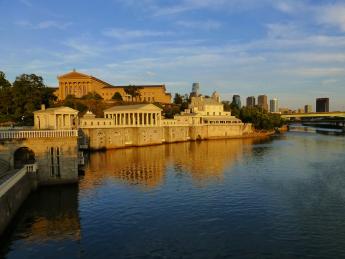 Philadelphia's acropolis is Faire Mount, where the Art Museum marks the entrance to Fairmount Park. Stretching beyond is Boathouse Row and its rowing races. When the azaleas are in bloom, it's the match of any place in the world.
Life On The River (3)
Until just a few decades ago, Philadelphia life was life along the river, with the gentry building houses upriver from the port. They were surrounded by abundant fishing, hunting, and all the sports of horsemanship.
Mussolini in South Philadelphia
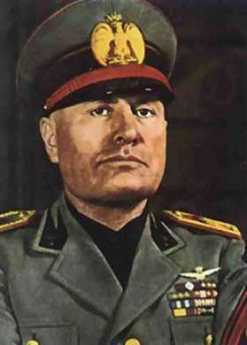 The American public had scarcely heard of Benito Mussolini before World War II, but Italian immigrants in South Philadelphia were agitated by news from the old country.
Tony Junker: Tunnell's Boys
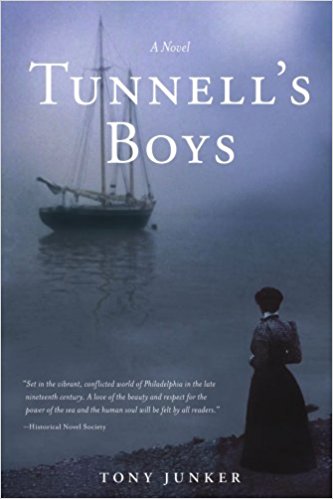 Pilots once had to race from the mouth of Delaware Bay to meet incoming ships. First one there got the job.
Field Marshal William Joseph Slim, 1st Viscount, Order of the Garter
the rises of Bill Slim from humble beginnings to the highest honors Great Britain can bestow, may seem natural enough to Americans but raises reflections about the origins of British world rule.
Quaker Efficiency Expert: Frederick Winslow Taylor 1856-1915
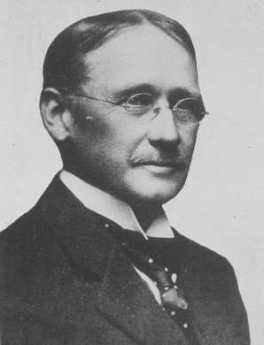 A rich Germantown Quaker boy became the world's symbol of the efficiency expert with a stop-watch, hated by Labor Unions but admired by Lenin and Stalin. He enriched the Midvale Steel Company with his invention of high-speed steel but was fired by Bethlehem Steel for eliminating too many employs. 000..0ees. Peter Drucker placed him in the class of innovators beside Darwin and Freud.
Philosophy Means Science in Philadelphia
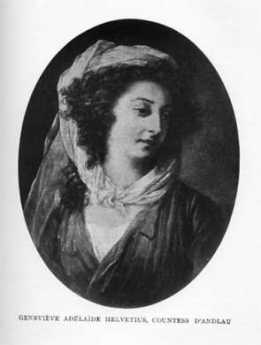 At least until he met Madame Helvetius, Benjamin Franklin displayed little interest in moral philosophy. His interest was in science, which was called natural philosophy in the Eighteenth Century. The American Philosophical Society is America's oldest and most prestigious society of scientific scholars. If investing is a science, the APS is good at that, too.
Skating and Humane
America's premier indoor skating club had its origin as a life-saving association.
Philadelphia Food: Ingredients
The region has always been surrounded by abundant fishing, hunting, and farm products.
Cricket Fanatics Say Baseball is for Sissies!
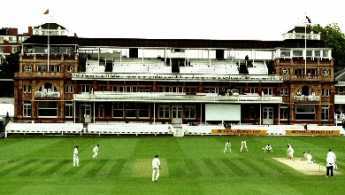 Cricket players may drink tea and eat watercress sandwiches, but they catch the batted ball with their bare hands, don't allow designated hitters, and keep playing one game for as long as five days. So, who's a sissy?
Rugby in Our Midst
Englishmen play cricket and rugby. Americans play baseball and football. The rest of the world plays soccer and calls it football.
Wall Art in Philadelphia
Several thousand Philadelphia buildings now display outdoor paintings by local artists, encouraged and funded by the City government. In the summer, bus trips with guides tour around the town, explaining things.
Community Volunteers in Medicine
A little group of medical volunteers in Pennsylvania's Chester County may not understand the underlying issues very well, but they just pitch in and do what they can about the medically underserved.
Please Touch
The Please Touch Museum, a roaring success story, is planning to move too much larger quarters in the Fall of 2008.
Corinthian Epistle
Corinth and Olympia are in Greece, both famous for amateurism in sports. A Corinthian yacht club is a type of yacht club, with no professional sailors. If you hired sailors for your yacht, and who didn't, you were supposed to keep it somewhere else.
The American Friends Service Committee
Bravery in the face of danger, both physical and social, underlies the enormous international prestige of this remarkable Quaker relief organization. Many of its achievements defy all comparison.
Settlement Music School
Without much notice, fifteen thousand music students attend six branches of a school with connections to the NAACP, ACLU, and the Bull Moose Party.
Loaves and Fishes
Philabundance comes close to automating the feeding of homeless people, drawing on the techniques of the supermarket chains.
Plain Speech
A visit to a neighboring city.
Charles Peterson and Amity Buttons
Most of our really historic buildings have an ivory button nailed to the newel post, and there is the only word of mouth to explain why. America's most famous preservation architect tried very hard to document some proof but couldn't.
Furniture for the Horse Country
Fine art is generally the product of rich people demanding something special from a nearby artisan community. Furniture making in Chester County is sort of like that.
Trenton's Tomato Pie Cult
The capital of New Jersey teaches an important lesson about ethnic food.
Citywide Social Calendar
Every city needs a central clearinghouse for timing social events, perhaps a different one for sports events, a third for conventions. And so on..
Manna
It's heartening to see Philadelphians as unlike each other as show biz, and the City Troop, coming together to help the victims of HIV/AIDS.
Wagner Free Institute of Science
The Wagner science museum may not be the oldest museum in Philadelphia, but it is certainly the only one that is exactly the same as it was in the Nineteenth Century. It's a museum museum.
Edgar Allan Poe, 1809-1849
Edgar Allan Poe may not have the highest literary esteem of any American, but he is probably our most famous poet. At the 200th anniversary of his birth, his disordered life symbolizes an era.
Philadelphia Drink
Philadelphia water has always been questionable, so there is resort to substitutes, at least for drinking purposes.
x
Blackball
To blackball someone has nothing to do with billiards. At one time, most Philadelphia social clubs required a unanimous agreement for the admission of a new member. There actually was a wooden box into which voting members dropped either a white ball or a black one.
Dr. Cadwalader's Hat
Sometimes it's hard for others to understand what makes Quakers tick.
Georgetown Returns Day
Glimpse what American democracy was supposed to be in the little Delaware village of Georgetown, even after nearly three centuries have gone by. Two days after the election, the victorious and the defeated candidates still appear for announced election results, ride around the courthouse in a carriage together, and actually bury a hatchet.
Kenneth Gordon, MD, Hero of Valley Forge
This soft-spoken child psychiatrist was mainly responsible for keeping real estate developers from building houses all over the Valley Forge encampment.
City Troop
America.
Please Don't Lose Any Sleep Over This
New research suggests that when medical Resident physicians stay up all night working, they get sleepy. When a minimum sleep requirement for doctors was suggested, administrators were a little stunned to find doctors were annoyed.
Police Athletic League
The Police Athletic League wasn't invented in Philadelphia, but it has done the city a lot of good.
A Few Rooms of Your Own
The way we live changes what we are.
Use the Internet for Your Club (2)
Clubs like to have newsletters. If you have enough news to fill one, they are pretty easy to create and maintain. However, they are a little hard to explain, so stick with us as we build up the idea.
Use the Internet for Your Club
HSP: Philadelphia's Attic
The Historical Society of Pennsylvania started out in 1824 as a repository of family treasures. Several mergers and changes of direction have given it a new mission.
Laurel Hill
Public attitudes about cemeteries continue to evolve.
House that Love Built: Ronald McDonald of Philadelphia
The idea of a temporary residence for patients and their families near a children's hospital came from Dr. Audrey Evans of Philadelphia. Initial fundraising was driven by Fred Hill of the Philadelphia Eagles. In 25 years, over three hundred others in 26 nations have independently taken up the idea.
Put Down That Lid!
The toilet, or loo, has been around for centuries. Only recently has the lid become an issue.
Neopolitan Right Angle
A transplanted Philadelphian plants a metastasis in Florida.
Gardening Survives
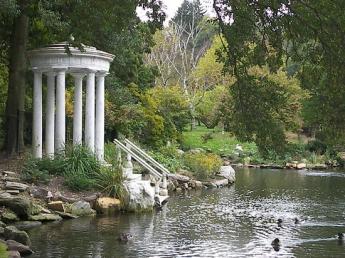 A new book has arrived, describing the 90 great public gardens of the Philadelphia regions, and discussing the best 40 of them in detail.
The Inky
The Philadelphia Inquirer had a new, local, management. We wished it well.
Quilts, Patchwork Style
Although quilting can be found in the tombs of ancient Egypt, American farm women are correct that they invented an art form.
Chinese North
Like Philadelphia, Beijing has its streets laid out in squares. Take a look from a space satellite to see how the main aisle of the Forbidden City runs due north and south..
Social Disintermediation
 A term borrowed from the banking world seems to explain the recent decline of local government, local clubs, and local news sources. Alas, the consequence of such social disintermediation is a rise of insolence, insubordination, and junkyard dog-ism.
Dog Days
Hunting rabbits with a pack of French hounds scarcely sound like a matter to agitate the Pennsylvania Legislature and its Governor, so maybe something else is afoot.
Commercial Academic Think Tank
There are universities and there are think tanks. Philadelphia has at least one commercial consulting firm which combines elements of both.
Durance Vile
Imprisonment is a comparatively recent form of punishment, only marginally better than the alternatives.
July 4, 1776: Patients in the Pennsylvania Hospital on Independence Day
Patients in Pennsylvania Hospital on Independence Day, 1776.
Nation's First Hospital, 1751-2016
The nation's oldest hospital changed more from 1948 to 2016 than it did from July 4. 1776 to 1948.
A Woman's Work
When Haverford admitted women students perhaps it meant to go all-women.
Turtles and Bananas
Snapper soup can be made from snapping turtles, but the historical source of the ingredients has been shipped from the Caribbean.
Lawn Tennis at the Cricket Club
Lawn tennis is slightly older than tennis on clay courts, but it's harder to maintain grass than other surfaces, so it's less common.
Acorn Club of Philadelphia
The Acorn Club is the oldest club for women in the United States. Men are welcome, but they come in through the side door on the neighboring alley.
Merging Cities With Their Suburbs
When middle-sized cities are thriving and growing, they tend to want to annex neighboring districts. Their newspapers are ecstatic about it.
A Just Society
 The Right Angle Club tries something new.
Singing Waiters
 Opera exists for high society, but it also exists as folk music. In Philadelphia, the folk tradition has centered around Victor's Cafe for almost a century.
Globalization
Peter Alois, now retired from a career as an international economics envoy for the Department of Commerce, discusses free and fair trade, and other issues related to globalization.
Block Captains
A remarkable group of volunteers look out for their neighbors.
Brewerytown
 Brewerytown is an unofficial term for the North Philadelphia area which filled with a hundred breweries and ethnic German residents after the Civil War. Prohibition destroyed that industry and created slums. Gentrification is now in progress.
Onward, Christian Soldiers
Like a fairy godmother, Jane Kroc has dropped a spectacular gift on the poor of North Philadelphia, and the Salvation Army. Opening in 2009.
The Jews in Colonial Philadelphia
Sephardic Jews came to Philadelphia quite early as part of New Amsterdam, with a second influx when the British occupied New York. They seem to have played an important role in financing the Revolution.