3 Volumes
Culture: The Flavors of Philadelphia Life
Philadelphia began as a religious colony, a utopia if you will. But all religions were welcome, so Quakerism mainly persists in its effects on others, both locally and in America, in Art, clubs, and the way of life.
Sociology: Philadelphia and the Quaker Colonies
The early Philadelphia had many faces, its people were varied and interesting; its history turbulent and of lasting importance.
Philadelphia Clubs
New volume 2016-02-16 21:29:48 description
Philadelphia Fish and Fishing
Less than a century ago, Delaware Bay, Delaware River, Schuylkill River, Pennypack Creek, Wissahickon Creek, and dozens of other creeks in this swampy region were teeming with edible fish, oysters and crabs. They may be coming back, cautiously.
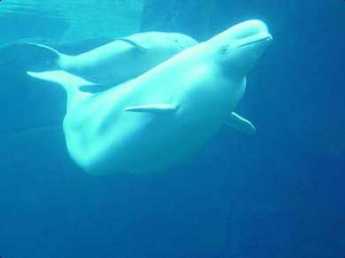
Helis the Whale
|
| Beluga Whale |
Helis the beluga whale, male, 12 feet long, said to be 30 years old in a species with a life expectancy of about 35, made an appearance in the upper Delaware River in the spring of 2005. A scar on his back was recognized as having been seen on the St. Lawrence River, where Beluga whales are more commonly observed. Needless to say, there was a local sensation, with crowds of whale-watchers along the banks of the river, sharing binoculars, and buying special whale cookies, t-shirts and the like from opportunistic vendors. Helis arrived April 14, 2005, in time to pay income taxes, go to Trenton, cruising Trenton to Burlington and back, eating shad. Experts saying he is happy as a clam, shad fishermen grumbling a little. Crowds of excited people tried to take snapshots of themselves with Helis in the background.
He stayed with us another week, going back and forth between Burlington and Trenton. Not many other events took place, so the newspapers had front-page stories by Beluga whale experts, sought out for fifteen minutes of fame. Will he come back? How big do Belugas get to be? Frantic calls by reporters obtained the information that Belugas like icy arctic waters, seldom travel alone or this far south. The suggestion was made that Helis may have been banished by the male whales he usually swims with, but others pointed out the unusually good shad run this year and conjectured Helis was an adventurous loner who had discovered a private river of goodies.
|
| Cape May NJ |
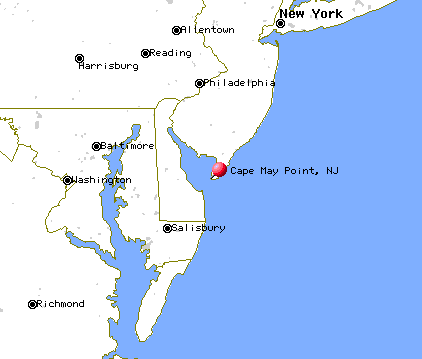
We were informed that lots of whales are sighted off Cape May every year; there's a rather large whale sight-seeing industry. Mammals don't breathe the Delaware pollution, but like other mammalian swimmers, they swallow some. So here's a sign that river pollution maybe can't be too bad.
The French Canadians call him "ee-lus" but don't expect that to catch on around here. What's helis mean, anyway? This seems to be the most southern sighting of a Beluga. Reminds us that Kingston New York, a hundred miles up the Hudson, used to be a big whaling port. that Ahab of Melville's Moby Dick was a Quaker, Nantucket variety. Cape May Quakers are related to them more than to Philadelphia Yearly Meeting. After all, Philadelphians are whale-lovers.
Unless someone harpoons Helis, we are all hoping he will bring back lots of his friends next year. Even the shad fishermen recognize that if the whales are searching for shad, there have to be a lot of shad to be attractive. And the whale-memento industry will surely be ready for them.
Shad
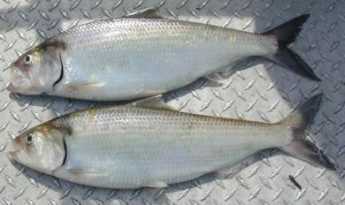
Nowadays, we have fresh fruit and vegetables all year Shadround. When produce isn't in season locally, we get it from Florida and California. When even those places are out of season, we bring it in from Chile. But the supermarket and its attendant supply chains are recent phenomena. Before the two World Wars, our food was pretty drab and monotonous during the winter. The first sign of the culinary joys of spring was shad.
|
| Shad |
Everybody loved, which everybody ate in its various forms. Shad was cheap because it was abundant; indeed, it seems difficult for the modern fisherman to imagine the huge quantities of fish that came up the rivers in early March. There was even a special term for fish weighing less than three pounds; at the fish market, such fish were thrown in, free. The term "Bushwacker" referred to the practice of beating the fish in the water to catch them. There once was a time when everybody knew how to use a shad dart, everyone could filet the bones, everyone had fried shad roe for breakfast. Spring, it was acumen in.
Unfortunately, the diversion of fresh water from upper Delaware to New York City, the dumping of waste from the oil refineries near Marcus Hook, and heaven know what other pollution, wiped out the annual shad run. Once a river's shad run is depleted, the main obstacle to getting it revived is the striped bass, who feast on the fingerlings coming back downriver from the spawning areas. You can still catch a few shad at the place where Amtrak crosses the Susquehanna, and a few hardy pioneer fish are starting to make it all the way to Lambertville. But the bulk of shad in Philadelphia markets now comes from North Carolina, and you better be alert to your timing or even they will be all gone before you've had any. There once was a time when a diner could be identified as a boorish stranger picking gingerly at the strong-tasting fish, or messing around dubiously with the unfamiliar roe served on toast. Nowadays, even lifelong Philadelphians will occasionally behave like that. You put lemon juice on the roe, dummy.
And you filet the fish. The bones of a shad are complex, going both forward and back within the flesh, so you have to be experienced to take a very sharp knife, twist, and turn, duck your shoulders and flip the fish, to produce boneless" shad0. If you don't know how to do that, you may have to bake the fish for hours to melt the bones and make it edible, but tasteless. Such products can be rescued by stuffing them with bread crumbs and spices. When things reach the point where no butcher knows how to produce boneless shad, our culture is on the edge of extinction. The big center for wholesale boned shad is Dill's in Bridgeton, NJ. There is, right now, only one place where you can obtain planked shad. That's the Salem Country Club (if you look respectable they let nonmembers in) out at the point on the Jersey side where Delaware takes a big bend before it flows down to the sea. A shad is planked by splitting it open and nailing it to a board, which is then placed before an open fire in the fireplace. Snap, crackle and wow.
Maybe the conservationists can get these fish back for us. The Eagles will certainly like that; had used to be what mainly sustained the American bird, and the depletion of the shad is part of the near-extinction of eagles. And maybe we can swallow our pride and teach the West Coast how to treat shad with respect. Shad was always an East-coast, Atlantic fish, and there is hardly a river left which has much shad. But someone transported some shad to the Sacramento, California area a century ago -- and they have flourished. Where the fish ladders of the Columbia River used to teem with salmon, nowadays they teem with shad. California likes to think it invents everything in America. Brace yourself for being told they invented shad.
Where Do Shad Go, When They Aren't Around Here?
|
| BAY OF FUNDY |
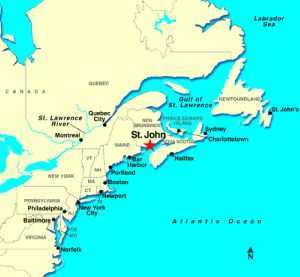
Some day, we're going to clean up our rivers, and then maybe the shad will come back. Since every female shad produces a couple hundred thousand eggs a season, when the shad come back, there could be a lot of them. We now know some things George Washington didn't know about shad. For example, they all go to the Bay of Fundy, once a year. All of them, whether they spawn in North Carolina, the Delaware, or the Connecticut River.

By tagging them, it was learned that shad swim at a depth of several hundred feet, apparently seeking a certain amount of darkness, which is in turn related to the growth of algae and plankton, their favorite food. So, when the surviving shad go back down a spawning river to the ocean, they head North in a huge counter-clockwise ocean rotation, adjusting their depth to the degree of darkness. Just about the time summering Philadelphians start packing for Bar Harbor, the shad also reach the Bay of Fundy, which is muddy and dark. Fundy is famous for its unusually high tides, so the turbulent water achieves the shad's desired degree of murkiness at about thirty feet instead of the normally deeper waters of the cyclic migration in the open ocean. People who know about these things say that just about every shad on the East Coast passes through the Bay of Fundy in late spring. In the fall, the fish turn around and start to go South again, maybe following the sun, maybe seeking a desired temperature, or both. Somehow or other, this pattern of migration helps them escape predator sharks and seals, as judged by that wholesome entertainment, the examination of stomach contents. Look out for sharks and seals in the open ocean, but striped bass are the big enemies of fingerlings in the spawning rivers. The Hudson River curiously has lots of striped bass lurking among the abandoned piers, and so does the Chesapeake. The Delaware also has a few stripers around the mouth of the Rancocas Creek; go ahead and fish 'em out.
All of this brings us to a suggestion for our tourist bureau. Shad don't eat much when they are on a spawning run, but they will strike at a lure. That is, you don't use worms, you do fly-casting. If we ever got anything approaching the old shad runs in the Spring, you could expect thousands and thousands of eager fly-casters to flock to the Delaware, filling up our marinas, hotels, restaurants, and cabarets. You wouldn't need to advertise a river teeming with eight-pound action-eager fish; the news would spread like magic. The best proof of this claim can be found on the only river on the East Coast which continues to have a classic shad run. The existence of this river was told to me as a sworn secret, but the invitation to try it was given with the assurance that "every single cast results in a strike".
And here's the zinger. Except for that one secret stream, the Delaware is the only major river on the East Coast that doesn't have a dam between the ocean and the spawning grounds. Once these fish have picked a river, they keep coming back to it, forsaking all others. The situation positively cries out for Federal assistance, and the lure-casting fishermen of America demand no less. Presidential elections have been won and lost on less important issues than this one. But just one dedicated congressman could do it, particularly if he sits on the Committee on Fisheries. Bring back our shad and get rewarded with lifetime incumbency that even Gerrymandering can't dislodge.
Life On The River (3)
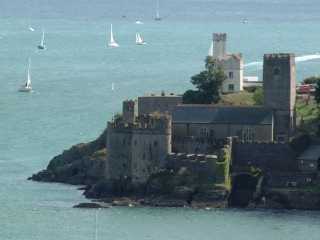
|
| Darth Mouth Castle |
All over Europe the scene is repeated: a market town and seaport at the mouth of a river, with many miles of riverbank castles in the hinterland. The seaports had to be fortified against pirates, the hinterland against marauding brigands. But the two flows of commerce consisted of baronies upriver feeding the seaport, while secondarily their seaports carried on trade with nearby river-organized economies. From time to time, someone like Julius Caesar, Napoleon, Bismarck or Hitler would try to unify the various river economies, usually unsuccessfully. In fact, the same pattern was seen along the Pacific Coast of South America, until the Incas figured out how to go along the mountain ridge in the far interior, and then come down the rivers from the sparsely populated areas to the maritime settlements at the mouth of the river, whose defenses were planned for enemies from the sea. Philadelphia followed the commercial pattern, but without fortresses and castles.
Because of the vagaries of King Charles II, and underneath that, because of marshes and their mosquito-borne diseases, the Delaware Bay was settled fairly late in colonial times -- and almost entirely by Quakers. The Dutch were interested in fur trading rather than settlement, the Dutch were anyway too few, their sovereign too indifferent, and William Penn took care of the Indians. So the English settlers had no one to fight except other Englishmen, once the French stab at Inca-like strategy was put down in 1753. After 1783, or perhaps 1812, the world finally left us alone. The Delaware Bay and River are essentially free of fortresses, Philadelphia has no castles. The peaceful sixty miles of upper Delaware Bay became lined with big farmhouses, or big Federalist and Victorian mansions. For a century, from the Revolutionary War to the Civil War, and even for a time after that, the history of this peaceful pond reads like a novel by Jane Austen.
As a playground for menfolk, it would be hard to improve on Victorian Delaware Bay. The river was full of fish, notably shad. In the fall, the migrating ducks and geese made for marvelous hunting. In the countryside behind the riverfront, houses were found all the sports having to do with horses; fox hunting, racing, horses shows. The kids could putter around in small sailboats, the adult sailors could sail a yacht to Europe if they wanted to. After John Fitch invented the Steamboat, it was possible to take a daily commute to the best male game of all -- trading, investing and gambling in the financial and commercial center of Philadelphia.
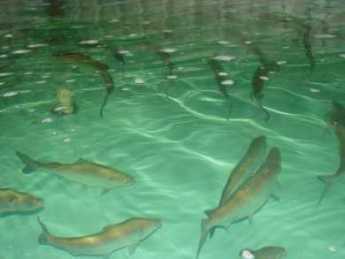
|
| Shad |
Marion Willis Rivinus and Katherine Hansel Biddle wrote a little book in 1973 called Lights Along the Delaware which tells the river story from the female point of view. The woman of the house was sort of the mayor of a little city, organizing the staff, supervising the garden, educating the children, planning the household, and organizing the dinners and social events. Educated and trained to the role, she knew what to do and enjoyed doing it. Jane Austen wrote the handbook. And while the menfolk were essential members of the cast of characters, women were the managing directors. The men were off with their horses, or sailboats, or fishing rods, or their faraway big-deal mergers and acquisitions. True, it was not a notably intellectual community, there was no Edith Wharton, Abigail Adams or Emily Dickinson. You might find some of that in Germantown, perhaps. The professions, law, and medicine, lured the more studious male members away from Society, but the international diplomatic circle was seen as the ideal career for any truly graceful graduates of this environment.
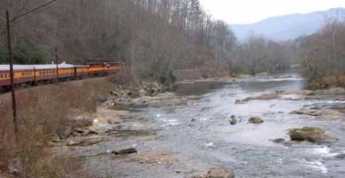
|
| Riverbank Railroad |
As the riverbank was gradually destroyed by railroads and expressways, only a few mansions like Andalusia remain in good repair. Curiously, what endures best are the clubs. The fishing club variously called the Fish House, the Castle, the Colony in Schuylkill, or the Schuylkill Fishing Company of the State in Schuylkill, has moved as many times as the name has changed. Started in 1732, it is the oldest continuously existing men's club in the world. It moved to the Delaware River from the Schuylkill when the Fairmount dam was built, and to its present location at Devon, the estate of William B. Chamberlain in 1937. New members do the cooking, cleaning, and serving, older members tell stories. When the river pollution is finally controlled, they may go back to catching the fish as well as cooking them. There's the Philadelphia Gun Club, which before 1877 was the Public Holiday Shooting Club of Riverton NJ. And then there's the Gloucester (NJ) Fox Hunt, which during the Revolution turned into First Troop, Philadelphia City Cavalry. After escorting George Washington to the battles of Boston Harbor, The Troop has been an active fighting unit of the National Guard (most recently in Bosnia) as well as a devoted center of male horsemanship between wars. The Farmer's Club, the Agricultural Society, and the Horticultural Society all reflect the rural interests that once predominated just behind the riverfront estates, still thriving aloof after 150 years of suburbia, exurbia and urban revival.
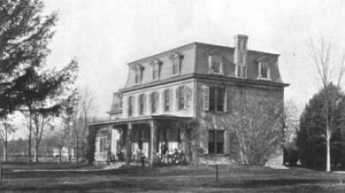
|
| Philadelphia Gun Club |
Although the riverfront industrial slums which destroyed the Philadelphia branch of Jane Austen's gracious living subculture are themselves declining and seem about to go away, it would take a real visionary to imagine how the Grand Life on the River will ever return. The banks of Delaware are much lower than the bank of the Hudson, for example. They make a great place to put high-speed rail lines and even higher speed interstate highways. The patrons of Hyde Park, West Point, and Poughkeepsie are much higher up a cliff and can overlook the river without much noticing an occasional whoosh. The mansions along Delaware have to look right at the tracks. Except for a few places like Bristol which have become isolated on the river side of the tracks and highway, it's not easy to see how you would get from here to there, or when.
Philadelphia Food: Traditional
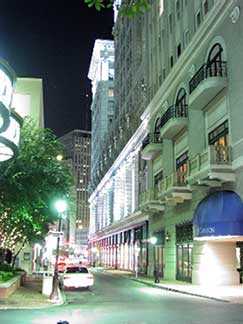
|
| The Ritz Carlton |
New Orleans is famous for its cooking, and its residents claim it is impossible to get a bad meal in NOLA. New York is famous for its restaurants, where you can get things to eat that are available nowhere else, even though there is lots of bad cooking in that city. Philadelphia is famous for its food, which puts a slightly different twist on the matter. The Delaware Bay provides seafood, the Garden State of New Jersey provides fresh fruit and vegetables, the Pennsylvania Dutch Farm area provides meat and produce, the Diamond State of Delaware is famous for poultry, and lately, the shipping for Chile brings in fruit and vegetables out of normal season. Philadelphia is within easy distance of the very best and freshest of groceries. The city responded with bakeries, meat markets, fish markets, breweries, dairies. One by one, the latest ethnic arrivals brought in new recipes, quickly modified to fit the local style. All of this explains why Philadelphia can be famous for its ice cream, for example, even though it was not invented here as some local patriots carelessly contend.
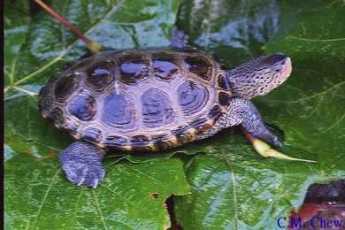
Snapper soup is certainly one of the traditional Philadelphia dishes. To make it in the traditional way, you have to dedicate a stove for the process. New material is dumped in the top and today's soup is taken out the bottom, imitating the process for making sherry wine. The Old Original Bookbinder's restaurant had such a dedicated stove, but it has gone out of business, apparently leaving the Union League as the only traditional snapper soup source. Philadelphia Pepper Pot Soup is pretty much the same as Snapper soup, substituting tripe for the turtle as the meat base.
Scrapple is not to everyone's taste in this age of cholesterol fears, but it is certainly a locally famous dish, usually served as fried slices for breakfast. Scrapple is actually a mixture of cornmeal mush and Pennsylvania Dutch Puddin', a stew of scrap meats which is also sold as a chilled loaf. Puddin' is a dish for real traditionalists who have inherited low cholesterol to protect them from it. Only one or two old stands in the Reading Terminal market still carry it, and then only at butchering season. The Reading and Lancaster farmers markets are a more dependable source for Puddin', and Scrapple survives as more popular because it can be obtained in cans in the supermarkets. While you are there in a farmers market, you might get a loaf of head cheese, which substitutes gelatin for congealed fat as the binder for cooked meat chips with spices. Among the local heavy breakfasts must be mentioned stewed kidneys on waffles. The local belief is that this surprisingly delicious dish was introduced from Virginia, by steamboat vacationers to Cape May who mixed with Philadelphia vacationers at places like the Chalfonte Hotel, where stewed kidneys can/may still be obtained on Sunday morning.
Cinnamon buns, or Philadelphia Sticky Buns, are a local delicacy with the tradition of coming from Saxony in what is now Germany. The more butter and sugar the better, and real Philadelphians fry the sticky buns for breakfast. Out in San Francisco, they are famous for sourdough bread, while in Philadelphia the locally famous bread is black bread, a form of pumpernickel. Unfortunately, it is easily imitated by putting cocoa in white bread, so you need to lift a loaf before you buy it. Real black bread is as heavy as a cannonball, and about the same size and shape; it's even better with raisins in it. Toasted Crumpets are a Scottish introduction to the town's traditions, ambrosial if you can get fresh crumpets. Crumb cake is another traditional breakfast bun, known as coffee cake in the Dutch country, and imitated in commercial form as Tastykake.
|
| Snapper |
When turtles were more abundant, snapper stew, fried oysters and sherry were favorites, but now terrapin is such a rarity that it is saved for special occasions and special guests. It's usually served in a cream sauce in Philadelphia, whereas cream sauce is called abhorrent in Baltimore. Because of the availability problem, the party dish nowadays is apt to be fried oyster and chicken salad, and even oysters are getting a little scarce.
No one seems to challenge the idea that iced tea originated in Philadelphia, and in the Dutch Country, it is quite common to have iced tea 365 days a year, pitcher after pitcher. Let's not forget meatloaf, and corned beef hash with an egg, which is both perfectly delicious when served by someone who knows how to make them. They sound like leftovers, but it depends on where you get them. In the men's clubs, and in some Reading Terminal Restaurants, they are a star feature of the menu.
|
|
| Shad |
Around March 15, it is a good idea to ask if shad or shad roe is available. The trick is to get the fish with the bones removed. In recent years, shad is increasingly abundant, but it isn't so easy to find a butcher or chef who knows how to excise the bones while leaving the filet intact. At the moment, just about the only place that serves traditional planked shad is the Salem Country Club, out on the tip of the abrupt bend in the river above Salem, New Jersey. The ceremony is to split the big fish and nail it to a board, which is then placed in the open fireplace to cook, snapping and popping while its marvelous aroma fills the dining area. Owen Johnson once wrote a famous Lawrenceville book about The Tennessee Shad, so other towns must enjoy shad, too, but we wouldn't really know.

Special Philadelphia dishes may be a little hard for the tourist visitor to find. If you click on this link , you'll find a website put together by an enthusiast, who lists some of the better places for a wandering tourist to find local specialties. Philadelphia has quite a few high-toned fancy sit-down restaurants, too, but these are cheap, good, and easy to find.
Philadelphia Food: Ingredients
|
| Super Market |
There was a time when locally grown farm produce was much more critical than it is at present. There were even resort hotels with their own farms that offered fresh vegetables as the main attraction for vacationers, but now almost any supermarket will supply reasonably good produce to most places in the country. Nevertheless, certain things like fresh corn on the cob must be cooked and eaten almost the same day they are picked, and such seasonal local produce is better around Philadelphia than any other metropolitan area.

|
| Campbell Soup Kids |
The states of Delaware and New Jersey were once Atlantic barrier islands, so the sandy loam is particularly favorable for growing asparagus, for example. An asparagus field is planted as perennials, with new shoots harvested by stoop labor fields of asparagus is difficult to plant and quite valuable once established. Tomatoes are annuals, which in their finest form will continuously produce all summer. It's only worth planting "steak" tomatoes, or so-called Jersey Tomatoes, if there is a local market willing to pay premium prices for the fact that the human picker can tell a green one from a red one. The tomato industry which once supplied Campbell Soup to the world has now mostly moved to California where improved varieties of soup-grade tomatoes all ripen simultaneously, thus can be harvested with machinery at a single pass. Lancaster County in Pennsylvania boasts the best topsoil in the country, although it must be admitted that the glaciers dumped topsoil fourteen feet deep around northern Illinois. Such topsoil is almost too valuable to be used for truck gardens. Lancaster County grows fodder for cattle, and the cattle are hidden away in barns where passersby never see them, just as you never see chickens when you drive through Delaware. What visitors see are silos in Lancaster County and chicken sheds in the lower counties, and acres and acres of animal-feed crops (field corn and soybeans) surrounding the farms. A century ago, all those Swamps("wetland") around Delaware Bay held lots of ducks, geese, quail, and other game, but the game is less popular than it used to be. Location, location is always the true source of value, and in this case, the source of good Philadelphia food is the local location of a vast variety of fresh produce.
|
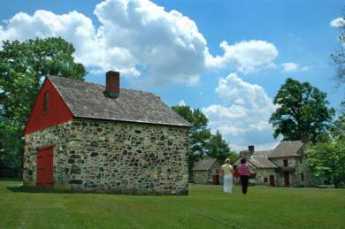
| Brandywine Battlefield |
Somewhere, the story needs to be retold of the mushroom growers of Kennett Square. This little nondescript town near the Brandywine Battlefield at the top of the state of Delaware was the mushroom capital of the world. It stayed that way for generations, by keeping the secrets of the mushroom trade a strict family secret. Among the various oddities was the production around Thanksgiving time of the first crop of the season, which were often as large as grapefruit, and usually only given to members of the family or special friends actually to be carved at the Thanksgiving table next to the turkey. During the Second World War, Franklin Roosevelt (his daughter-in-law was Ethel DuPont, who lived nearby) personally appealed to the mushroom farmers to reveal their secret methods to the makers of penicillin, needed for the war effort. The farmers gave it up, penicillin saved thousands of lives. And nowadays, most mushrooms in American supermarkets are grown in Taiwan, flown in at prices the Kennet Square growers cannot match.
Real estate developers are doing their best to fill up those truck gardens with split-level houses, of course, and the lovers of good food are allies of the lovers of the environment. So, the individual householder needs to know how to find the Red, Blue and Green Dot roadside farm stands along the highway to the Jersey shore, when the Jersey corn, tomatoes, and melons are at their best, or earlier in the year when Jersey berries are available. You need to know about the Reading Terminal Marketplace, the South Philadelphia street markets, the ethnic neighborhood butcher shops and bakeries, the Kutztown Fair and the farmer's markets in Lancaster County. It's surprising what you can order over the internet, but for the really choice fresh produce in season, you have to hunt around a little.
The farmers of South Jersey have traditionally been Quakers. One Quaker family named Taylor has had a farm right next to the Delaware River in Cinnaminson, just north of the Tacony Palmyra Bridge, since the days of William Penn. Taylors signed the 1783 minute of the Yearly Meeting of Quakers to the Continental Congress, advocating an end to slavery. As the Cinnaminson area became built up, the Taylors had a thriving fruit and vegetable stand, which was left unattended. That is, Joe Taylor brought out the corn and other produce and left it on the stand, while the customers just came up and left their money in a box on the same table. No one stole the money for a century, just as no one in the neighborhood ever locked the door of his house. As things evolved, Joe Taylor, Jr. eventually won the 1993 Nobel Prize in Physics for discoveries helping to explain the force of gravity. But in time, the family decided to give up the farm and turned it over to the State as a nature preserve. Undoubtedly a major factor in the decision, if not the only deciding factor, was the repeated discovery that people were stealing the money from the vegetable stand box.
|
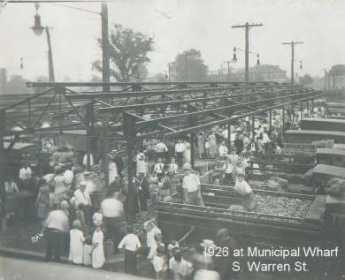
| Market on Spruce Street |
For the most part, however, the supermarkets and the chefs of Philadelphia's restaurant revolution nowadays just need to go to the South Philadelphia Food Distribution Center, down in the old filled-in swamp and garbage dump area at the foot of the Walt Whitman Bridge. This is Harry Batten's gift to his city. The former chief of the N.W. Ayer advertising agency made it a personal crusade to put across a remarkable transformation in his home town. Until well past the Korean War, wholesale food distribution took place in the streets of the former Society Hill, never mind how historic it is. Traffic was at a crawl, cartons of vegetables were strewn over the streets, the noise and stench of America's Most Historic Square Mile was a disgrace. The city was persuaded to set aside land for the purpose, and the wholesale grocers were persuaded to move their warehouses to one combined location with rail, bridge, highway and local access. Within months of opening, the wholesale grocery business had moved to the new location, where it became an international marvel. Meanwhile, Charles E. Peterson bought a Spruce Street mansion that once belonged to Stephen Girard from the old Spruce Street Osteopathic Hospital for $8,000.00, rehabilitated it in absolutely authentic style, and moved into the new home, himself. Society Hill Restoration had begun, Philadelphia's restaurant revolution had begun, a great many people became millionaires out of the commercial side of the process, tax ratables soared, tourists poured into the Independence Park area and Penn's Landing and the Camden waterfront. It's been a long time since Harry Batten's name was heard much, but he ought to have a bronze statue sixty feet high. As the Quakers say, you can do anything if you have leadership. And leadership is one man.
Lambertville and Lewis Island
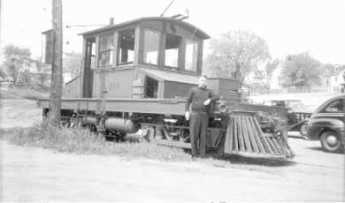 |
| Atlantic Shore Railroad |
Recall that open Atlantic shoreline once stretched from Perth Amboy to New Castle, Delaware. Glaciers pulverized the nearby mountains and dumped a huge moraine of sand into the ocean, creating southern New Jersey as an offshore island in geological times. The bay silted up and eventually attached that island to New Jersey. The silting-up probably would have continued for another sixty miles, making Philadelphia a land-locked inland city, except that the true
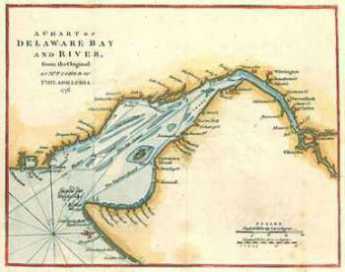 |
| Delaware River |
Delaware River came tumbling down from the mountains to Trenton, turning sharply right and then maintaining an open shallow channel to the sea. From Lambertville to Trenton, the river drops over a series of small falls or rapids, easily visible except when heavy rains "drown" them.
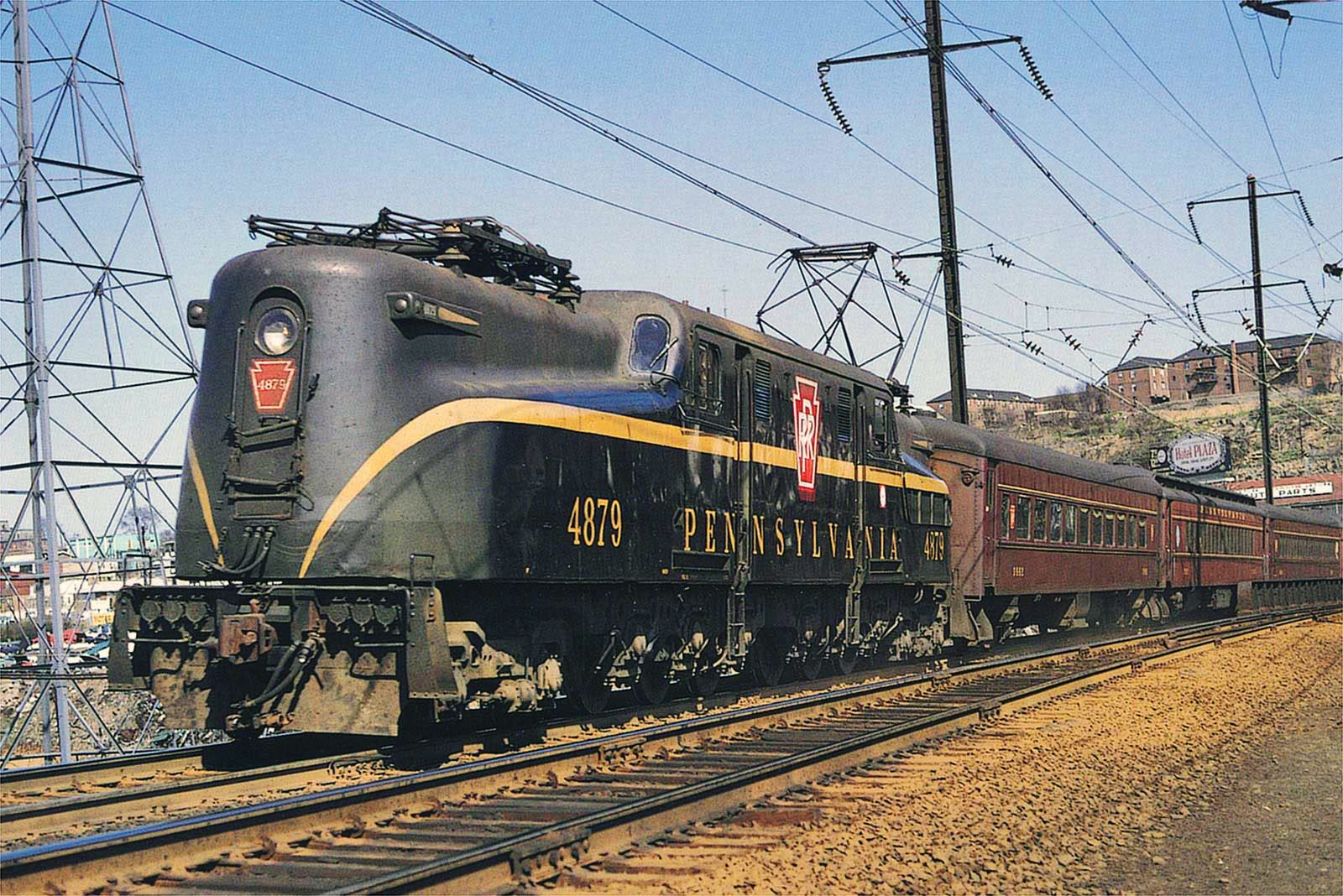 |
| Pennsylvania Railroad |
So, geography accounts for the scenery and early history of the upper end of Delaware Bay. It's still a beautiful hilly countryside with small antique villages, sparsely populated in spite of two nearby cities. Water power at the Fall Line, and then anthracite from the upstate mountains once encouraged early industry in an area that was rather poor farm country. But the Pennsylvania Railroad then rearranged commerce so that a blossoming New Jersey industrial area withered into quaintness. The early railroads mostly all ran East-West along the rivers, since investors in Atlantic port cities obtained both finance and protection from their state legislatures; railroads had almost reached the Mississippi before any were able to establish North-South connecting spurs. A seaboard trunk line was almost impossible to imagine. Finally, a consortium organized by
J.P. Morgan bullied through the main trunk line running through the bituminous coal areas of Pennsylvania and on to the West, with the major port cities connected by the great Northeast Corridor of the Pennsy. This corridor would run on the Pennsylvania side of Delaware. Industry on the bypassed New Jersey side would just wither and decline, and eventually so would the anthracite cities. Since the original colonies and states all ran from the ocean to the interior, each had a vital political interest in resisting this outcome. Only a strong and brutal corporation could bring it off.
When George Washington was circling around Trenton to attack it on Christmas, a narrow spot up-river with a dozen houses on either side was called Coryell's Crossing or Ferry. That's now Coryell Street in Lambertville, linked to the other side of the river at New Hope, after first crossing a narrow wooden bridge to Lewis Island, the center of shad fishing, or at least shad fishing culture.
The Lewis family still has a house on Lewis Island, and they know a lot about shad fishing, entertaining hundreds of visitors to the shad festival in the last week of April. The river is cleaning up its pollution, the shad are coming back, but they, unfortunately, took a vacation in 2006. At the promised hour, a boatload of men with large deltoids attached one end of a dragnet to the shore, rowed to the middle of the river, floated downstream and towed the other end of the net back to the shore. The original anchor end of the net was then lifted and carried downstream to make a loop around the tip of Lewis Island, and then both ends were pulled in to capture the fish. There were fifty or so fish in the net, but only two shad of adequate size; since it was Sunday, the fish were all thrown back.
But it was a nice day, and fun, and the nice Lewis lady who explained things knew a lot. Remember, the center of the river is a border separating two states. You would have to have a fishing license in both states to cross the center of the river with your net; game wardens can come upon you quickly with a power boat. But the nature of fishing with a dragnet from the shore anyway makes it more practical to stop in the middle, where shotguns from the other side are unlikely to reach you. An even more persuasive force for law and order is provided by the fish. Fish like to feed when the sky is overcast, so there is a tendency on a North-South river for the fish to be on the Pennsylvania (West) side of the river in the morning, and the New Jersey (East) side in the evening. During the 19th Century when shad were abundant, work schedules at the local mills and factories were arranged to give the New Jersey workers time off to fish in the afternoon, while Pennsylvania employers delayed the starting time at their factories until morning fishing was over.
Somehow, underneath this tradition one senses a local Quaker somewhere with a scheme to maintain the peace without using force. Right now, there aren't enough fish to justify either stratagem or force, but one can hope.
Founding Fish
|
| Potomac |
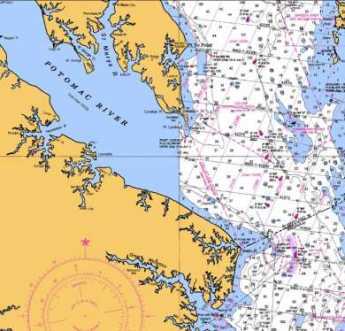
In 2002, John McPhee brought out a perfectly splendid book about fish and fishing history in this region, with particular emphasis on shad. He makes the whole topic remarkably interesting, but you have to be a little wistful about the way he demolished a splendid story of fish in Philadelphia during the Revolutionary War. The book is called The Founding Fish.
As everyone knows, George Washington and the Continental Army were starving and freezing at Valley Forge, a few miles up the Schuylkill, while Major Andre and the other British officers were cavorting downtown with the Tory ladies, grr. The story has long been told that things got to a desperate state at Valley Forge when, lo, the annual shad run was several weeks early and mountains of fish came roaring up the river to the excited shouts of the starving patriots and rescued the raggedy starving Continental Army. It would make a wonderful scene in a movie.


McPhee tells us that George Washington was in fact a shady merchant, having caught and pickled many barrels of shad coming up the Potomac River. The annual shad excitement was no news to him, and it seems quite possible he selected the campsite at Valley Forge with this spring event in mind. Shad was no news to the British, either; there are records of their trying to block off the Schuylkill with nets to prevent the fish from getting upriver to Valley Forge.
Unfortunately, a careful search of letters and records fails to record any shad run earlier than April that year. The rescue of song and story does not appear in contemporary documents. What's more, some unnecessarily diligent scholars have sifted through the garbage heaps of the encampment area, and have only found pig and sheep bones, no shad bones.
Those graduate students undoubtedly deserve to be awarded degrees for their work, especially the digging in garbage part. But nevertheless, it all does seem a pity to ruin a good story that way.
The Swamps of Philadelphia
|
| Fort Mifflin |
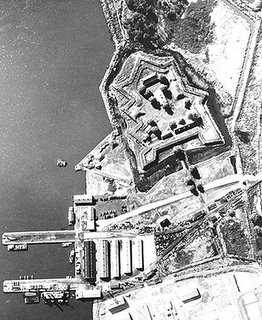
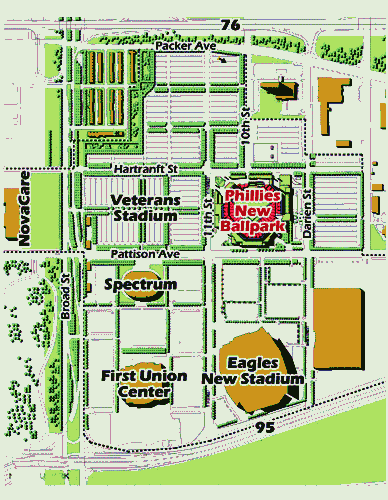
Fort Mifflin has been restored, somewhat, and gets a surprising number of visitors at Hallowe'en. The explanation offered is that it seems somewhat spooky. A far greater number of people go to Philadelphia International Airport, or the several sports stadia constructed nearby in a project whose financing is described as "borrowing to expand the tax base". In so doing, visitors travel at some height above the edge of the now-closed Philadelphia Naval Base, with a large number of very large naval vessels in storage, the so-called Mothball Fleet. All visitors are naturally impressed with a view of the wide expanse of the deep and impressive Delaware River. How could such a mighty river be the site of mud islands and narrow channels so shallow that British sailboats couldn't navigate past the Friesian Horses sunk on the bottom?

Well, as water spreads out, it gets shallower. Conversely, as water is compressed into narrower channels, the channel gets deeper, eventually deep enough for nuclear aircraft carriers. So, think back to the days when the Dutch sailed around here, finding the first solid land along the Schuylkill at Gray's Landing, opposite where the University of Pennsylvania now has a row of medical skyscrapers on the West Bank. Everything South of that point was once swamp, so there were miles and miles of shallow water before you got to the Delaware; you could sort of say that the Delaware River was five miles wide at that point. Lots of fish, and ducks, muskrats and beaver.
The main highway to the South, the one that Washington and Jefferson traveled regularly, ran near Gray's Landing, along the edge of the great Philadelphia swamp. Later on, the railroads were built along the same path, and the industrial devastation of that area was accelerated immediately. It was a natural place for "landfill", which is to say it was a good place to dump garbage. By 1940, you had to drive for miles through garbage dumps to reach the Municipal Stadium, where the Army-Navy football game, attended by 105,000 spectators, was played in the freezing winds. The Naval Yard had been moved from the foot of Federal Street to a filled-in island near Fort Mifflin and provided a railroad spur on which the President of the United States regularly parked his private railroad car as he attended The Game. Some enormous liquor distilleries were built near the garbage dumps, and it was difficult to prove which was responsible for the greater odor. World War II caused a great proliferation of war industries on the banks of the river to the South, and the gasoline refineries in the area added to the aroma and river pollution.

In time, the garbage dumps were covered with dirt, and thousands of houses were built where the mosquitoes used to swarm. When the wartime river traffic declined, unemployment set in, and housing got cheaper, even abandoned. With abandoned housing comes slums, and there, in a nutshell, you have South Philadelphia, waiting for an industrial revival. Meanwhile, the swamps are mostly gone, and the river is a lot deeper.
Draining Suburbia
|
| Creek |
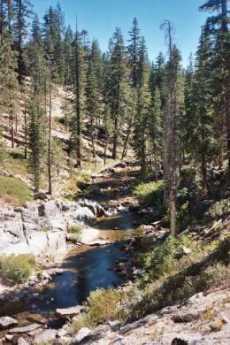
Philadelphia's triangle of land between two large rivers once was laced with streams, brooks, and creeks. These were great places to catch fish, especially trout, and they had what poets call mossy banks. Nowadays, these streams are enclosed in culverts or their exposed banks are sharp cliffs of clay. Few people have heard of Indian Brook, which was once the brook that ran through town but is now the brook underneath Overbrook.
The Conservancy has given thoughtful consideration to the consequences of building hard surfaces on top of what was once spongy soil. The streets, the roofs, the driveways of progress, of development, cause immediate runoff of water after a rainstorm instead of allowing seepage into the soil and gravel of the wilderness. The rain of a storm quickly surges into the storm sewers, and surges into the neighboring creeks, scouring the banks in a flood surge. The grass slopes cannot withstand such a housing, leading to sharp clay banks, which become undermined by later storms, toppling trees. The clay material from the banks makes the streams muddy, and the deposits of clay suffocate the insect larvae and fish eggs on the stream bottom. It's perhaps true that there are fewer mosquitoes, but there are no fish. The matter is compounded by the heating of the water as it drains over large sunlit surfaces like shopping mall parking lots, and the different water temperature in the streams changes the insect and fish content, too.
It's almost hopeless to do anything useful in the downtown city areas, where the former streams are not only enclosed in pipes but run underneath skyscrapers. There may even be too much disruption involved to contemplate doing anything useful in towns which allowed storm sewage and sanitary sewage to flow in the same pipes. But it would be a comparatively simple thing to divert rainwater into gravel driveways or out over lawn areas since the goal is to slow its flow into the streams rather than dispose of it. Local ordinances could require such forethought for new construction, and perhaps make construction permits conditional on it. Many suburban homeowners would probably follow suit voluntarily, and gradually the situation might come under control with education and minor pain.
There are other approaches that would get results quicker. In present China, "infrastructure" is upgraded much more directly. One recent visitor was discussing the problem of construction in an area where there was a Chinese town. He was told not to worry about it. The next time he visited the area, that town would be gone.
Native Habitat
|
| Gifford Pinchot |
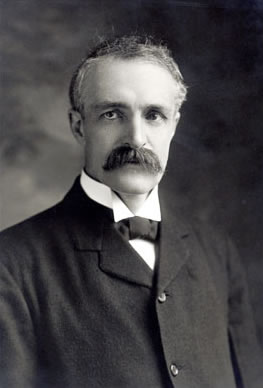
Teddy Roosevelt's friend Gifford Pinchot is credited with starting the nature preservation movement. He became a member of the Governor's cabinet in Pennsylvania, so Pennsylvania has long been a leader in the formation of volunteer organizations to help the cause. Sometimes the best approach is to protect the environment, letting natural forces encourage the growth of butterflies and bears in a situation favorable to them. Sometimes the approach preferred has been to pass laws protecting threatened species, like the eagle or the snail darter. Sometimes education is the tool; the more people hear of these things, the more they will be enticed to assist local efforts. The direction that Derek Stedman of Chadds Ford has taken is to help organize the Habitat Resource Network of Southeast Pennsylvania.
|
| butterfly |
The thought process here is indirect and gentle, but sophisticated; one might call it typically Quaker. Volunteers are urged to create a little natural habitat in their own backyards, planting and protecting plant life of the sort found in America before the European migration. If you wait, some insects which particularly favor the antique plants in your garden will make a re-appearance, and in time higher orders like birds that particularly favor those insects, will appear. The process of watching this evolution in your own backyard can be very gratifying. To stimulate such habitats, a process of conferring Natural Habitat certification has been created. In our region, there are over three thousand certified habitats.
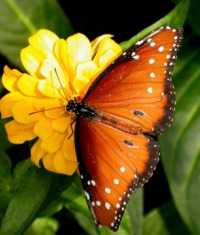
Of course, you have to know what you are doing. Provoking people to learn more about natural processes is the whole idea. For example, milkweed. That lowly weed is the source of the only food Monarch butterflies will eat, so if you want butterflies, you want milkweed. For some reason, perhaps this one, the Monarch is repugnant to birds, so Monarchs tend to flourish once you get them started. After which, of course, they have their strange annual migration to a particular mountain in Mexico. Perhaps milkweed has something to do with that.
|
| Empress tree |
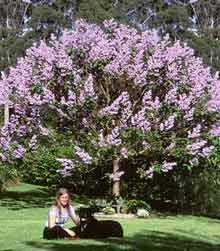
If you plant trees and shrubs along the bank of a stream, the shade will cool the water. That attracts certain insects, which attract certain fish. If you want to fish, plant trees. And then we veer off into defending against enemies. The banks of the Schuylkill from Grey's Ferry to the Airport are lined with oriental Empress trees, with quite pretty purple blossoms in the Spring. These trees seem to date from the early 19th Century trade in porcelain (dishes of "China" ) on sailing vessels. The dishes were packed in the discarded husks of the fruit of the Empress tree, and after unpacking, floated down the Schuylkill until some of them sprouted and took root. Empress trees are certainly an improvement over the auto junkyards hidden behind them. On the other hand, Kudzu is an oriental plant that somehow got transported here, and loved what it found in our swamplands. Everywhere you look, from Louisiana to Maine, the shoreline grasslands are a sea of towering Kudzu, green in the spring, yellow in the fall. It may have been an interesting visitor at one time, nowadays it's a noxious weed. So far at least, no animals have developed a taste for Kudzu, and no one has figured out a commercial use for it. When an invasive plant of this sort gets introduced, native habitat and its dependent animal life quickly disappear. So, in this situation, nature preservation takes the form of destroying the invader.
|
| Charles Darwin |
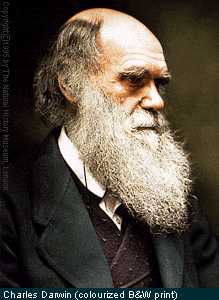
But where is Charles Darwin in all this? The survival of the fittest would suggest that successful aggressors are generally fitter, so evolution favors the victor. Perhaps swamps are somehow better for being dominated by Kudzu, pollination might be enhanced by killer bees. At first, it might seem so, but if the climate or the environment is destined to be in constantly cycling flux, diversity of species is the characteristic most highly desired. For decades, biologists have puzzled over the surprising speed of adaptation to environmental change. Mutations and minor changes in species seem to be occurring constantly, and most of them are unsuccessful changes. But when ocean currents change, or global warming occurs, or even man-made changes in the environment alter the rules, we hope somewhere a favorable modification of some species has already occurred standing ready to take advantage of the changing environment. Total eradication of species variants, even by other species which are temporarily better adapted, is undesirable. In this view, the preservation of previously successful but now struggling species is a highly worthy project. The meek, so to speak, will someday have their turn, will someday inherit the earth. For a while.
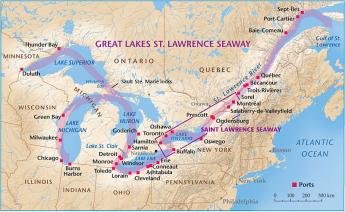
|
| St. Lawrence Seaway map |
And finally, there are variants of the human species to consider. To be completely satisfying, a commitment to preserving "native" species in the face of aggressive new invaders must apply to our own species. Surely, a devotion to preserving little plants and insects against the relentless flux of the environment does not support a doctrine of driving out Mexican and Chinese immigrants at the first sign of their appearance, like those aggressive Asian eels plaguing the St. Lawrence Seaway?. Here, the answer is yes, and no. For the most part, invasive species are aggressive mainly because they find themselves in an environment which contains no natural enemies. If that is the case, fitting the newcomers into a peaceful equilibrium is a matter of restraining their initial invasion long enough for balance to be restored through the inevitable appearance of natural enemies. So, if we apply our little nature lessons to social and economic issues related to foreign immigration, the goal becomes one of restraining an initial influx to a number which can be comfortably integrated with native tribes and clans. In the meantime, we enjoy the hybrid vigor which flourishes from exposure to new ideas and customs.
In the medium time period, that is. For the long haul, if the immigrant tribes really do have -- not merely a numerical superiority -- a genetic superiority for this environment, perhaps we natives will just have to resign ourselves to retreating into caves.
WWW.Philadelphia-Reflections.com/blog/1219.htm
Germantown Avenue, One End to the Other

|
| Germantown Map |
Chestnut Hill really is a big hill poking up in the middle of Philadelphia, and Germantown Avenue follows an old Indian trail from the Delaware River right up to that hill. The waterfront area of the city has been built and rebuilt to the point where it's now a little hard to say just where Germantown Avenue begins. From a map viewpoint, you might look for a four-way intersection of Frankford Avenue, Delaware Avenue, and Germantown Avenue, underneath the elevated interstate highway of I-95. The present state of demolition and rubble heaps suggests that a Casino might be built there sometime soon, politics and the Mafia permitting.
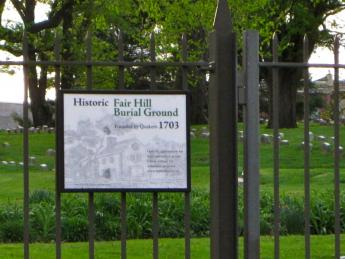
|
| Fair Hill Cemetery |
Although Germantown Avenue has wandered northwestward from this uncertain beginning for over 300 years, up to the rising slope of the town toward Broad Street, it is now rather difficult to make out anything but industrial slum along its path which could be called historic. There is hardly any structure standing which has a colonial shape, and no Flemish bond brickwork is seen in the tumble-down buildings. When with the relief you finally approach Temple University Medical Center at Broad Street, the Fair Hill cemetery does show some effort at preservation, and a sign says that Lucretia Mott is buried there. But that's about all you could photograph without provoking suspicious stares. Here's the first of four segments of Germantown Ave., and it's a pretty sorry sight.
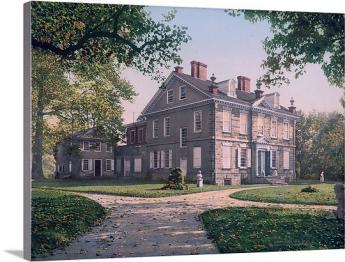
|
| Chew Mansion |
Crossing Broad Street, the busy intersection suggests 19th Century prosperity in its past, and on the west side of Broad, you can start to see signs of historic houses, either in colonial brickwork or grey fieldstone. The road gets steeper as you go west past Mt. Airy, where it almost brings tears to the eyes to see brave remnants of another time. George Washington lived here for a while, and the Wisters, Allens, and Chews; Grumblethorp and Wyck. The huge stone pile of the Chew Mansion glares at the imposing Upsala mansion, where British and Americans lobbed artillery at each other during the Battle of Germantown. Benjamin Chew the Chief Justice built this house as a summer retreat, to get away from Yellow Fever and such, and started the first migration to the leafy suburbs. His main house was on 3rd Street in Society Hill, next to the Powels and where George Washington stayed. At the peak of the hill in Chestnut Hill, a suburb within the city. Germantown Avenue rather abruptly goes from the relics of Germantown to the charming elegance of Chestnut Hill, but during a recession, it frays a little even there. At the very top is the mansion of the Stroud family, now in the hands of non-profits; across the road in Chestnut Hill Hospital, once the domain of the Vaux family. Then down the hill to Whitemarsh, where the British once tried to make a surprise raid on Washington's army. As you cross the county line into Montgomery County, it's conventional to start calling the Avenue, Germantown Pike. Germantown Pike was in fact created in 1687 by the Provincial government as a cart road from Philadelphia to Plymouth Meeting. Farmers used to pay off their taxes by laboring on the dirt road, at 80 cents a day. Germantown Pike, Ridge Pike, Skippack Pike, Lancaster Pike, and others are a local reminder that Pennsylvania was always the center of turnpike popularity; that's how we thought roads should be paid for. The present governor (Rendell) hopes to sell off some better-paying turnpikes to the Arabs and Orientals, possibly imitating Rockefeller Center by buying them back and reselling them several times by outguessing the business cycle. Parenthetically, the Finance Director of another state at a cocktail party recently snarled that the purpose of privatizing state infrastructure was not to raise revenue, but to provide collateral for more state borrowing. He wasn't at a tea party, but he may soon find himself there.
From a modern perspective, the third segment of the Germantown road runs from Chestnut Hill to Plymouth Meeting, with lovely farmhouses getting swallowed up by intervening, possibly intrusive, exurbia. The township of Plymouth Meeting is a hundred years older than Montgomery County, having been built to be near a natural ford in the Schuylkill River. Norristown, a little downstream, is the first fordable point on the Schuylkill, with Pottstown making a third. Plymouth's colonial character survived a period of industrialization based on local iron and limestone, and has established several prominent schools for the surrounding area. But the construction of a substantial highway bridge attracted a large and busy shopping center. The shopping center looks as though it will eradicate the quaint historical atmosphere more effectively than industrialization ever could.
The fourth and final segment of Germantown Pike starts at the Schuylkill and goes over rolling countryside to its final destination at Perkiomenville, where it joins Ridge Pike at the edge of the Perkiomen Creek. That's an Indian name, originally Pahkehoma. Perkiomenville Tavern claims to be the oldest inn in America, although that honor is contested by another one along the Hudson River near Hyde Park. The WPA during the Great Depression constructed a large park along the Perkiomen Creek for several thousand acres of camping and fishing, so Perkiomenville has several large roadhouse restaurants and antique auctions for bored wives of the fishermen. In the V where Ridge Pike and Germantown Pike come together, a dozen or more colonial houses are tucked away in a town called Evansburg. This formerly Mennonite terminus of Germantown Pike obviously still has a lot of charm potential, and its local inhabitants are very proud of the place. But it's easy to zip past without noticing the area, which includes an 8-arch stone bridge, said shyly to be the oldest in the country. It's hard to know whether you wish more people would visit and appreciate; or whether you are happy that obscurity might permit it to survive another century or so.
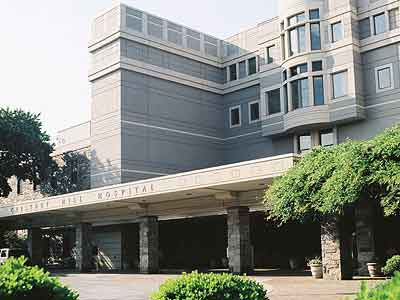
|
| Chestnut Hill Hospital |
The name change of the Germantown road from Avenue to Pike is probably not precisely where the turnpike began, but it is now notable for some pretty imposing mansions, standing between the humble and even somewhat dangerous slums along Delaware, and the charmingly humble but well-preserved Mennonite villages, at the other end. It is arresting to consider the two ends, whose houses were built at the same time; only the Mennonites endure. Somewhere just beyond the Chestnut Hill mansions is an invisible line. West of that point, when you say you are going to town, you mean Pottstown. When you say you are going to the City, you mean Reading. And as for Philadelphia, well, you went there once or twice when you were young.
Turtles and Bananas
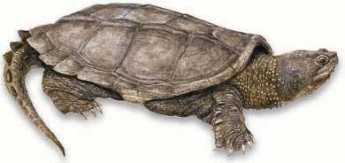
|
| Snapper Turtle |
Snapper soup, the old Philadelphia stand-by, probably got its name from snapping turtles. But for a century or two, the ingredient turtles came from the Caribbean or even further south. The huge tortoises of the Galapagos were once picked up by whalers, stored alive in the hold of the ship, to be used as needed by the sailors. Only the paws were edible. In time, the more usual imported turtle had a diameter of two feet and was picked up on South American voyages. By the end of the nineteenth century, the steamship trade was dominated by Moore-McCormack, United Fruit, and the Grace lines, who all sailed much the same kind of steamship, carrying a few passengers and a lot of cargo. Generally speaking, the cargoes going out of American East Coast ports consisted of machinery, while the cargoes coming back were bananas. If a ship carried more than twenty-five passengers it was required to have a physician on board, so passengers were either just a handful or about a hundred in number; it made for two general classes of vessel.
As a throwback to the Galapagos business of the sailing-vessel era, United Fruit would always bring home about fifty live turtles in the hold for the Waldorff in New York. It's now unclear who supplied Bookbinders and the Union League in Philadelphia, but it was apparently the same sort of arrangement: turtles came back with the bananas. It's getting hard to find snapper soup anymore; the explanation is probably mixed up with disturbances to this historical source.
www.Philadelphia-Reflections.com/blog/1481.htm
Hidden River
.jpg)
|
| Schuylkill River |
In Dutch, Schuylkill means "hidden river", thus making it redundant to speak of the Schuylkill River. As soon as you become aware of this little factoid, you start to come across Philadelphians who do indeed speak of the Schuylkill in a way that acknowledges the origin of the term. To give it emphasis, it is common to speak of the "Skookle". The point comes up because cruises have started to leave from the dock at 24th and Walnut Streets, where it becomes quite noticeable that the Schuylkill really is rather hidden as it winds seven miles south to the airport, in contrast to the wide-open vista we all are accustomed to seeing from the Art Museum northwards.
The bluff at Gray's Ferry, where the University of Pennsylvania's new buildings now dominate the scene, was originally the beginning of dry land, or the end of the rather large swamp, through which the river winds its way essentially shaded by trees along the riverbank. Never mind the junkyards and auto parks you happen to know lurk behind the trees on the west side or the oil tanks which loom above the trees on the south bank. As evening closed in on the riverboat, the gaily lit towers of center city were looming in the stern, but some fishermen along the bank proudly held up a respectable string of six or seven rather large catfish. If you are there in the evening, the river has the same feeling of wilderness that the Dutch traders would have experienced three hundred years earlier. No swans, however. There were many reports in the Seventeenth Century of large flocks of swans sailing around the entrance of the Schuylkill into the Delaware River. A noted local ornithologist on the recent cruise remarked that forty or fifty species of birds are found there. Even a flock of owls still live within the city limits. You don't see owls, even if you are an ornithologist; their presence is made known by taking recordings of the sounds of the night.
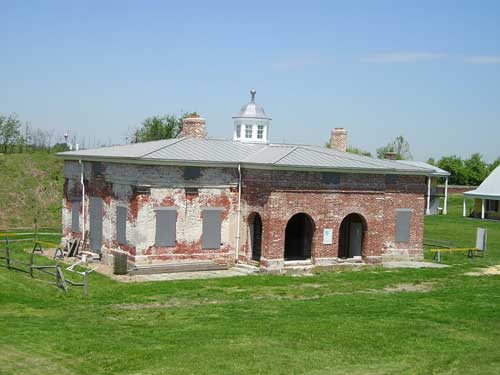
|
| Fort Mifflin |
The geography of swampy South Philadelphia was created by the abrupt bend in the Delaware River at what is now thought of like the airport region. As the river flows at the bend, sediment is deposited in mud flats that once created Fort Mifflin of Revolutionary War fame, and later Hog Island of the Naval Yard, home of the hoagie. Swans are beautiful creatures, but they seem to like a lot of mud. The lower Schuylkill is tidal, and the industrial waste of the region is cleaned out of the land by cutting drainage ditches laterally from the river, flooding the lowlands as the tide rises, and draining it again as the tide falls. This cleansing seems to be working, as judged by the return of spawning fish. And maybe mosquitos, as well, but it would seem rude to inquire.
The Bartram family seems to have known how to make use of river bends and riverbanks, placing the stone barn and farmhouse higher up the bank, but below the bluff of Gray's Ferry forces a bend in the Schuylkill, below which of course flatlands were created. It's a peaceful place, now made available for tours and excursions by placing a landing dock on metal pilings so that it can ride up and down with the tides. The great advantage is that riverboat landings are no longer restricted to two a day, at high tide, with limited time to visit before the tide falls again. Bartram recognized how popular strange plants from the New World would be in England, and his exotic plants were quite a commercial success. Nowadays the big sellers are Franklinia Trees, available the first week in May. The last Franklin (named of course for his friend Benjamin) ever found growing in the wild, was the one John Bartram found and nurtured. Every Franklinia is thus a descendant of this one. They look rather like dogwood but bloom in the early fall. If it suits the fancy, a dogwood next to a Korean dogwood which blooms in June, next to a Franklinia, can make a continuous display of bloom from May to October. And best of all, no one will appreciate it, unless they are in the know.
Water Works, Emblem of the Past
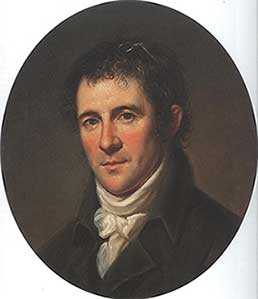
|
| Benjamin Henry Latrobe |
Philadelphia didn't really want the national capital to move to Washington DC, but the yellow fever epidemics, brought from Haiti by refugees, made it politically impossible to reverse the decision to move. We now know that Yellow Fever is transmitted by mosquitoes, but there were enough trash and pollution lying about the that it was plausible that polluted water was the cause. With no time to waste, water was piped in, through wooden pipes, from the comparatively pristine Schuylkill to a pumping station in Center Square, where City Hall now stands. Even today, no one wants a water tower in the neighborhood, so Benjamin Henry Latrobe made it look like a Roman Temple, thereby introducing classical architecture to Philadelphia, and starting quite a trend. The new system worked well enough from 1801 to 1815, when the new city outgrew it. Therefore, a new pumping system was built at the base of Faire Mount, where William Penn once planned to have a mansion, and was attached to Latrobe's wooden pipe system. In a unique and ingenious way,
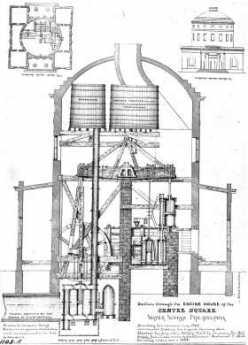
|
| Latrobe Water Works |
Frederic Graff pumped Schuylkill water up to a series of reservoirs on top of Faire Mount, utilizing a water stack to maintain constant pressure. The classical architecture was continued, parks and decorative gardens were placed around it, and admirers came from around the world to marvel. Meanwhile, Latrobe's original building could now be torn down, providing room for City Hall, which was planned to be the tallest building in the world, although the French sort of cheated and put up Eiffel Tower, which in a sense really isn't a building. Meanwhile, Philadelphia and the rest of America kept growing and growing, leading to industrial plants along the Schuylkill all the way up to Pottsville, where the anthracite came from. The pure sparkling municipal water of which Philadelphia was so proud soon became a stinking sewer, and the Civil War encampments accelerated the process.
|
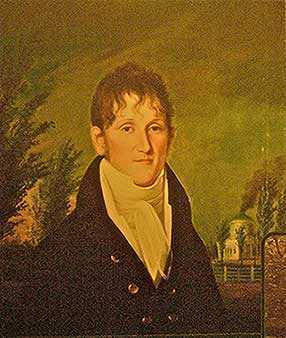
| Frederic Graff |
Following the lead of the Philadelphia College of Physicians, the concept of Fairmount Park emerged from clearing the banks of the river, and the Wissahickon Creek, of industry. The Philadelphia Water Works thus became the southern anchor of the largest city park in the world, including the building of Laurel Hill Cemetery, which had sanitary overtones which were embarrassing to discuss. Philadelphia led the world in adapting to this particular feature of the Industrial Revolution, and the insights of Louis Pasteur. By 1890, however, the system was again outmoded, and Philadelphia water became the butt of every joke. Between 1815 and 1840 the wooden pipes were replaced by iron ones. Robert Morris's old estate of Lemon Hill was acquired by Fairmount Park and used to construct a second reservoir on the neighboring hill. More about that second reservoir, in another blog.
Eventually, there would be more reservoirs at Belmont and Green Lane. But the city's new reputation for foul water was deserved. Deaths from typhoid fever rose to 80 per 100,000 residents before a water filtration system was installed; deaths from typhoid promptly fell to 2 per 100,000. Statistics on hepatitis were not available, but virus diseases must have been a serious hazard under primitive conditions of filtration, aeration and chlorination -- as they still are in many third-world countries, and in most southern European nations before 1950. As late as 1950 in Philadelphia, it was considered witty for a dowager to accept a drink from her hostess, saying "I'll drink absolutely anything, except Philadelphia water -- and 'Coke' ". The implication was that alcohol sterilizes water, which of course it doesn't, and also that absolutely everybody knows that Philadelphia has terrible water, whatever that means.
A reputation like that is bad for the city, making it harder to persuade workers and business to locate here, but the traditions underlying this response are quite ancient. Back in the days when water came from your own well, whole neighborhoods would move to new unspoiled areas to seek cleaner water and regions where the local privies were not yet mature. It takes quite a lot to persuade people to abandon the investment in a home or mansion as in Society Hill, and build a new one in a nearby undeveloped region. Particularly when the germ theory was not yet available to explain the issues with precision, pulling up stakes for a new neighborhood was an accepted reaction to almost any threat.
|
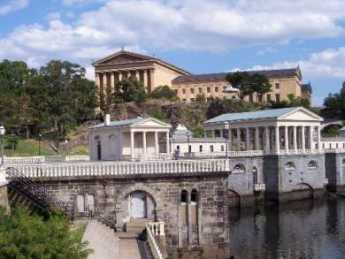
| Water Works Today |
However, strenuous exertions for half a century have made Philadelphia water safer, tastier, and far cheaper than bottled water. The recent trend of young people to walk about sucking a three dollar bottle of water drives the Philadelphia Water Department up to a wall. For example, 25% of bottled water comes straight from the tap. The inspection standards for public water are much stricter than for commercially bottled water, whose safety is in large part secondary to the safety of the tap water from which it is derived. True, public water is chlorinated, but then it is also fluoridated, putting legions of dentists out of business. In Philadelphia, that's the main difference justifying the rather appalling price difference, and the accumulation of plastic bottles in various trash heaps.
The recent advances in Philadelphia's water can in part be traced to Ruth Patrick, now over a hundred years old but the world's foremost expert on streams and water, and to the persistent professionalism of the Philadelphia Water Department. Perhaps, though, it may take a century of slander about water to persuade the politicians to keep their hands off the Water Department. It does take a lot of tax money to implement the third step in the process of cleaning up the water supply, which is the purification of wastewater. For centuries, the guiding principle was to obtain and maintain pure water at the source; wastewater was flushed down the sewer to go back out to the ocean. However, seven times as much water is removed from Delaware, as it flows past the city. That is, the water now recirculates through the sewage system seven times before it is turned over to residents of lower Delaware Bay. The expensive and elaborate -- but scarcely visible -- system of treating sewage in various sewage treatment centers has now resulted in returning water to Delaware in better condition of purity than it had when it came down past Bucks County.
But it costs lots of bucks, and nobody seems to notice the water. People only notice the bucks.
Heron Rookery on the Delaware
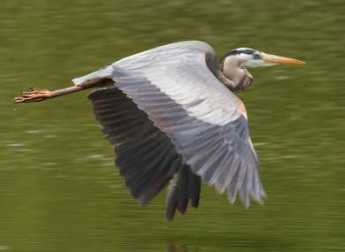 |
| Great Blue Heron |
When the white man came to what is now Philadelphia, he found a swampy river region teeming with wildlife. That's very favorable for new settlers, of course, because hunting and fishing keep the settlers alive while they chop down trees, dig up stumps, and ultimately plow the land for crops. As everyone can plainly see, however, the development of cities eventually covers over the land with paving materials; it becomes difficult to imagine the place with wildlife. But the rivers and topography are still there. If you trouble to look around, there remain patches of the original wilderness, with quite a bit of wildlife ignoring the human invasion.
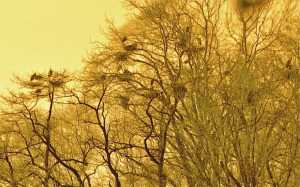 |
| Heron Nests |
Such a spot is just north of the Betsy Ross Bridge, where some ancient convulsion split the land on both sides of the Delaware River; the mouth of the Pennypack Creek on the Pennsylvania side faces the mouth of the Rancocas Cree on Jersey side. In New Jersey, that sort of stream is pronounced "crick" by old-timers, who are fast becoming submerged in a sea of newcomers who don't know how to pronounce things. The Rancocas was the natural transportation route for early settlers, but it now seems a little astounding that the far inland town of Mt. Holly was once a major ship-building center. The wide creek soon splits into a North Branch and a South Branch, both draining very large areas of flat southern New Jersey and making possible an extensive network of Quaker towns in the wilderness, most of whose residents could sail from their backyards and eventually get to Europe if they wanted to. In time, the banks of the Rancocas became extensive farmland, with large flocks of farm animals grazing and providing fertilizer for the fields. Today, the bacterial count of Delaware is largely governed by the runoff from fertilized farms into the Rancocas, rising even higher as warm weather approaches, and attracting large schools of fish. My barber tends to take a few weeks off every spring, bringing back tales of big fish around the place where the Pennypack and Rancocas Creeks join Delaware, but above the refineries at the mouth of the Schuylkill The spinning blades of the Salem Power Plant further downstream further thin them out appreciably.
Well, birds like to eat fish, too. For reasons having to do with insects, fish like to feed at dawn and dusk, so the bottom line is you have to get up early to be a bird-watcher. Marina operators have chosen the mouth of the Rancocas as a favorite place to moor boats, so lots and lots of recreational boaters park their cars at these marinas and go boating, pretty blissfully unaware of the Herons. Some of these boaters go fishing, but most of them just seem to sail around in circles.
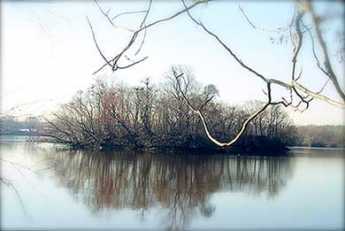 |
| As Seen From Amico Island |
Blue herons are big, with seven-foot wingspreads as adults. Because they want to get their nests away from raccoons and other rodents, and more recently from teen-aged boys with 22-caliber guns, herons have learned to nest on the top of tall trees, but close to water full of fish. And so it comes about that there is a group of small islands in the estuary of the Rancocas, where the mixture of three streams causes the creek mud to be deposited in mud flats and mud islands. There is one little island, perhaps two or three acres in size, sheltered between the river bank and some larger mud islands, where several dozen families of Blue Herons have built their nests. One of the larger islands is called Amico, connected to the land by a causeway. If you look closely, you notice one group of adult herons constantly ferries nest building materials from one direction, while another group ferry food for the youngsters from some different source in another direction. At times, diving ducks (not all species of ducks dive for fish) go after the fish in the channel between islands, with the effect of driving the fish into shallow water. The long-legged herons stand in the shallow water and get 'em; visitors all ask the same futile question -- what's in this for the ducks? The heron island is far enough away from places to observe it, that in mid-March its bare trees look to be covered with black blobs. Some of those blobs turn out to be heroes, and some are heron nests, but you need binoculars to tell. When the silhouetted birds move around, you can see the nests are really only big enough to hold the eggs; most of the big blobs are the birds, themselves. There are four or five benches scattered on neighboring dry land in the best places to watch the birds, but you can expect to get ankle-deep in the water a few times, and need to scramble up some sharp hills covered with brambles, in order to get to the benches. In fact, you can wander around the woods for an hour or more if you don't know where to look for the heron rookery. Look for the benches, or better still, go to the posted map near the park entrance south of the end of Norman Avenue. There are a couple of kiosks at that point, otherwise known as portable privies. Strangers who meet on the benches share the information supplied by the naturalists that herons have a social hierarchy, with the most important herons taking the highest perches in the trees. That led to visitors naming the topmost herons "Obama birds", and the die-hard Republicans on the benches responding that the term must refer to dropping droppings on everybody else. That's irreverent Americans for you.
There is quite a good bakery and coffee shop just north on St. Mihiel Street (River Road), and the new diesel River Line railroad tootles past pretty frequently. That's the modern version of the old Amboy and Camden RR, the oldest railroad in the country. It now serves a large group of Philadelphia to New York commuters, zipping past an interesting sight they probably never realized is there because they are too busy playing Hearts (Contract Bridge requires four players, Hearts are more flexible). However, there's one big secret.
The birds are really only visible in the Spring until the trees leaf out and conceal them. Since spring floods make the mud islands impassible until about the time daylight savings time appears, there remains only about a two-week window of time to see the rookery, each year. But it is really, really worth the trouble, which includes getting up when it is still dark and lugging heavy cameras and optics. Dr. Samuel Johnson once remarked that while many things are worth seeing, very few are worth going to see. This is worth going to see.
And by the way, the promontory on the other side of the Rancocas is called Hawk Island. After a little research, that's very likely worth going to see, too.
Marcellus Shale Gas: Good Thing or Bad?
|
| Marcellus Shale |
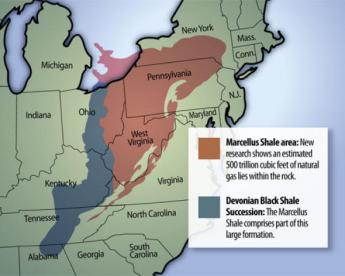
Soon after discovering widespread hard and soft coal, Pennsylvania found in Bradford County it also had oil. Local oil was particularly "sweet", with a low sulfur content. Long after much cheaper oil (cheaper to extract, that is) was found in Texas and Arabia, Pennsylvania oil was prized for the special purpose of lubricating engines, which commanded a higher price. This discovery of oil in the western part of the state also provided a vital competitive advantage for local railroads. Other east-west railroads like the New York Central and the Baltimore and Ohio lacked a dependable return cargo like this, so the Pennsylvania Railroad lowered prices and became the main line to the west for a century. Refineries were built in Philadelphia, and continue to dominate Atlantic coast gasoline production, even though the source of crude oil is mostly from Africa. When oil and coal declined in use, Pennsylvania's industrial mightiness declined, too. Philadelphia and Pittsburgh lost much of their competitive advantage, while the center of the state just about went to sleep. When even Texas oil later ran low, America's industry turned to computer-improved productivity to keep its prices competitive, helping California at the expense of Pennsylvania. The bleakness for Pennsylvania may not last, however. Suddenly, we discover we have another enormous source of cheap energy, shale gas.
It's rather deep, however, even deeper than our supply of fresh water. The next layer below surface minerals is porous rock filled with fresh water, the so-called aquifer. Gas bearing shale is layered just under the aquifer. We'll return to the aquifer later.
There is and will be abundant oil in the world, well into the future; but cheap oil has been selectively depleted. When military and economically weak nations like the Persian Gulf had cheap oil, only transportation costs were irksome. But now Russia is emerging as an oil-rich state, previously impoverished states like Iran are asserting themselves, the existence of an international oil cartel becomes more threatening because it reinforces oil price with military threats. Raw material discoveries -- gold rushes -- are always destabilizing because they are tempting to the dictator mindset. That's known in the political literature as the source of the "Dutch Disease", not because Netherlanders are aggressive, but because North Sea oil discoveries destabilized the politics of even that little peaceful nation. America has now made a universal decision to establish energy independence. It once was credible to make predictions that in a decade or two, we would run out of competitively priced energy. To be both rich and weak invites aggression and we knew it.
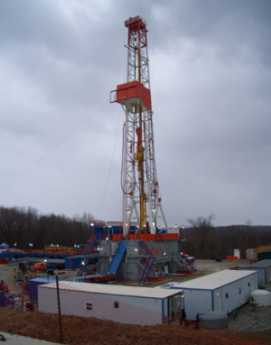
|
| Gas Drilling |
There's little question America is profligate with its energy, so the need for energy conservation is undisputed. Actually, we are already five times more efficient with energy use than China is; furthermore, we have improved energy efficiency by 20% while China has defiantly worsened. We'll do better, but unfortunately, our immense investments in inefficient home heating and transportation are too costly to discard abruptly in both cases. There is also little question that American research and development of alternative energy sources has been neglected, while China is subsidizing R & D appreciably. In our frenzy, converting food into gasoline by subsidy is a bad joke, electric cars are subsidized and widely described as "Welfare buggies", wind power is twice as costly as carbon-sourced energy and needs better battery development to be able to store it, atomic energy has been encouraged by the French government, but totally held back by ours, in response to public anxieties. The long and the short of it is this: we face a fifteen-year period of doubtful energy sources, a vulnerability our international competitors and enemies might easily use against us.
And then along came shale gas, like a gleaming savior on a white horse. For seventy-five years, the world has known unlimited amounts of petrol carbons are locked into vast stores of shale. Unfortunately, it is buried deep, and located where it is expensive to transport to market. The techniques for extracting such carbons were unacceptably expensive in a world that shrugged off abundant oil. Politics and geology turned against us; we now need fifteen years of catch-up to make alternative energy sources more affordable. Cheap oil ran out before non-carbon sources became practical. But miraculously shale gas is now upon us, right here in Pennsylvania. It takes a long time to map out the existence of shale from Canada to Texas, when it is 8000 feet deep; it was first recognized in 1839 from a cliff outcrop around the little town of Marcellus, New York and vigorously explored in the disappointed hope it would lead to discoveries of bituminous coal, iron ore or other minerals. Land speculators have been roaming Pennsylvania for two centuries. Now, they are offering $5000 an acre plus royalties, just for the right to drill. In 2010, probably 5000 leases will be issued. Needless to say, the discovery is popular with local farmers, and "gas fever" has enormous political momentum. With techniques discovered around Fort Worth, Texas, about 10% of the existing gas can be extracted easily, serving America's energy needs for much of the 15 years required to make renewable, non-fossil, energy cheap and practical. This long history paradoxically accounts for the apparent suddenness of the current popularity; it's not a new mineral discovery, it is the development of practical extraction methodology at a critical political and marketing moment.
|
| Tree Hugger |
And equally needless to say, the environmental movement is being called to its barricades. Whatever is their objection to drilling for gas, 8000 feet below the surface of a wilderness? In the first place, just cutting roads through the forests is destructive to migrating and local bird populations. In a well-known process of "fragmentation", the cutting of roads allows an invasion of raccoons and similar bird predators. Forest fragmentation simply cannot be avoided if drilling rigs are to enter and leave the forests; some vulnerable bird species are bound to go extinct. This particular region is particularly prone to emissions of radon, which is a radioactive gas traveling along the stone layer and occasionally entering the basement of houses; will drilling through to the shale layer make radon seepage better or worse? Furthermore, since this sedimentary shale layer lies underneath the aquifer, drilling must go through the freshwater-bearing caverns before it gets to the shale; expensive sealing methods may be needed to keep the contaminants below from seeping up through and around the drill holes. The practice of fracturing the shale by high-pressure mixtures raises issues with water, sand, and chemicals. Water consumption is millions of gallons per year per well, seemingly enough to drain the rivers and creeks. Some operators will be tempted to use the aquifer as a surreptitious source of water, leading to consequences hard to anticipate. The sand is meant to support the walls of the rock fractures but may clog up other channels unintentionally. And the composition of the chemical drilling components is a trade secret which the extraction companies naturally wish to keep private; it's pretty hard to get public approval of a secret. So to sum it all up, there is a legitimate need to hurry the drilling, and there are legitimate environmental safety issues to be addressed, slowing it all down. New York State has passed laws prohibiting further drilling. Is that an opportunity for Pennsylvania, or a warning we should heed?
|
| Where's My Aquifer? |
This is a time for serious negotiation, and the spending of serious amounts of money on study and monitoring, not for shouting. Politicians sense you can't make omelets without breaking eggs. For them, it's a question whether to choose to be blamed for the inevitable problems of exploring new science, or whether to be blamed for lack of patriotism in a national emergency. The amount of heedless rhetoric is predictably extreme, and the money available to spin it is daunting. If there is anything resembling a middle road in this uproar, let's explore it. In the first place, some sensible discussion between scientists of both sides can be held immediately. Geologists are probably unaware of issues like forest fragmentation, while naturalists are probably unfamiliar with radon hazards and available drilling precautions. Some concerns are exaggerated, some are unsuspected; let's get the experts together quickly and establish most of the knowns and unknowns before popular media runs away with the issue. Let's get the responsible leaders of the gas extraction industry into continuous dialogue with the responsible leaders of environmental protection organizations, so wars they get dragged into are real and not hysterical. Let Congress consider the issue and appropriate funds immediately to study the issues everybody agrees need to be addressed. It seems very likely the huge corporations involved in this issue will rather easily agree among themselves on responsible positions unless they get rattled by overly vocal denunciations. Since this is a gold rush, however, it is also likely that underfunded small operators will start to employ short-cuts and rush heedlessly into dangerous territory; large operators will wish to have laws passed to restrain everybody, small operators will plead fairness. The more transparency this field has, the better. And the most immediately obvious area of resistance to transparency is the natural wish to protect trade secrets in the composition of drilling fluids. In time, the other continents of the world will develop satisfactory drilling fluids; the secret won't last long. The situation cries out for the large operators to negotiate among themselves so those who have an incentive to protect secrecy can tell us how to do it responsibly, while those with a political incentive to expose secrets can be offered time limits related to the how fast the rest of the world catches up. Politicians particularly need to be offered some mechanism for assuring the public about those secret injection ingredients.
Anyway, let's negotiate a way to take chances we have to take, but avoid the costly blunders of studying the issue to death. Hurry up, folks, it's a matter of time before problems have to be faced.
Pennsylvania Likes Private Property Private
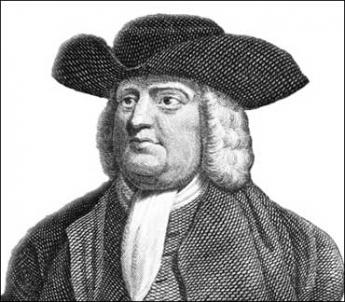
|
| William Penn Holding his Charter |
William Penn was the largest private landowner in America, maybe the whole world. He owned all of Pennsylvania, with the states of Delaware and New Jersey sort of thrown in. Although he and his descendants tried actively to sell off his real estate from 1684 to 1783, they still held an unsold three-fifths of it at the conclusion of the Revolutionary War, which they were forced to sell to the state for about fifteen cents per acre. This bit of history partly explains both the strong feeling this is private, not communal, land despite the existence of 2.3 million acres of the state forest system, which is affirmed right alongside the rather inconsistent feeling that raw land is somehow inexhaustible. Early settlers regarded the center of the state as poor farmland, particularly when compared with soil found in Lancaster and Dauphin Counties, or anticipated by settlers going to Ohio and Southern Illinois. A complimentary description is that glaciers descended to about the middle of Pennsylvania, denuding the northern half of topsoil which was then dumped on the southern part as the glaciers receded. Even today, farmers tend to avoid the northern region if they can, reciting the ancient advice from their fathers that "Only a Mennonite can make a go of it, around there."
So, lumbering had a century-long flurry in Central Pennsylvania, exhausting the trees and moving on. But that only related to the top layer of soil; beneath it lay anthracite in the East, and bituminous coal in Western Pennsylvania, supporting the steel industries of the two ends of the state with exuberant railroad development. Even today worldwide, hauling coal is the chief money-maker for railroads. The resulting availability of rail transport promotes the location of heavy industry near coal regions; the 20th Century decline of coal demand ultimately hurried the decline of heavy industry in the state by impairing the railroads.
Beneath all this lie the aquifers, porous caverns of fresh water. And beneath that, largely unsuspected for two centuries, lie the sedimentary deposits of a huge inland sea, compressed into petroleum which evaporates into natural gas. All of this is held by huge deposits of semi-porous shale rock, now mostly 8000 feet deep, stretching from Canada to Texas and called the Marcellus shale formation. If it can be economically recovered, there is more natural gas than in Arabia, and there is a similar formation along the near side of the Rocky Mountains in Colorado, stretching up to the Athabasca tar sands in Canada. There is another similar formation in France underneath Paris. No doubt, we will find the whole world has similar huge deposits for which the main problem has always been: how do you get it out?
There's another question, of course, of who owns it. Those who clearly do not own it maintain that everyone owns it. In the western world, most particularly in America, it is our firm belief that if you live on top of it, you own it. Since it is expensive to extract, quarrels like this are usually settled by purchasing mineral rights from the surface owner, who generally could not possibly extract it by himself. Those who assert they have a conflicting right to it because it belongs to everyone can expect belligerent resistance. At the present time when America faces a critical fifteen year period of dwindling oil supply, ultimately relieved by perfecting alternative energy sources, there is too little time to achieve consensus for any other governance theory. The problem which could possibly gain enough traction to interfere is the issue of potential damage to others which might result from the extraction of this subsurface treasure. Because of the apparent urgency of a decision to extract or go elsewhere to extract, the best we can hope for is some fairly rough justice.
Not a Single Red Knot
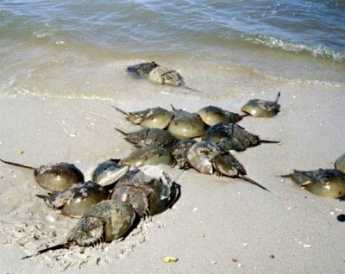
|
| Horseshoe Crabs |
A full moon brings high tide, which for centuries has brought vast numbers of horseshoe crabs to the banks of the Delaware River, toward the end of May. Marine biologists tell us these ugly-looking beasts have evolved very little for thousands of years.
Horseshoe crabs transport oxygen through their blood as a blue copper compound instead of that iron-containing hemoglobin the rest of us use. That's red, of course. Somewhere in the evolutionary path, these ancient animals also neglected to develop an immune system, but defend themselves against bacteria by precipitating sediment when they encounter endotoxin. By luck, this reaction takes place even though the bacteria are dead, so it is routinely employed as a way of detecting and eliminating endotoxin in intravenous fluids, which would otherwise go undetected by failing to grow the original bacteria in conventional culture media. Unfortunately, those of us who have never experienced a temperature spike to 106 degrees from an intravenous infusion of "sterile" water is more or less indifferent to the contribution of the Delaware crabs to our well-being. As well as being sadly indifferent to the unique nature of their nerve cells, in long single neurons, which make a number of important experiments possible.
|
| Bombay Hook |
The horseshoe crab offers still other attractions. When they come ashore to lay eggs (at a full moon, or high tide, in May), they lay incredibly large quantities of them, attracting astonishing swarms of birds, which can be seen gliding a few feet above the water surface in groups of hundreds or even thousands. The Red Knot sandpiper is certainly not the only egg-eater at Bombay Hook, but there are some unique features of that bird to be mentioned in a minute. A lot of people object to being attacked by monster swarms of mosquitoes in the summer, but screens and air-conditioning have encouraged a large number of rather prosperous houses to be built along the shore, particularly where there are sandy beaches. In fact, it is so crowded the Fish and Wild Life Service has placed street lights at such public places, with a narrow driveway to lead you to the beach. If you don't know how to recognize such amenities, well, too bad for outsiders.
Although there are plenty of naturalists and bird-watchers who come in the early spring, most of the houses along "Slaughter Beach" seem to belong to fishermen and duck hunters, the two outdoor sports with most popularity. Different migrations of different food-producers bring different prey for the sportsmen, but somehow the most up-scale members of this fraternity tend to go there in May, looking for Red Knots. A Red Knot is a form of sandpiper, with a red head and breast. The birds are born in the Arctic tundra, eating vast amounts of mosquito eggs and larvae, migrating south in the fall. They winter over in Tierra del Fuego at the opposite end of the earth and then migrate north to Bombay Hook on Delaware. For these long migrations, they must eat voraciously when they do eat and somehow have learned to look for the horseshoe crab eggs at just the right time, presumably following cycles of the moon for timing. Residents of the area for centuries have remarked on the timing of the birds and the tides and the crabs. Unfortunately, the two-continent migration was only recognized fairly recently, and when the supply seemed endless, the crabs were scooped up and used for fertilizer until their supply began to dwindle; both Delaware and New Jersey now have protective legislation, and Virginia is being verbally excoriated by bird watchers, to do the same. The crabs have started to come back, but the Red Knots are slower to respond, and now the threat is Sushi. Another ecological damage has reduced the supply of crabs in the Pacific, so the crab fishermen have migrated to the Atlantic to catch the crabs as bait for conch and other ingredients of Sushi. Once again, the abundance of crabs has declined, although to a much smaller degree than the Red Knots. This year, on the very best day of the year for this sort of thing, with dozens of out-of-state license plates wandering aimlessly up and down thirty miles of shoreline, the shouted greetings among serious bird watchers returned the sad news, "No Red Knots today. Try the beach." It was generally agreed there was a bit too much wind for good Red Knot sighting, and that oil spills in the Gulf of Mexico were to be suspected, and that perhaps tomorrow would be a better day. But judging by the very expensive optical equipment these people were carrying around, these were serious birders, indeed. If they couldn't find Red Knots, the rest of us might as well give up.
The most plausible theory for the latest decline centers around the old-timer birds. When the first-timers start their northward migrations, they are guided by the old-timers who have made the trip at least once before. If something injures the flock, it may be a few years before the supply of old-timers revives enough to supply the first-timers with guides. That's just a theory, of course, but currently the most popular one. Just what it would take to eliminate the Red Knot migration completely, may now be close to being tested. Just on principle alone, it does seem a pity to eliminate a phenomenon which took thousands of years to develop.
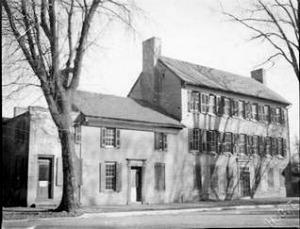
|
| Benjamin Chew's Whitehall |
When you finally give up on Red Knots, you might as well wander around this enormous wildlife sanctuary. A few miles up the road is the former location of Whitehall, the plantation house of Benjamin Chew, lawyer for the family of William Penn, and owner of the stone fortress on Germantown Avenue in Philadelphia that thwarted George Washington's attempt to stall and starve the British before they could join up with their ships in the harbor below Fort Mifflin. The original buildings on the plantation have disappeared, but the spongy plantation trails have been replaced by elevated gravel roads. So it is possible to roll up the windows of your car in mosquito season, turn on the air conditioning, and cruise around the spectacularly beautiful ponds and inlets. Further south is the plantation of Caesar Rodney, who rode to Philadelphia in the rain to cast the deciding vote for the Declaration of Independence. And further south of that is the plantation of John Dickinson, who made Rodney's ride necessary by refusing to sign the Declaration, on the grounds that the colonies showed insufficient unity, in his eyes, to be able to win a war with England. And anyway, the argument was largely economic, hence more likely to be won by economic means than military ones.
To the west of these historic plantations are some pretty impressive farms, new style. The houses give them away since no farmer will spend a cent on his house if he can profitably expand his farm; these houses belong in glossy magazines. The silos are grouped in clusters of ten or twelve, the irrigation sprinklers are a quarter-mile long, attachable to what resembles a fire hydrant in the center of the field. There are over a hundred sheds on some farms, filled with chickens fattening up. And do you know what? You can drive for miles without seeing a single chicken.
Eventually, the road leads to the Dover Air Force Base, very large indeed. No planes are in evidence, as is true on most days. But one day in 1962 Mr. Kennedy was talking to Mr. Castro, and overhead at Dover you could see dozens, maybe hundreds, of eight-engine bombers. Just circling, circling, waiting for orders to go lay an egg on the Kremlin. It wasn't clear to onlookers at the time, just what this was all about. But the idea can now be entertained that perhaps Red Knots weren't the only species flirting with extinction.
State in Schuylkill Fishing Club
|
| Richard Romm |
Richard Romm, a rising historical scholar with a special interest in early Philadelphia, recently educated the Right Angle Club in the history of the Schuylkill Fishing Club in the State in Schuylkill, and was immediately accepted into membership. Of the Right Angle, that is, which is an old club by some standards, but scarcely a hundred years old in the eyes of the really old, old clubs.
The State in Schuylkill is an eating club, originally a fishing and eating club, apparently organized around the annual shad run up the river. The clubhouse, or Castle, was moved several times, in response to damming of the river, and is now located on the grounds of, or adjoining the edge of, Nicholas Biddle's estate on the Delaware River called Andalusia. One by one, the Atlantic Ocean rivers of America have been dammed and their annual shad migrations brought to an end, except through the city of Richmond, Va, so there was little point in moving The Castle to follow the fish. It remains, overlooking Delaware in spite of its name.
There seems to have been several name changes, the most important of which was to change the Colony of Schuylkill to the State of Schuylkill for obvious reasons. Originally, the Castle was roughly opposite the falls of Fairmount on the West Bank of the Schuylkill at about Girard Avenue; thus, from 1732 to 1822 located on Baron Warner's property called Eaglesfield. In 1822 it moved to Rambo's Rock (the Rambo family is said to be the oldest European settler family in Pennsylvania) opposite Bartram's Gardens, then finally in 1887 to Andalusia, Nicholas Biddle's country estate. The club was founded in 1732, and dates of movings are possibly hazy, possibly somewhat because of the reluctance of club officers to return the calls of inquiring historians. The State in Schuylkill claims to be the oldest organized men's club in the world, an honor contested by White's in London. The roots of this argument are found tangled in the vital issue of whether their age should be based on the formal organization of the clubs, or on the establishment of the coffee houses which housed the original clubs. Four books are said to have been written about club history, but we depend here on Mr. Romm.
|
| Chief Tammenend |
There is also an unclear relationship with Chief Tammenend, possibly traceable to the shad run, but in any event to the Indian chief depicted with William Penn in the paintings by Benjamin West and Edward Hicks. May 1 is St. Tammany's day, growing into the fancy that he was the "Patron Saint of America", before a branch of the nation-wide Tammany association opened in New York and sort of tarnished up the name. Other traditions of the Fishing club have to do with wearing Mandarin hats, possibly having to do with the export of ginseng which was once abundant in our colonial suburbs, with a return cargo of Chinese dishware. All of the cooking is done by official citizens of the club. The quantities of food are remarkable; one 19th Century menu listed eleven pounds of meat per member. The club drink is a punch, the famous Fishhouse Punch, widely recognized to be rather strong. Its inventor is reputed to be Edward Shippen Willing, on the occasion of the first visit to the clubhouse by women guests. The quantity of alcoholic beverage at these events is especially remarkable in view of the Quaker origins of many original members of the club, but not necessarily of the guests. Among the various guests were Generals Grant, Meade, and McClellan. Dinner begins with two traditional toasts: to George Washington, and to Captain Sam Morris. Washington was appropriate enough, having a history of drinking a bottle of Madeira every day at lunch. But Sam? Captain Sam the Quaker?
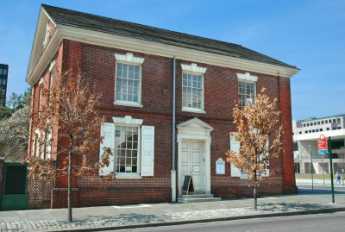
|
| Free Quaker Meetinghouse, Fifth and Arch Streets |
Somewhere in this tradition are allusions to the Free Quakers, Quakers who abandoned the peace testimony to fight the British. There is also the tradition of hostility to British rule which antedates the Revolution and may have some connection to the fanciful contention that their little state was not really part of Penn's colony. Captain (of the City Troop) Sam was a stalwart, possibly the sole founder, of the Gloucester (N.J.) Fox-hunting club. The history is passed down that 22 of the original 26 members of the First City Troop were members of the fox-hunting club, and many if not most were Quakers. The first "Governor" of the State in Schuylkill was Thomas Stretch, but the second Governor, from 1766 until his death, was Captain Sam. He was repeatedly referred to as the life of the club and held in the highest esteem by all. He was "read out" of the main Quaker Meeting, not so much for his drinking as for his flouting of Quaker belief in pacifism. He reputedly led a saber charge at the Battle of Trenton and was a leader of the City Troop in that revolution within a revolution at James Wilson's house, which rescued at least four future signers of the Constitution from a mob of militia which momentarily turned Jacobin.
Naturally, descendants of Quakers on both side of this uproar have been reluctant to say much about it. But somewhere within the history of Samuel Morris must be some important clues about the 18th Century splits within the Quaker Church, to say nothing of the revolt of the three Quaker colonies against British rule.
Conowingo
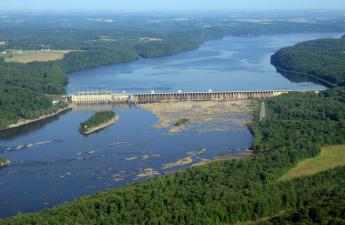
|
| Conowingo Dam |
IT was once a major hazard of travel between Philadelphia and Virginia, to cross the Susquehanna River along the way. The river is wide at the top of Chesapeake Bay, and the cliffs are high on both sides. Consequently, the cute little towns of Port Deposit and Havre de Grace grew up as places to stay in inns overnight, perhaps to throw a line into the water and catch your breakfast. Today, these little towns can be seen to have millions of dollars worth of cabin cruisers and sailboats at anchor, at least during certain seasons of the year. In 1928 the Conowingo Dam was built about ten miles north of the mouth of the river in order to harness the water power, and the Philadelphia Electric Company put a power station there as part of the dam, to generate electricity for Philadelphia. It doesn't seem so long ago, but it gave a mighty boost to the electrification of Philadelphia and its industries at the end of its industrial decline from 1900 to 1929. Unfortunately, competitive forms of power generation have now reduced the dam's output of electric power to periodic bursts during the day, and Philadelphia no longer enjoys a reliable cheap water-powered electricity advantage. Coal and nuclear came along, and now shale gas looks like the coming future.
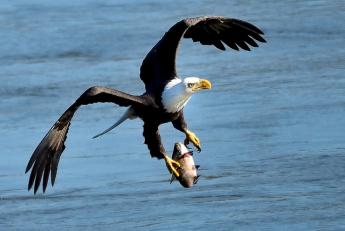
|
| Bald Eagle Fishing |
Although water power could be claimed to be not merely cheap but environmentally friendly, the unvarnished fact is fish get caught in the turbines and rather chewed up by being sucked from the tranquil lake on the upside, emerging at the bottom as a diced fresh fish salad. That attracts seagulls and other fish lovers to the base of the dam. Some fish escape the meat grinder and merely are stunned by the experience, floating downstream to be attractive to eagles, turkey vultures, hawks, and owls. The consequence is that many thousands of gulls sit on the downside of the dam, while hundreds of turkey vultures and eagles sit on the higher levels of the power generation apparatus. And hundreds of bird-watching nature lovers stand on the southern shore below the dam, poised with many thousands of dollars worth of camera equipment and binoculars. If you don't have a pair of binoculars, your visit there will certainly be substandard. Lots of fishermen are there, too, but depending on the waves of spawning fish at different seasons of the year; shad is particularly favored. You can now begin to see the prosperity of Port Deposit and Havre de Grace has a wider variety of attractiveness than merely sailboating and crabbing. There is, however, a large and ominous yellow warning sign.
The sign says you are standing on a riverbank where the water can suddenly rise without warning; if the red lights start blinking and the warning siren starts honking, immediately gather up your tripods and head for higher land. It looks pretty peaceful, however, and the people with tripods are mostly chatting happily with their friends. It can be pointed out, however, that about two hundred bald eagles are perched on the superstructures roundabout. Cameras are mostly digital these days, attached to the rear of a telescopic lens three feet long, and when they shoot bursts of exposures they sound like a machine gun. So, the bird photographers follow a swooping eagle eagerly, shooting away and hoping to catch the bird in an attractive pose, throwing away the rest of the pictures. Good shots are called "keepers", which the photographer is happy to show onlookers on the rear view screen of the camera/machine gun. More sedate bird watchers carry binoculars made in Germany or Switzerland, which cost thousands of dollars and produce really spectacular images. It's unclear whether all this expenditure is worth it, but there is little doubt in the bird lovers' minds you are wasting significant parts of the trip without some kind of binocular.
Suddenly, ye gods, the lights start to flash and the siren starts to honk loudly. Not knowing exactly what to expect, first-time visitors head for the hills. The old-timers with a Gatling gun on a tripod are much more casual, picking up their apparatus and scuttling several feet up the river bank. The birds seem to know what the signals mean, scramble into the air, or start to arrive from far perches. The electric company seems to have received a notice that more electric power generation is needed, so the gates at the bottom of the dam are lifted and water gushes forth; the water does indeed rise rather rapidly. The birds divide themselves into two groups: the gulls' circle in a thick spiral at the base of the dam, while the eagles and vultures circle independently in a second spiral, several hundred yards below the dam. One group looks for fish salad, and the other group prefers stunned whole fish. Photographers however much prefer the eagles downstream, circling and then swooping to the water's surface to grab a wiggling fish and running off with it. Some of the bigger bullies prefer to let others do the fishing, simply swooping to steal the fish. Ratta-tap-ratty tap goes the digitals. After twenty minutes it is all over, and the birds seem to realize it before the water stops gushing into geysers. The river recedes, birds go back to their perches, and quiet again rules the land.
On the way home, you notice something you perhaps should have known. Interstate 95 takes people speeding down the turnpike, just out of sight of the dam. You get there quicker, but don't see the sights. Coming back from the bird watching parking area which the electric company provides, you are more or less compelled to recognize that U.S. highway Number One goes right across the top of the dam, up to the hill and over the charming rolling countryside. Back to Philadelphia.
Proposal for the Parkway
|
| Alvin Holm |
Architect Alvin Holm spoke recently about an idea he had dreamed up in 1986, for an amphitheater in the Eakins Oval, right in the middle of the Benjamin Franklin Parkway. At that time he envisioned it as a memorial to Grace Kelly, but Monaco wasn't interested, and the City was broke. But times change, neighborhoods change, and maybe the idea needs to be re-examined.
A bit of history needs to be refreshed. Around 1900 when the Parkway was dreamed up, Philadelphia was said by some local boosters to be the richest city in the world. That may have been a little overoptimistic, but it was nearly true enough that no one laughed loudly when it was enunciated. The Parkway was envisioned as a new departure to transform the whole city from square blocks of red-brick buildings of Georgian style, into a classical French version of grand elegance. To emphasize the new departure, it cut a diagonal from City Hall to the Art Museum, uniting these two French architectural monuments into a transformational classic boulevard. It wasn't just an imitation of Champs Elysees, it was a design by the very same architects, intended to lead the centers of many great cities of the world into modernized versions of the Roman Forum. Paris somehow managed to get away with it in time, but the 1929 crash stopped Philadelphia's dreams dead in their tracks, and the city just didn't recover.
Consequently, vast stretches of North and West Philadelphia were abandoned, then transformed into slums as poor people sought cheap housing. If you just look at Baltimore and Newark, you can easily see how sudden reversals can destroy a city completely. Philadelphia retreated into Center City, surrounded by an inner ring of slums, which were in turn surrounded by a ring of newer suburbs. The automobile hastened the flight to the suburbs, while the business district retreated to the inner core of Center City. In order to protect the Shining City on a Hill from being completely disrupted, informal barriers were sought, and the Parkway became one of them. They weren't walled moats, but they served the same purpose. Therefore, during the long decades of limping along, occasional cries of, "Why don't we make the Parkway into a grand boulevard?" had a silent, sullen answer. We weren't really sure it was a good idea. It didn't fit within our revised circumstances.
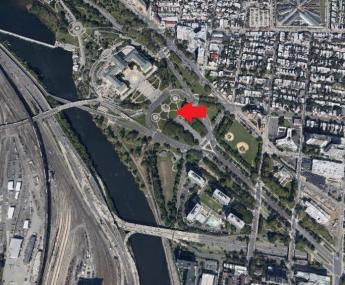
|
| The Amphitheatre on the Parkway |
But the City is now getting back on its feet, as anyone who has noticed the astonishing restaurant revival of Fairmount Avenue, or of Old Towne, or Society Hill, and the rebuilt "Chinese Wall" leading to and from the old Broad Street Pennsylvania Railroad station, can easily see. The Independence Mall and the University of Pennsylvania areas were largely built with Federal Money, but no matter, the transformation is still evident, the tide has turned. So Alvin Holm got out his drawings about premature dreams we couldn't afford, and asked, "Is it time?"
The unfinished Ben Franklin Parkway has cut its path, willy-nilly, through the neighborhoods, the trees have had time to grow, the museums time to migrate. The childless couples of the metropolitan area were coming back in town to enjoy the restaurant revolution and the theater revolution. Alvin Holm was getting a little older but not less energetic. He remembered that at the foot of the Art Museum was a statue of George Washington on a horse, and behind our First President was a big expanse of empty land. To build an amphitheater only took bulldozers, and could seat a thousand people. If you were as lucky as the ancient Greeks, and possibly if you built in precisely the same way, a speaker in the center could be heard -- without artificial amplification -- if he whispered, by everyone in the amphitheater audience. If you do use electronics, there's plenty of space in back of General Washington for a dignitary to give a speech on a raised platform, and there's enough empty audience space in a wider sweep, for fifty thousand people to congregate and listen. To him, or to a rock band, or whatnot. There aren't very many places left on earth in the center of a big city, where a single person can stand against a magnificent classical background, and be heard by fifty thousand chanting, hollering true believers. All of this could be accomplished by essentially digging a hole in the ground and closing off the area to traffic. But oh, yes, it takes one more thing. You have to want to do it. So let's consider for a moment who else covers the neighborhood, waiting for the right time to make a move.
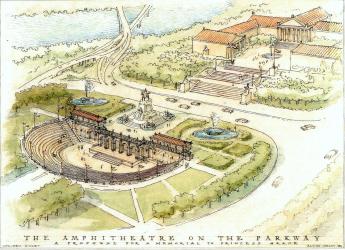
|
| Amphitheater Sketch |
Instead of regarding Fairmount Hill as just a big obstacle to automobiles trying to get home, let's just see what some others are thinking. For example, the people who run Drexel University are seriously talking about buying the air rights above the railroad marshaling yards on the west bank of the Schuylkill, and putting up a major business district and residential complex. They are thinking mainly of reviving West Philadelphia, and that's fine, but another bridge at that spot is badly needed to divert traffic around the present choke point on the Schuylkill Expressway, and that's also fine. Put some paths down to the river from the Art Museum to meet a new pathway to the Drexel development, as well as the recreational area along the river, and you could really have something pretty nice for the commuters who would otherwise begrudge the cost of digging an amphitheater hole in back of G. Washington.
Looking to the north of the Art Museum, there's a second small mountain with Kelly Drive between the two. At one time, both hills had reservoirs on top. The Art Museum demolished one reservoir, but the other reservoir is still there. It's a fifty-acre lake surrounded by dense forest; but from the inside look back over the top of the trees and you can see skyscrapers, almost right next to you. It's been adopted by migratory birds as part of the Atlantic flyway, and you would just be amazed at the hawks and ducks and all manner of other little black jobs that fly around and get recorded by bird watchers. The lake is full of fish, probably originally dropped by passing birds. The Audubon Society has a fundraising project going on, right now, to build a visitors' center in the forest, in conjunction with Outward Bound, the rock climbers group. Go to the left and you are overlooking the races at Boathouse Row, turn in the other direction to see Girard College, the hospital complex, and the further north you get to Temple University.
And one more thing. The old B&O Railroad once snaked along the Schuylkill and turned right around the (now) Art Museum, through tunnels over to Spring Garden Street, and down to Reading Terminal. Just what to do with this ditch running through the center of town unnoticed, is beyond my scope. Let someone else have a chance at being a visionary, but it must be remembered that New York City recently had a similar relic on its hands, and made something pretty nice out of the West Side of their town.
All of this potential even has the danger that projects will collide with each other, so it would sound like a nice idea for some Foundation to put together a planning board, to fit it all together without getting mixed up in politics, or squabbling over who will run things. But even that fuss would be a novelty, a nice thing to have for a while.
Philadelphia to Savannah: A New View
Bob Reinecke and I recently took a trip by boat down the inland waterway to Savannah. There isn't time to recite all the details, but four or five real surprises popped up, and maybe there is time to talk about them.
The first discovery was an accident of my visiting my daughter in Northern Virginia, and discovering there is no direct train service to Williamsburg. It's only once a day, each way, but it is direct from 30th Street Station to the train station about a hundred yards from the hotel in Williamsburg. Actually, it starts in Boston and goes to the Portsmouth Naval Base, branching off at Richmond toward the banking centers of Charlotte, North Carolina. But Williamsburg is about the only tourist destination in Virginia if you haven't been paying attention, while 30th Street is about the only place to take a train, right? We had a lot to learn.
A travel brochure announced there was a cruise boat of about a hundred passengers, which leaves Richmond, goes down the James River, and then heads south on the Inland Waterway, making stops along the way until it ends up in Savannah, Georgia. On this particular trip, there was a busload taking tours of Revolutionary history, and a second one taking Civil War excursions at every stop, take your pick. Most people took the Civil War choices, but the lecturers were both excellent, and it pretty much turned into two tours on a single boat. We learned the hard way that the only train to Richmond gets there after the boat has already departed, so it was necessary to arrive a day early and stay in a hotel. We were certainly glad we did because Richmond is having a revival since the devastation of the Civil War. A dozen hotels and restaurants cluster around the train station, which is a few blocks from the renovated Capitol, sitting on top of a hill. The hill has been extensively undermined and turned into a pretty elaborate museum, well worth a two-hour visit if you get there at the right hours. Not far away is a perfectly spectacular art museum, apparently donated by Paul Mellon, and well worth a four-hour visit. Paul Mellon has also donated his huge collection of British Art to the Yale Museum, and of course, the Mellon Gallery in Washington was largely given by his father. The Mellons of Pittsburgh may well have been pretty tough bankers, but in the art world, they certainly knew their stuff. Even if the Virginia museum didn't contain a single painting, the building itself would be worth a trip to visit.
Richmond also has a secret treasure in the James River. A century ago, every major river on the East Coast would have a major run of spawning shad fish, about the middle of April. One by one, the rivers were dammed up at the "fall line" and industrial pollution put an end to the shad run. That was probably also getting to be true at Richmond until General Grant and his army put an end to industrialization. For whatever reason, Richmond is the only major city on a river that still has a spring shad run. Since the river runs through the center of town, the big problem for fishermen is to find a boat to rent, and this spring event is largely forgotten. Four or five big restaurants were pointed out as specializing in seafood, but although I called them all, none of them knew what a shad is.
When you go down to where the tourist boat docks, however, you soon find the local teen-aged boys know all about shad, and a hundred or more of them line the banks with their fishing gear. As you might expect, fishing is best toward dusk in the evening, and around dawn in the morning. Unfortunately, we were late. The boys were all pulling in strings of six or eight fish on a line, but they were uniformly small ones. The big fish spend all winter in the Bay of Fundy, and return to the river where they were born, to spawn again. So the big fellows, the fish that were supposed to have rescued George Washington at Valley Forge, had already gone upstream to spawn, and all that was available to the teenagers were young fry, trying to return down the river toward the Bay of Fundy. Incidentally, although the Hudson River has also pretty much lost its industrialization, there is no shad run on the Hudson. The explanation seems to be that the striped bass congregates along the abandoned piers on the New York waterfront, and devour the shad fingerlings on their way out to sea. In Philadelphia, it seems to be the refineries at Marcus Hook that give the shad their fatal problem.
So off we sail from Richmond, making the first stop at the mansions along the James River. Of particular interest is the splendid mansion of William Henry Harrison, of Tippecanoe and Tyler, Too. You know, the fellow who won election to the Presidency by advertising he had been born in a log cabin. Off down the James River, where two more surprises await the callow Philadelphia visitor. We knew about Williamsburg, but it was a surprise to find that both Jamestown and Yorktown have been restored within an inch of their lives, each one just as interesting as Williamsburg. The woods surrounding these three colonial villages are manicured and painted, filled with an incredible number of retired military. As you tour the area in buses, it becomes clear that almost the entire peninsula between the James and York Rivers is filled with military reservations of various sorts, Air Force, Naval, Marine, and at least two hush-hush CIA establishments. This is what Generals Grant and McClellan fought over as the "wilderness", attempting to take Richmond from the rear. If you add to this military complex the huge establishment of government contractors neighboring Washington, it is easy to see why the demographics and politics of the Old Dominion are rapidly changing.
One of the military retirement villages in the area is Fort Monroe, on an island in the mouth of the Chesapeake. Like Pea Patch Island in the Delaware, and Fort Sumpter to the south, this fort was constructed after the War of 1812 as one of a chain of defenses for the Atlantic Coast. It once housed President Jefferson Davis as a prisoner after the Civil War, and the house where Lincoln stayed is proudly on display. It looks like a really nice place for a retired Colonel to live if he enjoys sailing and fishing. Nearby, both the Merrimac and the Monitor are under reconstruction as museums, together with the museums which display how naval warfare was completely transformed by two iron boats in a single afternoon.
So off down the Inland Waterway on a ship that scraped bottom a couple of times on the previous journey. Because of our maritime unions, only a ship that has been constructed in America is allowed to sail between two American ports, and only American employees are allowed. That makes for scarcity, and although it is pleasant to be surrounded by a thoroughly American crew, it makes this sort of cruising expensive. But the sense of American history is heightened, as you go past towns that were burned by the British, and gardens that were planted by members of the Continental Congress. Particularly Beaufort, which General Sherman decided was too beautiful to burn. You can walk the side streets of Charleston, where "Porgy and Bess" was portrayed, and imagine you see the bombardment of Fort Sumpter. Savannah, the fictional home of Rhett Butler the blockade runner in "Gone with the Wind", the home port of Revolutionary blockade runners, the site of smugglers for prohibition days -- affects an atmosphere of decay and decadence which air conditioning has rendered obsolete, but still attracts tourists looking for a thrill.
And so we ended the trip as we began it, by telling the local guides a thing or two. It was thirty miles north of Savannah on the Savannah River, that our famous Philadelphia river expert, Ruth Patrick, advised the President of DuPont to place the manufacturing center for the hydrogen bomb. She lived to be one hundred five years old, and the building which bears her name can still make bombs as needed. And not one guide or employee of that ship, or resident of that town, had ever heard of her.
| Posted by: cheapostay | Feb 13, 2012 9:44 AM |
| Posted by: esalerugs promo code | Feb 13, 2012 9:22 AM |
| Posted by: George Fisher L '42 | Mar 5, 2010 5:37 PM |
| Posted by: William Eichelberger | Mar 5, 2010 3:51 PM |
A puppy caught the ball.
The girl and the puppy ate a snack.
| Posted by: Spencer Geerts | Aug 21, 2009 6:35 PM |
Kenneth square is actually Kennett Square.
| Posted by: Nat Scott | Aug 7, 2008 10:27 AM |
23 Blogs
Helis the Whale
In the spring of 2005, a solitary Male Beluga whale made his way up the Delaware River, causing great excitement. He hung around for a week or so, presumably searching for shad.
Shad
The rivers once teemed with these big fish every springtime. They are making a hesitant comeback.
Where Do Shad Go, When They Aren't Around Here?
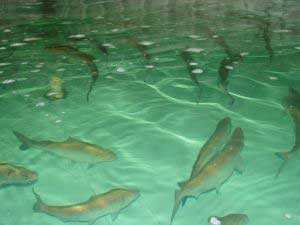 The Bay of Fundy.
Life On The River (3)
Until just a few decades ago, Philadelphia life was life along the river, with the gentry building houses upriver from the port. They were surrounded by abundant fishing, hunting, and all the sports of horsemanship.
Philadelphia Food: Traditional
The oysters, crabs, and fish are having trouble with river pollution, New Jersey is filling up with split-levels, and fear of cholesterol is tough on Pennsylvania Dutch cooking. But on special occasions, it's nice to have the traditional goodies.
Philadelphia Food: Ingredients
The region has always been surrounded by abundant fishing, hunting, and farm products.
Lambertville and Lewis Island
As Philadelphia and New York City gradually expand until they meet, they could meet at Lambertville.
Founding Fish
The story about shad rescuing the starving Continental Army at Valley Forge makes a wonderful story, but there's a reason to think it may be fictional.
The Swamps of Philadelphia
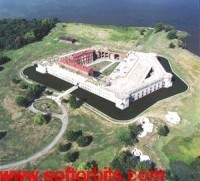 It's now a little hard to remember that the swamps began at what is now the Airport, and extended to what we now call Gray's Ferry. A lot of garbage got dumped there.
Draining Suburbia
Clueless storm sewer design is destroying our brooks and streams.
Native Habitat
Increased foreign trade, especially to Asia, has brought us some new plant types. Lacking natural enemies, they are taking over.
Germantown Avenue, One End to the Other
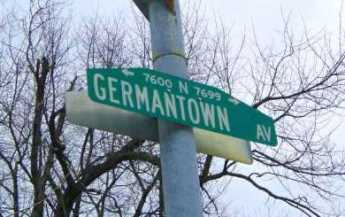 An old Indian trail cuts diagonally across Penn's street grid, from the Delaware River to Chestnut Hill, and beyond. Lots of history, there.
Turtles and Bananas
Snapper soup can be made from snapping turtles, but the historical source of the ingredients has been shipped from the Caribbean.
Hidden River
In season, and for benefits, cruises of the Schuylkill are starting to be available at the Walnut Street dock. Go down the stairs at 24th Street.
Water Works, Emblem of the Past
Water pollution doesn't cause Yellow Fever, but in 1799 Philadelphians thought it might, and united to make a work of art out of a new water utility. Eventually, it did eliminate Typhoid deaths.
Heron Rookery on the Delaware
Two or three miles from Philadelphia City Hall, a large flock of Blue Herons with seven-foot wingspreads are nesting in the trees, largely unnoticed.
Marcellus Shale Gas: Good Thing or Bad?
There's a gold rush, in gas not gold, in Pennsylvania. What are the unintended consequences?
Pennsylvania Likes Private Property Private
The King used to own the whole country. William Penn got us used to the idea that my property is mine, not the King's.
Not a Single Red Knot
Between the Dover Air Force Base and the west bank of the Delaware River is a large area of wetland and fertile soil centered on what is called the Bombay Hook. Benjamin Chew, Caesar Rodney, and John Dickinson all had extensive plantations there. In some ways, remarkable wealth is all centered on the fertility deposited over the centuries by the eggs of horseshoe crabs along the bank
s of the river.
State in Schuylkill Fishing Club
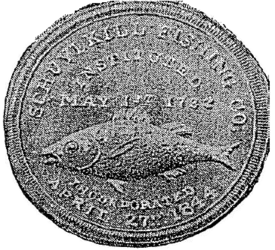 Unless you listen to some quibbles from White's in London, the Schuylkill Fishing Club of the State in Schuylkill is the oldest organized men's club in the world. And even if that exception is admitted, it's the oldest men's club in America. It's no secret, but it's very private.
Conowingo
After ancient disputes between William Penn and Lord Baltimore, the mouth of the Susquehanna into the Chesapeake Bay is located in Maryland. However, the Philadelphia Electric Company got its power from the Conowingo Dam, and Philadelphia bird watchers by the hundreds go there to watch thousands of birds, attracted by millions of fish. But when the buzzers sound and the red lights flash, run for higher ground.
Proposal for the Parkway
In 1986 the architect Alvin Holm proposed an amphitheater for the Parkway. It was too soon, but maybe its time is approaching.
Philadelphia to Savannah: A New View
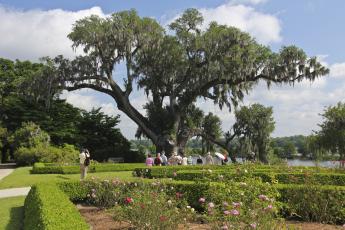 Two members of Right Angle took a vacation trip to Savannah. It seems to be a new world, down there.