Related Topics
Government Organization
Government Organization
Democracy Turns Out To Be a Two-Party System
|
| American two-party system |
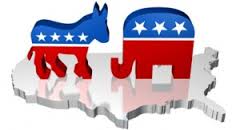
America's two-party system took fifty years to stumble into permanence. Regardless of the happenstances of their eventual emergence, political parties were clearly not designed into the original plan. Those few founding fathers who did think about political parties rejected them as "factionalism", something to be condemned. The true nature and advantages of a two-party system began to be truly venerated when other nations tried something quite different, which we now call Proportional Representation. PR is a fairly natural outgrowth of creating a large democracy from a collection of little tribes -- then creating surrogate political parties for them as part of the design. Guided by historical experience, it is now possible to ignore all minor differences between stable two-party democracy and multi-party democracy, except one. In a two-party system, the political dealing and vote-swapping takes place before the election, with all the players jockeying and sacrificing principle to answer a single candidate question, "Can he win?" By contrast, in a multi-party or proportionally-represented democracy, the election comes first, and only subsequently do vote-swapping and artful promises construct the ticket of candidates and the policy platform. The plain fact is the public doesn't know whom it is voting for and often is disagreeably surprised. Furthermore, important matters remain unsettled by a multi-party election. A cabinet member of a splinter party, potentially one with negligible public support, retains the threat of resigning if things don't go his way, and his resignation may trigger a whole new national election if it breaks up the political margin of the ruling coalition. At least, a two-party system settles things for a while and gives the public a relative rest from factional tensions.
The American system has evolved into a universal conviction, stronger than any Constitution, that two parties are quite enough. Third parties are of course tolerated because they aren't forbidden, but most offer a mechanism in case there is a serious wish to reconstitute one of the two major parties. The strength of third parties is to discipline the leadership of the major parties; the weakness is they threaten the unifying principle of compromise-in-order-to win. Nothing except religious fanaticism would likely induce any ambitious American politician to remain within a third party, fruitlessly frittering away his life's chances. Because of 18th Century history more than wisdom, an "established" religion is constitutionally prohibited in America; observation of the turmoils in other nations, and perhaps wisdom also, keep it that way.
If two parties are then quite enough, is it possible only one would be better? The quickest look abroad, the briefest exposure to history, shows a one-party system is synonymous with dictatorship. Communism and fascism had only this one feature in common; in fact, China seems to be morphing from one to the other, while resolutely retaining its single ruling-party system. The paradox of this situation is that it leads to the American realization that maintaining a two-party system means that neither party must ever achieve total victory. After each national election, the electorate settles back with relief that one side won, but neither side conquered. Even academics are muffled by the system; with much to criticize, there is nothing else worth substituting.
There is one thing left to mention about the two-party system, which is that the interests and affiliations which arouse the club-like loyalties of party members seldom perfectly match the party's current campaign policy issues, and depend in a high degree on habit and a formless sense of group comfort. Any schoolchild can notice, although the party candidates avoid mentioning, that policy issues move back and forth between the two parties. Whether it is tariffs, public schooling, the gold standard or a thousand other matters, the issues repeatedly shift to the other party when lack of progress or apparent betrayal offends them. The special interests seek to use the parties, and the parties regard each special interest as a bargaining chip; the gut feelings of the party membership adjust far more slowly. For maximum effectiveness, a two-party system needs the public to see itself as two warring affinity groups; for a while, polarization seemed to revolve around the rich and the poor. There would always be more poor people than rich ones, as the Founding Fathers feared and the anti-Federalists sought to exploit; but now Populism can only be sustained by continuous massive immigration. The times are growing stale for the Republicans to suggest that only they have an electoral incentive to eliminate poverty, while the Democrats would secretly like to increase it. Or for the Democrats to imply they have a monopoly of sympathy for the poor. Compared with the status of the rest of the world, permanent lifetime poverty in America is growing too infrequent to dominate elections, even supplemented by fear of poverty, a recollection of having once been poor, or guiltiness about never being poor. It is difficult to maintain the firmness of party members with such vague attitudes for abstruse legislative policies like banking reform or compulsory health insurance. Therefore, the search is on for large social affiliations which would more comfortably enlist loyalties for pressing specific legislative actions. At the present time, division of the working populace into the public and private sectors is being promoted as a bedrock political affiliation, but it is questionable whether that will be as successful as the public sector unions seem to hope for. Only twice in our history, during the administrations of George Washington and James Monroe, have Americans overwhelmingly agreed on core issues of religion, foreign policy, and prospects for the future. During both episodes, political parties virtually disappeared.
Originally published: Thursday, June 22, 2006; most-recently modified: Thursday, May 16, 2019