3 Volumes
Constitutional Era
American history between the Revolution and the approach of the Civil War, was dominated by the Constitutional Convention in Philadelphia in 1787. Background rumbling was from the French Revolution. The War of 1812 was merely an embarrassment.
Culture: The Flavors of Philadelphia Life
Philadelphia began as a religious colony, a utopia if you will. But all religions were welcome, so Quakerism mainly persists in its effects on others, both locally and in America, in Art, clubs, and the way of life.
Sociology: Philadelphia and the Quaker Colonies
The early Philadelphia had many faces, its people were varied and interesting; its history turbulent and of lasting importance.
Black Philadelphia
The City of Philadelphia is only a part of the region, but within that part, the black population holds political power. That's definitely not true in the rest of the region. Discordances like this create problems until political evolution smooths them out.
Slavery: If This be done well, What is done evil?

|
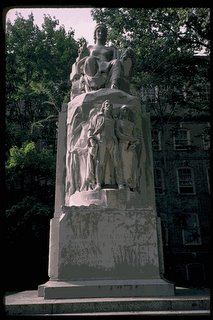
| Francis Daniel Pastorius |
The Declaration of the German Friends of Germantown, Against Slavery, in 1688.
These are the reasons why we are against the traffic of men's body, as followeth:
Is there any that would be done or handled in this manner? viz.: to be sold or made a slave for all the time of his life? How fearful and faint-hearted are many at sea, when they see a stranger vessel, being afraid it should be a Turk, and they should be taken, and sold for slaves in Turkey. Now, what is this better done, than Turks do? Yea, rather it is worse for them, which say they are Christians; for we hear that the most part of such negers is brought hither against their will and consent and that many of them are stolen. Now though they are black, we cannot conceive there is more liberty to have them, slaves, as [than] it is to have other white ones. There is a saying , that we shall do to all men like as we will be done [to] ourselves; making no difference of what generation, descent, or color they are. And those who steal or rob men, and those who purchase them, are they not all alike? Here is liberty of conscience, which is right and reasonable; here ought to be likewise liberty of the body, except evil-doers, which is another case. But to bring men hither, or to rob, [steal] and sell them against their will, we stand against. In Europe, there are many oppressed for conscience sake; and here there are those oppressed which are of black color. And we who know others, separating wives from their husbands, and giving them to others: and some sell the children of these poor creatures to other men. Ah! do consider well this thing, you who do it, if you would be done in this manner--and if it is done according to Christianity! You surpass Holland and Germany in this thing. This makes an ill report in all those countries of Europe when they hear of [it,] that the Quakers do here handler men as they handle there the cattle. And for that reason, some have no mind or inclination to come hither. And who shall maintain this your cause, or plead for it? Truly, we cannot do so, except you shall inform us better hereof, viz,: That Christians have liberty to practice these things, Pray, what thing in the world can be done worse, towards us, than if men should rob or steal us away, and sell us for slaves to strange countries; separating husbands from their wives and children. Being now this is not done in the manner we would be done at, [by]; therefore, we contradict [oppose], and are against this traffic of men's body. And we who profess that it is not lawful to steal, must, likewise, avoid purchasing such things as are stolen, but rather help to stop this robbing and stealing, if possible. And such men ought to be delivered out of the hands of the robbers, and set free as in Europe. Then is Pennsylvania to have a good report, instead, it hath now a bad one, for this sake, in other countries. Especially whereas the Europeans are desirous to know in what manner the Quakers do rule in their province; and most of them do look upon us with an envious eye. But if this is done well, what shall we say is done evil?
If once these slaves ( which they say are so wicked and stubborn men,) should join themselves--fight for their freedom, and handle their masters and mistresses, as they did handle them before; will these masters and mistresses take the sword at hand and war against these poor slaves, like, as we are able to believe, some will not refuse to do? Or, have these poor negers not as much right to fight for their freedom, as you have to keep them slaves?
Now consider well this thing, if it is good or bad. And in case you find it to be good to handle these blacks in that manner, we desire and require you hereby lovingly, that may inform us herein, which at this time never was done, viz., that Christians have such a liberty to do so. To this end, we shall be satisfied on this point, and satisfy likewise our good friends and acquaintances in our native country, to whom it is a terror, or fearful thing, that men should be handled so in Pennsylvania.
This is from our meeting at Germantown, held ye 18th of the 2nd month, 1668, to be delivered to the monthly meeting at Richard Worrell's.
Garret Henderich
Derick op de Graeff
Francis Daniel Pastorius
Abram op de Graeff.***
At our Monthly meeting, at Dublin, ye 30th 2d mo., 1688, we have inspected ye matter, above mentioned, and considered of it, we find it so weighty that we think it not expedient for us to meddle with it here, but do rather commit it to ye consideration of ye quarterly meeting; ye tenor of it is related to ye truth.On behalf of ye monthly meeting,
Jo. Hart.
***
This above mentioned was read in our quarterly meeting, at Philadelphia, the 4th of ye 4th mo., '88, and was from thence recommended to the yearly meeting, and the above said Derick, and the other two mentioned therein, to present the same to ye above said meetings, it is a thing of too great a weight for this meeting to determine.Signed by order of ye meeting.
Anthony Morris
Differences of Quaker Opinion
A reader of Philadelphia Reflections feels that a balanced appraisal of the slavery issue should include mention of the Quakers who were determined in their opposition to abolition. After all, it took eighty years for the original concern of the Germantown meeting to be fully adopted by the Philadelphia Yearly meeting as a formal minute under the prodding of John Woolman. Since the minute gives permission for particularly concerned Friends to go speak with slave-holding Quakers, it is clear that even some Philadelphia Quakers held slaves and were reluctant to release them.
| ||
| Abraham Redwood 1709-1788 |
Newport, Rhode Island, was an even more awkward case. In colonial times, and even today to some degree, individual Yearly meetings were cordial, but under no formal obligation to respond to each other's decisions. The English seaport of Bristol had developed a sugar trade with the West Indies, and a number of Bristol Quakers moved to Newport. Acquiring very large sugar plantations in the Indies, they shipped molasses to rum distilleries in Newport or else directly back to Bristol where a candy industry had been established. The next step was the shipment of rum and/or trading trinkets to Africa, to be exchanged for slaves, who were taken to the Caribbean and exchanged for a cargo of molasses. Molasses then went to Newport, in a triangular trade pattern which admittedly avoided bringing slave cargo to Rhode Island, but whose principal purpose was taking advantage of the prevailing Atlantic trade winds while maintaining a full cargo over the whole distance. The largest partnership in this trade belonged to four Newport Quakers, one of whom was Abraham Redwood.
Redwood owned 230 slaves in Antigua and was among the richest men in America at the time. It is rather troubling to learn that the average "turnover" of slaves on Antigua was seven years, and that slave rebellions were fairly common. Redwood donated five hundred pounds to the Newport Philosophical Society for the purchase of 1300 books, thereby establishing the Redwood Library in 1747, one of the oldest in the country, although the Library Company of Philadelphia was established in 1731. By almost any standard, Redwood was nevertheless a "weighty" Quaker. When he resolutely refused to sell his slaves, he was "read out" of the meeting.
Details of the discussions which were conducted are no longer readily available, but it is obvious that collision of these two equally stubborn viewpoints was particularly awkward when it led to the banishment of the main employer of the town, and its most important local benefactor. Furthermore, those who worked harmlessly in the rum industry in Newport, or the candy industry in England, were called upon to reflect deeply on the unfortunate slave dealings in which they were, perhaps unknowingly, implicated.
Somehow all of this was accomplished without a total rupture, because thirteen years later Abraham Redwood donated another five hundred pounds to the Quaker Meeting, for the establishment of a school.
Pennsylvania Prison Society
|
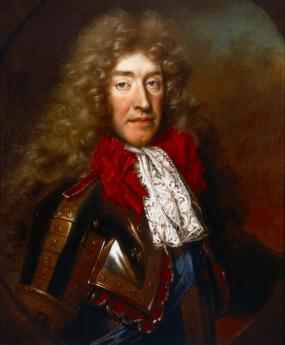
| Duke of York |
William Penn, who spent considerable time in British prisons, established a penal code for his new colony which largely swept away the draconian punishments established by the code of the Duke of York. Until as late as 1780, jails were mainly confinement hotels for debtors, prisoners awaiting trial, and witnesses. For actual punishment, the methods were execution and flogging. Penn's Code for Pennsylvania restricted execution to the crime of murder, and flogging to sexual offenses; everything else was punished by fines and imprisonment. Hidden in this code, of course, was the need to invent and construct prisons to service the imprisonment. It would take over a century to address this need, and Philadelphia still has not completely caught up with the need for more prison cells. Without a prison system, the Penn code was impractical, and the colonial penal code retrogressed toward floggings, pillories, and hangings after Penn's death.
|
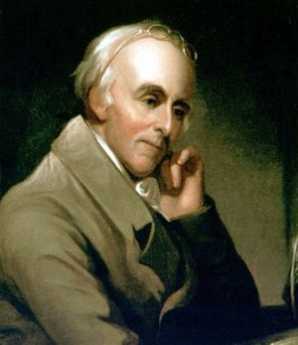
| Dr. Benjamin Rush |
In colonial Philadelphia, the main prison was on Walnut Street, with sixteen cells. A neighboring Quaker, Richard Wistar, started a soup kitchen in his own home, taking the soup over to prisoners. By 1773, he had established the Pennsylvania Society for Assisting Distressed Prisoners, which was unfortunately disbanded by the occupying British Army in 1777. In 1783, Dr. Benjamin Rush with the assistance of Benjamin Franklin, Bishop White, and the Vaux family, founded the Philadelphia Society for Alleviating the Miseries of Public Prisons, which after a century changed its name to the Pennsylvania Prison Society. The Prison Society believes it is the oldest continuous non-profit society in America.
|
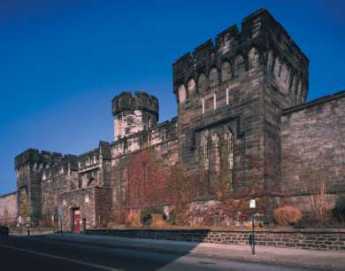
| Eastern State Penitentiary |
The Prison Society has had several major changes in direction. The original concept was to substitute public labor for imprisonment, a less costly arrangement than imprisonment while avoiding a return to floggings and dismemberment. However, the degrading sight of prisoners in chain gangs caused a public outcry, and the approach was abandoned. In the spirit of the French and American revolutions, loss of liberty was seen as the greatest punishment conceivable. Added to this was the Quaker concept of inspiring remorse through silent meditation, and the eventual outcome was the construction of the Eastern State Penitentiary on what was then called Cherry Hill. In 1823, it was ominous that Eastern State Penitentiary was the largest structure in America. Although the concept was widely admired and imitated, the prolix Charles Dickens took a violent dislike to the idea of never talking to anyone, and led a reversion away from penitentiaries back to simple prisons. In the days before Alzheimers and schizophrenia were well characterized, the spectacle of massive recidivism was added to the rumor that protracted solitude led to insanity.

|
| Catherine Wise |
From Catherine Wise the Communications Director of the Pennsylvania Prison Society, the Right Angle Club recently learned that the current evolution of the American penal system has led to a steady state, but a troubled one. There are 2.2 million inmates in American prisons today, more than any other nation including Russia and China. Of these, 75,000 are confined in Pennsylvania, 9,000 in Philadelphia. Recidivism is 67%, the cost is $31,000 per year per inmate, the majority of inmates have been involved with illicit drugs, a growing number are infected with HIV and Hepatitis C, mental illness runs around 20%. The cost of incarceration is growing faster than the cost of either education or healthcare for the community. Prison overcrowding is extremely serious, the programs for managing parole and integration back into society are weak and underfunded. Eighty percent of the inmates are non-white, most prisons are located in remote regions too far for easy visiting, medical care in prison would not seem at all acceptable in general society. The Prison Society has no difficulty finding projects which are urgently needed. Just for an example, take the peculiar prison statistics; it really seems improbable that only 9,000 of the 75,000 Pennsylvania prisoners are in Philadelphia. Then reflect, NIMBY, that no one wants a prison or its visitors near his home, except areas of rural poverty welcome the employment a prison brings. Reflect for a moment that "jails" are paid for by local county taxes and contain prisoners with less than two years to serve. "Prisons" are paid for with state taxes, and contain those sentenced to longer than two years. Finally, add the fact that nonvoting Philadelphia prisoners in rural prisons are counted by the census as residents of the rural area for the purpose of distributing legislative and congressional seats. The rural politicians love the system, the urban neighbors love to be rid of the prison environment, but the prisoner families can't visit the prisoner. Who cares? Who even notices?
During the first World War, Quaker interest in prison matters was greatly stimulated by the imprisonment of many Quaker conscientious objectors to the wartime draft; since that time prison conditions have again become a central interest of the religion. It's hard to prove but is confidently asserted, that violence and mistreatment of prisoners are appreciably less in Pennsylvania than the rest of the country, California for example. In any event, The Pennsylvania Prison Society is a particularly effective advocate for humane treatment because of credibility achieved over two centuries, with newspaper editors on its board, and sympathetic affiliations with the legislative judicial committees. It knows what it is talking about, as a result of over 5000 annual prison visitations, and it has served the prison administrative corps by performing volunteer work, accepting contracts for parole projects, arranging bus trips for prisoner families to remote prisons, and working for improved funding for prisons. At the moment, there are six highly imaginative bills before the Pennsylvania Legislature, devised and researched by this outside organization with credibility, and political clout. Although the Society takes an occasional contract for a project, it is itself entirely funded by outside contributions, and because of occasional adversarial situations, asks for no funds from the state. Even the contract funds have been questioned, and are only accepted when the working relationships fostered are more useful for the prisoner clients than any co-option which might result.
One final word about medical care in prison. It's not as good as medical care for non-prisoners, and unfortunately it probably never can be. The remote rural location of prisons makes it difficult to obtain physicians and nurses, regardless of wage levels. It's dangerous to be around prisoners, as any guard will tell you, and it's more dangerous to be in control of narcotics amidst a population of addicted convicts. Malingering is nearly universal, both to obtain desired drugs and to spend "easy time" in the infirmary. Many prison escapes are engineered around the necessarily weakened security of the medical system. The prison budgeting system has all the rigidity and weaknesses of any governmental medical system, and in this case, it's run far out of sight of the public. Even the bureaucrats in charge are victimized by other bureaucrats. The average duration of incarceration in Pennsylvania is longer than in most other states; the prisons have to keep mental patients because the mental hospitals have all been closed. Fifty years ago, when there was no place to put a non-criminal with tuberculosis, he was put in jail. The parole system is underfunded, there is not nearly enough community support to absorb ex-con. Behind all this is a shortage of prison facilities. The legislature has got itself into a position that if it moved more prisoners into the outside, more prisoners would just fill the vacancies, costs would go up, and things wouldn't look much better. Only after the backlogs have been absorbed, would there be much visible effect.
No Laborer Left Behind
 |
| Ivy League |
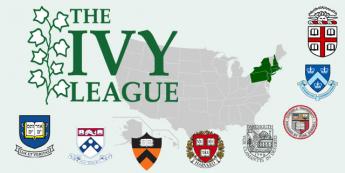
The top thirty American colleges have ten times the applicants they have room for. Demand vastly exceeds supply, prices are essentially fixed; shortages result. Can-do is the American way, so our first reaction is to build a lot more colleges and beat them over the head if they aren't first-rate. To bring this down to a local scale, implications are that Philadelphia has a moral duty to build eighteen more Ivy-League universities.
 |
| Cosa Ricians Roofers |
Let's think about that, in a back-of-the envelope way. Since the rest of the country is going to be similarly driven, we can't attract Americans to run those universities. Philadelphians who are doing other things must staff those universities; people inclined to become professionals of a different sort are going to have to be trained to be university professors. Students now being rejected will be admitted, since that's the purpose of the thing. Unless we somehow increase academic productivity, every man, woman and child from Trenton to Wilmington is going to be in a college classroom in some capacity or other. We here confront the extrapolation fallacy; a new problem must be addressed in more productive ways than just more of the same.
Curiously, the readjustments to this overall shift from an industrial to a service economy are first making their appearance in things like roof repairs and ironing shirts. When my house needed a new roof, I found I had a choice of workgangs composed of Costa Rican, Puerto Rican, or Polish roofers. The Costa Ricans made the best bid and went to work immediately. They started pounding on my roof at 6 AM, and we're still pounding after I went to bed at night; I have grave doubts that American roofers would approach that work standard. I am told that the entire building industry, on which our current prosperity rests, would collapse if we banned illegal immigration. In a different industry, Philadelphia's convention hall cannot attract visitors unless we build more hotels. But the hotel industry cannot find nearly enough people who speak English to make the beds. For one purpose or another, we have imported 12 million illegal immigrants who mostly remain invisible because they are so hard at work.
We are going too recklessly fast with what is fundamentally a useful transformation of our society. Americans want to go to college because statistics show that will make them prosper. But that's only half of their transformation. The other half is a resulting shortage of labor in the jobs which do not require college. Normally, you would expect wages to rise, but they are suppressed -- deflated -- by substituting immigrant labor, legal and illegal. Impose an effective barrier to immigrants, and you would quickly see inflation like you wouldn't believe. Combat inflation by raising interest rates and the housing market would quickly collapse. That would prove to be a painful way to make the immigrants decide to go back home, although it would be effective. And so on, and so on, and so on.
Slow down, America. You're going in the right direction, but exceeding the speed limit.
Commercial Academic Think Tank
|
| Stephen P. Mullin |
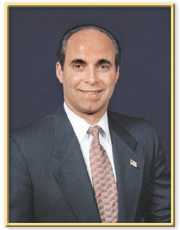
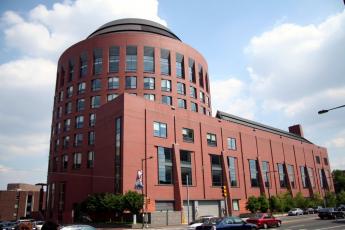
Stephen P. Mullin recently addressed the Right Angle Club of Philadelphia about assorted economic subjects; he is certainly qualified. He was once the only Republican in Mayor Rendell's cabinet, acting first as Finance Director and then as Commerce Director. At first, he doesn't appear extroverted enough to be a politician but quickly demonstrated that he knew the first names of more of the members of the club than the president did, so maybe he does have the innate talents of a politician. Urban political machines don't usually respond cordially to graduates of Exeter and the Wharton School of the University of Pennsylvania. A number of University professors are consultants to the firm, which offers statistical economic advice to the many law firms in town, to philanthropic organizations considering public-interest projects in the region, to government agencies faced with regulating unfamiliar activities, and very likely to anyone else willing to pay for the service of academics, statisticians and analysts. It certainly sounds like a service that governments and philanthropies need, and which the region needs to avail itself of. In a way, it is probably something the University needs, as well. A friend of mine is now retired, but at one time I commuted on the train with an academic administrator of the Wharton School, who was quite obviously disturbed by handing diplomas to students who promptly took jobs which paid those graduates more than he was paid himself. Obviously, such a system cannot persist very long without creating a brain drain, so income supplementation by commercial consulting is a necessary and valuable support for academics. There are, of course, probably some negative features as well.
|
| The Wharton School |
It is interesting to hear from Steve how Philadelphia can be variously described. We have, for example, significantly less foreign immigration than other cities. New York, by contrast, has net immigration of about 700,000 persons a year; such forces can quickly transform a city in a variety of ways. The bombing of West Philadelphia during the Goode Administration was news for a while, then vanished from the papers. But it had a shattering effect on Philadelphia commerce, leading to a period of 8 or 9 years when there was essentially no private investment in the city. Philadelphia indeed now needs to have its municipal bonds issued by the state bonding authority, because our own bond rating is so low the extra cost of municipal debt is a significant one. And there is the cost of invisible shifting of power to Harrisburg. An unexpected result is that sales and real estate transfer taxes escalated to make up for property taxes which they could not possibly be raised as much as inflation. Real estate was in big trouble; whether ingenious strategies like the 10-year tax abatement for a new property will be successful in rescuing the real estate industry, remains to be seen. New office towers have been built, but they drain off tenants from older office buildings. We're seeing a massive conversion of older office space into residential apartments, an apparently successful maneuver. But that drains the older residential areas, which leads to -- well, who knows what it will lead to, but it could be slums.
|
| Mayor Michael Nutter |
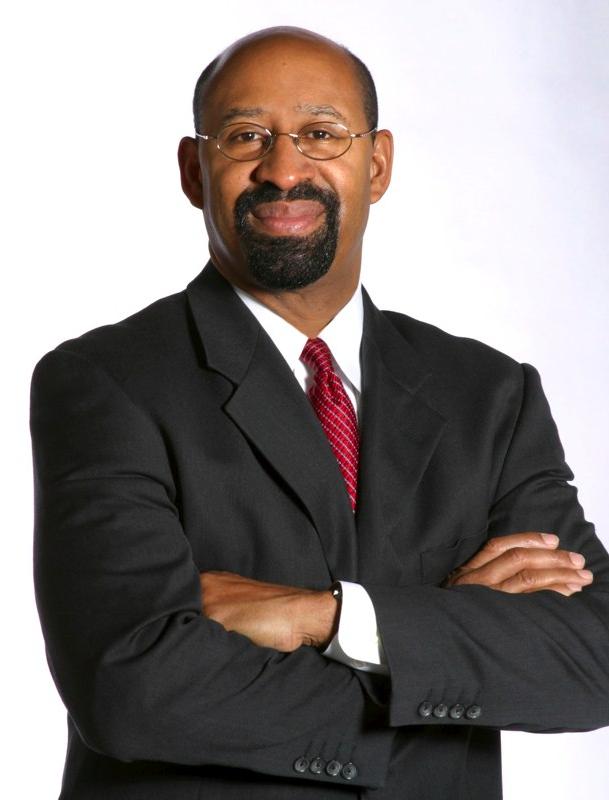
The traditional hostilities between Philadelphia and its neighbors can be defined in a new way, too. For a century, Philadelphia contributed more tax money to the rest of the state than it received in state services. But in the past 20 years, Philadelphia city has become a net importer of an annual billion dollars -- from the rest of the state. Two or three billion go to the schools, which the rest of the state regards as a deplorable waste in view of the quality of the product. And yet, the most hopeful feature of the situation is the vigor and ingenuity of the attempts being made to rescue the situation. In a certain sense, Mayor Nutter is the candidate of the Wharton School. He may well have some innovative ideas, and academic places like the Wharton School will surely suggest others. It remains to be seen whether Nutter can combine idealism with sufficient ruthlessness to make the city function. Cynical oldtimers will grumble that a mayor has to employ a moderate amount of deception and corruption in order to accomplish his mission. Maybe that overstates things, but it is very certain he must be tough. He's dealing with construction unions who will certainly be tough, and whose interest in sacrificing their own agendas in order to help the schools or street crime -- always fairly small -- is even further impaired by the econometrics that 70% of them live in the suburbs. We wish our new mayor all the best, since he seems smart enough to know what needs to be done, and is definitely smart enough not to drop any bombs on houses. He's smart enough to see that extra city revenue derived from gambling might permit the lowering of wage taxes, and hence an urban business recovery. But is he tenacious enough to stay in office long enough to achieve the balanced result; or will the forces of evil simply kick him out of office before wage taxes can be lowered and gambling discontinued? He won't break his promises, but will they break them for him? Beyond being competent, a city mayor needs to be tougher than the convivial but very mean friends he needs to associate with. He must, for example, decline to run for national office, the traditional way that city machines rid themselves of pointy-headed reformers.
States Rights Confront Civil War
|
| Dr. Randall Miller |
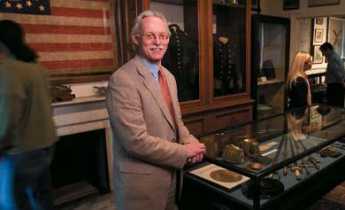
Dr. Randall Miller of St. Joseph's University recently gave the Union League an interesting insight into the non-military upheavals of America by Congress during the Civil War. (Parenthetically, Dr. Miller is the author of Encyclopedia of Greater Philadelphia, which may give him still greater prominence in these columns when it reaches print.) Lincoln and the military get most of the headlines, but the greatest nation-building activities were products of the Congress, not Abraham Lincoln directly; the President was too busy directing the war to take much lead in other matters. The Republican Party of that time was freshly created, still strong in its idealism around elements of the party platform which really meant something to them. Although Senators John Sherman of Ohio and William P. Fessenden of Maine are remembered by history, most of the activity was conducted by members of the Congress who had reached seniority in committees and hence mostly had died off by the end of the War. It seems like one of history's great unfairnesses that a remarkable transformation of the nation was accomplished by people who are now largely unknown.
So Lincoln gets much of the credit by default, and the idealism and grand plans are lost in the current view that the Civil War was about liberating the slaves. That was, of course, part of it, but the Civil War was in fact mostly fought about the Union, and the Whig principles essential to nation-building. And the transformation was the vision of party politicians in offices which we currently regard as being filled by party hacks in safe seats. That wasn't the case at all; these visionaries knew where they wanted the country to go, and cleverly designed a set of programs to make it happen. Lincoln wanted to win the war; these men wanted to have a new nation emerge, after the war.
|
| Civil War |
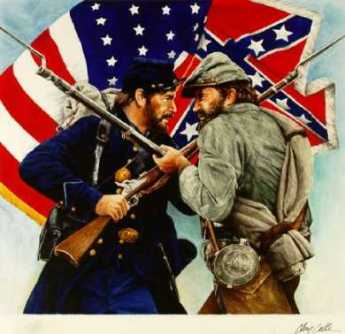
It almost goes without saying that a Civil War over the secession of rebellious state governments from a Union created by the Constitution was going to weaken state power -- and strengthen Federal control -- if the Unionists won the war. That's what the Republicans wanted, and what the Southerners feared. But, strangely, both sides harbored warm feelings for the Constitution, wanting to preserve much of its essence. The Republicans, therefore, realized that many of the laws which were essential for winning the war, would lose their popularity and hence their force, once victory had been achieved. Reconstruction of the South, for example, was going to be unsustainable as soon as the huge Union Army was demobilized. The liberated slaves were unlikely to migrate to the western wilderness, and so the problems of racial readjustment were going to remain Southern problems for decades to come, without an army of occupation to maintain stability, law, and order. In fact, it was largely Southern whites who migrated to the far West, leaving the situation even more unstable back in the old Confederacy. How was a brave new nation to emerge from this mess?
War measures did help. There was no Federal currency until the War, and so a national system of greenbacks and war bonds helped to unify a vast and far-flung continent. The National Banks, fought over and feared for nearly a century, simply had to be created; all of these national rather than local symbols strengthened the national feeling. Putting 10% tax on state bonds was a pretty good indication that the congressional Republicans knew where they were driving things. The telegraph was of great value to wartime communication; it helped create a virtual community, with national news taking the place of local news.
Up until the Civil War, the main source of Federal income was derived from the sale of land; the new nation had a lot more land than gold. After the war, the nation found itself with taxation as the main source of income. The income tax was a step too far, of course, and it was repealed; but a system of national currency organized a system of national taxes which persisted. The country still had plenty of raw lands, but it was distributed by giving it to railroads in return for national transportation, and to land-grant colleges in return for greater uniformity of culture. Notice the hand of Congress, however. This land was to be surveyed land, not the land between this rock and that creek. Surveyors since the time of William Penn and George Washington were the agents of orderliness, law, and peaceful settlement of disputes. To that extent, surveyors broke up the reliance on local clans and territoriality; peace instead of conquest. The leaders of the North, the Republicans in Congress and the cabinet knew what they wanted; it was that the sacrifices of the war would find a reward in the peace that would follow and that reward would be a new nation.
Notice carefully the second section of the Thirteenth Amendment. The first section freed the slaves. The second section gave to the Federal government the charge of enforcing that liberty. The crafters of words and designers of rules, knew exactly where they wanted to go.
|
| The Constitution |
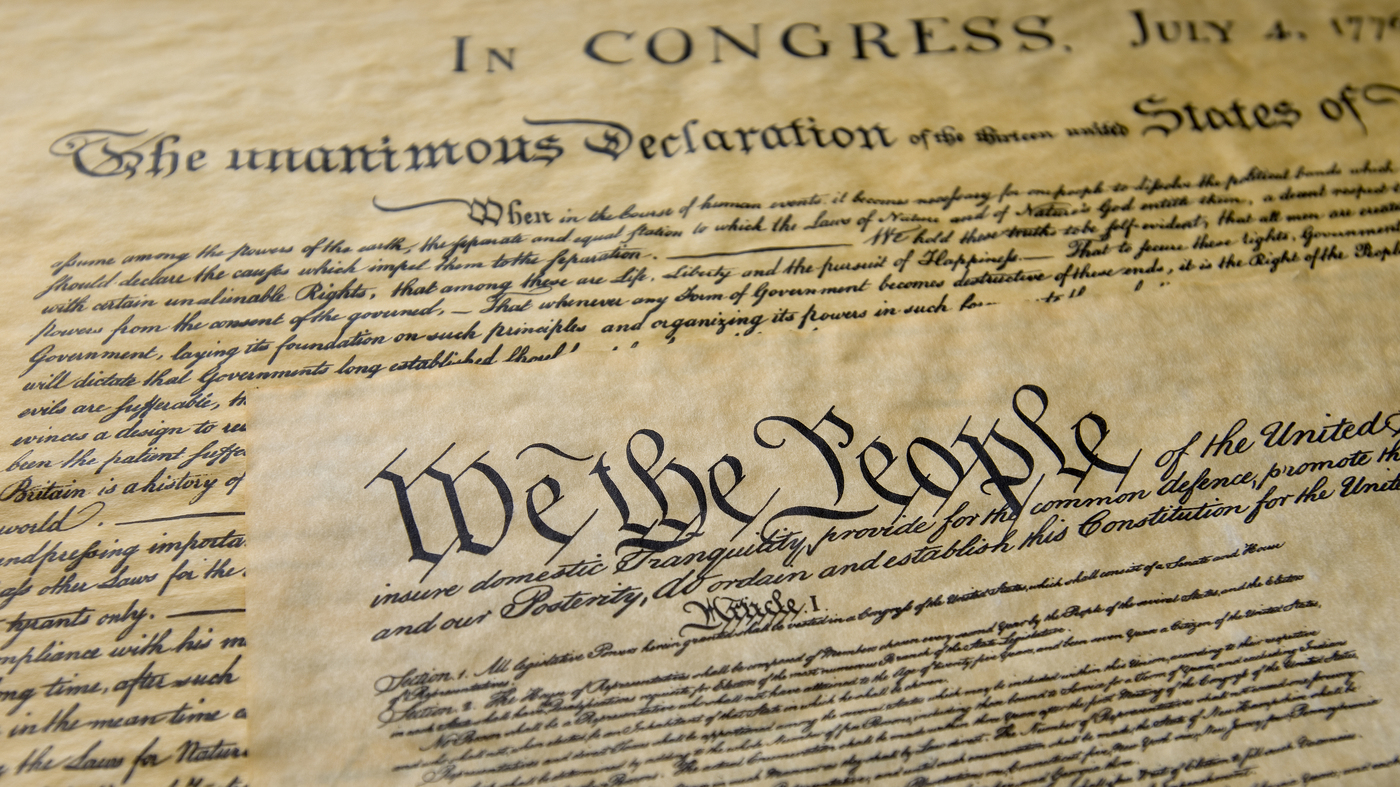
They did their work so well, that it begins to look as though the next few decades will display a crisis, created by going too far, too fast. In all these idealistic schemes, the state government is the enemy. State governments would interfere with Reconstruction; state governments would interfere with land grants and misuse their undisputed control of local law enforcement. State governments would introduce little strategies for restoring the power to tax and control, and to govern. State governments would slowly remember that the Constitution conferred only a few limited powers on the Federal government, and reserved all other powers to the states. The Constitution would never have achieved ratification without this explicit provision in the XII Amendment. And so, step by step, we have achieved some sort of goal by making the state governments into the weakest, most ineffectual, and yes the most corrupt parts of our national system. California, New York, New Jersey, and Michigan lead the way into what seems a certain disaster of enlisting municipal employees into political machines of the worst sort, and bankrupting the states that permit it. Massachusetts, Rhode Island, Maryland and West Virginia are not far behind.
Fanatics could persuade themselves that a solution readily lies in simply going all the way and eliminating state governments. But to do so would destroy James Madison's brilliant insight. The states place a limit on unlimited power from whatever source by offering the citizens a choice: if things get too bad, just move to a nearby state.
Children's Scholarship Fund (1)

|
| Children's Scholarship Fund of Philadelphia |
Ida Lipman recently visited the Right Angle Club, to acquaint members with the nature of the club's new charity, the Children's Scholarship Fund of Philadelphia. This fund could be seen as a response to the rising realization that the nation's leading social problem is fast becoming one of upgrading the educational strength of the current generation of poor people, who face hopeless odds competing for unskilled jobs against a vastly larger population of foreign poor people in a globalized economy. Our poor people can never hope to rise out of poverty by taking jobs that foreign competitors are willing to perform at even lower wages. And while everyone hopes our poor people can take on better-paying jobs, it requires better education to do it. Ultimately, the question for America is whether to place the emphasis on better teaching or better learning, and the two are not quite the same thing.
The educational problem of motivating children to higher attainments than their parents is a difficult social task in both urban and rural districts, but self-defeating peer pressures to hold down their classmates somehow seems a stronger force in the urban settings. In both environments, of course, the educational attainments of both the parents and the teachers have been aimed at a lower level than the task requires. It somehow proves unrealistic to shift expectations as rapidly as we need to, and part of the present problem is that the education industry has become demoralized by repeated defeats. Consequently, we are certainly lucky that philanthropic donors have been willing to support some radical experiments in the whole educational experience, including students, teachers and parents.
Thus, the Children's Scholarship Fund has been willing to dispense several thousand scholarships to private schools in the Philadelphia region, purely by lottery, without regard to the traditional guidepost of student merit. This policy would probably be disruptive if scholarships were universally available, undermining the spirit of meritocracy which is so central to our educational system. But since we are only partially addressing the failures of a system of universal free public education, a stronger argument can be made that changing the culture occasionally requires that we set aside the traditional incentive of rewarding the behavior we seek. The hope is that a demonstration project with such a radical change will set other motives into motion. Resources are limited; it is recognized that among the ninety percent of students who fail to receive the scholarship by lottery, there will be many who are more talented than the few who are lucky enough to get an award. The point is easily overlooked however that scholarship students must apply for this lottery, and be supported by partial financial assistance from their parents. These parents must sincerely want to raise the educational goals of their children, and convey that motivation to the kids in whatever way they are able to convey it. The pressure of less lucky playmates and neighbors to hold them back, it is hoped, will be lessened by the simple recognition that a lottery gives everyone an equal chance, provided only that they step forward and pledge themselves to try to succeed.

|
| John Walton of the Wal-Mart family |
It's a bold and imaginative approach, a highly counter-intuitive one. John Walton of the Wal-Mart family matches the contributions of other donors at fifty cents on the dollar through his family foundations, which was jointly founded with Ted Forstmann of the Wall Street firm. Many longitudinal studies will eventually show how much this bold and charitable venture really helps the students and the community; since it is private money in use, criticism should be held back until the results begin to be apparent. To whatever degree and in whatever way the scholarship fund is a success, the public must be willing to praise both its spirit of generosity, and its willingness to take a chance. Let's all mark this down in our notebooks, to see how it all turns out in ten or so years.
Paul Robeson 1898-1976
|
| Paul Robeson 1898-1976 |
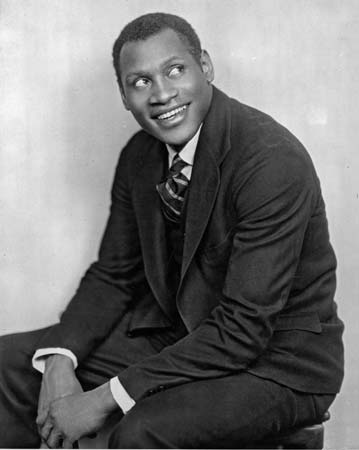
Everyone with international fame and fortune seems to belong to another planet, but Paul Robeson belongs to the Philadelphia region as much as to any locality. He was born in Princeton, of a black minister who went to Lincoln University, and a mother of Quaker heritage. Not only an All-American football player, but he also won twelve varsity letters. He not only was accepted to Columbia Law School, but the only black person in the class became its Valedictorian. Later on, his amazing baritone voice made him the perfect person to sing "Old Man River" in the musical Showboat, and quite a different dimension emerged in his highly memorable portrayal of

|
| Paul Robeson as Othello |
Shakespeare's Othello. He was combative athlete, nobody's fool, and had a commanding stage presence. It was scarcely surprising that he resented the social slights he encountered in his upward mobility, or in a time when many people -- not just in show business -- were leaning leftward, that he frightened people with his praise of Communist Russia and seeming incitement of his race to rebellion.
Probably the first false note in this tragedy was his resignation from a prestigious New York law firm because a white secretary insulted him. No defensive explanation from his admirers could quite justify this unlikely story of a promising career cast aside for a trifling affront. Some of his foreign travels may have been entirely motivated by a search for social progress, but his several hospitalizations abroad do raise the possibility that he hoped to avoid publicity about his illness. The last two decades of his life were destroyed by undeniable mental illness. There are schools of the psychiatric theory which contend that depression can be caused by severe life stresses, but majority opinion now mostly views such illness as an inherited disorder. In any event, he was born too soon. In recent years, the treatment of depression has much improved.
The failure of early promise is an old story, but in Robeson's case, it was far more than personal decline, and more the hunting-down of a wounded animal. The son of an ex-slave, Robeson evoked memories of slave rebellions in the past with his mournful song of the Mississippi laborer, as did his vengeful destruction of the innocent Desdemona. His exploiters in the entertainment industry probably deserve some criticism for pushing him too far into a rebel image, and the ruthless manipulation of communist agitators during the 1930s is not a myth. So, there was really not much to prevent Senator Joseph McCarthy and his associates Cohn, Shine and Kennedy from converting the post-war fears of the nation into a circus of fearful demagoguery. Millions of people had just died in foreign wars, nations had been reduced to rubble, and vengeful heedlessness was on every side. It was not a pleasant time.
More than twenty years later, Paul Robeson died where he had been living with his sister, in West Philadelphia.
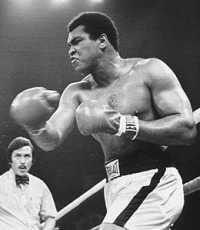
Mohammed Ali, Cassius Clay
|
| Mohamed Ali |
He doesn't live there any more, but for a long time Mohamed Ali the Prizefighter lived in Cherry Hill, New Jersey. Although a celebrity, he made little local news in Philadelphia; comparatively few Philadelphia's even knew he was here. One day, my ten-year-old son came in the house with a check endorsed by Ali for a hundred dollars or so. It had apparently flown out the window of a passing car, and my son was very excited to have the autograph of such a famous person. There was an ethical question here, since the check was apparently worth something to its owner, and should be returned. My suggestion was followed to mail the check back with a note suggesting that perhaps the Great Man would be willing to send his autograph as a reward. The check was accepted, but the letter was never answered, no autograph was forthcoming.
Since that time I remained a little irked that Mohamed Ali would be ungrateful for the favor, unwilling to take a little trouble to help me teach my children the right thing to do. That small, perhaps unwarranted, irritation was balanced by reports from a respected friend of mine who was his doctor. My friend always referred to him as "Champ" and never failed to praise him as a person. Perhaps the check incident had been some sort of accident, something I should overlook.
There were those news reports, of course, of his refusal to accept the draft, his public conversion to Muslim faith and adopting a frankly Muslim name at a time when the perception was that black Muslim had the significance of a prison cult, both anti-American and anti-Western Society, perhaps even racist. Surrounded by news media as he was, he became a symbol of resistance to the Vietnam War and American foreign policy. It was hard to know what to think of him, but on balance it was unfavorable, even when he was reported to be incapacitated by crippling Parkinson's disease.
|
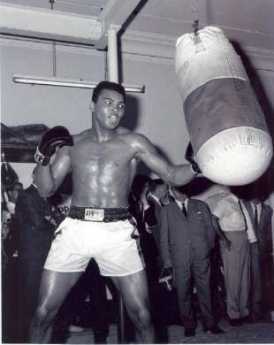
| sports |
And then recently, The Constitution Center held a forum on the relationship between sports and the media. The point was repeatedly made that a sports career is brief, that financial success in it depends heavily on fast and early publicity. All publicity is good publicity, so outsiders who seek to publicize a political agenda can often put their words into the mouths of eager kids who are being privately urged to grab publicity of any sort, anyway they can. You tell me what to say; I'll say it. Make me sound clever and serious; I'll agree to your words.
It thus happened that a reporter who had been covering Mohamed Ali for 25 years and knew him well was able to say he was certain the Champ had never had a political thought in his life. Having been pressured by others into making political noises for celebrity purposes, and perhaps under some intimidation by acquaintances, he finally rebelled against the whole scene. Respect for a man I had never met finally welled up in me when I thus saw his famous quotation to the press in a new context: " I don't have to be -- what you want me to be."
John Woolman Reports on Yearly Meeting, 1758

|
| John Woolman House |
"In this yearly-meeting (1758) several weighty matters were considered; and, toward the last, that in relation to dealing with persons who purchase slaves. . . .
"Many faithful brethren labored with great firmness, and the love of truth, in a good degree, prevailed. Several Friends who had Negro's expressed their desire that a rule might be made to deal with such Friends as offenders who bought slaves in future. To this, it was answered, that the root of this evil would never be effectually struck at until a thorough search was made into the circumstances of such Friends who kept Negro's, with respect to the righteousness of their motives in keeping them, that impartial justice might be administered throughout. Several Friends expressed their desire that a visit might be made to such Friends who kept slaves, and many Friends said that they believed liberty was the Negro's' right; to which, at length, no opposition was made publicly. A minute was made, more full on that subject than any heretofore, and the names of several Friends entered, who were free to join in a visit to such who kept slaves. "
Whigs, Slaves, and Tariffs
At the time of the Revolution, Philadelphia had 25-30,000 residents. Although then it was the largest city in North America, today it would compare with a small suburb. By the time of the 1800 census, Philadelphia had 67,000 residents. The Capitol was moving to Washington; Philadelphia's fifteen minutes of fame were over. Still, the city had only achieved the size of what we would now call a one-industry town. The fifty state capitals today are about that size; look there if you want to observe the mentality and social structure of one-industry towns.
|
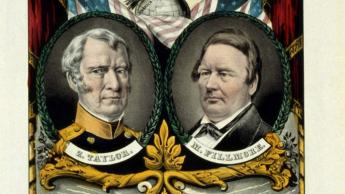
| Zachary Taylor, His vice president, Millard Fillmore |
But by the 1850 census, Philadelphia's population was 408,000, 30% foreign-born. That's an entirely different environment. By the time of the Civil War, Philadelphia was a real city, with real growing pains. The rest of the country had similar problems, with different details. The voting franchise was extended beyond land-owning taxpayers in 1838, mostly affecting backwoodsmen who had immigrated a century earlier. In Philadelphia and other seaboard cities, however, the franchise was extended to factory workers from foreign cultures, and the result was natives. Street riots calmed down into politics but transformed into politics. "Know Nothings." a Nativity political party was named for its pledge to say "I know nothing" when the police arrived. (Philadelphia's 1854 city-county consolidation can be traced in part to a need to get local police forces to follow orders.) The extension of the franchise could be traced back to the 1828 election of Andrew Jackson, and it could be traced forward to the creation of modern political parties. The founding fathers supposed that leaders would be elected on the basis of deference, with a town like Philadelphia run by the Biddle's, Ingersoll's and Wharton's. And in fact, that was mostly how it was until 1828. After that, it was just a matter of time before the only thing that counted was the only thing that was being counted - votes. Since that time, business and social elites have from time to time rebelled with what they called "reform movements." But as Adlai Stevenson wryly remarked, it takes a majority to win. Election of elites is always and everywhere a rarity.
The critical moment for Philadelphia and the Republican Party came in a smoke-filled room in the 1850s when the anti-slavery movement was united with the Nativity Know-Nothing Party. Both of these parties held their national presidential convention in Philadelphia in 1856.In the background was dissolution of the Whig Party, and on the table was the protectionist tariff. The Whigs were an idealistic group, and Lincoln had been a fervent Whig. Their theme was building canals, roads, railroads and other features designed to promote prosperity by enhancing the economic infrastructure. The weakness of the Whigs lay in the way their approach usually raised taxes. The Know Nothings were far from idealistic; their weakness lay in the general fear they were promoting class warfare.
Someone proposed that the common ground between the two splinter parties lay in advocating the protective tariff. Of course, that's another bad idea, but as a vote-getter it was wonderful. It united the workers with the business owners, potentially enriching both of them. More importantly, it reassured the idealistic Whigs and abolitionists that class warfare could be avoided. Freeing the slaves, conversely, would appeal to businesses and workers who compete with slaves.
A hundred years earlier, Adam Smith had demonstrated that artificially raising prices impoverishes consumers, and the Wealth of Nations is thus always injured by tariffs. But anyway, on to the Wigwam, and on to Fort Sumpter.
Slaveowning Quaker Steps Up To The Plate
|
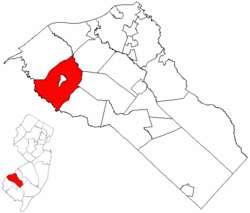
| County of Gloucester |
I, Joseph Nicholson of the Township of Woolwich and County of Gloucester, do hereby set free from bondage my Negro Tenor, aged about twenty-two years, and do, for myself, my Executors and Administrators, release unto the said Tenor, all my Right, and all claim whatsoever as to her person or to any Estate that may acquire, hereby declaring the said Tenor, absolutely free, without any interruption from me, or any person claiming under me.
In Witness whereof I have hereunto set my Hand and Seal this twenty-seventh day of the Twelfth Month, in the Year of our Lord One Thousand Seven Hundred and Seventy-nine. 1779.
. . . Joseph Nicholson (Seal)
. . Sealed and Delivered in the presence of Joseph Allen
SCORE
|
| Mark Maguire |
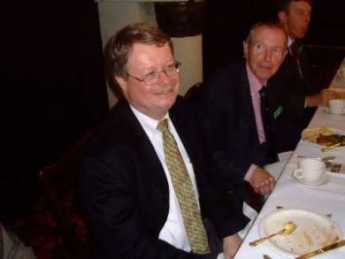
Frank Pace, formerly Secretary of the Army, founded SCORE, the Service Corps of Retired Executives, in 1964. Philadelphia was one of the main founding chapters but tended to dwindle as business large and small dwindled after the bombing of West Philadelphia by the then-Mayor; former executives living in the suburbs lost interest. In December 2006, Mark Maguire took charge and gave SCORE a new direction. This former executive of Rohm and Haas is not related to the baseball home-run king, but at least his name is easy to remember.
The new sociology of center city demanded that more small businesses be started by minority residents, who have very little family and cultural experience in this sort of activity, which nevertheless is recognized as the main source of job creation in any area. It turns out that the main source of energy in the minority community is among minority women, who are particularly unfamiliar with the problems of small business. So, SCORE needs to dispel a number of misconceptions and unrealistic ambitions, and familiarize these budding entrepreneurs with the tax and regulatory headaches ahead of them, and teach them to be watchful of common traps and obstacles, learn to cope with fair competition, and how to recognize the signs of fraud before it happens to them.
The usual vehicle for teaching these elements of commercial life is to induce the writing of a detailed business plan, which executives can criticize for lack of realism or inadequate capitalization, suggesting ways to succeed in a field that experiences 50-60% failure in the best of circumstances. Some of this requires face-to-face discussions, lectures, and required reading. But much of it can be handled with weekly email consultations, a favorite tool of Philadelphia's SCORE chapter. Much of it can be addressed by referring the client to the proper agency or service business, or bank. SCORE has a strict ethical code for its volunteers, including a prohibition of becoming a vendor or participant in the business.
In addition to the changing nature of new small businessmen, there is a changing demographic of the volunteer executives who do the advising. Over 80% of them describe themselves as retired, but in fact, it is rare for one to be totally retired from all business activity. These guys really like to work, and a thirty-year vacation is not their goal in life. Just by acting as an example, they are establishing an important goal for the young businessmen and women who look to them for guidance. Work is how you accomplish something in life, and work, believe it or not -- is fun.
www.Philadelphia-Reflections.com/blog/1430.htm
Passenger Stop
|
| Passenger Stop |
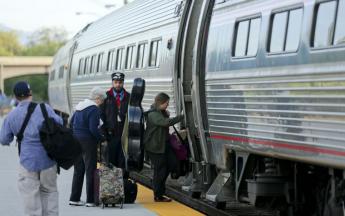
Having eight grandchildren provides a reminder that June is a time for graduations. So last week I returned from one in Virginia on a very full train, early in the morning, somewhat sleep deprived. High prices of gasoline had forced people onto trains who would otherwise have taken an airplane or driven a car, so the conductors were unusually hassled to service tickets between stops, and were rather brusque. It's likely I was the only passenger wearing a jacket and tie.
The conductor in my car came by with terse orders to sign the tickets, perhaps unnecessarily brisk about it. We only exchanged brief maneuvers, long enough for me to see that this representative of corporate authority was wearing, well, dreadlocks. Both of us were wearing symbols.
As we passed Wilmington, Delaware, I fell asleep. The next I knew, I woke up looking out the window at 30th Street Station, realizing with horror the train was already moving forward. Jumping to my feet, I encountered Conductor Dreadlocks, who asked where I was going. My answer, "Philadelphia" was met with his order, "Follow me". He pushed some buttons, brought the train to a stop, and let me off.
I was then the only person on a long platform; the train remained stopped for two or three minutes. It was a very long silver snake, stretching out of sight in both directions, live but motionless. Looking up, I saw the conductor looking out the vestibule window. So I waved at him.
And he waved back.
Urban Bridges
|
| Reverend Mary E. Laney |
The Reverend Mary E. Laney recently told the Right Angle Club about her experiences in an Episcopal mission church, along with the history behind this innovation, and the establishment of a 501(c)(3) organization to help the idea on a national level. That may mean no more to readers of this site than at first it probably did to the Right Angle Club, before Mary Laney made it all come alive. It was quite moving.
|
| Bishop Alan Bartlett |
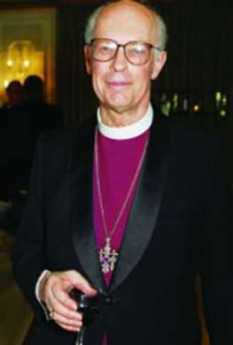
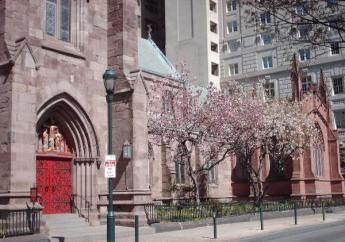
During the 1980's she asked Bishop Alan Bartlett, at that time the Bishop of Eastern Pennsylvania for the Episcopal Church, if she might be assigned to an urban mission. As ethnic and religious population migrated around the Philadelphia landscape, quite a few Episcopal churches have been stranded in economically depressed neighborhoods, unable to afford a full-time pastor. The concept of a mission church was developed as a designation for churches that had dwindled to the point where only a handful of parishioners were left and were assigned to a category in which the Bishop would appoint a part-time Vicar to be in charge of what then needed financial support from the main church. Although in a sense Bishop White started the idea two hundred years earlier, there were no mission churches in Philadelphia in colonial times, but there are now over fifty of them, a quarter of the Episcopal churches in the region. Reverend Lancey was assigned to St. Gabriel's at the corner of Front Street and Roosevelt Boulevard, and stayed there fifteen years. She is now with St. Christopher's in Gladwynne.
The initial concept was to identify eight lead mission churches, build them up to be self-sustaining, and then replace them with eight new ones. With all good will and hard work in the world, this concept failed, largely because the social conditions of the poor at that time also depressed their educational level, and had instilled in them a culture of constant failure. In one telling episode, the parishioners said there was no hot water in the church. As a matter of fact, the pilot light of the hot water heater had gone out, and the parish was so sunken in the mindset of failure and despair they had not even looked into it. Mary Laney decided something had to be done to change the model.
What seems to have worked was the creation of a 501(c)(3) organization called Urban Bridges. The original idea behind this organization was that since the Constitutional separation of church and state precluded government grants to church no matter how struggling, but perhaps a tax exemption would make it possible for private donations to accomplish what was needed. There was, in addition, the sad experience that whenever the constitution barriers had somehow been overcome by circumvention, the many layers of bureaucracy usually consumed the money. It had proved disheartening to see four or five years go by after a government grant, with not a cent getting to the programs and all consumed by consultants, advisers and supervisors.
Meanwhile, the poor parishioners continued to base their hopes on this sort of relief, while neglecting things which might be more effective.
The Urban Bridges program evolved from a primarily fund-raising organization into a system of partnerships between prosperous suburban churches and the struggling urban missions. The suburban churches proved to be inspired with a wish to help but frustrated by a lack of means to do anything effective. It thus evolved that the suburban Episcopal churches supplied what was really most needed: practical examples of leadership on a local level, combined with visible evidence of successful effort. Literacy courses, drum and bugle instruction, computer tutoring and a variety of other spontaneous activities led to the example of leadership, and in the long run, was a far more effective fund-raising tool than printed appeals and button-holing. Even in the case of crime, it was the leadership that made the difference.
|
| St. Christopher's Church |
The story was told of a drug dealer in the neighborhood who dominated the streets with dogs and blocked access to schools unless the children agreed to sell drugs for him. Local police had proved unhelpful, and hopelessness was rampant. What would prosperous suburbanites do in such a situation? Obviously, suburbanites would not stand for such a situation and called in the Federal Drug Enforcement Agency. The crook was promptly deprived of his dogs and now resides in jail. That may not be wholly in the spirit of peaceful reasoning, but it's the American Way, all right. This was what seemed to be missing in the culture of poverty. It's the determination that whatever the cost, intolerable things will not be tolerated, combined with absolute faith that the system does provide ways to be effective without becoming either lawless or wards of the state. This is America, right?
Selection of Constitutional Rights for the Bill of Rights
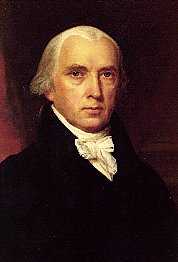
When the First Congress convened in 1789, it confronted more than a hundred proposed amendments to the Constitution, largely stirred up by supporters of Thomas Jefferson who feared any strong government would be too similar to the monarchy we had just discarded. Essentially, Congress dumped these noisy dissatisfactions into the lap of James Madison who had largely constructed the Constitution, constituting a committee with Madison as its chairman. The first ten amendments emerged together as a package, enabling trade-offs and compromises; all subsequent amendments have been taken up individually, one by one. Since members of the First Congress and the Constitutional Convention were largely the same people, much of the durability of the Constitution can be traced to them. And therefore, the tendency of the nation to feel its way into a new idea, sometimes retreating, sometimes plunging ahead, has migrated into the Supreme Court. This result was probably accidental, but nevertheless, the power of the Supreme Court was greatly strengthened by default; it alone can tip-toe out of a Constitutional tangle created by momentary impulses.
After winnowing out duplicates and half-baked ideas, Madison's committee condensed the wildly disparate proposals into ten amendments, supposedly limited to ten by alluding to Ten Commandments which were sufficient for Moses. Three main principles emerged. The Constitution should be parsimonious in granting divine, or natural, rights because what Nature's God had granted was hard to tell but what the judiciary could enforce had limits. But thirdly, granting even these few self-evident rights to slaves might tear the Union apart.
|
| James Madison |
So Madison's committee narrowed the legally enforceable human rights to a handful, selecting only those so self-evident they could withstand the tensions of enforcing them. When contemplating the problem of extending mandated rights to slaves, however, there was no obvious solution at all. That made it easier to limit the Federal Government to enforce a handful of enumerated powers, leaving all unspecified matters to the state legislatures to enforce if they could. The boundary might shift with time, but without saying so, the Bill of Rights kept the Union out of the one main foreseeable problem, of slavery. The unmentioned conflict between universal rights and slavery defaulted to the individual states, or to whomever, but definitely not to the Federal Government.
That tap-dance held together for nearly a century, and then it didn't and we had a Civil War. During all that time, the balance of power was steadily shifting from the confederated states to the centralized federal government, and after the Civil War, it shifted still more. However, the southern confederation may have been defeated, but it was not exactly reconciled, nor were the former slaves exactly equalized. Their current drift toward entitled dependency was particularly unexpected.
|
| Robert E. Lee |
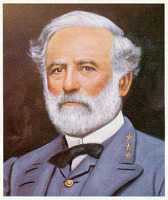
Many post-war expedients were tested to heal these wounds, some of them useful and some, like forcible Reconstruction, disruptive. Two expedients opened new wounds and distracted the country for a century. The first was the intentional weakening of the quality and effectiveness of state governments, to the point where it can now be asserted that state government is the weakest part of our whole government structure. Those who prized universality and efficiency, or who sought greater international power, regarded state legislatures as a hindrance; just look who got us into a Civil War. Consequently, corruption and ineffectiveness were privately tolerated in state legislatures, because discrediting state governments made them easier to ignore. Repairing the resulting imbalance in our overall system is now growing to be one of our greatest problems. Almost no one remembers this was the price of a ratified Constitution, so increasingly that excuse is futile. In fact, in the thirty-seven more recent states to be admitted to the Union, it is not even accurate.
The second response to a sluggish equalization of racial rights was invented by Madison himself. He felt that the ability to migrate from one state to another would discipline any temptation of a state to misbehave. If your state taxes you unfairly, move. If your state government gets too corrupt, first try to throw the rascals out, but in the last extremity, go somewhere else. This concept has worked magnificently in maintaining national interest rates with appropriate local modifications, and we are about to learn whether it will adequately restrain the half dozen states who have pushed the limits of taxes and borrowing. In the case of former slaves, massive out-migration took a century to happen and then it happened all at once, just after World War II. Wave after wave of slave descendants from the rural South got on buses and came to the heart of Northern cities. Overwhelming the ability of weakened local governments to cope, city institutions disintegrated, particularly the public school and justice systems. The consequence is continuing disarray in Washington DC, Baltimore, Detroit -- and Philadelphia -- together with a host of smaller cities like Reading, Newark, Paterson, Wilkes-Barre, and many others, in all of which the unsustainable wave of immigrants added to local industrial and civic problems which had other causes. So now we have two new problems, weakened state government and disruptive migrations, which in other circumstances tended to mitigate each other, but now increasingly make each other worse. Someone must take hold of the issue that applying Madison's concept of competitive states has created a strong state disincentive to deal with poverty.
It took a century for Madison's scheme to break down into war, and Lyndon Johnson was surely quite right to feel a century was long enough to tolerate the disunity of the Civil War. If he could not make people love one another, at least he could enforce the law. State governments were not doing it, so he whipped the Congress into taking it on as a Federal duty, by passing the Civil Rights Act. Half a century has passed with some progress, but surely not an end to the disunity. State governments have been further weakened, but mass migrations have calmed down. In another half century, the slavery issue and its consequences may fully subside. Meanwhile, the reaction of extending federal power continues, now threatening to extend to the medical profession, the finance industry, the automobile industry, and the Internet. Our Constitution continues to survive more or less intact into its third century, and we grow increasingly wary of tinkering with it as we watch most other nations fail to achieve its essential quality. Which is, it survives. Aside from the Bill of Rights and some technical tweaks, there have only been five amendments of any substance. Meanwhile, new federal statutes and regulations grow by a hundred ponderous volumes a year.
Anatomy of an Urban Political Machine
|
| One Big Family |
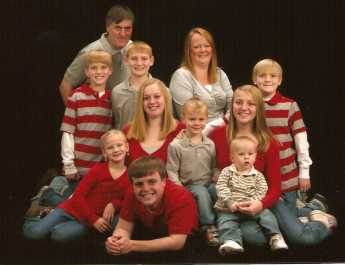
The Franklin Inn Club meets every Monday morning to discuss the news, and recently it discussed the upcoming local political campaign. The discussion went on for fifteen minutes before a newcomer asked if we were talking about the primary or the general election. The question was met with broad smiles all around because of course, we were talking about the primary. Voter registration is 6:1 in favor of the Democrats in Philadelphia, so the general election is just a required formality. The election, that is, consists only of the Democrat primary; election of the Democrat nominee in the general election is a foregone conclusion. Someone idly remarked on the number of politicians who are blood relatives of other politicians, someone else said that was true of union officers, too. So, skipping from the inside baseball of the election, we took a little time to discuss the anatomy of an urban political machine.
The first step in consolidating control of a city by a political machine is to eliminate the issue of the general election by making the other party's chances seem hopeless. That converts an election which typically turns out 40% of the voters into an exclusively primary election, turning out 20% of the voters, or even less in an off-year. In some "safe" districts a winner needs far less than 10% of the eligible voters to win.
The second step is to run as a prominent member of a local ethnic or religious group, preferably the largest of such groups within the district. If possible, an election is almost assured by being the sole candidate associated with the largest ethnic group. Here's where family connections work for you. If your father held the same seat, or some other family member had been prominent in the district, it helps assure everybody that you are really an ethnic member and not just someone whose name sounds as though it would be. Your relative will know who is important in locally local politics, the members of large families or people are known to be the "go-to guy".
Assembling all that, the final step is to get everyone else who is a member of the ethnic group to drop out of the primary, and to encourage other ethnic groups to field as many candidates as possible, splitting up their vote. Getting other members of your religious group to drop out, consists of having your relative approach them and tell them to wait their turn. The implicit promise underneath that advice is probably next to worthless, unless it is specific and witnessed, and the other fellow's ability to deliver it is credible. If all else fails, the resistant opponent is muscled in some way, verbally at first, and then increasingly threatening. The consequence of this ethnic/religious influence is more involvement in government by clergy than is healthy for either one of them. Now, that's about all there is to achieving permanent incumbency, but the minority party should be mentioned, as well as the flow of money.
It quite often happens that the minority party in the big city, hopeless in its own election chances, finds itself with a Governor and/or Legislature of their party. The patronage of state jobs becomes available to the foot soldiers who have no chance of local election. Much of the wrangling within state legislatures revolves around whether appointive patronage jobs should be lodged in state agencies, or local ones; at the moment, the Parking Authority and the Port Authorities figure prominently as jobs for which a local Republican could aspire. The coin of this trade is maintaining influence in the state nominating process and paying off with increased voter turn-out in elections which have no local effect but may be important at the state or national level. Since party dominance at state and national levels changes frequently, the local machine finds it useful to continue this system. Where they have nothing to lose in local elections, they may even encourage it.
Money is the mother's milk of politics. Except for safe districts no one can get elected without it. And various degrees of corruption provide money to be "spread around" the clubhouse, sometimes to induce people to drop out of primary races, sometimes to console "sacrifice" candidates who run hopeless campaigns just to make the party look good, and sometimes just to enrich the undeserving. The politically connected parts of the legal profession participate a good deal in the flow of funds, sometimes in order to get government legal work, sometimes to obtain judgeships, sometimes to launder the money for clients. One particularly lurid story circulates that professional sports teams are expected to make seven-figure contributions in return for lavish new stadium construction, from which they, in turn, are able to generate various sorts of compensating revenue.
But, as the old story goes, if you eat lunch with a tiger, the tiger eats last.
Ruminations About the Children's Education Fund (3)
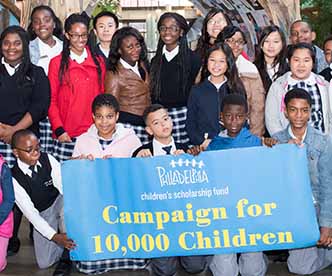
The Right Angle Club runs a weekly lottery, giving the profits to the Children's Educational Fund. The CEF awards scholarships by lottery to poor kids in the City schools. That's quite counter-intuitive because ordinarily most scholarships are given to the best students among the financially needy. Or to the neediest among the top applicants. Either way, the best students are selected; this one does it by lottery among poor kids. The director of the project visits the Right Angle Club every year or so, to tell us how things are working out. This is what we learned, this year.
The usual system of giving scholarships to the best students has been criticized as social Darwinism, skimming off the cream of the crop and forcing the teachers of the rest to confront a selected group of problem children. According to this theory, good schools get better results because they start with brighter kids. Carried to the extreme, this view of things leads to maintaining that the kids who can get into Harvard, are exactly the ones who don't need Harvard in the first place. Indeed, several recent teen-age billionaires in the computer software industry, who voluntarily dropped out of Harvard seem to illustrate this contention. Since Benjamin Franklin never went past the second grade in school perhaps he, too, somehow illustrates the uselessness of education for gifted children. Bright kids don't need good schools or some such conclusion. Since dumb ones can't make any use of good schools, perhaps we just need cheaper ones. Or some such convoluted reasoning, leading to preposterous conclusions. Giving scholarships by lottery, therefore, ought to contribute something to educational discussions and this, our favorite lottery, has been around long enough for tentative conclusions.

|
Just what improving schools means in practical terms, does not yet emerge from the experience. Some could say we ought to fire the worst teachers, others could say we ought to raise salary levels to attract better ones. Most people would agree there is some level of mixture between good students and bad ones. At that point, the culture mix becomes harmful rather than overall helpful; whether just one obstreperous bully is enough to disrupt a whole class or something like 25% of well-disciplined ones would be enough to restore order in the classroom, has not been quantitatively tested. What seems indisputable is that the kids and their parents do accurately recognize something desirable to be present in certain schools but not others; their choice is wiser than the non-choice imposed by assigning students to neighborhood schools. Maybe it's better teachers, but that has not been proved.
|
It seems a pity not to learn everything we can from a large, random experiment such as this. No doubt every charity has a struggle just with its main mission, without adding new tasks not originally contemplated. However, it would seem inevitable for the data to show differences in success among types of schools, and among types of students. Combining these two varieties in large enough quantity, ought to show that certain types of schools bring out superior results in certain types of students. Providing the families of students with specific information then ought to result in still greater improvement in the selection of schools by the students. No doubt the student gossip channels already take some informal advantage of such observations. Providing school administrations with such information also ought to provoke conscious improvements in the schools, leading to a virtuous circle. Done clumsily, revised standards for teachers could lead to strikes by the teacher unions. Significant progress cannot be made without the cooperation of the schools, and encouragement of public opinion. After all, one thing we really learned is that offering a wider choice of schools to student applicants leads to better outcomes. What we have yet to learn, is how far you can go with this idea. But for heaven's sake, let's hurry and find out.
Quakers and Idolatry
|
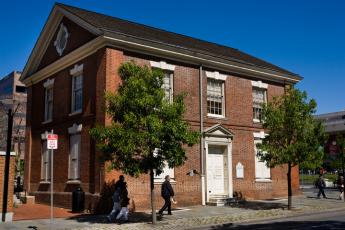
| Philadelphia's Quaker Meetinghouse |
There are about forty thousand bodies buried in Philadelphia's Quaker Meetinghouse grounds at Fourth and Arch Streets, which contain only two tombstones. The yellow fever epidemics of the era account for much of that, but it's nevertheless a striking portrayal of early Quaker aversion to anything resembling idolatry. It underlines this attitude by sharp contrast with more recent uproars about desecrating statues of Confederate generals in public spaces of the Old South, which even Robert E. Lee objected to constructing. They led plausibly to erecting and then defacing Union generals in Northern states as well; since it seemed natural for statue-desecration to evolve into an equal-opportunity demonstrations. A little primitive perhaps, but even-handed.
|
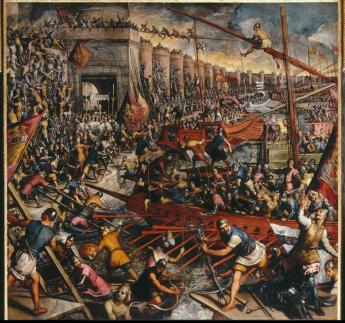
| The Fourth Crusade |
Worshiping graven images has a long history. You needn't be a public-statue expert to remember the terracotta Chinese soldiers are two thousand years old, and the Egyptian pyramids are even older. The chariot horses over the Brandenburg Gate make a stronger illustration of the idea, intertwined over the shorter length of Western civilization. Although carvings might be older, we also have a reasonably accurate history of the bronze statues of these horses. The technique evolved with different proportions of copper and tin, with other metals sometimes added, but the underlying idea is to make a hollow bronze statue, giving the appearance of a much heavier solid bronze one, apparently originating in the Greek islands off the coast of Turkey in the second Century. There were in fact two such statues, with different subsequent histories. The Fourth Crusade was the one where Western European Christian Crusaders invaded Constantinople the main eastern Christian capital, never getting to the Holy Land. Even if they started with good intentions, Christians were content to carry off Christian booty, including the bronze horses. One set was sent to Venice and the other set got to the Christians in Southern France.
|
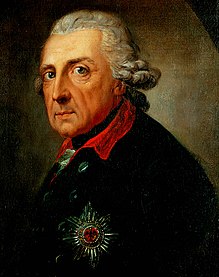
| Frederick the Great |
Frederick the Great put one set in the center of Berlin. In time, Napoleon took both statues to Paris, but later returned them. The one in Berlin, or perhaps copies of it eventually came to symbolize Nazi Germany, but later Checkpoint Charlie. The details of these conquests and adventures are not not of much consequence today, leaving only the central point that someone conquered someone else, and God must love the victor. The main point became victory, dogmas have been forgotten. Only the Quakers seem to be willing to mention another main point: Thousands of people died for these statues, but very few tourists could now tell you why. The Quakers reached a conclusion we might reconsider. Pulverize all statues and churches, thus saving the world from future grief. Since the Quakers also were first to free the slaves but later mostly disapproved of the Civil War, the irony was not lost on them. But most of their grandchildren reversed the assessment. It's too early to say how another generation will be persuaded to feel.

|
| General Lucius Clay |
During the War against Nazi Germany, my uncle was General Lucius Clay's room-mate, and the two of them were appointed to oversee de-Nazification of the defeated Germans by a third Pennsylvania Dutchman, Dwight Eisenhower. The concept was devised by Henry Morgenthau, then Secretary of the Treasury, in a famous letter urging a program to make Germany into an agricultural nation "for a thousand years". Accordingly, my father's brother oversaw the public burning of tons of postage stamps containing swastikas, plus every photograph of Adolph Hitler the Army could locate, along with similar symbols of the Third Reich. Nearly eighty years have passed since then -- essentially two generations, but it still remains illegal to possess such documents. Evidently, a sense of vengefulness so regularly outlasts its provocation, that passing the grievance on to children is usually hard to justify.
| Posted by: Nichi | Dec 31, 2012 5:39 PM |
19 Blogs
Slavery: If This be done well, What is done evil?
Philadelphia German Quakers were the first to protest the evils of slavery.
Differences of Quaker Opinion
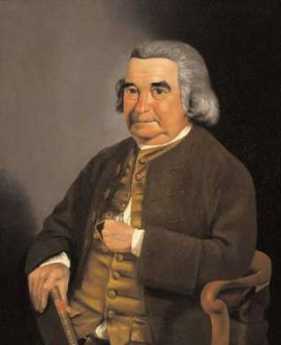 Some Quakers refused to go along with the abolition of slavery. That was particularly true in Newport, RI, the North American point of the triangular slave trade.
Pennsylvania Prison Society
When the British monarchy put William Penn in jail, they set in motion a social movement which has changed prison management more than it changed Penn.
No Laborer Left Behind
Expanding prestige universities to fill American academic demands, unexpectedly provoke inflation obscured by illegal immigration.
Commercial Academic Think Tank
There are universities and there are think tanks. Philadelphia has at least one commercial consulting firm which combines elements of both.
States Rights Confront Civil War
The Constitution took certain defined powers from the states and gave them to the Federal Government. A further steady erosion of states rights began, but the Republican Party gave things a big push during the Civil War.
Children's Scholarship Fund (1)
The Right Angle Club has decided to make donations to the Children's Scholarship Fund of Philadelphia..
Paul Robeson 1898-1976
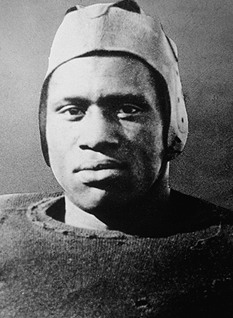 Valedictorian, All-American footballer, law degree, outstanding baritone, actor, film star, political activist -- Robeson rose to the top in the 1930s when by default he was always a pioneer. As a student, for example, he was the only black person on campus at Rutgers. His understandable resentments and show-biz surroundings propelled him into leftist activism. Mental infirmity and McCarthyism then brought him down.
Mohammed Ali, Cassius Clay
 The greatest prizefighter of all time. Float like a butterfly, sting like a bee.
John Woolman Reports on Yearly Meeting, 1758
At a time when the whole world thought slavery was perfectly natural, John Woolman brought the Philadelphia Yearly Meeting to declare it must be abolished.
Whigs, Slaves, and Tariffs
The city evolved from a little country town to a big modern city by adding waves of new immigrants. Obviously, there had to be a succession of upheavals in sociology, politics and economics, step after step.
Slaveowning Quaker Steps Up To The Plate
Slaves were valuable property, but it became a Quaker duty to give them their freedom. John Woolman, who started the idea, suggested freeing them in your will.
SCORE
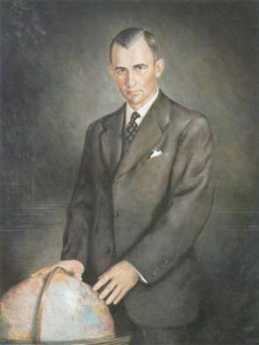 The Service Corps of Retired Executives has taken a new turn in Philadelphia, primarily serving minority start-ups, a majority of which are founded by black women.
Passenger Stop
Amtrak is proud of its on-time record, but in some ways the passenger still comes first.
Urban Bridges
The Episcopal Church has found a practical way for its prosperous suburban branches to form partnerships with struggling urban parishes.
Selection of Constitutional Rights for the Bill of Rights
James Madison tried to preserve the Union by allowing states some latitude in enforcing civil rights. Eventually, we got a Civil War, a weakening of state legislatures, massive black migration to northern cities, and the Civil Rights Act. It's all about slavery is hard to eliminate.
Anatomy of an Urban Political Machine
If Philadelphia is typical, here is how urban machine politics works.
Ruminations About the Children's Education Fund (3)
By selecting children for scholarships by lottery, it emerges that different schools make big differences.
Quakers and Idolatry
Early Quakers were so opposed to idolatry, they wouldn"t allow tombstones.