Related Topics
No topics are associated with this blog
Health Expenditures as a percent of GDP
My thanks to the US Census Bureau for this information.
The 2008 Statistical Abstract/International Statistics: Vital Statistics, Health, Education
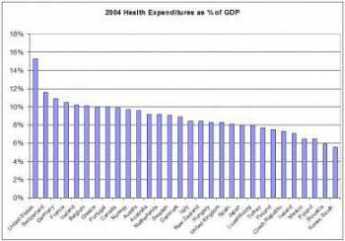
Let's make a couple of comments. Health expenditure as a percent of GDP is a ratio. If health expenditures go up or down while GDP remains the same, the ratio goes up or down. But if GDP goes down or up and health expenditures remain the same, then the reverse is true. In the present atmosphere of slanted debate, America is being compared with France. If we compared the state of Mississippi with France, we would get a different opinion about France. If we compare Ukraine with America, we get a different opinion about our expenditures. It really does seem more appropriate to compare America with Europe as a whole, rather than allow the comparison to be selective in its choice of the sections of Europe under comparison.
The point is this: if you add in the poorer sections of Europe, you reduce the average GDP of the nation (Europe) you compare with America, and hence you increase the expenditures for health care as a proportion of European GDP. At the same time, you would have to add in the average expenditures of the poorer sections of Europe, which will lower the average health expenditures per GDP unit. With twenty-seven different countries included under the heading of "Europe", you can seem to illustrate just about any conclusion you intend to reach, just by modifying the mixture. The same is true of taking different states or sections of the USA. Minnesota is considerably cheaper than Florida, and the quality of health care is if anything superior.
Health officials have puzzled about this discrepancy between Minnesota and Florida for at least forty years, ever since Medicare costs were available to sort by zip code. If we still can't understand the difference between Minnesota and Florida, there is little validity in drawing much health insurance conclusion from a comparison of USA data with that of France. Comparing USA data with the whole of the European community could result in some sort of opinion about national budgets, but nothing but quarrels if conclusions are reached about the nature of local health insurance. When we finally figure out what the same data about Minnesota and Florida means, perhaps that could be a starting place for further explorations. In case you haven't noticed, Minnesota and Florida share the same Medicare insurance.
Originally published: Friday, February 01, 2008; most-recently modified: Tuesday, May 21, 2019
| Posted by: Gary Maybarduk | Jun 24, 2009 1:23 PM |
The same would seem true of medicine. Although improving technology allows for much better health care it has not reduced the need for highly skilled pratitioners at all levels of medicine. Health care is therefore likely to continue to increase as a percent of GDP, although not without limits because the pressue for labor saving innovatons is likely to become intense.
When comparing accross countries, the US is probably the most invested in labor saving tedhniques. Since the health iindustry has probably not kept up with the rest of economy, it is not surprising that our health care costs - after substracting out a multitude of other causes - is also relatively high compared to other countries.
| Posted by: Gary Maybarduk | Jun 24, 2009 1:22 PM |